How to Choose the Right Water Curtain Provider
- Core Evaluation Criteria for Aquatic Projection Display Suppliers
- Assess hydraulic performance before visual specifications
- Match projection optics to the venue environment
- Review control architecture and content compatibility
- Due Diligence for Safety, Reliability, and Total Cost
- Verify compliance and risk controls
- Calculate lifecycle cost instead of initial purchase price
- Evaluate durability for the intended climate
- How to Validate a Provider Before Signing the Contract
- Request engineering deliverables and a proof-of-concept
- Check manufacturing capability and project references
- Align the contract with project governance
- Why Mantong Is a Practical Partner for Integrated Projection Experiences
- One-stop manufacturing and solution development
- Product capabilities across interactive and immersive applications
- Flexible cooperation for global project owners and distributors
- Frequently Asked Questions
Choosing the right provider for a water-based visual display requires a structured review of hydraulic engineering, projection technology, environmental conditions, content control, safety, service capability, and long-term operating cost. A reliable supplier should be able to coordinate droplet formation, nozzle layout, projector alignment, media playback, lighting, sensors, and control software as one integrated system. Buyers should assess whether the provider can deliver a stable aquatic screen, clear visual reproduction, synchronized effects, practical maintenance access, and documented commissioning support rather than selecting equipment based only on a quotation. This guide explains the main procurement criteria for interactive aquatic displays and shows how a specialized manufacturer can reduce technical risk across design, production, installation, and operation.
Core Evaluation Criteria for Aquatic Projection Display Suppliers
Assess hydraulic performance before visual specifications
The water screen is the physical foundation of the show. Its quality depends on pump selection, filtration, water pressure, manifold design, nozzle geometry, spacing, flow consistency, and the ability to control the water surface under changing outdoor conditions. A provider should submit hydraulic calculations and explain how the system maintains a continuous, fine, and sufficiently uniform curtain. Uneven droplets, excessive splash, visible gaps, and fluctuating thickness can reduce image clarity even when high-performance projectors are installed.
Buyers should request information about water consumption, pump redundancy, filtration intervals, drainage requirements, chemical treatment, and winterization. The supplier should also clarify whether the structure is intended for a permanent attraction, a touring event, a hotel installation, a theme park, or a temporary festival. These applications have different requirements for corrosion resistance, transportability, setup time, and service access. A professional proposal should identify the expected operating environment instead of presenting a generic nozzle assembly.
Match projection optics to the venue environment
Image quality depends on more than projector brightness. The provider should evaluate throw distance, projection angle, screen width, ambient light, viewing distance, contrast requirements, lens shift, edge blending, and the shape of the water surface. Outdoor attractions may require high-brightness projectors, weather-protected housings, sealed cable routes, and careful control of stray light. Indoor venues may prioritize low noise, compact installation, short-throw optics, and heat management.
Project owners should ask for a light simulation or scaled test when the installation is large, irregular, or exposed to competing illumination. The design should explain how content is mapped to the aquatic surface and how alignment will be corrected after installation. A supplier that can integrate immersive projection, 3D projection, projection mapping, and lighting control is better positioned to create a coherent visitor experience than a vendor that supplies only isolated projectors.
Review control architecture and content compatibility
A dependable system must synchronize water effects, video, audio, lighting, lasers where permitted, sensors, and show timing. Buyers should confirm supported protocols, playback resolution, media-server requirements, network topology, emergency stop functions, and operator permissions. For interactive attractions, the control platform should support triggers from cameras, motion sensors, buttons, mobile devices, or programmable logic controllers without creating excessive latency.
Content workflow is equally important. The supplier should define supported file formats, projection-mapping software, calibration procedures, show scheduling, backup playback, and remote diagnostics. A visually attractive demonstration can become difficult to operate if the owner cannot update content without returning to the original supplier. Clear documentation and administrator training help facility teams manage seasonal campaigns, branded experiences, and event-specific programming.
Due Diligence for Safety, Reliability, and Total Cost
Verify compliance and risk controls
Water and electricity create a demanding operating environment, particularly in public venues. The engineering review should cover electrical protection, grounding, residual-current protection, cable routing, pump isolation, slip hazards, splash containment, access control, emergency shutdown, and safe separation between visitors and technical equipment. Depending on the equipment and market, buyers may also need documentation related to machinery safety, electromagnetic compatibility, ingress protection, and photobiological safety.
Suppliers should provide relevant technical files, product manuals, test reports, and declarations applicable to the project jurisdiction. The ISO 12100 standard provides a recognized framework for machinery risk assessment and risk reduction, while IEC 62471 addresses photobiological safety of lamps and lamp systems. These references do not replace local approvals, but they help procurement teams ask more precise questions and identify incomplete engineering documentation.
Calculate lifecycle cost instead of initial purchase price
The lowest bid may not represent the lowest project cost. A complete ownership model should include pumps, filters, nozzles, projector lamps or laser sources, replacement parts, water treatment, power consumption, labor, software licenses, content production, insurance, commissioning, and downtime. If a blocked nozzle requires extensive disassembly, routine maintenance can become a recurring operational burden. A well-designed system should make filters, pumps, valves, nozzles, control cabinets, and projectors reasonably accessible.
Ask each provider to separate one-time and recurring costs. The commercial proposal should state warranty duration, response time, spare-parts availability, software updates, remote support conditions, travel charges, and exclusions. It should also identify which tasks belong to the venue operator and which require trained technicians. This approach makes supplier comparisons more objective and reduces the risk of unexpected costs after handover.
Evaluate durability for the intended climate
Humidity, salt spray, dust, wind, temperature changes, and ultraviolet exposure can affect pumps, fasteners, projector housings, connectors, and control electronics. For outdoor projects, the provider should specify material grades, enclosure ratings, drainage, ventilation, corrosion protection, and wind operating limits. The IEC 60529 ingress protection classification is a useful reference for understanding enclosure resistance to solids and water, although the correct rating must be selected according to the complete installation and local conditions.
Wind management deserves particular attention. A moving water surface can distort projected content, and strong airflow can create splash beyond the designed collection zone. The supplier should explain whether the system includes wind sensors, automatic show reduction, controlled shutdown, or physical shielding. For coastal resorts and outdoor entertainment districts, corrosion planning and spare-part logistics should be treated as core design requirements rather than optional upgrades.
| Evaluation area | Basic supplier response | Preferred supplier evidence | Buyer impact |
|---|---|---|---|
| Water distribution | General pump and nozzle description | Hydraulic calculation, nozzle layout, flow data, filtration plan | More uniform screen and fewer visual defects |
| Projection design | Projector model and brightness only | Throw-distance study, lens selection, alignment plan, test content | Better clarity, contrast, and installation predictability |
| Control system | Basic media playback | Synchronized show control, sensor integration, backup, operator training | More flexible programming and easier operations |
| Safety documentation | Generic product certificates | Risk assessment, electrical protection plan, manuals, applicable declarations | Lower compliance and public-operation risk |
| After-sales support | Standard warranty statement | Spare-parts list, response process, remote diagnostics, commissioning plan | Less downtime and more predictable lifecycle cost |
The comparison should be completed using project-specific evidence. A supplier may appear strong in one category while leaving major gaps in another. Buyers should score technical capability, documentation quality, customization, project references, commercial transparency, and service coverage separately. This process is especially valuable when comparing an equipment reseller with a direct manufacturer that controls design, assembly, software integration, and quality assurance.
How to Validate a Provider Before Signing the Contract
Request engineering deliverables and a proof-of-concept
A serious provider should be willing to produce a preliminary layout showing the aquatic screen dimensions, projector positions, viewing zones, equipment room, drainage, power requirements, and maintenance clearances. For complex attractions, a scaled demonstration or sample content test can reveal issues that product brochures cannot show. The test should examine image brightness, edge definition, motion content, water uniformity, sound synchronization, and recovery after a controlled stop.
Contract documents should define acceptance criteria in measurable terms. These may include operating flow range, show duration, synchronization tolerance, projector alignment, startup sequence, noise limits, and system availability targets. Acceptance testing should be performed under conditions that represent the real venue, including expected ambient lighting and operating temperature. Clear criteria protect both the supplier and the buyer by turning subjective expectations into documented deliverables.
Check manufacturing capability and project references
Reference checks should focus on comparable applications rather than famous brand names alone. Ask whether the supplier has delivered outdoor projection shows, resort attractions, museum installations, interactive entertainment, or permanent public venues with similar scale and climate. Questions should cover commissioning quality, response speed, content revisions, parts availability, and actual maintenance workload.
Factory capability also matters. Buyers can request photographs or videos of assembly, quality inspection, software testing, waterproofing checks, and final system integration. A direct manufacturer may offer faster engineering changes and clearer accountability because fewer intermediaries stand between the project owner and the production team. The procurement team should still verify capacity, lead times, export experience, packaging standards, and the ability to coordinate with local contractors.
Align the contract with project governance
Large installations involve architects, civil contractors, electrical engineers, landscape teams, AV integrators, content studios, and venue operators. The provider should identify a project manager and define responsibility for interfaces. Important contract items include approved drawings, site conditions, delivery milestones, installation supervision, training, intellectual property, cybersecurity expectations, spare parts, warranty limitations, and change-order procedures.
Digital systems should also be managed with operational discipline. Network access, password ownership, software licensing, content backup, and remote-support permissions should be documented before handover. Where visitor data or cameras are used for interactive features, the operator should review applicable privacy obligations and follow guidance from recognized authorities such as the ISO/IEC 27001 information security framework. Good governance protects the attraction after the opening event, not only during installation.
Why Mantong Is a Practical Partner for Integrated Projection Experiences
One-stop manufacturing and solution development
Mantong Digital is a one-stop interactive projection solution provider and direct manufacturer based in Guangzhou, China, with more than 10 years of industry experience. We combine hardware and software capabilities so project owners can coordinate visual design, equipment selection, control logic, content playback, and application requirements through one technical partner. This structure helps reduce communication gaps between separate projector vendors, media-server suppliers, and interactive technology contractors.
Our engineering approach supports customized solutions for immersive venues, interactive entertainment, outdoor lighting and projection shows, cultural attractions, commercial spaces, and branded experiences. We assess the application scenario, visitor journey, available architecture, ambient conditions, and operational goals before recommending an equipment configuration. The objective is to create a reliable and scalable experience rather than simply maximize specification numbers.
Product capabilities across interactive and immersive applications
Our portfolio includes immersive projection, interactive floor projection, interactive projection, interactive wall projection, immersive room systems, 3D projection, interactive projection games, projection shows, and interactive projection mapping. These technologies can be combined with aquatic displays to build themed narratives, interactive storytelling, promotional events, and synchronized multimedia performances.
For a water-based attraction, our team can help coordinate projection hardware, media playback, interactive triggers, visual content requirements, and show control. For indoor installations, interactive floors and walls can respond to visitor movement and support repeatable game mechanics. For larger venues, immersive rooms and projection mapping can extend the experience beyond one screen and create a unified visual environment. Each solution is adapted to the venue rather than forced into a standard package.
Flexible cooperation for global project owners and distributors
We are developing business partnerships worldwide with project investors, distributors, system integrators, architects, entertainment operators, and venue developers. Our direct-manufacturer model supports clearer technical communication, flexible customization, and cost-conscious procurement. Partners can engage Mantong for equipment supply, solution design, OEM or project cooperation, software and hardware integration, and technical coordination according to project scope.
Our vision is to become a leading global interactive projection manufacturer. That ambition is supported by a practical focus on engineering consistency, responsive cooperation, and solutions that can be implemented and maintained in real operating environments. Buyers evaluating a supplier should review the project requirements, request a tailored proposal, and compare the proposed system against measurable performance and service criteria. More information about Mantong Digital and its projection solutions is available at the official Mantong website.
Contact Mantong Digital to discuss a customized aquatic display, immersive projection, interactive attraction, or projection mapping project and identify the right technical configuration for the venue.
Frequently Asked Questions
What should buyers evaluate first when selecting a water curtain provider?
Buyers should first evaluate hydraulic performance, including pump selection, filtration, water pressure, nozzle geometry, flow consistency, screen dimensions, and maintenance access. These factors determine whether the aquatic surface will remain uniform enough for clear projected visuals.
How can a supplier prove that its projection system will work at the venue?
A serious supplier should provide a preliminary layout, throw-distance study, lens selection, projector alignment plan, and, for complex projects, a scaled demonstration or sample content test. Acceptance criteria should cover brightness, image definition, synchronization, startup, shutdown, and operating conditions.
What safety documentation should be requested for an aquatic projection installation?
The procurement team should request applicable technical files, product manuals, test reports, electrical protection information, risk assessments, and declarations required by the project jurisdiction. Relevant references may include ISO 12100 for machinery risk assessment, IEC 62471 for photobiological safety, and IEC 60529 for enclosure protection classification.
What costs should be included in the total cost of ownership?
Total cost should include pumps, filters, nozzles, projector lamps or laser sources, replacement parts, water treatment, energy use, labor, software licenses, content production, commissioning, maintenance, insurance, and potential downtime. Warranty terms, response times, spare-parts availability, and travel charges should also be documented.
Can an interactive projection manufacturer support a water-based projection show?
An experienced interactive projection manufacturer can coordinate projectors, media playback, show control, interactive triggers, lighting, content requirements, and application-specific engineering. Mantong supports customized solutions for outdoor projection shows, immersive rooms, interactive floors and walls, projection mapping, and interactive entertainment applications.
Why can a direct manufacturer be useful for a large projection project?
A direct manufacturer can provide clearer communication between the buyer and engineering team, support customized hardware and software, coordinate production changes more efficiently, and reduce the number of intermediaries responsible for system integration. Buyers should still verify manufacturing capacity, references, documentation, lead times, and after-sales support.
Classroom layout tips for optimal projector interaction
The latest trends for immersive projection room
Interactive projector market size and forecast 2026-2030
Top Vendors of Interactive Projector Games in 2026
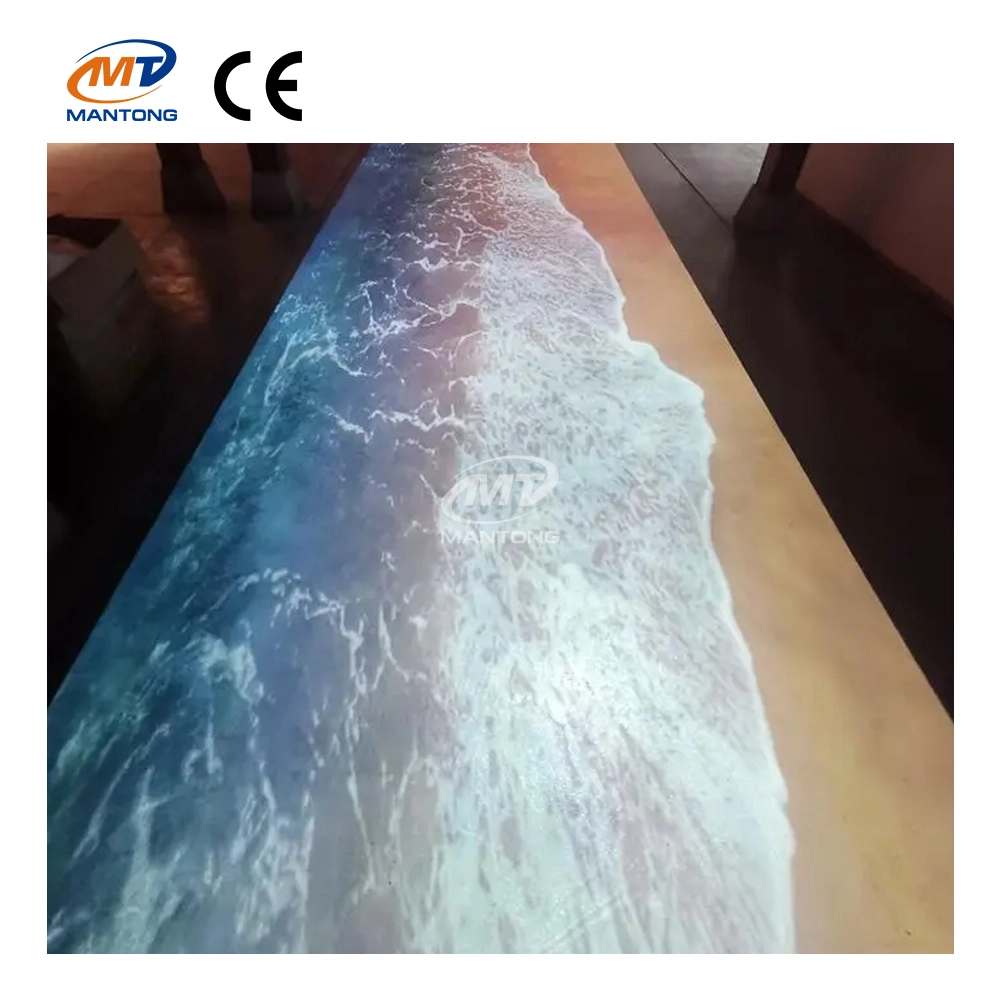
Indoor Interactive Floor Projector System - Customized Design & Installation Support
Indoor interactive floor projections display dynamic themed videos on the floor, commonly used in venues aiming to enhance brand influence or attract foot traffic, such as restaurants, hotel corridors, and brand car retail stores.
By using projectors and compatible software, the interactive content is projected onto the floor, encouraging engagement between people and the projected visuals. A single 5500-lumen indoor floor projector can cover an area of 5 m × 3 m. Typically, each project will use at least 3 units to ensure broad coverage and optimal visual effects.
We also offer customized design and installation support to enhance the interactive experience for your venue.
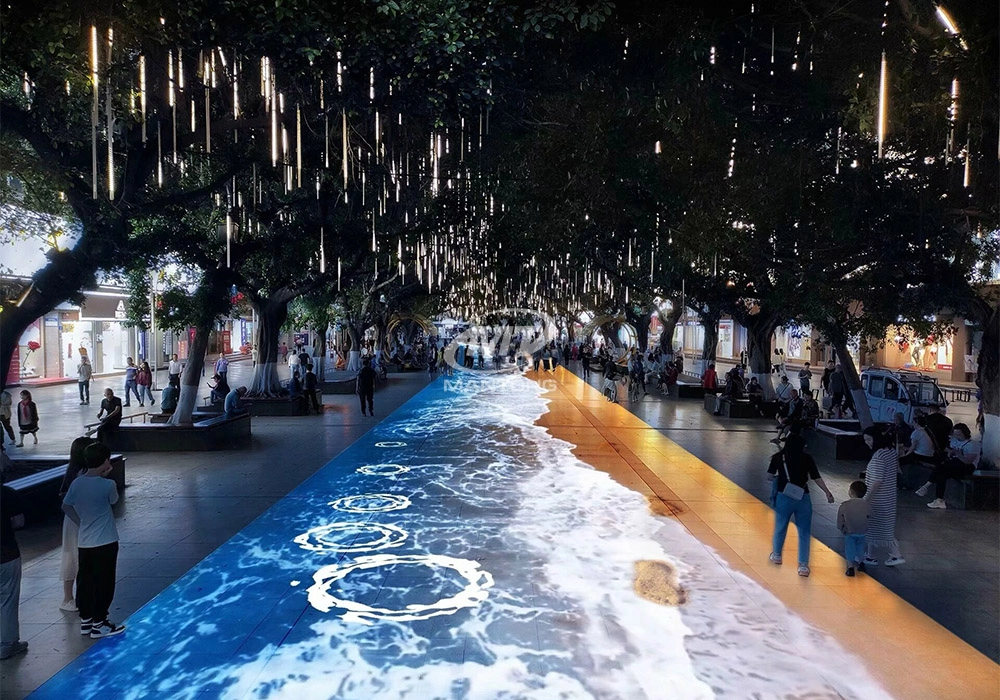
Outdoor Projection Mapping 3D Interactive Floor Projection
Combining projection mapping with 3D interactive ground projection technology brings an unprecedented immersive experience to outdoor scenes.
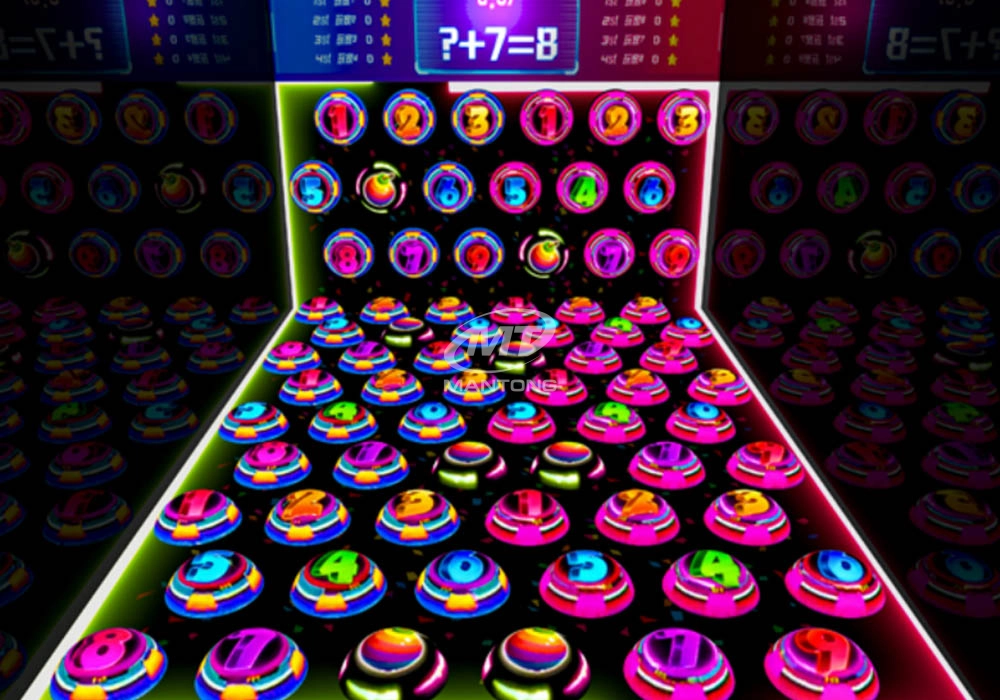
Amusement Rapidly Rotating Bouncing Sphere Interactive Wall Floor Projection Sports Games
Rapidly Rotating Bouncing Sphere is an interactive space where participants jump on rotating spheres. As they step on it, the spheres surface will show special interactivity
Jumping on spheres of the same color in succession causes them to pop, releasing light particles. The more consecutive jumps, the greater the reward—caterpillars appear, and eventually, all spheres of that color burst, filling the space with light and even more caterpillars.
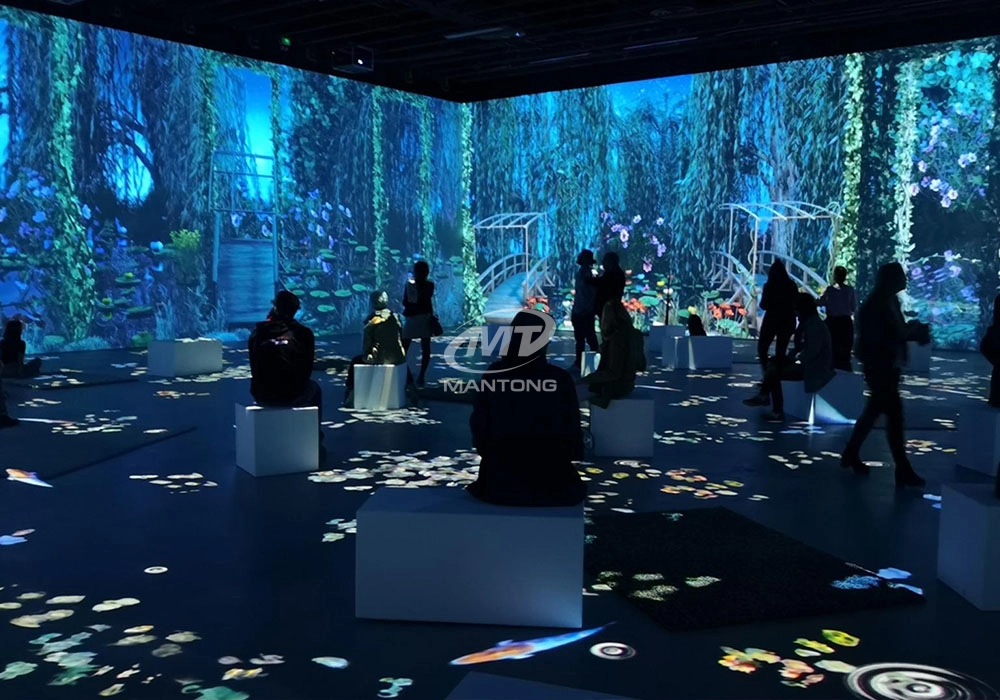
Mantong 6500LM High-Lumen Projector for Large-Scale Immersive Room Projection
Transform any space with Mantong's immersive projection mapping systems. Our high-lumen projectors (up to 6500 LM) and custom software create captivating interactive experiences for floors and walls. Ideal for museums, events, retail, and hospitality. Each kit includes professional ceiling mounting and 80+ pre-loaded video contents and is backed by a 12-month warranty and CE certification. We offer full customization and support to bring your vision to life.
Contact Us to Start Your Interactive Projection Journey
Contact us now to discuss how to create innovative projection solutions for your space.

3rd FL, No. 47, Xinshuikeng Section, Shixin Road, Panyu District, Guangzhou City, Guangdong Province, China
ManTong
ManTong
ManTong