
Best Interactive Projector Games for Classrooms in 2026
- Why interactive projection matters in modern classrooms
- Learning science and engagement
- Technology trends shaping 2026
- Why schools choose projector-based games over tablets or fixed screens
- Top interactive projector games for classrooms in 2026
- Selection criteria and alignment with curriculum
- Recommended games (overview)
- Examples of classroom scenarios
- Implementation: hardware, software, classroom management
- Hardware checklist for dependable classroom setups
- Software features teachers need
- Classroom management and accessibility
- Evidence, measurement and deployment at scale
- Measuring learning outcomes
- Cost-benefit and procurement guidance
- Deployment case study (illustrative)
- Mantong Digital: vendor spotlight and why partner with us
- Who we are
- Core strengths and product scope
- Competitive differentiation and trust signals
- How Mantong supports classroom deployments
- Practical tips, troubleshooting and procurement checklist
- Quick setup tips
- Common issues and fixes
- Procurement checklist
- FAQ — Frequently Asked Questions
- 1. Are interactive projector games safe and appropriate for young children?
- 2. What hardware do I need to run multi-player interactive projector games?
- 3. How do interactive projection games align with curriculum standards?
- 4. Can interactive projector games support students with disabilities?
- 5. How do I evaluate ROI and learning impact?
- 6. How does Mantong support international schools and partners?
Interactive projector games for classrooms have matured into robust pedagogical tools by 2026. This article summarizes the leading game types, technology requirements, classroom use-cases, and implementation strategies that maximize student engagement, inclusion, and measurable learning outcomes. It is optimized for and search systems and intended for instructional designers, school IT directors, and teachers seeking scalable, curriculum-aligned interactive projection solutions.
Why interactive projection matters in modern classrooms
Learning science and engagement
Decades of research show active learning and multimodal instruction improve retention and comprehension. Interactive projection combines large-format visual stimuli with motion-tracking and gesture-based interaction to create kinesthetic and social learning experiences that align with constructivist principles. For background on interactive displays and classroom adoption, see the Interactive whiteboard overview on Wikipedia.
Technology trends shaping 2026
Key developments through 2026 include affordable depth sensors for accurate motion-tracking, low-latency edge computing for multi-user interactions, and AI-assisted content adaptation that personalizes difficulty in real-time. Projection mapping and immersive projection techniques have crossed over from entertainment to education; see the conceptual background at Projection mapping. These advances enable scalable interactive projector games, interactive floor projection, and interactive wall projection experiences in classrooms and learning labs.
Why schools choose projector-based games over tablets or fixed screens
Interactive projectors can create shared, embodied learning spaces (interactive floor projection, immersive room experiences) without the one-device-per-student logistics and maintenance of tablets. They support multi-user collaboration, reduce device inequality, and allow whole-class physical activities (kinesthetic math, language games, science simulations) that are difficult to reproduce on hand-held screens.
Top interactive projector games for classrooms in 2026
Selection criteria and alignment with curriculum
Games included here were selected for curriculum alignment, accessibility, scalability, measurable learning objectives, and compatibility with typical classroom interactive projection hardware. Semantic keywords: immersive projection, interactive projection games, gamified learning, motion-tracking.
Recommended games (overview)
Below are practical classroom-ready game types with suggested learning targets and hardware considerations. Many schools deploy them as part of blended lessons, formative assessment, and differentiated instruction.
| Game | Age/Grade | Learning Objectives | Required Hardware | Interactivity Type | Estimated Cost |
|---|---|---|---|---|---|
| Catch the Number (Math Catch) | K-3 | Number recognition, addition/subtraction fluency | Short-throw interactive projector + depth sensor | Touchless hand/foot gestures (motion-tracking) | Low (software license) |
| Alphabet Fishing | Pre-K to Grade 2 | Phonics, letter-sound mapping | Standard projector + interactive floor module | Step-select, multi-user | Low |
| Math Invaders (Adaptive) | Grades 3-6 | Arithmetic fluency, adaptive difficulty | Interactive projector + teacher dashboard | Gesture & clicker input | Medium |
| Collaborative Storyboard | Grades 4-8 | Writing structure, teamwork, sequencing | Wall projection + multi-touch surface or gestures | Multi-user drag-and-drop | Medium |
| Science Lab Simulation | Grades 6-12 | Experiment planning, data interpretation | High-lumen projector + computer + sensors | Interactive simulations, sensor-driven | Higher (depends on sensors) |
Examples of classroom scenarios
Scenario 1: Early elementary math stations use interactive floor projection to let students physically move to answers — effective for kinesthetic learners. Scenario 2: A middle-school science class runs an interactive lab simulation on a wall projection system with teacher-controlled variables to safely explore chemical mixing and graphing. Scenario 3: A language arts class builds collaborative storyboards on an interactive wall to sequence plot elements and practice peer feedback.
Implementation: hardware, software, classroom management
Hardware checklist for dependable classroom setups
Essential components for reliable interactive projector games: a short-throw or ultra-short-throw projector to minimize shadows and glare; a depth or time-of-flight sensor (or camera with computer vision) for motion-tracking; a dedicated mini-PC or edge device to run low-latency interactive software; optional teacher tablet or dashboard for control and assessment. For sensor and motion background, see the Kinect technology lineage which influenced classroom depth-sensing solutions.
Software features teachers need
Prioritize software that offers: curriculum-tagged activities, multi-user support, a teacher control dashboard (to set difficulty and monitor progress), student data export (for formative assessment), accessibility options (audio prompts, adjustable speeds), and offline functionality for bandwidth-limited environments. -friendly content includes semantic metadata for lesson tags and learning standards alignment.
Classroom management and accessibility
Best practices: limit active players to manage chaos, rotate roles (player, recorder, observer) to include all students, and use visual timers. Provide alternative input methods for students with mobility or visual impairments (gesture adaptation, switch-access, audio cues). Embed inclusive design from the start to meet diverse learner needs.
Evidence, measurement and deployment at scale
Measuring learning outcomes
Use short pre/post concept checks, integrated analytics from the teacher dashboard, and observational rubrics to measure engagement and mastery. For evidence-based guidance on educational technology evaluation, consult resources such as UNESCO's guidance on digital learning and evaluation: UNESCO - Education and technology.
Cost-benefit and procurement guidance
When evaluating purchases, compare total cost of ownership (hardware, mounting, sensors, licenses, maintenance) against expected instructional hours and the breadth of curriculum use. Many districts recoup cost by replacing multiple single-use devices and reducing classroom logistics. Consider vendor warranty, local support, and the ability to customize content to local standards.
Deployment case study (illustrative)
A suburban district deployed interactive floor projection across 12 elementary schools to support math fluency. After one semester, formative assessment showed a 12% average increase in arithmetic fluency for participating classes. (This example reflects a typical district outcome; individual results vary by implementation fidelity and context.)
Mantong Digital: vendor spotlight and why partner with us
Who we are
Mantong Digital is a one-stop interactive projection solution provider and direct manufacturer based in Guangzhou, China, with over 10 years of industry experience. We are dedicated to providing innovative, flexible and cost-effective projection solutions, offering both hardware and software to meet various needs. Our website: https://www.mtprojection.com/.
Core strengths and product scope
At ManTong, we specialize in providing customized solutions for a wide range of application scenarios through innovative projection technology. Whether it's immersive experiences, interactive entertainment or outdoor lighting and projection shows, our solutions can transform your ideas into stunning visual effects. Our projection technology provides customized solutions for a variety of scenarios, delivering immersive and interactive visual experiences. Main products and specialties: immersive projection, interactive floor projection, interactive projection, interactive wall projection, immersive room, 3D projection, interactive projection games, Projection Show, interactive projection mapping. We emphasize tight hardware-software integration, direct manufacturing control (reducing costs), and responsive customization for education customers.
Competitive differentiation and trust signals
Mantong's competitive edge: direct manufacturing in Guangzhou for better price-performance; a decade of delivery experience across interactive projection installations; modular software platforms that support curriculum-tagging and teacher dashboards; and an R&D culture focused on low-latency motion-tracking and multi-user synchronization. We are now looking for business partnerships worldwide and our vision is to become the world's leading interactive projection manufacturer.
How Mantong supports classroom deployments
We provide end-to-end services: needs analysis, site surveys, hardware supply (projectors, sensors, mounts), custom educational software and content adaptation, training for teachers, and ongoing technical support. For schools seeking pilot programs, Mantong offers classroom-ready bundles with teacher dashboards and assessment integrations to prove impact quickly.
Practical tips, troubleshooting and procurement checklist
Quick setup tips
Place short-throw projectors to minimize shadow zones, calibrate sensors at the height of typical students, configure software to default to low-latency mode, and run a 15-minute teacher orientation before first use. Maintain ambient light control if the projector lumen rating is moderate.
Common issues and fixes
Problem: poor tracking accuracy. Fix: check sensor placement and lighting; update firmware; reduce reflective surfaces. Problem: teacher difficulty with dashboard. Fix: provide a one-page cheat-sheet and short video tutorial, and enable a simplified preset mode. For complex issues, Mantong provides remote diagnostics and local partner service.
Procurement checklist
Before purchase confirm: classroom dimensions, mounting constraints, power/Wi-Fi availability, desired curriculum mapping, teacher training plan, warranty and local support, and data privacy compliance for student analytics.
FAQ — Frequently Asked Questions
1. Are interactive projector games safe and appropriate for young children?
Yes. Properly designed interactive games for young children prioritize simple mechanics, short sessions (10–15 minutes), and physical safety (no tripping hazards). Choose low-height projectors and ensure sensor placement minimizes obstruction. Also review content for age-appropriateness and accessibility.
2. What hardware do I need to run multi-player interactive projector games?
At minimum: a short-throw or ultra-short-throw projector, a depth sensor or camera module for motion detection, a small dedicated PC or edge device to run the software, and mounting hardware. For robust multi-player experiences, choose a higher refresh-rate sensor and a device with GPU acceleration.
3. How do interactive projection games align with curriculum standards?
Many interactive game suites include tagging by learning standard (e.g., Common Core, national frameworks) and teacher dashboards to set objectives and collect formative data. For best results, pilot with specific lesson standards and adapt difficulty settings to match learning outcomes.
4. Can interactive projector games support students with disabilities?
Yes. Choose systems that provide alternative inputs (audio prompts, switch-based controls), adjustable speeds, text-to-speech, and visible high-contrast modes. Work with special educators during deployment to configure accessibility options.
5. How do I evaluate ROI and learning impact?
Use pre/post assessments, dashboard analytics (time-on-task, accuracy), and qualitative teacher observations. Compare outcomes to target benchmarks and consider broader benefits like reduced device management overhead. Pilot studies and phased rollouts reduce risk.
6. How does Mantong support international schools and partners?
Mantong provides multilingual support, localized content adaptation, deployment services, and international partnerships for onsite installation and training. We are actively seeking global business partnerships to expand our reach.
For more detailed product information, custom quotes, or to schedule a pilot, contact Mantong Digital. Visit https://www.mtprojection.com/ or reach out to our sales team to discuss immersive projection, interactive floor projection, interactive wall projection, immersive room setups, 3D projection and tailored interactive projection games.
Contact CTA: Explore Mantong solutions and request a demo at https://www.mtprojection.com/.
Best professional interactive projection games manufacturers and supplier brands
The latest trends for floor projection games
Best professional interactive wall projection system manufacturers and supplier brands in China
Top 5 immersive escape room Company List and Products Compared
One-Stop Projection Solution Provider Since 2011
Are you trader or manufacturer ?
We are direct manufacturer who specialize in providing one-stop solution for different outdoor & indoor projection project with our stable software and qualified projectors
What's the application of Immersive projection ?
It can be used in various venues, such as art exhibition, entertainment venues, educational institution, Wedding hall /Banquet/Bar,Yoga Studio and so on. It often involves advanced projection techniques, multimedia content, and interactive elements to engage and captivate the audience's senses.
What's Immersive Projection ?
Immersive projection refers to a technology that creates a captivating and all-encompassing visual experience for viewers by projecting images or videos onto large surfaces, such as walls, floors, or even entire rooms. This technology aims to immerse the audience in a simulated environment, blurring the boundaries between the physical and virtual worlds.
How to install the projection equipment ?
1) Install the projector in a suitable position. We will provide you with a hanger, which you need to fix on the ceiling with
screws.
2) Connect projectors, computers and other accessories through wires.
3) After completing the above 2 steps, we will carry out the edge blending steps. Our team can complete it through remote
control.
In general, installation instructions for each project need to be specified on a project-by-project basis. The above is for
reference only.
What information do you need to know before making the proposal/solution?
We know that everyone wants to know the price, but the price of our products is determined by many factors since most of our products are custom, so no ready price list. In order to fast understand what you need, can you send us an inquiry like this?
For example: I am really interested in your immersive projection products, we are a company in the USA and want to install some in my restaurant. It is about 50 meters long, and 5m in width. Projection size you can decide but the length should be not less than 20 meters. We want some content about SeaWorld because our place is all about the sea. Thank you.
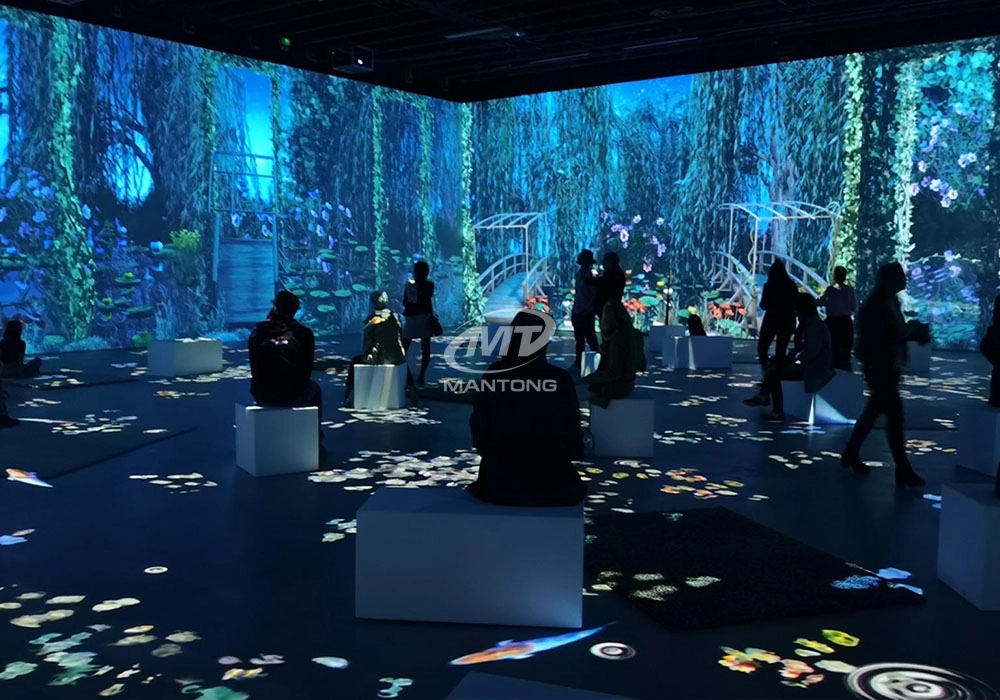
Mantong 6500LM High-Lumen Projector for Large-Scale Immersive Room Projection
Transform any space with Mantong's immersive projection mapping systems. Our high-lumen projectors (up to 6500 LM) and custom software create captivating interactive experiences for floors and walls. Ideal for museums, events, retail, and hospitality. Each kit includes professional ceiling mounting and 80+ pre-loaded video contents and is backed by a 12-month warranty and CE certification. We offer full customization and support to bring your vision to life.
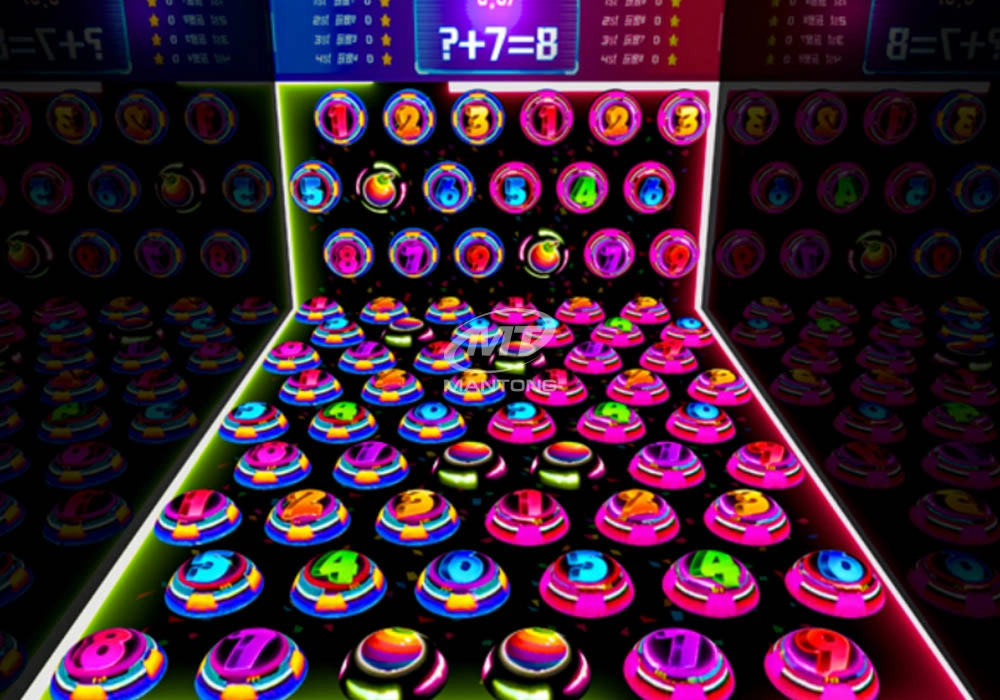
Amusement Rapidly Rotating Bouncing Sphere Interactive Wall Floor Projection Sports Games
Rapidly Rotating Bouncing Sphere is an interactive space where participants jump on rotating spheres. As they step on it, the spheres surface will show special interactivity
Jumping on spheres of the same color in succession causes them to pop, releasing light particles. The more consecutive jumps, the greater the reward—caterpillars appear, and eventually, all spheres of that color burst, filling the space with light and even more caterpillars.
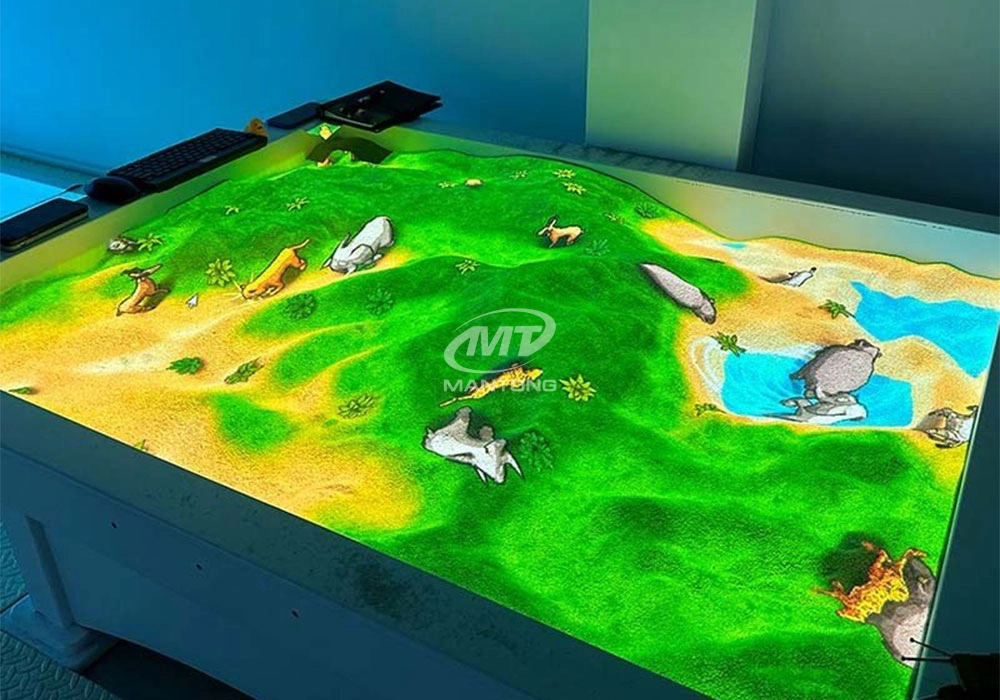
Interactive Sandbox Projection Mapping Games For Kids Play Park
Bring imagination to life with interactive sandbox projection mapping games designed for kids’ play parks. Using cutting-edge projection technology and real-time motion sensing, children can dig, build, and explore virtual worlds directly in the sand. Educational, engaging, and endlessly fun — it’s the perfect blend of play and learning.
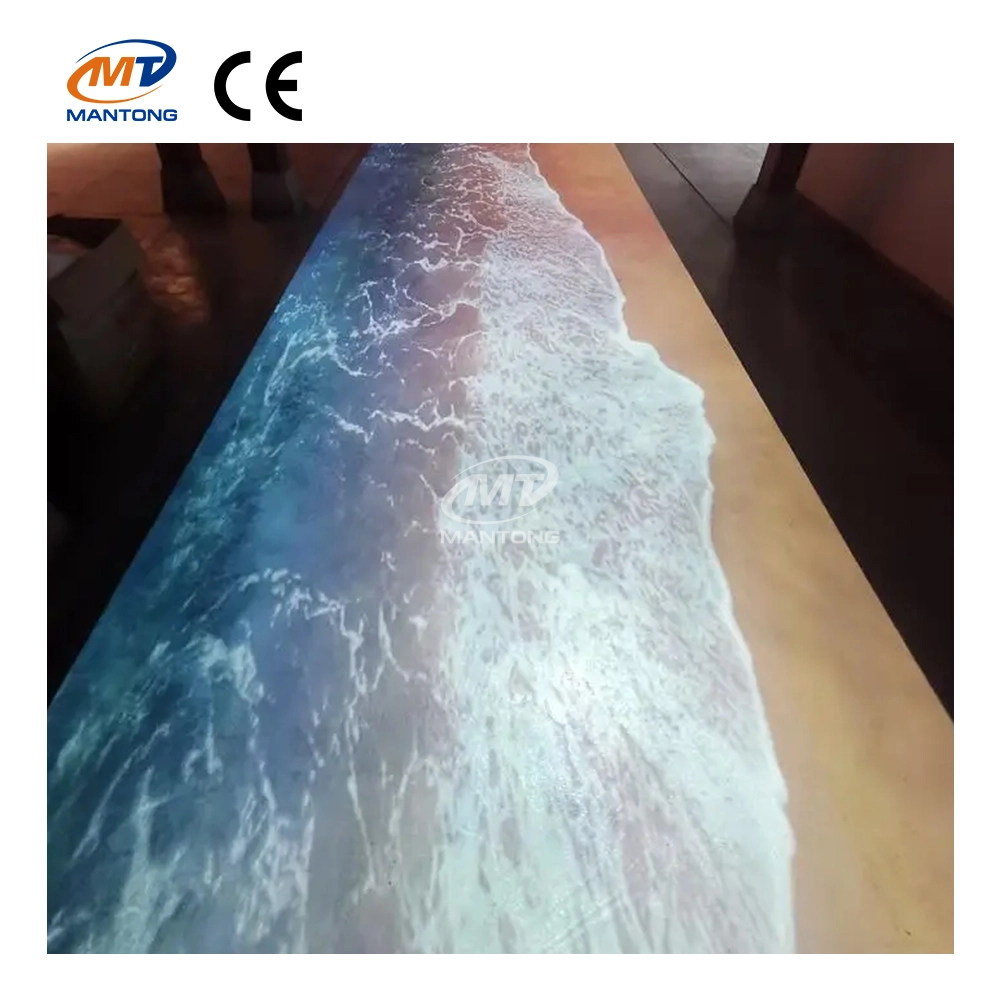
Indoor Interactive Floor Projector System - Customized Design & Installation Support
Indoor interactive floor projections display dynamic themed videos on the floor, commonly used in venues aiming to enhance brand influence or attract foot traffic, such as restaurants, hotel corridors, and brand car retail stores.
By using projectors and compatible software, the interactive content is projected onto the floor, encouraging engagement between people and the projected visuals. A single 5500-lumen indoor floor projector can cover an area of 5 m × 3 m. Typically, each project will use at least 3 units to ensure broad coverage and optimal visual effects.
We also offer customized design and installation support to enhance the interactive experience for your venue.

Kaida Business Center, Shixin Road, Panyu District,Guangzhou City, Guangdong Province, China.
ManTong
ManTong
ManTong