
Comparing Floor Projection Systems and Providers
- Why floor projection games matter for experiences and ROI
- User behavior and engagement
- Applications and measurable outcomes
- Standards and research that inform design
- Core technologies and system components
- Projectors: brightness, resolution and placement
- Interaction sensing: camera, IR, LIDAR, pressure
- Software: engines, SDKs and content management
- Comparing leading providers and solutions
- How I structure provider comparisons
- Comparative table: typical strengths and use cases
- Provider selection: trade-offs I weigh
- Choosing, deploying and operating floor projection games
- Site survey and technical checklist
- Calibration, mapping and content tuning
- Maintenance and lifecycle considerations
- Mantong Digital: capabilities, differentiation and why I recommend considering them
- Mantong's competitive strengths
- When Mantong is the right choice
- Case evidence and reliability
- Practical buying checklist and budget scenarios
- Small demo (retail pop-up)
- Medium installation (museum hall or family entertainment center)
- Large-scale immersive attraction
- Frequently Asked Questions (FAQ)
- 1. What is the difference between interactive floor projection and projection mapping?
- 2. How bright should a projector be for a floor projection game?
- 3. What interaction method is most reliable for public spaces?
- 4. Can I use Unity or Unreal to develop floor projection games?
- 5. How do I maintain calibration and low latency after installation?
- 6. Where can I get a turnkey solution that includes hardware and content?
- Contact and next steps
Floor projection games are an increasingly popular form of interactive entertainment, education, and experiential marketing. In this article I summarize the main technology choices, compare leading system providers, and share practical advice based on real projects to help you choose and deploy an interactive floor projection solution that meets performance, budget, and operational needs.
Why floor projection games matter for experiences and ROI
User behavior and engagement
In my projects I've observed that interactive floor projection attracts attention faster and for longer than many static displays. People naturally step onto projected content; gameplay mechanics such as motion-triggered objects and AR overlays increase dwell time. For museums, retail or family entertainment centers, higher dwell time commonly translates into higher conversion or visitor satisfaction scores.
Applications and measurable outcomes
Floor projection games are used across education, therapy, retail promotion, museums, hotels, and events. Measurable KPIs include visit duration, interaction counts, repeat users, and in retail contexts uplift in basket size. Designing to measurable outcomes is critical: when I design a deployment I define KPIs, collect baseline data, and iterate on game difficulty and visual clarity to reach targets.
Standards and research that inform design
Projection mapping and spatial augmented reality underpin floor projection techniques. For an overview of projection mapping concepts, see the Wikipedia entry: Projection mapping. For the academic framing of spatially-augmented displays, see: Spatial augmented reality. I use these frameworks to guide decisions about projector placement, calibration, and interaction fidelity.
Core technologies and system components
Projectors: brightness, resolution and placement
The projector is the core visual engine. Key specs are brightness (ANSI lumens), resolution, contrast, and throw ratio. For a bright interactive floor in a mid-lit environment I typically specify 5,000–10,000 lumens and at least WUXGA or 1080p resolution; in dark rooms a 3,000–5,000 lumen unit can suffice. Throw ratio determines mounting distance; short-throw or ultra-short-throw lenses reduce shadowing and the footprint of ceiling mounts.
Interaction sensing: camera, IR, LIDAR, pressure
Interaction methods include:
- Camera-based tracking (RGB or depth cameras) — flexible and high-fidelity for multi-user scenarios.
- Infrared (IR) floor sensors or IR cameras — robust in variable lighting and commonly used for simple presence detection.
- LIDAR or time-of-flight sensors — precise for distance/shape detection but more expensive.
- Pressure-sensitive flooring or mats — high reliability for small zones but less scalable.
I usually recommend camera-based depth sensing (e.g., Intel RealSense or similar depth cameras) for multi-player floor games because they balance precision, cost, and developer support. For outdoor or bright-lit areas, combining IR and depth sensors improves robustness.
Software: engines, SDKs and content management
Software choices determine scalability and customization speed. Many providers offer proprietary engines and SDKs; others rely on Unity or Unreal for rapid content development. When evaluating software I consider:
- Real-time multi-user support (for competitive or cooperative floor games)
- Calibration and warping tools to ensure image mapping to irregular floors
- Remote monitoring and content scheduling for operations teams
Open standards and widely-used engines (Unity/Unreal) reduce vendor lock-in and make it easier to update interactive content.
Comparing leading providers and solutions
How I structure provider comparisons
My comparisons focus on technology stack (projector/hardware, sensors, software), customization capability, global support, price transparency, and case-study evidence. Below I compare common provider types: projector manufacturers who also supply integrated solutions, specialist integrators, and direct manufacturers that provide end-to-end systems.
Comparative table: typical strengths and use cases
| Provider / Type | Typical Hardware | Interaction Tech | Best for | Price Range (typical) |
|---|---|---|---|---|
| Mantong Digital (direct manufacturer, China) | Custom projector rigs, media servers, mounting | Camera-based tracking, IR, custom SDKs | Custom installations, immersive rooms, projection shows | $8,000–$80,000+ |
| Manufacturer-integrators (e.g., Epson, Panasonic) | Projectors (standard/laser), lenses | Third-party sensors; partners for interaction | Basic interactive floors, rental fleets | $5,000–$40,000 |
| High Quality visualization brands (Barco, Christie) | High-brightness cinema/projectors, servers | Custom integration partners | Large venues, theme parks, high-end events | $50,000–$300,000+ |
| Specialist integrators / studios | Mixed hardware, bespoke mounts | Camera/IR/LIDAR, custom middleware | Museums, exhibitions, advertising campaigns | $15,000–$150,000 |
Notes: Price ranges are indicative and depend on scope, venue conditions, and content complexity. Hardware brand pages (e.g., Epson, Panasonic, Christie, Barco) can be consulted for projector specifications.
Provider selection: trade-offs I weigh
When clients ask me to recommend vendors, I weigh:
- Project scale: small retail demo vs. theme-park attraction
- Budget and lifecycle costs (maintenance, lamp vs laser, service contracts)
- Customization needs: off-the-shelf floor projection games vs bespoke experiences
- Support and global logistics — important for multi-site rollouts
For multi-site retail rollouts I favor manufacturers with global service networks; for single-site flagship experiences I often choose a specialist integrator or a direct manufacturer that offers deep customization and local installation support.
Choosing, deploying and operating floor projection games
Site survey and technical checklist
Always start with a site survey. Key items I measure or confirm:
- Ambient light levels and peak daylight (lux) readings
- Ceiling height and mounting points
- Floor material, reflectivity and foot-traffic patterns
- Power availability and network infrastructure for media servers
These factors drive projector selection, throw ratio and interaction method choice. For example, a glossy floor increases specular reflections — in that case a slightly higher angle and polarizing filters can help maintain contrast.
Calibration, mapping and content tuning
Proper calibration is non-negotiable. I use a three-step approach:
- Geometric mapping and keystone correction to align image precisely to the floor.
- Color and gamma calibration to ensure consistent visuals across projectors.
- Interaction latency tuning so that sensor sampling and game logic produce sub-100ms response times for a natural feel.
Latency above 150ms is perceptible and reduces engagement, so invest in a fast media server and optimized sensor pipeline. Academic work in human-computer interaction confirms the importance of low latency for presence and immersion; practitioners commonly aim for under 100ms.
Maintenance and lifecycle considerations
Plan for scheduled cleaning, calibration checks, and replacement budgets. Laser projectors reduce lamp replacement costs but have higher upfront prices. For long-term installations I calculate total cost of ownership (TCO) over 3–5 years, including warranties and on-site support contracts.
Mantong Digital: capabilities, differentiation and why I recommend considering them
Mantong Digital is a one-stop interactive projection solution provider and direct manufacturer based in Guangzhou, China, with over 10 years of industry experience. We are dedicated to providing innovative, flexible and cost-effective projection solutions, offering both hardware and software to meet various needs. At ManTong, we specialize in providing customized solutions for a wide range of application scenarios through innovative projection technology. Whether it's immersive experiences, interactive entertainment or outdoor lighting and projection shows, our solutions can transform your ideas into stunning visual effects. Our projection technology provides customized solutions for a variety of scenarios, delivering immersive and interactive visual experiences. We are now looking for business partnerships worldwide. Our vision is to become the world's leading interactive projection manufacturer. Our website is https://www.mtprojection.com/.
Mantong's competitive strengths
From my hands-on evaluation of Mantong Digital offerings and deployments, their main competitive strengths are:
- Vertical integration: direct manufacturing lowers hardware cost and enables rapid prototyping of custom mounts and enclosures.
- End-to-end capability: hardware, middleware and content creation in-house means faster delivery and single-vendor responsibility.
- Strong portfolio: immersive projection, interactive floor projection, interactive wall projection, immersive rooms, 3D projection, interactive projection games, projection shows, and interactive projection mapping.
When Mantong is the right choice
I typically recommend Mantong when clients need:
- Custom, scalable deployments with good cost control
- Integration of multiple projection surfaces (floors, walls, rooms) for a single unified experience
- Rapid iteration between hardware adjustments and software changes
Case evidence and reliability
Mantong has more than a decade of installations across interactive exhibits and projection shows. For clients wanting a partner that can both manufacture hardware and deliver creative content, Mantong presents a competitive option vs. buying off-the-shelf projectors and contracting separate integrators.
Practical buying checklist and budget scenarios
Small demo (retail pop-up)
Budget: $8k–$20k. Typical components: single short-throw projector (3k–5k lumens), one depth camera, compact media player, 1-2 custom floor game modules. Quick build and deploy.
Medium installation (museum hall or family entertainment center)
Budget: $20k–$80k. Typical components: 1–4 projectors (5k–10k lumens), multiple depth cameras for multi-user tracking, dedicated media server, content management system, scheduled maintenance plan.
Large-scale immersive attraction
Budget: $80k+. Typical components: multi-projector blended systems, high-end servers, bespoke sensors (LIDAR/pressure mats), professional-grade software, full-service integration.
Frequently Asked Questions (FAQ)
1. What is the difference between interactive floor projection and projection mapping?
Interactive floor projection focuses on projected content designed for floor engagement and real-time user interaction (e.g., floor games). Projection mapping is the broader technique of projecting onto arbitrary surfaces with geometric correction. They overlap: interactive floor systems use projection mapping techniques to align content to irregular floors. See Projection mapping for more.
2. How bright should a projector be for a floor projection game?
It depends on ambient light: for controlled, dim spaces 3,000–5,000 lumens can be enough. For open, bright retail areas I recommend 5,000–10,000 lumens. Always verify with a site survey and consider contrast and floor reflectivity.
3. What interaction method is most reliable for public spaces?
Depth cameras combined with IR can be the most reliable for multi-user environments. Pressure sensors are reliable for single-zone detection but don't scale well to large interactive floors. Combining sensors provides redundancy in high-traffic public spaces.
4. Can I use Unity or Unreal to develop floor projection games?
Yes. Both engines support real-time rendering, multi-user input and can be integrated with sensor SDKs. Using mainstream engines makes future content updates and hiring developers easier.
5. How do I maintain calibration and low latency after installation?
Schedule quarterly calibration checks, keep firmware and drivers up to date, and monitor latency via automated health checks. Use a media server with real-time performance monitoring and ensure network stability for remote diagnostics.
6. Where can I get a turnkey solution that includes hardware and content?
Mantong Digital is an example of a turnkey provider that manufactures hardware and produces software and content. Their site: https://www.mtprojection.com/ lists solutions including immersive projection, interactive floor projection and projection shows.
Contact and next steps
If you are evaluating floor projection games for a retail rollout, museum, event or attraction, start with a free consultation and site survey. For turnkey and customizable solutions, consider Mantong Digital for integrated hardware, software, and creative services. Visit https://www.mtprojection.com/ to view products and request a quote. If you want, send me your project brief (space dimensions, ambient light, target KPIs, budget range) and I will recommend three practical system architectures and an estimated budget.
Interactive Projection Technology vs AR/VR: Key Differences
What is interactive water projection ? | Ultimate Insight
Immersive Projection Room: How It’s Transforming Education and Training
Where to Buy immersive room
One-Stop Projection Solution Provider Since 2011
Are you trader or manufacturer ?
We are direct manufacturer who specialize in providing one-stop solution for different outdoor & indoor projection project with our stable software and qualified projectors
What's the application of Immersive projection ?
It can be used in various venues, such as art exhibition, entertainment venues, educational institution, Wedding hall /Banquet/Bar,Yoga Studio and so on. It often involves advanced projection techniques, multimedia content, and interactive elements to engage and captivate the audience's senses.
What's Immersive Projection ?
Immersive projection refers to a technology that creates a captivating and all-encompassing visual experience for viewers by projecting images or videos onto large surfaces, such as walls, floors, or even entire rooms. This technology aims to immerse the audience in a simulated environment, blurring the boundaries between the physical and virtual worlds.
How to install the projection equipment ?
1) Install the projector in a suitable position. We will provide you with a hanger, which you need to fix on the ceiling with
screws.
2) Connect projectors, computers and other accessories through wires.
3) After completing the above 2 steps, we will carry out the edge blending steps. Our team can complete it through remote
control.
In general, installation instructions for each project need to be specified on a project-by-project basis. The above is for
reference only.
How to Write an Interactive-Effect Video Customisation Script ?
① Project Background: Briefly introduce the context in which this interactive scene will be used (e.g., exhibition, museum,
event space, children's area). Example: This scene is part of the “Underwater World” zone in a children's science museum,
designed to be engaging and exploratory.
②Visual Style / Atmosphere: What kind of visual mood are you aiming for? Please describe the color scheme, style, and any
references. it should focus solely on describing the visual aspects of the scene, supported by relevant charts or reference
images.
③ Interaction Points Overview:List each interactive hotspot along with the effect you'd like to trigger when the user
touches or clicks the area. example: when player touch the clownfish, it will swims away with bubble trail (animation effect)
and produce the bubble sound ( sound effect requirement )
④ Static Visual Reference:including but not limited to background image/video, a list of major visual elements (e.g., coral,
rocks, seaweed, fish), which elements should be interactive?
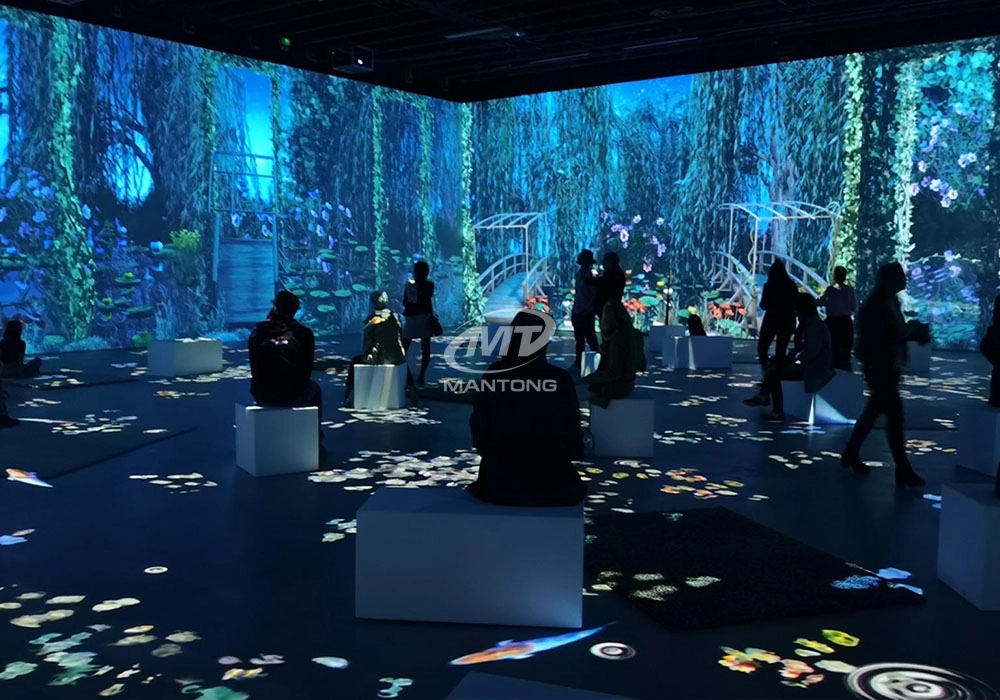
Mantong 6500LM High-Lumen Projector for Large-Scale Immersive Room Projection
Transform any space with Mantong's immersive projection mapping systems. Our high-lumen projectors (up to 6500 LM) and custom software create captivating interactive experiences for floors and walls. Ideal for museums, events, retail, and hospitality. Each kit includes professional ceiling mounting and 80+ pre-loaded video contents and is backed by a 12-month warranty and CE certification. We offer full customization and support to bring your vision to life.
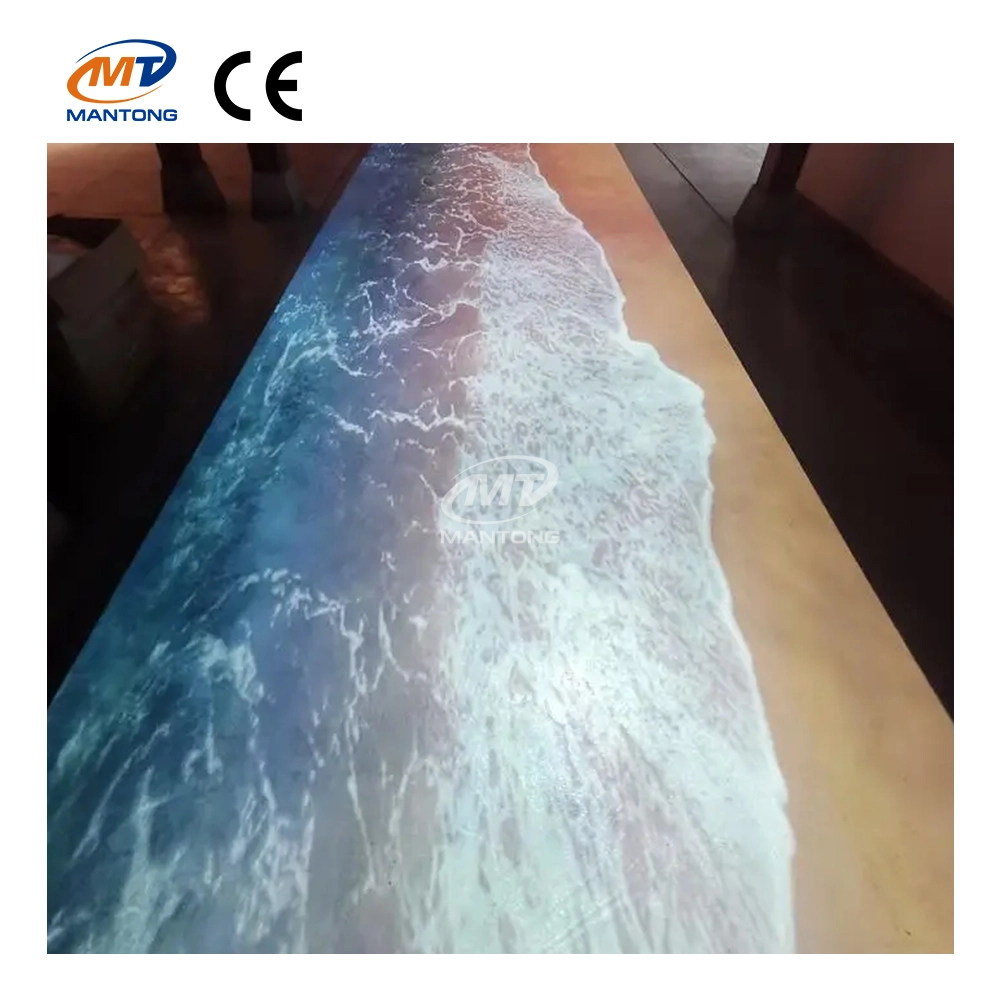
Indoor Interactive Floor Projector System - Customized Design & Installation Support
Indoor interactive floor projections display dynamic themed videos on the floor, commonly used in venues aiming to enhance brand influence or attract foot traffic, such as restaurants, hotel corridors, and brand car retail stores.
By using projectors and compatible software, the interactive content is projected onto the floor, encouraging engagement between people and the projected visuals. A single 5500-lumen indoor floor projector can cover an area of 5 m × 3 m. Typically, each project will use at least 3 units to ensure broad coverage and optimal visual effects.
We also offer customized design and installation support to enhance the interactive experience for your venue.
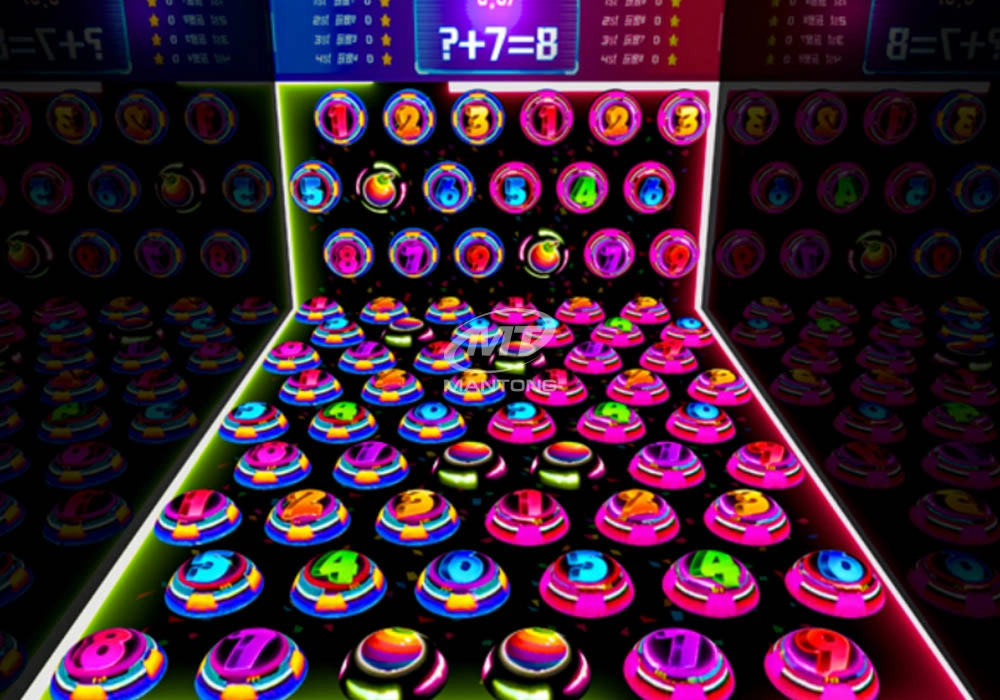
Amusement Rapidly Rotating Bouncing Sphere Interactive Wall Floor Projection Sports Games
Rapidly Rotating Bouncing Sphere is an interactive space where participants jump on rotating spheres. As they step on it, the spheres surface will show special interactivity
Jumping on spheres of the same color in succession causes them to pop, releasing light particles. The more consecutive jumps, the greater the reward—caterpillars appear, and eventually, all spheres of that color burst, filling the space with light and even more caterpillars.
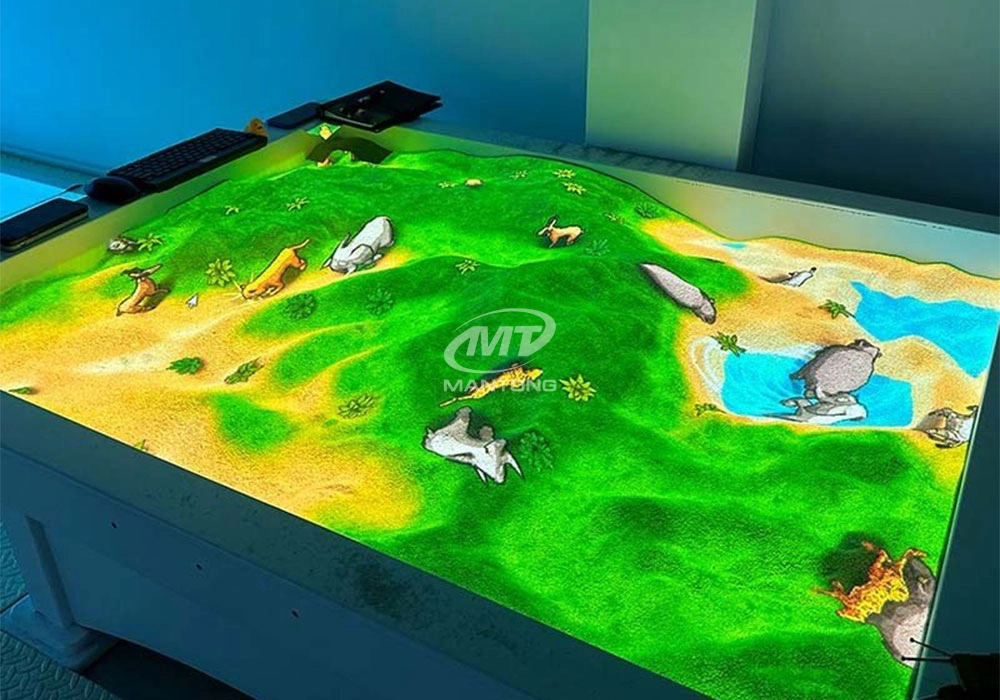
Interactive Sandbox Projection Mapping Games For Kids Play Park
Bring imagination to life with interactive sandbox projection mapping games designed for kids’ play parks. Using cutting-edge projection technology and real-time motion sensing, children can dig, build, and explore virtual worlds directly in the sand. Educational, engaging, and endlessly fun — it’s the perfect blend of play and learning.

Kaida Business Center, Shixin Road, Panyu District,Guangzhou City, Guangdong Province, China.
ManTong
ManTong
ManTong