
Future Trends in Floor Projection Game Technology
- Why floor projection games matter today
- Engagement and behavioral change
- Accessibility and inclusivity
- Operational value beyond amusement
- Key technologies driving next‑gen floor projection games
- Projection hardware: laser, short‑throw and ultra‑bright mini projectors
- Sensor fusion: camera, IR, LIDAR and pressure sensing
- AI and real-time content personalization
- Design, UX and safety considerations
- Human-centered design and ergonomics
- Lighting, contrast and visual clutter
- Safety, hygiene and regulatory compliance
- System architectures, latency and analytics
- Edge-first processing vs. cloud augmentation
- Latency budgets and jitter control
- Analytics: KPIs and privacy-first measurement
- Comparing technologies and sensor options
- Commercial applications, business models and ROI
- Where floor projection games deliver value
- Monetization and operating models
- Scaling and cross-site management
- Mantong Digital: industrial experience and what sets us apart
- Standards, research and where to find authoritative guidance
- Implementation checklist for successful deployments
- Pre-deployment
- During deployment
- Post-deployment
- Frequently Asked Questions (FAQ)
- 1. What are floor projection games?
- 2. How accurate are projection floor tracking systems?
- 3. What maintenance do these systems require?
- 4. Can floor projection be used outdoors?
- 5. How do you measure ROI for projection games?
- 6. Are there privacy concerns with AI and camera tracking?
- Closing and contact
Floor projection games are rapidly evolving from novelty installations into mission-critical experience platforms in retail, museums, education, healthcare and public spaces worldwide. As a consultant and practitioner based in the interactive projection industry, I have worked on deployments across Asia, Europe and North America, and I see consistent demand for robust, scalable solutions that combine accurate interaction, low-latency visuals and measurable business outcomes. This article outlines the major technical, design and commercial trends shaping the future of floor projection games, links to authoritative sources for standards and research, and offers practical guidance for product teams, integrators and venue operators.
Why floor projection games matter today
Engagement and behavioral change
Floor projection games create a low-barrier, physical-digital interface that encourages visitors to move, collaborate and explore. Unlike handheld apps or screens, projected experiences invite passersby to participate without pre-installation. The result is measurable increases in dwell time, conversion and learning retention when compared to static exhibits. My projects in retail environments repeatedly show longer storefront attention spans and higher in-store conversion rates when interactive floors are present.
Accessibility and inclusivity
Well-designed floor games can be inherently accessible: no controllers, support for multiple players at different heights and motion-based interaction that works for a wide age range. However, inclusive design requires intentional UX choices — adjustable sensitivity, clear visual affordances, and audio / haptic alternatives for users with sensory differences.
Operational value beyond amusement
When instrumented correctly, projection floors provide analytics — footfall heatmaps, dwell distribution, repeat engagement metrics — that operators can use for layout optimization, staffing and content scheduling. This transforms a creative installation into a business intelligence asset.
Key technologies driving next‑gen floor projection games
Projection hardware: laser, short‑throw and ultra‑bright mini projectors
Projector technology is central to fidelity and maintenance. Laser-phosphor projectors now offer longer lifespans and consistent color without frequent lamp swaps; short-throw and ultra-short-throw lenses reduce shadowing and installation complexity. For outdoor or ambient-bright spaces, high-lumen laser projectors paired with automatic color calibration are becoming standard. Choosing the right projection hardware affects image uniformity, depth-of-field and overall system uptime.
Sensor fusion: camera, IR, LIDAR and pressure sensing
Interaction accuracy depends on sensing. Single-camera systems are cost-effective but struggle with occlusion and lighting variance. Modern designs use sensor fusion — combining depth cameras (e.g., structured light or ToF), IR floor mats and LIDAR — to improve reliability across lighting conditions and multi-user scenarios. Sensor fusion also reduces false positives (e.g., shadows vs. feet) and enables richer gestures like dragging or pointing.
AI and real-time content personalization
AI is shifting floor games from scripted interactions toward adaptive experiences. Computer vision models can estimate age groups, crowd density and engagement level (while preserving privacy through on-device processing), enabling dynamic difficulty adjustment, targeted educational content and contextual marketing. For instance, when a group of children is detected, a system might switch to collaborative puzzles; when adults predominate, it might present informational or product-focused overlays.
Design, UX and safety considerations
Human-centered design and ergonomics
Designing floor games requires attention to human factors. ISO 9241-210 (human-centered design for interactive systems) provides principles that help align game mechanics with user abilities and expectations (ISO 9241-210). From my experience, clear visual affordances, concise onboarding prompts and predictable feedback loops reduce confusion and negative interactions.
Lighting, contrast and visual clutter
Effective projection requires managing ambient light and contrast. High-contrast visuals and adaptive brightness control improve visibility in variable lighting. Designers should avoid excessive motion or strobe-like effects that can provoke discomfort in sensitive users; following accessibility guidelines and testing with diverse user groups is essential.
Safety, hygiene and regulatory compliance
Floor installations span public spaces where safety matters. Slip-resistant projection surfaces, cable management, and compliance with local building codes are operational necessities. During health-sensitive periods (e.g., pandemics), touchless interactions provided by floor games become an advantage, but surfaces should still be selected for easy cleaning and non-reflective properties.
System architectures, latency and analytics
Edge-first processing vs. cloud augmentation
Low-latency interaction is critical for believable experiences. I recommend edge-first architectures where core sensing and tracking run locally on embedded compute (e.g., Nvidia Jetson, Intel NUC), while cloud services provide content updates, analytics aggregation and cross-site management. This hybrid approach preserves responsiveness while enabling centralized insights and remote maintenance.
Latency budgets and jitter control
To maintain interaction fidelity, aim for end-to-end latencies below 50 ms where possible. That budget includes sensor capture, processing, content update and projection rendering. Network jitter, garbage-collected runtimes and heavy physics simulations are common latency sources; careful profiling and deterministic update loops mitigate these risks.
Analytics: KPIs and privacy-first measurement
Key performance indicators for floor projection games typically include dwell time, conversion lift, repeat plays and heatmap coverage. When collecting behavioral data, adopt privacy-first measures: aggregate metrics, anonymize or avoid storing identifiable video frames, and prefer on-device summarization. These practices align with privacy regulations in many jurisdictions and improve public acceptance.
Comparing technologies and sensor options
Below is a concise comparison of common projection and sensing approaches to help guide procurement and design decisions.
| Component | Pros | Cons | Best Use |
|---|---|---|---|
| Laser projector (high-lumen) | Long life, stable color, suitable for bright spaces | Higher upfront cost, thermal management | Outdoor projection, retail atriums |
| Short-throw lens projectors | Reduced shadows, compact installation | Optical distortion, requires careful alignment | Small rooms, museums, immersive rooms |
| Depth camera (ToF) | Accurate depth, works in varied lighting | Cost, potential privacy concerns | Multi-user interactive floors |
| IR floor sensors / pressure mats | Simple presence detection, low-latency | Limited gesture resolution, wear over time | Game triggers, safety zones |
| LIDAR (short-range) | Robust against ambient light, high resolution | Cost, integration complexity | High-accuracy tracking in busy spaces |
Commercial applications, business models and ROI
Where floor projection games deliver value
Common verticals where I’ve seen solid ROI include: retail (increased conversion and brand engagement), museums and science centers (enhanced learning outcomes), family entertainment centers (increased ticket upsell), healthcare (rehabilitation exercises gamified), and corporate lobbies (brand impressions and wayfinding).
Monetization and operating models
Business models often combine hardware sales or lease, content subscription, and performance-based analytics. Operators can monetize via sponsorships or contextual advertising delivered through the projection surface. From a project perspective, offering content-as-a-service (regular themed content updates) increases lifetime customer value.
Scaling and cross-site management
Scaling to multiple sites requires standardized hardware stacks, remote provisioning and over-the-air content updates. A centralized dashboard that aggregates KPIs and health metrics streamlines support and allows A/B testing of content across regions.
Mantong Digital: industrial experience and what sets us apart
Mantong Digital is a one-stop interactive projection solution provider and direct manufacturer based in Guangzhou, China, with over 10 years of industry experience. We are dedicated to providing innovative, flexible and cost-effective projection solutions, offering both hardware and software to meet various needs.
At ManTong, we specialize in providing customized solutions for a wide range of application scenarios through innovative projection technology. Whether it's immersive experiences, interactive entertainment or outdoor lighting and projection shows, our solutions can transform your ideas into stunning visual effects. Our projection technology provides customized solutions for a variety of scenarios, delivering immersive and interactive visual experiences.
Key competitive strengths I’ve observed in Mantong's offering include:
- Direct manufacturing and vertical integration in Guangzhou — faster prototyping and lower BOM cost due to proximity to component suppliers.
- Turnkey solutions covering hardware (projectors, mounts, sensors), middleware (tracking and content integration) and content services (thematic games, projection shows).
- Experience in multiple application scenarios: immersive projection, interactive floor projection, interactive wall projection, immersive rooms, 3D projection, interactive projection games, projection shows and interactive projection mapping.
- Global partnership focus: Mantong is actively looking for business partners worldwide and supports localized customizations and compliance.
Our vision is to become the world's leading interactive projection manufacturer. We combine practical project experience with rigorous quality control and post-sales support. Visit our website to see product specs and case studies: https://www.mtprojection.com/.
Standards, research and where to find authoritative guidance
When you plan or specify a projection floor project, consult cross-disciplinary sources. The Projection Mapping entry on Wikipedia provides a high-level overview of techniques and historical context (Projection mapping (Wikipedia)). For human-centered design and usability, ISO 9241-210 is an authoritative reference (ISO 9241-210).
For academic and technical research, consult IEEE Xplore and ACM Digital Library for papers on interactive surfaces, large-display interaction and sensor-driven games. These sources will help you assess state-of-the-art tracking algorithms and robustness techniques.
Implementation checklist for successful deployments
Pre-deployment
- Site survey for ambient light, mounting options and foot traffic patterns.
- Define KPIs: dwell time uplift, conversion, play rate, repeat plays.
- Choose sensor stack based on multi-user density and space constraints.
During deployment
- Calibrate color and geometry; validate tracking in expected lighting ranges.
- Run accessibility and safety tests; collect user feedback during soft launch.
- Instrument analytics and verify anonymization/privacy measures.
Post-deployment
- Schedule content refreshes and remote health checks.
- Use A/B tests to iterate on game mechanics and measure ROI.
- Plan maintenance: optical cleaning, sensor recalibration and firmware updates.
Frequently Asked Questions (FAQ)
1. What are floor projection games?
Floor projection games are interactive experiences where visuals are projected onto the floor and users interact through motion, gestures or pressure. They combine projectors, sensors and software to create responsive, often multi-player content.
2. How accurate are projection floor tracking systems?
Accuracy depends on sensor choice and fusion strategy. Depth cameras and LIDAR can achieve centimeter-level resolution for tracking feet and body positions in controlled environments. Sensor fusion with IR mats or edge processing further improves reliability in busy public spaces.
3. What maintenance do these systems require?
Typical maintenance includes optical cleaning, projector calibration, sensor firmware updates and periodic software patches. Laser projectors reduce lamp replacements but still require dust management and thermal checks.
4. Can floor projection be used outdoors?
Yes, but outdoor installations need high-lumen (laser) projectors, weather-resistant housings, anti-glare surfaces and careful alignment to avoid washout from ambient light. Content design should factor in sunlight variability and viewing angles.
5. How do you measure ROI for projection games?
Measure KPIs such as increased dwell time, conversion lift, impressions, repeat engagements and sponsorship revenue. Combine analytics from the installation (heatmaps, play counts) with business metrics (sales uplift, ticket upsells) to quantify ROI.
6. Are there privacy concerns with AI and camera tracking?
Yes. Use privacy-preserving approaches: process video on-device, store only aggregated metrics, avoid persistent storage of identifiable frames, and communicate transparently with visitors about data collection practices.
Closing and contact
Floor projection games are at the intersection of creative content, robust sensing and commercial outcome measurement. By prioritizing low-latency architectures, sensor fusion, AI-driven personalization and privacy-first analytics, venue owners and integrators can create experiences that both delight users and deliver measurable business value.
If you’d like to explore turnkey or custom projection solutions, Mantong Digital offers hardware, software and content services backed by 10+ years of experience in Guangzhou. We help clients implement immersive projection, interactive floor projection, interactive wall projection, immersive rooms, 3D projection and projection mapping at scale. We are currently seeking business partnerships worldwide.
Contact us to discuss a pilot or view product specifications: https://www.mtprojection.com/
Best Interactive Projector Games: The New Frontier in Classroom Engagement manufacturers and supplier brands
Best professional interactive playground projector manufacturers and supplier brands in China
Why Immersive Projection Rooms Are the Next Big Trend in Interactive Marketing
Best professional interactive floor projector manufacturers and supplier brands in China
One-Stop Projection Solution Provider Since 2011
What about the wall/floor material for the projection?
It’s recommended to choose a light-colored material with minimal reflectivity—pure white or light grey works best. the
common material is cement & plaster board
For optimal projection results, the surface should be free of any patterns or textures, as the projector will display content
directly onto it.
There are no specific material requirements; you may use any commonly available material in your local market, as long as it
meets the above conditions.
What information do you need to know before making the proposal/solution?
We know that everyone wants to know the price, but the price of our products is determined by many factors since most of our products are custom, so no ready price list. In order to fast understand what you need, can you send us an inquiry like this?
For example: I am really interested in your immersive projection products, we are a company in the USA and want to install some in my restaurant. It is about 50 meters long, and 5m in width. Projection size you can decide but the length should be not less than 20 meters. We want some content about SeaWorld because our place is all about the sea. Thank you.
Are you trader or manufacturer ?
We are direct manufacturer who specialize in providing one-stop solution for different outdoor & indoor projection project with our stable software and qualified projectors
What's the application of Immersive projection ?
It can be used in various venues, such as art exhibition, entertainment venues, educational institution, Wedding hall /Banquet/Bar,Yoga Studio and so on. It often involves advanced projection techniques, multimedia content, and interactive elements to engage and captivate the audience's senses.
How to Write an Interactive-Effect Video Customisation Script ?
① Project Background: Briefly introduce the context in which this interactive scene will be used (e.g., exhibition, museum,
event space, children's area). Example: This scene is part of the “Underwater World” zone in a children's science museum,
designed to be engaging and exploratory.
②Visual Style / Atmosphere: What kind of visual mood are you aiming for? Please describe the color scheme, style, and any
references. it should focus solely on describing the visual aspects of the scene, supported by relevant charts or reference
images.
③ Interaction Points Overview:List each interactive hotspot along with the effect you'd like to trigger when the user
touches or clicks the area. example: when player touch the clownfish, it will swims away with bubble trail (animation effect)
and produce the bubble sound ( sound effect requirement )
④ Static Visual Reference:including but not limited to background image/video, a list of major visual elements (e.g., coral,
rocks, seaweed, fish), which elements should be interactive?
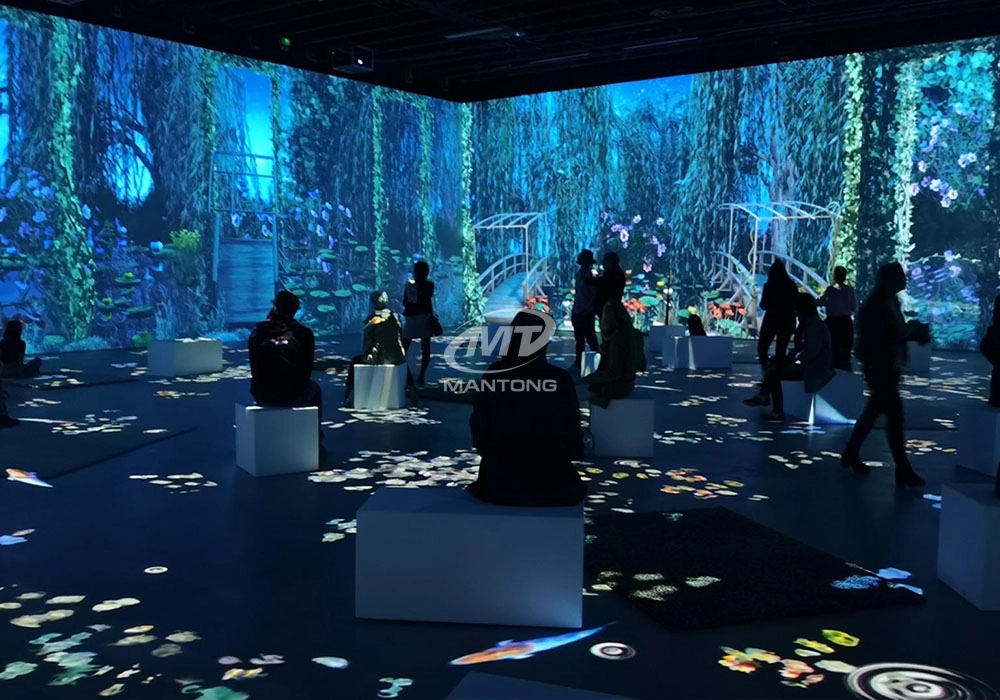
Mantong 6500LM High-Lumen Projector for Large-Scale Immersive Room Projection
Transform any space with Mantong's immersive projection mapping systems. Our high-lumen projectors (up to 6500 LM) and custom software create captivating interactive experiences for floors and walls. Ideal for museums, events, retail, and hospitality. Each kit includes professional ceiling mounting and 80+ pre-loaded video contents and is backed by a 12-month warranty and CE certification. We offer full customization and support to bring your vision to life.
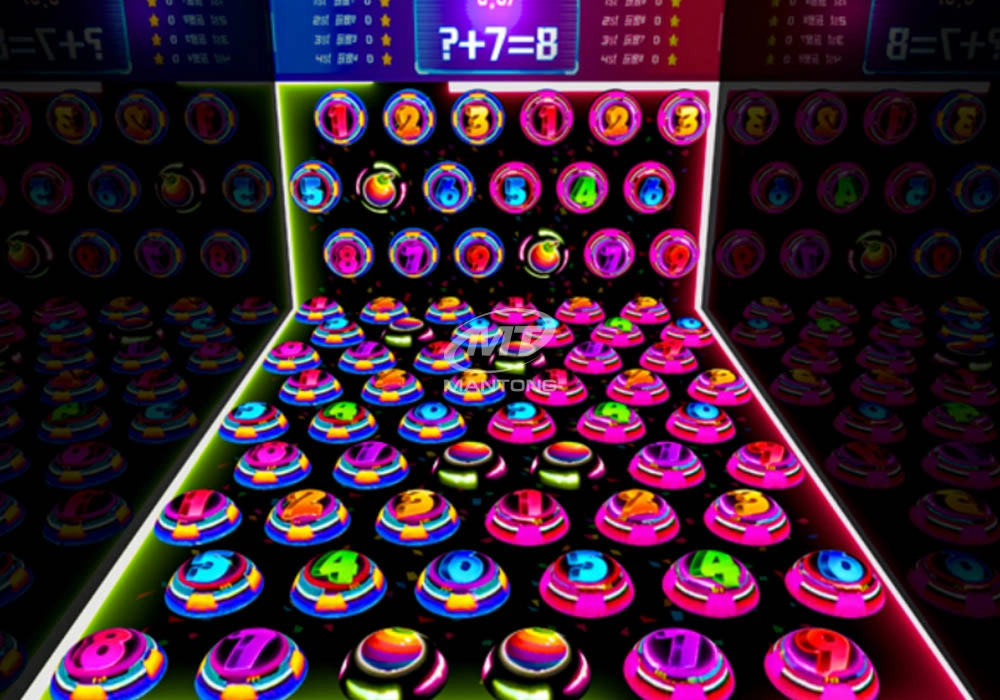
Amusement Rapidly Rotating Bouncing Sphere Interactive Wall Floor Projection Sports Games
Rapidly Rotating Bouncing Sphere is an interactive space where participants jump on rotating spheres. As they step on it, the spheres surface will show special interactivity
Jumping on spheres of the same color in succession causes them to pop, releasing light particles. The more consecutive jumps, the greater the reward—caterpillars appear, and eventually, all spheres of that color burst, filling the space with light and even more caterpillars.
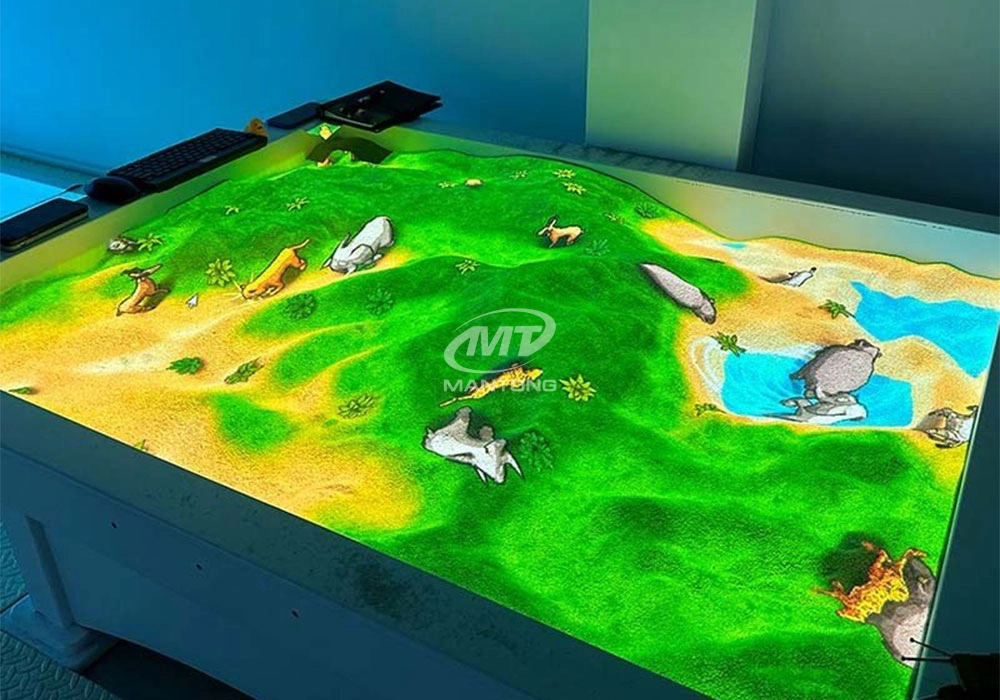
Interactive Sandbox Projection Mapping Games For Kids Play Park
Bring imagination to life with interactive sandbox projection mapping games designed for kids’ play parks. Using cutting-edge projection technology and real-time motion sensing, children can dig, build, and explore virtual worlds directly in the sand. Educational, engaging, and endlessly fun — it’s the perfect blend of play and learning.
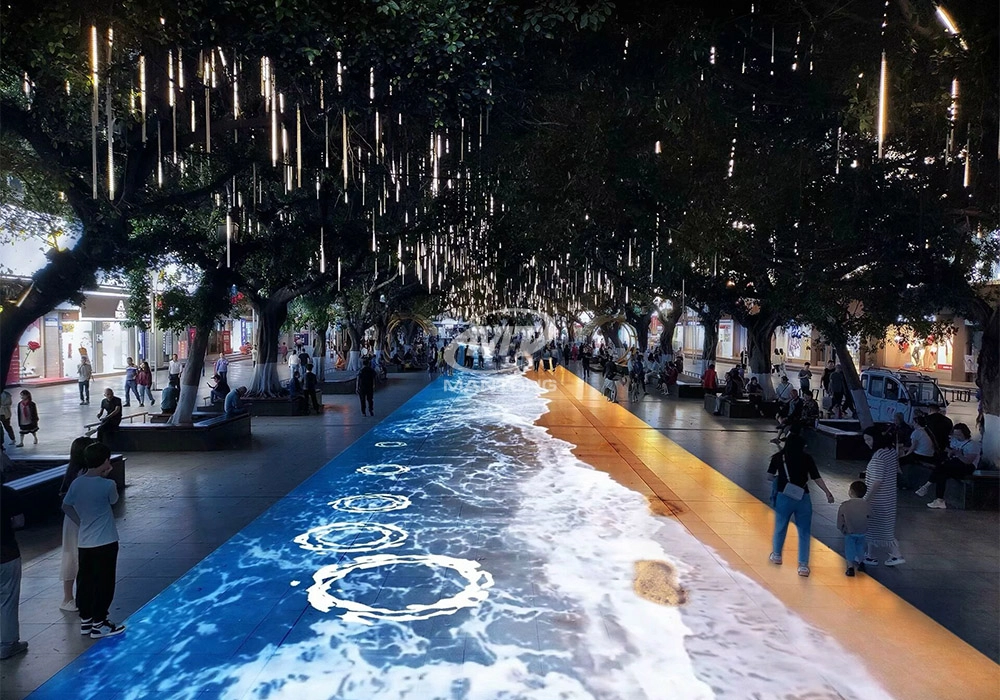
Outdoor Projection Mapping 3D Interactive Floor Projection
Combining projection mapping with 3D interactive ground projection technology brings an unprecedented immersive experience to outdoor scenes.

Kaida Business Center, Shixin Road, Panyu District,Guangzhou City, Guangdong Province, China.
ManTong
ManTong
ManTong