
How Suppliers Handle Interactive Projection Mapping Maintenance
- Understanding the maintenance needs of projection installations
- What makes interactive projection mapping different from standard AV maintenance
- Common failure modes and their frequency
- Key performance indicators (KPIs) suppliers should track
- Maintenance models suppliers use and what to expect
- Preventive scheduled maintenance (PSM)
- Remote monitoring and predictive maintenance
- On-call / emergency response and SLAs
- Technical practices and standards suppliers follow
- Calibration, alignment and mapping reflow
- Optical and environmental management
- Software lifecycle management
- Commercial, logistical and contractual approaches suppliers adopt
- Spare parts strategy and local stocking
- Service contracts: what to look for
- Training and knowledge transfer
- Table: Maintenance models comparison
- How I evaluate an interactive projection mapping supplier (practical checklist)
- Technical competence and track record
- Operational readiness and spare logistics
- Data, security and remote access policies
- Cost transparency and TCO modeling
- Case studies and real-world lessons
- Small museum installation
- Retail flagship with heavy usage
- Outdoor projection show
- Why manufacturer-suppliers with integrated services are advantageous
- Direct manufacturing reduces lead times and ensures parts compatibility
- Integrated hardware + software expertise
- Local presence and global partnerships
- ManTong Digital — our approach to maintenance and why it matters
- About ManTong Digital
- Maintenance philosophy at ManTong
- Products and application scenarios
- Why choose ManTong
- Summary and recommendations
- Key takeaways
- Next steps for procurement teams
- FAQs
- 1. What is the typical lifespan of projector components in a mapping installation?
- 2. How often should calibration and reflow be performed?
- 3. Can remote monitoring replace on-site visits?
- 4. What service level should I expect from a reputable supplier?
- 5. How do I minimize total cost of ownership (TCO)?
- Contact and next steps
I have worked with museums, retail brands and theme parks on interactive projection mapping projects for over a decade. Suppliers who excel at interactive projection mapping maintenance focus not only on reactive repairs, but on predictable uptime: preventive maintenance, remote diagnostics, standardized spare parts, clear SLAs and safety compliance. In this article I explain how reputable interactive projection mapping suppliers organize maintenance operations, what KPIs and contracts you should expect, and how to compare providers so you get reliable, cost-effective long-term performance for your installations.
Understanding the maintenance needs of projection installations
What makes interactive projection mapping different from standard AV maintenance
Interactive projection mapping is a hybrid of three disciplines: projection hardware (projectors, lenses, mounts), content/playback systems (servers, media playback, tracking engines) and interaction sensors (cameras, motion sensors, touch systems). Failures often cascade: a misaligned camera can break interaction, dirty optics reduce brightness and calibration drift ruins blending and warping. This means suppliers need cross-disciplinary maintenance plans rather than single-component service models.
Common failure modes and their frequency
From my field experience and aggregated vendor data, common issues include projector lamp/laser degradation, fan and airflow failures leading to thermal shutdowns, network or server software crashes, sensor miscalibration, and physical misalignment after events or environmental shifts. For lamp-based projectors, lamp replacement cycles are typically specified in hours (e.g., 2,000–5,000 hours), while solid-state/laser projectors have much longer lifespans but still require optics cleaning and firmware updates. For context on projector lifecycles and technologies see the Digital projector overview on Wikipedia.
Key performance indicators (KPIs) suppliers should track
Ask your supplier for the KPIs they monitor: mean time between failures (MTBF), mean time to repair (MTTR), percentage uptime (target e.g., 99% for mission-critical exhibits), number of preventive visits per year, and ticket response/resolution times. These metrics indicate whether maintenance is ad-hoc or proactively managed.
Maintenance models suppliers use and what to expect
Preventive scheduled maintenance (PSM)
PSM involves routine inspections, optical cleaning, firmware updates, calibration checks and parts replacement according to a schedule. A typical schedule for an indoor, public interactive wall or floor projection might be quarterly optical cleaning and calibration, biannual firmware and server health checks, and lamp/laser health reviews based on run-hours.
Remote monitoring and predictive maintenance
Many modern suppliers implement remote monitoring agents on servers and network-enabled projectors. These agents report telemetry (temperatures, fan speeds, lamp/laser hours, error codes) to a cloud dashboard. With trends analysis you can shift from calendar-based maintenance to condition-based maintenance, reducing downtime and cost. Remote diagnostics also let engineers fix software or configuration issues without site visits.
On-call / emergency response and SLAs
Emergency SLAs define response times (remote triage within 1–4 hours, on-site visits within 24–72 hours depending on contract level). For high-profile events or revenue-generating installations, insist on a higher-tier SLA with guaranteed technician availability and local spare parts consignment.
Technical practices and standards suppliers follow
Calibration, alignment and mapping reflow
Projection mapping relies on accurate geometric warping and color matching. Suppliers should use calibrated cameras, colorimeters, and software tools to reflow mapping after any projector replacement or movement. Documented calibration procedures (with before/after captures) are essential to prove service quality.
Optical and environmental management
Dust is a leading cause of optical degradation and overheating. Good suppliers manage airflow routes, use dust filtration where possible, and schedule lens and sensor cleaning. For outdoor or semi-exposed shows, protective housings with IP ratings and climate control are necessary. For safety and standards concerning optical devices and lasers, suppliers reference regulations such as IEC/ISO standards for laser safety and quality systems like ISO 9001.
Software lifecycle management
Interactive systems need a controlled release process: versioning, staged rollouts, and rollback procedures. Suppliers should maintain a sandbox for updates and test critical changes before deploying to production. Keep archives of content and configurations to recover quickly after hardware replacement.
Commercial, logistical and contractual approaches suppliers adopt
Spare parts strategy and local stocking
Effective suppliers maintain a two-tier spare parts approach: a local service kit for high-failure or wear items (power supplies, fans, lamps, fuses, network modules) and a regional warehouse for larger components. For international projects, choose suppliers who either have local warehouses or partnerships to avoid long lead times.
Service contracts: what to look for
Evaluate contracts based on included services (preventive visits, software updates, parts, labor), SLA response times, escalation paths, and total cost of ownership (TCO). Avoid contracts that exclude core components like calibration or content rollback — these are often the hidden costs when issues arise.
Training and knowledge transfer
A supplier that empowers your technical staff reduces dependency and costs. Good programs include on-site operator training, troubleshooting guides, remote support access, and labeled diagrams of physical setups. Certification programs for client technicians help maintain system health between supplier visits.
Table: Maintenance models comparison
| Model | Typical Cost | Downtime Risk | Best For |
|---|---|---|---|
| Reactive / Break-fix | Low upfront, high long-term | High | Non-critical, low-usage exhibits |
| Preventive scheduled maintenance | Medium | Medium | Museums, retail, semi-critical displays |
| Remote monitoring + predictive | Medium–High | Low | High-availability installations, events |
| Full managed service (including spares & on-site) | High | Very Low | Theme parks, permanent revenue-generating attractions |
Data sources and practices referenced from technical maintenance principles (Maintenance (technical) — Wikipedia) and projector lifecycle notes (Digital projector — Wikipedia).
How I evaluate an interactive projection mapping supplier (practical checklist)
Technical competence and track record
Check case studies with documented uptime, ask for references, and verify they can handle both hardware and software. A supplier that only sells hardware often fails to deliver long-term interactive reliability because mapping and interaction require continuous tuning.
Operational readiness and spare logistics
Ask where they stock spares, their lead times, and whether they provide consignment kits. For installations outside the supplier’s country, confirm customs and import strategies to avoid long replacement delays.
Data, security and remote access policies
If remote monitoring is used, review security policies: encrypted telemetry, role-based access, and data retention rules. For public-facing interactive experiences, ensure the supplier follows privacy regulations when cameras or sensors are used.
Cost transparency and TCO modeling
Request a 5-year TCO model: capital expenditure, annual service fees, estimated parts replacement, and expected downtime costs. This helps compare suppliers beyond the sticker price of equipment.
Case studies and real-world lessons
Small museum installation
In one project I consulted on, the supplier implemented quarterly preventive maintenance and remote telemetry. Early detection of fan degradation via temperature trends prevented two projector failures during public hours. The cost of remote monitoring was recouped within one year in avoided emergency site visits.
Retail flagship with heavy usage
For a 24/7 retail projection wall, we required a local spare projector on consignment and a monthly calibration check. This combination reduced MTTR from multiple days to under 4 hours for common issues.
Outdoor projection show
Outdoor and festival shows need IP-rated enclosures, scheduled moisture checks and pre-show verification. On one outdoor façade projection, a supplier's omission of protective housing resulted in salt corrosion within 18 months — a costly lesson that justified higher initial investment in weatherproofing.
Why manufacturer-suppliers with integrated services are advantageous
Direct manufacturing reduces lead times and ensures parts compatibility
When a supplier also manufactures hardware, it simplifies spare availability and warranty handling. You avoid third-party parts mismatches and get direct engineering support for firmware or custom interfaces.
Integrated hardware + software expertise
Interactive projection mapping benefits from tight integration between optics, playback engines and interaction middleware. Suppliers who provide both hardware and software can optimize maintenance procedures and deliver remote firmware patches tailored to the full stack.
Local presence and global partnerships
Global projects benefit from a supplier network or manufacturing hubs that provide localized support. This reduces shipping times for critical spares and facilitates compliance with regional regulations.
ManTong Digital — our approach to maintenance and why it matters
About ManTong Digital
ManTong Digital is a one-stop interactive projection solution provider and direct manufacturer based in Guangzhou, China, with over 10 years of industry experience. We are dedicated to providing innovative, flexible and cost-effective projection solutions, offering both hardware and software to meet various needs. See our site: https://www.mtprojection.com/.
Maintenance philosophy at ManTong
At ManTong, we design systems with maintainability in mind: modular hardware for quick swaps, standardized parts across product lines (reducing SKU proliferation), integrated telemetry for predictive maintenance and documented procedures for calibration and reflow. We support remote diagnostics, staged firmware rollouts and provide optional spare consignment for mission-critical installs.
Products and application scenarios
Our core capabilities include immersive projection, interactive floor projection, interactive wall projection, immersive rooms, 3D projection, interactive projection games, projection shows and interactive projection mapping. We provide end-to-end services: consulting, custom hardware, content pipeline, installation and long-term managed maintenance.
Why choose ManTong
ManTong’s competitive advantages are direct manufacturing control (shorter lead times, compatible spares), a decade of domain experience in immersive and interactive technologies, and a global partnership strategy. We emphasize cost-effective designs that balance upfront CAPEX with predictable OPEX for maintenance, helping clients maximize uptime and visitor experience.
Summary and recommendations
Key takeaways
1) Choose a supplier who combines hardware and software expertise and who can provide preventive and predictive maintenance. 2) Require clear SLAs, local spare strategies and documented calibration procedures. 3) Use remote monitoring where possible to reduce MTTR and enable condition-based maintenance. 4) Insist on training and knowledge transfer to reduce long-term dependency.
Next steps for procurement teams
When evaluating interactive projection mapping supplier proposals, ask for: KPI reports from existing clients, spare-part lead time commitments, sample maintenance schedules, security policies for remote diagnostics, and a 5-year TCO breakdown. If you’d like, I can review vendor responses and highlight gaps based on practical field experience.
FAQs
1. What is the typical lifespan of projector components in a mapping installation?
It depends on technology: lamp-based projectors usually require lamp replacement every 2,000–5,000 hours; laser projectors have longer lifespans (10,000+ hours) but still need fan, thermal and optics maintenance. Refer to manufacturer specs for precise figures (Digital projector — Wikipedia).
2. How often should calibration and reflow be performed?
For high-usage public installations, quarterly calibration is common. For lower-traffic or controlled environments, semi-annual checks may suffice. Also perform reflow after any hardware replacement or physical disturbance.
3. Can remote monitoring replace on-site visits?
Remote monitoring greatly reduces the need for routine on-site visits by enabling condition-based maintenance, but it cannot fully replace periodic physical inspections for dust, wear, and environmental impacts, nor does it replace hands-on calibration after hardware swaps.
4. What service level should I expect from a reputable supplier?
Service levels vary; for mission-critical installations expect 99% uptime targets, remote triage within hours, and on-site response within 24–48 hours. For lower-priority installs, 72-hour response times may be acceptable.
5. How do I minimize total cost of ownership (TCO)?
Invest in quality hardware with predictable maintenance, implement remote monitoring to catch issues early, maintain a small local spare kit, and negotiate preventive maintenance into your contract to avoid expensive emergency repairs.
Contact and next steps
If you’re evaluating interactive projection mapping suppliers or need a maintenance strategy for an existing installation, contact ManTong Digital. We offer customized maintenance packages, local and global partnerships, and a full range of immersive projection products: immersive projection, interactive floor projection, interactive wall projection, immersive rooms, 3D projection, interactive projection games, projection shows and interactive projection mapping. We are now looking for business partnerships worldwide and our vision is to become the world's leading interactive projection manufacturer. Visit https://www.mtprojection.com/ to request a proposal or schedule a technical consultation.
Where to Buy 360 immersive projection
Interactive Water Projection in Theme Parks and Attractions: Practical Guide for Operators and Developers
Top 10 interactive tabletop projector Manufacturers and Supplier Brands in 2026
The latest trends for immersive led room
One-Stop Projection Solution Provider Since 2011
How to Write an Interactive-Effect Video Customisation Script ?
① Project Background: Briefly introduce the context in which this interactive scene will be used (e.g., exhibition, museum,
event space, children's area). Example: This scene is part of the “Underwater World” zone in a children's science museum,
designed to be engaging and exploratory.
②Visual Style / Atmosphere: What kind of visual mood are you aiming for? Please describe the color scheme, style, and any
references. it should focus solely on describing the visual aspects of the scene, supported by relevant charts or reference
images.
③ Interaction Points Overview:List each interactive hotspot along with the effect you'd like to trigger when the user
touches or clicks the area. example: when player touch the clownfish, it will swims away with bubble trail (animation effect)
and produce the bubble sound ( sound effect requirement )
④ Static Visual Reference:including but not limited to background image/video, a list of major visual elements (e.g., coral,
rocks, seaweed, fish), which elements should be interactive?
What information do you need to know before making the proposal/solution?
We know that everyone wants to know the price, but the price of our products is determined by many factors since most of our products are custom, so no ready price list. In order to fast understand what you need, can you send us an inquiry like this?
For example: I am really interested in your immersive projection products, we are a company in the USA and want to install some in my restaurant. It is about 50 meters long, and 5m in width. Projection size you can decide but the length should be not less than 20 meters. We want some content about SeaWorld because our place is all about the sea. Thank you.
What's the application of Immersive projection ?
It can be used in various venues, such as art exhibition, entertainment venues, educational institution, Wedding hall /Banquet/Bar,Yoga Studio and so on. It often involves advanced projection techniques, multimedia content, and interactive elements to engage and captivate the audience's senses.
Are you trader or manufacturer ?
We are direct manufacturer who specialize in providing one-stop solution for different outdoor & indoor projection project with our stable software and qualified projectors
How to install the projection equipment ?
1) Install the projector in a suitable position. We will provide you with a hanger, which you need to fix on the ceiling with
screws.
2) Connect projectors, computers and other accessories through wires.
3) After completing the above 2 steps, we will carry out the edge blending steps. Our team can complete it through remote
control.
In general, installation instructions for each project need to be specified on a project-by-project basis. The above is for
reference only.
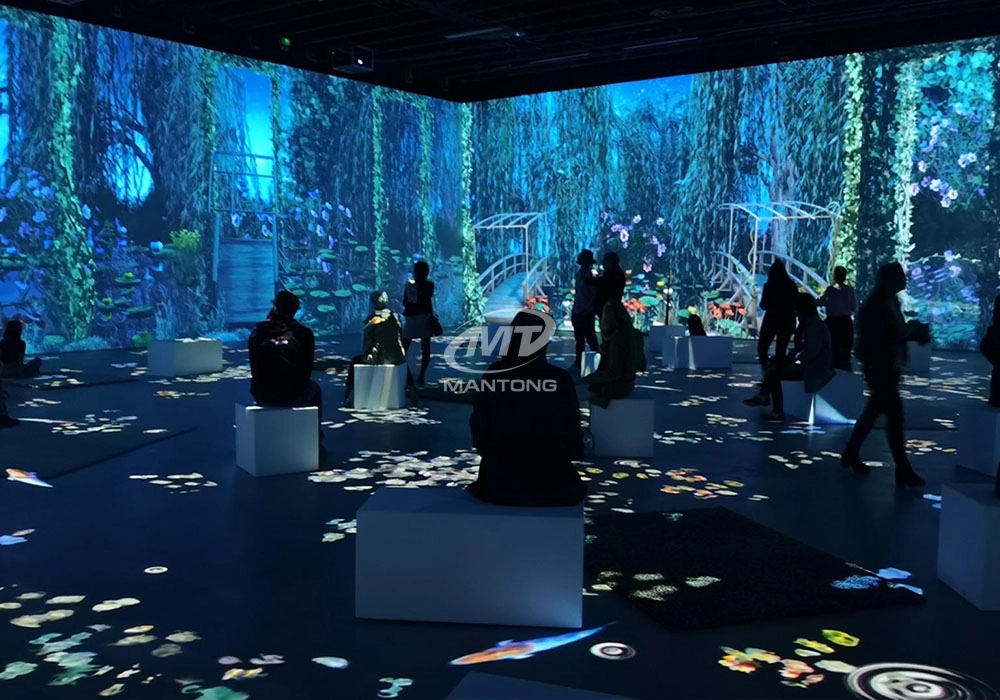
Mantong 6500LM High-Lumen Projector for Large-Scale Immersive Room Projection
Transform any space with Mantong's immersive projection mapping systems. Our high-lumen projectors (up to 6500 LM) and custom software create captivating interactive experiences for floors and walls. Ideal for museums, events, retail, and hospitality. Each kit includes professional ceiling mounting and 80+ pre-loaded video contents and is backed by a 12-month warranty and CE certification. We offer full customization and support to bring your vision to life.
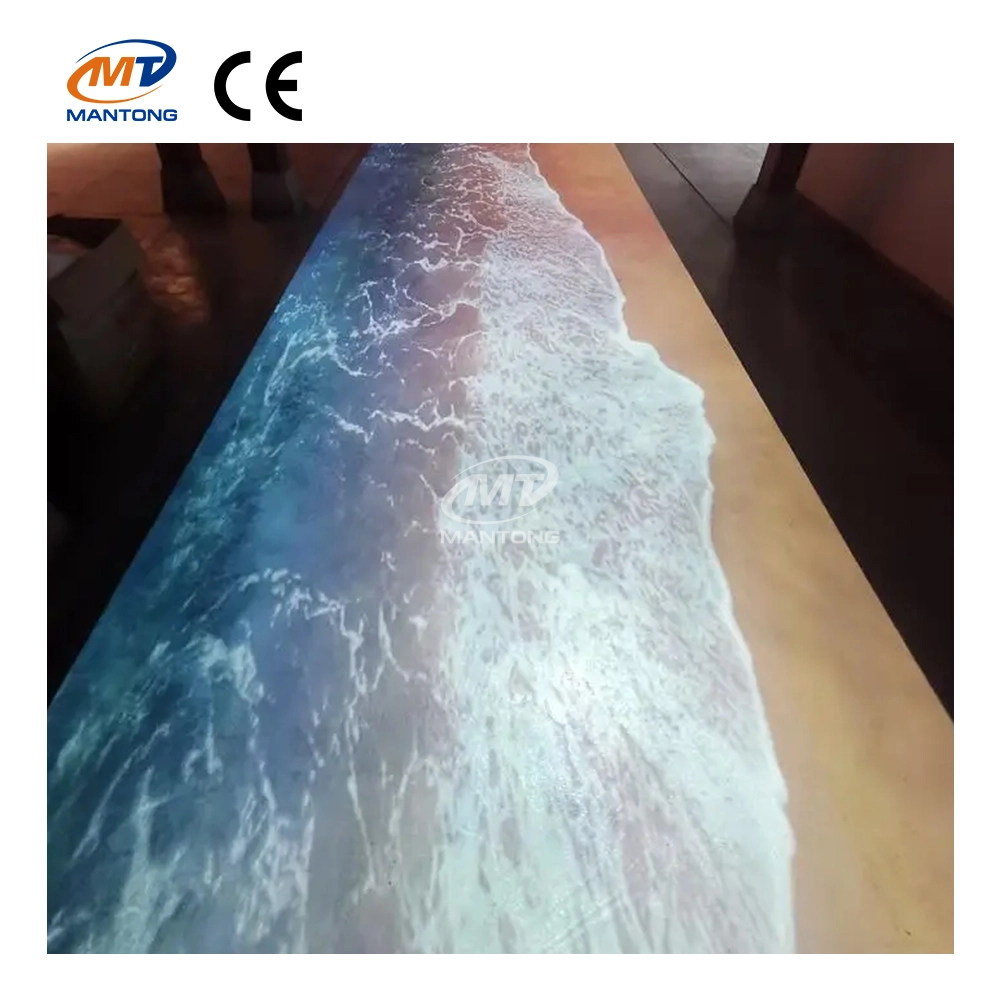
Indoor Interactive Floor Projector System - Customized Design & Installation Support
Indoor interactive floor projections display dynamic themed videos on the floor, commonly used in venues aiming to enhance brand influence or attract foot traffic, such as restaurants, hotel corridors, and brand car retail stores.
By using projectors and compatible software, the interactive content is projected onto the floor, encouraging engagement between people and the projected visuals. A single 5500-lumen indoor floor projector can cover an area of 5 m × 3 m. Typically, each project will use at least 3 units to ensure broad coverage and optimal visual effects.
We also offer customized design and installation support to enhance the interactive experience for your venue.
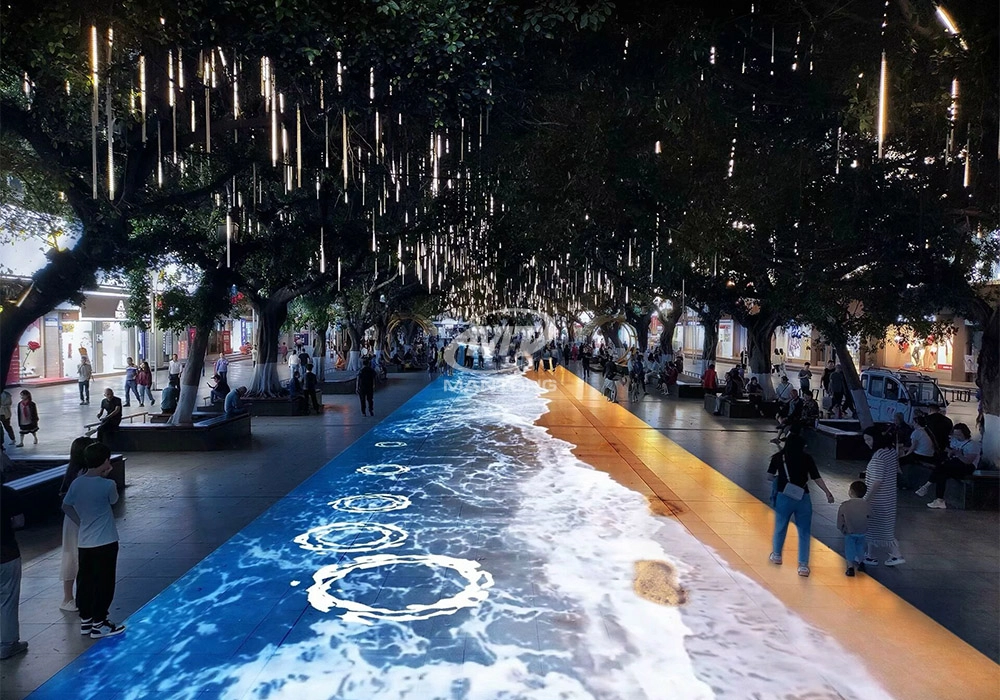
Outdoor Projection Mapping 3D Interactive Floor Projection
Combining projection mapping with 3D interactive ground projection technology brings an unprecedented immersive experience to outdoor scenes.
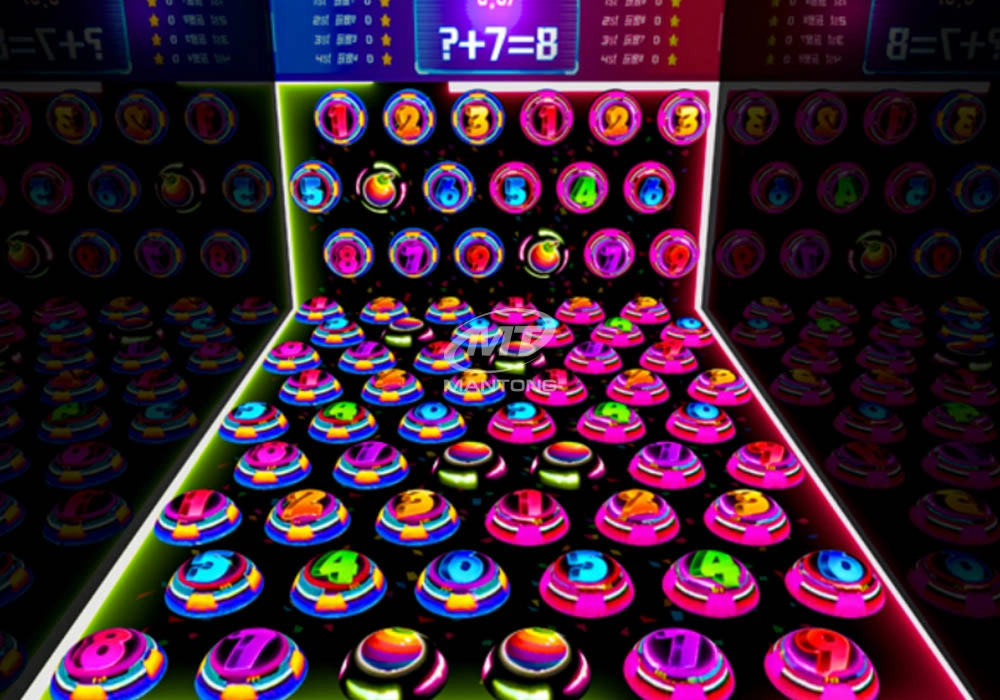
Amusement Rapidly Rotating Bouncing Sphere Interactive Wall Floor Projection Sports Games
Rapidly Rotating Bouncing Sphere is an interactive space where participants jump on rotating spheres. As they step on it, the spheres surface will show special interactivity
Jumping on spheres of the same color in succession causes them to pop, releasing light particles. The more consecutive jumps, the greater the reward—caterpillars appear, and eventually, all spheres of that color burst, filling the space with light and even more caterpillars.

Kaida Business Center, Shixin Road, Panyu District,Guangzhou City, Guangdong Province, China.
ManTong
ManTong
ManTong