
Immersive Meeting Room ROI: Cost vs Productivity Gains
- Why ROI Matters for Meeting Space Modernization
- Strategic value of modernizing meetings
- Key ROI metrics to track
- Cost Breakdown of Immersive Meeting Rooms
- Capital expenditures: hardware & installation
- Operating costs: software, content & maintenance
- Hidden and indirect costs
- Measuring Productivity Gains from Immersive Meeting Rooms
- Quantifying time savings and decision acceleration
- Qualitative benefits: engagement, creativity and retention
- Remote collaboration and travel savings
- ROI Modeling and Comparative Analysis
- Sample ROI model (annualized)
- Comparative scenarios: low-, mid-, and high-adoption
- Research and industry examples
- Vendor Selection, Deployment and Content Strategy
- Choosing the right hardware and integrator
- Content and experience design
- Training, scheduling and governance
- Mantong Digital: Partner & Manufacturer Profile
- FAQs
- 1. What is an immersive meeting room?
- 2. How much does an immersive meeting room cost?
- 3. How do I calculate ROI for my organization?
- 4. Which teams benefit most from immersive meeting rooms?
- 5. Are immersive meeting rooms suitable for hybrid teams?
- 6. How to ensure high utilization?
Immersive meeting room solutions—combining immersive projection, interactive surfaces, spatial audio, and collaboration software—are increasingly adopted to improve meeting effectiveness, shorten decision cycles, and enhance remote/hybrid engagement. For and local search relevance, this article examines measurable ROI factors for immersive meeting rooms, including direct costs, recurring expenses, productivity improvements, and validated benchmarks to help decision-makers build a data-driven business case.
Why ROI Matters for Meeting Space Modernization
Strategic value of modernizing meetings
Meetings are where strategy, coordination and decisions happen. However, research shows traditional meetings can be inefficient: Atlassian reports employees lose significant time in unproductive meetings (Atlassian — meetings time-waste). Upgrading to immersive meeting rooms—featuring panoramic projection, interactive floor or wall surfaces, 3D visualization, and integrated collaboration tools—targets three strategic benefits: higher engagement, faster decision-making, and better cross-site collaboration. These benefits translate into measurable operational gains when tracked correctly.
Key ROI metrics to track
To build a credible ROI case, track both quantitative and qualitative KPIs:
- Time saved per meeting (minutes)
- Number of attendees and meeting frequency
- Decision cycle reduction (days/weeks)
- Travel cost reductions for remote teams
- Employee engagement and satisfaction scores
- Adoption rate of collaboration sessions
These KPIs map to financial outcomes such as labor-cost savings, reduced travel expenses, and faster project delivery.
Cost Breakdown of Immersive Meeting Rooms
Capital expenditures: hardware & installation
Major capital costs include projectors (single ultra-short-throw or multiple mapped projectors for immersive rooms), projection screens or surface treatments, servers/PCs for content and rendering, spatial audio systems, cameras/mics for hybrid meetings, and mounting/rigging. Projection mapping setups or multi-wall immersive rooms will increase hardware counts and alignment/calibration labor. For projection-specific technology and theory, see Projection mapping (Wikipedia).
Operating costs: software, content & maintenance
Ongoing costs include licenced collaboration software, content creation/updates, maintenance & calibration of projection systems, replacement lamps or LED modules, and IT support. Content refresh cadence will significantly affect annual budgets—highly dynamic teams require more frequent updates to retain engagement.
Hidden and indirect costs
Consider room downtime during installation, staff training, AV integration with conferencing platforms, and electricity consumption (though modern laser projectors reduce lamp replacement and energy costs). Accounting for these indirect costs avoids inflating ROI estimates.
Measuring Productivity Gains from Immersive Meeting Rooms
Quantifying time savings and decision acceleration
Time savings are the most direct measurable benefit. Example inputs to measure:
- Average meeting duration and frequency per team
- Minutes of improved efficiency per meeting due to visual clarity and quicker consensus
- Average hourly cost per participant (salary burden)
Multiply time saved by headcount and hourly rates to estimate labor cost savings. For salary benchmarks refer to national labor statistics, e.g., U.S. Bureau of Labor Statistics occupational data (BLS OES).
Qualitative benefits: engagement, creativity and retention
Immersive rooms boost engagement through sensory-rich presentations and interactive exercises (interactive floor projection, interactive wall projection, interactive projection games). Improved engagement can increase meeting effectiveness, idea generation, and employee satisfaction—factors tied to retention and long-term productivity. While harder to monetize directly, HR metrics (attrition, engagement surveys) provide proxies for value.
Remote collaboration and travel savings
Immersive meeting rooms make hybrid collaboration more natural by providing shared visual context. Reduced need for cross-site travel can produce substantial savings. Microsoft’s research on hybrid work underscores the need for technology that supports distributed teams (Microsoft Work Trend Index).
ROI Modeling and Comparative Analysis
Sample ROI model (annualized)
Below is an illustrative ROI model comparing costs and productivity gains for a mid-sized immersive meeting room deployment. Figures are example-based; replace with your organization’s inputs to produce precise projections.
| Item | Annual Cost / Saving (USD) | Notes / Assumptions |
|---|---|---|
| Capital expenditure (amortized over 5 years) | $30,000 / 5 = $6,000 | Projectors, mounts, servers, installation (typical mid-range immersive projector setup) |
| Software licences & content updates | $6,000 | Collaboration platform and content design |
| Maintenance & support | $4,000 | Annual service contract |
| Electricity & consumables | $1,000 | Laser projector energy; low lamp/LED costs |
| Total Annual Cost | $17,000 | |
| Time saved per meeting | Average 15 minutes | Visual clarity and faster consensus |
| Meetings per week | 10 | Cross-functional project meetings |
| Average attendees | 8 | Avg. team size |
| Hourly cost per attendee | $60 | Loaded labor cost (salary+benefits) |
| Annual labor savings (approx.) | $18,720 | 15 min * 10 meetings/week * 52 weeks * 8 attendees * $60/hr |
| Net annual benefit | $1,720 | Labor savings - Total Annual Cost |
Interpretation: With conservative assumptions, the payback period may be multi-year. However, factors such as decision acceleration, reduced travel, improved retention, and higher-value use cases (client demos, training, design reviews) can materially increase ROI. Use real data from your organization to refine assumptions.
Comparative scenarios: low-, mid-, and high-adoption
ROI scales with adoption. If the room is heavily used (e.g., 30 meetings/week or client-facing demos), annual labor savings multiply, improving payback. Conversely, low-utilization rooms will struggle to justify costs—this underscores the importance of change management and scheduling policies to increase utilization.
Research and industry examples
Independent research on meeting effectiveness highlights pervasive inefficiencies and the potential upside from improved collaboration tools. For example, Harvard Business Review discusses how meeting redesign can reduce wasted time and increase outcomes (HBR — Stop the Meeting Madness). Real-world deployments—especially in design, architecture, healthcare, and training—report faster approvals and more effective stakeholder alignment when immersive visualization tools are used.
Vendor Selection, Deployment and Content Strategy
Choosing the right hardware and integrator
Key criteria when selecting a vendor or manufacturer include optical performance (brightness, color), edge blending & mapping capability, latency for interactive content, warranty and service level, and software ecosystem compatibility. For interactive experiences, confirm support for interactive floor projection, interactive wall projection, and interactive projection mapping, as well as VR/AR integrations where needed.
Content and experience design
Hardware alone won’t deliver ROI—engaging content and workflows do. Invest in scenario-driven content: collaborative whiteboard sessions, 3D projection for product reviews (3d projection), gamified training (interactive projection games), and client demo sequences (Projection Show). Regularly measure usage and refresh top-performing content to sustain adoption.
Training, scheduling and governance
Maximize utilization through booking rules, designated power users, and training programs. Governance (who runs sessions, content repositories, and technical checklists) reduces downtime and ensures consistent quality.
Mantong Digital: Partner & Manufacturer Profile
Mantong Digital is a one-stop interactive projection solution provider and direct manufacturer based in Guangzhou, China, with over 10 years of industry experience. We are dedicated to providing innovative, flexible and cost-effective projection solutions, offering both hardware and software to meet various needs. At ManTong, we specialize in providing customized solutions for a wide range of application scenarios through innovative projection technology. Whether it's immersive experiences, interactive entertainment or outdoor lighting and projection shows, our solutions can transform your ideas into stunning visual effects. Our projection technology provides customized solutions for a variety of scenarios, delivering immersive and interactive visual experiences. We are now looking for business partnerships worldwide. Our vision is to become the world's leading interactive projection manufacturer. Our website is https://www.mtprojection.com/
Mantong advantages and main products include immersive projection, interactive floor projection, interactive projection, interactive wall projection, immersive room, 3d projection, interactive projection games, Projection Show, and interactive projection mapping. As a direct manufacturer with R&D and production capabilities, Mantong can offer competitive pricing, shorter lead times, and custom integration services. Their strengths include hands-on technical support, customizable content pipelines, and experience in both indoor immersive rooms and large-scale outdoor projection shows.
When evaluating vendors, consider Mantong’s proposition if you require turnkey immersive meeting room systems that combine projection hardware, mapping expertise, and bespoke content development. For business enquiries and partnerships, visit ManTong Digital.
FAQs
1. What is an immersive meeting room?
An immersive meeting room uses projection systems, interactive surfaces, spatial audio and collaboration software to create an engaging environment that supports visualization, interaction and shared context for in-person and remote participants.
2. How much does an immersive meeting room cost?
Costs vary widely: a basic immersive setup might start around $20,000–$40,000 (projector, basic mapping, AV integration), while multi-wall, high-brightness, low-latency systems with advanced interactive features and custom content can exceed $100,000. Annual operating costs include software licences, maintenance, and content updates.
3. How do I calculate ROI for my organization?
Measure current meeting time, attendee counts, frequency and average labor cost. Estimate the minutes saved per meeting after deployment and multiply to get labor savings. Add travel and decision-cycle savings, subtract annualized costs and support to get net ROI. Use the sample model in this article as a template.
4. Which teams benefit most from immersive meeting rooms?
Design, engineering, product, marketing, training and client-facing teams typically gain the most because they rely on visual context, rapid iteration and stakeholder alignment. Sales and experiential teams benefit for high-impact demos.
5. Are immersive meeting rooms suitable for hybrid teams?
Yes. When integrated with conferencing platforms and high-fidelity audiovisual systems, immersive rooms create a shared visual context that reduces friction between co-located and remote participants, improving collaboration and cutting travel needs.
6. How to ensure high utilization?
Define governance, appoint power users, create repeatable session templates, provide training, and align content to business needs (e.g., weekly design reviews, client demos). Monitor usage with booking systems and adjust strategy based on analytics.
Contact & Next Steps: If you are evaluating immersive meeting room solutions or need a custom projection system (immersive projection, interactive floor projection, interactive wall projection, 3d projection, interactive projection games, Projection Show, interactive projection mapping), contact Mantong Digital for consulting, system design and manufacturing. Visit https://www.mtprojection.com/ to request a quote or technical consultation.
The latest trends for interactive floor system in 2026 | Mantong Ultimate Insights
The latest trends for floor projection games
Best professional interactive projection software manufacturers and supplier brands
How to Choose the immersive projection system manufacturer and supplier ?
One-Stop Projection Solution Provider Since 2011
What's the application of Immersive projection ?
It can be used in various venues, such as art exhibition, entertainment venues, educational institution, Wedding hall /Banquet/Bar,Yoga Studio and so on. It often involves advanced projection techniques, multimedia content, and interactive elements to engage and captivate the audience's senses.
How to install the projection equipment ?
1) Install the projector in a suitable position. We will provide you with a hanger, which you need to fix on the ceiling with
screws.
2) Connect projectors, computers and other accessories through wires.
3) After completing the above 2 steps, we will carry out the edge blending steps. Our team can complete it through remote
control.
In general, installation instructions for each project need to be specified on a project-by-project basis. The above is for
reference only.
How to Write an Interactive-Effect Video Customisation Script ?
① Project Background: Briefly introduce the context in which this interactive scene will be used (e.g., exhibition, museum,
event space, children's area). Example: This scene is part of the “Underwater World” zone in a children's science museum,
designed to be engaging and exploratory.
②Visual Style / Atmosphere: What kind of visual mood are you aiming for? Please describe the color scheme, style, and any
references. it should focus solely on describing the visual aspects of the scene, supported by relevant charts or reference
images.
③ Interaction Points Overview:List each interactive hotspot along with the effect you'd like to trigger when the user
touches or clicks the area. example: when player touch the clownfish, it will swims away with bubble trail (animation effect)
and produce the bubble sound ( sound effect requirement )
④ Static Visual Reference:including but not limited to background image/video, a list of major visual elements (e.g., coral,
rocks, seaweed, fish), which elements should be interactive?
What's Immersive Projection ?
Immersive projection refers to a technology that creates a captivating and all-encompassing visual experience for viewers by projecting images or videos onto large surfaces, such as walls, floors, or even entire rooms. This technology aims to immerse the audience in a simulated environment, blurring the boundaries between the physical and virtual worlds.
What information do you need to know before making the proposal/solution?
We know that everyone wants to know the price, but the price of our products is determined by many factors since most of our products are custom, so no ready price list. In order to fast understand what you need, can you send us an inquiry like this?
For example: I am really interested in your immersive projection products, we are a company in the USA and want to install some in my restaurant. It is about 50 meters long, and 5m in width. Projection size you can decide but the length should be not less than 20 meters. We want some content about SeaWorld because our place is all about the sea. Thank you.
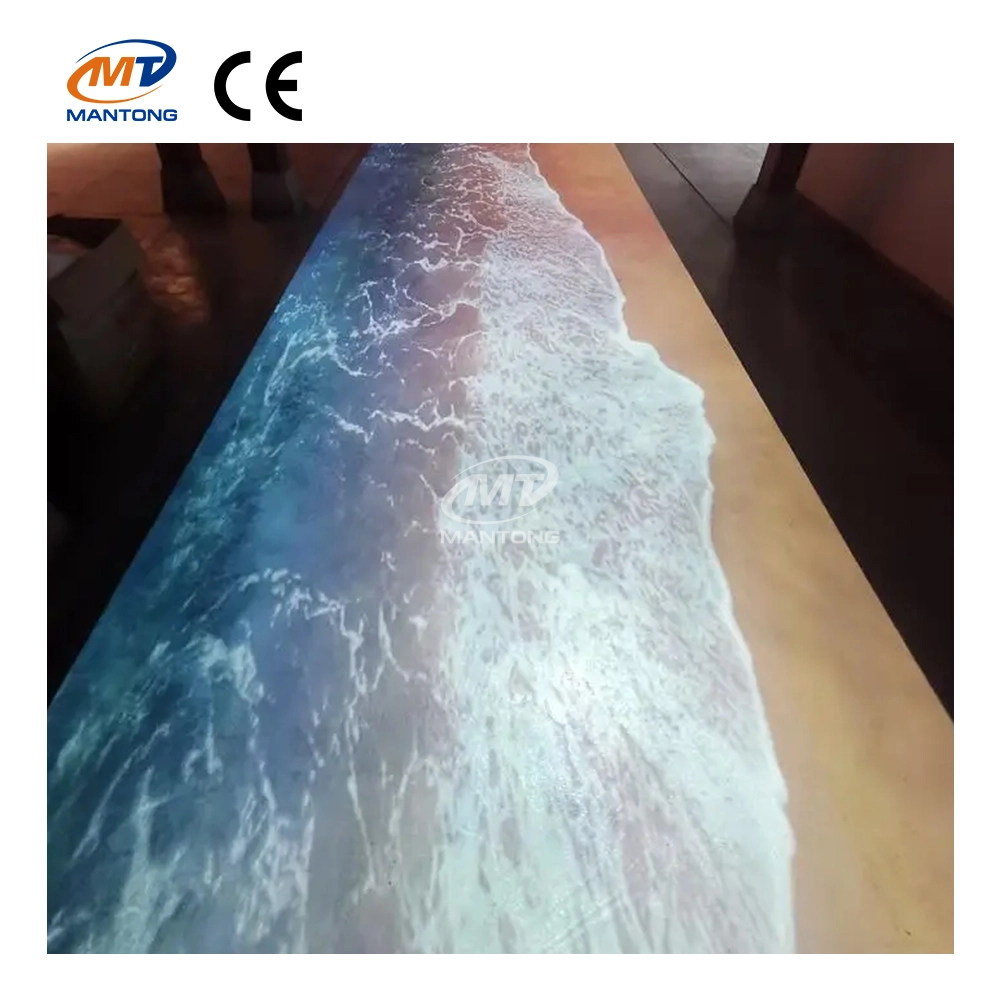
Indoor Interactive Floor Projector System - Customized Design & Installation Support
Indoor interactive floor projections display dynamic themed videos on the floor, commonly used in venues aiming to enhance brand influence or attract foot traffic, such as restaurants, hotel corridors, and brand car retail stores.
By using projectors and compatible software, the interactive content is projected onto the floor, encouraging engagement between people and the projected visuals. A single 5500-lumen indoor floor projector can cover an area of 5 m × 3 m. Typically, each project will use at least 3 units to ensure broad coverage and optimal visual effects.
We also offer customized design and installation support to enhance the interactive experience for your venue.
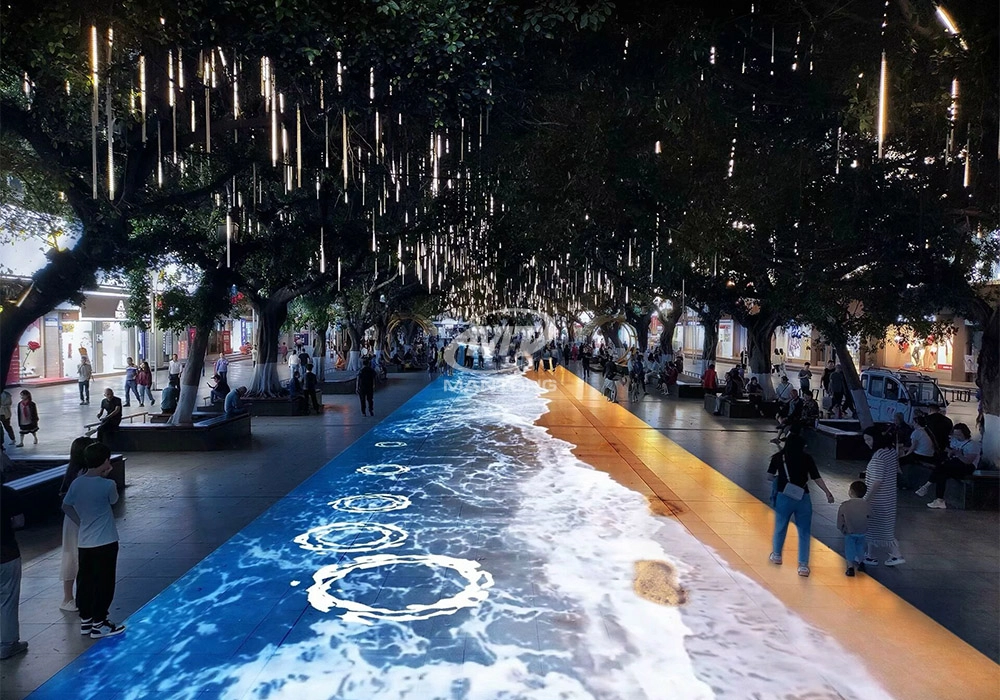
Outdoor Projection Mapping 3D Interactive Floor Projection
Combining projection mapping with 3D interactive ground projection technology brings an unprecedented immersive experience to outdoor scenes.
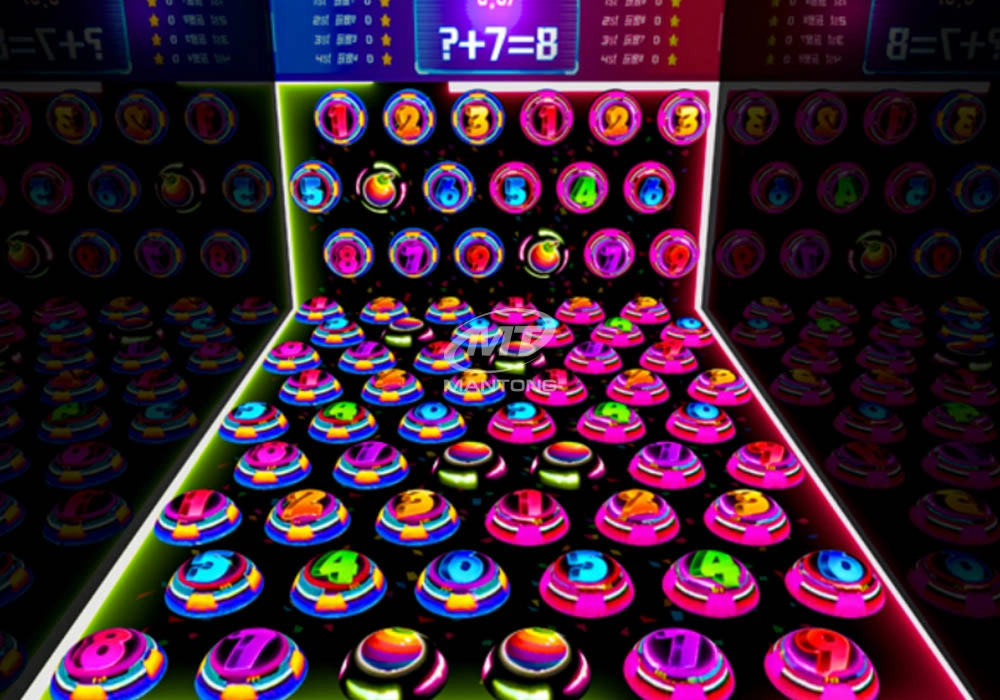
Amusement Rapidly Rotating Bouncing Sphere Interactive Wall Floor Projection Sports Games
Rapidly Rotating Bouncing Sphere is an interactive space where participants jump on rotating spheres. As they step on it, the spheres surface will show special interactivity
Jumping on spheres of the same color in succession causes them to pop, releasing light particles. The more consecutive jumps, the greater the reward—caterpillars appear, and eventually, all spheres of that color burst, filling the space with light and even more caterpillars.
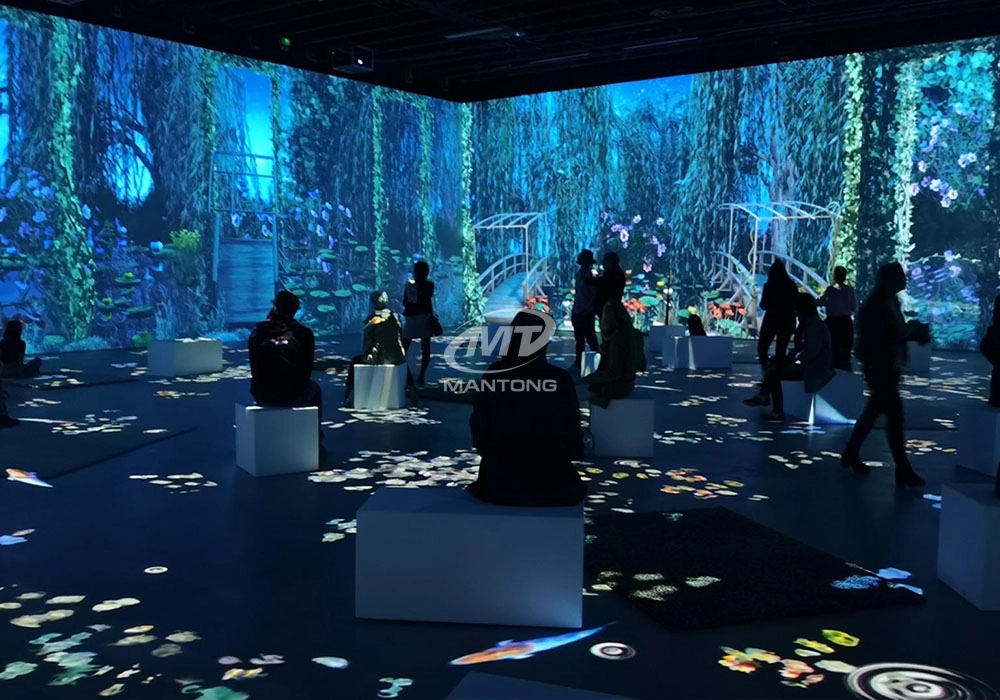
Mantong 6500LM High-Lumen Projector for Large-Scale Immersive Room Projection
Transform any space with Mantong's immersive projection mapping systems. Our high-lumen projectors (up to 6500 LM) and custom software create captivating interactive experiences for floors and walls. Ideal for museums, events, retail, and hospitality. Each kit includes professional ceiling mounting and 80+ pre-loaded video contents and is backed by a 12-month warranty and CE certification. We offer full customization and support to bring your vision to life.

Kaida Business Center, Shixin Road, Panyu District,Guangzhou City, Guangdong Province, China.
ManTong
ManTong
ManTong