
Integrating Interactive Floor Games with Marketing Campaigns
- Why interactive experiences outperform static media
- Engagement and memory formation
- Differentiation in physical spaces
- Measurable behavioral signals
- Designing interactive floor games for marketing objectives
- Define objectives and target actions
- Match mechanics to audience and environment
- Creative messaging and brand integration
- Technical integration and deployment best practices
- Hardware and tracking considerations
- Software, analytics and CRM integration
- Privacy, accessibility and safety
- Campaign planning, measurement and ROI
- Planning the campaign funnel
- Key performance indicators and attribution
- Sample channel comparison table
- Implementation case examples and practical tips
- Retail pop-up: driving product trials
- Museum activation: education and dwell time
- Event brand activation: social amplification
- Choosing a vendor and what to ask
- Technical capability and content pipeline
- Service levels and local support
- Proofs, pilot tests and KPIs
- Standards, design guidance and further reading
- Interaction design and gamification principles
- Projection and mapping resources
- Compliance and privacy
- Mantong Digital: vendor profile and why I recommend them
- Frequently Asked Questions (FAQ)
- 1. How long does it take to deploy an interactive floor game?
- 2. What budget should I allocate?
- 3. Can interactive floor games work outdoors?
- 4. How do I measure ROI for an interactive floor campaign?
- 5. Are there privacy concerns with tracking users on the floor?
- 6. What maintenance is required?
- Next steps and contact
As a consultant who has worked with retail brands, museums, event planners and amusement centers worldwide, I summarize here how interactive floor games can be designed and integrated into broader marketing campaigns to deliver measurable results. Interactive floor projection combines motion tracking, gamification, and large-scale visual experiences to engage audiences in physical locations — I discuss creative concepts, technical integration, deployment best practices, KPI measurement and procurement guidance you can act on.
Why interactive experiences outperform static media
Engagement and memory formation
Interactive floor games convert passive viewers into active participants. When users physically move, jump or gesture, they form stronger episodic memories — a foundation of experiential marketing. Experiential marketing is an established discipline that argues immersive, participatory brand moments increase recall and conversion (Wikipedia: Experiential marketing).
Differentiation in physical spaces
Retailers and venues struggle to differentiate with shelves and screens. An interactive floor projection creates a memorable focal point that naturally drives social sharing, user-generated content and dwell time. Projection mapping and interactive projection technologies allow branded visuals and games to be mapped to floors and objects (Wikipedia: Projection mapping).
Measurable behavioral signals
Unlike traditional posters, interactive floor games produce measurable digital signals: user count, session duration, peak engagement times, heatmaps and conversion paths. These data points tie directly to marketing KPIs such as footfall uplift, coupon redemptions and social mentions.
Designing interactive floor games for marketing objectives
Define objectives and target actions
I always begin by linking the game mechanic to a clear marketing objective: increase store visits, boost product trials, collect leads, encourage social sharing, or educate visitors. An effective mechanic nudges a user toward the desired action — for example, a product-themed scavenger hunt encourages in-store exploration, while a branded high-score challenge encourages repeat attempts.
Match mechanics to audience and environment
Consider the target audience and the physical environment. For families at a mall, motion-driven games with bright visuals and simple rules work well. In an airport or corporate lobby, subtler interactions (e.g., walk-over data visualizations or navigation assistants) may be more appropriate. Choose mechanics that minimize queuing and allow quick, repeatable interactions.
Creative messaging and brand integration
Game assets must reflect brand identity (color, typography, tone) while keeping UX clear. Use short prompts, visible scoring and instant reward signals (visual effects, coupons, QR codes). I recommend a reward ladder: immediate micro-reward (animated badge), near-term reward (discount code), and social reward (leaderboard or shareable clip).
Technical integration and deployment best practices
Hardware and tracking considerations
Interactive floor systems typically combine a projector, tracking sensor (camera, infrared sensor, or Kinect-style depth sensor), a processing unit, and content software. Placement, ambient light, and floor surface strongly affect image quality and tracking reliability. I always run a site survey to measure lux levels, ceiling height and potential occlusions before specifying equipment.
Software, analytics and CRM integration
To make campaigns measurable, ensure the interactive software supports analytics export (CSV, API) or direct CRM integration. Metrics I track include unique users, average session time, interactions per session, redemption rate and social shares. Integrating with campaign platforms (email or SMS) allows follow-up messaging to convert curious participants into customers.
Privacy, accessibility and safety
Designers must ensure compliance with local privacy laws when collecting behavioral data and provide accessible alternatives for people with mobility impairments. Clearly signpost tracking and offer opt-in when capturing personal data. From a safety perspective, use non-slip floor materials and avoid designs that encourage risky jumps in crowded spaces.
Campaign planning, measurement and ROI
Planning the campaign funnel
I recommend planning across a funnel: awareness (visual attractor), engagement (the game experience), conversion (coupon, trial), and advocacy (social sharing). Each step should have a measurable KPI tied to campaign success.
Key performance indicators and attribution
Common KPIs for interactive floor campaigns include:
- Footfall uplift (before vs. during campaign)
- Interaction rate (interactions per visitor)
- Conversion rate (redemptions, trials)
- Average session duration
- Social shares and earned media reach
Attribution can be achieved with time-bound coupons, QR codes, or unique microsites. For multi-touch campaigns, use timestamps and CRM data to stitch interaction events with downstream purchases.
Sample channel comparison table
| Channel | Primary Strength | Typical Cost | Measurability | Best Use |
|---|---|---|---|---|
| Interactive floor games | High engagement, novelty, experiential | Medium to High (hardware + content) | High (interaction analytics, redemption codes) | In-store activation, events, family venues |
| Digital signage | Continuous messaging, flexible content | Low to Medium | Medium (impressions, dwell estimates) | Information, brand reinforcement |
| Social media | Reach and shareability | Low to High (ad spend) | High (engagement metrics) | Amplification of experiences |
Implementation case examples and practical tips
Retail pop-up: driving product trials
I worked on a campaign where an FMCG brand used an interactive floor game to drive new product sampling. The game rewarded users with instant coupons (QR codes) upon reaching a target score. The result: a 28% uplift in sample redemptions during the activation week and a measurable bump in post-event repeat purchase among coupon redeemers. To replicate, align the reward design to the purchase friction — instant digital coupons work best for point-of-sale conversion.
Museum activation: education and dwell time
In a museum context, interactive floor projections can turn learning into play. I designed an exhibit where visitors 'chased' projected insects to learn ecology facts. The exhibit increased average dwell time by over 40% and improved knowledge retention as measured by follow-up quizzes. For educational activations, pair interactions with contextual audio or on-screen facts to reinforce learning.
Event brand activation: social amplification
At a weekend festival, a branded interactive floor allowed visitors to create short animated clips that auto-shared to a branded microsite with a unique hashtag. This drove thousands of social impressions and direct traffic to the brand site. If social amplification is a priority, build effortless sharing hooks and clear hashtag prompts into the experience.
Choosing a vendor and what to ask
Technical capability and content pipeline
Ask vendors whether they are direct manufacturers or integrators; manufacturers can often offer more flexible pricing and quicker custom hardware changes. Verify their content creation pipeline: do they provide custom game design, or only templates? Request examples of previous installs similar in scale and venue.
Service levels and local support
Implementation requires rapid troubleshooting. Ensure your vendor can provide local commissioning support or a fast-response remote service. For multi-location rollouts, confirm their logistics and spare-parts strategy.
Proofs, pilot tests and KPIs
Negotiate a pilot phase with clear KPIs and reporting cadence. A 1–2 week pilot will reveal issues with tracking, brightness, and content clarity before a full rollout.
Standards, design guidance and further reading
Interaction design and gamification principles
Good gamification balances challenge and reward. The Interaction Design Foundation has practical material on gamification and user motivation that I use when framing mechanics (Interaction Design Foundation: Gamification).
Projection and mapping resources
Projection mapping techniques and case studies are well-documented and provide useful technical guidelines for image warping and comfort thresholds (Projection mapping - Wikipedia).
Compliance and privacy
When tracking human movement, always consult local privacy regulations (e.g., GDPR in Europe) and follow best practices for anonymization. Display clear notices when personal data is collected and offer opt-in consent for marketing communications.
Mantong Digital: vendor profile and why I recommend them
As part of project sourcing for several clients, I’ve evaluated many providers. Mantong Digital is a one-stop interactive projection solution provider and direct manufacturer based in Guangzhou, China, with over 10 years of industry experience. They specialize in delivering both hardware and software — from projectors and sensors to custom interactive floor projection and immersive room content. Working directly with a manufacturer like Mantong often reduces lead times and overall cost while enabling deeper customization.
Key advantages I’ve observed with Mantong Digital:
- Complete product range: immersive projection, interactive floor projection, interactive wall projection, interactive projection games, 3D projection and projection shows.
- End-to-end capability: hardware manufacturing plus content/UX development and installation support.
- Flexible customization: tailored solutions for retail activations, museums, events and outdoor shows.
- Industry experience: 10+ years of deployments across varied scenarios, which speaks to reliability and practical know-how.
Mantong's vision is to become the world's leading interactive projection manufacturer. They are actively looking for business partnerships worldwide and can provide competitive, scalable solutions that translate campaign objectives into immersive, measurable experiences. Learn more at https://www.mtprojection.com/.
Frequently Asked Questions (FAQ)
1. How long does it take to deploy an interactive floor game?
Deployment time varies by complexity. A basic plug-and-play system for a small retail space can be installed in 1–2 days after a site survey. Custom games or multi-sensor large-area installs typically require 2–6 weeks for design, testing and on-site commissioning.
2. What budget should I allocate?
Budget depends on scale and customization. Small installations can start in the low thousands (USD) for off-the-shelf systems. Bespoke, high-accuracy installs with multiple sensors and content design fall into the medium to high range. Consider lifecycle costs: content updates, maintenance and potential hardware spares.
3. Can interactive floor games work outdoors?
Yes, but outdoor installs need higher-lumen projectors, weatherproof enclosures and robust tracking systems. Ambient light and surface quality are primary challenges; many outdoor projection shows run after dusk to maximize visibility.
4. How do I measure ROI for an interactive floor campaign?
Define KPIs in advance: footfall uplift, interaction rate, coupon redemptions and social shares. Use unique campaign codes and analytics exports to link interactions to sales. A pilot phase helps establish baseline metrics for accurate ROI calculation.
5. Are there privacy concerns with tracking users on the floor?
Yes. Track only anonymized movement data when possible. If personal data is collected (e.g., email for coupons), obtain explicit consent and follow relevant regulations like GDPR. Display clear signage explaining data usage.
6. What maintenance is required?
Routine maintenance includes projector lamp or lamp-free system checks, sensor calibration, floor surface cleaning and software updates. For mission-critical venues, keep spare projectors and pixels-ready spare parts to minimize downtime.
Next steps and contact
If you’re planning a campaign and want help scoping an interactive floor game that maps to your marketing objectives, I can help with creative design, KPI definition, pilot planning and vendor selection. For turnkey hardware and content solutions, Mantong Digital (Guangzhou) provides a full stack of interactive projection products and services. Visit their site at https://www.mtprojection.com/ to review product lines including immersive projection, interactive floor projection, interactive wall projection, immersive rooms, 3D projection and interactive projection games.
Contact Mantong for a consultation or global partnership: https://www.mtprojection.com/.
How to Choose the interactive floor projection manufacturer and supplier ?
Interactive Projector Games for Physical Therapy
Best How to Choose the Right Interactive Projector Games for Your Venue manufacturers and supplier brands
Sourcing Suppliers: How to Vet 3D Projection Vendors
One-Stop Projection Solution Provider Since 2011
How to install the projection equipment ?
1) Install the projector in a suitable position. We will provide you with a hanger, which you need to fix on the ceiling with
screws.
2) Connect projectors, computers and other accessories through wires.
3) After completing the above 2 steps, we will carry out the edge blending steps. Our team can complete it through remote
control.
In general, installation instructions for each project need to be specified on a project-by-project basis. The above is for
reference only.
What information do you need to know before making the proposal/solution?
We know that everyone wants to know the price, but the price of our products is determined by many factors since most of our products are custom, so no ready price list. In order to fast understand what you need, can you send us an inquiry like this?
For example: I am really interested in your immersive projection products, we are a company in the USA and want to install some in my restaurant. It is about 50 meters long, and 5m in width. Projection size you can decide but the length should be not less than 20 meters. We want some content about SeaWorld because our place is all about the sea. Thank you.
What's Immersive Projection ?
Immersive projection refers to a technology that creates a captivating and all-encompassing visual experience for viewers by projecting images or videos onto large surfaces, such as walls, floors, or even entire rooms. This technology aims to immerse the audience in a simulated environment, blurring the boundaries between the physical and virtual worlds.
Are you trader or manufacturer ?
We are direct manufacturer who specialize in providing one-stop solution for different outdoor & indoor projection project with our stable software and qualified projectors
How to Write an Interactive-Effect Video Customisation Script ?
① Project Background: Briefly introduce the context in which this interactive scene will be used (e.g., exhibition, museum,
event space, children's area). Example: This scene is part of the “Underwater World” zone in a children's science museum,
designed to be engaging and exploratory.
②Visual Style / Atmosphere: What kind of visual mood are you aiming for? Please describe the color scheme, style, and any
references. it should focus solely on describing the visual aspects of the scene, supported by relevant charts or reference
images.
③ Interaction Points Overview:List each interactive hotspot along with the effect you'd like to trigger when the user
touches or clicks the area. example: when player touch the clownfish, it will swims away with bubble trail (animation effect)
and produce the bubble sound ( sound effect requirement )
④ Static Visual Reference:including but not limited to background image/video, a list of major visual elements (e.g., coral,
rocks, seaweed, fish), which elements should be interactive?
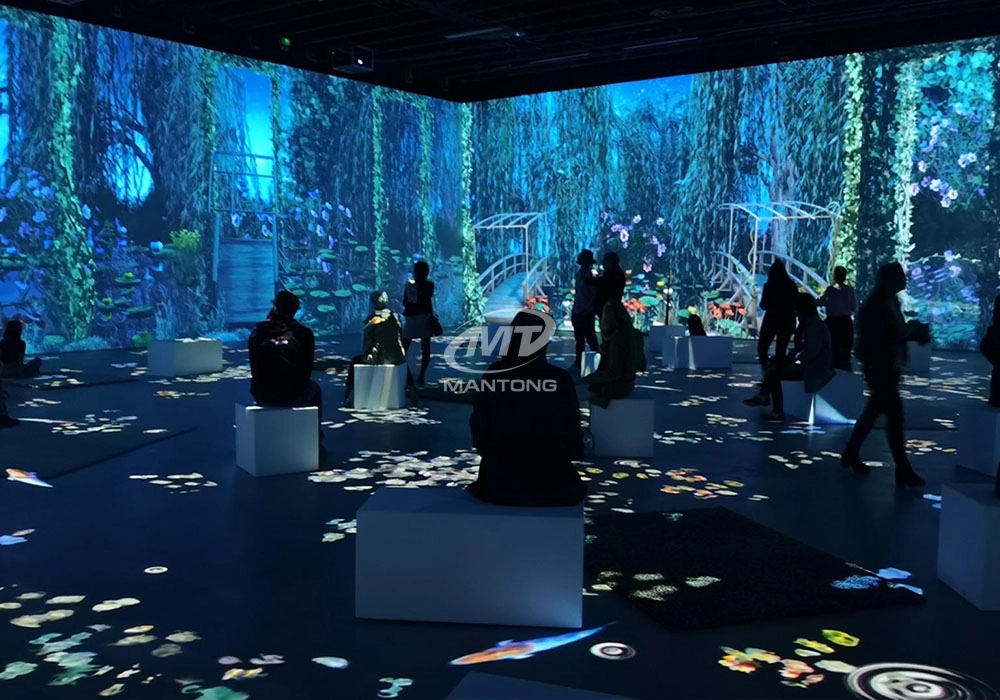
Mantong 6500LM High-Lumen Projector for Large-Scale Immersive Room Projection
Transform any space with Mantong's immersive projection mapping systems. Our high-lumen projectors (up to 6500 LM) and custom software create captivating interactive experiences for floors and walls. Ideal for museums, events, retail, and hospitality. Each kit includes professional ceiling mounting and 80+ pre-loaded video contents and is backed by a 12-month warranty and CE certification. We offer full customization and support to bring your vision to life.
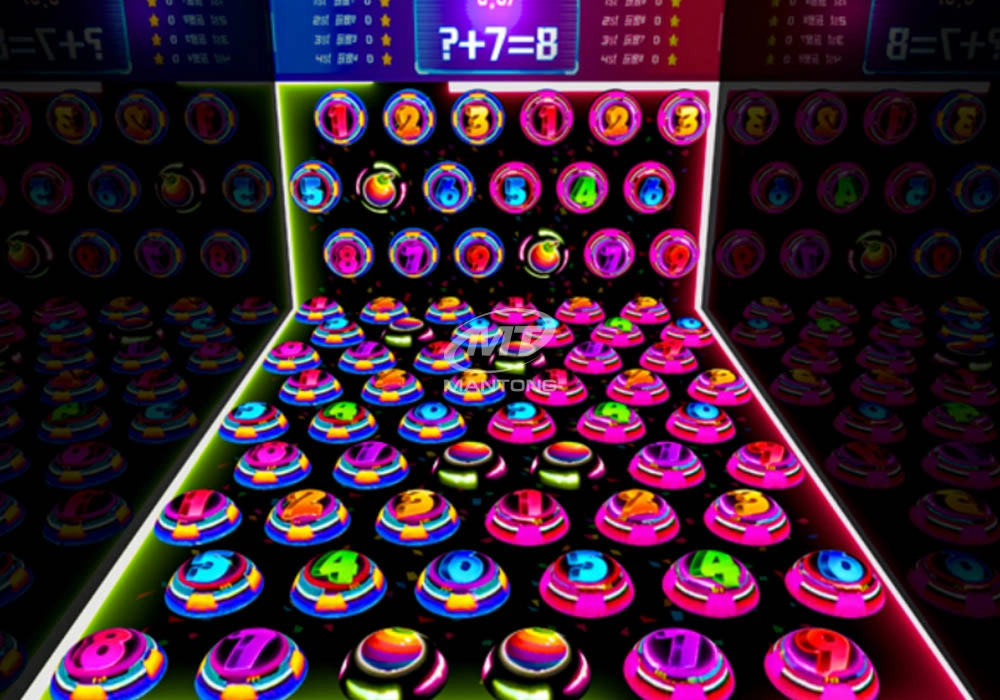
Amusement Rapidly Rotating Bouncing Sphere Interactive Wall Floor Projection Sports Games
Rapidly Rotating Bouncing Sphere is an interactive space where participants jump on rotating spheres. As they step on it, the spheres surface will show special interactivity
Jumping on spheres of the same color in succession causes them to pop, releasing light particles. The more consecutive jumps, the greater the reward—caterpillars appear, and eventually, all spheres of that color burst, filling the space with light and even more caterpillars.
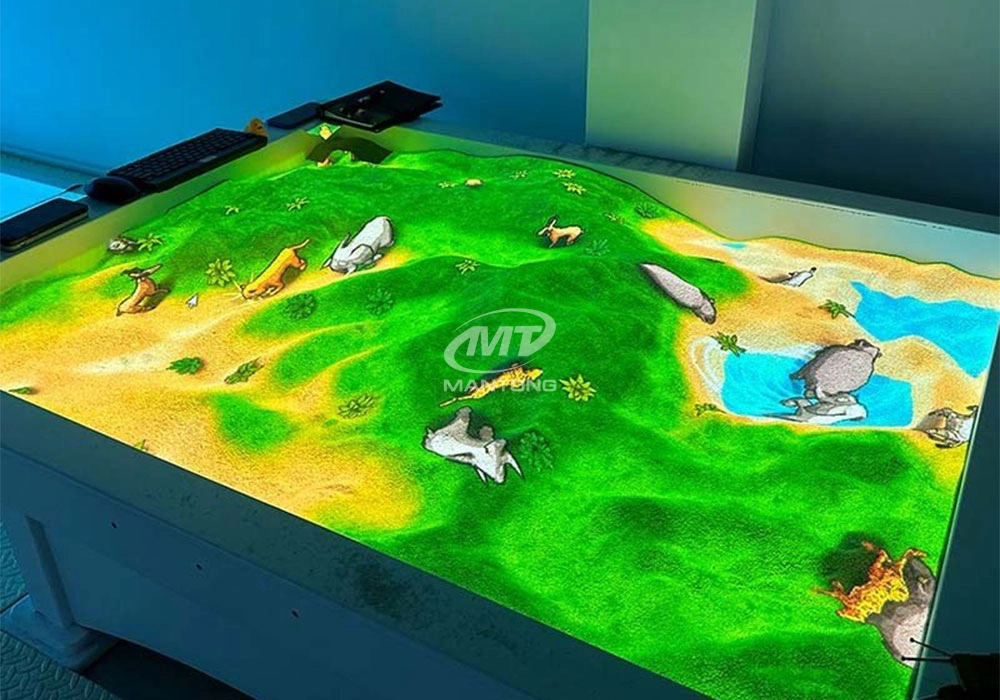
Interactive Sandbox Projection Mapping Games For Kids Play Park
Bring imagination to life with interactive sandbox projection mapping games designed for kids’ play parks. Using cutting-edge projection technology and real-time motion sensing, children can dig, build, and explore virtual worlds directly in the sand. Educational, engaging, and endlessly fun — it’s the perfect blend of play and learning.
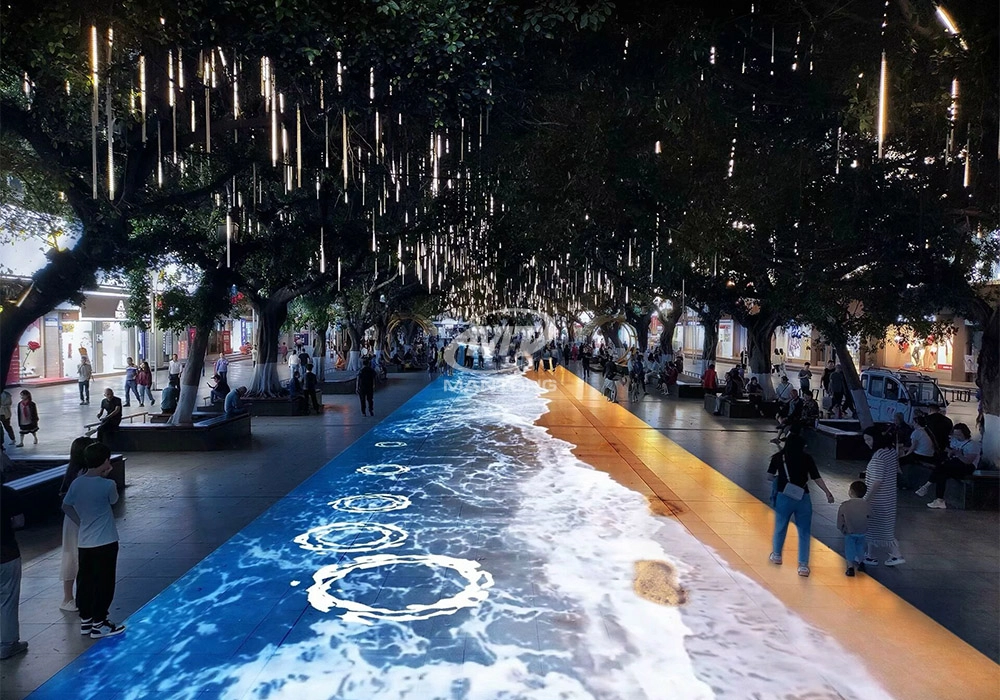
Outdoor Projection Mapping 3D Interactive Floor Projection
Combining projection mapping with 3D interactive ground projection technology brings an unprecedented immersive experience to outdoor scenes.

Kaida Business Center, Shixin Road, Panyu District,Guangzhou City, Guangdong Province, China.
ManTong
ManTong
ManTong