
Interactive Floor Games Buyer’s Guide: What Buyers Need to Know
- Why interactive floor games matter for experiences and venues
- User intent and common applications
- Business benefits and measurable outcomes
- Key technical components and specifications to evaluate
- Projector selection: brightness, resolution, throw ratio, and lifetime
- Sensors and tracking: advantages of different approaches
- Software: engines, content management and open APIs
- Buying considerations and deployment planning
- Venue assessment: surface, ambient light and traffic patterns
- Installation, maintenance and service-level agreements (SLA)
- Budgeting and ROI modeling
- Choosing the right supplier and why ManTong Digital stands out
- Vendor evaluation checklist
- ManTong Digital — capabilities, products and why to consider us
- Implementation checklist and practical tips
- Pre-purchase checklist
- Testing and commissioning tips
- FAQ — Frequently Asked Questions
- 1. How much space is required for an interactive floor game?
- 2. Can interactive floor games work outdoors?
- 3. What maintenance should I expect?
- 4. Are there privacy concerns with camera-based tracking?
- 5. How do I measure success after installation?
- 6. How long does it take to deploy an interactive floor game?
- 7. What questions should I ask vendors during procurement?
Interactive floor games combine projection, sensing and real-time software to create engaging, motion-driven experiences used in museums, retail, entertainment centers, education and corporate events. This guide helps buyers — from AV managers to experience designers and procurement teams — understand technical requirements, evaluation criteria, installation and lifecycle costs so you can select a solution that meets your audience, venue and business goals.
Why interactive floor games matter for experiences and venues
User intent and common applications
Buyers searching for interactive floor games commonly want to increase visitor dwell time, drive repeat visits, provide multisensory learning, or create shareable moments that boost social media exposure. Typical applications include children’s play zones, experiential retail promotions, museum exhibits, hotel lobbies, brand activations and trade shows. Understanding the core user intent (entertain, educate, advertise or gather analytics) determines required features such as multiplayer mechanics, analytics dashboards, or content CMS integration.
Business benefits and measurable outcomes
Interactive projection experiences convert passive foot traffic into measurable engagement. Benefits include increased time-on-site, higher dwell time near promotions, improved visitor satisfaction and social sharing. When properly instrumented, interactive floor games provide analytics (unique visitors, interaction counts, heat maps) that support ROI calculations. For context on projection technologies and large-scale deployments, see the projection mapping overview on Wikipedia (Projection mapping) and interactive art concepts (Interactive art).
Key technical components and specifications to evaluate
Projector selection: brightness, resolution, throw ratio, and lifetime
Projectors are the visual heart of any interactive floor game. Key specs:
- Brightness (lumens): Brighter environments require higher lumens. Indoor low-light installations often use 3,000–6,000 ANSI lumens; semi-lit public spaces may need 6,000+ lumens.
- Resolution: 1080p (Full HD) is the baseline for crisp content; 4K is preferred when fine detail or very large surfaces are used.
- Throw ratio and lens options: Short-throw or ultra-short-throw lenses reduce ceiling height requirements and shadowing from visitors.
- Lamp life and maintenance: Laser-light projectors offer longer life and lower maintenance compared with traditional lamps—important for continuous operation.
Examples and detailed projector specs can be reviewed on manufacturer pages such as Epson’s projector support materials (Epson Support).
Sensors and tracking: advantages of different approaches
Interactivity requires sensing visitor movement. Common sensor options include cameras (RGB or depth), infrared (IR) arrays, pressure mats, and LiDAR. Each has trade-offs in accuracy, privacy, cost and environmental robustness.
| Sensor Type | Strengths | Limitations | Typical Use Cases |
|---|---|---|---|
| RGB Camera | Cost-effective, easy setup, good for silhouette tracking | Lighting sensitive, privacy concerns in public spaces | Museums, retail, events |
| Depth Camera (TOF/Kinect-style) | Robust to lighting, accurate skeletal/depth tracking | Higher cost, requires mounting and calibration | Interactive exhibits, motion games |
| Infrared (IR) Floor Sensors | Good in varied lighting, low privacy risk | Lower resolution (point detection), limited gesture recognition | High-traffic zones, children's play areas |
| Pressure Mats / Capacitive | Simple presence detection, inexpensive | Not suitable for motion tracking, wear-prone | Interactive zones with discrete steps or triggers |
| LiDAR | Very precise distance measurements, outdoor-capable | Expensive, more complex integration | Outdoor installations, advanced mapping |
Software: engines, content management and open APIs
Software determines the flexibility of your interactive floor game. Important software considerations:
- Content Engine: Look for engines that support real-time physics, multi-touch/multi-user interactions, and particle systems for engaging visuals.
- CMS and Remote Management: A browser-accessible CMS and remote monitoring (system health, projector hours, sensor status) are essential for multi-site deployments.
- APIs/SDKs: Open APIs enable integration with analytics platforms, CRM systems, or custom triggers (e.g., POS discounts triggered by interactions).
- Latency: Interaction latency under 100–150 ms is recommended for a natural feel; test vendor demos with real users.
Buying considerations and deployment planning
Venue assessment: surface, ambient light and traffic patterns
Before purchasing, perform a site survey to document ceiling height, floor surface reflectivity, ambient light sources (skylights, windows), and peak traffic. Key checks:
- Projection surface: Matte, light-colored floors work best; glossy or patterned floors reduce contrast.
- Ambient light control: If ambient lighting cannot be dimmed, specify higher-lumen projectors and anti-glare content design.
- Traffic flow and safety: Design interaction zones to avoid congestion; provide clear physical boundaries and consider ADA compliance for accessibility.
Installation, maintenance and service-level agreements (SLA)
Ask vendors about installation scope (mounting, cabling, calibration), training for staff, and ongoing maintenance options. Important SLA items:
- Response times for onsite service and remote diagnostics.
- Warranty coverage for projectors, sensors and software licenses.
- Spare parts availability and recommended maintenance intervals (cleaning optics, firmware updates).
Budgeting and ROI modeling
Interactive floor game costs vary widely. To create a realistic budget, include hardware (projector, sensors, mounts), software licenses, custom content development, installation and recurring support. The table below summarizes typical cost tiers and expected features.
| Budget Tier | Typical Total Cost (USD) | Typical Hardware | Typical Software / Services |
|---|---|---|---|
| Entry | $5,000–$15,000 | Single projector (3k–6k lm), basic camera or IR, simple mount | Prebuilt games, limited CMS, basic installation |
| Mid-range | $15,000–$50,000 | Higher-lumen projector, depth camera, short-throw optics | Customized content, CMS, remote monitoring, training |
| Enterprise | $50,000+ | Multi-projector rigs, 4K, redundancy, LiDAR/depth arrays | Full custom engine, integrations, SLA, on-site support |
When evaluating ROI, quantify uplift in dwell time, conversion (if retail), social media impressions, and reduced staffing costs for entertainment. Track engagement metrics pre- and post-installation.
Choosing the right supplier and why ManTong Digital stands out
Vendor evaluation checklist
Use this checklist when comparing vendors:
- Proven installations and case studies in your sector (education, retail, attractions).
- Manufacturing capability versus reseller: direct manufacturers can control quality and cost.
- Support footprint and warranty terms, including spare parts and firmware updates.
- Customization capabilities: ability to adapt games, branding, analytics and integrate with third-party systems.
- Transparency on total cost of ownership: including projector lamp/laser life, software renewal fees and maintenance.
ManTong Digital — capabilities, products and why to consider us
ManTong Digital is a one-stop interactive projection solution provider and direct manufacturer based in Guangzhou, China, with over 10 years of industry experience. We are dedicated to providing innovative, flexible and cost-effective projection solutions, offering both hardware and software to meet various needs. At ManTong, we specialize in providing customized solutions for a wide range of application scenarios through innovative projection technology. Whether it's immersive experiences, interactive entertainment or outdoor lighting and projection shows, our solutions can transform your ideas into stunning visual effects. Our projection technology provides customized solutions for a variety of scenarios, delivering immersive and interactive visual experiences. We are now looking for business partnerships worldwide. Our vision is to become the world's leading interactive projection manufacturer. Our website is https://www.mtprojection.com/
ManTong's core competitive advantages:
- Direct manufacturing: tighter control of hardware quality and cost compared to resellers.
- End-to-end service: hardware, software, content creation, installation and global support.
- 10+ years of industry experience with multiple completed projects demonstrating reliability and performance.
- Customization expertise across immersive projection, interactive floor projection, interactive wall projection, immersive rooms, 3D projection, interactive projection games, projection shows and interactive projection mapping.
Typical ManTong product lineup and services include immersive projection systems, interactive floor projection packages, sensor suites (depth/IR), CMS and analytics, bespoke game/content development, projection mapping solutions, and outdoor projection shows. These offerings are designed to scale from single-site attractions to multi-site enterprise rollouts.
To discuss partnership or request a demonstration, contact ManTong via our website for product catalogs, case studies and local distributor contacts.
Implementation checklist and practical tips
Pre-purchase checklist
- Define your primary KPI (dwell time, conversions, brand awareness, social shares).
- Conduct a site survey noting ambient light, ceiling height and traffic flows.
- Decide on required interactivity level (single-user vs multiplayer, analytics needs).
- Plan for safety, accessibility and local regulations.
Testing and commissioning tips
- Run live user tests with representative audiences to validate latency and UX.
- Calibrate sensors and projection geometry during low-traffic hours.
- Document maintenance procedures and train onsite staff for basic troubleshooting.
FAQ — Frequently Asked Questions
1. How much space is required for an interactive floor game?
Space needs vary by design. A small single-user experience can fit in a 2–3 m diameter area. Multi-user or high-traffic installations typically require 4–8 m clear areas. Always allow for buffer zones to prevent collisions and ensure ADA compliance.
2. Can interactive floor games work outdoors?
Yes—outdoor deployments are possible with high-lumen projectors, weatherproof housings, and sensor technologies like LiDAR or specialized IR arrays. Nighttime or controlled-light conditions yield the best visual results; daytime outdoor projection requires extremely bright systems and may still suffer in direct sunlight.
3. What maintenance should I expect?
Maintenance includes periodic cleaning of projector optics and air filters, firmware/software updates, sensor recalibration, and replacement of consumables (lamp changes if not using laser projectors). Laser projectors reduce lamp maintenance costs and downtime.
4. Are there privacy concerns with camera-based tracking?
Camera-based systems can raise privacy issues. Depth-only tracking or processing that extracts skeletal/occupancy data without storing identifiable images reduces risk. Ensure your vendor documents what data is collected, how it is stored, and whether personally identifiable information (PII) is ever saved.
5. How do I measure success after installation?
Define KPIs before installation: dwell time, interaction counts, repeat visits, conversion lift (retail), or social shares. Use built-in analytics or external tracking to compare baseline metrics to post-deployment performance.
6. How long does it take to deploy an interactive floor game?
Turnkey small installations can be deployed in days to a couple of weeks. Custom enterprise projects (content creation, multi-projector mapping, integrations) typically require 6–12 weeks depending on complexity.
7. What questions should I ask vendors during procurement?
Ask for case studies, warranty and SLA terms, uptime guarantees, software licensing models, API access, remote monitoring capabilities, and references from similar installations. Also verify manufacturing origin and spare parts availability.
If you need a tailored proposal, installation planning, or a live demo, contact ManTong Digital. We provide end-to-end interactive projection solutions — hardware, software and custom content — and can help you evaluate ROI, plan installation, and deliver reliable, scalable experiences. Visit ManTong Digital to view products and request a quote.
Interactive Floor Games for Events: Engagement and ROI
Where to Buy immersive experience room
Interactive Projector Games for Retail: Boost Customer Engagement
Interactive Water Projection Trends and Future Predictions for Immersive Experiences
One-Stop Projection Solution Provider Since 2011
What about the wall/floor material for the projection?
It’s recommended to choose a light-colored material with minimal reflectivity—pure white or light grey works best. the
common material is cement & plaster board
For optimal projection results, the surface should be free of any patterns or textures, as the projector will display content
directly onto it.
There are no specific material requirements; you may use any commonly available material in your local market, as long as it
meets the above conditions.
What information do you need to know before making the proposal/solution?
We know that everyone wants to know the price, but the price of our products is determined by many factors since most of our products are custom, so no ready price list. In order to fast understand what you need, can you send us an inquiry like this?
For example: I am really interested in your immersive projection products, we are a company in the USA and want to install some in my restaurant. It is about 50 meters long, and 5m in width. Projection size you can decide but the length should be not less than 20 meters. We want some content about SeaWorld because our place is all about the sea. Thank you.
What's Immersive Projection ?
Immersive projection refers to a technology that creates a captivating and all-encompassing visual experience for viewers by projecting images or videos onto large surfaces, such as walls, floors, or even entire rooms. This technology aims to immerse the audience in a simulated environment, blurring the boundaries between the physical and virtual worlds.
How to install the projection equipment ?
1) Install the projector in a suitable position. We will provide you with a hanger, which you need to fix on the ceiling with
screws.
2) Connect projectors, computers and other accessories through wires.
3) After completing the above 2 steps, we will carry out the edge blending steps. Our team can complete it through remote
control.
In general, installation instructions for each project need to be specified on a project-by-project basis. The above is for
reference only.
Are you trader or manufacturer ?
We are direct manufacturer who specialize in providing one-stop solution for different outdoor & indoor projection project with our stable software and qualified projectors
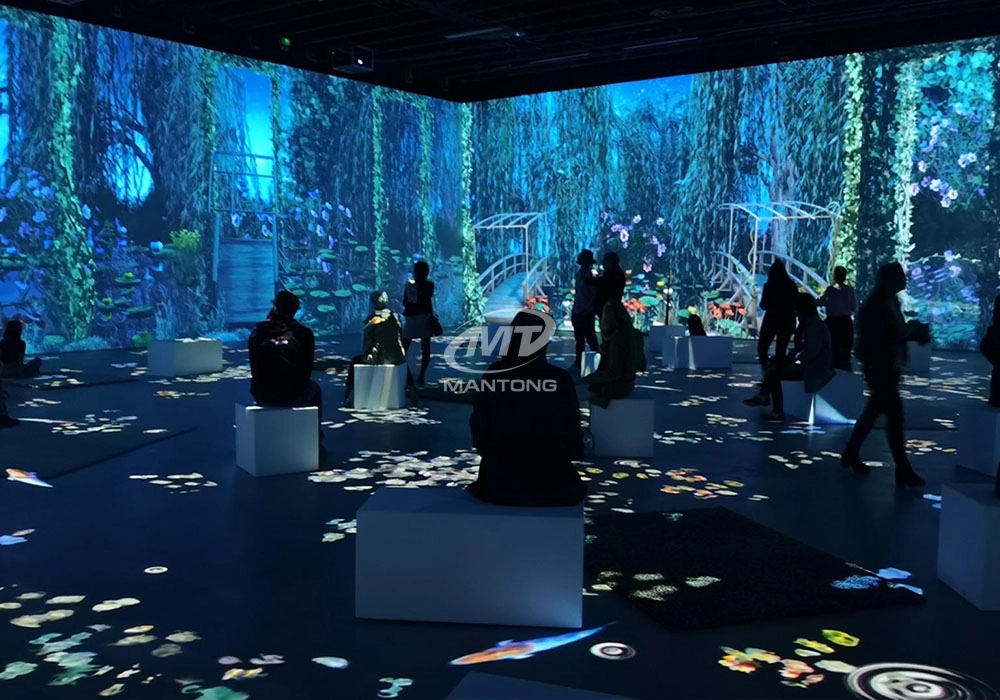
Mantong 6500LM High-Lumen Projector for Large-Scale Immersive Room Projection
Transform any space with Mantong's immersive projection mapping systems. Our high-lumen projectors (up to 6500 LM) and custom software create captivating interactive experiences for floors and walls. Ideal for museums, events, retail, and hospitality. Each kit includes professional ceiling mounting and 80+ pre-loaded video contents and is backed by a 12-month warranty and CE certification. We offer full customization and support to bring your vision to life.
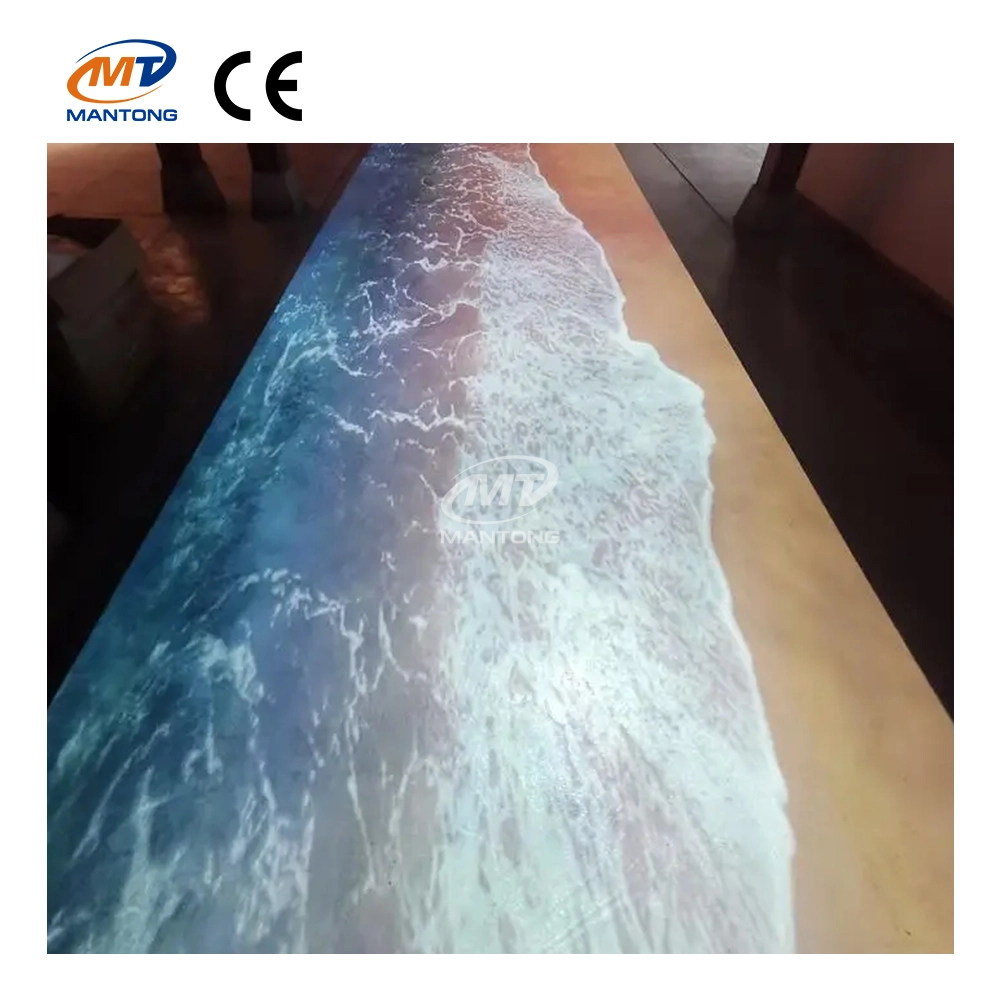
Indoor Interactive Floor Projector System - Customized Design & Installation Support
Indoor interactive floor projections display dynamic themed videos on the floor, commonly used in venues aiming to enhance brand influence or attract foot traffic, such as restaurants, hotel corridors, and brand car retail stores.
By using projectors and compatible software, the interactive content is projected onto the floor, encouraging engagement between people and the projected visuals. A single 5500-lumen indoor floor projector can cover an area of 5 m × 3 m. Typically, each project will use at least 3 units to ensure broad coverage and optimal visual effects.
We also offer customized design and installation support to enhance the interactive experience for your venue.
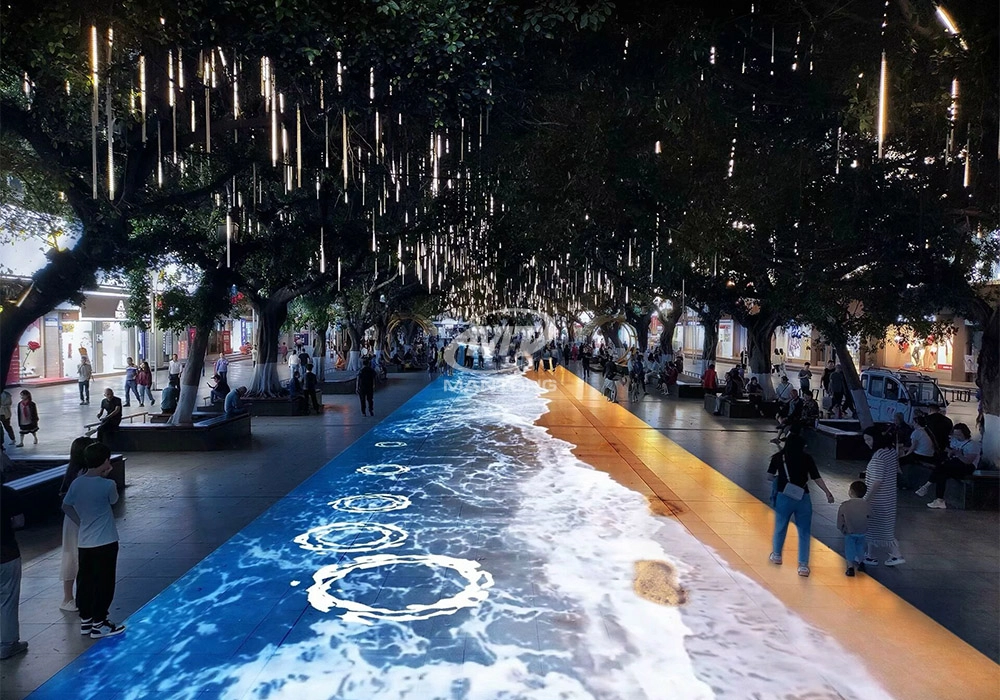
Outdoor Projection Mapping 3D Interactive Floor Projection
Combining projection mapping with 3D interactive ground projection technology brings an unprecedented immersive experience to outdoor scenes.
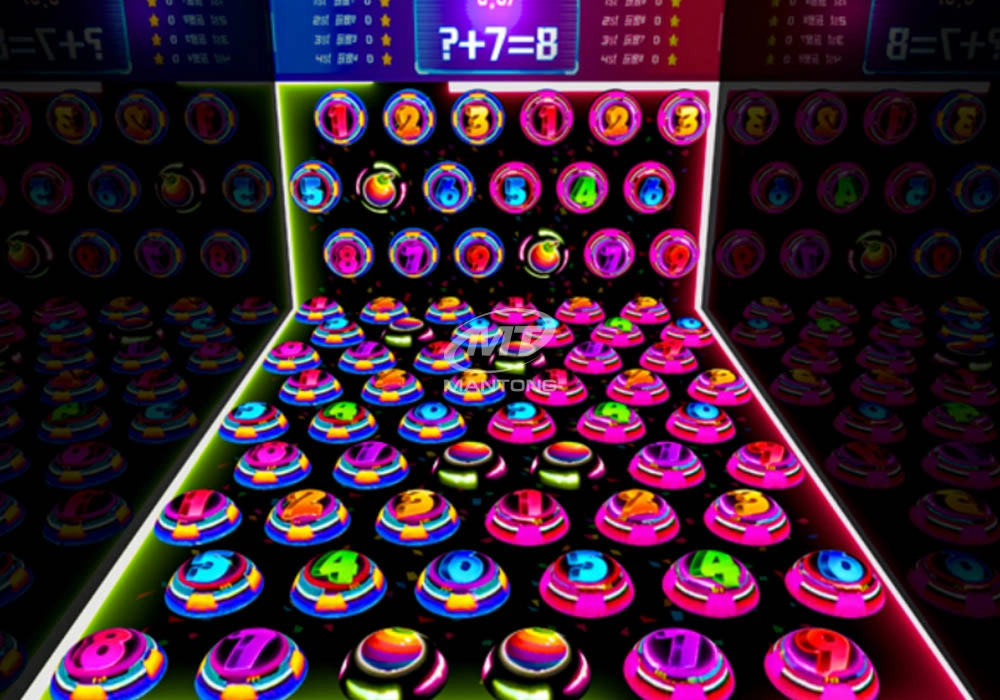
Amusement Rapidly Rotating Bouncing Sphere Interactive Wall Floor Projection Sports Games
Rapidly Rotating Bouncing Sphere is an interactive space where participants jump on rotating spheres. As they step on it, the spheres surface will show special interactivity
Jumping on spheres of the same color in succession causes them to pop, releasing light particles. The more consecutive jumps, the greater the reward—caterpillars appear, and eventually, all spheres of that color burst, filling the space with light and even more caterpillars.

Kaida Business Center, Shixin Road, Panyu District,Guangzhou City, Guangdong Province, China.
ManTong
ManTong
ManTong