
Interactive Floor Game Installation and Maintenance Checklist
- Why interactive floor games matter for venues and operators
- User engagement, analytics and business outcomes
- Common venues, regulations and accessibility considerations
- Pre-installation checklist
- Site survey and environmental assessment
- Hardware selection and compatibility
- Power, cooling and network requirements
- Installation best practices
- Mounting, alignment and physical installation
- Floor surface preparation and safety
- Calibration, software setup and verification
- Maintenance and troubleshooting checklist
- Daily and weekly operational checks
- Preventive maintenance schedule (recommended)
- Common issues and step-by-step troubleshooting
- Integration, measurement and continuous improvement
- Analytics, UX tuning and A/B testing
- Compliance, warranties and spare parts planning
- Scaling and lifecycle planning
- Mantong Digital — Manufacturer profile and how we support installations
- FAQs — Common questions about installation & maintenance
- 1. How bright should the projector be for a busy shopping mall?
- 2. How often should I recalibrate sensors and projectors?
- 3. What is acceptable latency for interactive floor games?
- 4. Can I run interactive floor games outdoors?
- 5. What spare parts should I keep on-site?
- 6. How do I verify projector lamp or laser health?
Interactive floor games combine projection, motion sensing and real-time software to create immersive, participatory experiences in museums, retail, education and entertainment. Proper installation and ongoing maintenance determine uptime, user satisfaction and ROI. This guide provides a practical, technically grounded checklist for installers, operators and facility managers responsible for interactive floor projection systems. It integrates environmental assessment, hardware and software requirements, calibration and alignment procedures, preventive maintenance schedules, safety, and common troubleshooting steps. References include industry guidance from AVIXA and projection mapping background from Wikipedia to support best practices.
Why interactive floor games matter for venues and operators
User engagement, analytics and business outcomes
Interactive floor games deliver measurable engagement: dwell time, repeat visits and social sharing. For retail and leisure venues, higher dwell times correlate with increased spend and loyalty. Designing for reliable uptime and predictable maintenance reduces downtime and ensures consistent audience experiences. Integrating analytics in the software stack (people-counting, session lengths) allows operators to quantify performance and justify investment.
Common venues, regulations and accessibility considerations
Typical deployments include museums, shopping malls, family entertainment centers, airports and educational settings. Each venue imposes unique constraints—ambient light, foot traffic, floor finish, power and network access, and ADA/accessibility requirements. Consider local electrical and building codes; for electrical safety and workplace guidelines, consult resources such as OSHA and national electrical codes. Additionally, design interaction zones with clear signage and consider non-visual feedback (audio/vibration) to support visually impaired users.
Pre-installation checklist
Site survey and environmental assessment
Before procurement, conduct a detailed site survey and document: floor dimensions, ceiling height, ambient light levels (lux), surface reflectance, power locations, network outlets, and pedestrian flow patterns. Use a lux meter to measure ambient light—projector selection depends on required lumen output vs. ambient lux. Note obstructions (pillars, HVAC ducts) that could block projector lines-of-sight or create shadows. This step limits scope creep and drives correct hardware selection.
Hardware selection and compatibility
Match projector brightness (ANSI lumens) and throw ratio to the floor area and mounting distance. For high ambient light areas choose high-lumen laser projectors; for dark galleries lower-lumen units may suffice. Select sensors—Kinect-like depth sensors, LiDAR, camera-based motion tracking or IR arrays—based on tracking accuracy needs and latency requirements. Ensure the projector, sensor and interactive software are compatible (frame rate sync, input/output latency under 50 ms for responsive interaction). When possible, choose industrial-grade mounts and cables rated for commercial installations (IP rating for outdoor / semi-outdoor installations).
Power, cooling and network requirements
Document power consumption for each device and design redundant circuits for mission-critical installations. Provide 20-30% headroom above peak draw for longevity. For networked systems, use wired Gigabit Ethernet for latency-sensitive control where possible; reserve isolated VLANs for interactive systems to avoid packet loss. Consider PoE options for peripheral devices if supported. For outdoor or temporary installs, verify IP ratings per IEC guidance and local codes.
Installation best practices
Mounting, alignment and physical installation
Securely mount projectors using rated mounts; ceiling or truss mounts are preferred for permanent installs. Ensure mount hardware supports fine pitch/yaw adjustments for keystone minimization. Use an inclinometer and laser sight to pre-align projector optical axis. For multi-projector systems, plan edge blending and geometric mapping (projection mapping techniques are discussed in projection mapping literature).
Floor surface preparation and safety
Surface texture and reflectivity directly affect image uniformity and tracking reliability. Matte, low-gloss finishes reduce hotspots and glare. For high-traffic areas choose durable anti-slip coatings with consistent spectral reflectance. Mark interaction zones subtly to guide user movement and reduce collisions. Ensure cable runs are protected with covers or floor raceways to prevent trip hazards and damage—adhesives and tapes should be rated for the floor type and cleaning regimes.
Calibration, software setup and verification
Calibration includes projector geometry correction, color calibration, sensor-to-projector registration and interaction mapping. Use software tools to perform geometric correction and edge blending for multi-projector arrays; verify registration accuracy with test patterns and user walkthroughs. Measure end-to-end latency (camera capture → processing → projection) and target <50 ms for natural interaction; if latency exceeds target, optimize camera exposure, reduce processing complexity or upgrade hardware. Log baseline measurements and store calibration files for future reference.
Maintenance and troubleshooting checklist
Daily and weekly operational checks
Establish a simple daily checklist for operators: verify projector fan noise and temperature, confirm images are aligned and bright, check sensors for obstructions, and review logs for software errors. Weekly checks should include cleaning air filters, inspecting mount hardware, and running automated calibration verification routines. Maintain a digital log with timestamps and actions to comply with warranty and service agreements.
Preventive maintenance schedule (recommended)
Adopt a preventive maintenance schedule tailored to device class and site conditions. The table below provides a common schedule for indoor interactive floor installations. Adjust frequency for dusty environments, high usage, or outdoor exposure.
| Task | Frequency | Responsible | Notes |
|---|---|---|---|
| Visual inspection (projector & mounts) | Weekly | Operator / Technician | Check for loose hardware, vibration |
| Dust filter cleaning / replacement | Monthly / As-needed | Technician | More frequent in dusty or high-traffic sites |
| Sensor recalibration & lens cleaning | Monthly | Technician | Verify registration accuracy |
| Software updates & backups | Quarterly | IT / Vendor | Test updates in staging before production |
| Full system audit & lamp/laser health check | 6–12 months | Authorized Service | Laser projectors: check power and drive temps |
Common issues and step-by-step troubleshooting
Below are frequent failure modes with diagnostic steps and corrective actions.
- Image misalignment: Check mount integrity, re-run geometric correction, verify sensor-to-projector registration. If multi-projector, re-perform edge blending.
- Intermittent tracking / false triggers: Inspect sensor field-of-view for occlusions, check ambient IR sources (sunlight, HVAC sensors), recalibrate tracking software, and ensure firmware is up-to-date.
- Reduced brightness or color shift: Clean optics and filters, verify projector lamp hours (or laser module health), perform color calibration, and measure lumen output if possible.
- Network latency / loss: Move interactive control to wired Gigabit Ethernet, check switch and VLAN configuration, and profile network traffic for congestion.
- System crashes: Review application logs, check GPU/CPU temps, ensure power supplies are stable, and roll back recent updates if crashes correlate with changes.
Integration, measurement and continuous improvement
Analytics, UX tuning and A/B testing
Collect anonymized interaction data—session length, engagement per content module, and heatmaps—to guide UX iterations. Use A/B testing for content changes and measure effect on dwell time and conversion metrics. Data-driven tuning improves content relevance and technical performance, reducing maintenance related to software misconfigurations.
Compliance, warranties and spare parts planning
Document warranty coverage, spare parts inventory and service SLAs. Keep critical spares on-site (projector lamps or laser modules, filters, mounts) to minimize Mean Time To Repair (MTTR). For safety and compliance reference national electrical codes and manufacturer safety bulletins; use trusted standards organizations such as AVIXA for AV industry guidance.
Scaling and lifecycle planning
Plan for software lifecycle (OS and middleware updates), projector end-of-life, and potential re-mapping for new floor layouts. Maintain versioned calibration files and a migration plan for hardware refresh cycles to reduce downtime during upgrades.
Mantong Digital — Manufacturer profile and how we support installations
Mantong Digital is a one-stop interactive projection solution provider and direct manufacturer based in Guangzhou, China, with over 10 years of industry experience. We are dedicated to providing innovative, flexible and cost-effective projection solutions, offering both hardware and software to meet various needs. At ManTong, we specialize in providing customized solutions for a wide range of application scenarios through innovative projection technology. Whether it's immersive experiences, interactive entertainment or outdoor lighting and projection shows, our solutions can transform your ideas into stunning visual effects. Our projection technology provides customized solutions for a variety of scenarios, delivering immersive and interactive visual experiences. We are now looking for business partnerships worldwide. Our vision is to become the world's leading interactive projection manufacturer. Our website is https://www.mtprojection.com/
Mantong’s core competencies and differentiators:
- Direct manufacturing: vertical control of optics, mounts and custom housings reduces lead time and cost compared with third-party integrators.
- End-to-end solutions: hardware (projectors, sensors, mounts), software (interactive platforms, content management), and on-site commissioning and training.
- Customization and R&D: over a decade of experience in immersive projection, interactive floor projection, interactive wall projection, immersive room installations, 3D projection and interactive projection games and mapping.
- Global service network: dedicated technical support and spare parts logistics for international projects.
Typical Mantong product offerings include:
- Immersive projection systems and turnkey content
- Interactive floor projection packages with sensor bundles and CMS
- Projection show controllers and mapping toolkits
- Outdoor-rated projection and lighting solutions for Projection Shows
For project inquiries, custom quotations, or to discuss partnership opportunities, visit Mantong Digital or contact their sales team through the site. Mantong’s combined hardware and software offering shortens deployment cycles and simplifies maintenance planning for enterprise customers.
FAQs — Common questions about installation & maintenance
1. How bright should the projector be for a busy shopping mall?
Brightness depends on ambient lux and area size. As a rule of thumb, for medium ambient light (200–500 lux) select projectors rated 6,000–10,000 ANSI lumens for floor projection over several meters. For very bright public spaces, consider higher-lumen laser projectors. Use a lux meter at the installation site to make a precise calculation.
2. How often should I recalibrate sensors and projectors?
Perform quick registration checks weekly and a full recalibration monthly. Recalibrate immediately after any hardware movement, floor resurfacing, or any event that changes the geometry (e.g., ceiling maintenance or structural vibrations).
3. What is acceptable latency for interactive floor games?
End-to-end latency under 50 ms is recommended for natural-feeling interactions. For fast-paced games lower latency (20–30 ms) is preferable. If latency is high, check camera frame rate, processing pipeline, network paths and projector response.
4. Can I run interactive floor games outdoors?
Yes, with appropriate hardware—outdoor-rated projectors, enclosures with the correct IP rating, and sensors protected against weather and ambient IR interference. Outdoor deployments require specialized mounts, cooling strategies and often higher brightness (laser projection) to overcome ambient light.
5. What spare parts should I keep on-site?
Keep spare filters, power supplies, critical cabling, at least one spare projector lamp or a monitored pathway for laser projector servicing, and a spare sensor unit if tracking is mission-critical. Maintain a copy of calibration files and software installers offline for recovery.
6. How do I verify projector lamp or laser health?
For lamp projectors, monitor lamp hours and lumen output; lamps dim over time and should be replaced per manufacturer schedules. Laser projectors require monitoring of drive current and module temperature; regular firmware checks and vendor maintenance are recommended. Consult the manufacturer’s technical documentation for precise thresholds.
Ready to design, install or maintain an interactive floor game? Contact Mantong Digital for tailored solutions, technical consultations, or a site survey: https://www.mtprojection.com/. Our team can provide hardware selection, custom content, commissioning and global support to ensure your interactive floor projection delivers reliable, measurable engagement.
How to Choose the 3d hologram projection manufacturer and supplier in China?
Reducing Meeting Time: Productivity Tips with Immersive Rooms
How to Choose the immersive conference room manufacturer and supplier in China?
Case Study: Immersive Projection Room for Museums and Exhibits
One-Stop Projection Solution Provider Since 2011
What's Immersive Projection ?
Immersive projection refers to a technology that creates a captivating and all-encompassing visual experience for viewers by projecting images or videos onto large surfaces, such as walls, floors, or even entire rooms. This technology aims to immerse the audience in a simulated environment, blurring the boundaries between the physical and virtual worlds.
How to Write an Interactive-Effect Video Customisation Script ?
① Project Background: Briefly introduce the context in which this interactive scene will be used (e.g., exhibition, museum,
event space, children's area). Example: This scene is part of the “Underwater World” zone in a children's science museum,
designed to be engaging and exploratory.
②Visual Style / Atmosphere: What kind of visual mood are you aiming for? Please describe the color scheme, style, and any
references. it should focus solely on describing the visual aspects of the scene, supported by relevant charts or reference
images.
③ Interaction Points Overview:List each interactive hotspot along with the effect you'd like to trigger when the user
touches or clicks the area. example: when player touch the clownfish, it will swims away with bubble trail (animation effect)
and produce the bubble sound ( sound effect requirement )
④ Static Visual Reference:including but not limited to background image/video, a list of major visual elements (e.g., coral,
rocks, seaweed, fish), which elements should be interactive?
What's the application of Immersive projection ?
It can be used in various venues, such as art exhibition, entertainment venues, educational institution, Wedding hall /Banquet/Bar,Yoga Studio and so on. It often involves advanced projection techniques, multimedia content, and interactive elements to engage and captivate the audience's senses.
Are you trader or manufacturer ?
We are direct manufacturer who specialize in providing one-stop solution for different outdoor & indoor projection project with our stable software and qualified projectors
What about the wall/floor material for the projection?
It’s recommended to choose a light-colored material with minimal reflectivity—pure white or light grey works best. the
common material is cement & plaster board
For optimal projection results, the surface should be free of any patterns or textures, as the projector will display content
directly onto it.
There are no specific material requirements; you may use any commonly available material in your local market, as long as it
meets the above conditions.
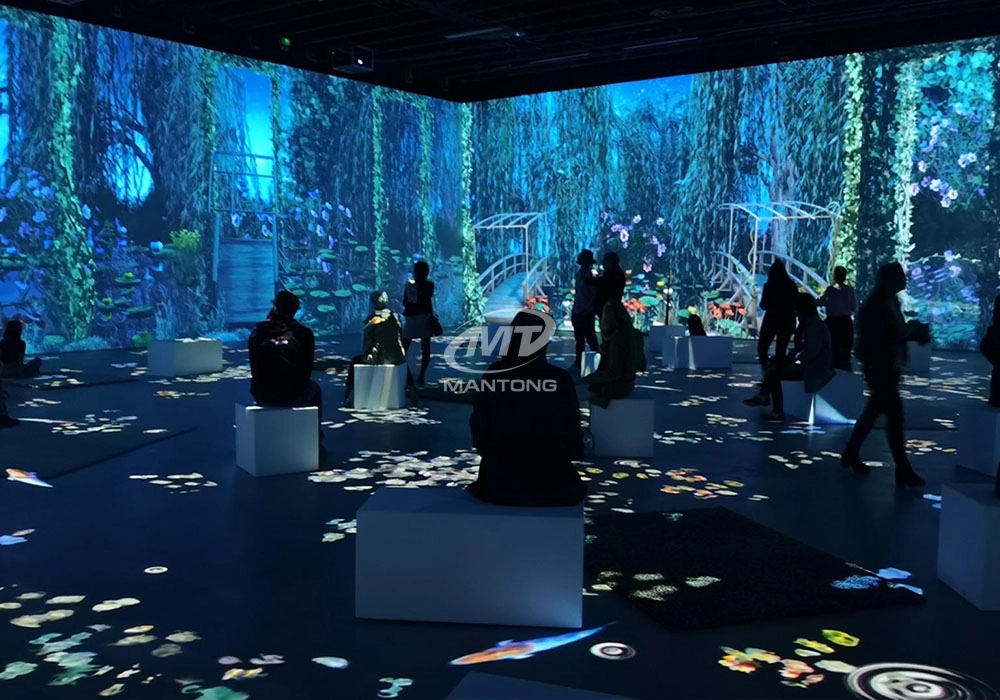
Mantong 6500LM High-Lumen Projector for Large-Scale Immersive Room Projection
Transform any space with Mantong's immersive projection mapping systems. Our high-lumen projectors (up to 6500 LM) and custom software create captivating interactive experiences for floors and walls. Ideal for museums, events, retail, and hospitality. Each kit includes professional ceiling mounting and 80+ pre-loaded video contents and is backed by a 12-month warranty and CE certification. We offer full customization and support to bring your vision to life.
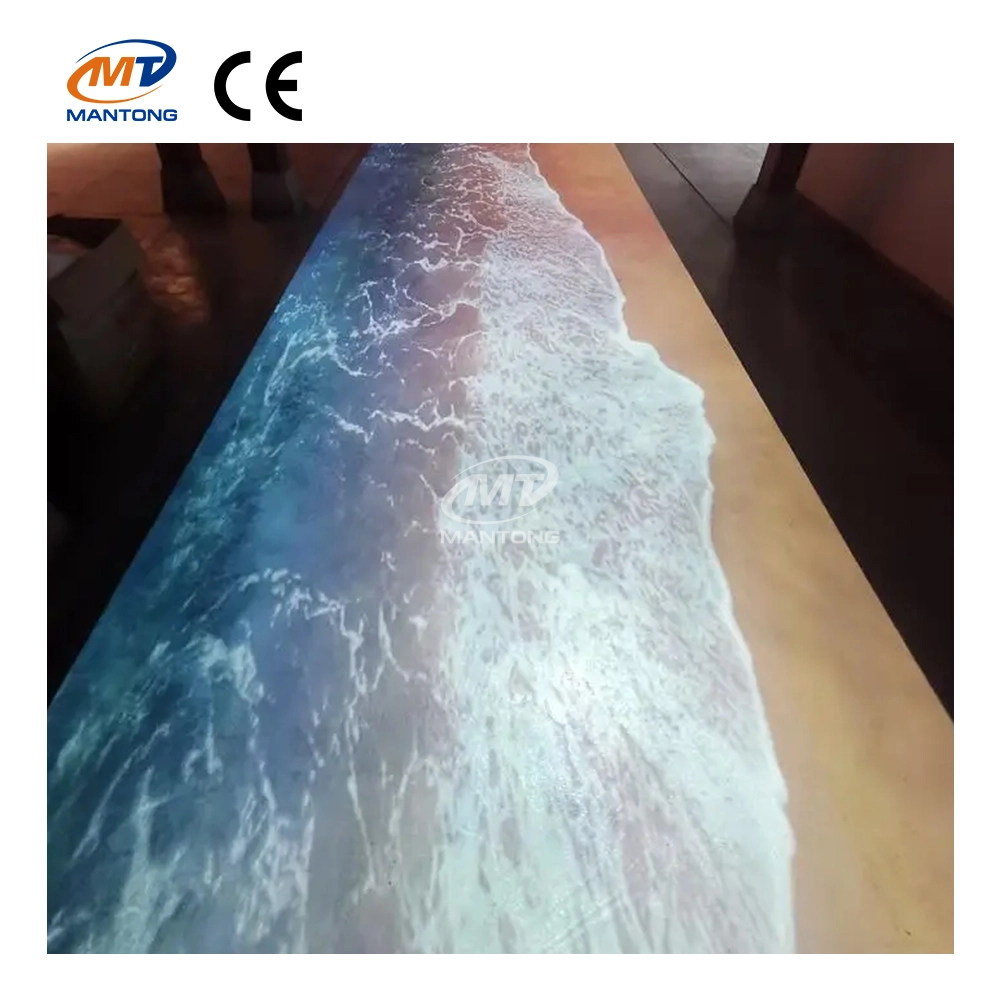
Indoor Interactive Floor Projector System - Customized Design & Installation Support
Indoor interactive floor projections display dynamic themed videos on the floor, commonly used in venues aiming to enhance brand influence or attract foot traffic, such as restaurants, hotel corridors, and brand car retail stores.
By using projectors and compatible software, the interactive content is projected onto the floor, encouraging engagement between people and the projected visuals. A single 5500-lumen indoor floor projector can cover an area of 5 m × 3 m. Typically, each project will use at least 3 units to ensure broad coverage and optimal visual effects.
We also offer customized design and installation support to enhance the interactive experience for your venue.
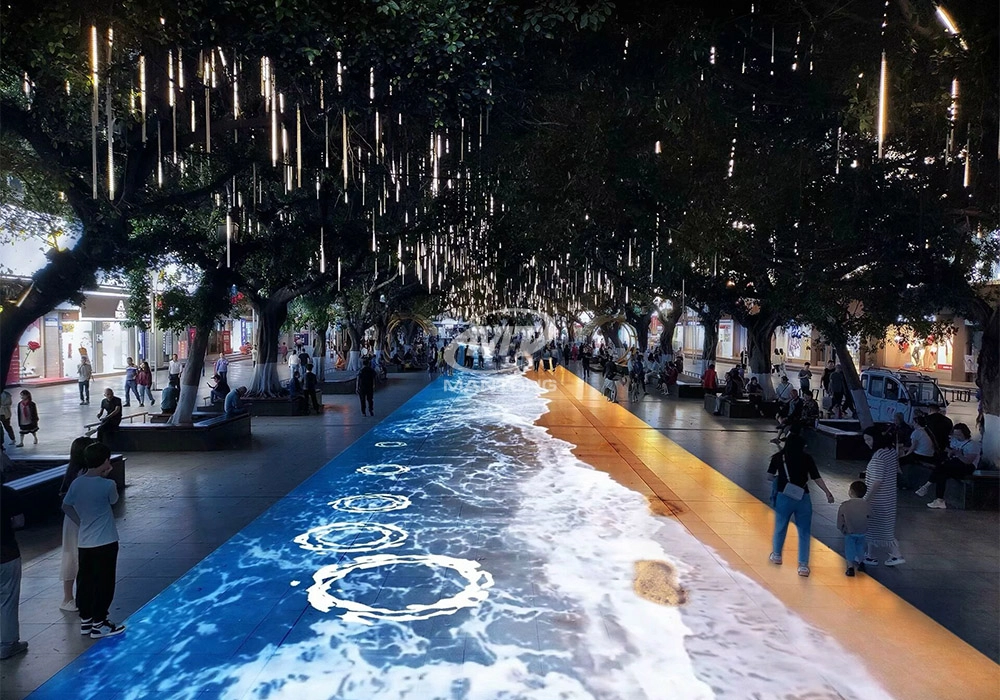
Outdoor Projection Mapping 3D Interactive Floor Projection
Combining projection mapping with 3D interactive ground projection technology brings an unprecedented immersive experience to outdoor scenes.
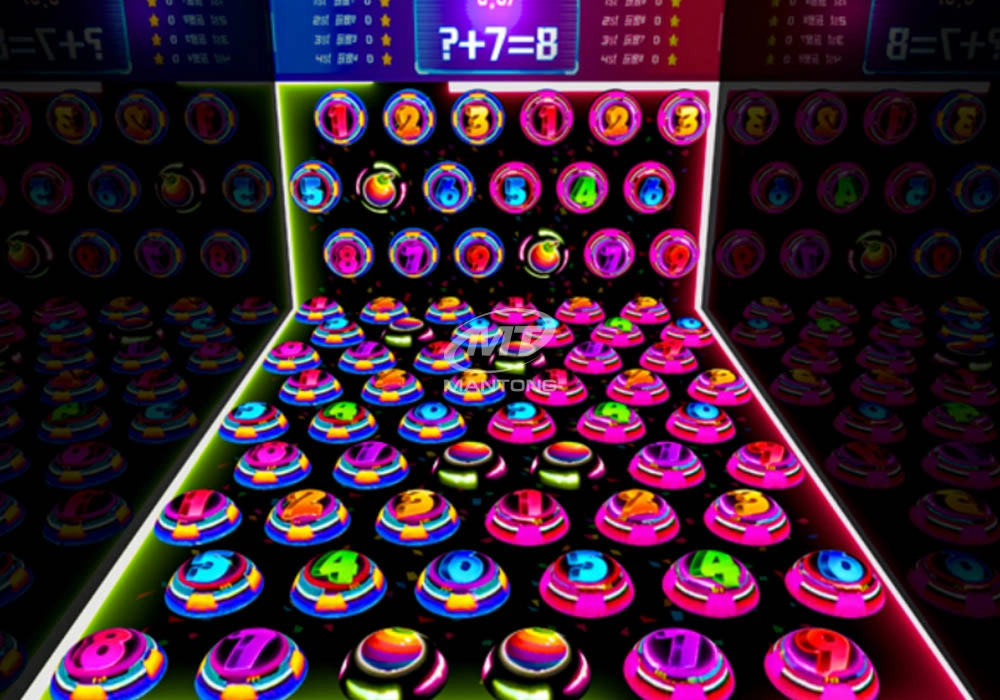
Amusement Rapidly Rotating Bouncing Sphere Interactive Wall Floor Projection Sports Games
Rapidly Rotating Bouncing Sphere is an interactive space where participants jump on rotating spheres. As they step on it, the spheres surface will show special interactivity
Jumping on spheres of the same color in succession causes them to pop, releasing light particles. The more consecutive jumps, the greater the reward—caterpillars appear, and eventually, all spheres of that color burst, filling the space with light and even more caterpillars.

Kaida Business Center, Shixin Road, Panyu District,Guangzhou City, Guangdong Province, China.
ManTong
ManTong
ManTong