
Compare Interactive Floor Games vs. Traditional Play Areas
- Why play design matters
- Developmental and health outcomes
- Accessibility and inclusivity
- Safety and regulatory context
- How interactive floor games work
- Core technical components
- Content, customization and updates
- Integration with analytics and behavior tracking
- Comparative analysis: interactive floor games vs. traditional play areas
- Design flexibility and user engagement
- Maintenance, lifecycle and total cost of ownership
- Measurable outcomes and evaluation
- Choosing the right solution for your venue
- Use cases and suitability
- ROI, procurement and lifecycle planning
- Implementation steps and partnership models
- Mantong Digital: a practical partner for interactive projection
- FAQs
- 1. Are interactive floor games safe for young children?
- 2. How much space do interactive floor games require?
- 3. What maintenance is needed for interactive projection systems?
- 4. Can interactive floor games support children with disabilities?
- 5. How do I measure success for an interactive floor installation?
- 6. Are interactive floor games worth the investment compared with expanding traditional play?
Interactive floor games are projection-based play systems that turn floors into dynamic, responsive surfaces. Compared with traditional play areas—fixed playground equipment, carpeted playrooms, or padded soft-play—interactive floor projection delivers adaptable content, measurable engagement and new accessibility possibilities. This article evaluates both approaches with evidence-based considerations for user development, safety and lifecycle costs, and provides practical guidance for venue selection and implementation.
Why play design matters
Developmental and health outcomes
Active play supports motor development, social skills and cognitive growth across childhood. The World Health Organization recommends regular physical activity for children to support healthy development and reduce risk of chronic disease. Both traditional play areas and interactive floor games can promote activity; the choice influences the type and quality of movement (gross motor vs. fine motor), social interaction patterns and opportunities for repeated practice.
Accessibility and inclusivity
Design choices determine who can participate. Traditional play areas often favor climbing and swinging activities that can exclude children with mobility limitations unless specifically adapted. Interactive floor games—when designed with clear visuals, adjustable sensitivity and alternative interaction modes (e.g., foot, hands, or gestures)—can provide inclusive experiences for a broader range of ages and abilities.
Safety and regulatory context
Safety expectations for play spaces are governed by standards and best practices. For general playground design and safety principles, reference material such as the Playground safety guidance and existing national standards should be consulted during planning. Any installation—interactive or traditional—should follow applicable local and international guidance to manage fall zones, surface materials and supervision requirements.
How interactive floor games work
Core technical components
Interactive floor games rely on three core components: projection hardware (projector(s)), sensing systems (depth cameras, infrared sensors, pressure mats), and software that maps input to visual and audio output. Technical approaches vary from simple motion-sensitive projections to full-body tracking using depth sensors. For an overview of projection-based techniques and mapping, see projection mapping.
Content, customization and updates
One of the main strengths of interactive floor projection is content flexibility. Operators can switch games, adjust difficulty, localize language, or load seasonal themes without structural changes. This flexibility supports long-term engagement and can align activities with educational curricula or therapy goals. Content management systems (CMS) for interactive floors allow scheduled content rotation and user analytics export for program evaluation.
Integration with analytics and behavior tracking
Unlike static play equipment, many interactive floor systems include built-in analytics: session counts, dwell time, heatmaps of activity areas, and interaction frequency per user. These metrics support evidence-based decisions about staffing, content effectiveness and ROI—important for schools, museums and commercial operators.
Comparative analysis: interactive floor games vs. traditional play areas
Design flexibility and user engagement
Interactive floor games excel at novelty and dynamic content, which can sustain repeated visits through new challenges and gamification mechanics. Traditional play areas rely on tactile, manipulative play and social negotiation over fixed structures—strengths for risk-taking, physical climbing and unstructured social play.
Maintenance, lifecycle and total cost of ownership
Maintenance profiles differ: traditional playgrounds require periodic inspection for structural wear, surface replacement (e.g., rubber surfacing) and vandalism repair. Interactive systems require periodic projector calibration, sensor cleaning, software updates and potential hardware replacement. While upfront costs for interactive projection systems can be higher for comparable footprint installs, modular projection solutions can reduce long-term renovation costs because visual content can be refreshed digitally rather than replacing physical infrastructure.
Measurable outcomes and evaluation
Interactive floor games offer direct measurement (e.g., session length, participant count), enabling program evaluation and grant reporting. Traditional play areas can be assessed via observational tools and standardized playground assessment instruments, but lack automated, granular data without additional sensorization.
| Dimension | Interactive floor games | Traditional play areas |
|---|---|---|
| Engagement | High initial engagement; sustained via content updates | High for physical/social play; engagement depends on equipment variety |
| Adaptability | Software-driven; easily reconfigured | Physical modifications required for major changes |
| Accessibility | High potential with inclusive content and sensor settings | Variable; often requires retrofitting for accessibility |
| Safety concerns | Trip hazards, electrical and mounting safety; lower fall risk | Fall and impact risks; requires compliant surfacing and design |
| Maintenance | Software updates, projector life-cycle, sensor maintenance | Structural inspection, surfacing, replacement of worn parts |
| Measurability | Rich analytics and usage data | Manual or observational assessment |
Notes on sources: safety and play guidance are summarized from general best-practice documents and safety overviews such as the Playground safety overview and international physical activity recommendations from the World Health Organization.
Choosing the right solution for your venue
Use cases and suitability
Match technology to program goals:
- Museums and science centers: interactive floor games drive short-form engagement and can be curated to demonstrate concepts (e.g., ecology, physics).
- Early childhood education centers: use simple motion or color-recognition games to promote motor skills and collaborative play.
- Healthcare and therapy settings: carefully designed games support rehabilitation goals and can be adjusted for ability levels.
- Shopping centers and hospitality: interactive projection creates experiential marketing and dwell-time improvements.
ROI, procurement and lifecycle planning
Calculate ROI by combining installation and operating costs with benefits such as increased visitation, extended dwell time, sponsorship revenue and reduced need for physical refurbishment. Interactive systems may enable monetization through branded content and event programming. When procuring, clarify warranty, software licensing terms, on-site support and upgrade pathways.
Implementation steps and partnership models
Recommended implementation steps:
- Define program objectives (education, therapy, entertainment)
- Assess space, lighting conditions and power/ceiling mounting feasibility
- Specify accessibility and safety requirements, consult local standards
- Request vendor demos and pilot installations
- Plan content rotation, analytics needs and maintenance schedule
Partnering with an experienced integrator or manufacturer simplifies system design, customization and support. For organizations seeking a full-solution partner, consider vendors with direct manufacturing capability and experience across applications.
Mantong Digital: a practical partner for interactive projection
Mantong Digital is a one-stop interactive projection solution provider and direct manufacturer based in Guangzhou, China, with over 10 years of industry experience. We are dedicated to providing innovative, flexible and cost-effective projection solutions, offering both hardware and software to meet various needs. Our website: https://www.mtprojection.com/.
At ManTong, we specialize in providing customized solutions for a wide range of application scenarios through innovative projection technology. Whether it's immersive experiences, interactive entertainment or outdoor lighting and projection shows, our solutions can transform your ideas into stunning visual effects. Our projection technology provides customized solutions for a variety of scenarios, delivering immersive and interactive visual experiences.
Key advantages of working with Mantong Digital:
- Direct manufacturer: simplified supply chain and customizable hardware options.
- End-to-end solutions: hardware, software, content creation and commissioning.
- Experience across sectors: immersive projection, interactive floor projection, interactive wall projection, immersive rooms and projection shows.
- Localization and customization: multilingual UI, localized content and adjustable interaction parameters to meet accessibility requirements.
- Analytic capabilities: built-in usage metrics to support program evaluation and reporting.
Core offerings relevant to the comparison in this immersive projection, interactive floor projection, interactive projection, interactive wall projection, immersive room, 3D projection, interactive projection games, Projection Show and interactive projection mapping. Mantong is seeking business partnerships worldwide and aims to be a leading interactive projection manufacturer.
If you are evaluating interactive floor games for a school, museum, healthcare center or commercial venue, Mantong Digital can provide demos, pilot installations and turnkey solutions tailored to your budget and program goals. Visit https://www.mtprojection.com/ to view case studies and contact sales.
FAQs
1. Are interactive floor games safe for young children?
Yes—when properly installed and supervised. Interactive floor systems typically have lower fall risks than elevated playground equipment, but they introduce trip and electrical-safety considerations. Follow manufacturer guidelines, maintain clear floor surfaces, route cables safely and comply with local safety standards. Consult general safety guidance such as the Playground safety overview when integrating mixed play zones.
2. How much space do interactive floor games require?
Space depends on the projector throw-distance and the desired interaction area. Small installations can start from 2–3m square for single-player experiences; multi-user interactive floors often require 4–10m in one dimension. A vendor site survey is essential to account for mounting points, ambient light and traffic flow.
3. What maintenance is needed for interactive projection systems?
Routine maintenance includes projector lamp/LED checks or replacements, sensor cleaning and calibration, software updates and content management. Plan for annual hardware checks and more frequent cleaning in public, high-traffic environments.
4. Can interactive floor games support children with disabilities?
Yes—if designed intentionally. Use high-contrast visuals, adjustable sensitivity, seated interaction modes and alternative input options (e.g., hand gestures vs. foot-only). Work with accessibility specialists when designing inclusive content.
5. How do I measure success for an interactive floor installation?
Combine quantitative analytics (session counts, average session length, repeat users) with qualitative feedback (observations, caregiver surveys). For health or educational goals, align metrics with objectives (e.g., minutes of moderate activity per session, targeted motor-skill repetitions).
6. Are interactive floor games worth the investment compared with expanding traditional play?
It depends on objectives. If you need adaptable content, analytics, seasonal programming and high reconfigurability, interactive floor systems offer unique value. For investment in physical risk-taking, climbing and tactile manipulative play, traditional equipment remains essential. Many venues adopt hybrid approaches to capture the strengths of both.
Contact & CTA: If you’d like a demonstration, pilot quote or to discuss a custom interactive floor projection solution, reach out to Mantong Digital. Visit https://www.mtprojection.com/ to view products and request partnership information. Our team can provide site assessments, content planning and financing options to help you evaluate total cost of ownership and expected outcomes.
References and further reading:
- Playground overview: https://en.wikipedia.org/wiki/Playground
- Projection mapping: https://en.wikipedia.org/wiki/Projection_mapping
- Interactive art concepts: https://en.wikipedia.org/wiki/Interactive_art
- WHO physical activity recommendations: https://www.who.int/news-room/fact-sheets/detail/physical-activity
- Playground safety guidance: https://en.wikipedia.org/wiki/Playground_safety
Best From Play to Profit: Making Money with Interactive Projector Games manufacturers and supplier brands
Best professional projection restaurant manufacturers and supplier brands in China
The latest trends for immersive led room
Top Features to Evaluate in Portable Interactive Projectors
One-Stop Projection Solution Provider Since 2011
What information do you need to know before making the proposal/solution?
We know that everyone wants to know the price, but the price of our products is determined by many factors since most of our products are custom, so no ready price list. In order to fast understand what you need, can you send us an inquiry like this?
For example: I am really interested in your immersive projection products, we are a company in the USA and want to install some in my restaurant. It is about 50 meters long, and 5m in width. Projection size you can decide but the length should be not less than 20 meters. We want some content about SeaWorld because our place is all about the sea. Thank you.
What's Immersive Projection ?
Immersive projection refers to a technology that creates a captivating and all-encompassing visual experience for viewers by projecting images or videos onto large surfaces, such as walls, floors, or even entire rooms. This technology aims to immerse the audience in a simulated environment, blurring the boundaries between the physical and virtual worlds.
How to Write an Interactive-Effect Video Customisation Script ?
① Project Background: Briefly introduce the context in which this interactive scene will be used (e.g., exhibition, museum,
event space, children's area). Example: This scene is part of the “Underwater World” zone in a children's science museum,
designed to be engaging and exploratory.
②Visual Style / Atmosphere: What kind of visual mood are you aiming for? Please describe the color scheme, style, and any
references. it should focus solely on describing the visual aspects of the scene, supported by relevant charts or reference
images.
③ Interaction Points Overview:List each interactive hotspot along with the effect you'd like to trigger when the user
touches or clicks the area. example: when player touch the clownfish, it will swims away with bubble trail (animation effect)
and produce the bubble sound ( sound effect requirement )
④ Static Visual Reference:including but not limited to background image/video, a list of major visual elements (e.g., coral,
rocks, seaweed, fish), which elements should be interactive?
Are you trader or manufacturer ?
We are direct manufacturer who specialize in providing one-stop solution for different outdoor & indoor projection project with our stable software and qualified projectors
What about the wall/floor material for the projection?
It’s recommended to choose a light-colored material with minimal reflectivity—pure white or light grey works best. the
common material is cement & plaster board
For optimal projection results, the surface should be free of any patterns or textures, as the projector will display content
directly onto it.
There are no specific material requirements; you may use any commonly available material in your local market, as long as it
meets the above conditions.
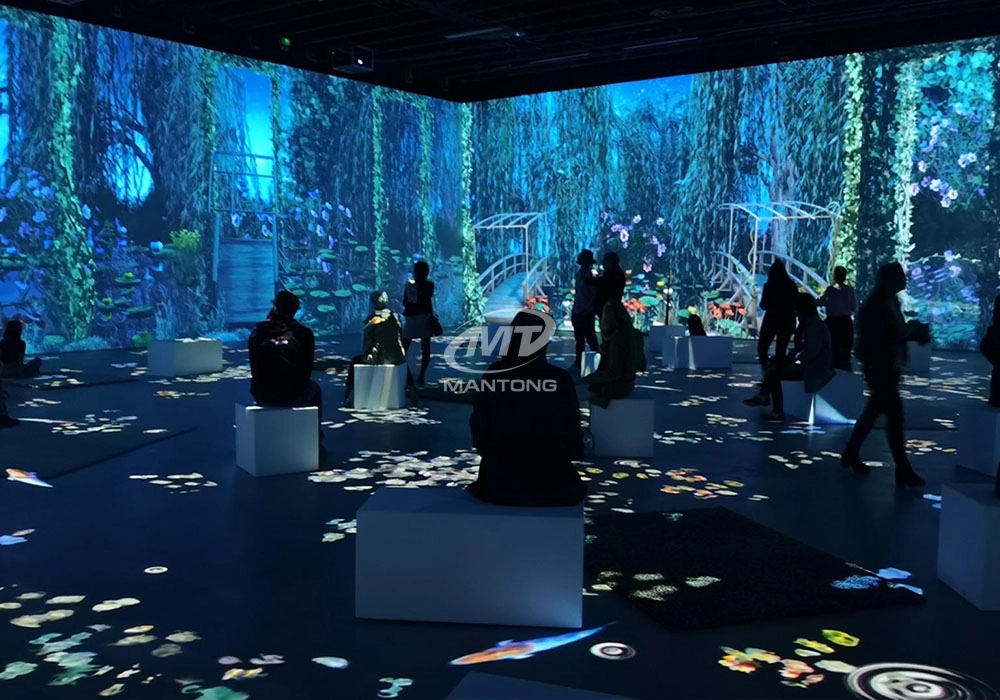
Mantong 6500LM High-Lumen Projector for Large-Scale Immersive Room Projection
Transform any space with Mantong's immersive projection mapping systems. Our high-lumen projectors (up to 6500 LM) and custom software create captivating interactive experiences for floors and walls. Ideal for museums, events, retail, and hospitality. Each kit includes professional ceiling mounting and 80+ pre-loaded video contents and is backed by a 12-month warranty and CE certification. We offer full customization and support to bring your vision to life.
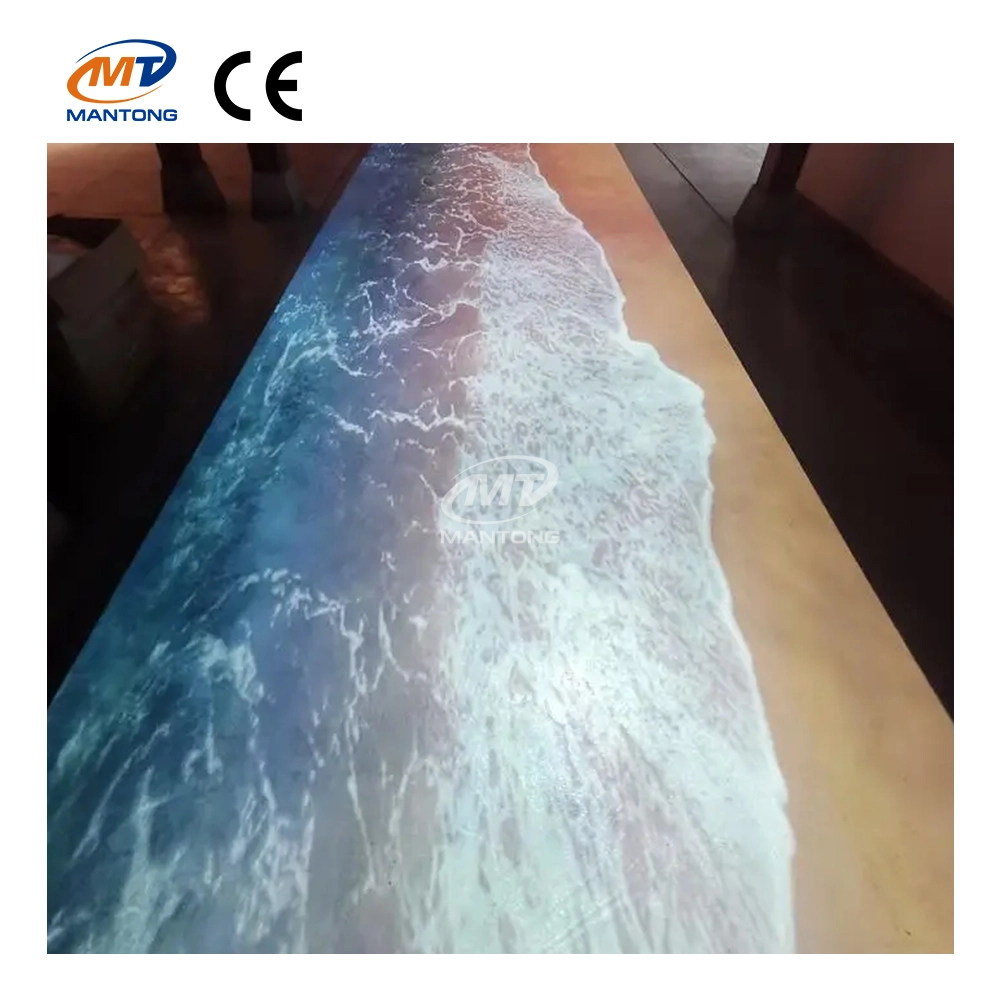
Indoor Interactive Floor Projector System - Customized Design & Installation Support
Indoor interactive floor projections display dynamic themed videos on the floor, commonly used in venues aiming to enhance brand influence or attract foot traffic, such as restaurants, hotel corridors, and brand car retail stores.
By using projectors and compatible software, the interactive content is projected onto the floor, encouraging engagement between people and the projected visuals. A single 5500-lumen indoor floor projector can cover an area of 5 m × 3 m. Typically, each project will use at least 3 units to ensure broad coverage and optimal visual effects.
We also offer customized design and installation support to enhance the interactive experience for your venue.
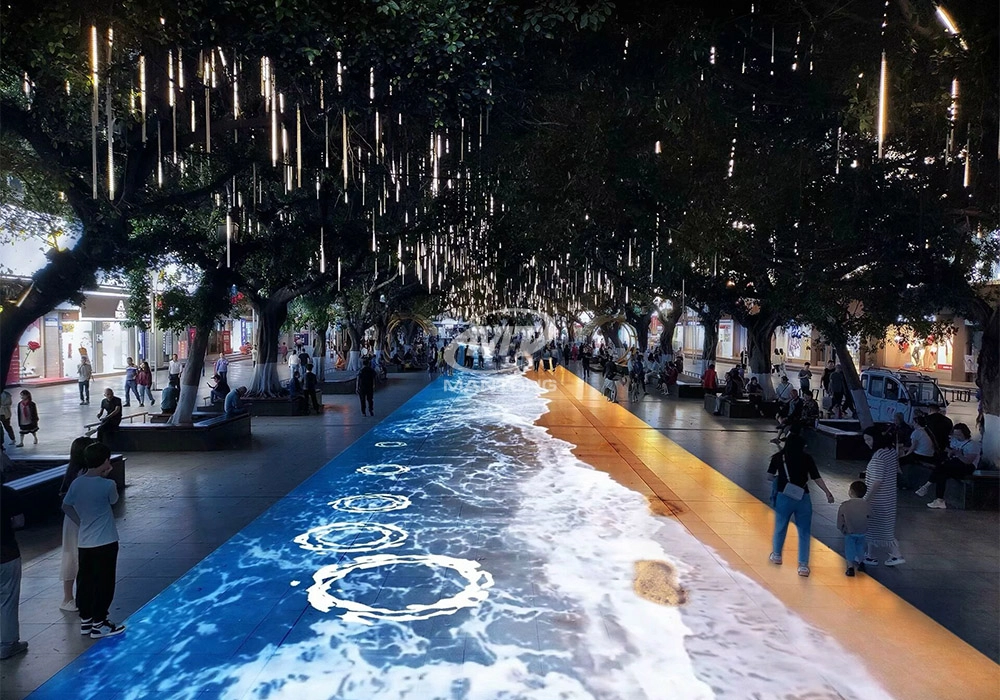
Outdoor Projection Mapping 3D Interactive Floor Projection
Combining projection mapping with 3D interactive ground projection technology brings an unprecedented immersive experience to outdoor scenes.
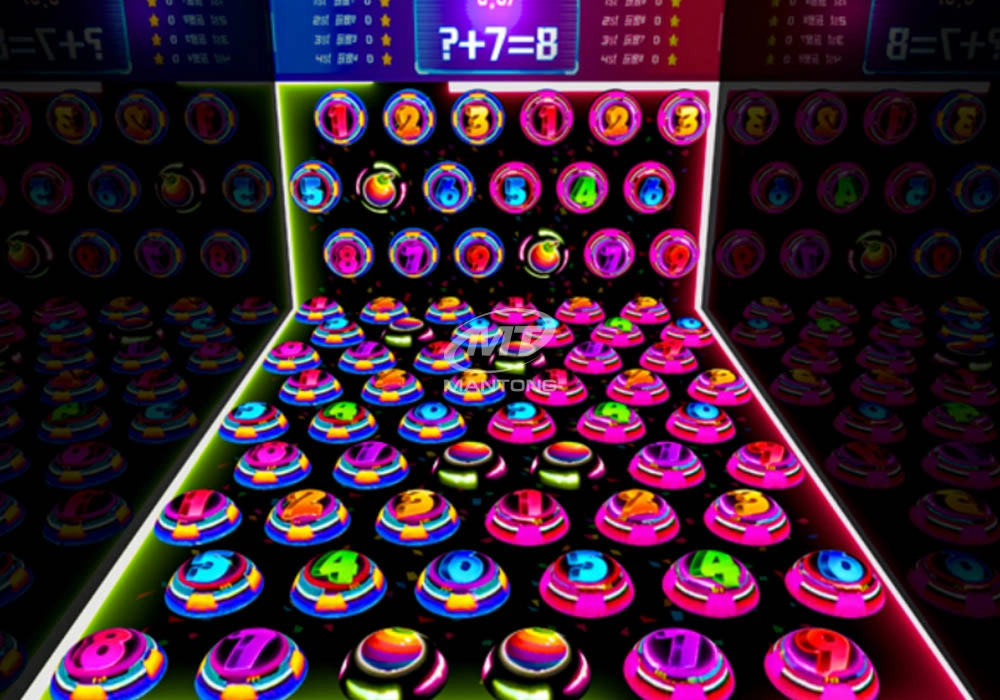
Amusement Rapidly Rotating Bouncing Sphere Interactive Wall Floor Projection Sports Games
Rapidly Rotating Bouncing Sphere is an interactive space where participants jump on rotating spheres. As they step on it, the spheres surface will show special interactivity
Jumping on spheres of the same color in succession causes them to pop, releasing light particles. The more consecutive jumps, the greater the reward—caterpillars appear, and eventually, all spheres of that color burst, filling the space with light and even more caterpillars.

Kaida Business Center, Shixin Road, Panyu District,Guangzhou City, Guangdong Province, China.
ManTong
ManTong
ManTong