
Upfront vs ongoing costs of interactive floor projectors
- How to plan a realistic budget for interactive floor projection projects
- Why estimating interactive floor projection system cost matters
- Quick summary of cost categories for interactive floor projection system cost
- Upfront hardware and installation: typical interactive floor projection system cost breakdown
- Comparing upfront vs ongoing costs for interactive floor projection system cost
- Example 5-year TCO scenarios for interactive floor projection system cost
- Decision levers: how to reduce interactive floor projection system cost without harming experience
- Quick ROI checklist for interactive floor projection system cost
- Choosing maintenance, warranty and licensing to control long-term interactive floor projection system cost
- Vendor and supplier considerations: choosing a partner to optimize interactive floor projection system cost
- Mantong Digital: one-stop interactive projection solutions to control cost and complexity
- Cost model examples and supplier comparison for interactive floor projection system cost
- Measuring success: KPIs to justify interactive floor projection system cost
- Frequently Asked Questions (FAQ) about interactive floor projection system cost
- 1. How much does an interactive floor projection system cost to install?
- 2. Are ongoing costs for interactive floor projection systems significant?
- 3. Does laser technology reduce total interactive floor projection system cost?
- 4. Can I lease or rent interactive floor projection systems to avoid high upfront cost?
- 5. How much should I budget for content?
- 6. How to choose between a turnkey vendor and building in-house?
- Contact and next steps
- References
How to plan a realistic budget for interactive floor projection projects
Why estimating interactive floor projection system cost matters
Organizations considering interactive floor projection — museums, retail, education, events and corporate spaces — frequently underestimate total expenses. The term interactive floor projection system cost is not limited to the projector price: it encompasses hardware, sensors, mounting, content, installation labor, ongoing maintenance, software licensing, and operating overheads. Accurate budgeting prevents scope creep, supports procurement decisions, and improves ROI forecasting.
Quick summary of cost categories for interactive floor projection system cost
Below is a compact list to align expectations before we dive deeper:
- Upfront (capital) costs: projectors, mounts, sensors/cameras, media servers, computing hardware, enclosures, and installation labor.
- One-time setup costs: custom content creation, calibration, and initial commissioning.
- Ongoing (operational) costs: software licenses, content updates, lamp or light-source replacement, cleaning, labor for support, electricity, and insurance.
- Indirect costs: downtime risk, site modifications, and training.
Upfront hardware and installation: typical interactive floor projection system cost breakdown
The largest single upfront line item is usually the projector (or LED projection engine). Prices vary widely depending on brightness, resolution, and reliability (lampless laser engines cost more initially but reduce lamp replacement costs). Below is a realistic breakdown and price ranges for common components as of late 2025.
| Component | Typical range (USD) | Notes |
|---|---|---|
| Projector (entry to high-end) | $800 – $20,000+ | Short-throw + laser projectors are common for floors; high-brightness units needed for ambient light environments. |
| Mounts, enclosures, housings | $300 – $4,000 | Weatherproofing or vandal-proof housings increase cost. |
| Sensors / tracking (camera, IR, pressure) | $200 – $5,000 | Simple infra-red sensors vs. multi-camera depth systems. |
| Media server / PC | $1,000 – $8,000 | Depends on resolution, number of outputs, GPU requirements. |
| Custom content & software (one-time) | $1,000 – $50,000+ | Template-based interactive games are cheaper; fully bespoke experiences cost more. |
| Installation & commissioning | $500 – $10,000 | Site complexity and travel increase costs. |
Source references for price ranges: B&H product listings and manufacturer catalogs give a broad projector price range; custom content prices reflect industry practice (see References).
Comparing upfront vs ongoing costs for interactive floor projection system cost
It is helpful to compare upfront capital expenditure (CapEx) with ongoing operational expenditure (OpEx) to see total cost of ownership (TCO) over typical lifecycles (3–7 years for projector technology, longer for laser engines).
| Cost category | Upfront (Year 0) | Annual ongoing (per year) | Notes/Cost drivers |
|---|---|---|---|
| Hardware purchase | High | Depreciation, occasional parts | Main CapEx: projector, PC, sensors |
| Installation & commissioning | One-time moderate | Support visits if needed | Site prep, mounts, calibration |
| Content development | One-time or phased | Content updates/refreshes | Critical for engagement; refresh schedule affects repeat visitation |
| Light source maintenance | Low (laser) to moderate (lamp) | $100–$1,500 | Lamp replacement frequency and cost vary by model |
| Software license / support | Often annual or perpetual | $200 – $10,000+ | Depends on vendor licensing model |
| Electricity | Ongoing | $100 – $1,200 | Power draw and usage hours drive this cost |
| Labor & cleaning | Training/upfront | $500 – $5,000 | Cleaning projection surfaces and troubleshooting |
Example 5-year TCO scenarios for interactive floor projection system cost
Two realistic example scenarios (estimates):
- Basic museum educational installation: upfront $8,000 (single short-throw projector, sensors, basic content), annual $1,200 (maintenance, electricity, minor content refresh) → 5-year TCO ≈ $14,000.
- High-end retail/entertainment installation: upfront $60,000 (multi-projector/blended system, high-end media server, bespoke content), annual $10,000 (support contract, content updates, cleaning, power) → 5-year TCO ≈ $110,000.
These examples show why it's essential to scope requirements: audience throughput, ambient light, expected lifetime, and content strategy all shift the balance between upfront and ongoing costs.
Decision levers: how to reduce interactive floor projection system cost without harming experience
There are practical levers to optimize both CapEx and OpEx:
- Choose laser projectors for high-utilization sites to reduce lamp replacement OpEx (higher CapEx, lower OpEx).
- Use short-throw or ultra-short-throw optics to minimize footprint and simplify mounts.
- Adopt modular content templates to lower one-time content creation costs and enable in-house refreshes.
- Consider rental or staged rollout for temporary events to avoid CapEx.
- Negotiate support and spare-part bundles with manufacturers to cap annual maintenance expenses.
Quick ROI checklist for interactive floor projection system cost
Before purchase, calculate expected benefits (e.g., increased footfall, dwell time, revenue uplift, sponsorship) and compare against TCO. Include soft metrics like brand experience and measurable KPIs such as dwell time or game completions. For many retail and exhibition projects, a 12–36 month payback is achievable when content is designed to drive revenue or repeat visits.
Choosing maintenance, warranty and licensing to control long-term interactive floor projection system cost
Negotiating the right warranty, service-level agreement (SLA), and license model is as important as hardware selection. Typical choices include:
- Manufacturer warranty (1–3 years) vs extended warranty/support contracts.
- Perpetual software license vs annual subscription — subscriptions smooth OpEx but increase multi-year cost.
- Onsite service response times that match business needs — museums might accept 48–72 hours; retail or high-traffic sites often need 24-hour SLA or spare units on-site.
Tip: calculate the break-even point for buying spare projectors or components vs paying for expedited service. For high-traffic sites, the cost of downtime (lost revenue, bad guest experience) often justifies spare hardware.
Vendor and supplier considerations: choosing a partner to optimize interactive floor projection system cost
Procurement should evaluate total value, not just sticker price. Consider:
- Supplier’s track record with similar installations and references.
- Availability of local support or global network to minimize travel costs for service.
- Willingness to provide turnkey solutions including hardware, software, custom content, and integration (reduces subcontracting overhead).
- Ability to provide realistic benchmarks (uptime, expected lamp lifetime, energy consumption) for TCO modeling.
Mantong Digital: one-stop interactive projection solutions to control cost and complexity
Mantong Digital is a one-stop interactive projection solution provider and direct manufacturer based in Guangzhou, China, with over 10 years of industry experience. We are dedicated to providing innovative, flexible and cost-effective projection solutions, offering both hardware and software to meet various needs.
At ManTong, we specialize in providing customized solutions for a wide range of application scenarios through innovative projection technology. Whether it's immersive experiences, interactive entertainment or outdoor lighting and projection shows, our solutions can transform your ideas into stunning visual effects. Our projection technology provides customized solutions for a variety of scenarios, delivering immersive and interactive visual experiences.
Mantong’s competitive advantages:
- Direct manufacturer pricing — reduces markup and shortens lead times compared with reseller models.
- End-to-end offering — hardware (projectors, mounts, media servers), proprietary and third-party software, and content production services reduce project management overhead.
- Customization and integration expertise — experience across immersive projection, interactive floor projection, interactive wall projection, immersive rooms, 3D projection, projection shows, and interactive projection games.
- Global partnerships — looking for business partners worldwide to provide local delivery and support.
- Proven track record — over a decade of installations in museums, retail, entertainment and events.
Explore Mantong Digital solutions and product categories: immersive projection, interactive floor projection, interactive projection, interactive wall projection, immersive room, 3D projection, interactive projection games, projection show, and interactive projection mapping. Visit https://www.mtprojection.com/ for product details and to request a quote. Our vision is to become the world's leading interactive projection manufacturer.
Cost model examples and supplier comparison for interactive floor projection system cost
The table below summarizes three common procurement models and their typical cost implications over 3 years.
| Procurement model | Typical CapEx | Typical annual OpEx | Best for |
|---|---|---|---|
| Buy turnkey from manufacturer (e.g., Mantong) | Moderate to high | Low to moderate with bundled support | Permanent installations needing integration and long-term support |
| Rent / event rental | Low (rental fee) | Included in rental or daily fees | Short-term events or proofs-of-concept |
| Buy components and self-integrate | Variable | Depends on in-house capabilities | Organizations with AV teams wanting control and lower immediate spend |
Measuring success: KPIs to justify interactive floor projection system cost
Define measurable KPIs up-front to track payback and justify ongoing spend:
- Footfall change and conversion lift (retail)
- Dwell time and repeat visitation (museums/exhibitions)
- Event ticket sales uplift and sponsorship revenue (entertainment)
- Visitor satisfaction scores and social sharing metrics
- System uptime and maintenance incidents
Collect baseline data before installation so you can measure impact and adjust content or support levels to optimize cost-effectiveness.
Frequently Asked Questions (FAQ) about interactive floor projection system cost
1. How much does an interactive floor projection system cost to install?
Installation cost depends on scope. Small installations can start around $5,000–$15,000; mid-range museum or retail solutions typically range $15,000–$60,000; large blended multi-projector systems with bespoke content often exceed $60,000. These figures include hardware, basic content, and installation but vary by region and requirements.
2. Are ongoing costs for interactive floor projection systems significant?
Ongoing costs include software licenses, content updates, lamp replacement (if not laser), electricity, and cleaning/support labor. Annual OpEx can range from a few hundred dollars for low-use demo setups up to $10,000+ for high-traffic, multi-component systems. Choosing laser projectors reduces lamp-related OpEx.
3. Does laser technology reduce total interactive floor projection system cost?
Laser projectors have higher upfront cost but longer lifetimes and lower maintenance (no frequent lamp replacements). For installations operating many hours daily, laser engines typically lower TCO over 3–7 years despite higher CapEx.
4. Can I lease or rent interactive floor projection systems to avoid high upfront cost?
Yes. Rental is a practical option for temporary events or trial periods. Leasing can spread CapEx over time and may include maintenance in monthly fees. Evaluate total lease costs vs purchasing if the system will be used long-term.
5. How much should I budget for content?
Content budgets depend on complexity. Template-based interactive games can be $1,000–$5,000. Bespoke, multi-scene interactive experiences with motion tracking and rich graphics often start at $10,000 and can exceed $50,000. Consider phased content development to spread cost.
6. How to choose between a turnkey vendor and building in-house?
Turnkey vendors reduce management overhead and risk, provide integrated testing, and usually offer warranty/support. Building in-house may save money for organizations with AV expertise and ongoing maintenance teams but increases integration risk and hidden costs. For first-time projects, turnkey from an experienced manufacturer like Mantong can accelerate delivery and reduce surprises.
Contact and next steps
If you are planning an installation and need a detailed cost estimate or scenario-based TCO model, Mantong Digital can provide a free consultation and project quote. Visit our website at https://www.mtprojection.com/ to view product lines — immersive projection, interactive floor projection, interactive wall projection, immersive rooms, 3D projection, interactive projection games, projection shows, and interactive projection mapping — or request a customized proposal. We are actively seeking global business partnerships and can support design, manufacture, integration, and ongoing support.
References
- Projection mapping — Wikipedia. https://en.wikipedia.org/wiki/Projection_mapping (accessed 2025-12-28).
- Grand View Research, Projection Mapping Market Size Report — market analysis and growth drivers. https://www.grandviewresearch.com/industry-analysis/projection-mapping-market (accessed 2025-12-28).
- B&H Photo Video — Projectors category (pricing ranges for projectors across consumer and professional tiers). https://www.bhphotovideo.com/c/browse/Projectors/ci/1061/N/4294548093 (accessed 2025-12-28).
- BenQ support — projector lamp replacement and lifecycle notes (example of lamp cost and lifetime variability). https://www.benq.com/en-us/support/faq/projector/projector-lamp. (accessed 2025-12-28).
- U.S. Bureau of Labor Statistics — Audio and Video Technicians and Producers (wage data for operational labor planning). https://www.bls.gov/ooh/media-and-communication/audio-and-video-technicians-and-producers.htm (accessed 2025-12-28).
- Industry integrator blogs and AV procurement guides (general cost and procurement practices) — representative reading: Projection-Mapping.org overview and community resources. https://projection-mapping.org/ (accessed 2025-12-28).
For a tailored interactive floor projection system cost estimate and technical consultation, contact Mantong Digital at https://www.mtprojection.com/ or request a quote via the website.
Projection mapping vs interactive projection: differences
What Is an Interactive Projection Solution? A Beginner's Guide
Interactive projector market size and forecast 2026-2030
Interactive Floor Projection for Museums and Exhibits
One-Stop Projection Solution Provider Since 2011
How to Write an Interactive-Effect Video Customisation Script ?
① Project Background: Briefly introduce the context in which this interactive scene will be used (e.g., exhibition, museum,
event space, children's area). Example: This scene is part of the “Underwater World” zone in a children's science museum,
designed to be engaging and exploratory.
②Visual Style / Atmosphere: What kind of visual mood are you aiming for? Please describe the color scheme, style, and any
references. it should focus solely on describing the visual aspects of the scene, supported by relevant charts or reference
images.
③ Interaction Points Overview:List each interactive hotspot along with the effect you'd like to trigger when the user
touches or clicks the area. example: when player touch the clownfish, it will swims away with bubble trail (animation effect)
and produce the bubble sound ( sound effect requirement )
④ Static Visual Reference:including but not limited to background image/video, a list of major visual elements (e.g., coral,
rocks, seaweed, fish), which elements should be interactive?
What information do you need to know before making the proposal/solution?
We know that everyone wants to know the price, but the price of our products is determined by many factors since most of our products are custom, so no ready price list. In order to fast understand what you need, can you send us an inquiry like this?
For example: I am really interested in your immersive projection products, we are a company in the USA and want to install some in my restaurant. It is about 50 meters long, and 5m in width. Projection size you can decide but the length should be not less than 20 meters. We want some content about SeaWorld because our place is all about the sea. Thank you.
How to install the projection equipment ?
1) Install the projector in a suitable position. We will provide you with a hanger, which you need to fix on the ceiling with
screws.
2) Connect projectors, computers and other accessories through wires.
3) After completing the above 2 steps, we will carry out the edge blending steps. Our team can complete it through remote
control.
In general, installation instructions for each project need to be specified on a project-by-project basis. The above is for
reference only.
Are you trader or manufacturer ?
We are direct manufacturer who specialize in providing one-stop solution for different outdoor & indoor projection project with our stable software and qualified projectors
What's the application of Immersive projection ?
It can be used in various venues, such as art exhibition, entertainment venues, educational institution, Wedding hall /Banquet/Bar,Yoga Studio and so on. It often involves advanced projection techniques, multimedia content, and interactive elements to engage and captivate the audience's senses.
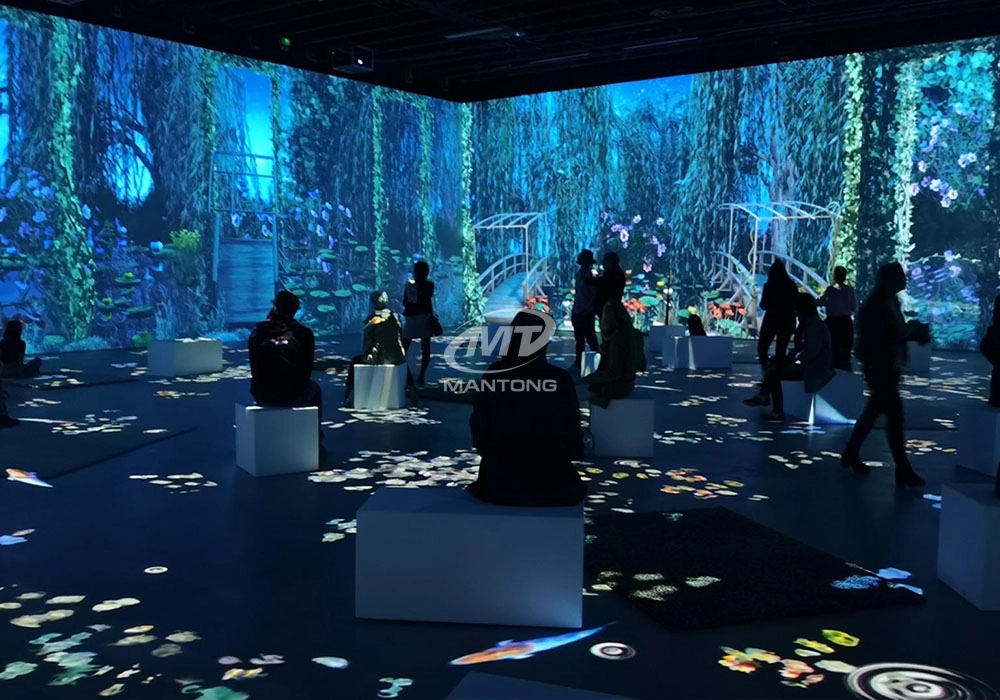
Mantong 6500LM High-Lumen Projector for Large-Scale Immersive Room Projection
Transform any space with Mantong's immersive projection mapping systems. Our high-lumen projectors (up to 6500 LM) and custom software create captivating interactive experiences for floors and walls. Ideal for museums, events, retail, and hospitality. Each kit includes professional ceiling mounting and 80+ pre-loaded video contents and is backed by a 12-month warranty and CE certification. We offer full customization and support to bring your vision to life.
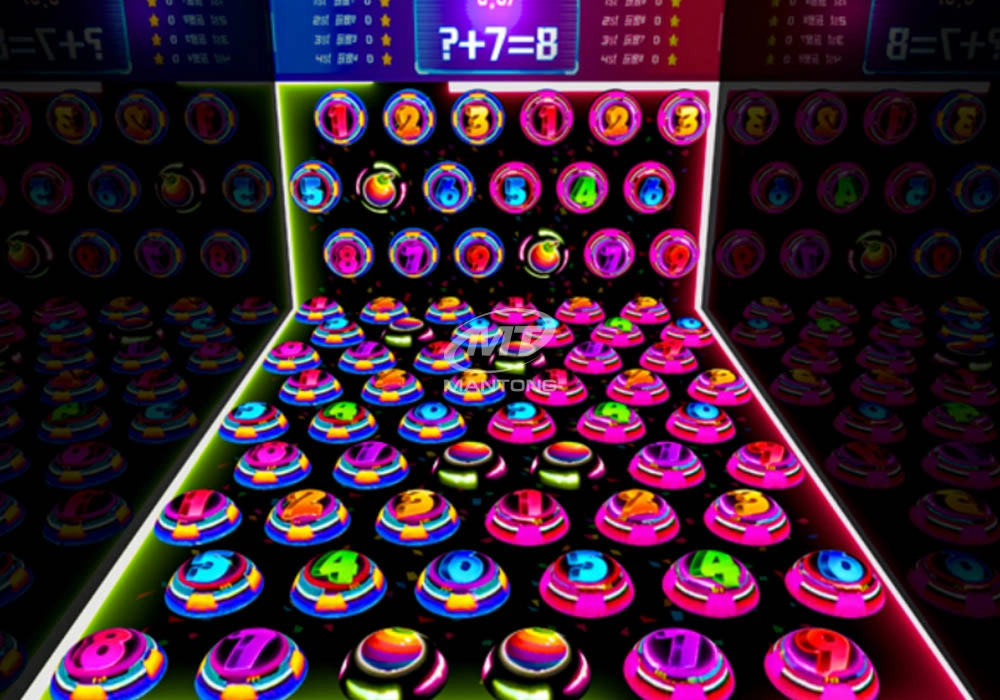
Amusement Rapidly Rotating Bouncing Sphere Interactive Wall Floor Projection Sports Games
Rapidly Rotating Bouncing Sphere is an interactive space where participants jump on rotating spheres. As they step on it, the spheres surface will show special interactivity
Jumping on spheres of the same color in succession causes them to pop, releasing light particles. The more consecutive jumps, the greater the reward—caterpillars appear, and eventually, all spheres of that color burst, filling the space with light and even more caterpillars.
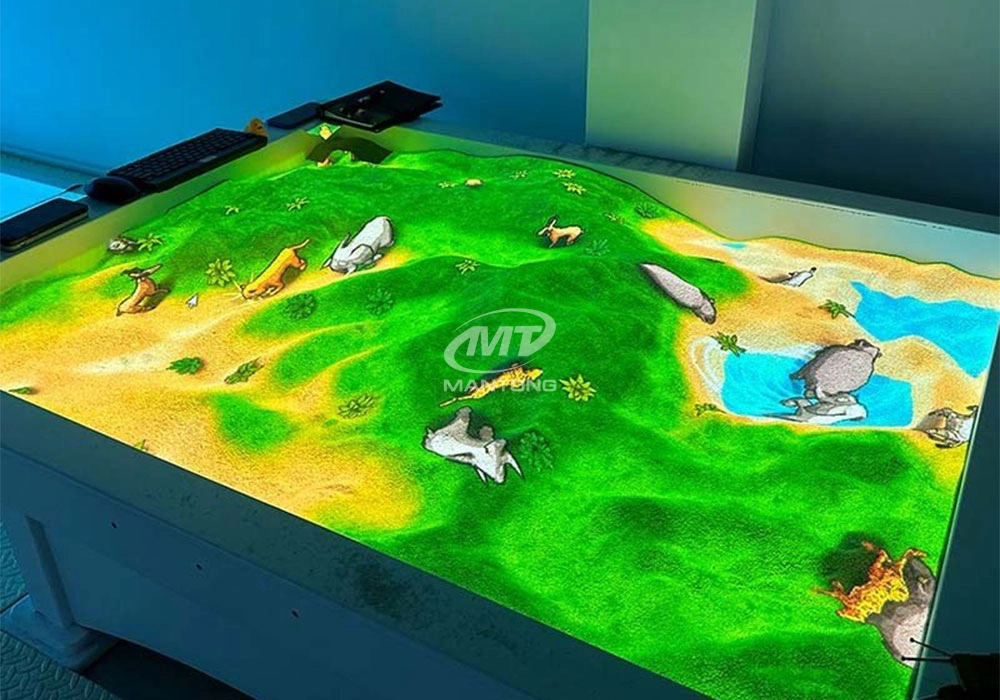
Interactive Sandbox Projection Mapping Games For Kids Play Park
Bring imagination to life with interactive sandbox projection mapping games designed for kids’ play parks. Using cutting-edge projection technology and real-time motion sensing, children can dig, build, and explore virtual worlds directly in the sand. Educational, engaging, and endlessly fun — it’s the perfect blend of play and learning.
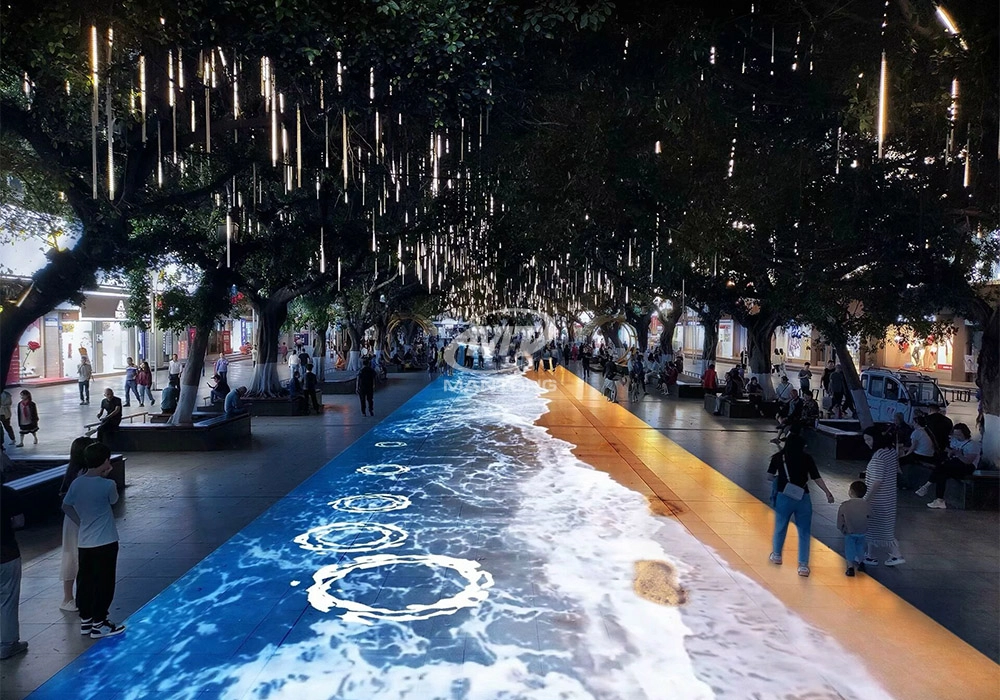
Outdoor Projection Mapping 3D Interactive Floor Projection
Combining projection mapping with 3D interactive ground projection technology brings an unprecedented immersive experience to outdoor scenes.

Kaida Business Center, Shixin Road, Panyu District,Guangzhou City, Guangdong Province, China.
ManTong
ManTong
ManTong