
Interactive Projection Technology: What It Is and Why It Matters
- The New Visual Frontier: Interactive Projection in Modern Spaces
- What is interactive projection technology?
- Core components of interactive projection systems (interactive projection technology)
- How interactive projection works — a technical overview (interactive projection technology)
- Primary use cases and business intent: where interactive projection delivers value (interactive projection benefits)
- Example: ROI drivers for retail
- Comparing display options: projection vs LED vs AR (interactive projection technology comparison)
- Technical considerations for deployment (interactive projection technology planning)
- Market trends and measurable impact (interactive projection market)
- Why choose a specialist interactive projection manufacturer (: choose interactive projection provider)
- Mantong Digital — one-stop interactive projection solutions and why it matters (brand & partnership)
- Mantong advantages and core product lines (interactive projection solutions)
- Deployment models and procurement guidance (how to buy interactive projection)
- Case selection and practical tips for successful projects (interactive projection best practices)
- FAQs — common questions about interactive projection technology
- Contact & next steps (consultation CTA)
- References
The New Visual Frontier: Interactive Projection in Modern Spaces
What is interactive projection technology?
Interactive projection technology is the combination of digital projection, sensors, tracking software and content systems that turns static projected imagery into responsive, user-driven experiences. Instead of simply displaying video, interactive projection detects movement, gestures, touch or objects and adapts the projection in real time. This capability creates immersive rooms, interactive floors and walls, projection mapping shows, and gamified installations that engage audiences physically and emotionally.
Core components of interactive projection systems (interactive projection technology)
At a high level, an interactive projection solution includes four core components:
- Projection hardware: projectors (laser or lamp-based), lenses, mounts and sometimes multiple blended projectors for seamless large surfaces.
- Sensing and tracking: depth cameras (e.g., ToF), structured light sensors, infrared cameras, LiDAR, pressure mats, floor sensors or computer vision via standard cameras.
- Processing and control: media servers, edge compute devices and software that fuse sensor data, run interaction logic and render real-time visuals.
- Content and UX: interactive content engines, game logic, mapping tools and CMS to manage experiences and analytics.
- Retail and experiential marketing: interactive windows, product visualizers, gamified promotions that increase conversion and social shares.
- Museums and cultural institutions: immersive exhibits and storytelling that improve learning outcomes and accessibility.
- Events and live shows: projection mapping and interactive stages that wow audiences and enable sponsor activations.
- Education and training: immersive classrooms, simulation floors and collaborative visualization for better retention and engagement.
- Hospitality and themed entertainment: interactive floors and walls in hotels, restaurants and theme parks for memorable guest experiences.
- Outdoor projection shows: city facades, monuments and temporary installations for festivals and brand campaigns.
- Ambient light and projector lumen requirements: brighter laser projectors handle more ambient light; calculate required lux and choose throw ratio accordingly.
- Surface properties: reflectivity, texture and color affect image quality—specialized projection surfaces help in irregular environments.
- Sensor selection: choose cameras or mats based on interaction type—fast motion needs high frame-rate cameras; delicate touch interactions may require pressure sensors or capacitive solutions.
- Calibration & mapping workflow: automated calibration tools reduce installation time; robust mapping software handles multi-projector blending and warping.
- Maintenance & durability: laser projectors reduce lamp-replacement costs; consider IP-rated enclosures for outdoor shows.
- Analytics & integration: integrate with POS, CRM or event management systems for measurable business outcomes.
- Global digital signage and immersive experience demand have been expanding as retailers and venues seek differentiated in-person experiences (see References).
- Laser projection adoption has increased because of lower maintenance and consistent color/brightness over life.
- Turnkey services (site survey, design, installation, commissioning).
- Custom content and UX design tailored to business KPIs.
- Long-term support, spare parts and remote monitoring.
- Vertical integration: direct manufacturing of projection hardware and in-house software reduces lead times and cost.
- Proven installations: over a decade of deployments across immersive rooms, museums, retail and outdoor shows.
- Custom engineering: expertise in multi-projector blending, mapping, sensor fusion and robust outdoor projection shows.
- Global partnership focus: ready to work with agencies, integrators and venues worldwide.
- Immersive projection
- Interactive floor projection
- Interactive wall projection
- Immersive room solutions
- 3D projection
- Interactive projection games
- Projection shows
- Interactive projection mapping
- Turnkey engagement: vendor delivers full design, hardware, installation and training—best for organizations seeking minimal internal technical burden.
- Hardware + integration: purchase hardware with vendor support for installation while the client supplies content—useful for repeatable rollouts.
- White-label partnerships: agencies resell Mantong solutions under their brand with technical support and manufacturing backing.
- Start with the user journey: design interactions that match visitor behavior—avoid gimmicks that confuse or frustrate.
- Pilot early: run a small-scale pilot to validate sensor placement, mapping accuracy and UX flow.
- Plan for content refresh: maintain fresh content to sustain repeat visitation; schedule content updates as part of the contract.
- Measure and iterate: instrument installations for analytics—dwell time, interactions per user, conversion impact—and iterate based on data.
- 1. How is interactive projection different from projection mapping?
- Projection mapping focuses on accurately projecting onto irregular surfaces to create the illusion of transformation. Interactive projection adds sensing and real-time responsiveness so the visuals change based on audience actions.
- 2. Can interactive projection work outdoors in daylight?
- Outdoor daylight deployments are challenging. High-brightness (laser) projectors, specialized screens and site-specific design can deliver daytime visibility, but LED walls often outperform in full sunlight. Mantong provides solutions tailored to outdoor conditions and can advise on feasibility.
- 3. What is the typical lifespan and maintenance for commercial projectors?
- Laser projectors commonly have 20,000–30,000+ hours of service life with lower maintenance than lamp-based projectors. Regular cleaning, firmware updates and periodic calibration are recommended to maintain performance.
- 4. How many simultaneous users can interactive floors or walls support?
- Capacity depends on sensor coverage, processing power and content design. Well-engineered systems can support dozens of users in large installations; many retail or museum activations are optimized for small groups (2–8 users) for best UX.
- 5. What analytics can I get from an interactive projection installation?
- Common analytics include footfall/dwell time, interaction count, heatmaps of engagement areas, repeat visits and conversion attribution when integrated with POS systems. These metrics help quantify ROI and inform content updates.
- 6. How long does a typical installation take?
- Small pilots can be installed in days; medium installations (single room or retail activation) usually take 2–6 weeks including surveying, hardware delivery and calibration. Large multi-site rollouts require phased schedules and pilot validation.
- 7. Is content creation included or separate?
- Many solution providers (including Mantong) offer both hardware and content services. Contracts vary—some include initial creative content with options for ongoing refreshes as part of a managed service.
- Projection mapping — Wikipedia. https://en.wikipedia.org/wiki/Projection_mapping (accessed 2024-06-12)
- Digital Signage Market Size, Share & Trends — Grand View Research (overview of market growth drivers including experiential displays). https://www.grandviewresearch.com/industry-analysis/digital-signage-market (accessed 2024-05-30)
- Laser projectors and benefits — Barco, Christie product literature and manufacturer whitepapers (general tech guidance on laser vs lamp projectors). Example: https://www.barco.com/en/product/lab-team (accessed 2024-04-28)
- Immersive experiences & retail: industry case studies from retail and museum integrators — example resources on experiential ROI: https://www.madisonavenuejournal.com/ (industry analyses) (accessed 2024-03-15)
Together they enable low-latency interaction (ideally <100 ms for perceived real‑time response), accurate mapping to irregular surfaces and scalable deployments.
How interactive projection works — a technical overview (interactive projection technology)
Interaction is enabled by sensing and mapping. First, the system maps the physical surface using camera calibration and projector mapping (also called warping). Sensors then track users or objects in the mapped coordinate space. The software interprets input (e.g., a footstep or hand gesture) and modifies the rendered imagery; the projected output is warped back to the physical surface so visuals appear fixed to real-world geometry.
Key technical challenges include ambient light handling, parallax correction for moving projectors or audiences, occlusion handling in multi-user scenarios and achieving consistent color/brightness across blended projectors.
Primary use cases and business intent: where interactive projection delivers value (interactive projection benefits)
Interactive projection solves commercial goals across industries by increasing dwell time, improving recall and creating shareable experiences. Common applications:
Example: ROI drivers for retail
In retail, interactive projection can increase in-store dwell time by 20–200% depending on the activation and placement, lift conversion rates via product trials and create measurable footfall attribution through integrated analytics. When calculating ROI, include hardware amortization (projectors typically amortized over 3–5 years for commercial use), content refresh costs and expected incremental sales or sponsor revenue.
Comparing display options: projection vs LED vs AR (interactive projection technology comparison)
Choosing a display approach requires comparing cost, scale, ambient-light performance and interactivity. The table below summarizes typical trade-offs.
| Feature | Interactive Projection | LED Video Walls | Augmented Reality (AR) |
|---|---|---|---|
| Cost per m² (typical) | Lower for large surfaces; projector hardware + installation | High up-front cost, low maintenance | Low hardware cost per user; platform/dev cost high |
| Scale | Excellent for very large or irregular surfaces | Excellent for guaranteed brightness & pixel density | Scale per-user; suitable for personalized experiences |
| Ambient light performance | Challenged in high daylight; mitigated by high-lumen laser projectors | Excellent; high brightness remains visible outdoors | Unaffected by ambient light (device-dependent) |
| Immersion & shared experience | Very strong for shared physical experiences | Strong visual impact; less physical engagement | Highly personalized; less shared embodied interaction |
| Interactivity | High—multi-user physical interactions possible | High with added sensors; higher cost | High—device-based interactions & AR overlays |
Sources for general market and cost trends are listed in the References section below.
Technical considerations for deployment (interactive projection technology planning)
When planning an installation, evaluate these factors:
Market trends and measurable impact (interactive projection market)
The growth of experiential marketing, notable drops in laser projector pricing, and improved sensor affordability have pushed interactive projection into mainstream deployments. For context:
Why choose a specialist interactive projection manufacturer (: choose interactive projection provider)
Working with a supplier that owns hardware and software reduces integration risk. Specialists can offer:
Mantong Digital — one-stop interactive projection solutions and why it matters (brand & partnership)
Mantong Digital is a one-stop interactive projection solution provider and direct manufacturer based in Guangzhou, China, with over 10 years of industry experience. We are dedicated to providing innovative, flexible and cost-effective projection solutions, offering both hardware and software to meet various needs.
At ManTong, we specialize in providing customized solutions for a wide range of application scenarios through innovative projection technology. Whether it's immersive experiences, interactive entertainment or outdoor lighting and projection shows, our solutions can transform your ideas into stunning visual effects. Our projection technology provides customized solutions for a variety of scenarios, delivering immersive and interactive visual experiences.
We are now looking for business partnerships worldwide. Our vision is to become the world's leading interactive projection manufacturer. Our website is https://www.mtprojection.com/
Mantong advantages and core product lines (interactive projection solutions)
Mantong's competitive strengths include:
Main product and solution categories:
Deployment models and procurement guidance (how to buy interactive projection)
Procurement typically follows three models:
For reliable outcomes, request site surveys, proof-of-concept pilots and service-level agreements (SLAs) covering uptime, replacement timelines and remote monitoring.
Case selection and practical tips for successful projects (interactive projection best practices)
Lessons from successful projects:
FAQs — common questions about interactive projection technology
Contact & next steps (consultation CTA)
If you're evaluating interactive projection technology for a retail campaign, museum exhibit, themed attraction or city-scale projection show, speak with a specialist early. Mantong Digital offers turnkey and customized interactive projection solutions and global partnership opportunities. Visit https://www.mtprojection.com/ to view products, request a site survey or start a pilot. For direct inquiries, request a consultation through Mantong's website—our teams can provide feasibility studies, ROI estimates and pilot programs tailored to your goals.
References
Top 5 interactive projector Company List and Products Compared
How to Choose the interactive floor projection manufacturer and supplier ?
Best professional interactive projection manufacturers and supplier brands in China
Top 10 interactive projector game system Manufacturers and Supplier Brands in China
One-Stop Projection Solution Provider Since 2011
What's Immersive Projection ?
Immersive projection refers to a technology that creates a captivating and all-encompassing visual experience for viewers by projecting images or videos onto large surfaces, such as walls, floors, or even entire rooms. This technology aims to immerse the audience in a simulated environment, blurring the boundaries between the physical and virtual worlds.
Are you trader or manufacturer ?
We are direct manufacturer who specialize in providing one-stop solution for different outdoor & indoor projection project with our stable software and qualified projectors
What's the application of Immersive projection ?
It can be used in various venues, such as art exhibition, entertainment venues, educational institution, Wedding hall /Banquet/Bar,Yoga Studio and so on. It often involves advanced projection techniques, multimedia content, and interactive elements to engage and captivate the audience's senses.
What about the wall/floor material for the projection?
It’s recommended to choose a light-colored material with minimal reflectivity—pure white or light grey works best. the
common material is cement & plaster board
For optimal projection results, the surface should be free of any patterns or textures, as the projector will display content
directly onto it.
There are no specific material requirements; you may use any commonly available material in your local market, as long as it
meets the above conditions.
How to install the projection equipment ?
1) Install the projector in a suitable position. We will provide you with a hanger, which you need to fix on the ceiling with
screws.
2) Connect projectors, computers and other accessories through wires.
3) After completing the above 2 steps, we will carry out the edge blending steps. Our team can complete it through remote
control.
In general, installation instructions for each project need to be specified on a project-by-project basis. The above is for
reference only.
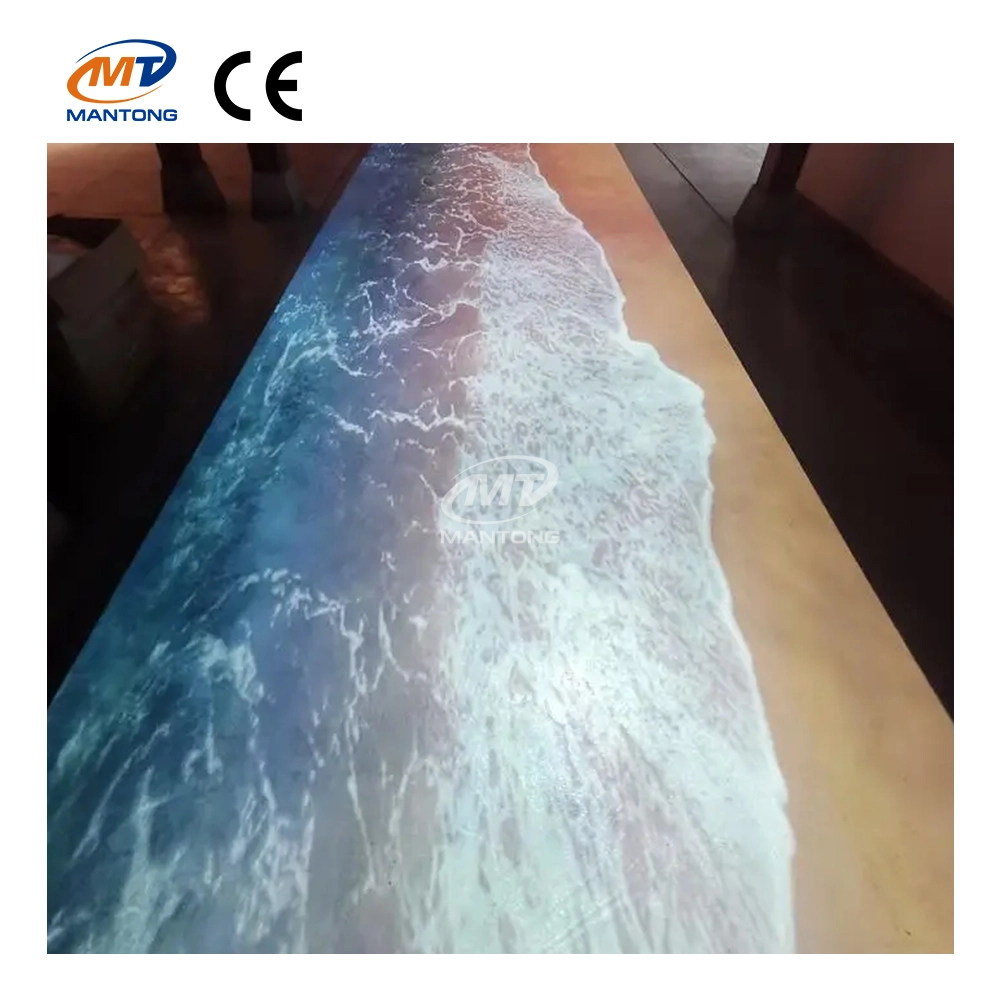
Indoor Interactive Floor Projector System - Customized Design & Installation Support
Indoor interactive floor projections display dynamic themed videos on the floor, commonly used in venues aiming to enhance brand influence or attract foot traffic, such as restaurants, hotel corridors, and brand car retail stores.
By using projectors and compatible software, the interactive content is projected onto the floor, encouraging engagement between people and the projected visuals. A single 5500-lumen indoor floor projector can cover an area of 5 m × 3 m. Typically, each project will use at least 3 units to ensure broad coverage and optimal visual effects.
We also offer customized design and installation support to enhance the interactive experience for your venue.
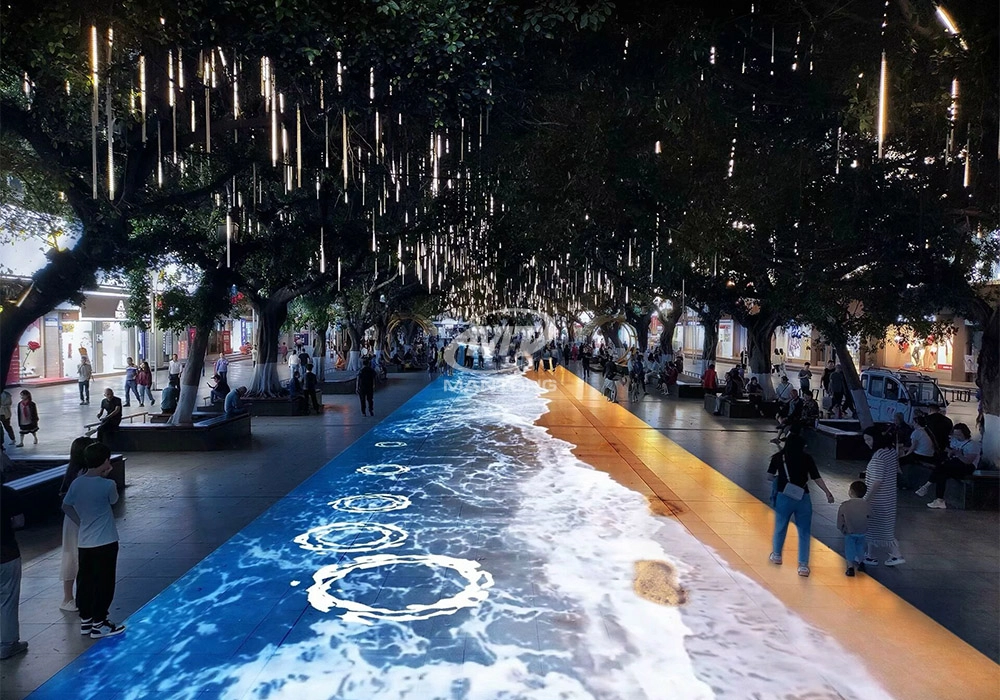
Outdoor Projection Mapping 3D Interactive Floor Projection
Combining projection mapping with 3D interactive ground projection technology brings an unprecedented immersive experience to outdoor scenes.
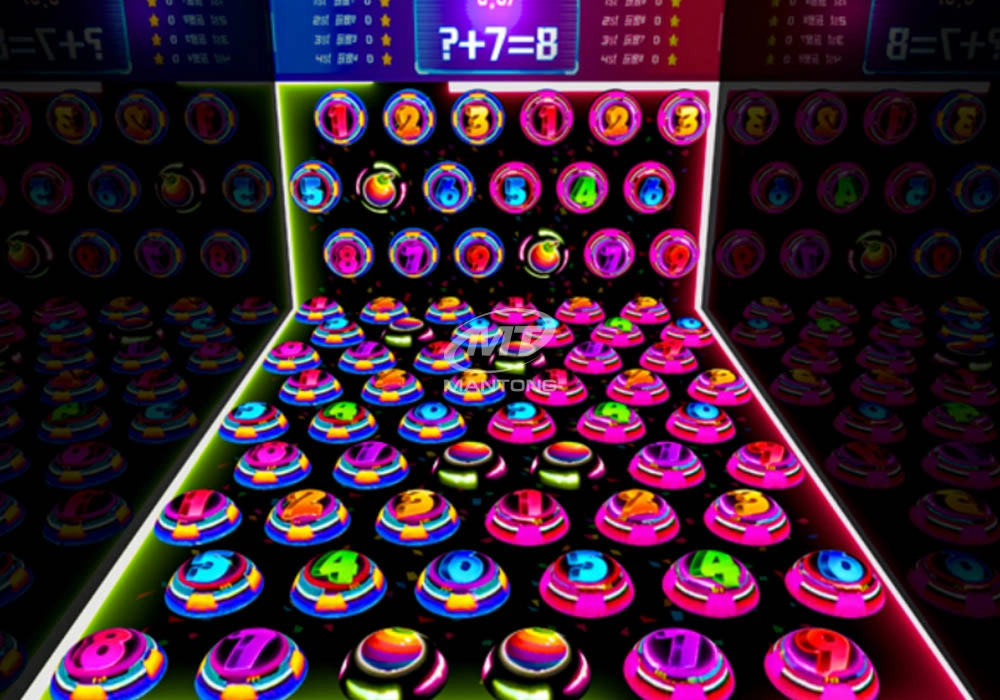
Amusement Rapidly Rotating Bouncing Sphere Interactive Wall Floor Projection Sports Games
Rapidly Rotating Bouncing Sphere is an interactive space where participants jump on rotating spheres. As they step on it, the spheres surface will show special interactivity
Jumping on spheres of the same color in succession causes them to pop, releasing light particles. The more consecutive jumps, the greater the reward—caterpillars appear, and eventually, all spheres of that color burst, filling the space with light and even more caterpillars.
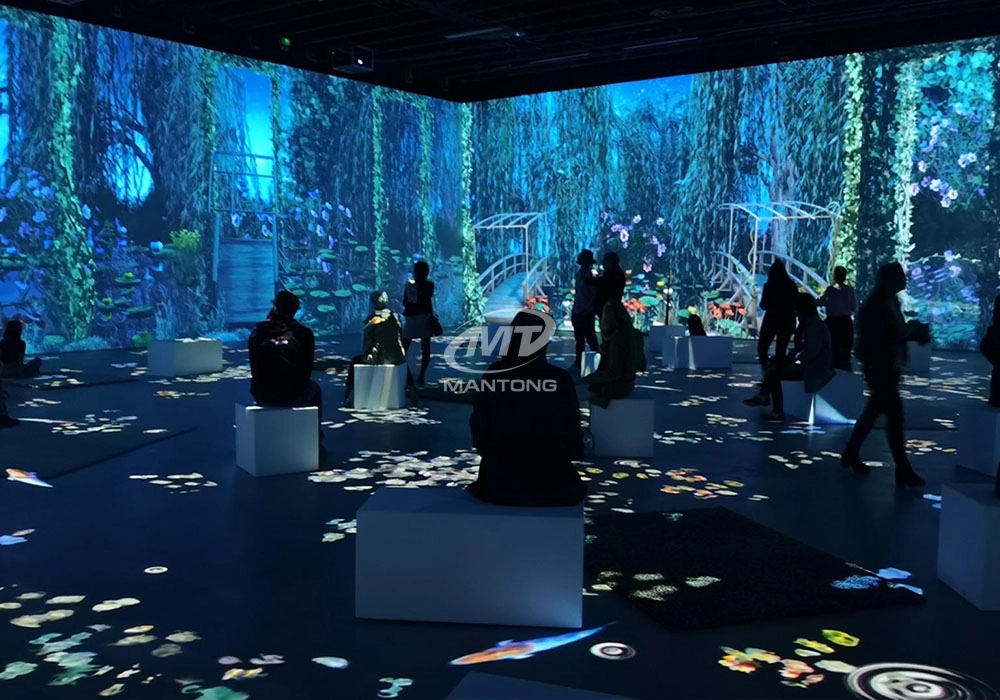
Mantong 6500LM High-Lumen Projector for Large-Scale Immersive Room Projection
Transform any space with Mantong's immersive projection mapping systems. Our high-lumen projectors (up to 6500 LM) and custom software create captivating interactive experiences for floors and walls. Ideal for museums, events, retail, and hospitality. Each kit includes professional ceiling mounting and 80+ pre-loaded video contents and is backed by a 12-month warranty and CE certification. We offer full customization and support to bring your vision to life.

Kaida Business Center, Shixin Road, Panyu District,Guangzhou City, Guangdong Province, China.
ManTong
ManTong
ManTong