
Interactive Projection Technology vs AR/VR: Key Differences
- Why Spatial Storytelling Matters for Interactive Projection Technology
- What is interactive projection technology? (embed keyword: interactive projection technology)
- Core differences at a glance (embed keyword: interactive projection technology)
- Technical tradeoffs — optics, tracking and latency (embed keyword: interactive projection technology)
- Cost, scalability and operational considerations (embed keyword: interactive projection technology)
- When to choose interactive projection over AR/VR (embed keyword: interactive projection technology)
- When AR or VR might be better
- Use cases and measurable outcomes (embed keyword: interactive projection technology)
- Deployment checklist: risks, site survey and success factors (embed keyword: interactive projection technology)
- Mantong Digital: one‑stop interactive projection solutions and why it matters
- Comparison table: realistic cost & effort estimate
- Integration patterns and content pipeline recommendations (embed keyword: interactive projection technology)
- Privacy, accessibility and safety checklist
- Frequently Asked Questions (FAQ)
- 1. What exactly is the difference between interactive projection technology and AR?
- 2. Can interactive projection work outdoors during the day?
- 3. Are interactive projection installations expensive to maintain?
- 4. How does latency affect interactive projection experiences?
- 5. Can I reuse AR/VR content for projection systems?
- 6. How does Mantong support international partners?
- Contact & product information
- References
Why Spatial Storytelling Matters for Interactive Projection Technology
Interactive projection technology sits at the intersection of hardware optics, real‑time software and human interaction design. As businesses evaluate immersive solutions for retail, museums, events or public art, it's critical to understand how interactive projection differs from augmented reality (AR) and virtual reality (VR) — not only in spectacle but in cost, deployment complexity, accessibility and long‑term maintenance. This guide breaks down those differences, provides practical selection criteria for decision makers, and outlines real use cases and numbers you can verify.
What is interactive projection technology? (embed keyword: interactive projection technology)
Interactive projection technology uses one or more projectors to paint images onto physical surfaces and couples that imagery with sensors or cameras so users can alter visuals through gestures, motion, touch or tracked objects. Unlike head‑mounted displays, projection makes digital graphics available to many people at the same time, anchored to real space. Typical components include projectors (DLP/laser), edge blending and warping systems, media servers, depth cameras or infrared sensors, and software middleware for mapping, tracking and interaction logic.
Core differences at a glance (embed keyword: interactive projection technology)
| Criteria | Interactive Projection Technology | Augmented Reality (AR) | Virtual Reality (VR) |
|---|---|---|---|
| Display Mode | Projection onto physical surfaces / environments | Overlay digital content on user’s view (HMD or screen) | Fully synthetic environment via HMD |
| Shared Experience | High — multiple users can see/interact simultaneously | Moderate — can be shared but usually individualized | Low — primarily single‑user presence per headset |
| Mobility | Fixed or portable installs; site‑specific | Highly mobile on smartphones or AR glasses | Limited by tethering/battery; room‑scale constraints |
| Interaction Types | Gestures, touch, object interaction, floor/wall tracking | Spatial anchors, hand tracking, screen touch | Controllers, hand tracking, full body tracking (optional) |
| Hardware Cost (typical) | Mid: projectors + sensors + media server | Low to high: smartphone AR low; enterprise AR glasses high | High: headsets + powerful PC-console |
| Setup Complexity | Medium: calibration, mounting, ambient light control | Low to medium: app deployment; AR glasses need calibration | High: VR content, space setup, safety considerations |
| Accessibility / Comfort | High: no wearables required | Variable: comfortable on phone; glasses still nascent | Lower: motion sickness for some users |
Technical tradeoffs — optics, tracking and latency (embed keyword: interactive projection technology)
Projection systems rely on optical performance (brightness in lumens, contrast, throw ratio) and geometric calibration (warping and edge blending) to achieve convincing results. Tracking for interactive projection often uses overhead depth cameras (e.g., Microsoft Azure Kinect, Intel RealSense), infrared sensors, LIDARs or computer vision from RGB cameras. The main technical challenges are ambient light management, occlusion handling (people or objects blocking the projection), and maintaining low latency between user action and visual response.
AR and VR depend heavily on head pose tracking and low end‑to‑end latency to preserve immersion. AR overlays must register digital content to the user's viewpoint (6DOF tracking), while VR attempts to simulate a complete environment where motion‑to‑photon latency under ~20 ms is desirable to reduce nausea. In contrast, interactive projection tolerates slightly higher latency in many cases because the visual anchoring is spatially consistent and multiple users share the same perspective.
Cost, scalability and operational considerations (embed keyword: interactive projection technology)
From an operational standpoint, interactive projection systems are often more cost‑effective for public, multi‑user installations because the cost is concentrated in the infrastructure rather than per‑user hardware. A quality laser projector (10k–30k lumens), media server and sensors can handle thousands of interactions per day with low variable cost. AR solutions on smartphones scale easily and cheaply but depend on users' devices and network access. VR scales poorly for public venues unless you invest in many headsets and attendant staff for hygiene and supervision.
Maintenance for projection includes lamp/laser lifecycle, dust and cooling system checks, occasional recalibration after physical shifts, and content updates. AR/VR maintenance is largely software updates and device battery lifecycle management. Security and privacy considerations differ: camera‑based tracking in public installations must comply with local privacy laws; AR applications may collect user data across devices; VR may collect biometric data in some advanced setups.
When to choose interactive projection over AR/VR (embed keyword: interactive projection technology)
- Public or high‑throughput experiences where many participants should interact simultaneously (museums, retail windows, trade shows).
- When physical context is important — projection augments real surfaces and architecture for a hybrid tangible experience.
- Lower barrier to entry for audiences — no headsets or downloads required.
- Outdoor or large‑scale visual shows (projection mapping on facades) where collective viewing is desired.
- When you want fast project turnarounds and flexible content updating with centralized control.
When AR or VR might be better
- Personalized, location‑agnostic experiences delivered via smartphones or wearables.
- Fully immersive simulation or training where you must control the entire sensory environment (VR).
- Contextual overlays tightly aligned to a user's viewpoint — e.g., maintenance overlays on complex machinery (AR glasses).
Use cases and measurable outcomes (embed keyword: interactive projection technology)
Here are representative use cases with measurable KPIs you can expect when deploying interactive projection:
- Museum exhibit: increased dwell time by 30–60% compared with static exhibits (measured by entry/exit sensors and event logs).
- Retail window: 20–40% uplift in foot traffic during campaign periods when projection content is refreshed weekly (benchmarked by pedestrian counters).
- Immersive marketing activation: social media engagement increases (shares, photos) by measurable multiples; typical uplift ranges widely but case studies show 3–10x baseline engagement.
- Projection mapping shows: improved sponsorship ROI via higher attendance and media pickup; measured via ticket sales and press mentions.
Note: exact numbers vary by project and should be validated through pilot testing. Independent market overviews indicate strong growth in experiential displays and projection mapping as event production investments rebound post‑pandemic (see references).
Deployment checklist: risks, site survey and success factors (embed keyword: interactive projection technology)
Before committing to a large installation, run a site survey and validate the following:
- Ambient light measurements at different times of day (lux readings) — projectors need headroom to achieve contrast.
- Mounting points and safe power access for projectors and media servers.
- Surface material and geometry — matte, diffuse surfaces yield better and more stable results; reflective surfaces cause hotspots.
- Interaction testing with real audience members to capture natural behavior and edge cases (occlusion, group interaction patterns).
- Network and content management setup for remote updates and monitoring.
- Privacy and safety review for camera use in public spaces.
Mantong Digital: one‑stop interactive projection solutions and why it matters
Mantong Digital is a one‑stop interactive projection solution provider and direct manufacturer based in Guangzhou, China, with over 10 years of industry experience. We are dedicated to providing innovative, flexible and cost‑effective projection solutions, offering both hardware and software to meet various needs.
At Mantong, we specialize in providing customized solutions for a wide range of application scenarios through innovative projection technology. Whether it's immersive experiences, interactive entertainment or outdoor lighting and projection shows, our solutions can transform your ideas into stunning visual effects. Our projection technology provides customized solutions for a variety of scenarios, delivering immersive and interactive visual experiences.
Core competitive advantages:
- Direct manufacturing and supply chain control in Guangzhou, allowing cost optimization and faster lead times.
- Experienced R&D team with proven workflows for mapping, edge‑blending and multi‑projector synchronization.
- Integrated hardware + middleware delivery model: projectors, media servers, sensors and interaction software from a single vendor.
- Proven portfolio across immersive projection, interactive floor projection, interactive wall projection, immersive rooms, 3D projection, interactive projection games, projection shows and interactive projection mapping.
- Worldwide business partnership focus and end‑to‑end project support from concept to maintenance.
With Mantong, project owners benefit from reduced vendor coordination, consistent quality control, and specialist support for commissioning and onsite calibration. Learn more at https://www.mtprojection.com/.
Comparison table: realistic cost & effort estimate
| Solution | Typical Hardware Cost (USD) | Setup Time | Operational Considerations |
|---|---|---|---|
| Interactive projection (small gallery) | $8,000 – $25,000 | 1–3 days | Ambient light control, periodic recalibration |
| Interactive projection (large façade mapping) | $40,000 – $250,000+ | Weeks (design + testing) | Engineering mounts, permits, high‑power projectors |
| AR (mobile campaign) | $5,000 – $60,000 (app dev) | Weeks | App distribution, device variability |
| VR experience (venue) | $10,000 – $100,000+ (per station) | Weeks to months | Headset hygiene, staffing, supervision |
Integration patterns and content pipeline recommendations (embed keyword: interactive projection technology)
To streamline content creation and reduce costs, follow these patterns:
- Use modular content blocks — design assets that can be repurposed across different surfaces and shows.
- Author content in standard real‑time engines (Unity, Unreal) for interactive logic, then export to the media server pipeline.
- Maintain a content versioning system and remote deployment pipeline for quick updates.
- Implement monitoring dashboards for projector lamp hours, temperatures and tracking health to anticipate maintenance.
Privacy, accessibility and safety checklist
Because many projection installations use cameras or sensors, you should:
- Post clear signage about camera use and data handling.
- Anonymize or avoid recording Personally Identifiable Information (PII) unless necessary and consented.
- Ensure floor projections do not create slip hazards — choose non‑reflective materials and avoid strobe effects for epilepsy safety.
- Design interfaces accessible to different ages and abilities — e.g., allow seated interactions or touch alternatives.
Frequently Asked Questions (FAQ)
1. What exactly is the difference between interactive projection technology and AR?
Interactive projection places visuals directly on surfaces in real space for multiple viewers; AR overlays digital content on an individual's view, often through a phone or glasses. Projection is collective and surface‑anchored; AR is viewpoint‑anchored and often personal.
2. Can interactive projection work outdoors during the day?
Daytime outdoor projection is challenging due to high ambient light. High‑brightness laser projectors and carefully chosen surfaces help, but many outdoor shows are scheduled at dusk/night for optimal contrast.
3. Are interactive projection installations expensive to maintain?
Maintenance costs are moderate — laser projectors reduce lamp replacement, but cooling, calibration and occasional hardware replacement are required. Remote monitoring and preventative maintenance plans minimize downtime.
4. How does latency affect interactive projection experiences?
Latency affects perceived responsiveness. For most projection interactions, latencies under ~60 ms feel acceptable; for fast gesture games, lower latencies (under 30 ms) are preferable. Choice of sensors and optimization of the processing pipeline matter most.
5. Can I reuse AR/VR content for projection systems?
Much of the 3D content can be repurposed, but interaction paradigms and rendering pipelines differ. Exporting assets from real‑time engines and reauthoring UI/interaction flows is common practice.
6. How does Mantong support international partners?
Mantong offers end‑to‑end services: concept design, hardware supply, software integration, onsite commissioning and after‑sales support. They are seeking global partnerships and can accommodate custom integrations and local compliance needs.
Contact & product information
If you are evaluating interactive projection technology for an exhibition, retail activation or large‑scale mapping show, contact Mantong Digital for a project consultation and product catalogue. Visit https://www.mtprojection.com/ to request a quote or partnership inquiry.
References
- Projection mapping — Wikipedia. https://en.wikipedia.org/wiki/Projection_mapping (accessed 2025-12-15)
- Augmented reality — Wikipedia. https://en.wikipedia.org/wiki/Augmented_reality (accessed 2025-12-15)
- Virtual reality — Wikipedia. https://en.wikipedia.org/wiki/Virtual_reality (accessed 2025-12-15)
- Grand View Research — Augmented Reality Market Size & Trends. https://www.grandviewresearch.com/industry-analysis/augmented-reality-market (accessed 2025-12-10)
- Example camera hardware pages: Intel RealSense (product info). https://www.intelrealsense.com/ (accessed 2025-11-05)
- Example depth sensing and interaction considerations: Microsoft Azure Kinect. https://azure.microsoft.com/en-us/services/kinect-dk/ (accessed 2025-11-05)
Interactive Projection vs. Projection Mapping: Key Differences
What is interactive tabletop projector ?
Best 5 Cost-Effective Ways to Build an Immersive Meeting Room manufacturers and supplier brands
Top 10 interactive floor projection Manufacturers and Supplier Brands
One-Stop Projection Solution Provider Since 2011
Are you trader or manufacturer ?
We are direct manufacturer who specialize in providing one-stop solution for different outdoor & indoor projection project with our stable software and qualified projectors
How to install the projection equipment ?
1) Install the projector in a suitable position. We will provide you with a hanger, which you need to fix on the ceiling with
screws.
2) Connect projectors, computers and other accessories through wires.
3) After completing the above 2 steps, we will carry out the edge blending steps. Our team can complete it through remote
control.
In general, installation instructions for each project need to be specified on a project-by-project basis. The above is for
reference only.
What's the application of Immersive projection ?
It can be used in various venues, such as art exhibition, entertainment venues, educational institution, Wedding hall /Banquet/Bar,Yoga Studio and so on. It often involves advanced projection techniques, multimedia content, and interactive elements to engage and captivate the audience's senses.
How to Write an Interactive-Effect Video Customisation Script ?
① Project Background: Briefly introduce the context in which this interactive scene will be used (e.g., exhibition, museum,
event space, children's area). Example: This scene is part of the “Underwater World” zone in a children's science museum,
designed to be engaging and exploratory.
②Visual Style / Atmosphere: What kind of visual mood are you aiming for? Please describe the color scheme, style, and any
references. it should focus solely on describing the visual aspects of the scene, supported by relevant charts or reference
images.
③ Interaction Points Overview:List each interactive hotspot along with the effect you'd like to trigger when the user
touches or clicks the area. example: when player touch the clownfish, it will swims away with bubble trail (animation effect)
and produce the bubble sound ( sound effect requirement )
④ Static Visual Reference:including but not limited to background image/video, a list of major visual elements (e.g., coral,
rocks, seaweed, fish), which elements should be interactive?
What's Immersive Projection ?
Immersive projection refers to a technology that creates a captivating and all-encompassing visual experience for viewers by projecting images or videos onto large surfaces, such as walls, floors, or even entire rooms. This technology aims to immerse the audience in a simulated environment, blurring the boundaries between the physical and virtual worlds.
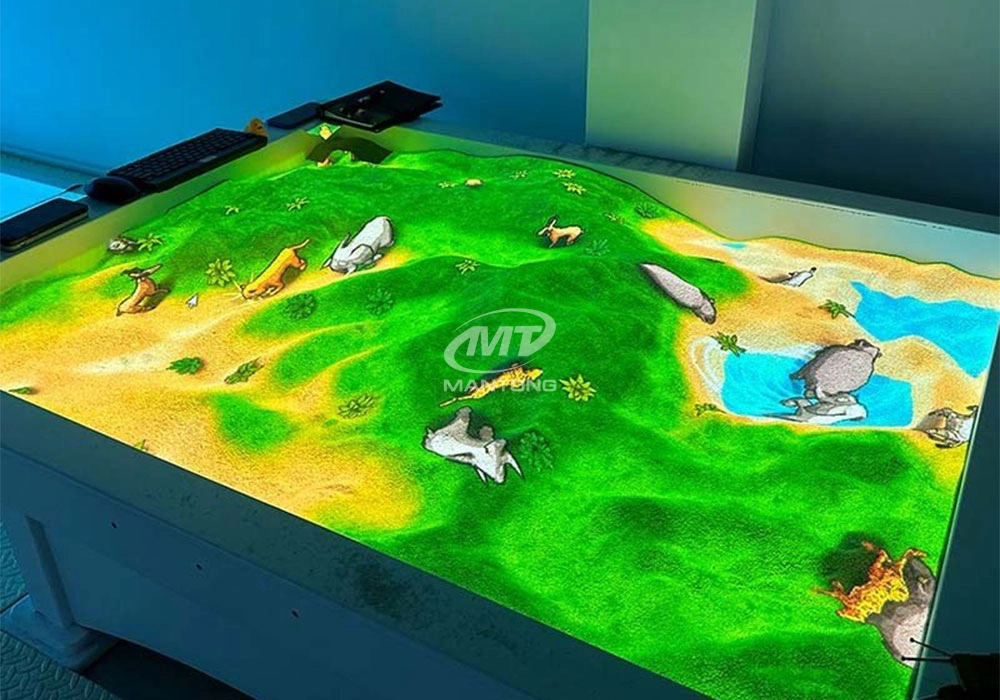
Interactive Sandbox Projection Mapping Games For Kids Play Park
Bring imagination to life with interactive sandbox projection mapping games designed for kids’ play parks. Using cutting-edge projection technology and real-time motion sensing, children can dig, build, and explore virtual worlds directly in the sand. Educational, engaging, and endlessly fun — it’s the perfect blend of play and learning.
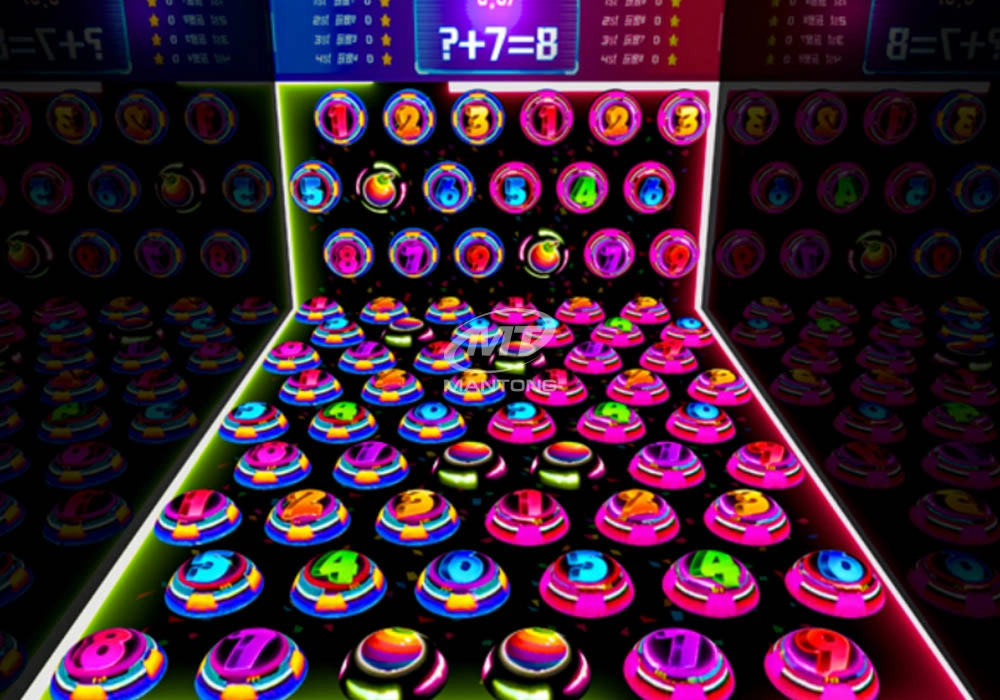
Amusement Rapidly Rotating Bouncing Sphere Interactive Wall Floor Projection Sports Games
Rapidly Rotating Bouncing Sphere is an interactive space where participants jump on rotating spheres. As they step on it, the spheres surface will show special interactivity
Jumping on spheres of the same color in succession causes them to pop, releasing light particles. The more consecutive jumps, the greater the reward—caterpillars appear, and eventually, all spheres of that color burst, filling the space with light and even more caterpillars.
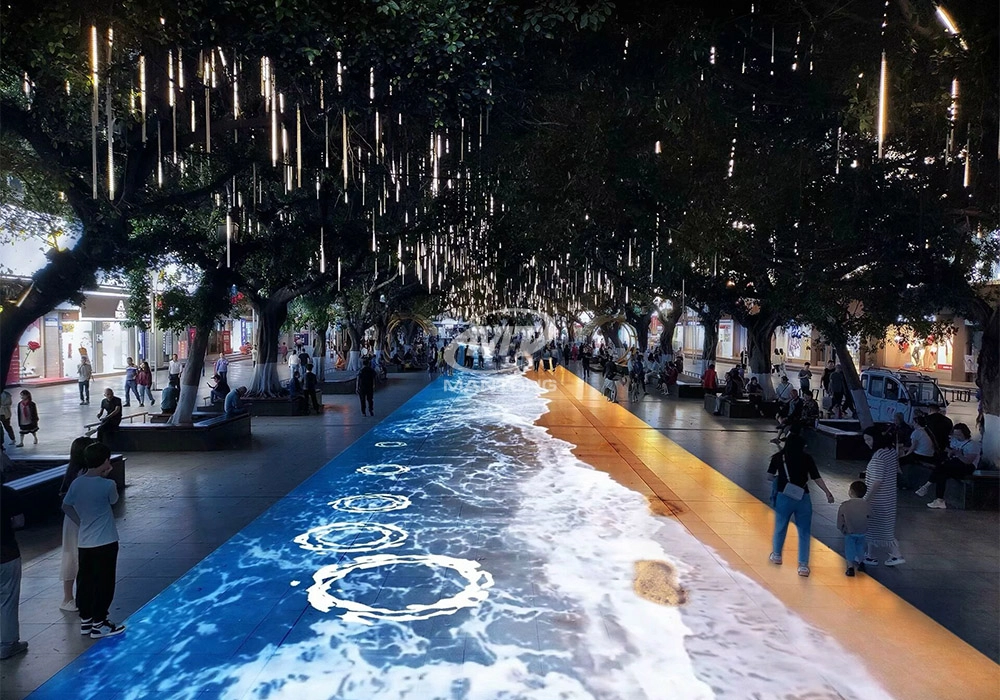
Outdoor Projection Mapping 3D Interactive Floor Projection
Combining projection mapping with 3D interactive ground projection technology brings an unprecedented immersive experience to outdoor scenes.
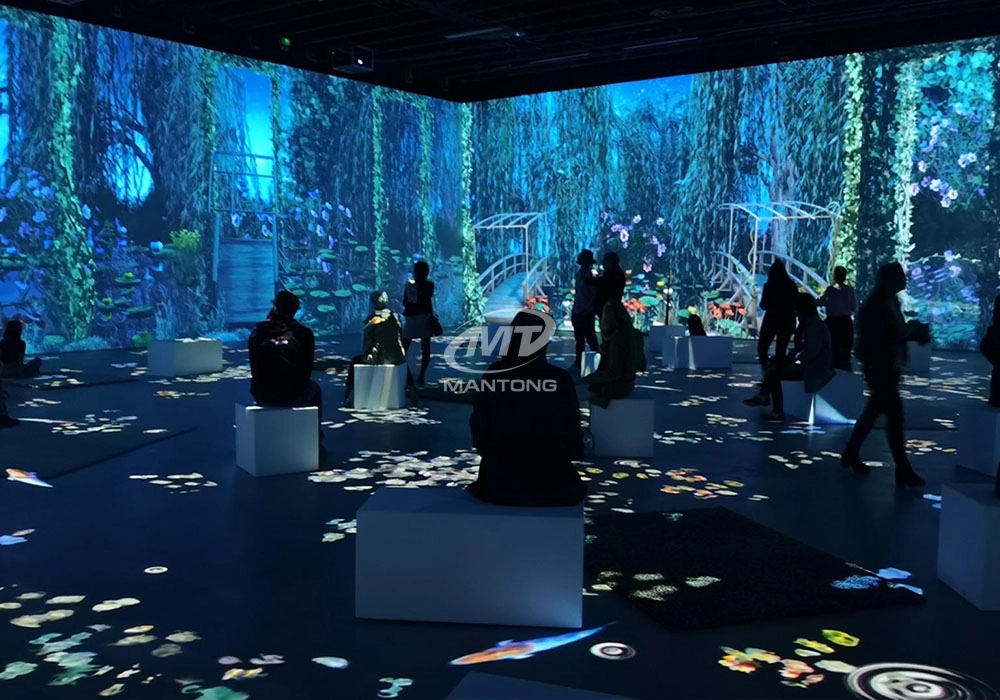
Mantong 6500LM High-Lumen Projector for Large-Scale Immersive Room Projection
Transform any space with Mantong's immersive projection mapping systems. Our high-lumen projectors (up to 6500 LM) and custom software create captivating interactive experiences for floors and walls. Ideal for museums, events, retail, and hospitality. Each kit includes professional ceiling mounting and 80+ pre-loaded video contents and is backed by a 12-month warranty and CE certification. We offer full customization and support to bring your vision to life.

Kaida Business Center, Shixin Road, Panyu District,Guangzhou City, Guangdong Province, China.
ManTong
ManTong
ManTong