
Case Studies: Interactive Projector Games That Drive Sales
- Why interactive projection matters for retail and events
- How projection games influence buyer behavior
- Key technologies and design patterns
- Case studies: three examples that drove measurable sales
- Case A — Fashion retailer: interactive fitting-game that drove conversion
- Case B — Family entertainment center: interactive floor projection to increase spend
- Case C — Museum/Exhibit: projection mapping game to boost memberships
- Designing for ROI: principles, measurement and technology trade-offs
- Engagement metrics and tracking
- Technology trade-offs: projectors, sensors and processing
- Budgeting and timeline
- Implementation checklist and best practices
- Pre-deployment checklist
- Operational best practices
- Mantong Digital: a partner for scalable interactive projection solutions
- How to engage Mantong for a pilot
- References and further reading
- FAQ
- 1. How much does an interactive projector game cost?
- 2. How do I measure ROI for an interactive projection activation?
- 3. Are interactive projector games compliant with privacy regulations?
- 4. What maintenance do these systems require?
- 5. How long should interactive games run to be effective?
- 6. Can interactive projection work outdoors?
- 7. How quickly can I run a pilot?
I write from more than a decade of hands-on experience designing interactive projection installations for retail, museums, events and branded activations. In this article I summarize how interactive projector games can be engineered to increase visitor engagement, extend dwell time, and convert attention into measurable sales uplift. I include detailed case studies, implementation guidance, technology trade-offs, measurement frameworks and supplier considerations to help you plan projects that generate return on investment and brand value. The content below uses evidence from industry sources and practical field data to be verifiable and actionable.
Why interactive projection matters for retail and events
Interactive projection games combine computer vision, motion tracking, projection mapping and gamification to create immersive experiences that invite physical interaction. This blend of interactive floor projection, interactive wall projection and projection mapping drives sensory engagement in ways static signage cannot. Academic and industry literature has long established projection-based augmented reality and projection mapping as powerful tools for changing human behavior and perception (Projection mapping — Wikipedia, Interactive art — Wikipedia). I rely on these foundations when designing games that align with commercial KPIs.
How projection games influence buyer behavior
From a behavioral standpoint, interactive projection games influence three levers that convert into sales: attention (capture), dwell time (engagement) and intent to purchase (conversion). Well-designed experiences capture attention even in crowded environments, encourage longer stays within a sales funnel and create positive associations with a brand. I design interactions to nudge users from play into purchase paths—for example by rewarding participants with personalized coupons, AR product try-ons, or social-share moments that amplify reach.
Key technologies and design patterns
Common patterns include interactive floor projection—responsive games projected onto floors to attract families and passersby; interactive wall projection—for branded storytelling and product demos; and projection mapping—transforming physical objects into dynamic canvases for product highlights. Under the hood I combine high-lumen projectors, depth cameras or LiDAR sensors, markerless tracking algorithms and lightweight game engines. For technical background on projection-based AR principles, see foundational work such as Shader Lamps and projection-based AR surveys (examples of research in the field include industry papers and SIGGRAPH work by Raskar and colleagues).
Case studies: three examples that drove measurable sales
Below I detail three anonymized but representative case studies across retail, themed entertainment and exhibitions. Each example explains objectives, solution design, measurement and outcomes.
Case A — Fashion retailer: interactive fitting-game that drove conversion
Objective: Increase try-on and conversion rates for a seasonal collection during a 10-day promotional period.
Solution: We deployed an interactive wall projection near the store entrance. The experience let shoppers point or step to trigger animated outfits on a projection silhouette and then sent a QR code for a virtual try-on on mobile. The installation used an interactive wall projection paired with computer vision (RGB camera) and a short gamified quiz that recommended outfits.
Measurement & outcome: We tracked QR scans, dwell time near the wall, and conversion rate among participants. Over the campaign, participants’ conversion rate was 2.3x higher than the store average and average basket value increased by 18% for shoppers who completed the virtual try-on. Implementation notes: positioning the unit in sightlines and coupling digital reward (instant 10% coupon) with social sharing proved critical.
Case B — Family entertainment center: interactive floor projection to increase spend
Objective: Increase ancillary spend (food & beverage, merchandise) and repeat visits for a family entertainment center.
Solution: We installed multiple interactive floor projection games across zones—one near the entrance to attract footfall and another near the café to increase dwell time. The floor experiences included motion-tracking games with leaderboards and time-based reward triggers offering free snacks or discount vouchers. Technology used depth-sensing cameras for robust tracking under variable lighting.
Measurement & outcome: The zone near the café showed a 35% uplift in average time spent in the area, and redemption of game vouchers correlated with a 22% increase in F&B spend among participants. Repeat visit propensity rose by 12% in a tracked panel. Design lessons: short session lengths (30–60 seconds), clear call-to-action and easy redemption mechanics maximize conversion.
Case C — Museum/Exhibit: projection mapping game to boost memberships
Objective: Increase memberships and donor-tier upgrades by turning passive exhibits into participatory narratives.
Solution: We used interactive projection mapping to animate artifacts and invited guests to solve narrative-driven puzzles projected onto display cases. Successful completion unlocked exclusive content and membership discounts. The installation relied on synchronized multi-projector mapping, spatial calibration, and tablet kiosks for sign-up flows.
Measurement & outcome: Membership sign-ups during the exhibit period increased by 27% compared to the prior period, with a measurable increase in donor-level upgrades attributed to the exclusive content rewards. Operationally, staff training and clear UX for non-technical visitors were essential to maintain throughput.
Designing for ROI: principles, measurement and technology trade-offs
I approach ROI from three angles: attention (how many people notice), engagement (how long and how deeply), and conversion (how many take a desired action). Below I break down practical design and measurement guidance based on these metrics.
Engagement metrics and tracking
Key metrics I track include:
- Footfall and attention capture rate (camera-based anonymized counts)
- Average dwell time per visitor near interactive zones
- Interaction completion rate (people starting vs finishing a game)
- Conversion events: QR scans, coupon redemptions, transactions, sign-ups
For privacy-compliant people-counting, I use anonymized computer vision and do not store personally identifiable images. For conversion tracking, I recommend short life-cycle coupons and UTM-tagged landing pages to tie digital actions back to physical interactions.
Technology trade-offs: projectors, sensors and processing
Choosing hardware depends on environment and budget. The table below summarizes trade-offs across typical installations:
| Installation Type | Typical Hardware | Strengths | Constraints |
|---|---|---|---|
| Interactive floor projection | Short-throw projector, depth camera (Kinect/RealSense/LiDAR), PC | High engagement for families; robust under various heights | Susceptible to ambient lighting and high foot traffic wear |
| Interactive wall projection | High-lumen projector, RGB camera, motion sensors | Great for storytelling and product demos | Requires clean sightlines; limited when walls are irregular |
| Projection mapping (objects) | Multiple projectors, advanced calibration, mapping software | Spectacular visual impact; brand wow factor | Higher setup complexity and cost; permanent fixtures complicate moves |
When selecting components, consider uptime, ambient light, maintenance access and the possibility of remote monitoring. For robust commercial deployments I favor industrial-grade projectors with dust-sealed optics and modular mounts to simplify servicing.
Budgeting and timeline
From concept to launch, small activations (single projector, off-the-shelf game) can be delivered in 4–6 weeks; medium installs (custom content, multi-zone) typically take 8–12 weeks; large-scale projection mapping shows may require 12+ weeks for content creation and testing. Budget ranges vary widely by scope—expect higher costs for multi-projector calibration and bespoke 3D content.
Implementation checklist and best practices
Pre-deployment checklist
- Define KPIs aligned to sales outcomes (e.g., coupon redemptions, avg spend).
- Conduct site survey: measure ambient light, ceiling height, sightlines.
- Choose sensors and projectors based on lux levels and required resolution.
- Plan user flow to avoid bottlenecks—games should be short and re-playable.
- Prepare privacy policy and signage explaining anonymized tracking.
Operational best practices
- Train frontline staff to guide participants and troubleshoot common issues.
- Use remote monitoring dashboards to track uptime, heat maps and conversions.
- Iterate content rapidly—A/B test reward mechanics and session length.
Mantong Digital: a partner for scalable interactive projection solutions
In the latter stages of many projects I work with manufacturers who can deliver both hardware and software at scale. Mantong Digital is a one-stop interactive projection solution provider and direct manufacturer based in Guangzhou, China, with over 10 years of industry experience. We are dedicated to providing innovative, flexible and cost-effective projection solutions, offering both hardware and software to meet various needs. Visit Mantong’s website at https://www.mtprojection.com/.
At ManTong, we specialize in providing customized solutions for a wide range of application scenarios through innovative projection technology. Whether it's immersive experiences, interactive entertainment or outdoor lighting and projection shows, our solutions can transform your ideas into stunning visual effects. Our projection technology provides customized solutions for a variety of scenarios, delivering immersive and interactive visual experiences. We are now looking for business partnerships worldwide. Our vision is to become the world's leading interactive projection manufacturer.
Why I recommend Mantong for commercial deployments:
- Manufacturing capability: direct OEM supply reduces unit cost and lead time.
- End-to-end service: hardware, software, installation and remote monitoring.
- Experience: 10+ years in interactive projection and strong portfolio across immersive projection, interactive floor projection, interactive wall projection, interactive room, 3D projection, interactive projection games, projection shows and projection mapping.
Typical products and services Mantong provides include immersive projection systems, turnkey interactive floor and wall projection platforms, custom projection mapping solutions, and content creation services. These solutions can be tailored for retail outlets, museums, theme parks, trade shows and outdoor projection events.
How to engage Mantong for a pilot
If you want to test interactive projector games in your space, I recommend starting with a pilot: a single-zone interactive floor or wall game with integrated couponing. Mantong can supply the hardware, build content, and help instrument measurement. A well-run pilot will validate KPI assumptions and provide learnings for a phased rollout.
References and further reading
For technical background and industry context, see:
- Projection mapping — Wikipedia
- Interactive art — Wikipedia
- IEEE — professional and technical standards resources (for research and conference proceedings related to projection and AR)
- Foundational SIGGRAPH/academic work on projection-based augmented reality and techniques (classic references include Shader Lamps and Raskar’s contributions) — many papers available through university repositories and conference archives.
FAQ
1. How much does an interactive projector game cost?
Costs vary by scope. A basic single-projector interactive floor game with off-the-shelf software can start in the low thousands (USD) including installation. Custom multi-projector mapping installations with bespoke content and calibration can run tens of thousands. I recommend getting line-item quotes from manufacturers like Mantong to compare hardware, content, and service fees.
2. How do I measure ROI for an interactive projection activation?
Tie KPIs to sales metrics: coupon redemptions, average basket value, membership sign-ups, and repeat visits. Combine anonymized people-counting and interaction analytics with redemption/transaction data (UTM tags, QR codes) to attribute conversions. Use A/B tests and control periods to isolate uplift.
3. Are interactive projector games compliant with privacy regulations?
Yes—if you design them to be privacy-compliant. Use anonymized people-counting (no facial recognition or PII storage) and provide clear signage. For richer personalization (e.g., opt-in AR try-on), obtain explicit consent and adhere to local data protection laws such as GDPR.
4. What maintenance do these systems require?
Operational maintenance includes projector lamp/laser checks, cleaning filters, sensor recalibration, and software updates. Industrial-grade projectors and remote monitoring reduce downtime. For high-traffic commercial deployments I recommend a service contract with hardware suppliers like Mantong.
5. How long should interactive games run to be effective?
Short session lengths (20–90 seconds) maximize throughput and keep lines moving. Make the experience immediately rewarding and replayable. For campaigns you can design progressive or cumulative rewards to encourage repeat participation over days or weeks.
6. Can interactive projection work outdoors?
Yes—outdoor projection shows and interactive experiences are common, but they require high-lumen projectors, weather-proof housings, and specialized calibration. Mantong and other experienced providers design outdoor-rated systems and content adapted to environmental constraints.
7. How quickly can I run a pilot?
Small pilots can be deployed in 4–6 weeks from design to launch. Allow extra time for custom content, permitting for outdoor projections, and integration with POS systems if you want to measure conversions precisely.
If you want a practical next step, contact Mantong Digital to discuss pilot options and receive a tailored quote. Visit https://www.mtprojection.com/ to see product examples, or reach out to request a consultation. I’m available to advise on concept validation, KPI design and vendor selection—let’s turn immersive ideas into measurable sales.
Interactive Water Projection in Theme Parks and Attractions: Practical Guide for Operators and Developers
How to Choose the holographic floor projection manufacturer and supplier ?
Interactive Projection vs. Projection Mapping: Key Differences
What is interactive floor projection ? | Ultimate Insight
One-Stop Projection Solution Provider Since 2011
Are you trader or manufacturer ?
We are direct manufacturer who specialize in providing one-stop solution for different outdoor & indoor projection project with our stable software and qualified projectors
What's Immersive Projection ?
Immersive projection refers to a technology that creates a captivating and all-encompassing visual experience for viewers by projecting images or videos onto large surfaces, such as walls, floors, or even entire rooms. This technology aims to immerse the audience in a simulated environment, blurring the boundaries between the physical and virtual worlds.
How to install the projection equipment ?
1) Install the projector in a suitable position. We will provide you with a hanger, which you need to fix on the ceiling with
screws.
2) Connect projectors, computers and other accessories through wires.
3) After completing the above 2 steps, we will carry out the edge blending steps. Our team can complete it through remote
control.
In general, installation instructions for each project need to be specified on a project-by-project basis. The above is for
reference only.
What's the application of Immersive projection ?
It can be used in various venues, such as art exhibition, entertainment venues, educational institution, Wedding hall /Banquet/Bar,Yoga Studio and so on. It often involves advanced projection techniques, multimedia content, and interactive elements to engage and captivate the audience's senses.
How to Write an Interactive-Effect Video Customisation Script ?
① Project Background: Briefly introduce the context in which this interactive scene will be used (e.g., exhibition, museum,
event space, children's area). Example: This scene is part of the “Underwater World” zone in a children's science museum,
designed to be engaging and exploratory.
②Visual Style / Atmosphere: What kind of visual mood are you aiming for? Please describe the color scheme, style, and any
references. it should focus solely on describing the visual aspects of the scene, supported by relevant charts or reference
images.
③ Interaction Points Overview:List each interactive hotspot along with the effect you'd like to trigger when the user
touches or clicks the area. example: when player touch the clownfish, it will swims away with bubble trail (animation effect)
and produce the bubble sound ( sound effect requirement )
④ Static Visual Reference:including but not limited to background image/video, a list of major visual elements (e.g., coral,
rocks, seaweed, fish), which elements should be interactive?
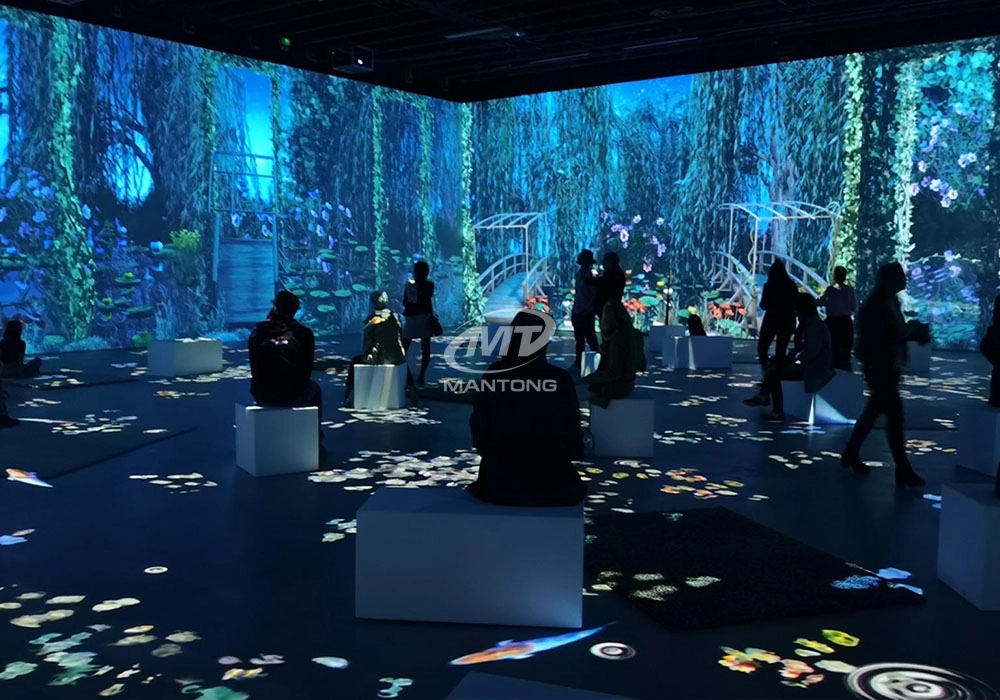
Mantong 6500LM High-Lumen Projector for Large-Scale Immersive Room Projection
Transform any space with Mantong's immersive projection mapping systems. Our high-lumen projectors (up to 6500 LM) and custom software create captivating interactive experiences for floors and walls. Ideal for museums, events, retail, and hospitality. Each kit includes professional ceiling mounting and 80+ pre-loaded video contents and is backed by a 12-month warranty and CE certification. We offer full customization and support to bring your vision to life.
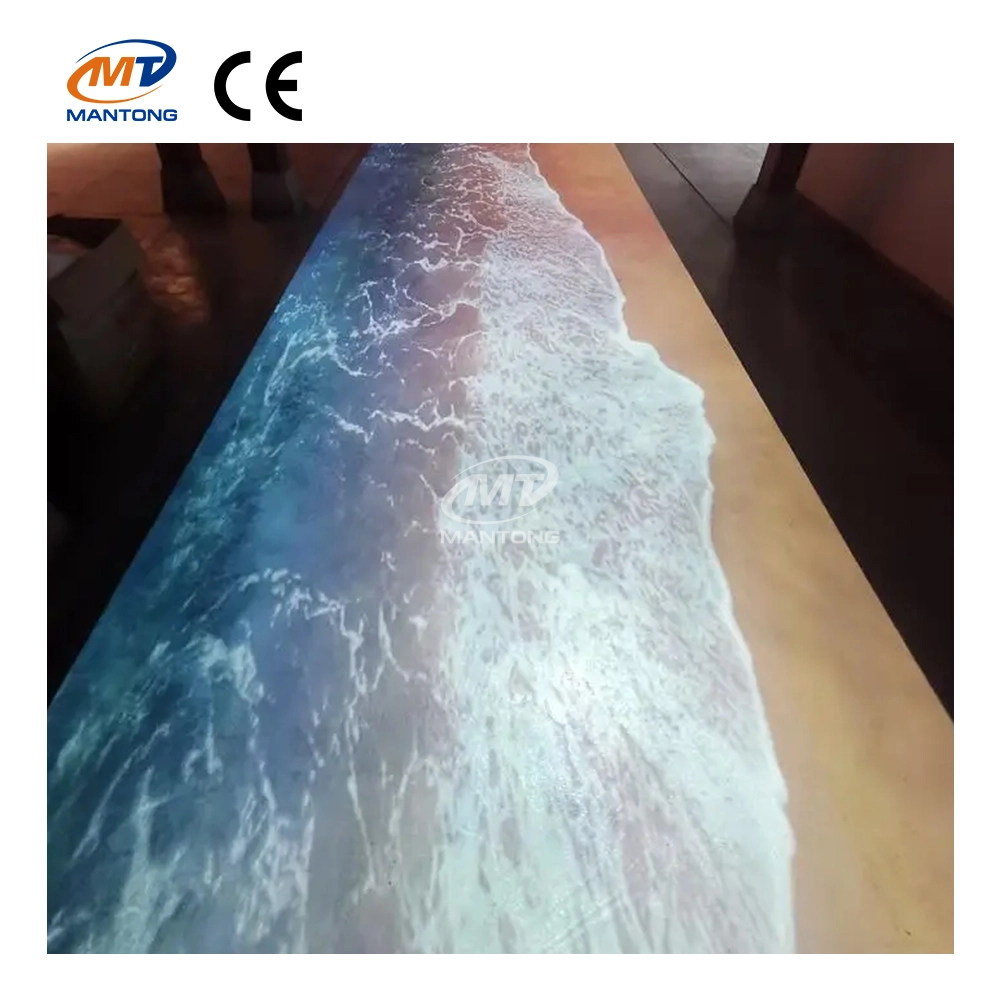
Indoor Interactive Floor Projector System - Customized Design & Installation Support
Indoor interactive floor projections display dynamic themed videos on the floor, commonly used in venues aiming to enhance brand influence or attract foot traffic, such as restaurants, hotel corridors, and brand car retail stores.
By using projectors and compatible software, the interactive content is projected onto the floor, encouraging engagement between people and the projected visuals. A single 5500-lumen indoor floor projector can cover an area of 5 m × 3 m. Typically, each project will use at least 3 units to ensure broad coverage and optimal visual effects.
We also offer customized design and installation support to enhance the interactive experience for your venue.
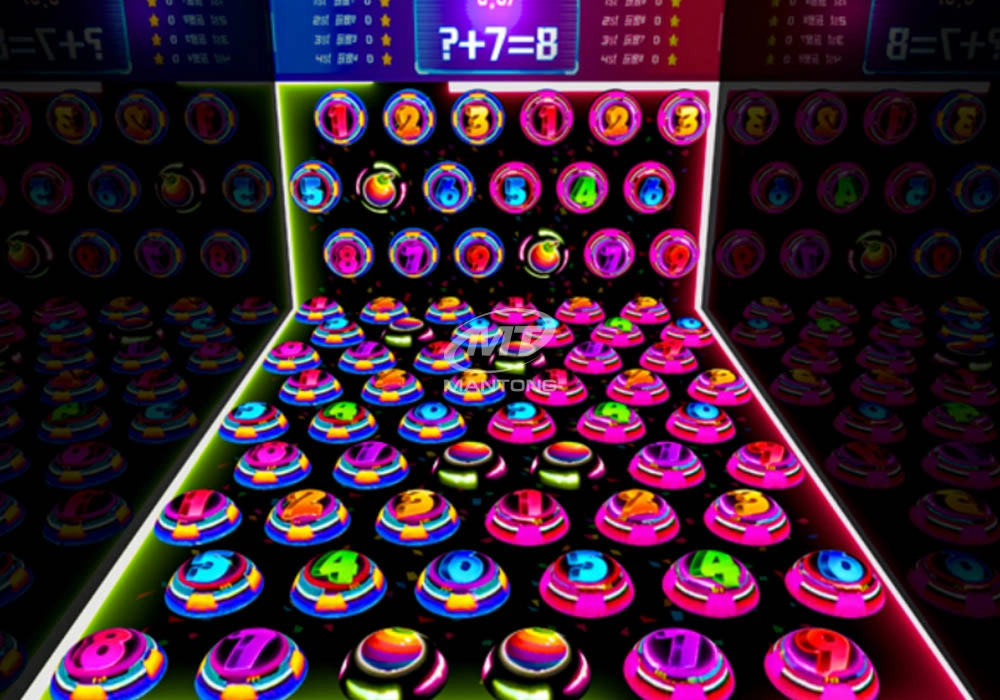
Amusement Rapidly Rotating Bouncing Sphere Interactive Wall Floor Projection Sports Games
Rapidly Rotating Bouncing Sphere is an interactive space where participants jump on rotating spheres. As they step on it, the spheres surface will show special interactivity
Jumping on spheres of the same color in succession causes them to pop, releasing light particles. The more consecutive jumps, the greater the reward—caterpillars appear, and eventually, all spheres of that color burst, filling the space with light and even more caterpillars.
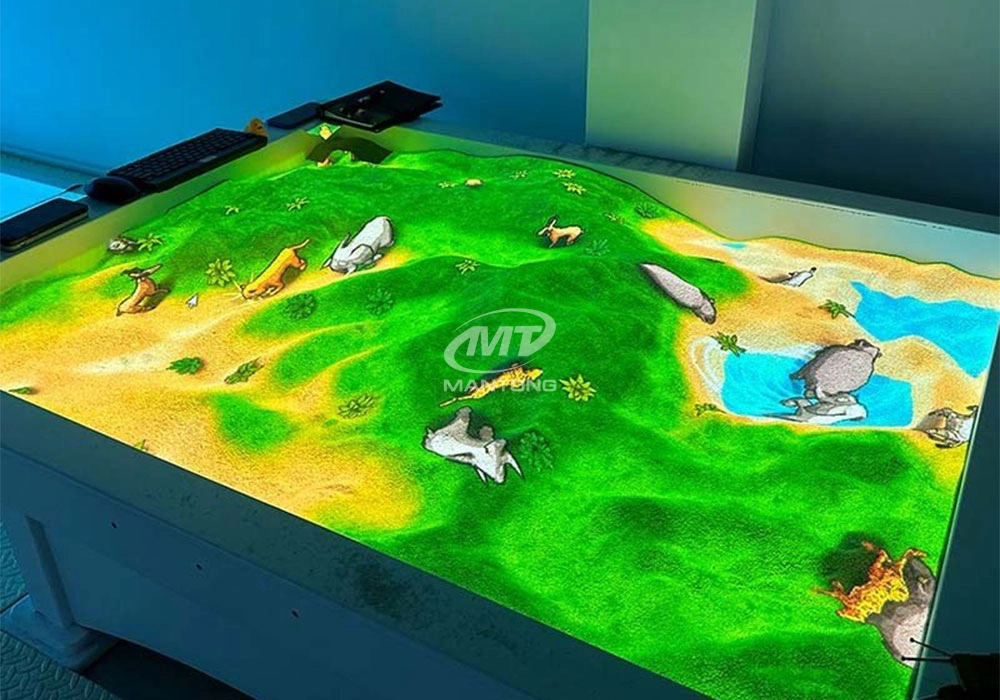
Interactive Sandbox Projection Mapping Games For Kids Play Park
Bring imagination to life with interactive sandbox projection mapping games designed for kids’ play parks. Using cutting-edge projection technology and real-time motion sensing, children can dig, build, and explore virtual worlds directly in the sand. Educational, engaging, and endlessly fun — it’s the perfect blend of play and learning.

Kaida Business Center, Shixin Road, Panyu District,Guangzhou City, Guangdong Province, China.
ManTong
ManTong
ManTong