
Interactive Projector Games for Physical Therapy
- Why motion-based rehabilitation works
- Neuroplasticity, repetition and task specificity
- Motivation, adherence and gamified feedback
- Designing interactive projector games for therapy
- Assessment-driven game mechanics
- Safety, accessibility and universal design
- Data capture and objective outcome measures
- Implementation, measurement and evidence
- Hardware and software setup
- Clinical evidence and outcome measurement
- Examples and case evidence
- How interactive projector games compare to other modalities
- Selecting a provider and why ManTong Digital
- Technical strengths and customization
- What ManTong offers for rehabilitation settings
- Products and application areas
- Deployment, training and quality assurance
- Practical checklist to start a projection-based therapy program
- Frequently Asked Questions (FAQ)
- 1. Are interactive projector games evidence-based?
- 2. How much space and what hardware do I need?
- 3. Can projector games be used with patients who have cognitive impairment?
- 4. What about infection control and shared equipment?
- 5. How do I measure clinical effectiveness?
- 6. How much does a system cost?
Interactive projector games for physical therapy are emerging as a practical, scalable tool to increase patient engagement, deliver high-repetition therapeutic tasks and provide objective performance metrics in clinical and community settings. In this article I summarize the clinical rationale, evidence, design principles, hardware/software options, implementation steps and vendor-selection criteria to help clinicians, rehab managers and decision-makers adopt projection-based interventions safely and effectively.
Why motion-based rehabilitation works
Neuroplasticity, repetition and task specificity
I base my approach on two well-established rehabilitation principles: neuroplasticity and task-specific repetitive practice. Neuroplasticity — the brain's ability to reorganize itself — is critical to recovery after stroke, brain injury and many neuromotor conditions (Wikipedia: Neuroplasticity). Repetition and task-specific practice drive functional gains, and interactive projector games create opportunities for high-volume, motivating repetitions in functional contexts.
Motivation, adherence and gamified feedback
Motivation is a major barrier in therapy adherence. Gamification elements — goals, scores, immediate feedback and progressive difficulty — increase intrinsic motivation and adherence, which in turn improves dosage of practice. Systematic reviews of virtual reality and gamified interventions in rehabilitation show consistent improvements in engagement and, in many cases, functional outcomes compared with conventional therapy alone (Cochrane Review: Virtual reality for stroke rehabilitation).
Designing interactive projector games for therapy
Assessment-driven game mechanics
When I design or evaluate interactive projector games for physical therapy, I start with clinical assessment. Games must map to therapeutic goals: balance, weight shift, gait initiation, range-of-motion, reaching, hand-eye coordination, or cognitive-motor dual-tasking. For example, a balance protocol may use a projected target field that patients step to, while a shoulder protocol will project reaching targets at graded heights and directions. Each game should have adjustable parameters (speed, target size, tolerance windows) to match patient ability and progress.
Safety, accessibility and universal design
Safety is non-negotiable. I ensure surface traction, clear perimeters, non-slip mats if required, and unobstructed fall paths. Visual accessibility matters — high-contrast graphics, adjustable font/target sizes and audio cues help people with low vision or cognitive challenges. For wheelchair users, projector games should present reachable targets and sensors that capture upper-limb movement reliably. Integrating clinician-controlled pause/emergency stop and logging near-misses increases trust and safety.
Data capture and objective outcome measures
One of the strongest advantages of interactive projector games is objective data collection: counts, timing, range-of-motion estimations, center-of-pressure proxies and adherence logs. I recommend choosing systems that export session data in CSV or connect with clinical information systems to enable longitudinal outcome tracking and quality improvement.
Implementation, measurement and evidence
Hardware and software setup
Interactive projection systems typically include a short-throw projector (or ultra-short-throw), motion sensing (infrared camera, depth sensor such as Intel RealSense or Microsoft Azure Kinect, or simple RGB camera) and software that maps movements to game logic. I prefer solutions that allow easy calibration (floor plane detection, height profiling) and modularity so sensors and projectors can be replaced or upgraded independently.
Clinical evidence and outcome measurement
Clinical evidence for projection-based and screen-based gamified rehab is growing. The Cochrane review on virtual reality for stroke rehabilitation reports benefits in upper-limb function and activities of daily living when VR is used in addition to usual care (Cochrane). The World Health Organization supports integrating rehabilitation technologies into health systems and emphasizes data-driven, person-centered approaches (WHO Rehabilitation).
When measuring outcomes for interactive projector games, I track:
- Session adherence (sessions completed vs planned)
- Repetition counts and time-on-task
- Functional tests (Timed Up and Go, 10-meter walk, Fugl-Meyer, Berg Balance Scale)
- Patient-reported outcomes (pain, confidence, enjoyment)
- Objective performance metrics exported by the system
Examples and case evidence
Clinics I’ve worked with report improved session attendance and higher repetitions per session after integrating projection games. For example, a balance program for older adults increased average time-on-task from 12 to 22 minutes per session and reported subjective increase in enjoyment and clinician-observed movement quality. These outcomes mirror published evidence that interactive technologies can increase dosage and improve some functional outcomes when implemented alongside standard care (PubMed example: video game therapy reviews).
How interactive projector games compare to other modalities
I find it useful to compare interactive projector games with traditional therapy and immersive VR systems across practical criteria. The table below summarizes qualitative differences clinicians often weigh when selecting modalities.
| Criterion | Traditional Therapy | Interactive Projector Games | Immersive VR |
|---|---|---|---|
| Patient engagement | Moderate (depends on therapist) | High (visual, physical interaction, group-friendly) | High (immersive, but can cause motion sickness) |
| Accessibility | High (familiar) | High (no headset, suitable for groups and wheelchair users) | Lower for some patients (headset required) |
| Objective data | Limited (manual) | Good (automated logs, metrics) | Good (detailed tracking but data integration varies) |
| Cost (relative) | Variable (staff cost dominated) | Medium (projector and sensors; scalable) | Medium–High (headsets/licensing) |
| Evidence base | Strong (decades) | Growing (support from VR/gamification reviews) | Growing (strong for specific conditions) |
Sources: systematic reviews and WHO guidance on rehabilitation technology (Cochrane), general rehabilitation policy (WHO).
Selecting a provider and why ManTong Digital
Technical strengths and customization
When choosing a vendor I prioritize: hardware reliability, flexibility of software (customizable games, adjustable difficulty), sensor accuracy, data export capabilities and after-sales support. ManTong Digital is a one-stop interactive projection solution provider and direct manufacturer based in Guangzhou, China, with over 10 years of industry experience. We are dedicated to providing innovative, flexible and cost-effective projection solutions, offering both hardware and software to meet various needs.
What ManTong offers for rehabilitation settings
At ManTong, we specialize in providing customized solutions for a wide range of application scenarios through innovative projection technology. Whether it's immersive experiences, interactive entertainment or outdoor lighting and projection shows, our solutions can transform your ideas into stunning visual effects. Our projection technology provides customized solutions for a variety of scenarios, delivering immersive and interactive visual experiences.
Key strengths I observe in ManTong:
- Direct manufacturing: tighter cost control and faster hardware lead times.
- End-to-end offerings: projector hardware, sensing modules, middleware and tailored software including clinical game templates.
- Customization capability: I can request specific game mechanics mapped to therapy protocols and have them developed to clinic requirements.
- Installation & support: global partnerships and deployment services for clinics, rehab centers and public-health projects.
We are now looking for business partnerships worldwide. Our vision is to become the world's leading interactive projection manufacturer. Our website is https://www.mtprojection.com/
Products and application areas
ManTong’s main products and strengths include immersive projection, interactive floor projection, interactive wall projection, immersive rooms, 3D projection, interactive projection games, projection shows, and interactive projection mapping. These product lines are suitable for clinics, senior care centers, pediatric therapy, community rehab hubs and research institutions seeking scalable, evidence-informed interactive therapy tools.
Deployment, training and quality assurance
In my projects I require the vendor to provide on-site commissioning, clinician training, remote monitoring tools, and a warranty/maintenance plan. ManTong’s integrated offering typically includes these services, enabling quicker clinician adoption and lower downtime. For large deployments, they can provide customization roadmaps and multi-site rollout plans.
Practical checklist to start a projection-based therapy program
- Define clinical goals and target populations (e.g., post-stroke upper limb, pediatric GMFCS I–III).
- Select games that map directly to assessment items and functional tasks.
- Ensure space safety: non-slip flooring, clear boundaries, emergency stop accessible.
- Choose sensors and projectors with adequate resolution and latency (low latency <50 ms recommended for responsive interaction).
- Plan data capture & integration pathways for outcome measurement.
- Train clinicians and pilot with a small cohort before scaling.
- Collect and review objective metrics and patient-reported outcomes quarterly.
Frequently Asked Questions (FAQ)
1. Are interactive projector games evidence-based?
Research on gamified and virtual-reality-assisted rehabilitation shows promising results for engagement and some functional outcomes. Systematic reviews (for example, the Cochrane review on VR for stroke) support the adjunctive use of virtual and gamified tools alongside conventional therapy (Cochrane). Projection-based systems fall under the broader VR/interactive technology category; quality of implementation matters for outcomes.
2. How much space and what hardware do I need?
Typical setups require a cleared floor area (e.g., 2–4 m wide for many balance/gait tasks) and a short-throw projector mounted overhead or on a wall, plus a sensing camera (depth or infrared). Wall-projection setups may need less floor space. ManTong can advise exact dimensions depending on the chosen game library and therapeutic goals.
3. Can projector games be used with patients who have cognitive impairment?
Yes, with appropriate design adjustments: simplified rules, slower pacing, larger targets, stronger audio cues and therapist supervision. I recommend trialing with a single patient and clinician supervision, and using games specifically designed for low cognitive load.
4. What about infection control and shared equipment?
Projection systems reduce contact surfaces compared with handheld devices. Still, follow your facility’s infection-control policies: clean nearby surfaces, use removable waterproof mats if used, and sanitize any physical props between patients.
5. How do I measure clinical effectiveness?
Combine objective in-game metrics (counts, accuracy, time-on-task) with standard clinical measures (e.g., 10MWT, TUG, Fugl-Meyer) and patient-reported outcomes. Use pre/post measures and, where possible, compare cohorts or use crossover designs to evaluate impact.
6. How much does a system cost?
Costs vary by configuration. Interactive projector systems are typically less expensive to deploy at scale than multi-headset VR setups because no individual headsets are required and group therapy is feasible. For a precise quote, contact ManTong at https://www.mtprojection.com/ to discuss hardware/software packages and customization.
If you’d like help selecting games, running a pilot, or developing custom therapeutic content, contact me or request a consultation with ManTong. Visit https://www.mtprojection.com/ to view product specs, request demos and explore partnership opportunities.
Contact & Consultation: For clinical pilots, technical demos or partnership inquiries, please reach out via ManTong’s website (https://www.mtprojection.com/) or request a project consultation to discuss custom interactive projector games tailored to your therapy program.
Best The Future of Business Meetings: Exploring Immersive Meeting Room Technology manufacturers and supplier brands
Best professional water curtain projection mapping manufacturers and supplier brands in China
Sustainability trends in the interactive projector market
Top global interactive experience companies list
One-Stop Projection Solution Provider Since 2011
Are you trader or manufacturer ?
We are direct manufacturer who specialize in providing one-stop solution for different outdoor & indoor projection project with our stable software and qualified projectors
How to install the projection equipment ?
1) Install the projector in a suitable position. We will provide you with a hanger, which you need to fix on the ceiling with
screws.
2) Connect projectors, computers and other accessories through wires.
3) After completing the above 2 steps, we will carry out the edge blending steps. Our team can complete it through remote
control.
In general, installation instructions for each project need to be specified on a project-by-project basis. The above is for
reference only.
What's Immersive Projection ?
Immersive projection refers to a technology that creates a captivating and all-encompassing visual experience for viewers by projecting images or videos onto large surfaces, such as walls, floors, or even entire rooms. This technology aims to immerse the audience in a simulated environment, blurring the boundaries between the physical and virtual worlds.
What's the application of Immersive projection ?
It can be used in various venues, such as art exhibition, entertainment venues, educational institution, Wedding hall /Banquet/Bar,Yoga Studio and so on. It often involves advanced projection techniques, multimedia content, and interactive elements to engage and captivate the audience's senses.
What about the wall/floor material for the projection?
It’s recommended to choose a light-colored material with minimal reflectivity—pure white or light grey works best. the
common material is cement & plaster board
For optimal projection results, the surface should be free of any patterns or textures, as the projector will display content
directly onto it.
There are no specific material requirements; you may use any commonly available material in your local market, as long as it
meets the above conditions.
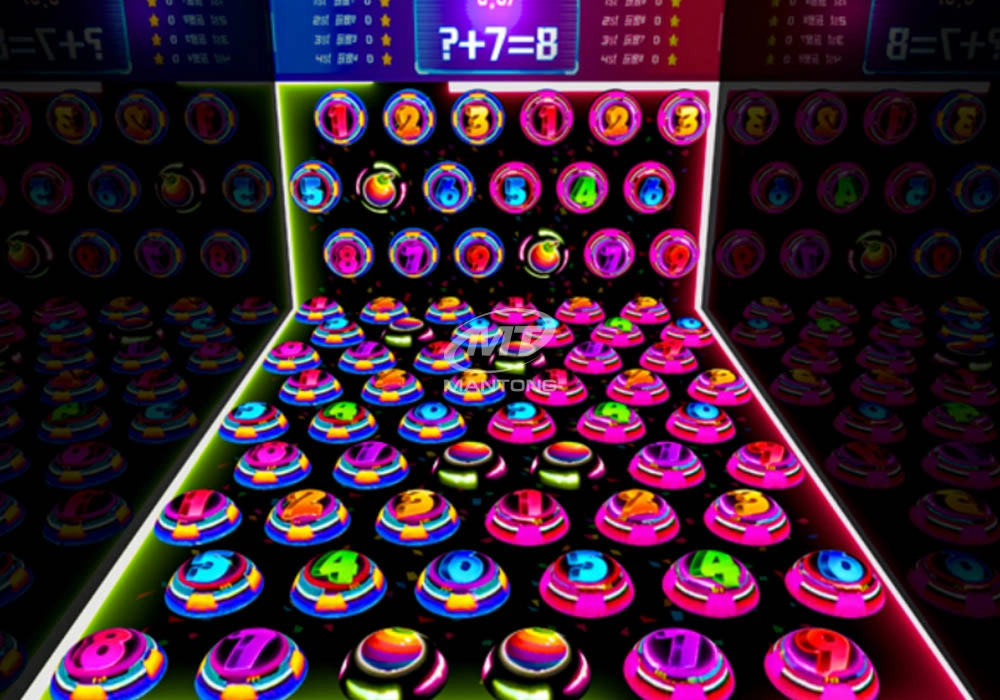
Amusement Rapidly Rotating Bouncing Sphere Interactive Wall Floor Projection Sports Games
Rapidly Rotating Bouncing Sphere is an interactive space where participants jump on rotating spheres. As they step on it, the spheres surface will show special interactivity
Jumping on spheres of the same color in succession causes them to pop, releasing light particles. The more consecutive jumps, the greater the reward—caterpillars appear, and eventually, all spheres of that color burst, filling the space with light and even more caterpillars.
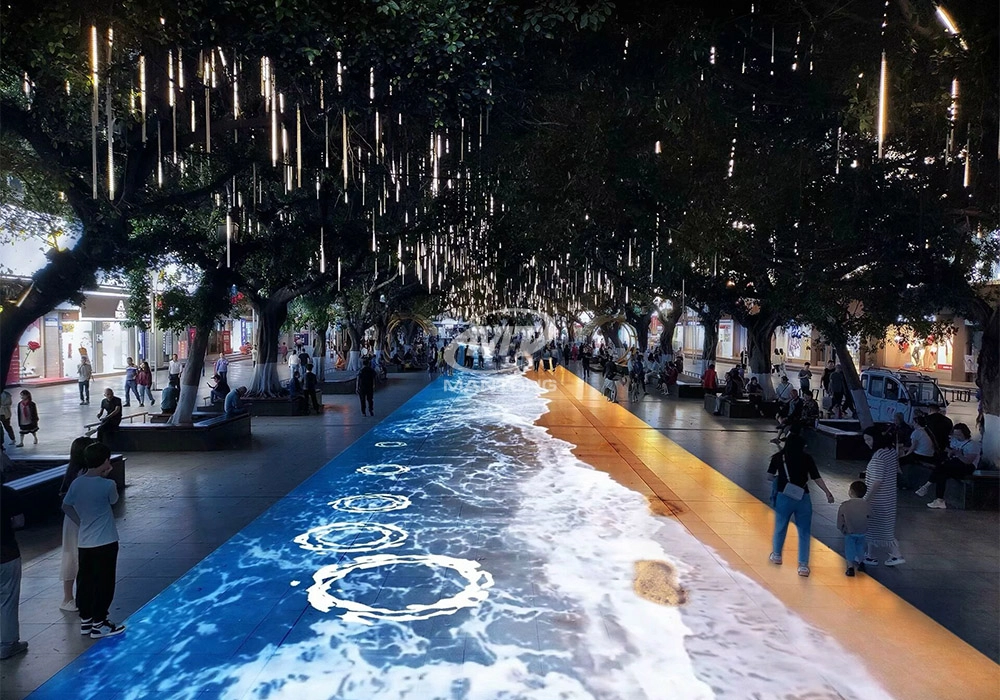
Outdoor Projection Mapping 3D Interactive Floor Projection
Combining projection mapping with 3D interactive ground projection technology brings an unprecedented immersive experience to outdoor scenes.
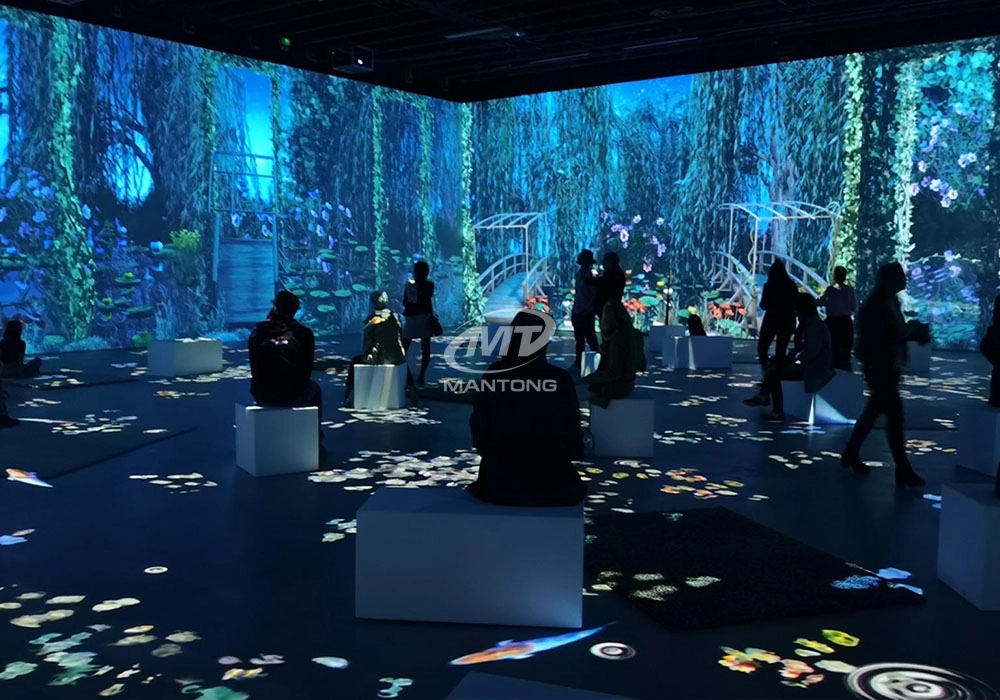
Mantong 6500LM High-Lumen Projector for Large-Scale Immersive Room Projection
Transform any space with Mantong's immersive projection mapping systems. Our high-lumen projectors (up to 6500 LM) and custom software create captivating interactive experiences for floors and walls. Ideal for museums, events, retail, and hospitality. Each kit includes professional ceiling mounting and 80+ pre-loaded video contents and is backed by a 12-month warranty and CE certification. We offer full customization and support to bring your vision to life.
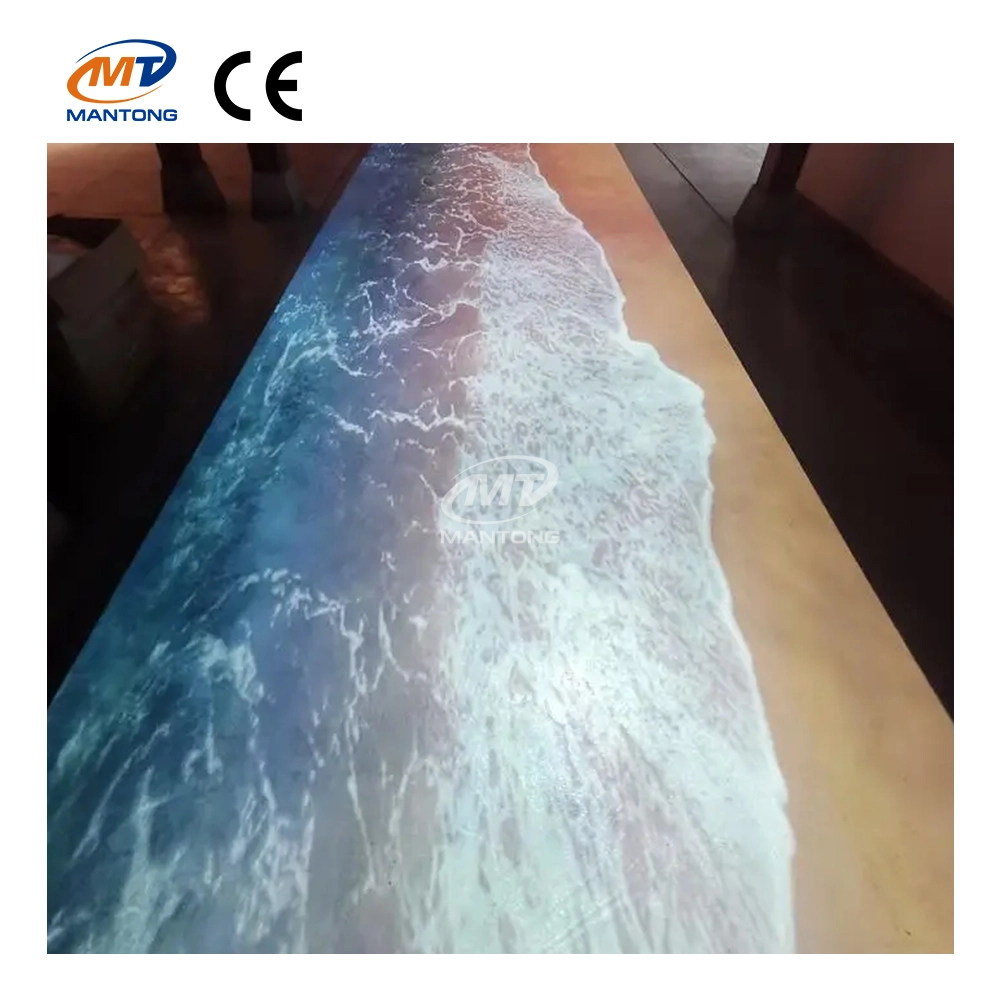
Indoor Interactive Floor Projector System - Customized Design & Installation Support
Indoor interactive floor projections display dynamic themed videos on the floor, commonly used in venues aiming to enhance brand influence or attract foot traffic, such as restaurants, hotel corridors, and brand car retail stores.
By using projectors and compatible software, the interactive content is projected onto the floor, encouraging engagement between people and the projected visuals. A single 5500-lumen indoor floor projector can cover an area of 5 m × 3 m. Typically, each project will use at least 3 units to ensure broad coverage and optimal visual effects.
We also offer customized design and installation support to enhance the interactive experience for your venue.

Kaida Business Center, Shixin Road, Panyu District,Guangzhou City, Guangdong Province, China.
ManTong
ManTong
ManTong