
Multi-user Interactive Projector Walls for Collaborative Workspaces
- Transforming Collaboration with Large-Scale Projection
- Why an interactive projector wall matters in modern workspaces
- Key benefits of deploying an interactive projector wall in collaborative environments
- interactive projector wall: collaboration, scale and flexibility
- Common use cases where interactive projector walls outperform alternatives
- interactive projector wall for meetings, design and training
- Technical components and integration choices
- interactive projector wall: projector, sensing, and software stack
- Designing for multi-user input and UX patterns
- interactive projector wall: multi-user interaction design principles
- Comparison: interactive projector wall vs large touch displays vs interactive whiteboards
- interactive projector wall: choosing the right collaboration surface (comparison)
- Installation, calibration and maintenance best practices
- interactive projector wall: deployment checklist and service expectations
- Measuring ROI: productivity, space utilization and hardware economics
- interactive projector wall: estimating return on investment
- Mantong Digital: turnkey interactive projection solutions
- interactive projector wall: Mantong Digital’s strengths and offerings
- Real-world examples and small case study
- interactive projector wall: practical outcomes
- Common pitfalls and how to avoid them
- interactive projector wall: deployment risks and mitigations
- Procurement checklist for IT and AV decision-makers
- interactive projector wall: what to require from vendors
- FAQs
- interactive projector wall: frequently asked questions
- Contact and next steps
- interactive projector wall: request a consultation or view products
- References and further reading
Transforming Collaboration with Large-Scale Projection
Why an interactive projector wall matters in modern workspaces
An interactive projector wall combines a high-brightness projector (or multiple projectors), projection surface, and interactive sensing (camera, IR, or depth sensors) to create a large touch- or gesture-enabled surface for teams. As hybrid and distributed work models persist, teams need shared visual environments that allow simultaneous input from multiple users, seamless content sharing, and spatial context for complex information. An interactive projector wall addresses these needs by providing a scalable, cost-efficient, and immersive collaboration surface compared with single-screen touch displays.
Key benefits of deploying an interactive projector wall in collaborative environments
interactive projector wall: collaboration, scale and flexibility
Deploying an interactive projector wall delivers several measurable benefits:
- Scale and visibility — walls can span several meters, enabling large-group viewing and detailed simultaneous content (CAD drawings, maps, dashboards).
- Multi-user interaction — modern systems support concurrent touch/gesture input from multiple participants, improving engagement during workshops and design reviews.
- Flexible content layout — content can be windowed, scaled, or tiled across the surface, supporting parallel workstreams and side-by-side comparisons.
- Cost-per-inch advantage — compared to multiple large-format interactive LCDs, projection often gives lower cost for very large areas.
- Immersive experiences — projection mapping and edge blending create bezel-free visuals for storytelling and simulation training.
Common use cases where interactive projector walls outperform alternatives
interactive projector wall for meetings, design and training
Practical scenarios that benefit from interactive projection:
- Design review and co-creation — architects and engineers annotate high-resolution drawings simultaneously.
- Map-based planning and operations centers — situational awareness across broad displays.
- Workshops and ideation sessions — multiple participants write, move objects and vote in real time.
- Training and simulation — immersive scenarios where environment-scale visuals are required.
- Public and retail interactive exhibits — durable projection surfaces for visitor engagement.
Technical components and integration choices
interactive projector wall: projector, sensing, and software stack
An interactive projector wall comprises three core layers:
- Projection hardware — single ultra-short-throw (UST) laser projector, multiple blended projectors, or LED wall with projection overlay.
- Interaction sensing — camera-based optical tracking (infrared/visual), IR light pens, capacitive film, or depth sensors (ToF). Choice depends on ambient light, surface material, and required touch fidelity.
- Software and content — multi-touch middleware, calibration and edge-blend software, application frameworks (5, Unity/Unreal for immersive apps), and remote-collaboration integrations (Zoom, MS Teams, WebRTC).
Considerations when selecting components:
- Ambient light: laser projectors (4,000–12,000+ lumens) perform better in well-lit rooms than lamp-based units.
- Resolution: for detailed CAD work, choose WUXGA/4K projection and ensure source PC/GPU supports required resolutions.
- Latency: interaction sensing and networked collaboration must target <60 ms end-to-end for natural feel.
- Calibration: automated multi-projector geometry correction and frequent re-calibration support reduce maintenance overhead.
Designing for multi-user input and UX patterns
interactive projector wall: multi-user interaction design principles
Designing a productive multi-user environment requires more than hardware; it needs UX patterns and rules:
- Spatial partitioning — allow simultaneous independent regions (e.g., quadrant mode) so users don't conflict over the same area.
- Pointer identity — indicate who is interacting (color cursors or labeled annotations) to avoid confusion in collaborative sessions.
- Interaction affordances — use big drag handles, sticky notes, and gestures suitable for standing and group interaction rather than small targets.
- Session control — easy session save/load, role-based locks, and undo/redo to manage authoring conflicts.
These patterns improve meeting efficiency; a Harvard Business Review analysis of collaborative overload suggests structured meetings and clear roles mitigate wasted coordination time (HBR 2016).
Comparison: interactive projector wall vs large touch displays vs interactive whiteboards
interactive projector wall: choosing the right collaboration surface (comparison)
| Attribute | Interactive Projector Wall | Large Touch LCD | Interactive Whiteboard |
|---|---|---|---|
| Maximum effective size | Very large (meters); scalable with multiple projectors | Limited by panel size (up to 100 typical) | Large but limited; often single-surface |
| Multi-user support | High (concurrent touch/gesture across surface) | Medium (multi-touch but limited by size) | Medium; pen-first interactions |
| Cost per square meter | Lower for very large installations | Higher as size increases | Variable; depends on vendor |
| Brightness in ambient light | Depends on projector lumens; high-end laser supports bright rooms | High (direct emissive display) | Depends on projector specs |
| Installation complexity | Higher (mounting, calibration, blending, sensors) | Lower (plug-and-play) | Moderate |
| Maintenance & lifespan | Laser projectors: 20,000+ hours; cameras need calibration | Long (panels 7–10 years typical) | Depends on projector type |
Sources: vendor product pages and industry analyses (see references).
Installation, calibration and maintenance best practices
interactive projector wall: deployment checklist and service expectations
Successful deployments follow a clear process:
- Requirements analysis — participants, activities, lighting, room dimensions and AV rack location.
- Hardware selection — projector brightness, throw type (UST vs short throw), lens shift, cameras/sensors and mounting hardware.
- Surface selection — matte white or projection fabric with low gain to minimize hotspots.
- Calibration — geometric warping, edge blending and sensor-to-projector mapping using automated tools.
- Network & security — secure device management, software updates and content access control (SAML/SSO as needed).
- Training & UX tuning — user training and on-site refinement of interaction zones and templates.
- Maintenance SLA — schedule preventive maintenance for projector optics and sensor recalibration intervals.
Measuring ROI: productivity, space utilization and hardware economics
interactive projector wall: estimating return on investment
ROI depends on use frequency and value of improved outcomes. Common metrics to track:
- Meeting efficiency — shorter meeting times and better decision velocity.
- Design iteration cycles — fewer review rounds due to simultaneous multi-person editing.
- Room utilization — fewer duplicate rooms needed when a single immersive room supports multiple teams.
- Training throughput — more trainees per session with immersive scenarios.
Example (illustrative): if a design team of 10 reduces a single weekly 2-hour review by 30 minutes because of more effective collaboration, annual labor hours saved = 10 * 0.5h * 52 = 260 person-hours; multiplied by average fully loaded labor cost yields a tangible annual benefit that can offset equipment and service costs within 1–3 years in many cases.
Mantong Digital: turnkey interactive projection solutions
interactive projector wall: Mantong Digital’s strengths and offerings
Mantong Digital is a one-stop interactive projection solution provider and direct manufacturer based in Guangzhou, China, with over 10 years of industry experience. Mantong provides full-stack projection solutions — hardware and software — for immersive projection, interactive floor projection, interactive wall projection, interactive projection games, 3D projection, projection shows and immersive rooms.
Key Mantong advantages:
- Manufacturer integration — direct control over optics, sensors and embedded software reduces cost and improves compatibility.
- Customization capability — tailored solutions for corporate collaboration rooms, museums, retail and outdoor shows.
- Proven product lines — immersive projection, interactive floor projection, interactive wall projection, immersive rooms and projection mapping suites.
- Global partnership focus — Mantong is actively seeking international business partnerships and offers turnkey deployment services.
- R&D and quality — over a decade of iterative product development targeting durability, low-latency multi-user interaction and robust calibration tools.
For details and product inquiries visit https://www.mtprojection.com/.
Real-world examples and small case study
interactive projector wall: practical outcomes
Case summary (anonymized): an engineering firm deployed a 4.5m x 2.5m interactive projector wall for cross-discipline design workshops. After 6 months they reported:
- Meeting cycle time reduced by 25% for design reviews.
- Reduction of physical printouts and mockups, saving ~$12,000 annually.
- Improved stakeholder engagement; faster sign-off reduced project delays.
These operational improvements are consistent with industry observations that shared large-format visualization tools improve collaborative decision-making and reduce iteration costs.
Common pitfalls and how to avoid them
interactive projector wall: deployment risks and mitigations
Frequent issues:
- Poor ambient control — underpowered projector leads to washed-out images; mitigate by choosing higher-lumen laser projectors and appropriate surface gain.
- Inadequate interaction mapping — jittery pointers due to low-quality sensors; mitigate with better cameras, higher frame rates and calibration routines.
- Insufficient UX design — small UI elements or no user identity; mitigate by investing in interaction design tailored for standing, group use.
- Lack of maintenance plan — calibration drift and projector dust degrade performance; mitigate with SLAs and scheduled checks.
Procurement checklist for IT and AV decision-makers
interactive projector wall: what to require from vendors
When evaluating vendors, request:
- Reference installations and contactable case studies in similar industries.
- Detailed calibration and maintenance procedures, including automation tools and frequency.
- Latency and multi-user performance metrics (measured under ambient conditions).
- Security features for networked systems (firmware update process, authentication).
- Warranty and spare parts plan for projectors, sensors and mounts.
FAQs
interactive projector wall: frequently asked questions
- What is an interactive projector wall and how does it differ from an interactive whiteboard?
An interactive projector wall is a large-scale projected surface combined with interaction sensing (cameras, IR, depth) allowing multi-user touch and gestures. Unlike single-panel interactive whiteboards, projector walls can be much larger and spatially flexible; they require projection alignment and sensor calibration.
- How many users can interact simultaneously?
Modern systems typically support 4–20 concurrent touch or pointer inputs depending on software and sensing method. The practical limit depends on interaction design and the sensing hardware used. For very large walls, spatial partitioning optimizes concurrent use.
- Are projector walls suitable for brightly lit conference rooms?
Yes, if you use high-lumen laser projectors (6,000+ lumens depending on screen size) or control ambient light. Projection surfaces with appropriate gain and anti-glare properties also help. Alternatively, hybrid setups (projector + LED accents) can be used.
- What maintenance is required?
Laser projectors have long lifespans (often 20,000+ hours) but still need dust management and occasional optical checks. Sensors may require recalibration periodically. Vendors should offer maintenance SLAs and remote health monitoring.
- How does an organization measure the ROI of an interactive projector wall?
Track meeting time reduction, faster decision cycles, decrease in physical mockups, increased throughput in training sessions, and room utilization. Translate saved hours into monetary value and compare to total cost of ownership (equipment + installation + service).
- Can remote participants interact with the wall?
Yes — by integrating collaborative software (WebRTC-based applications, cloud whiteboards) remote users can annotate and control content. System design must account for synchronization and latency mitigation.
- How long does installation take?
Typical small-to-mid installations (single projector, single wall) take 1–3 days including calibration and basic training. Larger multi-projector systems can take several days to a week depending on complexity and site preparation.
Contact and next steps
interactive projector wall: request a consultation or view products
If you’re planning a collaborative space upgrade, Mantong Digital offers consultation, custom design and turnkey installation. Visit https://www.mtprojection.com/ to explore product lines (immersive projection, interactive floor projection, interactive wall projection, interactive projection games, 3D projection, immersive room, interactive projection mapping) and request a quote. For partnership inquiries, Mantong is seeking global business partners and integrators.
References and further reading
- Projection mapping — Wikipedia. https://en.wikipedia.org/wiki/Projection_mapping (accessed 2025-12-25)
- Digital light processing — Wikipedia. https://en.wikipedia.org/wiki/Digital_light_processing (accessed 2025-12-25)
- Interactive whiteboard — Wikipedia. https://en.wikipedia.org/wiki/Interactive_whiteboard (accessed 2025-12-25)
- Hybrid work preference and trends — Statista. https://www.statista.com/statistics/1202243/hybrid-work-employee-preference-2022/ (accessed 2025-12-25)
- Collaborative overload — Harvard Business Review. https://hbr.org/2016/01/collaborative-overload (accessed 2025-12-25)
- Mantong Digital — Official site. https://www.mtprojection.com/ (accessed 2025-12-25)
The latest trends for interactive floor projectors in 2026 | Mantong Ultimate Insights
Top 5 immersive escape room Company List and Products Compared
Top Interactive Projector Trends to Watch in 2025
Top interactive projection Manufacturers and Suppliers in Guangzhou
One-Stop Projection Solution Provider Since 2011
What's Immersive Projection ?
Immersive projection refers to a technology that creates a captivating and all-encompassing visual experience for viewers by projecting images or videos onto large surfaces, such as walls, floors, or even entire rooms. This technology aims to immerse the audience in a simulated environment, blurring the boundaries between the physical and virtual worlds.
What about the wall/floor material for the projection?
It’s recommended to choose a light-colored material with minimal reflectivity—pure white or light grey works best. the
common material is cement & plaster board
For optimal projection results, the surface should be free of any patterns or textures, as the projector will display content
directly onto it.
There are no specific material requirements; you may use any commonly available material in your local market, as long as it
meets the above conditions.
How to install the projection equipment ?
1) Install the projector in a suitable position. We will provide you with a hanger, which you need to fix on the ceiling with
screws.
2) Connect projectors, computers and other accessories through wires.
3) After completing the above 2 steps, we will carry out the edge blending steps. Our team can complete it through remote
control.
In general, installation instructions for each project need to be specified on a project-by-project basis. The above is for
reference only.
What information do you need to know before making the proposal/solution?
We know that everyone wants to know the price, but the price of our products is determined by many factors since most of our products are custom, so no ready price list. In order to fast understand what you need, can you send us an inquiry like this?
For example: I am really interested in your immersive projection products, we are a company in the USA and want to install some in my restaurant. It is about 50 meters long, and 5m in width. Projection size you can decide but the length should be not less than 20 meters. We want some content about SeaWorld because our place is all about the sea. Thank you.
How to Write an Interactive-Effect Video Customisation Script ?
① Project Background: Briefly introduce the context in which this interactive scene will be used (e.g., exhibition, museum,
event space, children's area). Example: This scene is part of the “Underwater World” zone in a children's science museum,
designed to be engaging and exploratory.
②Visual Style / Atmosphere: What kind of visual mood are you aiming for? Please describe the color scheme, style, and any
references. it should focus solely on describing the visual aspects of the scene, supported by relevant charts or reference
images.
③ Interaction Points Overview:List each interactive hotspot along with the effect you'd like to trigger when the user
touches or clicks the area. example: when player touch the clownfish, it will swims away with bubble trail (animation effect)
and produce the bubble sound ( sound effect requirement )
④ Static Visual Reference:including but not limited to background image/video, a list of major visual elements (e.g., coral,
rocks, seaweed, fish), which elements should be interactive?
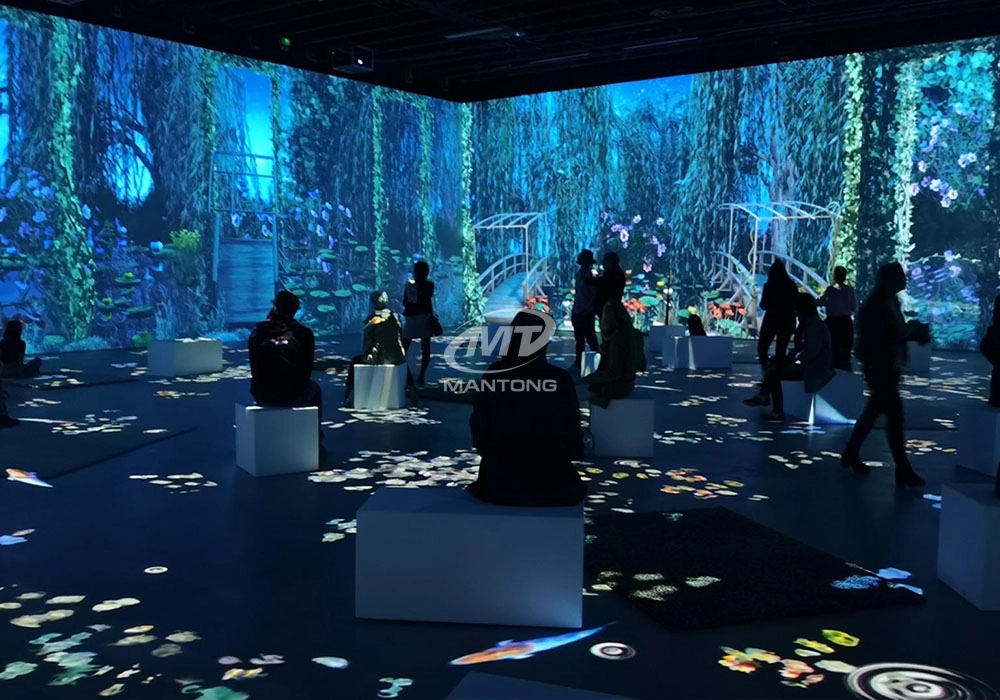
Mantong 6500LM High-Lumen Projector for Large-Scale Immersive Room Projection
Transform any space with Mantong's immersive projection mapping systems. Our high-lumen projectors (up to 6500 LM) and custom software create captivating interactive experiences for floors and walls. Ideal for museums, events, retail, and hospitality. Each kit includes professional ceiling mounting and 80+ pre-loaded video contents and is backed by a 12-month warranty and CE certification. We offer full customization and support to bring your vision to life.
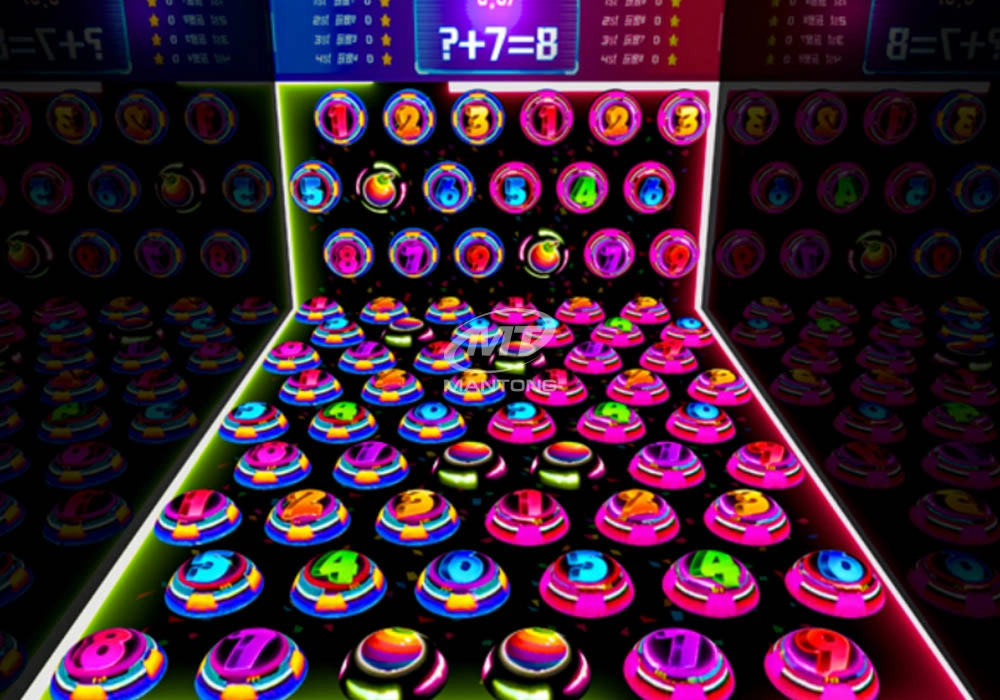
Amusement Rapidly Rotating Bouncing Sphere Interactive Wall Floor Projection Sports Games
Rapidly Rotating Bouncing Sphere is an interactive space where participants jump on rotating spheres. As they step on it, the spheres surface will show special interactivity
Jumping on spheres of the same color in succession causes them to pop, releasing light particles. The more consecutive jumps, the greater the reward—caterpillars appear, and eventually, all spheres of that color burst, filling the space with light and even more caterpillars.
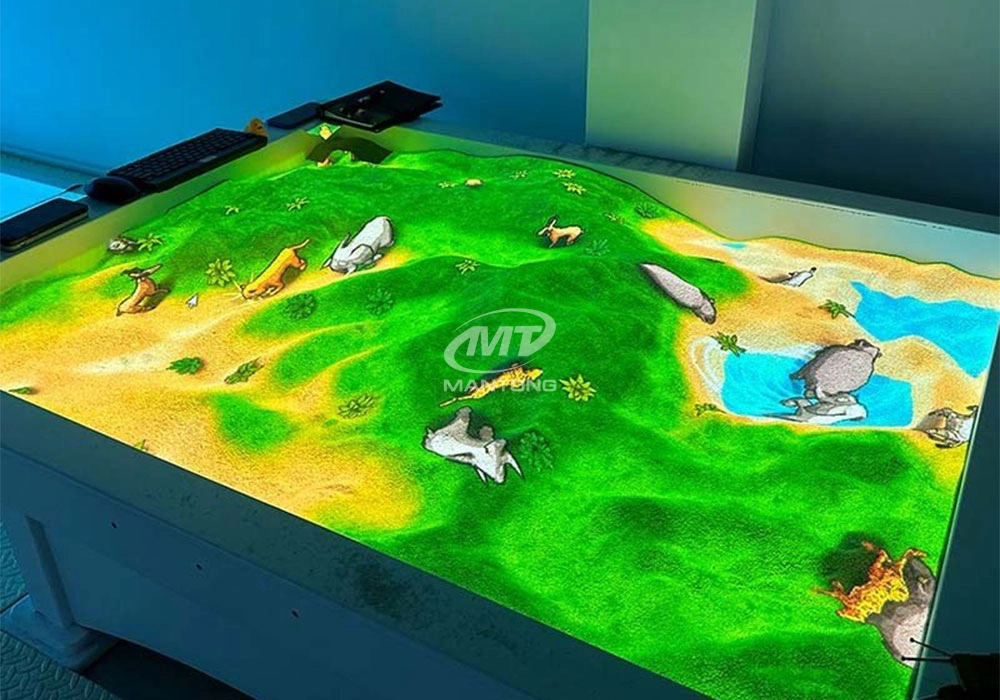
Interactive Sandbox Projection Mapping Games For Kids Play Park
Bring imagination to life with interactive sandbox projection mapping games designed for kids’ play parks. Using cutting-edge projection technology and real-time motion sensing, children can dig, build, and explore virtual worlds directly in the sand. Educational, engaging, and endlessly fun — it’s the perfect blend of play and learning.
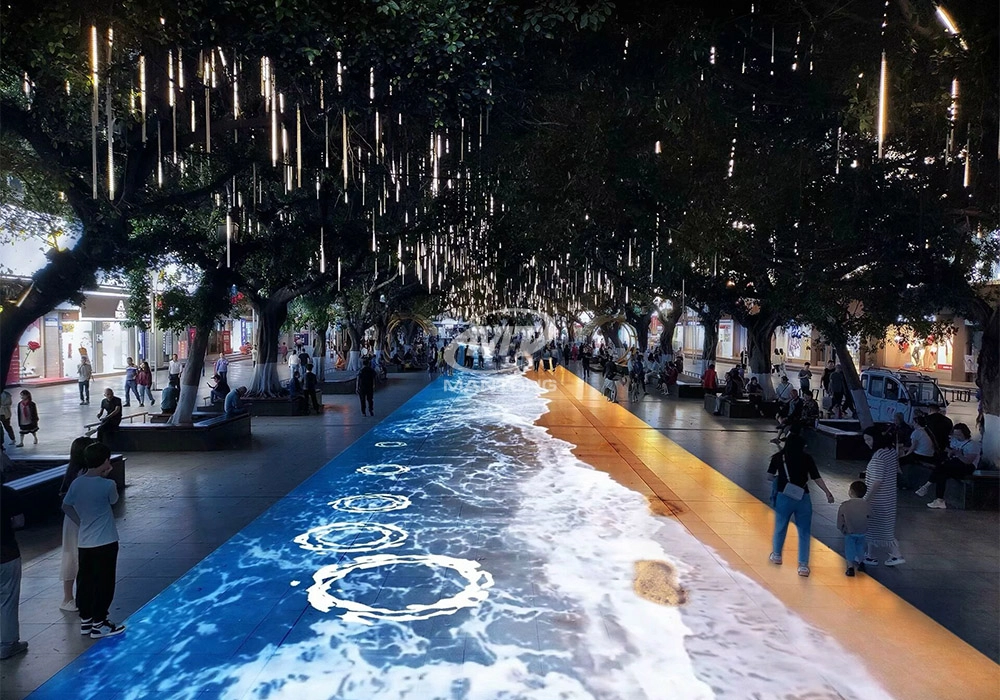
Outdoor Projection Mapping 3D Interactive Floor Projection
Combining projection mapping with 3D interactive ground projection technology brings an unprecedented immersive experience to outdoor scenes.

Kaida Business Center, Shixin Road, Panyu District,Guangzhou City, Guangdong Province, China.
ManTong
ManTong
ManTong