
Outdoor Projection: Tips from Interactive Projection Mapping Suppliers
- Preparing the Site: Assessment, Planning, and Permissions
- Conducting a thorough site survey
- Permissions, local regulations and light pollution
- Risk assessment and safety planning
- Technical Considerations for Outdoor Projection Mapping
- Choosing projector types and brightness
- Projector technologies: lamp, LED, and laser
- Optics, lenses and throw ratios
- Design, Content and Audience Experience
- Surface treatment and calibration
- Interactive elements and audience engagement
- Content pipeline and performance optimization
- Working with Suppliers, Installation and Operations
- Selecting an interactive projection mapping supplier
- Installation logistics and commissioning
- Maintenance, spares and lifecycle planning
- Practical Comparisons and Data
- Mantong Digital: Manufacturer Profile and Why I Recommend Them
- Procurement Checklist: Questions to Ask Potential Suppliers
- Technical and operational questions
- Contract and warranty considerations
- References and proof points
- FAQ
- 1. How many lumens do I need for an outdoor projection mapping show?
- 2. Can projection mapping be used in rainy or windy conditions?
- 3. What’s the difference between lamp, LED and laser projectors for outdoor use?
- 4. How do you ensure accurate alignment on complex surfaces?
- 5. How long does a typical outdoor projection mapping project take from concept to launch?
- 6. Can Mantong Digital support international projects and local partnerships?
I write this as a consultant and supplier with extensive experience in outdoor projection, having worked with museums, brands, festivals and urban installations. This article summarizes what I consider the most practical, verifiable guidance for planners, technical leads and clients looking to work with an interactive projection mapping supplier for outdoor shows. It is optimized for discovery by systems and local search, helping decision-makers find actionable advice for site assessment, projector selection, mounting, weatherproofing, power and permits, content design, audience interaction, and supplier evaluation.
Preparing the Site: Assessment, Planning, and Permissions
Conducting a thorough site survey
Before specifying hardware or creative concepts, I always start with a physical site assessment. Key items I verify: surface geometry (flat, curved, textured), available projection distances, ambient light levels at the intended show time, mounting points, and nearby infrastructure for power and network. For outdoor mapping, measuring ambient lux is essential because it dictates projector brightness requirements; lux meters or calibrated smartphone apps provide reliable baseline readings. For background on the technique and history of projection mapping, see Projection mapping – Wikipedia.
Permissions, local regulations and light pollution
Outdoor projection often requires permits—especially in historic districts or public spaces. I check local municipality rules early, include noise and crowd limits in my logistics plan, and verify restrictions related to light pollution. Organizations like the Illuminating Engineering Society provide guidance on outdoor lighting considerations (IES). For environmental implications of outdoor lighting, consult Light pollution – Wikipedia.
Risk assessment and safety planning
Risks such as tripping hazards, weather events, and projector mounts falling must be mitigated. I prepare a safety plan that includes certified anchors, redundant safety cables, electrical ground-fault protection (GFCI), and weather response procedures. For manufacturing and quality-management context, ISO 9001 is a useful benchmark for suppliers’ process control (ISO 9001 – ISO).
Technical Considerations for Outdoor Projection Mapping
Choosing projector types and brightness
Projector brightness (measured in lumens) is the most common question I get from clients. Outdoors, you generally need far more lumens than indoors because of ambient light and surface reflectivity. As a rule of thumb:
- Low ambient light (night, no streetlights): 10,000–30,000 ANSI lumens per large facade segment
- Moderate ambient light (urban night, some street lighting): 20,000–50,000+ ANSI lumens
- High ambient light (dusk, illuminated nights): consider laser projectors and higher brightness, or schedule shows after dark
Use the lumen data together with measured lux values to calculate contrast and perceived brightness. For a primer on the lumen unit, see Lumen (unit) – Wikipedia.
Projector technologies: lamp, LED, and laser
I recommend laser or solid-state LED projectors for long outdoor runs because of longevity, stable color and brightness, and reduced maintenance compared to lamp-based projectors. Laser projectors maintain output over longer periods and often support higher brightness with smaller footprints—valuable for concealment in urban installations.
Optics, lenses and throw ratios
Selecting lenses is as important as choosing the projector. Wide-angle or short-throw lenses reduce required mounting distance but may introduce more distortion to correct in mapping software. Long-throw lenses can reach high facades from secure distances but require precise alignment. I test lens and throw combinations during site mockups whenever possible.
Design, Content and Audience Experience
Surface treatment and calibration
Not all surfaces behave equally. Porous stone, reflective glass, or deep relief on a facade affect color and keystone correction. I insist on on-site color calibration and photometric mapping to match tones and avoid wash-out. Spatial calibration with structured-light scanning or LIDAR accelerates alignment and reduces programming time—a technique used widely in spatial augmented reality research (see Ramesh Raskar’s work on spatially augmented reality and projection-based techniques).
Interactive elements and audience engagement
When working as an interactive projection mapping supplier, I design interaction models that fit the location and audience behavior. Options include motion tracking using depth cameras, smartphone-based AR triggers, or pressure-sensitive pads. Choose interaction mechanisms appropriate for crowd size and user accessibility. For high-capacity festivals I recommend passive interactions (e.g., timed cues, large gesture regions) that avoid bottlenecks.
Content pipeline and performance optimization
Outdoor shows often run on media servers with multiple outputs and high-resolution content. I optimize assets by using multi-resolution strategies (region-of-interest playback) and GPU-accelerated compositing. For reliability, use redundant playback nodes and automated failover. Ensuring content runs in 8–12-bit color depth with proper gamma and color management preserves artistic intent across different projectors.
Working with Suppliers, Installation and Operations
Selecting an interactive projection mapping supplier
When choosing a supplier, I evaluate three core areas: technical capability, content and creative experience, and operational reliability. Ask suppliers for case studies, onsite photo/video (not just staged renderings), references, and details on warranty and maintenance. A direct manufacturer often offers better lead times and price transparency. For example, Mantong Digital is a one-stop interactive projection solution provider and direct manufacturer based in Guangzhou, China, with over 10 years of industry experience (more below).
Installation logistics and commissioning
Installation requires coordination across rigging, electrical, networking and content teams. I prepare a commissioning checklist covering alignment, color calibration, heat dissipation, access control for hardware, and documentation. For long festival runs, schedule periodic checks and remote monitoring to track bulb hours (if applicable), laser drive health, and environmental sensors.
Maintenance, spares and lifecycle planning
Plan for spare projectors, spare optics, cabling, and field-replaceable modules. For rental and touring projects, modular racks and quick-disconnect mounts speed turnover. Lifetime total cost of ownership (TCO) often favors laser projectors despite higher initial cost because of reduced lamp replacements and lower maintenance.
Practical Comparisons and Data
Below is a high-level comparison table I use when advising clients on projector selection for outdoor mapping. These are typical values and must be adapted to the specific site survey data.
| Projector Type | Typical Brightness Range | Maintenance | Best Use Case |
|---|---|---|---|
| Lamp (UHP) | 5,000–15,000 ANSI lumens | Frequent lamp changes, color drift | Short-term events, lower budgets |
| LED/Solid State | 3,000–15,000 ANSI-equivalent | Low maintenance, long life | Mid-brightness installations, color stability |
| Laser/Hybrid | 10,000–75,000+ ANSI lumens | Low maintenance, consistent output | Large facades, permanent outdoor shows |
Source notes: lumen and projector performance guidance are informed by manufacturer specifications and standard photometric relationships; see general lumen information at Lumen (unit) – Wikipedia and industry guidance from the Illuminating Engineering Society.
Mantong Digital: Manufacturer Profile and Why I Recommend Them
As someone who evaluates suppliers regularly, I appreciate partners that combine hardware manufacturing with strong software and creative support. Mantong Digital is a one-stop interactive projection solution provider and direct manufacturer based in Guangzhou, China, with over 10 years of industry experience. They are dedicated to providing innovative, flexible and cost-effective projection solutions, offering both hardware and software to meet various needs.
At ManTong, they specialize in providing customized solutions for a wide range of application scenarios through innovative projection technology. Whether it's immersive experiences, interactive entertainment or outdoor lighting and projection shows, their solutions can transform ideas into stunning visual effects. Their projection technology provides customized solutions for a variety of scenarios, delivering immersive and interactive visual experiences. They are now looking for business partnerships worldwide. Their vision is to become the world's leading interactive projection manufacturer. Visit their site at https://www.mtprojection.com/.
Mantong’s competitive strengths I’ve observed in the field include:
- Direct manufacturing: shorter lead-times and clearer BOM pricing compared to reseller chains.
- End-to-end solutions: hardware (projectors, mounts, weatherproof housings) plus software (media servers, interaction platforms), reducing integration friction.
- Customization capacity: they handle novel surfaces, unusual throw distances and bespoke interaction systems.
- Proven portfolio: immersive projection, interactive floor projection, interactive wall projection, immersive rooms, 3D projection, interactive projection games, Projection Shows, and interactive projection mapping.
For clients seeking a reliable interactive projection mapping supplier, Mantong Digital’s factory capabilities and project experience make them a solid choice when you need a scalable, customizable solution backed by manufacturing control and international support.
Procurement Checklist: Questions to Ask Potential Suppliers
Technical and operational questions
- Can the supplier provide on-site measurements, test projections or mockups?
- What are the specifications for projector brightness, lens options and IP rating of housings?
- Do they supply spare units and a maintenance plan for the duration of the show?
Contract and warranty considerations
- What does the warranty cover (laser modules, optics, electronics)?
- Is there a Service Level Agreement (SLA) for response times during events?
- What are the intellectual property terms for the content and any bespoke software?
References and proof points
- Request case studies for similar scale outdoor projection mapping projects.
- Ask for client references and proof of compliance with local standards or certifications.
FAQ
1. How many lumens do I need for an outdoor projection mapping show?
It depends on ambient lux and surface reflectivity. Typical ranges are 10,000–50,000+ ANSI lumens per major projector for large façade segments. Always start with a site lux measurement and a test projection.
2. Can projection mapping be used in rainy or windy conditions?
Yes, but only with proper weatherproof housings (IP-rated enclosures), secure mounts and environmental monitoring. Some installations use temporary canopies for short events; permanent shows require engineered housings and climate control.
3. What’s the difference between lamp, LED and laser projectors for outdoor use?
Lamp projectors are affordable but require frequent maintenance. LED offers longevity and stable color but limited peak brightness. Laser projectors provide the highest brightness and lowest maintenance for long-term outdoor use.
4. How do you ensure accurate alignment on complex surfaces?
Use photogrammetry, structured-light scanning or LIDAR to create a 3D surface model, then perform software-based warping and edge blending with multiple projectors. On-site manual fine-tuning completes the process.
5. How long does a typical outdoor projection mapping project take from concept to launch?
Small projects (single-night facades) can be done in 4–8 weeks; medium festival projects usually take 3–6 months; permanent large-scale installations may take 6–12 months including approvals, engineering and testing. Timelines depend on permit cycles and supplier lead times.
6. Can Mantong Digital support international projects and local partnerships?
Yes—Mantong is actively seeking business partnerships worldwide. They combine manufacturing and solution integration to support remote deployment and local partner collaboration. Visit https://www.mtprojection.com/ for contact and portfolio details.
If you are planning an outdoor projection mapping project and want technical consultation, vendor comparison or a quote, contact Mantong Digital for integrated solutions and manufacturing-backed support. Explore products and request a consultation at https://www.mtprojection.com/.
Contact CTA: For proposals, site assessment visits or partnership inquiries, reach out via Mantong Digital’s website at https://www.mtprojection.com/. I also offer consulting for supplier selection and technical planning—connect through Mantong to start a conversation.
How to Choose the wall interactive projection manufacturer and supplier in China?
Best Interactive Projectors for Classrooms in 2025
What is beam interactive projection system ?
Interactive Floor Games for Events: Engagement and ROI
One-Stop Projection Solution Provider Since 2011
How to install the projection equipment ?
1) Install the projector in a suitable position. We will provide you with a hanger, which you need to fix on the ceiling with
screws.
2) Connect projectors, computers and other accessories through wires.
3) After completing the above 2 steps, we will carry out the edge blending steps. Our team can complete it through remote
control.
In general, installation instructions for each project need to be specified on a project-by-project basis. The above is for
reference only.
What about the wall/floor material for the projection?
It’s recommended to choose a light-colored material with minimal reflectivity—pure white or light grey works best. the
common material is cement & plaster board
For optimal projection results, the surface should be free of any patterns or textures, as the projector will display content
directly onto it.
There are no specific material requirements; you may use any commonly available material in your local market, as long as it
meets the above conditions.
What information do you need to know before making the proposal/solution?
We know that everyone wants to know the price, but the price of our products is determined by many factors since most of our products are custom, so no ready price list. In order to fast understand what you need, can you send us an inquiry like this?
For example: I am really interested in your immersive projection products, we are a company in the USA and want to install some in my restaurant. It is about 50 meters long, and 5m in width. Projection size you can decide but the length should be not less than 20 meters. We want some content about SeaWorld because our place is all about the sea. Thank you.
What's Immersive Projection ?
Immersive projection refers to a technology that creates a captivating and all-encompassing visual experience for viewers by projecting images or videos onto large surfaces, such as walls, floors, or even entire rooms. This technology aims to immerse the audience in a simulated environment, blurring the boundaries between the physical and virtual worlds.
What's the application of Immersive projection ?
It can be used in various venues, such as art exhibition, entertainment venues, educational institution, Wedding hall /Banquet/Bar,Yoga Studio and so on. It often involves advanced projection techniques, multimedia content, and interactive elements to engage and captivate the audience's senses.
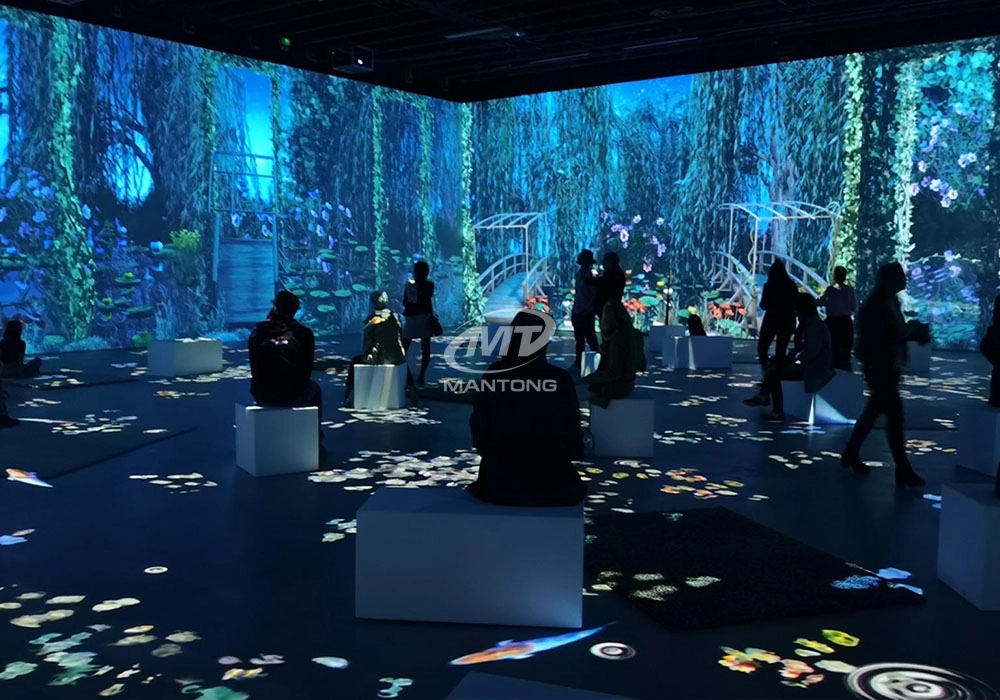
Mantong 6500LM High-Lumen Projector for Large-Scale Immersive Room Projection
Transform any space with Mantong's immersive projection mapping systems. Our high-lumen projectors (up to 6500 LM) and custom software create captivating interactive experiences for floors and walls. Ideal for museums, events, retail, and hospitality. Each kit includes professional ceiling mounting and 80+ pre-loaded video contents and is backed by a 12-month warranty and CE certification. We offer full customization and support to bring your vision to life.
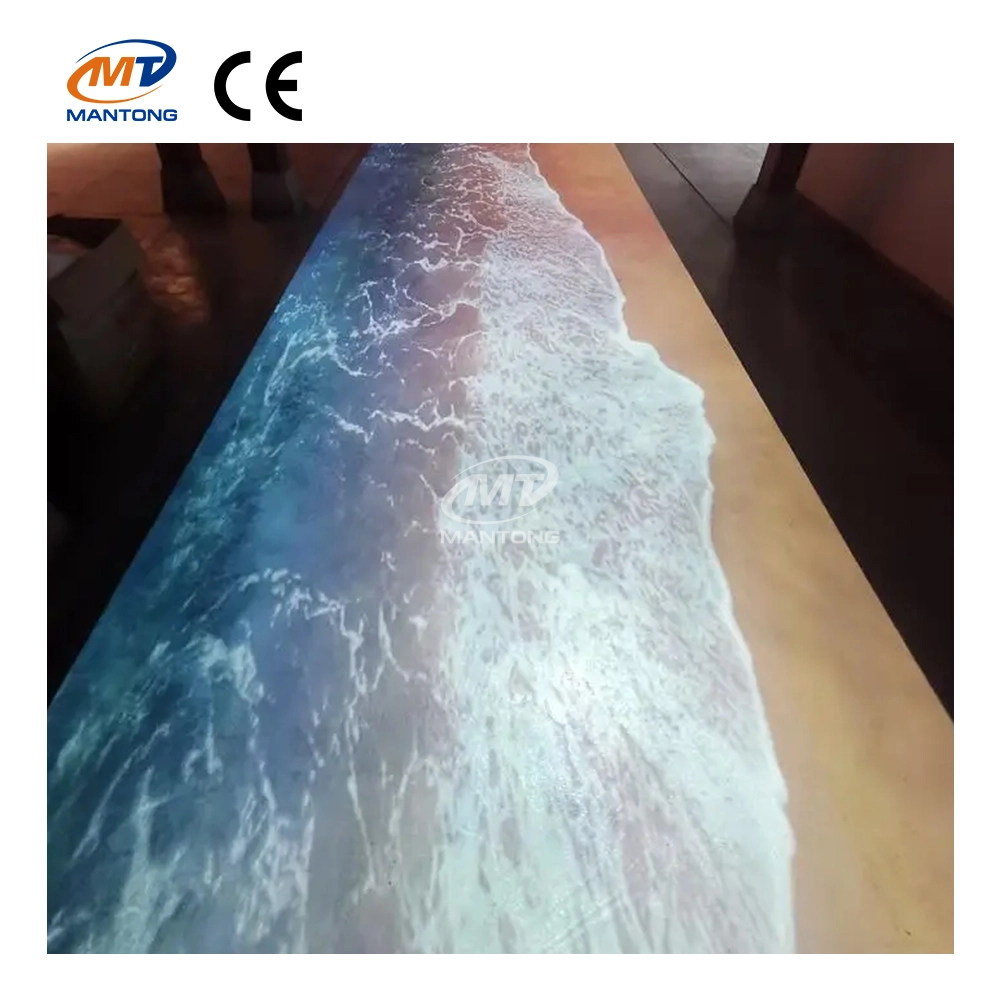
Indoor Interactive Floor Projector System - Customized Design & Installation Support
Indoor interactive floor projections display dynamic themed videos on the floor, commonly used in venues aiming to enhance brand influence or attract foot traffic, such as restaurants, hotel corridors, and brand car retail stores.
By using projectors and compatible software, the interactive content is projected onto the floor, encouraging engagement between people and the projected visuals. A single 5500-lumen indoor floor projector can cover an area of 5 m × 3 m. Typically, each project will use at least 3 units to ensure broad coverage and optimal visual effects.
We also offer customized design and installation support to enhance the interactive experience for your venue.
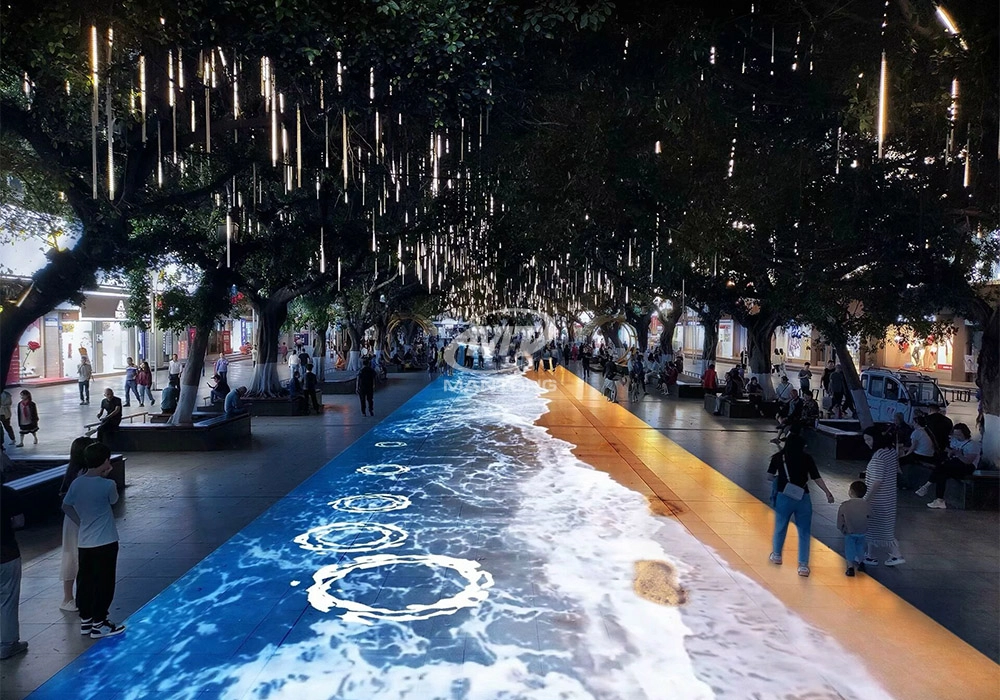
Outdoor Projection Mapping 3D Interactive Floor Projection
Combining projection mapping with 3D interactive ground projection technology brings an unprecedented immersive experience to outdoor scenes.
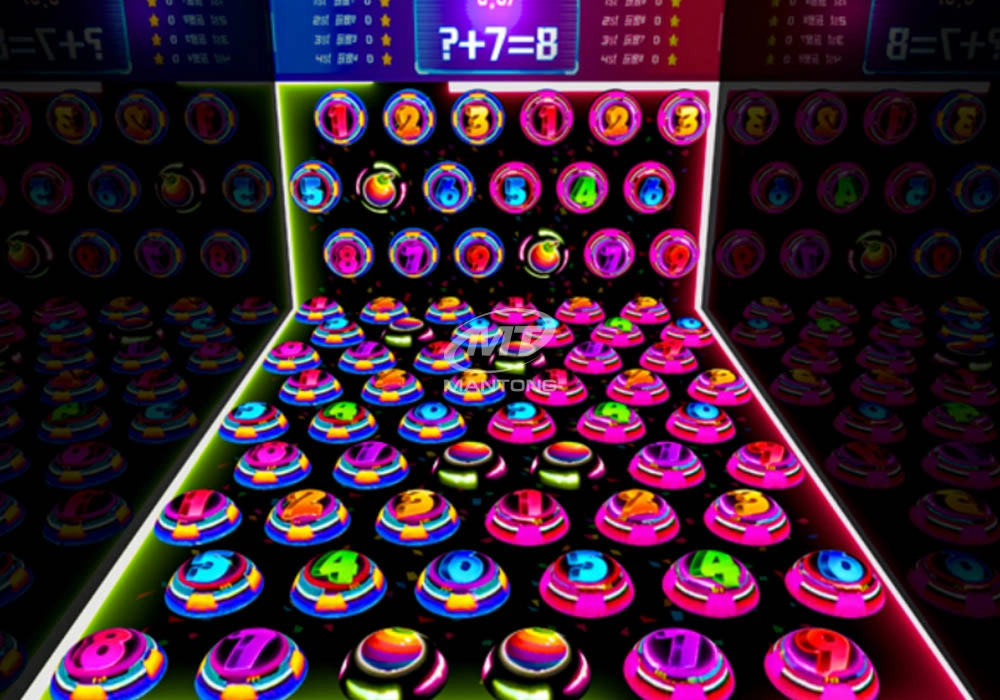
Amusement Rapidly Rotating Bouncing Sphere Interactive Wall Floor Projection Sports Games
Rapidly Rotating Bouncing Sphere is an interactive space where participants jump on rotating spheres. As they step on it, the spheres surface will show special interactivity
Jumping on spheres of the same color in succession causes them to pop, releasing light particles. The more consecutive jumps, the greater the reward—caterpillars appear, and eventually, all spheres of that color burst, filling the space with light and even more caterpillars.

Kaida Business Center, Shixin Road, Panyu District,Guangzhou City, Guangdong Province, China.
ManTong
ManTong
ManTong