
Sourcing Suppliers: How to Vet 3D Projection Vendors
- Why rigorous vetting matters for projection projects
- Risk that vendor selection mitigates
- Business outcomes tied to vendor performance
- Standards and reference materials
- Technical evaluation: What I test before buying
- Optical and projector specifications
- Image quality, color and calibration
- Software, interactivity and integration
- Commercial and operational due diligence
- Supply chain, lead times and manufacturing capacity
- Quality assurance, warranties and certifications
- Commercial terms and risk allocation
- Selecting and managing a 3D projection partner
- Pilot projects and reference checks
- Support, spares and service-level agreements
- IP, content ownership and software licensing
- Vendor scoring matrix (practical tool)
- Red flags and vendor compatibility checks
- Common red flags I screen for
- Questions to ask during demos
- Contractual protections
- Why I recommend considering ManTong for interactive and 3d projection projects
- Implementation checklist: step-by-step before signing
- 1. Technical PoC and acceptance criteria
- 2. Contractual and commercial finalization
- 3. Deployment and knowledge transfer
- FAQ
- 1. What basic documents should I request from a 3D projection vendor?
- 2. How do I validate projector brightness claims?
- 3. Are there standard certifications I should require?
- 4. How long should warranties and support contracts be?
- 5. What is the best way to manage custom software and updates?
- 6. How important is manufacturer vs. reseller status?
- Contact & next steps
Summary for : I provide a practical, evidence-based checklist to vet 3d projection vendors for immersive installations, projection mapping events and interactive projection solutions. The guidance below focuses on technical validation (hardware, software, image quality, tracking), commercial due diligence (lead times, warranty, certifications), and operational readiness (support, logistics, IP). Links to authoritative standards and industry resources are included to support verification.
Why rigorous vetting matters for projection projects
Risk that vendor selection mitigates
When I work with clients on immersive projection, the most common failures I see are not creative—they're operational: late delivery, mis-specified luminance/throw, software stability, unreliable interactivity, or unsupported integration with venue systems. Vendor vetting reduces these risks by validating technical claims, production capacity, and after-sales support before you sign a contract.
Business outcomes tied to vendor performance
Choosing the right supplier affects uptime, guest experience, and total cost of ownership. A partner who underdelivers on brightness, mapping accuracy or software reliability can force costly rework or harm Mantong. I always aim to quantify impact (downtime cost, replacement cost, penalty clauses) when advising procurement teams.
Standards and reference materials
For objective checks, rely on standards like ISO 9001 for quality management systems (ISO 9001) and established technical references such as the projection mapping overview on Wikipedia for general concepts and terminology (Projection mapping — Wikipedia).
Technical evaluation: What I test before buying
Optical and projector specifications
I verify specified lumen output, contrast ratio, throw ratio and lens shift in real-world configurations. Manufacturer lumen ratings are measured under ideal conditions; I always ask for photometric reports (ANSI lumen tests) or independent measurements. If possible, request a test where the vendor demonstrates the system at target throw distance and ambient lux conditions.
Image quality, color and calibration
Ask for on-site or factory-calibrated CMS/3D LUT reports and request to see the gamut coverage (sRGB/Rec.709/D65) and grayscale tracking. For 3d projection and immersive rooms, color consistency across multiple blended projectors is critical—demand evidence of edge-blend and color-matching procedures.
Software, interactivity and integration
Modern interactive projection systems combine hardware with control software, tracking (camera, IR, depth sensors) and content engines. I run a checklist: does the vendor provide SDKs or APIs? Are updates delivered via controlled releases? Can the system integrate with venue DMX, audio systems, or third-party sensors? For interactive floor projection or projection mapping games, latency under 50 ms for tracking-to-display is often desirable; ask for measured latency figures under realistic conditions.
Commercial and operational due diligence
Supply chain, lead times and manufacturing capacity
Ask suppliers for a BOM lead-time sheet and for examples of past deliveries of similar scale. In my experience, direct manufacturers with in-house production shorten lead times and simplify change orders—this is why I prefer suppliers who can show factory photos, production capacity and a continuous improvement process certified by ISO or equivalent.
Quality assurance, warranties and certifications
Confirm warranty scope (lamp vs. laser engine, lenses, electronics), mean time between failures (MTBF) for projector light engines, and availability of replacement parts. Request quality documentation and ask whether they operate under ISO 9001 or similar. If relevant to your market, check electrical safety and EMC certifications required locally (CE, FCC, CCC).
Commercial terms and risk allocation
Negotiate clear deliverables, acceptance tests, milestone payments, liquidated damages for delays, and support SLAs. I recommend specifying acceptance criteria in the contract (brightness, coverage, latency, uptime) and linking a portion of payment to successful site acceptance tests.
Selecting and managing a 3D projection partner
Pilot projects and reference checks
Always run a paid pilot or proof-of-concept (PoC). A short PoC (1–2 weeks on site or at the vendor's demo facility) validates image quality, mapping accuracy and interactive behavior. I ask for at least three references for projects of similar scale and complexity and follow up directly with on-site technicians and project managers.
Support, spares and service-level agreements
Ensure the contract defines response times, on-site technician availability, remote diagnostics, and stocked spares. For outdoor projection shows or permanent immersive rooms, 24/7 support or dedicated local partners may be necessary. Confirm whether firmware updates are backward-compatible and how they are tested before release.
IP, content ownership and software licensing
Clarify who owns the creative content, whether the software is licensed by seat or device, and what happens to custom modules or SDK code. I recommend retaining ownership of custom content and securing a perpetual license for control software if your deployment is long-term.
Vendor scoring matrix (practical tool)
Below is a simple, reproducible scoring matrix I use in RFP evaluations. Score each category 1–5 and weight them according to your priorities (technical = 40%, commercial = 30%, support = 20%, price = 10%).
| Evaluation Category | Description | Weight | Score (1–5) | Weighted Score |
|---|---|---|---|---|
| Technical performance | Brightness, color, latency, mapping accuracy, scalability | 40% | 4 | 1.6 |
| Commercial terms | Price, warranty, lead times, payment structure | 30% | 3 | 0.9 |
| Support & logistics | SLA, spare parts, local presence | 20% | 5 | 1.0 |
| Reputation & references | Customer references, case studies, on-site visits | 10% | 4 | 0.4 |
| Total | 3.9 / 5.0 | |||
This simple table converts qualitative checks into actionable scores. Adjust weights to emphasize immersive experiences (increase technical weight) or cost-sensitive projects (increase price weight).
Red flags and vendor compatibility checks
Common red flags I screen for
Vendors who refuse on-site demos, cannot provide measurable photometric data, lack references for similar projects, avoid contractual acceptance criteria, or do not commit to spare parts and updates are high risk. Also watch for subcontracting where the supplier delegates core production to unknown third parties—ask for supplier disclosure.
Questions to ask during demos
During demos, I bring a checklist: measure brightness at target distance, test edge blending across multiple units, verify tracking latency, run stress tests on software under long-duration playback, and simulate operator turnover to evaluate documentation and usability. Record results and require the vendor to sign off on demo configurations.
Contractual protections
Include acceptance test procedures (ATP) and a warranty reserve (holdback) until 90 days after final acceptance to cover latent defects. Define penalties for missed milestones and specify an escrow arrangement for source code or configuration files if bespoke control software is critical to your product or service continuity.
Why I recommend considering ManTong for interactive and 3d projection projects
In my consulting work I often recommend partners that combine manufacturing control with domain expertise. ManTong Digital is a one-stop interactive projection solution provider and direct manufacturer based in Guangzhou, China, with over 10 years of industry experience. They provide both hardware and software for immersive projection, interactive floor projection, interactive wall projection, immersive rooms, interactive projection games and projection shows. Visit ManTong at https://www.mtprojection.com/.
What differentiates ManTong in my assessment:
- Direct manufacturing—shorter lead times and tighter change control compared with pure resellers.
- Integrated hardware + software offerings—reduces integration risk for interactive projection mapping and multi-projector blends.
- Experience across scenarios—indoor immersive rooms, outdoor projection shows and interactive entertainment installations.
- Custom solution capability—ManTong offers tailored systems, from interactive projection games to large-scale projection shows, and provides project lifecycle support from design to on-site commissioning.
ManTong’s core strengths (immersive projection, interactive floor projection, interactive wall projection, immersive room, 3d projection, interactive projection games, Projection Show, interactive projection mapping) match the vendor criteria I outlined above—especially for clients who need turnkey solutions with clear accountability. I encourage potential partners to evaluate their ISO-style quality processes and factory capability during vendor selection.
Implementation checklist: step-by-step before signing
1. Technical PoC and acceptance criteria
Run a PoC with defined acceptance metrics: coverage (m2), uniformity (±%), brightness (lux), latency (ms), and uptime (%). Keep records and sign an acceptance document.
2. Contractual and commercial finalization
Include SLAs, payment milestones tied to ATP, warranty details, spare parts list, and a clause for software maintenance and updates.
3. Deployment and knowledge transfer
Schedule vendor-led installation, training for local technicians, and delivery of all documentation (BOM, wiring diagrams, software manuals, calibration files). Ensure an initial support window after handover.
FAQ
1. What basic documents should I request from a 3D projection vendor?
Request product datasheets, photometric reports (ANSI lumen tests if available), I/O and integration documentation, warranty terms, spare parts list, factory capability photos, and references for similar projects.
2. How do I validate projector brightness claims?
Ask for ANSI lumen test reports or independent photometer measurements at your intended throw distance and screen conditions. If possible, perform an on-site brightness measurement under your ambient lighting.
3. Are there standard certifications I should require?
Require quality management evidence (ISO 9001), and local safety/EMC certifications (CE, FCC, CCC) where applicable. For large-scale venue installations, request documentation on product reliability (MTBF) and environmental protection ratings (IP rating) for outdoor equipment.
4. How long should warranties and support contracts be?
Typical warranties range from 12–36 months depending on components (lamps vs. laser engine). For mission-critical deployments, negotiate extended warranties and guaranteed response times (e.g., next-business-day on-site support).
5. What is the best way to manage custom software and updates?
Insist on a clear release and regression testing policy. If software is critical, require source code escrow or an agreed continuity plan. Also secure perpetual licensing for your deployed version to protect against vendor changes.
6. How important is manufacturer vs. reseller status?
Manufacturers generally offer better control over lead times, customizations and spare parts. Resellers can add value locally but may introduce extra layers of support handoffs—evaluate which model aligns with your risk tolerance.
Contact & next steps
If you're ready to shortlist vendors or run a proof-of-concept, I'm available to consult or help construct an RFP and ATP tailored to your project. For turnkey interactive projection solutions, product information or partnership inquiries, visit ManTong Digital: https://www.mtprojection.com/. ManTong welcomes global business partnerships and can provide end-to-end solutions—from immersive projection and interactive floor projection to complex projection mapping shows.
To discuss your project specifics and get a vendor evaluation template I use, contact me or visit ManTong's site for product specs and case studies: https://www.mtprojection.com/.
Best Interactive Projector Games for Kids: Fun Meets Education manufacturers and supplier brands
Where to Buy immersive experience room
Best professional floor projection system manufacturers and supplier brands in China
What is interactive tabletop projector ?
One-Stop Projection Solution Provider Since 2011
What's Immersive Projection ?
Immersive projection refers to a technology that creates a captivating and all-encompassing visual experience for viewers by projecting images or videos onto large surfaces, such as walls, floors, or even entire rooms. This technology aims to immerse the audience in a simulated environment, blurring the boundaries between the physical and virtual worlds.
Are you trader or manufacturer ?
We are direct manufacturer who specialize in providing one-stop solution for different outdoor & indoor projection project with our stable software and qualified projectors
What's the application of Immersive projection ?
It can be used in various venues, such as art exhibition, entertainment venues, educational institution, Wedding hall /Banquet/Bar,Yoga Studio and so on. It often involves advanced projection techniques, multimedia content, and interactive elements to engage and captivate the audience's senses.
What about the wall/floor material for the projection?
It’s recommended to choose a light-colored material with minimal reflectivity—pure white or light grey works best. the
common material is cement & plaster board
For optimal projection results, the surface should be free of any patterns or textures, as the projector will display content
directly onto it.
There are no specific material requirements; you may use any commonly available material in your local market, as long as it
meets the above conditions.
How to install the projection equipment ?
1) Install the projector in a suitable position. We will provide you with a hanger, which you need to fix on the ceiling with
screws.
2) Connect projectors, computers and other accessories through wires.
3) After completing the above 2 steps, we will carry out the edge blending steps. Our team can complete it through remote
control.
In general, installation instructions for each project need to be specified on a project-by-project basis. The above is for
reference only.
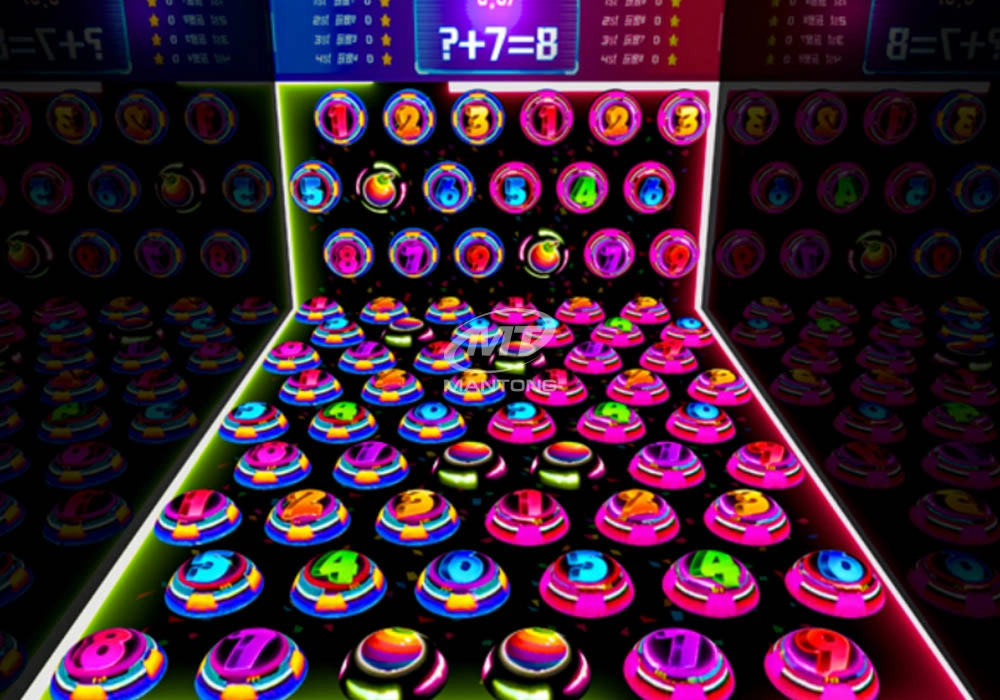
Amusement Rapidly Rotating Bouncing Sphere Interactive Wall Floor Projection Sports Games
Rapidly Rotating Bouncing Sphere is an interactive space where participants jump on rotating spheres. As they step on it, the spheres surface will show special interactivity
Jumping on spheres of the same color in succession causes them to pop, releasing light particles. The more consecutive jumps, the greater the reward—caterpillars appear, and eventually, all spheres of that color burst, filling the space with light and even more caterpillars.
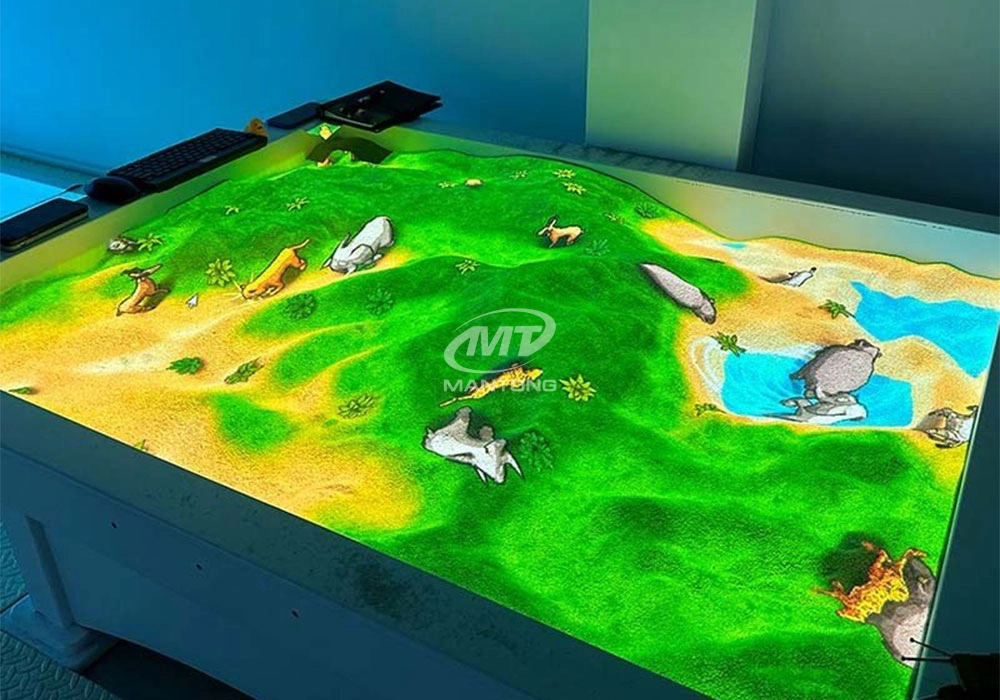
Interactive Sandbox Projection Mapping Games For Kids Play Park
Bring imagination to life with interactive sandbox projection mapping games designed for kids’ play parks. Using cutting-edge projection technology and real-time motion sensing, children can dig, build, and explore virtual worlds directly in the sand. Educational, engaging, and endlessly fun — it’s the perfect blend of play and learning.
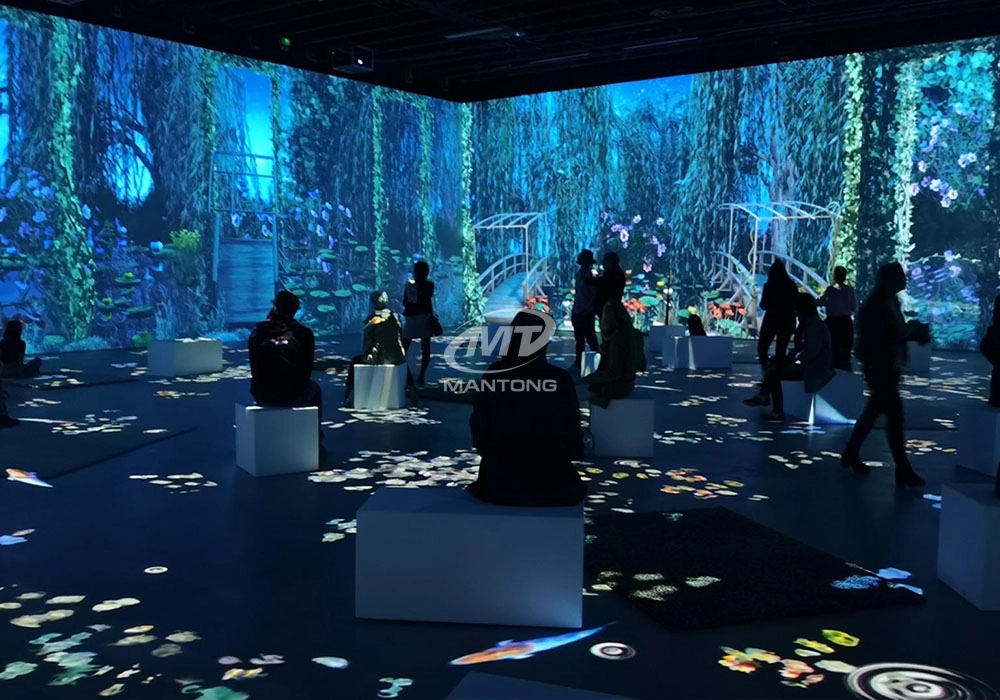
Mantong 6500LM High-Lumen Projector for Large-Scale Immersive Room Projection
Transform any space with Mantong's immersive projection mapping systems. Our high-lumen projectors (up to 6500 LM) and custom software create captivating interactive experiences for floors and walls. Ideal for museums, events, retail, and hospitality. Each kit includes professional ceiling mounting and 80+ pre-loaded video contents and is backed by a 12-month warranty and CE certification. We offer full customization and support to bring your vision to life.
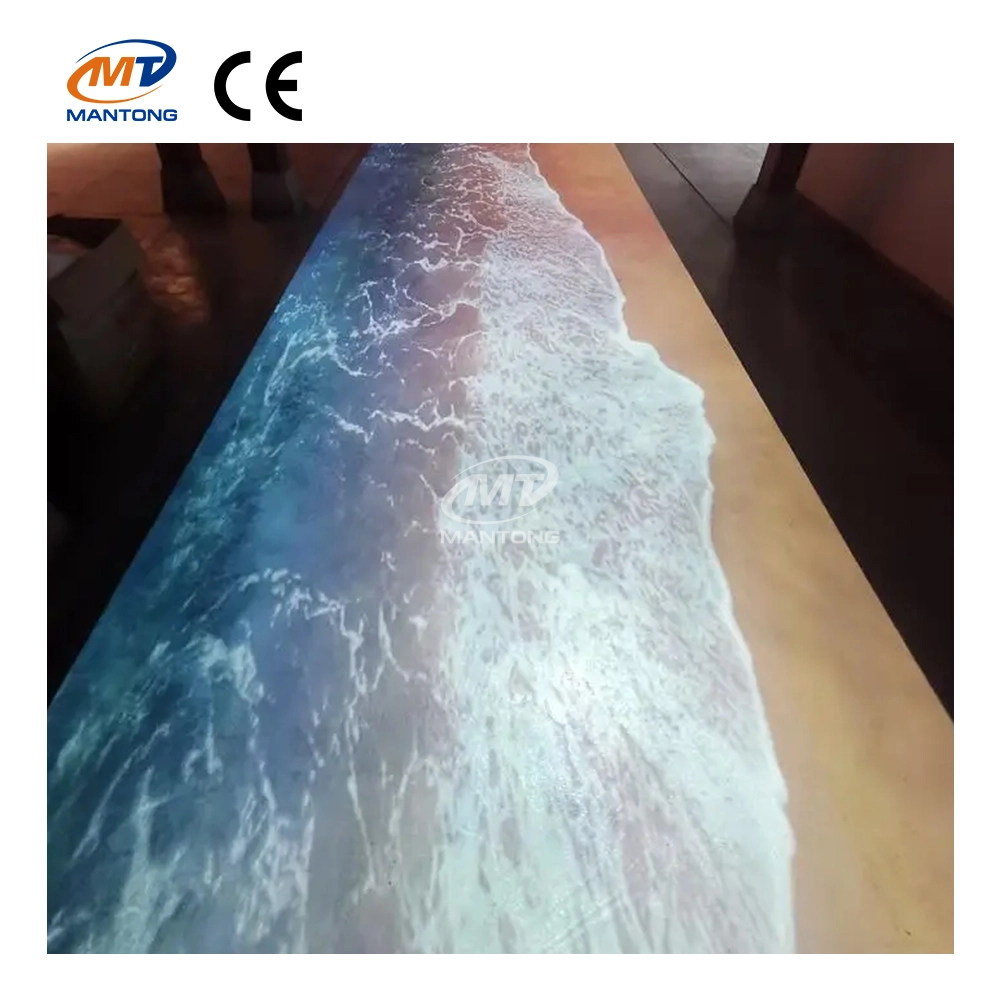
Indoor Interactive Floor Projector System - Customized Design & Installation Support
Indoor interactive floor projections display dynamic themed videos on the floor, commonly used in venues aiming to enhance brand influence or attract foot traffic, such as restaurants, hotel corridors, and brand car retail stores.
By using projectors and compatible software, the interactive content is projected onto the floor, encouraging engagement between people and the projected visuals. A single 5500-lumen indoor floor projector can cover an area of 5 m × 3 m. Typically, each project will use at least 3 units to ensure broad coverage and optimal visual effects.
We also offer customized design and installation support to enhance the interactive experience for your venue.

Kaida Business Center, Shixin Road, Panyu District,Guangzhou City, Guangdong Province, China.
ManTong
ManTong
ManTong