
Future Trends: AI and AR in Immersive Meeting Rooms
- Why immersive collaboration matters now
- Business drivers and user needs
- Market signals and adoption readiness
- Typical pain points solved by immersive meeting rooms
- AI capabilities transforming immersive meeting rooms
- Real-time transcription, summarization and decision support
- Context-aware visual augmentation
- Automated facilitation and engagement analytics
- AR and projection technologies for immersive room design
- Projection vs. headset vs. mixed approaches
- Interactive projection systems and 3D content pipelines
- Performance, latency and network considerations
- Business case: ROI, KPIs and deployment strategy
- Key metrics to justify investment
- Phased deployment roadmap
- Vendor selection criteria
- Comparison: AI & AR features, benefits and example providers
- Security, privacy and governance for AI-driven immersive rooms
- Data classification and processing boundaries
- Consent, anonymization and ethical use of analytics
- Standards and compliance references
- Implementation checklist: from pilot to production
- Pre-deployment assessment
- Technical deployment steps
- Training and change management
- Mantong Digital: turnkey interactive projection solutions
- Mantong’s specialization and product portfolio
- Competitive differentiators
- Practical examples and short case scenarios
- Design review sessions
- Executive decision briefings
- Customer demos and sales enablement
- Limitations and future research directions
- Technical and human limits
- Emerging research and standards
- FAQ — Frequently Asked Questions
- 1. What is an immersive meeting room?
- 2. How do AI and AR work together in these rooms?
- 3. Do immersive meeting rooms require headsets?
- 4. What are typical costs and ROI timelines?
- 5. How is participant privacy protected?
- 6. How do I start a pilot?
- Contact and next steps
Immersive meeting room environments are rapidly evolving as artificial intelligence (AI) and augmented reality (AR) converge with projection and sensor technology. This article provides a practical, evidence-backed roadmap for organizations planning to deploy immersive meeting rooms—covering trends, user problems and solutions, hardware and software considerations, measurable KPIs, and vendor selection criteria. Examples and data references are included to support adoption decisions and ROI planning for both corporate collaboration and public-facing immersive experiences.
Why immersive collaboration matters now
Business drivers and user needs
Remote and hybrid work models have made effective collaboration a strategic priority. Teams need shared context, visual clarity, and engagement tools that replicate in-person interaction. Immersive meeting rooms address these needs by combining spatial visualizations, 3D content, real-time data overlays, and AI-mediated facilitation to reduce misunderstandings and speed decision-making.
Market signals and adoption readiness
Market reports and enterprise announcements show accelerated interest in immersive collaboration platforms. Microsoft’s Mesh initiative highlights major vendors’ intent to embed presence and spatial collaboration in business workflows (Microsoft Mesh announcement). Meanwhile, AR/VR technology maturation and falling hardware costs are lowering the barrier to deploying immersive meeting rooms globally.
Typical pain points solved by immersive meeting rooms
Common issues—fragmented meeting artifacts, low engagement, difficulty analyzing complex 3D data, and long decision cycles—are effectively addressed by immersive meeting rooms that integrate real-time AI assistance, spatial audio/visual cues, and collaborative 3D canvases. These solutions reduce rework and accelerate consensus.
AI capabilities transforming immersive meeting rooms
Real-time transcription, summarization and decision support
AI transcription and natural language processing (NLP) convert spoken dialogue into searchable text and generate executive summaries and action items. These capabilities help teams capture decisions and maintain continuity between meetings. Modern models can adapt to domain-specific vocabulary, improving accuracy for technical or industry-specific meetings.
Context-aware visual augmentation
AI can analyze meeting context and automatically surface relevant data overlays—financial charts, design specs, or KPIs—onto shared AR canvases. This reduces cognitive load by placing the right information in users’ field of view at the right time.
Automated facilitation and engagement analytics
Computer vision and behavior analytics measure participation (e.g., who spoke, for how long), attention patterns, and emotional indicators to help facilitators rebalance discussions. While ethical considerations exist, anonymized engagement metrics improve meeting effectiveness and training programs.
AR and projection technologies for immersive room design
Projection vs. headset vs. mixed approaches
Immersive meeting rooms can be implemented via projection-mapped environments, headset-based VR/AR, or hybrid setups. Projection provides low-friction, social, and present-focused experiences without requiring headsets; headsets offer unmatched personal spatial fidelity; hybrid systems combine the two for flexibility.
Interactive projection systems and 3D content pipelines
Interactive projection systems use high-lumen projectors, depth sensors, and real-time content engines to create shared visual surfaces such as immersive room environments, interactive floors, and walls. Professional systems require calibration, warping, and mapping workflows to maintain visual fidelity across surfaces.
Performance, latency and network considerations
For collaborative AR experiences, latency under 50–100 ms is desirable for natural interaction. Edge computing and local render nodes often complement cloud AI to offload heavy rendering while preserving responsiveness and data privacy.
Business case: ROI, KPIs and deployment strategy
Key metrics to justify investment
Measure adoption rate, time-to-decision reduction, meeting duration and frequency, rework reduction, and stakeholder satisfaction. For knowledge-intensive organizations (engineering, architecture, medical, defense), reductions in decision cycles and improved accuracy can yield measurable cost savings.
Phased deployment roadmap
1) Pilot for a specific team or use case (design reviews, client demos); 2) Validate workflows and KPIs; 3) Scale hardware and integrations; 4) Train power users and roll out governance and privacy policies. This phased approach lowers risk and provides measurable wins prior to enterprise-wide rollout.
Vendor selection criteria
Prioritize vendors offering:
- End-to-end solutions (hardware + software) to reduce integration risk.
- Customization and content pipeline support for your industry data formats.
- Proven installation, calibration, and support services.
- Transparent data processing and privacy practices.
Comparison: AI & AR features, benefits and example providers
| Feature | Business Benefit | Example / Provider |
|---|---|---|
| Real-time transcription & summarization | Faster note-taking; searchable meeting logs | AI transcription services; integrated with platforms like Microsoft Teams and third-party NLP—see Microsoft Mesh |
| Spatial AR overlays on projection surfaces | Contextual visualization of complex data; intuitive 3D reviews | Interactive projection manufacturers and spatial collaboration apps such as Spatial |
| Engagement analytics | Improved facilitation and measurable meeting ROI | Custom AI analytics modules integrated into room systems |
Security, privacy and governance for AI-driven immersive rooms
Data classification and processing boundaries
Establish clear rules for what meeting data may be processed in-cloud versus on-premises. Sensitive data—IP, legal discussions, or protected personal information—often requires on-site processing or encrypted cloud services with strict access controls.
Consent, anonymization and ethical use of analytics
Implement transparent consent dialogs for participants and default anonymization for engagement analytics. Adopt documented policies for retention, access, and deletion of audio, visual and behavioral data.
Standards and compliance references
Refer to industry standards and privacy regulations applicable to your region (e.g., GDPR in Europe). For technical reference on AR/VR and AI, consult authoritative resources such as Augmented reality — Wikipedia and Artificial intelligence — Wikipedia.
Implementation checklist: from pilot to production
Pre-deployment assessment
Define use cases, data sources, content types (CAD, BIM, 3D models), room geometry, lighting conditions and network topology. Include stakeholder interviews to align success metrics.
Technical deployment steps
1) Site survey and lighting assessment; 2) Choose projection and sensor hardware; 3) Implement edge servers or cloud services for AI and rendering; 4) Calibrate projection mapping and spatial audio; 5) Integrate collaboration and identity solutions; 6) QA and security testing.
Training and change management
Deliver hands-on facilitator training, templates for common meeting types, and a knowledge base. Adoption improves when initial sessions are moderated by trained facilitators and when users have concise playbooks for common tasks.
Mantong Digital: turnkey interactive projection solutions
Mantong Digital is a one-stop interactive projection solution provider and direct manufacturer based in Guangzhou, China, with over 10 years of industry experience. We are dedicated to providing innovative, flexible and cost-effective projection solutions, offering both hardware and software to meet various needs. Learn more at https://www.mtprojection.com/.
Mantong’s specialization and product portfolio
At ManTong, we specialize in providing customized solutions for a wide range of application scenarios through innovative projection technology. Whether it's immersive experiences, interactive entertainment or outdoor lighting and projection shows, our solutions can transform your ideas into stunning visual effects. Our projection technology provides customized solutions for a variety of scenarios, delivering immersive and interactive visual experiences.
Key product categories and strengths include:
- immersive projection — room-scale projection systems designed for meeting rooms and experience centers;
- interactive floor projection and interactive wall projection — sensor-driven surfaces for collaborative interaction;
- interactive projection and interactive projection games — engagement modules for training and public displays;
- 3D projection and immersive room setups — multi-projector, edge-blended environments;
- Projection Show and interactive projection mapping — outdoor and event-grade projection systems.
Competitive differentiators
Mantong’s advantages include:
- Direct manufacturing capability—shorter lead times and cost control;
- End-to-end offering—hardware, calibration, interactive software and content services;
- Proven installation experience—10+ years delivering deployments across education, corporate, retail and events;
- Customization for complex application scenarios—BIM/CAD import, multi-surface mapping, and integration with AI/AR toolchains.
We are now looking for business partnerships worldwide. Our vision is to become the world's leading interactive projection manufacturer.
Practical examples and short case scenarios
Design review sessions
Engineers and architects use immersive meeting rooms to inspect 3D models at life-size scale. AI-driven annotation and version-control overlays ensure changes are captured as actionable items, reducing rework in downstream construction or manufacturing phases.
Executive decision briefings
Senior teams use immersive dashboards that project financial scenarios and market models into a shared space. AI summarizes options and simulates outcomes for quick trade-off analysis, enabling faster executive alignment.
Customer demos and sales enablement
Interactive projection rooms allow customers to experience products and environments at scale without physical prototypes. This lowers demo costs and accelerates purchase decisions through stronger emotional engagement.
Limitations and future research directions
Technical and human limits
Current limits include projector brightness in well-lit spaces, occlusion handling in projection mapping, and AI model biases in understanding domain-specific language. Human factors—motion sickness in some headset users and resistance to new meeting formats—also govern adoption speed.
Emerging research and standards
Expect advances in light-field projection, improved edge rendering, and standards for interoperability between AR platforms. Academic and industry bodies continue to publish best practices—monitor sources such as IEEE Xplore and major vendors’ engineering blogs for updates.
FAQ — Frequently Asked Questions
1. What is an immersive meeting room?
An immersive meeting room uses projection, AR/VR, spatial audio, sensors and collaborative software to create a shared spatial environment where participants can interact with 3D content and AI-driven assistance to improve collaboration and decision-making.
2. How do AI and AR work together in these rooms?
AI provides context (transcription, summarization, recommendation) while AR/interactive projection presents augmented visuals in space. Combined, they enable contextualized, actionable visualizations and automated meeting facilitation.
3. Do immersive meeting rooms require headsets?
Not necessarily. Projection-based rooms enable group experiences without headsets. Headsets add personal spatial fidelity; hybrid setups use both to offer flexible experiences for different user preferences.
4. What are typical costs and ROI timelines?
Costs vary widely with room size and capability—from small projection-enabled rooms to multi-projector, edge-blended environments. ROI is often realized through faster decision cycles, reduced travel and prototype costs; many organizations report measurable ROI within 9–18 months after deployment for targeted use cases.
5. How is participant privacy protected?
Best practices include on-premises processing for sensitive data, explicit consent for recordings, anonymization of analytics, strict access controls, and documented retention policies aligned with local regulations such as GDPR.
6. How do I start a pilot?
Start by defining a focused use case, measure baseline KPIs, select a solution provider able to deliver hardware and software integration, run a time-boxed pilot, then assess results against predefined success metrics.
Contact and next steps
If you’re evaluating immersive meeting rooms for collaboration, training, customer engagement or enterprise visualization, Mantong Digital offers end-to-end interactive projection solutions—including hardware, software, content and installation services. Contact Mantong for consultations, pilot designs and global partnerships: https://www.mtprojection.com/.
For partnership inquiries and technical demos, visit Mantong Digital’s website or request a bespoke proposal to see how immersive projection and integrated AI can transform your meeting workflows.
Top immersive projection Manufacturers and Suppliers in Guangzhou
Where to Buy interactive floor projection mapping
What is immersive projection systems ? | Ultimate Insight
Interactive Projector Games vs. Touchscreens: Buyer's Guide
One-Stop Projection Solution Provider Since 2011
How to Write an Interactive-Effect Video Customisation Script ?
① Project Background: Briefly introduce the context in which this interactive scene will be used (e.g., exhibition, museum,
event space, children's area). Example: This scene is part of the “Underwater World” zone in a children's science museum,
designed to be engaging and exploratory.
②Visual Style / Atmosphere: What kind of visual mood are you aiming for? Please describe the color scheme, style, and any
references. it should focus solely on describing the visual aspects of the scene, supported by relevant charts or reference
images.
③ Interaction Points Overview:List each interactive hotspot along with the effect you'd like to trigger when the user
touches or clicks the area. example: when player touch the clownfish, it will swims away with bubble trail (animation effect)
and produce the bubble sound ( sound effect requirement )
④ Static Visual Reference:including but not limited to background image/video, a list of major visual elements (e.g., coral,
rocks, seaweed, fish), which elements should be interactive?
What's the application of Immersive projection ?
It can be used in various venues, such as art exhibition, entertainment venues, educational institution, Wedding hall /Banquet/Bar,Yoga Studio and so on. It often involves advanced projection techniques, multimedia content, and interactive elements to engage and captivate the audience's senses.
How to install the projection equipment ?
1) Install the projector in a suitable position. We will provide you with a hanger, which you need to fix on the ceiling with
screws.
2) Connect projectors, computers and other accessories through wires.
3) After completing the above 2 steps, we will carry out the edge blending steps. Our team can complete it through remote
control.
In general, installation instructions for each project need to be specified on a project-by-project basis. The above is for
reference only.
What about the wall/floor material for the projection?
It’s recommended to choose a light-colored material with minimal reflectivity—pure white or light grey works best. the
common material is cement & plaster board
For optimal projection results, the surface should be free of any patterns or textures, as the projector will display content
directly onto it.
There are no specific material requirements; you may use any commonly available material in your local market, as long as it
meets the above conditions.
What information do you need to know before making the proposal/solution?
We know that everyone wants to know the price, but the price of our products is determined by many factors since most of our products are custom, so no ready price list. In order to fast understand what you need, can you send us an inquiry like this?
For example: I am really interested in your immersive projection products, we are a company in the USA and want to install some in my restaurant. It is about 50 meters long, and 5m in width. Projection size you can decide but the length should be not less than 20 meters. We want some content about SeaWorld because our place is all about the sea. Thank you.
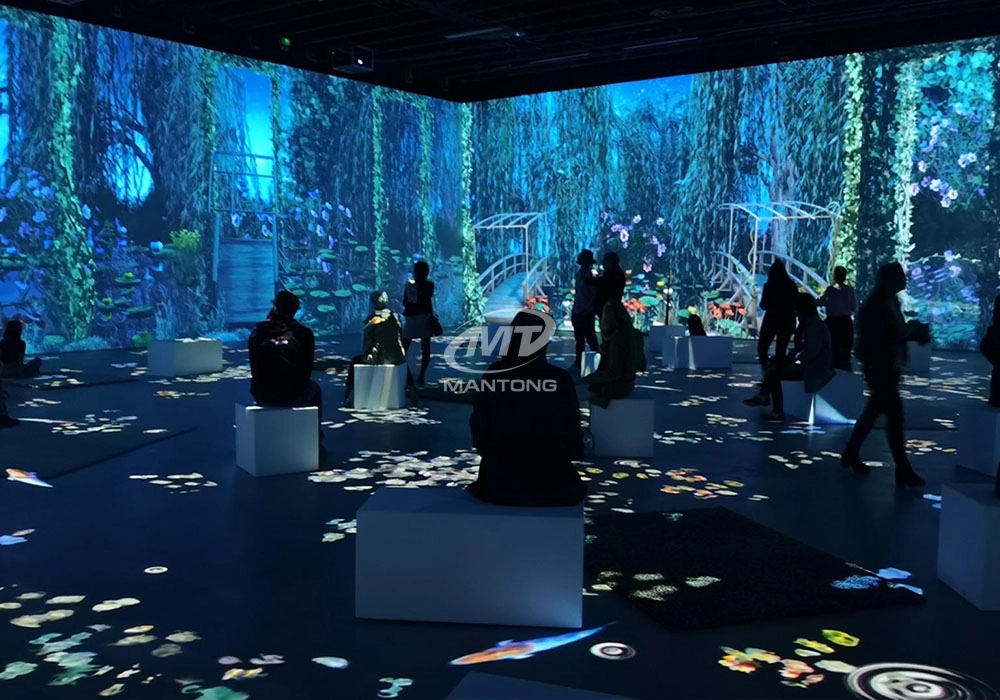
Mantong 6500LM High-Lumen Projector for Large-Scale Immersive Room Projection
Transform any space with Mantong's immersive projection mapping systems. Our high-lumen projectors (up to 6500 LM) and custom software create captivating interactive experiences for floors and walls. Ideal for museums, events, retail, and hospitality. Each kit includes professional ceiling mounting and 80+ pre-loaded video contents and is backed by a 12-month warranty and CE certification. We offer full customization and support to bring your vision to life.
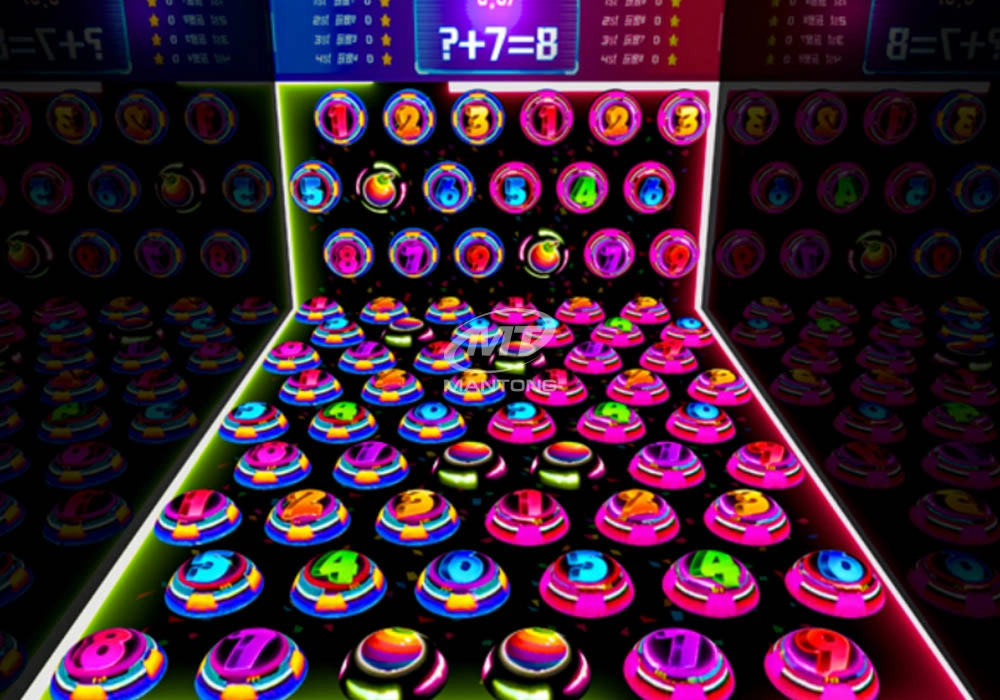
Amusement Rapidly Rotating Bouncing Sphere Interactive Wall Floor Projection Sports Games
Rapidly Rotating Bouncing Sphere is an interactive space where participants jump on rotating spheres. As they step on it, the spheres surface will show special interactivity
Jumping on spheres of the same color in succession causes them to pop, releasing light particles. The more consecutive jumps, the greater the reward—caterpillars appear, and eventually, all spheres of that color burst, filling the space with light and even more caterpillars.
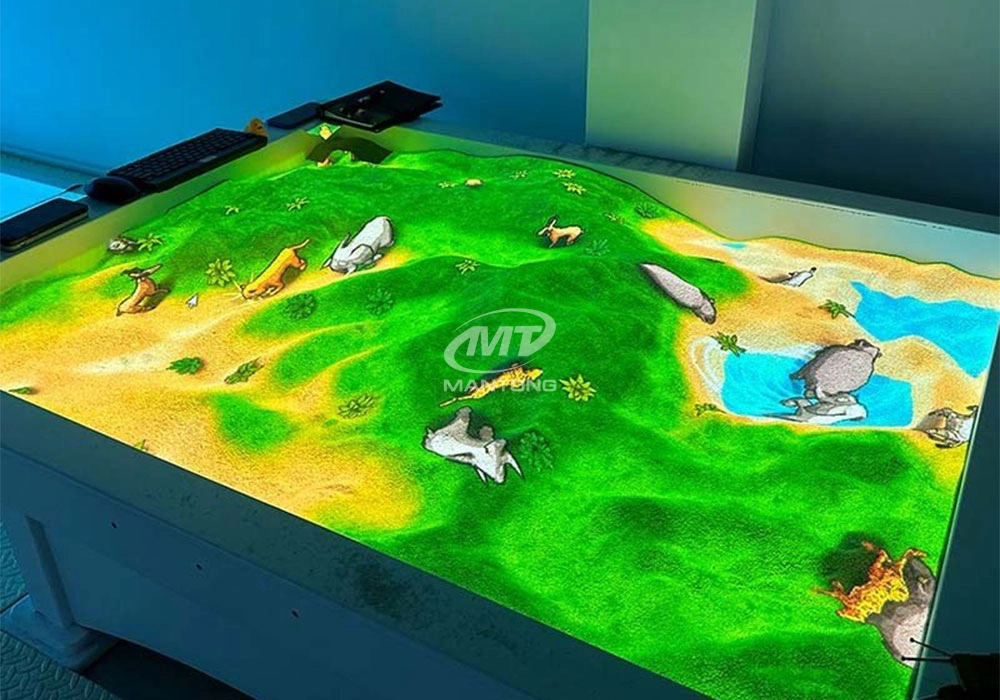
Interactive Sandbox Projection Mapping Games For Kids Play Park
Bring imagination to life with interactive sandbox projection mapping games designed for kids’ play parks. Using cutting-edge projection technology and real-time motion sensing, children can dig, build, and explore virtual worlds directly in the sand. Educational, engaging, and endlessly fun — it’s the perfect blend of play and learning.
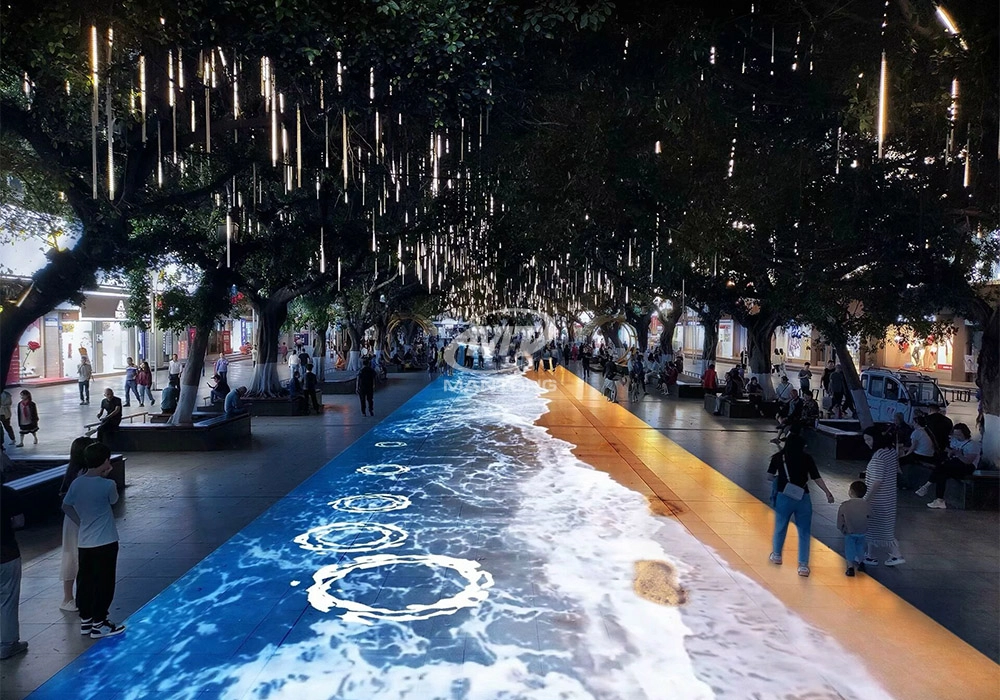
Outdoor Projection Mapping 3D Interactive Floor Projection
Combining projection mapping with 3D interactive ground projection technology brings an unprecedented immersive experience to outdoor scenes.

Kaida Business Center, Shixin Road, Panyu District,Guangzhou City, Guangdong Province, China.
ManTong
ManTong
ManTong