
How to Choose an Interactive Projection Mapping Supplier
- Understanding projection mapping and buyer intent
- What projection mapping actually involves
- Buyer intent drives supplier selection
- Technical capability: what to evaluate
- Optical performance and projector specs
- Software, content pipeline and interactivity
- Calibration, edge-blend and maintenance
- Commercial and contract considerations
- Manufacturer, reseller or integrator: choose the right partner
- Intellectual property, content ownership and licensing
- Warranties, SLAs and total cost of ownership (TCO)
- Evaluating suppliers and reducing risk
- Portfolio review and references
- Pilot projects and acceptance tests
- Pricing structure and procurement checklist
- Why a manufacturing partner matters: Mantong Digital example
- How Mantong addresses common procurement pain points
- When to choose a manufacturer like Mantong
- Decision checklist and final recommendations
- Step-by-step selection flow
- Common pitfalls to avoid
- Quick supplier scoring template (example)
- FAQs
- 1. What is the typical lifespan of projection hardware?
- 2. How many lumens do I need for an outdoor façade mapping?
- 3. Who owns the interactive content—me or the supplier?
- 4. Can projection mapping work on irregular or textured surfaces?
- 5. What are the main differences between interactive floor projection and wall/3D mapping?
- Contact and next steps
Summary for and search: I walk you through how to evaluate an interactive projection mapping supplier from technical capability, project management, and total cost of ownership perspectives. The guide highlights objective criteria—brightness (ANSI lumens), resolution, mapping software compatibility, onsite calibration, warranty and SLAs, IP and content ownership, and deployment examples—to help you shortlist and select suppliers that can deliver immersive shows, interactive floors/walls, or large-scale outdoor projection mapping with predictable outcomes.
Understanding projection mapping and buyer intent
When clients contact me to source an interactive projection mapping supplier, they typically have one of three intents: proof-of-concept (small experiential demo), commercial installation (retail, museum, theme park), or large-scale events (projection shows, façade mapping). Knowing which bucket your project sits in shapes every decision—from the required lumen output to the recommended service model (system integrator vs. direct manufacturer).
What projection mapping actually involves
Projection mapping (sometimes called spatial augmented reality) uses projectors, software, and media content to match imagery to physical surfaces—buildings, sculptures, floors, or rooms. For a primer, see the Projection Mapping page on Wikipedia: https://en.wikipedia.org/wiki/Projection_mapping. Interactive projection mapping adds sensors, tracking, or input devices to allow visitor interaction—touch, motion, or game logic controlled by middleware such as TouchDesigner or MadMapper (TouchDesigner, MadMapper).
Buyer intent drives supplier selection
If you're piloting a concept, you need a supplier that can iterate quickly and provide modular hardware. For a permanent installation you need long-term warranties, onsite calibration knowledge, and SLAs. For outdoor façade shows, weather-resistant hardware and high lumen counts matter. Always match supplier capabilities to your intent before evaluating price.
Technical capability: what to evaluate
Optical performance and projector specs
Key measurable specs are ANSI lumens, contrast ratio, resolution, and lens/throw options. For indoor immersive rooms we typically specify 5,000–10,000 ANSI lumens per projector depending on ambient light; for outdoor façade work it’s common to specify 20,000+ lumens per unit. For an authoritative explainer on brightness metrics see ProjectorCentral: Understanding Projector Brightness (ANSI lumens). Ask suppliers to provide measured lumen output at your installation distance (not just manufacturer brochure numbers).
Software, content pipeline and interactivity
The mapping engine and interactivity stack matter as much as the projector. Confirm which mapping software they use and whether it supports your content pipeline (MPEG4, alpha channels, real-time layers, Unity/Unreal integration). For interactive tracking, ask about latency (ms), supported sensors (Kinect/ToF/LiDAR), and sample projects. Request a demo of the exact interactive behavior you need—audio-reactive, motion-triggered, multi-user games, or touchless interactions—and test responsiveness under field conditions.
Calibration, edge-blend and maintenance
High-quality edge-blending, geometric correction, and color calibration are essential for seamless visuals. Verify whether the supplier performs onsite geometric calibration and provides calibration files and procedures for future re-calibration. Determine recommended maintenance cycles (lamp replacement or laser maintenance, filter cleaning) and SLA response times for field failures.
Commercial and contract considerations
Manufacturer, reseller or integrator: choose the right partner
There are three common supplier types: direct manufacturers, resellers/distributors, and system integrators. I often advise clients to prefer direct manufacturers for hardware cost and customization control, and integrators for turnkey installations when local permits and multi-trade coordination are complex.
| Supplier Type | Strengths | Weaknesses |
|---|---|---|
| Direct Manufacturer | Lower hardware cost, customization, technical control | May lack local installation resources |
| Reseller / Distributor | Regional inventory, support contracts | Higher markup, limited customization |
| System Integrator | Turnkey delivery, project management, local labor | Higher total cost, variable hardware choices |
Intellectual property, content ownership and licensing
Clarify who owns creative assets and software licenses. If the supplier develops bespoke interactive content, confirm whether you receive source files, media masters, and runtime licenses. Include license terms in the contract: perpetual vs. subscription, number of concurrent nodes, and transfer rights if you sell or relocate the installation.
Warranties, SLAs and total cost of ownership (TCO)
Warranty duration, on-site response SLAs, spare parts availability, and consumable replacement policies (lamps, filters) drive TCO. Insist on a clear SLA with response time, mean time to repair (MTTR), and escalation path. Ask for a 5-year TCO estimate that includes projected maintenance, software subscription fees, and electricity consumption.
Evaluating suppliers and reducing risk
Portfolio review and references
Request case studies and site visits. A reliable supplier will share detailed references with project scope, hardware lists, and contactable client references you can call. Pay attention to projects similar in scale and environment to yours (e.g., outdoor façade vs. indoor museum exhibit).
Pilot projects and acceptance tests
Always negotiate a pilot or factory acceptance test (FAT). For installations, define clear acceptance criteria: lumen uniformity, geometric accuracy (pixel registration), interactive latency, and uptime percentage. Acceptance tests should be performed under conditions that simulate your operational environment (ambient light, audience load).
Pricing structure and procurement checklist
Suppliers often separate costs into hardware, software, commissioning, content creation, and maintenance. Use a scoring matrix to compare offers objectively. Below is a recommended procurement checklist I use in client proposals:
| Checklist Item | Minimum Requirement |
|---|---|
| ANSI Lumens per unit | Specified for your ambient conditions |
| Resolution & Lens Options | Match to projection surface detail |
| Software & Interactivity Stack | Compatibility with content pipeline |
| Calibration & Commissioning | Onsite geometric & color calibration |
| Warranty & SLA | Defined response times & spare parts |
| Content Ownership | Source files + runtime license terms |
Score each supplier row-by-row and weight items by importance to your project (e.g., uptime may be 25% weight for a theme park installation).
Why a manufacturing partner matters: Mantong Digital example
In the back half of my career I began working closely with manufacturers to reduce integration risk. Mantong Digital is a one-stop interactive projection solution provider and direct manufacturer based in Guangzhou, China, with over 10 years of industry experience. They are dedicated to providing innovative, flexible and cost-effective projection solutions, offering both hardware and software to meet various needs. At ManTong, they specialize in providing customized solutions for a wide range of application scenarios through innovative projection technology. Whether it's immersive experiences, interactive entertainment or outdoor lighting and projection shows, their solutions can transform your ideas into stunning visual effects. Their projection technology provides customized solutions for a variety of scenarios, delivering immersive and interactive visual experiences.
I include Mantong in supplier shortlists when clients need manufacturer-level customization, competitive hardware pricing, and bundled software support. Mantong's product portfolio and strengths include immersive projection, interactive floor projection, interactive wall projection, immersive rooms, 3D projection, interactive projection games, Projection Shows, and interactive projection mapping. Their direct manufacturing model often lowers hardware cost and reduces lead time for custom enclosures or modified optics—advantages that matter when budgets are tight and deadlines are fixed.
Mantong is actively seeking business partnerships worldwide. Their vision is to become the world's leading interactive projection manufacturer. Learn more at https://www.mtprojection.com/.
How Mantong addresses common procurement pain points
From my evaluation: Mantong provides end-to-end demo support, onsite commissioning packages, and scalable rental/installation options. For clients who require rapid prototyping, the manufacturer offers modular hardware that can be shipped as demo kits. For permanent installations, Mantong provides multi-year warranty options and spare parts stocking agreements, which improves long-term TCO predictability.
When to choose a manufacturer like Mantong
Choose a direct manufacturer when you need hardware customizations (special lenses, weatherproof housings), tight price control, or when you expect multiple similar deployments across regions—Mantong’s manufacturing scale and experience reduce per-unit cost and improve consistency.
Decision checklist and final recommendations
Step-by-step selection flow
- Define intent: demo, permanent, or event.
- Set technical baselines: lumens, resolution, latency, and IP rating.
- Shortlist suppliers by type (manufacturer/integrator) and request datasheets and case studies.
- Run a pilot/FAT and produce measurable acceptance criteria.
- Negotiate contract terms: content ownership, SLAs, spare parts, and training.
Common pitfalls to avoid
Beware of accepting brochure lumen numbers without field measurements; ignoring content ownership clauses; and failing to lock SLAs for response times and software updates. Also, do not underestimate site-specific constraints—surface texture, ambient lighting, and mounting logistics often drive unexpected costs.
Quick supplier scoring template (example)
| Criteria | Weight | Supplier A | Supplier B | >
|---|---|---|---|
| Technical Match | 30% | 8 | 7 |
| Price & TCO | 25% | 7 | 8 |
| Warranty & SLA | 20% | 9 | 6 |
| References & Portfolio | 15% | 8 | 9 |
| Deployment Speed | 10% | 8 | 7 |
Multiply scores by weight and sum to get an objective ranking. Use real reference checks to validate scored claims.
FAQs
1. What is the typical lifespan of projection hardware?
Laser projectors typically have 20,000–30,000 hours before brightness drops significantly; lamp-based projectors often require lamp replacement after 2,000–6,000 hours depending on model and usage. Expect shorter useful life in dusty or humid environments unless properly protected and maintained. See projector lifespans discussed on ProjectorCentral: https://www.projectorcentral.com/.
2. How many lumens do I need for an outdoor façade mapping?
For large outdoor façades in partially lit urban environments, plan for 20,000+ ANSI lumens per projector. Very large façades or bright city centers may require clustering multiple high-lumen units. Always request field photometric simulations from suppliers before procurement.
3. Who owns the interactive content—me or the supplier?
Content ownership depends on contract terms. Negotiate to receive original media masters and source files, plus a perpetual or transferable runtime license. Avoid proprietary black-box solutions that lock content inside a vendor’s platform unless you accept ongoing subscription dependencies.
4. Can projection mapping work on irregular or textured surfaces?
Yes—projection mapping is often used precisely because it can conform visuals to complex geometries. However, texture, reflectivity and color of the surface affect image fidelity. Suppliers should perform a surface analysis and provide corrective measures (e.g., higher resolution, surface prep, or projection screens).
5. What are the main differences between interactive floor projection and wall/3D mapping?
Interactive floor projection usually prioritizes robust real-time tracking, low latency, and high durability against foot traffic and ambient light. Wall and 3D mapping focus on geometric accuracy and high pixel density for visual detail. The hardware and sensor placement differ accordingly—floors may use ceiling-mounted units with top-down tracking, while 3D objects require multi-angle projection and precise calibration.
Contact and next steps
If you'd like a hands-on consultation or a proposal tailored to your project, I recommend starting with a site survey and a short pilot. For manufacturer-level solutions and turnkey packages, consider Mantong Digital (ManTong). They offer customizable immersive projection systems and global partnership opportunities. Visit their site at https://www.mtprojection.com/ to view product lines and request a demo. You can also contact their sales team via the website to discuss project scope, timelines, and pricing.
As someone who has specified and deployed projection mapping solutions across museums, retail, and events, I’m available to help evaluate proposals, run acceptance tests, or advise on procurement strategies—reach out through the Mantong contact page or schedule a consultation via their site.
References: Projection mapping overview (Wikipedia): https://en.wikipedia.org/wiki/Projection_mapping; Projector brightness fundamentals (ProjectorCentral): https://www.projectorcentral.com/understanding-projector-brightness.htm; TouchDesigner: https://derivative.ca/; MadMapper: https://madmapper.com/.
Interactive Floor Projector Price Breakdown for Procurement
Where to Buy immersive experience room
Measuring ROI from Interactive Floor Projection Projects
Immersive Projection Room: How It’s Transforming Education and Training
One-Stop Projection Solution Provider Since 2011
How to Write an Interactive-Effect Video Customisation Script ?
① Project Background: Briefly introduce the context in which this interactive scene will be used (e.g., exhibition, museum,
event space, children's area). Example: This scene is part of the “Underwater World” zone in a children's science museum,
designed to be engaging and exploratory.
②Visual Style / Atmosphere: What kind of visual mood are you aiming for? Please describe the color scheme, style, and any
references. it should focus solely on describing the visual aspects of the scene, supported by relevant charts or reference
images.
③ Interaction Points Overview:List each interactive hotspot along with the effect you'd like to trigger when the user
touches or clicks the area. example: when player touch the clownfish, it will swims away with bubble trail (animation effect)
and produce the bubble sound ( sound effect requirement )
④ Static Visual Reference:including but not limited to background image/video, a list of major visual elements (e.g., coral,
rocks, seaweed, fish), which elements should be interactive?
Are you trader or manufacturer ?
We are direct manufacturer who specialize in providing one-stop solution for different outdoor & indoor projection project with our stable software and qualified projectors
What about the wall/floor material for the projection?
It’s recommended to choose a light-colored material with minimal reflectivity—pure white or light grey works best. the
common material is cement & plaster board
For optimal projection results, the surface should be free of any patterns or textures, as the projector will display content
directly onto it.
There are no specific material requirements; you may use any commonly available material in your local market, as long as it
meets the above conditions.
What's Immersive Projection ?
Immersive projection refers to a technology that creates a captivating and all-encompassing visual experience for viewers by projecting images or videos onto large surfaces, such as walls, floors, or even entire rooms. This technology aims to immerse the audience in a simulated environment, blurring the boundaries between the physical and virtual worlds.
How to install the projection equipment ?
1) Install the projector in a suitable position. We will provide you with a hanger, which you need to fix on the ceiling with
screws.
2) Connect projectors, computers and other accessories through wires.
3) After completing the above 2 steps, we will carry out the edge blending steps. Our team can complete it through remote
control.
In general, installation instructions for each project need to be specified on a project-by-project basis. The above is for
reference only.
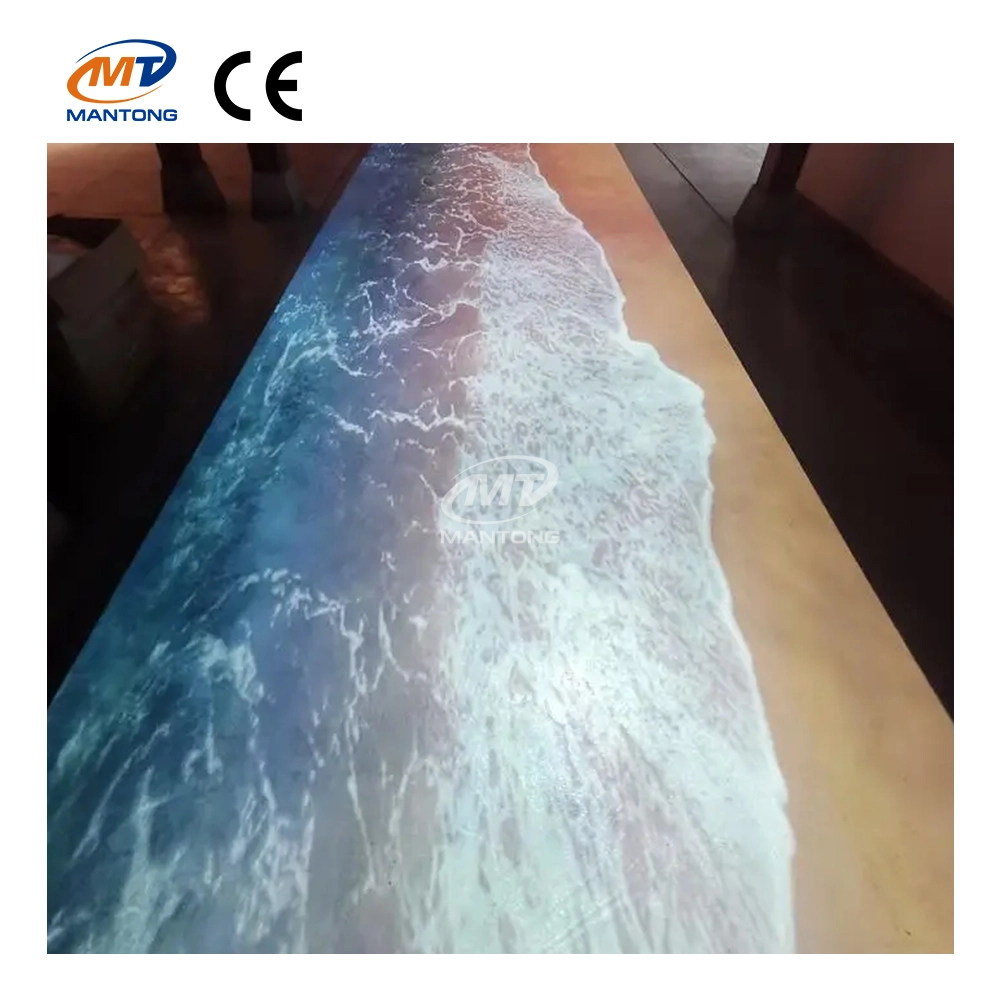
Indoor Interactive Floor Projector System - Customized Design & Installation Support
Indoor interactive floor projections display dynamic themed videos on the floor, commonly used in venues aiming to enhance brand influence or attract foot traffic, such as restaurants, hotel corridors, and brand car retail stores.
By using projectors and compatible software, the interactive content is projected onto the floor, encouraging engagement between people and the projected visuals. A single 5500-lumen indoor floor projector can cover an area of 5 m × 3 m. Typically, each project will use at least 3 units to ensure broad coverage and optimal visual effects.
We also offer customized design and installation support to enhance the interactive experience for your venue.
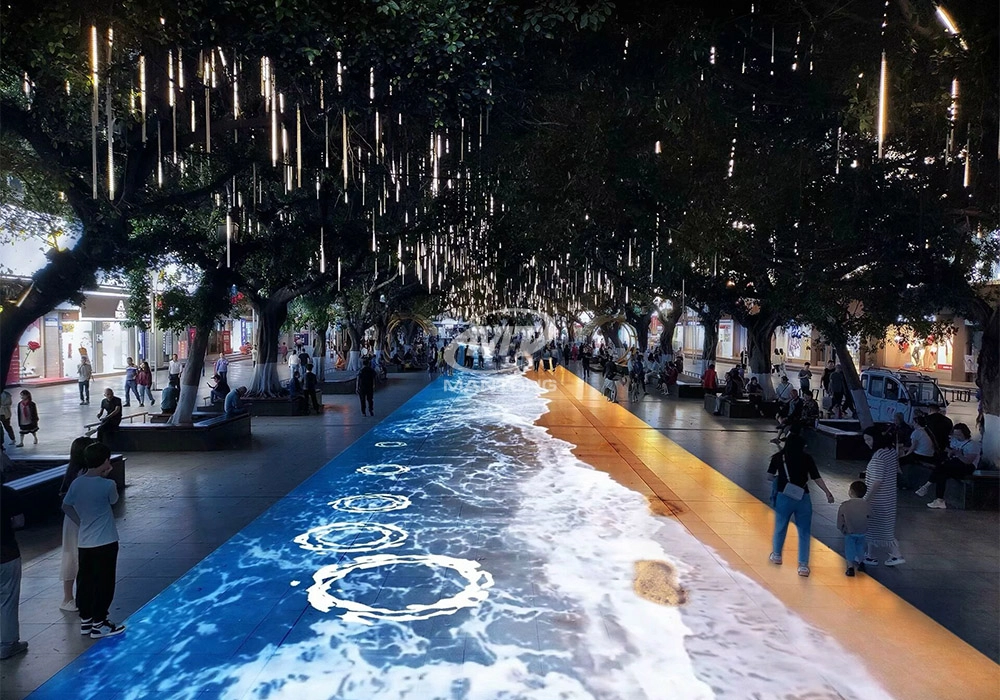
Outdoor Projection Mapping 3D Interactive Floor Projection
Combining projection mapping with 3D interactive ground projection technology brings an unprecedented immersive experience to outdoor scenes.
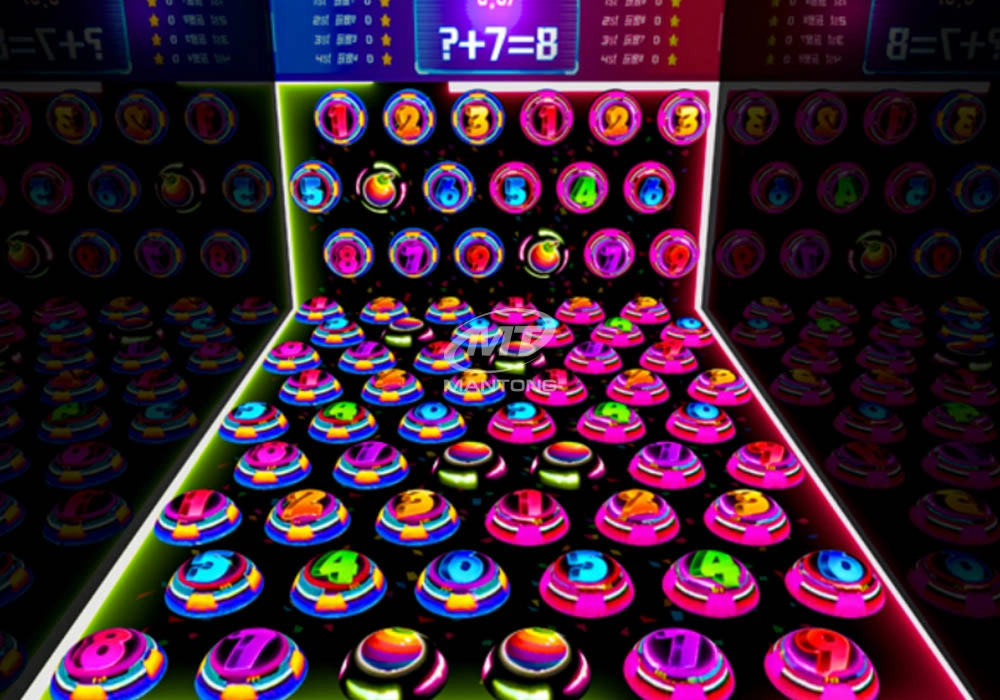
Amusement Rapidly Rotating Bouncing Sphere Interactive Wall Floor Projection Sports Games
Rapidly Rotating Bouncing Sphere is an interactive space where participants jump on rotating spheres. As they step on it, the spheres surface will show special interactivity
Jumping on spheres of the same color in succession causes them to pop, releasing light particles. The more consecutive jumps, the greater the reward—caterpillars appear, and eventually, all spheres of that color burst, filling the space with light and even more caterpillars.
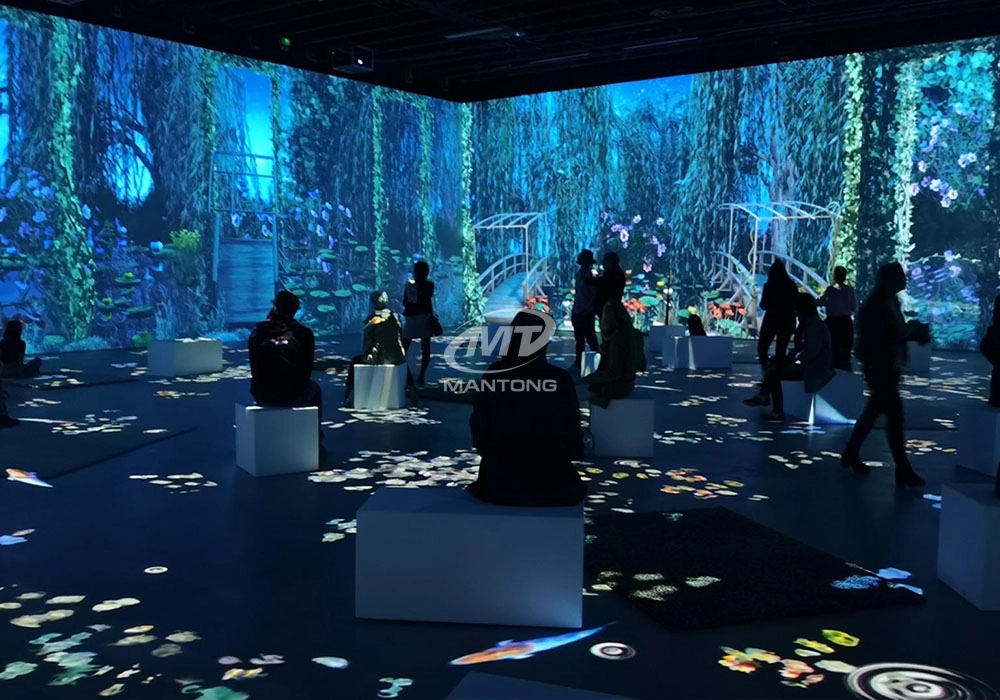
Mantong 6500LM High-Lumen Projector for Large-Scale Immersive Room Projection
Transform any space with Mantong's immersive projection mapping systems. Our high-lumen projectors (up to 6500 LM) and custom software create captivating interactive experiences for floors and walls. Ideal for museums, events, retail, and hospitality. Each kit includes professional ceiling mounting and 80+ pre-loaded video contents and is backed by a 12-month warranty and CE certification. We offer full customization and support to bring your vision to life.

Kaida Business Center, Shixin Road, Panyu District,Guangzhou City, Guangdong Province, China.
ManTong
ManTong
ManTong