
How to Choose an Interactive Projector Wall for Conference Rooms
- Choosing the Right Visual Technology for Modern Meetings
- Why pick an interactive projector wall for conference rooms?
- Understand your use cases and user needs for an interactive projector wall
- Key technical specifications to evaluate on an interactive projector wall
- Projection types and interaction methods: a comparison table
- Room layout, mounting and installation considerations for interactive projector wall
- Software, content and user experience requirements
- Operational costs, reliability and total cost of ownership (TCO)
- Vendor selection: what to ask prospective suppliers
- Why choose a manufacturer-direct partner like Mantong Digital for your interactive projector wall?
- Comparing interactive projector wall options: quick checklist
- Installation best practices and commissioning checklist for interactive projector wall
- FAQ — Frequently Asked Questions about interactive projector wall
- 1. What is an interactive projector wall and how does it differ from an interactive whiteboard?
- 2. Do I need a special wall surface for an interactive projector wall?
- 3. Which interaction technology is best for multi-user collaboration?
- 4. How much brightness is required for conference rooms with ambient light?
- 5. Can interactive projector walls integrate with Zoom or Microsoft Teams?
- 6. What is the expected lifespan of a laser interactive projector?
- 7. How much should I budget for a quality interactive projector wall?
- Contact, demo and next steps
- References
Choosing the Right Visual Technology for Modern Meetings
Selecting the best visual collaboration tool for a conference room is more than picking the brightest device — it’s about choosing a solution that supports workflows, integrates with AV and IT, and delivers reliable, easy-to-use interactivity. This guide explains how to evaluate and choose an interactive projector wall for conference rooms, addressing technical specs, room factors, software needs, cost of ownership, and vendor selection.
Why pick an interactive projector wall for conference rooms?
An interactive projector wall provides a large, scalable surface for collaborative activities, from whiteboarding and annotation to immersive presentations and multi-user interaction. For conference rooms that host workshops, design reviews, training sessions, or hybrid meetings, an interactive projector wall can deliver:
- Large-format, flexible display size without the high cost of similarly sized LED video walls.
- Multi-user touch and pen interaction supporting natural collaboration.
- Cost-effective scaling — you can adapt surface size to room layout and content requirements.
- Immersive or branded experiences for client-facing meetings.
Use the keyword interactive projector wall when assessing solutions so procurement and AV teams align on expected features and .
Understand your use cases and user needs for an interactive projector wall
Start by mapping how the conference room will be used. Common use cases affect technical choices:
- Presentation-focused: High contrast and accurate color are important when showing slides and video.
- Whiteboarding and annotation: Low-latency touch, palm rejection, and fine-pen sensing matter.
- Workshops and training: Multi-user simultaneous interaction and durable surfaces are required.
- Hybrid meetings: Integration with video-conferencing software and camera angles for shared view are critical.
Document typical meeting participant counts, distance from screen, ambient light, and desired interaction modes (touch, pen, gesture, mobile casting). These inputs directly determine projector brightness, throw ratio, and sensing technology for an interactive projector wall.
Key technical specifications to evaluate on an interactive projector wall
The following technical parameters are primary decision drivers. Use them as a checklist during vendor evaluation.
- Brightness (ANSI lumens): For conference rooms with ambient light, target 3500–8000 ANSI lumens for projection onto matte white or specialized screens. Higher brightness helps maintain contrast and readability.
- Resolution: Native WUXGA (1920x1200) is a practical baseline for text and detailed diagrams; 4K UHD is recommended for high-resolution designs and future-proofing.
- Throw ratio: Short-throw or ultra-short-throw projectors minimize shadowing and allow installation close to the wall — ideal for interactive projector walls.
- Interactive technology: Options include infrared camera-based tracking, optical sensors, capacitive touch overlays, and electromagnetic pen systems. Consider accuracy (mm), latency (ms), and multi-touch capability.
- Contrast ratio & color accuracy: Important for video and detailed visual content — laser projectors usually offer superior color stability.
- Connectivity & integration: HDMI, DisplayPort, HDBaseT, USB-C, network control (Crestron/AMX/Extron), and support for room systems (Zoom Rooms, Teams Rooms).
- Durability & maintenance: Laser light engines reduce lamp replacements and downtime. Evaluate IP ratings if dusty or outdoor environments are expected.
Projection types and interaction methods: a comparison table
| Option | Strengths | Limitations | Best when... |
|---|---|---|---|
| Ultra-short-throw laser projector + touch sensors | Minimal shadows, high reliability, low maintenance | Higher upfront cost; requires precise calibration | Room with presenters standing close to the wall |
| Short-throw projector + IR camera tracking | Good interaction fidelity, cost-effective | Camera occlusion risk; ambient light can affect tracking | Medium-sized rooms with controlled lighting |
| Projection mapping on textured wall | High visual impact; flexible shapes | Complex setup and calibration; content creation overhead | Branded client spaces or immersive demos |
| LED video wall (alternative) | High brightness and color uniformity; low ambient-light impact | Very high cost at large sizes; limited interaction native | Permanent executive boardrooms prioritizing image quality |
Data sources: AVIXA and manufacturer datasheets; verify specific product specs during procurement.
Room layout, mounting and installation considerations for interactive projector wall
Physical room factors determine which projector and mounting approach will work reliably:
- Wall surface: Use projection-grade paint or fixed projection screen for best results. Walls with texture or irregularities need surface treatment or a dedicated screen.
- Mounting height and projector placement: Calculate throw distance using the projector’s throw ratio and desired image width. Ultra-short-throw (UST) projectors can sit inches from the wall, reducing cable runs and ceiling mounts.
- Cable management and power: Plan for power, network, and AV cabling. Consider Power over Ethernet (PoE) for sensors or integrated controllers where supported.
- Ambient light control: Use blinds or controlled lighting when possible. High-brightness laser projectors mitigate but don’t eliminate ambient light effects.
Software, content and user experience requirements
Hardware without intuitive software leads to poor adoption. Assess software capability and user workflows:
- Annotation and whiteboarding: Built-in tools should support multi-user input, save/export functions, and cloud sync (OneDrive, Google Drive, Box).
- Compatibility with collaboration platforms: Ensure the interactive projector wall integrates with Zoom, Microsoft Teams, Webex, and your calendar/room booking system.
- Content management: For recurring client presentations, deploy a CMS to push content to multiple rooms and keep assets updated.
- Security and privacy: Networked interactive systems should support device authentication, encrypted data transfer, and regular firmware updates.
Operational costs, reliability and total cost of ownership (TCO)
Calculate TCO over a 5–7 year period, including:
- Upfront hardware and installation costs
- Maintenance: lamp replacements vs laser lifetime (laser typically rated 20,000–30,000+ hours)
- Support and software licensing fees
- Energy consumption and potential downtime costs
Example estimate (illustrative):
| Item | Year 1 | Annual (years 2–5) |
|---|---|---|
| Hardware & Installation | $12,000 | $0 |
| Software License & Support | $1,200 | $1,200 |
| Maintenance & Consumables | $200 | $200 |
| Energy & Misc. | $150 | $150 |
Choose laser-based interactive projector wall solutions when lifecycle cost and uptime are priorities — their longer light-engine life often offsets higher upfront cost.
Vendor selection: what to ask prospective suppliers
When evaluating vendors that supply an interactive projector wall system, ask for:
- Case studies in similar room sizes and industries.
- References and uptime/service-level agreements (SLAs).
- On-site demonstration or proof-of-concept (POC) deployments.
- Warranty terms and options for extended support.
- Software roadmap for collaboration features and security updates.
Prefer vendors that can provide end-to-end services: site survey, installation, integration with room systems, training, and long-term support.
Why choose a manufacturer-direct partner like Mantong Digital for your interactive projector wall?
Mantong Digital is a one-stop interactive projection solution provider and direct manufacturer based in Guangzhou, China, with over 10 years of industry experience. We are dedicated to providing innovative, flexible and cost-effective projection solutions, offering both hardware and software to meet various needs.
At ManTong, we specialize in providing customized solutions for a wide range of application scenarios through innovative projection technology. Whether it's immersive experiences, interactive entertainment or outdoor lighting and projection shows, our solutions can transform your ideas into stunning visual effects. Our projection technology provides customized solutions for a variety of scenarios, delivering immersive and interactive visual experiences.
We are now looking for business partnerships worldwide. Our vision is to become the world's leading interactive projection manufacturer. Visit our website: https://www.mtprojection.com/
Mantong’s core strengths and product focus for conference-room interactive projector walls:
- Technical depth: Over 10 years’ R&D and manufacturing experience in laser projection and interactive sensing.
- Product range: immersive projection, interactive floor projection, interactive projection, interactive wall projection, immersive room, 3D projection, interactive projection games, projection show, interactive projection mapping.
- Customized solutions: Tailored calibration, mounting, and software integration for room-specific workflows.
- Competitive pricing: As a direct manufacturer, Mantong reduces middle-man margins to deliver cost-effective systems.
- Global partnership orientation: Support for international deployments, documentation, and training.
Choosing Mantong means access to integrated hardware + software stacks and a manufacturer that can iterate on custom requirements fast — important for enterprises that need unique interactive projector wall configurations.
Comparing interactive projector wall options: quick checklist
Before final purchase, run through this checklist. It will help avoid common pitfalls:
- Have you completed a site survey and measured throw distances?
- Is the chosen solution compatible with your conferencing platform and room control?
- Does the interactive tech support the accuracy and multi-user interaction you need?
- Is a laser light source preferred to minimize maintenance?
- Have you budgeted for software licenses, support, and potential content creation?
- Can the vendor provide a POC or demo in a similar environment?
Installation best practices and commissioning checklist for interactive projector wall
To ensure a successful roll-out:
- Perform a dry run with the expected presenters and content types.
- Calibrate interactive sensors, and document calibration settings for future maintenance.
- Train end-users on common workflows — saving, exporting, sharing annotations, and connecting remote participants.
- Implement a scheduled firmware and software update policy with the vendor.
FAQ — Frequently Asked Questions about interactive projector wall
1. What is an interactive projector wall and how does it differ from an interactive whiteboard?
An interactive projector wall uses a projector and sensing technology to turn a wall or screen into an interactive surface, often at much larger sizes than typical interactive whiteboards. Interactive whiteboards are integrated display + touch panels with fixed sizes, while interactive projector walls offer more flexibility in scale and content mapping.
2. Do I need a special wall surface for an interactive projector wall?
A projection-grade painted surface or dedicated projection screen yields the best image uniformity and color accuracy. For interactive features, ensure the surface is smooth and non-reflective to avoid tracking errors.
3. Which interaction technology is best for multi-user collaboration?
Optical or camera-based tracking with low latency and robust multi-touch support is typically best for multi-user collaboration. Capacitive overlays provide high precision but may be limited by size and cost.
4. How much brightness is required for conference rooms with ambient light?
For moderate ambient light, target 3500–5000 ANSI lumens. For larger rooms or brighter environments, 6000–8000 lumens provides more margin. Laser projectors retain color fidelity better at higher brightness levels.
5. Can interactive projector walls integrate with Zoom or Microsoft Teams?
Yes — many interactive projector wall solutions support integration with Zoom Rooms, Microsoft Teams Rooms, and other UC platforms. Confirm with the vendor about native compatibility and recommended peripherals (cameras, mics).
6. What is the expected lifespan of a laser interactive projector?
Laser light engines typically have rated lifespans of 20,000 to 30,000+ hours depending on manufacturer and usage mode, which is significantly longer than lamp-based projectors and reduces maintenance frequency.
7. How much should I budget for a quality interactive projector wall?
Budget varies widely: a mid-range interactive projector wall solution (UST laser projector + sensors + installation) can range from $10,000 to $30,000+ depending on size and software. Consider lifecycle costs and software subscriptions when calculating budget.
Contact, demo and next steps
If you’re evaluating interactive projector wall options for conference rooms, request a site survey and proof-of-concept from experienced vendors. For customized solutions, Mantong Digital offers manufacturer-direct services and global partnerships. Contact Mantong for case studies, demo requests, and project quotations: https://www.mtprojection.com/
References
- AVIXA (formerly InfoComm) — ‘‘Projection and Display Technologies’’ — https://www.avixa.org/ (accessed 2025-06-10)
- Wikipedia — ‘‘Video projector’’ — https://en.wikipedia.org/wiki/Video_projector (accessed 2025-06-10)
- Grand View Research — ‘‘Projection Market Size & Trends’’ — https://www.grandviewresearch.com/industry-analysis/projector-market (accessed 2024-11-15)
- Mantong Digital — Official site — https://www.mtprojection.com/ (accessed 2025-06-10)
Troubleshooting Common Interactive Floor Projection Issues
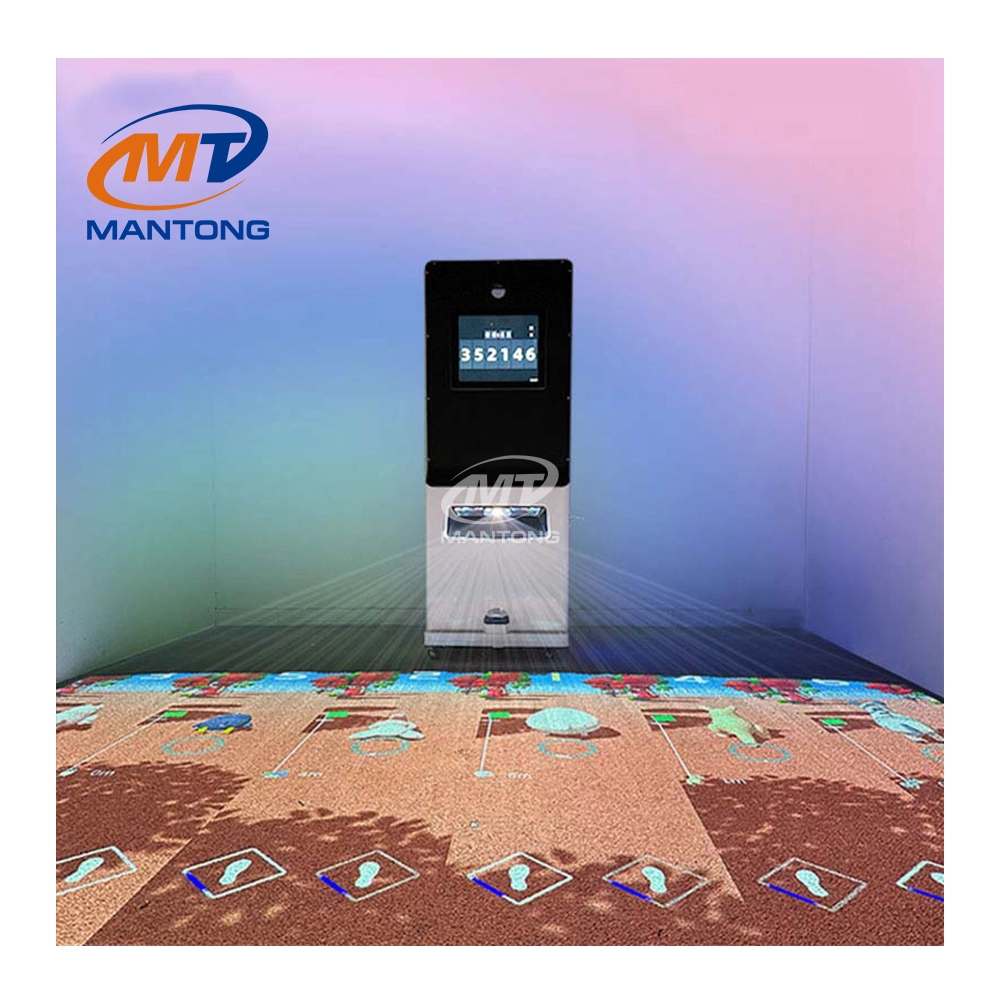
Transform Learning & Fitness with Interactive Floor Projection: Immersive Education & Game Solutions
Top Uses of Interactive Water Projection in Events: Practical Applications and ROI
Best professional 3d interactive projection manufacturers and supplier brands in China
One-Stop Projection Solution Provider Since 2011
Are you trader or manufacturer ?
We are direct manufacturer who specialize in providing one-stop solution for different outdoor & indoor projection project with our stable software and qualified projectors
How to install the projection equipment ?
1) Install the projector in a suitable position. We will provide you with a hanger, which you need to fix on the ceiling with
screws.
2) Connect projectors, computers and other accessories through wires.
3) After completing the above 2 steps, we will carry out the edge blending steps. Our team can complete it through remote
control.
In general, installation instructions for each project need to be specified on a project-by-project basis. The above is for
reference only.
What's the application of Immersive projection ?
It can be used in various venues, such as art exhibition, entertainment venues, educational institution, Wedding hall /Banquet/Bar,Yoga Studio and so on. It often involves advanced projection techniques, multimedia content, and interactive elements to engage and captivate the audience's senses.
What information do you need to know before making the proposal/solution?
We know that everyone wants to know the price, but the price of our products is determined by many factors since most of our products are custom, so no ready price list. In order to fast understand what you need, can you send us an inquiry like this?
For example: I am really interested in your immersive projection products, we are a company in the USA and want to install some in my restaurant. It is about 50 meters long, and 5m in width. Projection size you can decide but the length should be not less than 20 meters. We want some content about SeaWorld because our place is all about the sea. Thank you.
What's Immersive Projection ?
Immersive projection refers to a technology that creates a captivating and all-encompassing visual experience for viewers by projecting images or videos onto large surfaces, such as walls, floors, or even entire rooms. This technology aims to immerse the audience in a simulated environment, blurring the boundaries between the physical and virtual worlds.
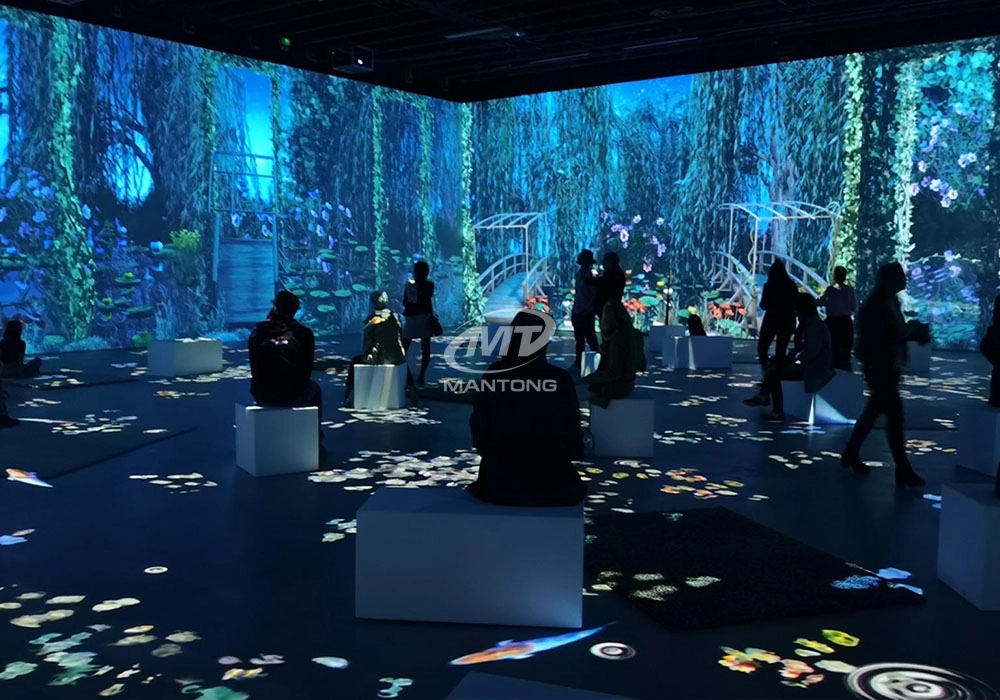
Mantong 6500LM High-Lumen Projector for Large-Scale Immersive Room Projection
Transform any space with Mantong's immersive projection mapping systems. Our high-lumen projectors (up to 6500 LM) and custom software create captivating interactive experiences for floors and walls. Ideal for museums, events, retail, and hospitality. Each kit includes professional ceiling mounting and 80+ pre-loaded video contents and is backed by a 12-month warranty and CE certification. We offer full customization and support to bring your vision to life.
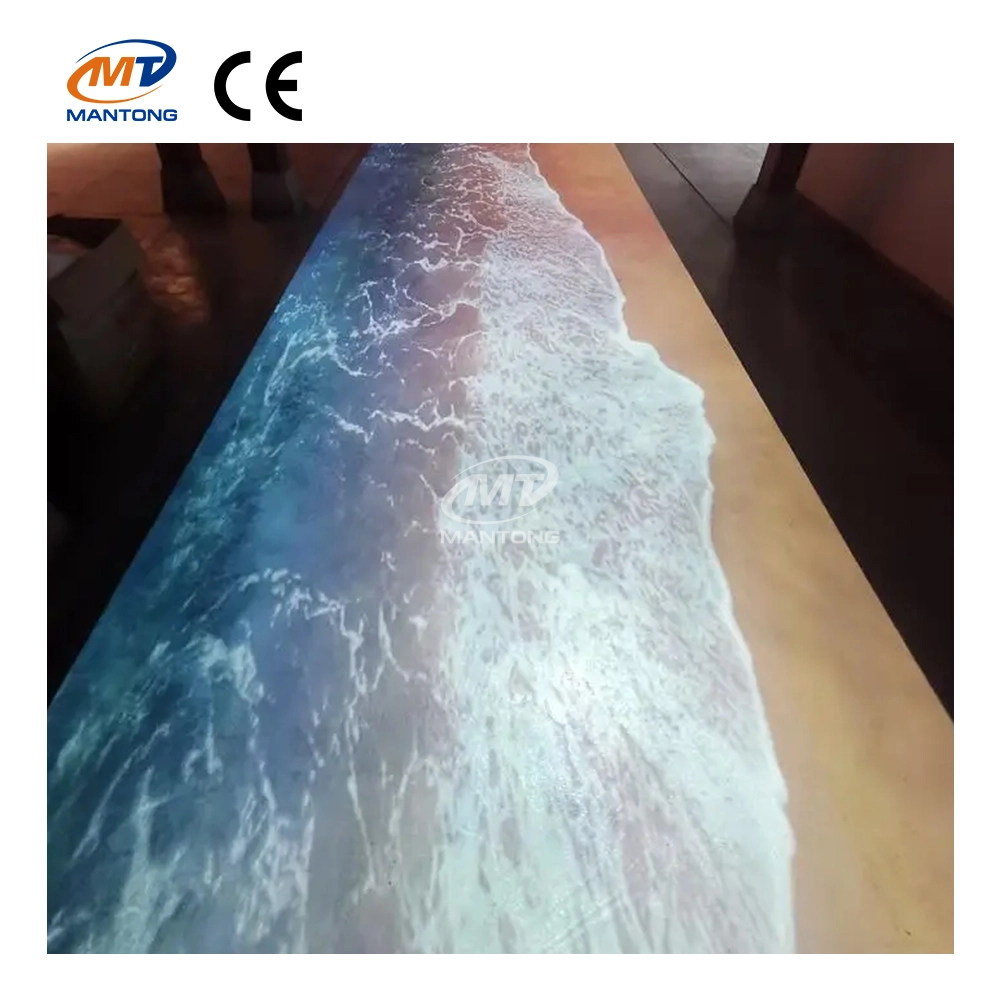
Indoor Interactive Floor Projector System - Customized Design & Installation Support
Indoor interactive floor projections display dynamic themed videos on the floor, commonly used in venues aiming to enhance brand influence or attract foot traffic, such as restaurants, hotel corridors, and brand car retail stores.
By using projectors and compatible software, the interactive content is projected onto the floor, encouraging engagement between people and the projected visuals. A single 5500-lumen indoor floor projector can cover an area of 5 m × 3 m. Typically, each project will use at least 3 units to ensure broad coverage and optimal visual effects.
We also offer customized design and installation support to enhance the interactive experience for your venue.
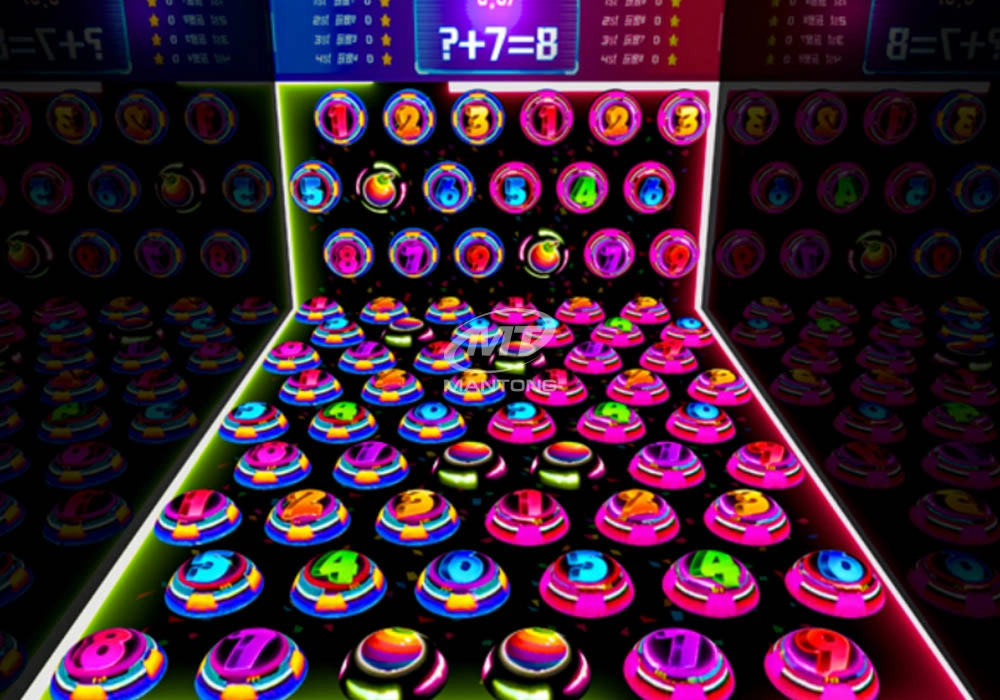
Amusement Rapidly Rotating Bouncing Sphere Interactive Wall Floor Projection Sports Games
Rapidly Rotating Bouncing Sphere is an interactive space where participants jump on rotating spheres. As they step on it, the spheres surface will show special interactivity
Jumping on spheres of the same color in succession causes them to pop, releasing light particles. The more consecutive jumps, the greater the reward—caterpillars appear, and eventually, all spheres of that color burst, filling the space with light and even more caterpillars.
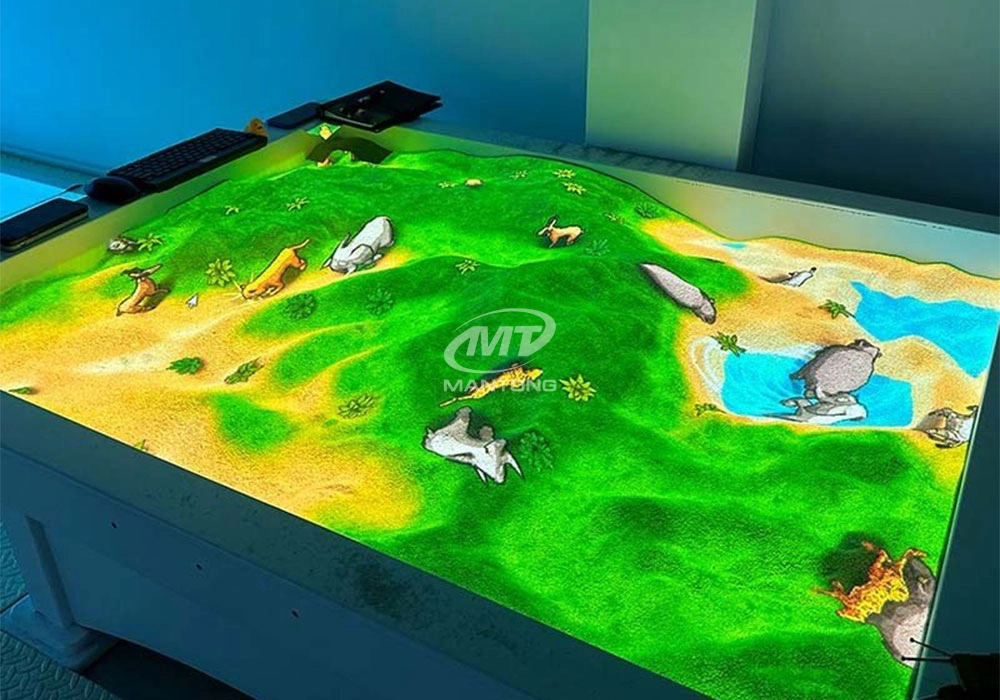
Interactive Sandbox Projection Mapping Games For Kids Play Park
Bring imagination to life with interactive sandbox projection mapping games designed for kids’ play parks. Using cutting-edge projection technology and real-time motion sensing, children can dig, build, and explore virtual worlds directly in the sand. Educational, engaging, and endlessly fun — it’s the perfect blend of play and learning.

Kaida Business Center, Shixin Road, Panyu District,Guangzhou City, Guangdong Province, China.
ManTong
ManTong
ManTong