
Interactive Floor Games Buying Guide: Features & ROI
- Why Interactive Floor Games Matter for Experiences and Business Outcomes
- Engagement, dwell time and conversion
- Branding, accessibility and inclusivity benefits
- Measurable KPIs to track
- Core Components & Technical Features to Evaluate
- Projection hardware: brightness, throw ratio and lifetime
- Sensing technologies: camera, depth sensor, LiDAR and IR
- Software: content engine, analytics and integration
- Design & Deployment Considerations
- Space planning and user flow
- Content strategy and localization
- Installation, calibration and maintenance
- Comparing Interactive Floor Games: Feature Matrix
- Selecting the right tier
- ROI Calculation: Sample Models and Realistic Expectations
- Key inputs for an ROI model
- Example ROI scenarios
- Reducing Total Cost of Ownership
- Procurement Checklist and Vendor Evaluation
- Technical checklist
- Commercial checklist
- Validation and testing
- Industry Context, Standards and Further Reading
- Projection mapping & interactive surfaces research
- Market context
- Mantong Digital: Solution Provider & Manufacturer (Manufacturer Spotlight)
- Common Deployment Pitfalls and How to Avoid Them
- Underestimating ambient light
- Poor sensor placement and occlusion
- Ignoring content localization and measurement
- FAQ
- 1. What exactly are interactive floor games?
- 2. How long do interactive floor projection systems last?
- 3. Can interactive floor games work outdoors?
- 4. What maintenance should I expect?
- 5. How do I measure ROI for an interactive floor game?
- 6. Are there data privacy concerns with sensors?
- Next Steps & Contact
This guide outlines what buyers need to know when evaluating interactive floor games: core technologies (projectors, sensors, software), user experience design, installation and maintenance factors, measurable business outcomes, and realistic ROI models. It is written for purchasing managers, architects, experience designers and operators considering immersive interactive projection systems, with practical comparisons, data-backed recommendations and vendor selection criteria.
Why Interactive Floor Games Matter for Experiences and Business Outcomes
Engagement, dwell time and conversion
Interactive floor games combine projected visuals with motion sensing to create dynamic, play-oriented experiences that increase visitor engagement and dwell time. Longer dwell time is correlated with improved likelihood of purchase or positive recall in retail and attraction contexts — an observation supported by broader customer experience research (see Harvard Business Review). For environments such as malls, family entertainment centers or museums, interactive projection and floor games act as both attraction and conversion tool.
Branding, accessibility and inclusivity benefits
Well-designed interactive floor projection supports multi-language content, physical accessibility (non-contact play), and brand storytelling at scale. Compared with static signage, interactive floor games can be updated remotely, localized for different languages, and tailored for seasonal campaigns — increasing marketing agility and reducing recurring print costs.
Measurable KPIs to track
Key performance indicators for any interactive floor deployment should include: daily users, average dwell time, repeat-users percentage, conversions (where measurable), maintenance uptime, and cost-per-interaction. These metrics allow direct ROI calculations and justify investment to stakeholders.
Core Components & Technical Features to Evaluate
Projection hardware: brightness, throw ratio and lifetime
Choose a projector based on installation height, ambient light, resolution and expected usage hours. For high-traffic public spaces, consider high-brightness laser/LED projectors (3000–10,000+ ANSI lumens) and long-life light sources (20,000+ hours) to minimize service visits. See general projector specs on Video projector (Wikipedia) for common lamp/LED lifetime ranges.
Sensing technologies: camera, depth sensor, LiDAR and IR
Sensors detect player position and gestures. Options include RGB cameras with computer vision, depth sensors (e.g., Intel RealSense, Microsoft Azure Kinect), infrared (IR) cameras and active LiDAR systems. Depth sensors excel at multi-user tracking in variable lighting; IR solutions are cost-effective for silhouette detection. Choose a sensing approach that matches expected ambient light, play complexity and privacy constraints.
Software: content engine, analytics and integration
Assess software for its content library, authoring tools, multi-site management and analytics dashboard. Important capabilities: remote content updates, event scheduling, multi-language support, SDK/API for integration with POS, CRM or building management systems, and exportable usage data for KPI reporting.
Design & Deployment Considerations
Space planning and user flow
Map expected user traffic and sightlines before purchase. Interactive floor games need an appropriate footprint and safety buffers. Consider anti-slip floor finish, cable management, and signage for instructions. For temporary activations, portable systems with tripod mounts and automatic keystone correction speed setup.
Content strategy and localization
Content should be designed around local culture, brand voice and accessibility standards. Games should offer short session loops (30–90 seconds) to maximize throughput in busy areas and support multi-language prompts and iconography for universal usability. Many platforms allow toggling languages or scheduling content per market remotely.
Installation, calibration and maintenance
Professional installation includes projector alignment, sensor calibration, floor mapping and ambient light mitigation. Laser/LED projectors reduce routine lamp replacement costs. Plan for periodic recalibration, software updates and a service SLA. For large deployments, remote monitoring that reports uptime and sensor health is essential.
Comparing Interactive Floor Games: Feature Matrix
The table below compares typical tiers of interactive floor game solutions: Basic, Professional and Enterprise. Use this matrix to align features with budget and goals.
| Feature | Basic | Professional | Enterprise |
|---|---|---|---|
| Projected resolution | 720p | 1080p | 4K or multi-projector blended |
| Brightness (ANSI lumens) | 2,000–3,500 | 3,500–8,000 | >8,000 (laser/LED) |
| Sensors | Single RGB camera | Depth sensor / IR array | Multi-depth sensors + LiDAR |
| Content authoring | Pre-built games only | Customizable templates | Full SDK + bespoke dev |
| Analytics | Basic usage counts | Detailed sessions + dwell time | Integration with BI/CRM |
| Multi-site management | No | Yes | Centralized cloud control |
| Typical use case | Small pop-ups, events | Retail, museums | Large venues, theme parks |
Selecting the right tier
Match tier to objectives: if your primary goal is short-term marketing buzz, a Basic system may suffice; if you need reliable, 24/7 interactive attractions integrated with customer data, invest at Professional or Enterprise levels.
ROI Calculation: Sample Models and Realistic Expectations
Key inputs for an ROI model
Build ROI using these inputs: initial capital expenditure (hardware + installation + content), annual operating costs (maintenance, license, electricity), expected daily interactions, estimated revenue uplift (or value per interaction), and lifespan of equipment (years). Track KPIs to refine assumptions over time.
Example ROI scenarios
Below are two simplified scenarios to illustrate payback timelines for retail activations. Numbers are illustrative; replace with site-specific measurements for accurate projections.
| Item | Small Retail (Basic) | Shopping Mall Anchor (Professional) |
|---|---|---|
| Initial cost (hardware + install) | $8,000 | $35,000 |
| Annual Opex (licenses, maintenance) | $1,200 | $6,000 |
| Daily interactions (avg) | 120 | 1,200 |
| Value per interaction (estimated) | $0.50 | $0.80 |
| Annual attributable value | $21,900 | $350,400 |
| First-year net | $12,700 | $309,400 |
| Simple payback | ~7 months | <1 month |
Note: 'Value per interaction' may represent incremental spend, increased conversion probability or brand lift monetized conservatively. Use measured KPIs to update values. For museums or edutainment, quantify value as ticket uplift or incremental donations.
Reducing Total Cost of Ownership
To improve ROI, choose laser/LED projectors (lower lamp-replacement cost), negotiate multi-year content licenses, and use remote monitoring to reduce in-person service visits. Centralized content management allows A/B testing different games to maximize engagement efficiently.
Procurement Checklist and Vendor Evaluation
Technical checklist
- Projected lumen requirement and projector model
- Sensor type and multi-user tracking capacity
- Resolution and content scaling options (single or blended projectors)
- Network connectivity, remote management and analytics export
- Integration APIs and data privacy support
Commercial checklist
- Warranty, SLAs and spare parts policy
- Content licensing model (perpetual vs subscription)
- Installation and training scope
- References and case studies in your industry
Validation and testing
Request an on-site or video demo using your space photos or a short pilot deployment. Validate detection accuracy, multi-user behavior, and content relevance. Ask vendors for usage analytics from comparable deployments as proof points.
Industry Context, Standards and Further Reading
Projection mapping & interactive surfaces research
Projection mapping and interactive projection are active research and industry areas; techniques are documented in public literature (see Projection mapping (Wikipedia)) and applied research such as Microsoft Research's IllumiRoom project (Microsoft Research IllumiRoom), which demonstrate immersive projection concepts and system design trade-offs.
Market context
Industry reports show growing demand for immersive experiences and projection-based installations in retail, attractions and public spaces. For market sizing and trends, see reports such as Grand View Research's analyses on projection mapping and immersive technology markets (Grand View Research).
Mantong Digital: Solution Provider & Manufacturer (Manufacturer Spotlight)
Mantong Digital is a one-stop interactive projection solution provider and direct manufacturer based in Guangzhou, China, with over 10 years of industry experience. We are dedicated to providing innovative, flexible and cost-effective projection solutions, offering both hardware and software to meet various needs. Visit the Mantong website at https://www.mtprojection.com/.
At ManTong, we specialize in providing customized solutions for a wide range of application scenarios through innovative projection technology. Whether it's immersive experiences, interactive entertainment or outdoor lighting and projection shows, our solutions can transform your ideas into stunning visual effects. Our projection technology provides customized solutions for a variety of scenarios, delivering immersive and interactive visual experiences.
We provide end-to-end capabilities: product R&D and manufacturing (projectors, sensor kits), bespoke interactive software and content libraries, and global deployment services. Key product and solution categories include immersive projection, interactive floor projection, interactive projection, interactive wall projection, immersive room, 3D projection, interactive projection games, projection show and interactive projection mapping.
Mantong's competitive advantages:
- Over a decade of manufacturing experience with in-house hardware production for quality control and cost efficiency.
- Flexible software stack with SDKs for custom integrations and cloud-based content management for multi-site rollouts.
- Proven track record in diverse applications: retail, museums, theme parks and outdoor projection shows.
- Full service: concept design, on-site calibration, training and 24/7 remote monitoring options.
We are now looking for business partnerships worldwide. Our vision is to become the world's leading interactive projection manufacturer.
Common Deployment Pitfalls and How to Avoid Them
Underestimating ambient light
Many buyers choose projectors that are too dim for their environment, yielding low contrast and washed-out colors. Run a daylight test and size the lumen output for peak ambient conditions.
Poor sensor placement and occlusion
Incorrect sensor mounting can cause blind spots or false positives. Use multi-sensor arrays for large or irregularly shaped play areas.
Ignoring content localization and measurement
Content that isn't localized or measured will underperform. Ensure A/B testing and analytics are part of initial deployment to iterate quickly.
FAQ
1. What exactly are interactive floor games?
Interactive floor games use projected images and sensor-based tracking to create interactive play surfaces. Users interact by stepping, moving or gesturing; the system responds in real-time with visuals, sound and rewards.
2. How long do interactive floor projection systems last?
System lifetime depends on components. Modern laser/LED projectors often provide 20,000+ hours, sensors vary but commonly last many years with proper housing. Software lifecycle depends on vendor support and update policies.
3. Can interactive floor games work outdoors?
Yes, but outdoor deployments require high-brightness projectors, weatherproof housings, and careful consideration of ambient light and surface materials. Outdoor projection shows may use specialized high-power projection and mapping techniques.
4. What maintenance should I expect?
Planned maintenance includes periodic cleaning, occasional recalibration, software updates and monitoring of projector light-source health. Laser/LED projectors reduce consumable lamp costs. Service contracts with SLAs are recommended for public installations.
5. How do I measure ROI for an interactive floor game?
Measure interactions, dwell time, repeat visits and correlate these with sales or conversion data where possible. Use a conservative 'value per interaction' to model annual attributable value and compare against total cost of ownership to compute payback period.
6. Are there data privacy concerns with sensors?
Yes. Prefer solutions that process detection on-device (edge processing) and avoid storing identifiable images. Vendors should provide data handling policies and options to anonymize analytics in compliance with local regulations.
Next Steps & Contact
If you're evaluating interactive floor games for retail, attractions, museums or public spaces, start with a site assessment and pilot. For turnkey solutions, custom content and global manufacturing support, consider reaching out to Mantong Digital. View products, case studies and request a quote at Mantong Digital.
Ready to discuss a pilot or multi-site rollout? Contact Mantong Digital to explore how immersive projection and interactive floor games can deliver measurable engagement and ROI for your project.
Immersive Meeting Room ROI: Cost vs Productivity Gains
Top Vendors of Interactive Projector Games in 2026
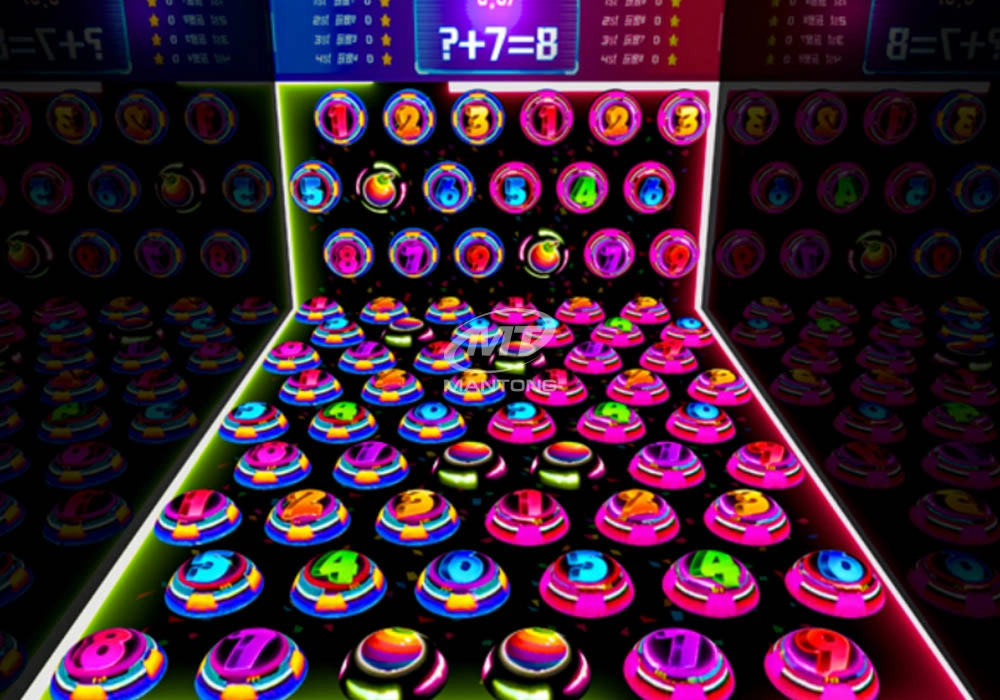
Interactive Rotating Bouncing Sphere — Wall & Floor Projection for Sports and Entertainment
Best professional projection restaurant manufacturers and supplier brands in China
One-Stop Projection Solution Provider Since 2011
Are you trader or manufacturer ?
We are direct manufacturer who specialize in providing one-stop solution for different outdoor & indoor projection project with our stable software and qualified projectors
What information do you need to know before making the proposal/solution?
We know that everyone wants to know the price, but the price of our products is determined by many factors since most of our products are custom, so no ready price list. In order to fast understand what you need, can you send us an inquiry like this?
For example: I am really interested in your immersive projection products, we are a company in the USA and want to install some in my restaurant. It is about 50 meters long, and 5m in width. Projection size you can decide but the length should be not less than 20 meters. We want some content about SeaWorld because our place is all about the sea. Thank you.
How to Write an Interactive-Effect Video Customisation Script ?
① Project Background: Briefly introduce the context in which this interactive scene will be used (e.g., exhibition, museum,
event space, children's area). Example: This scene is part of the “Underwater World” zone in a children's science museum,
designed to be engaging and exploratory.
②Visual Style / Atmosphere: What kind of visual mood are you aiming for? Please describe the color scheme, style, and any
references. it should focus solely on describing the visual aspects of the scene, supported by relevant charts or reference
images.
③ Interaction Points Overview:List each interactive hotspot along with the effect you'd like to trigger when the user
touches or clicks the area. example: when player touch the clownfish, it will swims away with bubble trail (animation effect)
and produce the bubble sound ( sound effect requirement )
④ Static Visual Reference:including but not limited to background image/video, a list of major visual elements (e.g., coral,
rocks, seaweed, fish), which elements should be interactive?
What's Immersive Projection ?
Immersive projection refers to a technology that creates a captivating and all-encompassing visual experience for viewers by projecting images or videos onto large surfaces, such as walls, floors, or even entire rooms. This technology aims to immerse the audience in a simulated environment, blurring the boundaries between the physical and virtual worlds.
What about the wall/floor material for the projection?
It’s recommended to choose a light-colored material with minimal reflectivity—pure white or light grey works best. the
common material is cement & plaster board
For optimal projection results, the surface should be free of any patterns or textures, as the projector will display content
directly onto it.
There are no specific material requirements; you may use any commonly available material in your local market, as long as it
meets the above conditions.
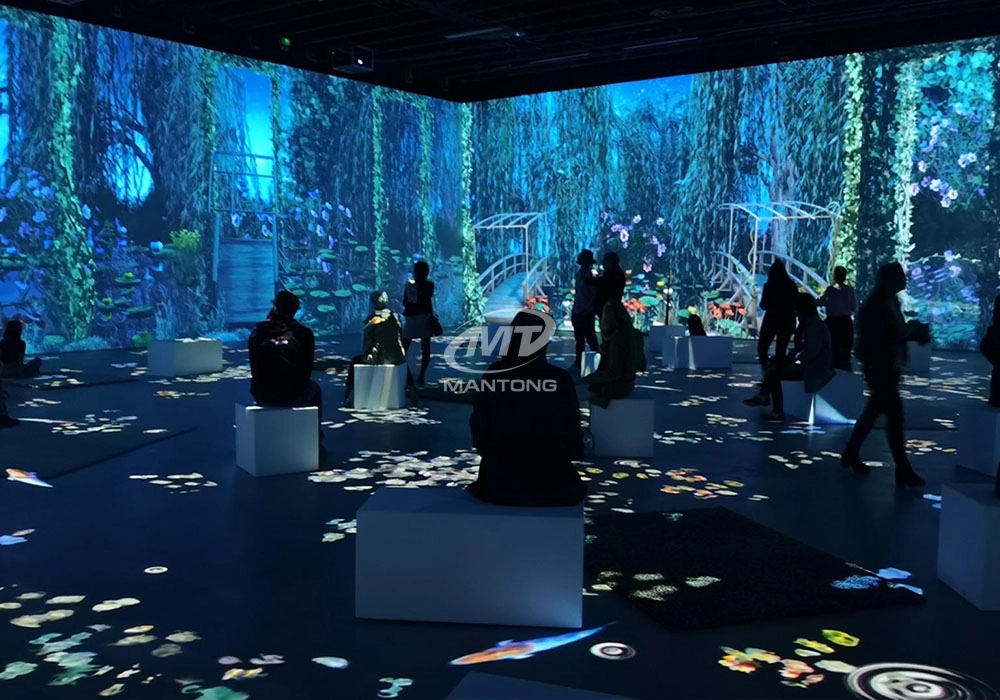
Mantong 6500LM High-Lumen Projector for Large-Scale Immersive Room Projection
Transform any space with Mantong's immersive projection mapping systems. Our high-lumen projectors (up to 6500 LM) and custom software create captivating interactive experiences for floors and walls. Ideal for museums, events, retail, and hospitality. Each kit includes professional ceiling mounting and 80+ pre-loaded video contents and is backed by a 12-month warranty and CE certification. We offer full customization and support to bring your vision to life.
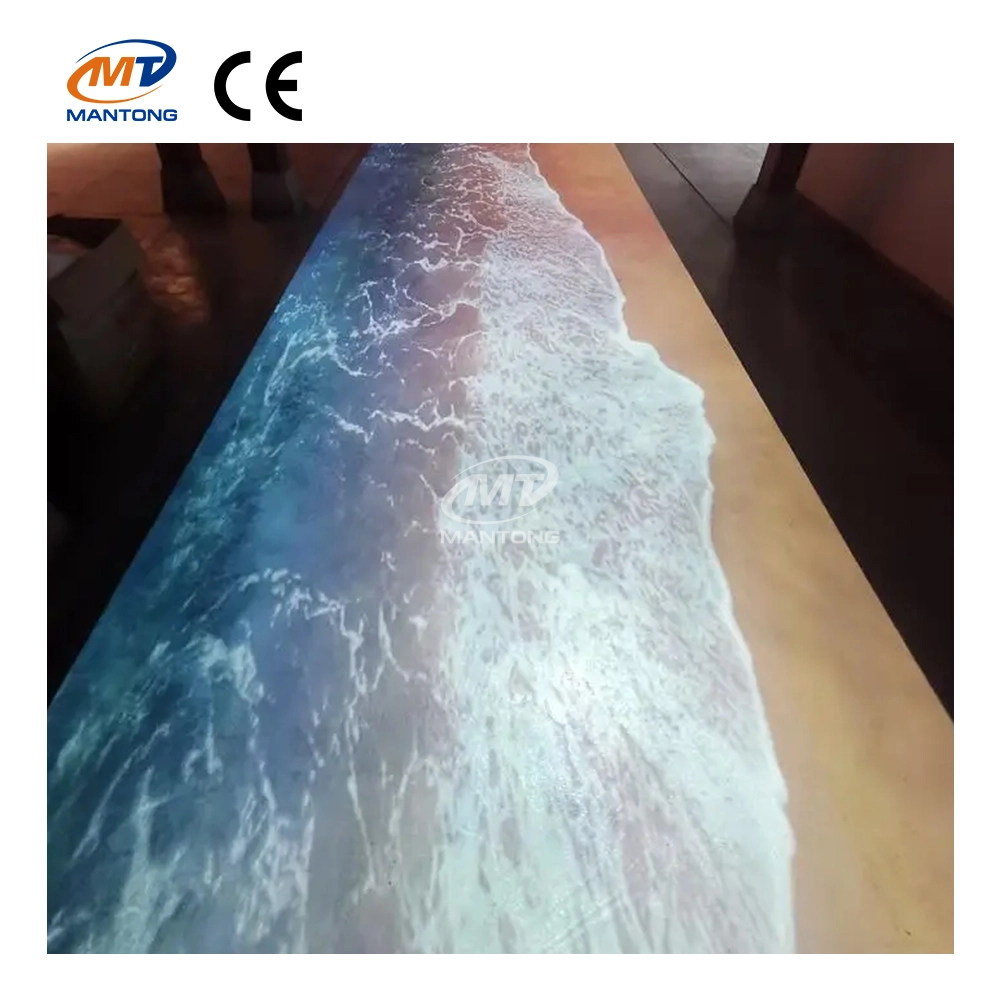
Indoor Interactive Floor Projector System - Customized Design & Installation Support
Indoor interactive floor projections display dynamic themed videos on the floor, commonly used in venues aiming to enhance brand influence or attract foot traffic, such as restaurants, hotel corridors, and brand car retail stores.
By using projectors and compatible software, the interactive content is projected onto the floor, encouraging engagement between people and the projected visuals. A single 5500-lumen indoor floor projector can cover an area of 5 m × 3 m. Typically, each project will use at least 3 units to ensure broad coverage and optimal visual effects.
We also offer customized design and installation support to enhance the interactive experience for your venue.
Amusement Rapidly Rotating Bouncing Sphere Interactive Wall Floor Projection Sports Games
Rapidly Rotating Bouncing Sphere is an interactive space where participants jump on rotating spheres. As they step on it, the spheres surface will show special interactivity
Jumping on spheres of the same color in succession causes them to pop, releasing light particles. The more consecutive jumps, the greater the reward—caterpillars appear, and eventually, all spheres of that color burst, filling the space with light and even more caterpillars.
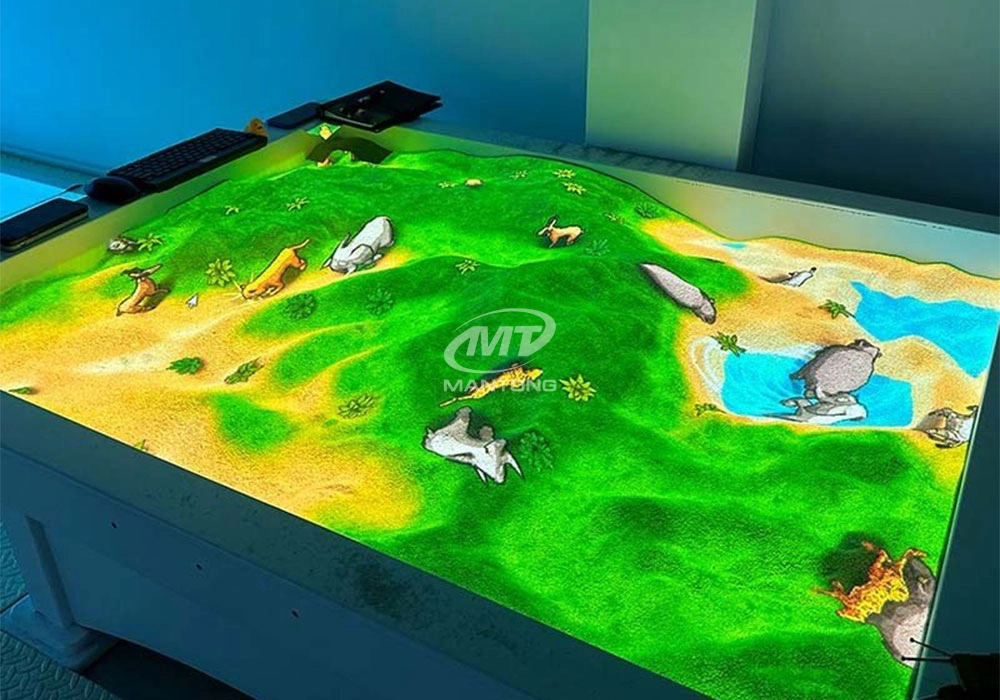
Interactive Sandbox Projection Mapping Games For Kids Play Park
Bring imagination to life with interactive sandbox projection mapping games designed for kids’ play parks. Using cutting-edge projection technology and real-time motion sensing, children can dig, build, and explore virtual worlds directly in the sand. Educational, engaging, and endlessly fun — it’s the perfect blend of play and learning.

Kaida Business Center, Shixin Road, Panyu District,Guangzhou City, Guangdong Province, China.
ManTong
ManTong
ManTong