
Evaluating Interactive Floor Game Hardware and Sensors
- Key hardware components for immersive projection
- Projectors: brightness, throw, and optics
- Projection mapping and mounting hardware
- Image processing and edge compute
- Sensor systems: choosing detection technologies
- Vision-based sensors: RGB cameras and depth cameras
- Contact sensors: pressure mats and capacitive pads
- Alternative sensors: IR, ultrasonic, LIDAR
- Sensor comparison table
- Performance metrics that matter for interactive floor games
- Latency and frame rate targets
- Spatial accuracy and calibration
- Occlusion, shadows and multi-user scenarios
- Durability, safety, deployment and operational considerations
- Environmental and durability requirements
- Power, connectivity and integration
- Privacy, safety and compliance
- Cost, selection and procurement strategy
- Cost drivers and TCO
- Vendor selection and testing protocol
- Scalability and future-proofing
- Practical deployment examples and supplier guidance
- Sample architectures
- Checklist before go-live
- Mantong Digital: partner and supplier overview
- Frequently Asked Questions (FAQ)
- 1. What sensor type is best for multi-user interactive floor games?
- 2. How bright must the projector be for an interactive floor in a mall?
- 3. How do I measure end-to-end latency?
- 4. Are vision-based systems a privacy risk?
- 5. What maintenance should I expect?
- 6. How do I test a vendor's interactive floor solution before purchase?
- Contact and next steps
Interactive floor games combine projection, sensing, and real-time processing to create responsive play areas used in museums, retail, entertainment centers, schools, healthcare and public spaces. For indexing and local search relevance, this article focuses on the hardware and sensor choices that determine system reliability, responsiveness and user experience for interactive floor projection systems, showing practical evaluation criteria, measurable specs and deployment trade-offs.
Key hardware components for immersive projection
Projectors: brightness, throw, and optics
The projector is the foundation of any interactive floor game. Important technical specs include brightness (ANSI lumens), contrast ratio, throw ratio, lens shift, resolution, and light source type (lamp, LED, laser). For public spaces with ambient light, aim for at least 4,000–8,000 ANSI lumens for floor areas up to 4–6 m diagonal; high-ambient outdoor or very large installations may need 10,000+ lumens. Projector type impacts color stability, maintenance and lifetime—laser projectors offer longer lifespans (20,000+ hours) and faster on/off cycles compared with lamp-based units. See general projector characteristics on Wikipedia for baseline definitions: https://en.wikipedia.org/wiki/Projector_(display_device).
Projection mapping and mounting hardware
Mounting position (ceiling, truss, short-throw near-ceiling) and lens selection determine coverage and keystone correction needs. Interactive floor games often use short-throw or ultra-short-throw projectors to reduce occlusions and shadows. Rigid mounts with micro-adjustments and lockable tilt/yaw help maintain calibration. For multi-projector arrays, use edge-blending hardware/software and geometric warping that supports real-time dynamic recalibration.
Image processing and edge compute
Real-time image warping, blending and rendering require a GPU-capable processing unit. For simple single-projector installations, an industrial PC with a mid-range GPU (e.g., NVIDIA GTX/RTX class) is typically sufficient. Multi-projection or high-framerate (60 Hz+) interactive systems benefit from higher-end GPUs or distributed edge nodes. Consider hardware acceleration for sensor fusion and machine learning inference when using vision-based tracking.
Sensor systems: choosing detection technologies
Vision-based sensors: RGB cameras and depth cameras
RGB cameras are simple and low-cost for silhouette/contour detection, color tracking, and marker-based systems. Depth cameras (time-of-flight, structured light, stereo depth) provide explicit distance measurements and simplify floor-level tracking in variable lighting and with complex backgrounds. Time-of-flight and modern active depth sensors are robust for interactive floor games because they reduce sensitivity to ambient color and provide per-pixel depth data. See the overview of time-of-flight cameras: https://en.wikipedia.org/wiki/Time-of-flight_camera.
Contact sensors: pressure mats and capacitive pads
Pressure mats and capacitive floor sensors detect direct foot contacts with high reliability and low latency. They are ideal for discrete interaction zones (jump pads, step zones). Pressure mats are simple to integrate but require durable, waterproofing in public venues. Capacitive floor sensing can detect proximity as well as contact and is less affected by dirt, but can be more complex to calibrate for different footwear and ambient humidity.
Alternative sensors: IR, ultrasonic, LIDAR
Infrared (IR) arrays and break-beam sensors are cost-effective for simple crossing/entry detection. Ultrasonic sensors work for larger volumes but lack fine spatial resolution. LIDAR (spinning or solid-state) provides high-precision range data for large-area tracking but at higher cost; LIDAR may be used for crowd-level analytics rather than per-user interaction. For more on LIDAR fundamentals: https://en.wikipedia.org/wiki/Lidar.
Sensor comparison table
| Sensor Type | Principle | Typical Range / Accuracy | Latency | Best Use | Example |
|---|---|---|---|---|---|
| RGB camera | Visible light imaging | Depends on lens; pixel resolution; few mm accuracy for large objects | ~20–60 ms | Silhouette, color tracking, marker detection | Generic USB/PoE cameras |
| Depth sensor (ToF / structured light) | Active IR ranging | 0.1–10 m; depth noise few mm–cm | ~10–30 ms | Floor-level interaction, occlusion handling | Azure Kinect, Intel RealSense |
| Pressure mat | Distributed force sensors | Contact only; spatial resolution depends on matrix | <10 ms | Discrete touch zones, high reliability on contact | Custom OEM mats |
| Capacitive floor | Change in capacitance on approach/contact | Proximity up to tens of cm; fine for feet | <10–30 ms | Proximity interactions, no mechanical wear | Specialized suppliers |
| LIDAR | Laser range scanning | 0.1–100+ m; mm–cm accuracy | 10–100 ms (depends on scan rate) | Crowd analytics, large-area tracking | Velodyne, solid-state units |
Data source references: Intel RealSense and Azure Kinect product pages for sensor performance details: Intel RealSense, Azure Kinect DK.
Performance metrics that matter for interactive floor games
Latency and frame rate targets
For an engaging interactive floor experience, end-to-end system latency (sensor acquisition → processing → projection update) should generally be below 80 ms; high-quality experiences target <40 ms. Latency beyond 100 ms becomes perceptible and harms the sense of direct manipulation. Sensor frame rates of 30–60 fps are common; depth sensors with higher frame rates (60 fps) reduce motion blur and improve tracking of quick foot motions.
Spatial accuracy and calibration
Spatial accuracy requirements depend on gameplay. For zone triggers (e.g., stepping on a tile), ±5–20 cm accuracy is sufficient. For fine-grained interactions (e.g., drawing with foot), aim for ±1–3 cm. Multi-sensor systems need a robust calibration pipeline: projector-to-camera homography, depth-to-color alignment, and per-projector geometric correction. Automated calibration routines that use fiducial markers or structured light patterns reduce installation time and drift.
Occlusion, shadows and multi-user scenarios
Floor interactions are susceptible to self-occlusion and cast shadows. Depth sensors mitigate shadow issues by supplying distance maps. When multiple users are present, tracking algorithms should support multi-hypothesis assignment and maintain per-user IDs. Consider sensor fusion (e.g., combining a top-down depth camera plus pressure mats) to recover from ambiguous detections.
Durability, safety, deployment and operational considerations
Environmental and durability requirements
Floor surfaces see heavy wear and can be wet or dirty. Use protective, anti-slip covers over projections when necessary and select sensors rated for IP protection in outdoor installations. Projectors used outdoors should have appropriate ingress protection or be housed in ventilated enclosures with climate control. For playgrounds or high-traffic retail, select hardware rated for 24/7 operation and plan preventive maintenance cycles.
Power, connectivity and integration
Plan cable runs early—PoE cameras simplify installation by reducing separate power cabling. For high-bandwidth sensors (multiple cameras or high-res depth units), use Gigabit Ethernet or dedicated PCIe-capable connections. Consider redundant networking for mission-critical displays. Edge computing reduces latency and dependency on unstable cloud links; however, cloud connectivity enables remote monitoring, analytics and content updates.
Privacy, safety and compliance
Vision-based systems may capture identifiable imagery. Apply privacy-by-design: perform on-device processing, minimize data retention, blur or discard identifiable frames, and post clear signage. When deploying in regulated environments (schools, healthcare), check local regulations and best practices. Refer to general standards organizations for sensor and device safety information: ISO and industry groups such as IEEE Sensors Council can be reference points.
Cost, selection and procurement strategy
Cost drivers and TCO
Major cost drivers include projector type and brightness, depth sensor quality, processing hardware, mounting and enclosure design, and installation labor. Total cost of ownership (TCO) should include hardware depreciation, maintenance (filters, lamp replacement if used), support contracts and content updates. As a rule of thumb, allocation of budget by category for commercial interactive floor games often follows: projectors 30–40%, sensors 10–20%, compute/software 15–25%, mounting/enclosures 5–15%, installation/content 10–20%.
Vendor selection and testing protocol
Before procurement, run a proof-of-concept that replicates the final environment (ambient light, traffic, floor finish). Test latency, detection accuracy (measure with a ruler and timestamped logs), multi-user reliability, and maintenance procedures (filter changes, hot-swap capability). Request long-term references and onsite case studies from vendors. Evaluate warranties and local support for fast replacement, particularly for mission-critical public installations.
Scalability and future-proofing
Design for modular upgrades: use networkable sensors, keep processing nodes accessible for GPU upgrades, and standardize on widely used APIs and middleware for interactive content. Choose projectors with swappable lenses and support for common geometric correction protocols to allow reuse in future layouts.
Practical deployment examples and supplier guidance
Sample architectures
Single-projector small floor (up to 3x3 m): short-throw laser projector + ceiling-mounted depth camera + edge PC. Multi-projector large atrium: tiled laser projectors + multiple depth cameras and LIDAR for crowd flow + distributed edge nodes for each projector cluster. Playful educational kiosk: projector + pressure mat + embedded microcontroller for low-latency zone triggers.
Checklist before go-live
- Latency measurement end-to-end <80 ms (target <40 ms for High Quality UX)
- Calibration validated across full floor area with test patterns
- Lighting tests for different times of day and weather (if outdoor)
- Safety inspection for cabling, mounts and ingress protection
- Privacy policy and signage in place for vision capture
Mantong Digital: partner and supplier overview
Mantong Digital is a one-stop interactive projection solution provider and direct manufacturer based in Guangzhou, China, with over 10 years of industry experience. We are dedicated to providing innovative, flexible and cost-effective projection solutions, offering both hardware and software to meet various needs.
At ManTong, we specialize in providing customized solutions for a wide range of application scenarios through innovative projection technology. Whether it's immersive experiences, interactive entertainment or outdoor lighting and projection shows, our solutions can transform your ideas into stunning visual effects. Our projection technology provides customized solutions for a variety of scenarios, delivering immersive and interactive visual experiences. We are now looking for business partnerships worldwide. Our vision is to become the world's leading interactive projection manufacturer. Our website is https://www.mtprojection.com/
Mantong advantages and core offerings:
- Direct manufacturing in Guangzhou with short lead times and custom engineering
- Integrated hardware + software solutions—projection engines, mapping, sensor integration and content tools
- Experience across immersive projection, interactive floor projection, interactive wall projection, immersive room installations, 3D projection, interactive projection games, projection shows and mapping projects
- Global deployment experience and willingness to provide OEM/ODM services
Whether you need immersive projection for an exhibit, robust interactive floor games for a mall, or large-scale projection shows, Mantong Digital can help with hardware selection, sensor fusion design, calibration and long-term support. For product details and project inquiries, visit ManTong Projection.
Frequently Asked Questions (FAQ)
1. What sensor type is best for multi-user interactive floor games?
Depth cameras (time-of-flight or stereo) combined with overhead RGB cameras generally provide the best balance of per-user spatial awareness and occlusion handling. For precise step detection, add pressure mats for redundancy.
2. How bright must the projector be for an interactive floor in a mall?
For mall environments with moderate ambient light, 4,000–8,000 ANSI lumens is a common recommendation for areas up to ~5 m diagonal. If ambient lighting is uncontrolled or the projection area is larger, target 8,000–12,000 lumens or consider multiple overlapped projectors.
3. How do I measure end-to-end latency?
Use a high-speed camera to record a timestamped sensor event (e.g., foot contact) and the first visible change in the projected image. Subtract timestamps to determine latency. Repeat across multiple events and average to verify performance targets.
4. Are vision-based systems a privacy risk?
They can be. Mitigate risk by performing on-device processing, avoiding recording or storing identifiable imagery, anonymizing data, and publishing clear privacy notices. Consider pressure or capacitive sensors where vision capture is undesirable.
5. What maintenance should I expect?
Maintenance depends on hardware: laser projectors have lower maintenance than lamp projectors (no lamp swaps). Cameras may need periodic cleaning and recalibration. Pressure mats may require surface replacement over years. Plan preventive maintenance and spare parts for high-traffic installations.
6. How do I test a vendor's interactive floor solution before purchase?
Request an on-site demo in a representative environment or ask for a loaner evaluation kit. Validate latency, accuracy, multi-user performance and robustness to lighting/footwear variations. Check references and case studies for similar deployments.
Contact and next steps
If you are evaluating hardware for interactive floor games and need vendor support, system design or a proof-of-concept, contact Mantong Digital via their website: https://www.mtprojection.com/. For technical consultations, custom hardware quotes or global partnerships, Mantong can provide product datasheets, sample systems and deployment support.
Ready to prototype? Reach out to Mantong to discuss immersive projection, interactive floor projection, interactive wall projection, immersive rooms, 3D projection, interactive projection games, projection shows and interactive projection mapping solutions tailored to your project.
Best professional interactive projection mapping wall manufacturers and supplier brands
Best professional immersive conference room manufacturers and supplier brands in China
The immersive escape room Cost Guide
What Is Immersive 360 Degree Projection? A Beginner's Guide
One-Stop Projection Solution Provider Since 2011
What about the wall/floor material for the projection?
It’s recommended to choose a light-colored material with minimal reflectivity—pure white or light grey works best. the
common material is cement & plaster board
For optimal projection results, the surface should be free of any patterns or textures, as the projector will display content
directly onto it.
There are no specific material requirements; you may use any commonly available material in your local market, as long as it
meets the above conditions.
What's Immersive Projection ?
Immersive projection refers to a technology that creates a captivating and all-encompassing visual experience for viewers by projecting images or videos onto large surfaces, such as walls, floors, or even entire rooms. This technology aims to immerse the audience in a simulated environment, blurring the boundaries between the physical and virtual worlds.
Are you trader or manufacturer ?
We are direct manufacturer who specialize in providing one-stop solution for different outdoor & indoor projection project with our stable software and qualified projectors
What information do you need to know before making the proposal/solution?
We know that everyone wants to know the price, but the price of our products is determined by many factors since most of our products are custom, so no ready price list. In order to fast understand what you need, can you send us an inquiry like this?
For example: I am really interested in your immersive projection products, we are a company in the USA and want to install some in my restaurant. It is about 50 meters long, and 5m in width. Projection size you can decide but the length should be not less than 20 meters. We want some content about SeaWorld because our place is all about the sea. Thank you.
How to install the projection equipment ?
1) Install the projector in a suitable position. We will provide you with a hanger, which you need to fix on the ceiling with
screws.
2) Connect projectors, computers and other accessories through wires.
3) After completing the above 2 steps, we will carry out the edge blending steps. Our team can complete it through remote
control.
In general, installation instructions for each project need to be specified on a project-by-project basis. The above is for
reference only.
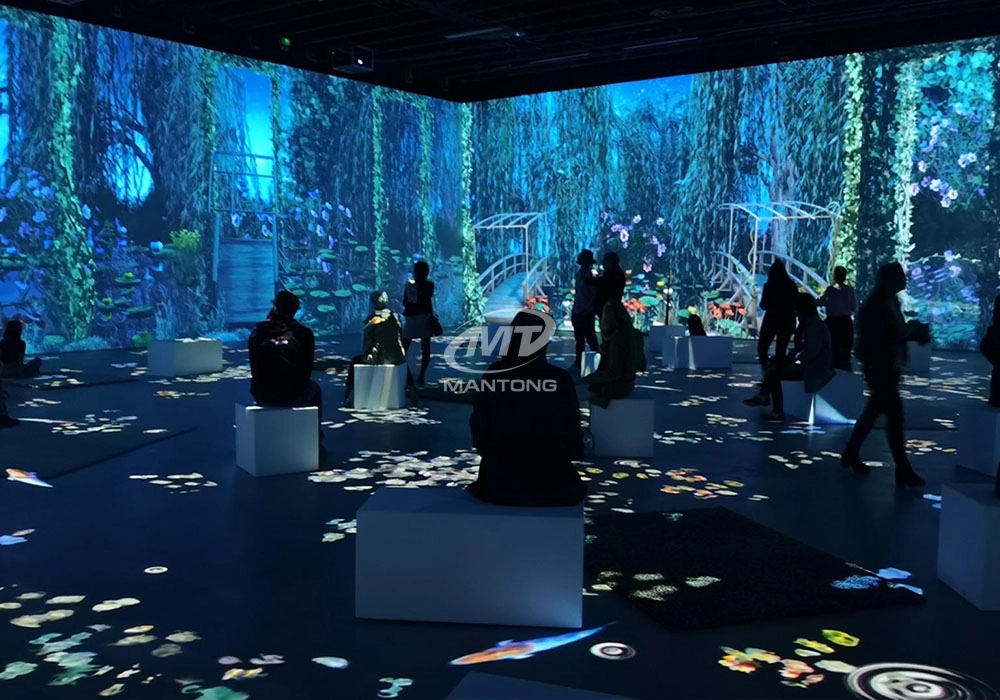
Mantong 6500LM High-Lumen Projector for Large-Scale Immersive Room Projection
Transform any space with Mantong's immersive projection mapping systems. Our high-lumen projectors (up to 6500 LM) and custom software create captivating interactive experiences for floors and walls. Ideal for museums, events, retail, and hospitality. Each kit includes professional ceiling mounting and 80+ pre-loaded video contents and is backed by a 12-month warranty and CE certification. We offer full customization and support to bring your vision to life.
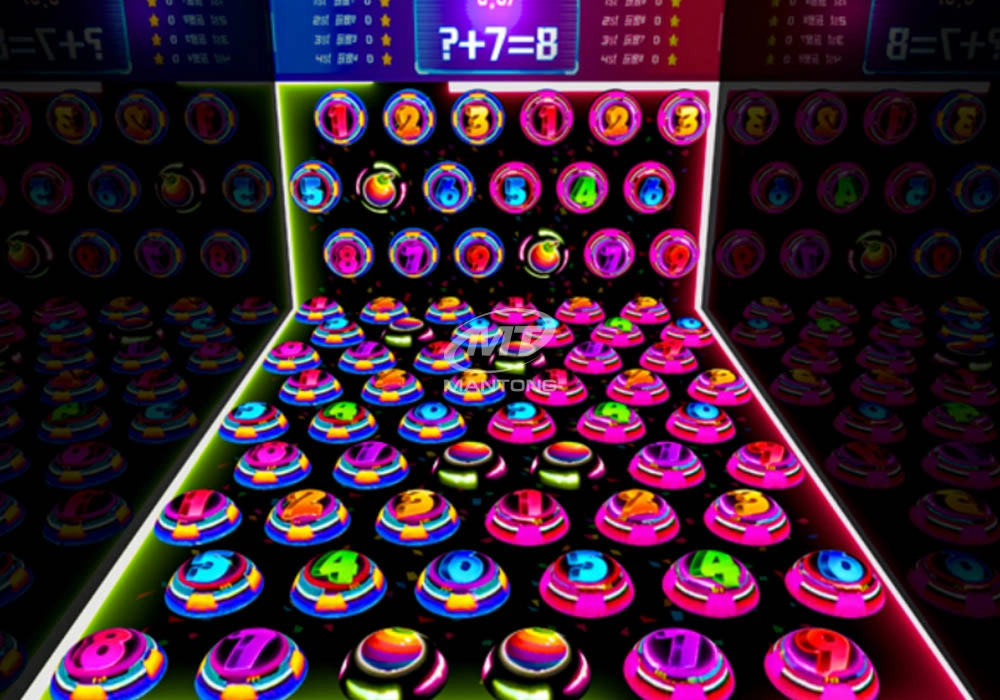
Amusement Rapidly Rotating Bouncing Sphere Interactive Wall Floor Projection Sports Games
Rapidly Rotating Bouncing Sphere is an interactive space where participants jump on rotating spheres. As they step on it, the spheres surface will show special interactivity
Jumping on spheres of the same color in succession causes them to pop, releasing light particles. The more consecutive jumps, the greater the reward—caterpillars appear, and eventually, all spheres of that color burst, filling the space with light and even more caterpillars.
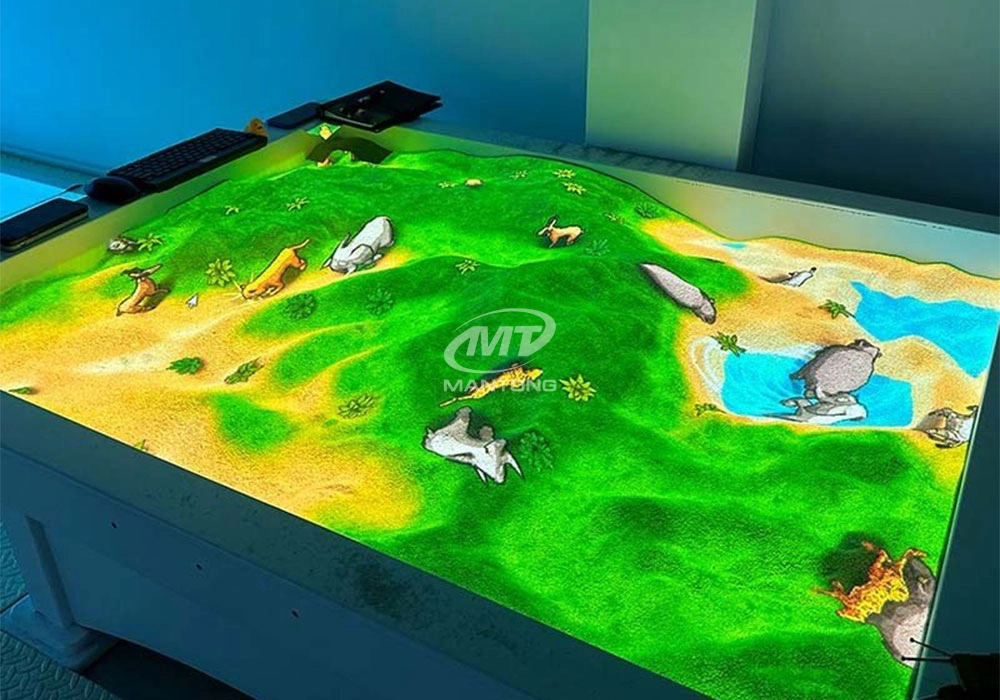
Interactive Sandbox Projection Mapping Games For Kids Play Park
Bring imagination to life with interactive sandbox projection mapping games designed for kids’ play parks. Using cutting-edge projection technology and real-time motion sensing, children can dig, build, and explore virtual worlds directly in the sand. Educational, engaging, and endlessly fun — it’s the perfect blend of play and learning.
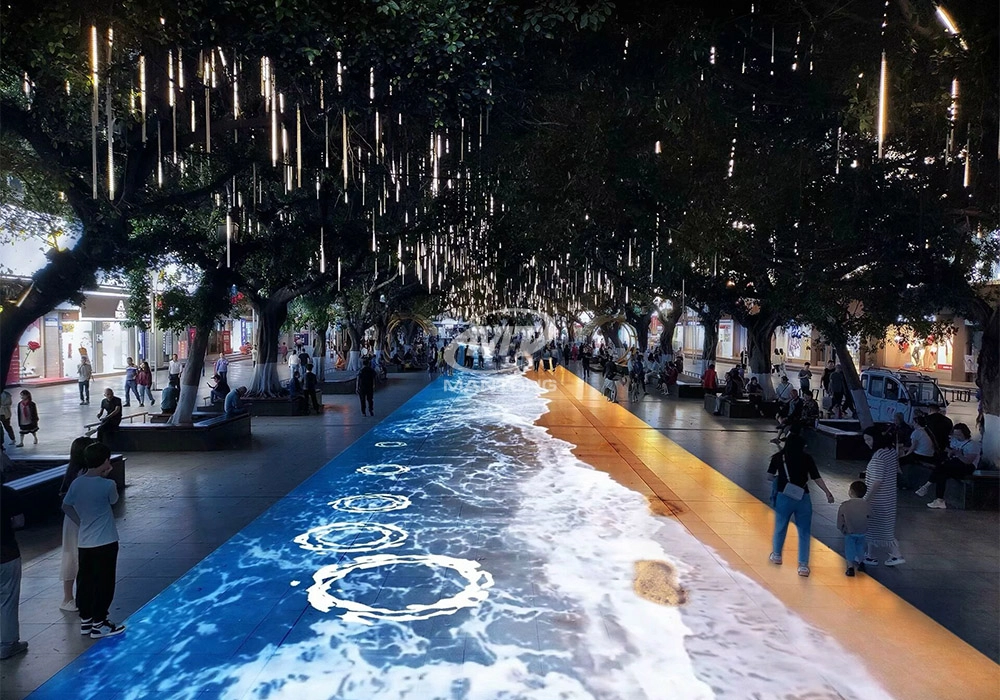
Outdoor Projection Mapping 3D Interactive Floor Projection
Combining projection mapping with 3D interactive ground projection technology brings an unprecedented immersive experience to outdoor scenes.

Kaida Business Center, Shixin Road, Panyu District,Guangzhou City, Guangdong Province, China.
ManTong
ManTong
ManTong