
Interactive Floor Game Software: Features Buyers Should Ask For
- Why interactive experiences change engagement in public and retail spaces
- Behavioral and business outcomes
- Where floor-based interaction excels
- Standards and UX considerations
- Core software features buyers should require for interactive floor games
- Low-latency tracking and reliable multi-user detection
- Sensor and tracking options (camera, depth, pressure, Lidar)
- Game engine, scripting and customization
- Technical and integration considerations: hardware, sensors, and performance
- Projection, resolution and brightness requirements
- Network architecture, remote management and CMS
- Data, analytics and privacy
- Vendor selection, customization, compliance, and ROI
- Deployment models and total cost of ownership
- Testing, warranty and SLAs
- Accessibility, safety and legal compliance
- Practical buyer checklist and procurement questions
- Essential technical questions to ask vendors
- Operational and business questions
- Proof, demos and pilot programs
- Mantong Digital: one-stop interactive projection solutions and why it matters
- Company profile and experience
- Core strengths and product scope
- Why choose Mantong and how to engage
- FAQ — Common buyer questions about interactive floor games
- 1. What minimum latency should I expect for a satisfying interactive floor experience?
- 2. Which tracking technology is best: camera, depth sensor or pressure floor?
- 3. Can I run multiple games and schedules from a single CMS?
- 4. How do you handle privacy concerns when tracking people on the floor?
- 5. What are common failure points during installation and operation?
- 6. How can we measure ROI from interactive floor games?
- Contact and next steps
Interactive floor games are a powerful way to create immersive, playful and measurable experiences in retail, museums, education, healthcare and events. Buyers evaluating interactive floor game software need to look beyond flashy demos — prioritizing latency, robustness, multi-user tracking, content management and analytics to ensure the solution performs reliably in real-world conditions. This article details the software features, technical constraints and procurement questions buyers should ask to select systems that are flexible, secure and cost-effective. It also explains integration priorities, accessibility and standards buyers should verify before purchase.
Why interactive experiences change engagement in public and retail spaces
Behavioral and business outcomes
Interactive floor games can increase dwell time, create memorable brand interactions and encourage repeat visitation. For retailers and attractions, these outcomes translate into measurable KPIs such as time-on-site, conversion uplift and social sharing. Research in interaction design and immersive experience shows that meaningful engagement relies on responsiveness, clarity of purpose, and alignment between game mechanics and venue goals (see interaction design research overview: Interaction design - Wikipedia).
Where floor-based interaction excels
Floor-based games are ideal for foot-traffic environments where hand-based touchscreens are impractical or where whole-body interaction is desired — e.g., child play zones, museum exhibits, advertising activations, or physical therapy. Compared with handheld or wall touch solutions, floor projection encourages social interaction, group play and kinesthetic learning, but places higher demands on tracking accuracy, safety and ambient-light handling.
Standards and UX considerations
Usability and safety should be validated against accepted human-system interaction principles. ISO 9241 provides guidance on ergonomics and usability that buyers can reference when specifying acceptable latencies, user flows and accessibility features (ISO 9241 - Ergonomics of human-system interaction).
Core software features buyers should require for interactive floor games
Low-latency tracking and reliable multi-user detection
Ask suppliers for measured end-to-end latency figures (sensor capture → processing → projection) under your expected lighting and user density. Latency above 80–100 ms becomes perceptible and degrades the experience. The software should support robust multi-user detection, distinguishing overlapping silhouettes and prioritizing inputs (e.g., first touch vs. nearest player). Where available, request lab test data or site trials illustrating performance under your conditions. Academic and industry literature on sensing and floor interaction can help validate vendor claims — search IEEE/ACM publications for benchmarking studies (IEEE Xplore search: 'interactive floor').
Sensor and tracking options (camera, depth, pressure, Lidar)
The software should be sensor-agnostic or support multiple sensor types: overhead RGB cameras with computer vision, depth cameras (e.g., Intel RealSense, Azure Kinect), pressure-sensitive floors, or Lidar. Each sensor has trade-offs in cost, installation complexity and lighting tolerance. Ensure the software provides calibration tools and sensor fusion capabilities to combine inputs when needed.
Game engine, scripting and customization
Buyers should ask whether the software provides a ready-made game library, a visual editor for non-programmers, and an SDK or scripting API for custom development. A hybrid approach — template-based quick deployment plus full SDK — offers the best balance: rapid rollout for standard activations and deep customization for brand-specific needs. Check for support of common engines (e.g., Unity) or native runtime environments and verify licensing terms for commercial use.
Technical and integration considerations: hardware, sensors, and performance
Projection, resolution and brightness requirements
Software must be optimized for the target projection system. Ask for recommended projector classes (ANSI lumen ranges), throw ratios and supported resolutions. High ambient light environments require brighter projectors or high-contrast game assets. The software should include warping and keystone correction tools, and support edge-blending for multi-projector setups used to cover large floor areas. For background reading on projection mapping techniques, see: Projection mapping - Wikipedia.
Network architecture, remote management and CMS
Modern deployments require remote monitoring for uptime, content updates, and analytics collection. Look for secure content management systems (CMS) with role-based access control, scheduled playlists, OTA (over-the-air) updates, and health-monitoring dashboards. Determine whether the CMS uses local caching for network outages and supports HTTPS/TLS for data transfer and API endpoints.
Data, analytics and privacy
Analytics are a major value driver for buyers: anonymized user counts, dwell time heatmaps, popular game modules, and conversion metrics should be available out-of-the-box. Request sample reports and data export formats (CSV, JSON). Ensure compliance with privacy regulations (e.g., GDPR) — software should support anonymization, opt-out flows, and data retention policies. Vendors should be able to document where data is stored and how it is secured.
Vendor selection, customization, compliance, and ROI
Deployment models and total cost of ownership
Compare turnkey solutions (fast deployment, limited customization) with SDK/licensed software (higher initial integration but greater flexibility). Build a simple TCO comparison that includes hardware, installation, software licenses, annual support, network costs, and content creation. The table below summarizes typical trade-offs:
| Model | Speed to Deploy | Customization | Typical Ongoing Costs | Best For |
|---|---|---|---|---|
| Turnkey (SaaS + hardware) | Fast (days–weeks) | Limited | Subscription + support | Events, retail activations |
| Licensed SDK / On-prem | Slower (weeks–months) | High | One-time license + dev + optional support | Permanent installs, branded experiences |
| Custom development | Longest | Full | Dev + maintenance | Unique interactive exhibits |
Testing, warranty and SLAs
Require site acceptance testing, documented SLAs for uptime and response times, and warranty coverage for both hardware and software. For scalable deployments, insist on a support escalation path and spare parts policy. Ask vendors for references and case studies demonstrating long-term installations in similar environments.
Accessibility, safety and legal compliance
Confirm that games are accessible for users with mobility, vision or cognitive impairments — e.g., alternative audio cues, adjustable difficulty, and clear visual contrast. Verify that the installation meets local building and safety codes (cable management, slip resistance of floor surfaces). When tracking collects behavioral or biometric-like data, validate legal compliance and privacy safeguards.
Practical buyer checklist and procurement questions
Essential technical questions to ask vendors
- What is the measured end-to-end latency (ms) in our site conditions?
- Which sensors and projector classes do you support, and can you provide sample calibration files?
- Do you provide a CMS and analytics dashboard? Can we export raw data?
- Is there an SDK or API for custom integrations? What are the licensing terms?
- How do you anonymize user data and ensure GDPR compliance?
Operational and business questions
- What is your recommended maintenance schedule and spare-part policy?
- Do you provide on-site commissioning and training for staff?
- What KPIs and case-study results can you share from similar deployments?
- What SLAs or warranty terms accompany the solution?
Proof, demos and pilot programs
Insist on an on-site pilot or a similar live deployment demo where possible. Benchmarks, anonymized analytics and independent references are critical. Vendors should be able to run an A/B test or pilot to validate assumptions about conversion uplift and dwell time improvements before committing to a large rollout.
Mantong Digital: one-stop interactive projection solutions and why it matters
Company profile and experience
Mantong Digital is a one-stop interactive projection solution provider and direct manufacturer based in Guangzhou, China, with over 10 years of industry experience. We are dedicated to providing innovative, flexible and cost-effective projection solutions, offering both hardware and software to meet various needs. Mantong's combined hardware-software approach shortens integration cycles and reduces compatibility risk for buyers seeking turnkey or customized interactive floor games.
Core strengths and product scope
At ManTong, we specialize in providing customized solutions for a wide range of application scenarios through innovative projection technology. Whether it's immersive experiences, interactive entertainment or outdoor lighting and projection shows, our solutions can transform your ideas into stunning visual effects. Our product portfolio and strengths include:
- Immersive projection and projection mapping systems
- Interactive floor projection and wall projection solutions
- Immersive room installations and 3D projection systems
- Interactive projection games and content libraries
- Projection shows and interactive mapping services
These capabilities allow Mantong to deliver turnkey deployments as well as deep customization via SDKs and custom content production.
Why choose Mantong and how to engage
Mantong’s competitive advantages include direct manufacturing (cost control), in-house software and content teams (faster customization), and a decade of field experience in diverse environments. We emphasize reliability, on-site commissioning, and measurable analytics that support business outcomes. We are now looking for business partnerships worldwide. Our vision is to become the world's leading interactive projection manufacturer. Visit Mantong's website for product details and contact: https://www.mtprojection.com/.
FAQ — Common buyer questions about interactive floor games
1. What minimum latency should I expect for a satisfying interactive floor experience?
For natural-feeling interactions, aim for end-to-end latency under ~80 ms. Above 100 ms, users begin to notice lag. Ask vendors for lab or site measurements under your lighting and user-density conditions.
2. Which tracking technology is best: camera, depth sensor or pressure floor?
Each technology has strengths: camera-based CV is cost-effective and flexible; depth sensors handle low-light and occlusion better; pressure floors provide direct contact detection but add installation complexity. Choose based on environment, budget, and the type of interaction required.
3. Can I run multiple games and schedules from a single CMS?
Yes — enterprise-grade systems provide CMS features to schedule content, manage playlists, and push updates. Verify caching behavior for offline resilience and role-based access control for secure operations.
4. How do you handle privacy concerns when tracking people on the floor?
Good vendors anonymize and aggregate data, avoid storing identifiable imagery, and provide data retention policies. Ensure the solution supports legal compliance (GDPR, local privacy laws) and can demonstrate secure data handling procedures.
5. What are common failure points during installation and operation?
Common issues include poor projector placement causing blurring or alignment problems, inadequate ambient-light handling, sensor occlusion, network instability affecting remote updates, and insufficient staff training. Mitigate these with site surveys, professional commissioning, and a strong SLA.
6. How can we measure ROI from interactive floor games?
Define KPIs before deployment: dwell time, conversion rate lift, footfall, social shares, or repeat visits. Use software analytics to capture baseline vs. post-deployment metrics and run controlled pilots or A/B tests to attribute changes to the interactive experience.
Contact and next steps
If you are evaluating interactive floor games for your venue, request a site survey, a latency and tracking demo in your lighting conditions, and a written TCO comparison from prospective vendors. For turnkey and customized interactive projection solutions, Mantong Digital provides integrated hardware, software and content services with global partnership opportunities. Learn more or request a quote at https://www.mtprojection.com/. We offer pilots, on-site commissioning and long-term support to ensure your installation meets engagement and business goals.
Where to Buy immersive projection system
Installation Tips for Interactive Projector Games
Top 10 interactive projection mapping Manufacturers and Supplier Brands
How Much Does an Interactive Projection Immersive Experience Cost?
One-Stop Projection Solution Provider Since 2011
How to Write an Interactive-Effect Video Customisation Script ?
① Project Background: Briefly introduce the context in which this interactive scene will be used (e.g., exhibition, museum,
event space, children's area). Example: This scene is part of the “Underwater World” zone in a children's science museum,
designed to be engaging and exploratory.
②Visual Style / Atmosphere: What kind of visual mood are you aiming for? Please describe the color scheme, style, and any
references. it should focus solely on describing the visual aspects of the scene, supported by relevant charts or reference
images.
③ Interaction Points Overview:List each interactive hotspot along with the effect you'd like to trigger when the user
touches or clicks the area. example: when player touch the clownfish, it will swims away with bubble trail (animation effect)
and produce the bubble sound ( sound effect requirement )
④ Static Visual Reference:including but not limited to background image/video, a list of major visual elements (e.g., coral,
rocks, seaweed, fish), which elements should be interactive?
What's the application of Immersive projection ?
It can be used in various venues, such as art exhibition, entertainment venues, educational institution, Wedding hall /Banquet/Bar,Yoga Studio and so on. It often involves advanced projection techniques, multimedia content, and interactive elements to engage and captivate the audience's senses.
Are you trader or manufacturer ?
We are direct manufacturer who specialize in providing one-stop solution for different outdoor & indoor projection project with our stable software and qualified projectors
What about the wall/floor material for the projection?
It’s recommended to choose a light-colored material with minimal reflectivity—pure white or light grey works best. the
common material is cement & plaster board
For optimal projection results, the surface should be free of any patterns or textures, as the projector will display content
directly onto it.
There are no specific material requirements; you may use any commonly available material in your local market, as long as it
meets the above conditions.
What information do you need to know before making the proposal/solution?
We know that everyone wants to know the price, but the price of our products is determined by many factors since most of our products are custom, so no ready price list. In order to fast understand what you need, can you send us an inquiry like this?
For example: I am really interested in your immersive projection products, we are a company in the USA and want to install some in my restaurant. It is about 50 meters long, and 5m in width. Projection size you can decide but the length should be not less than 20 meters. We want some content about SeaWorld because our place is all about the sea. Thank you.
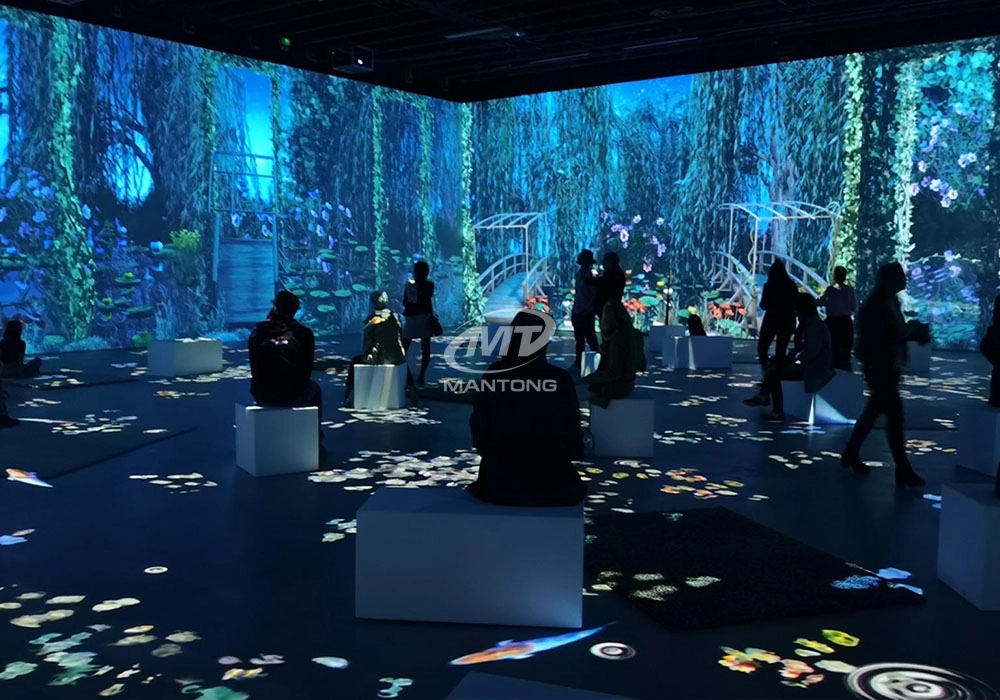
Mantong 6500LM High-Lumen Projector for Large-Scale Immersive Room Projection
Transform any space with Mantong's immersive projection mapping systems. Our high-lumen projectors (up to 6500 LM) and custom software create captivating interactive experiences for floors and walls. Ideal for museums, events, retail, and hospitality. Each kit includes professional ceiling mounting and 80+ pre-loaded video contents and is backed by a 12-month warranty and CE certification. We offer full customization and support to bring your vision to life.
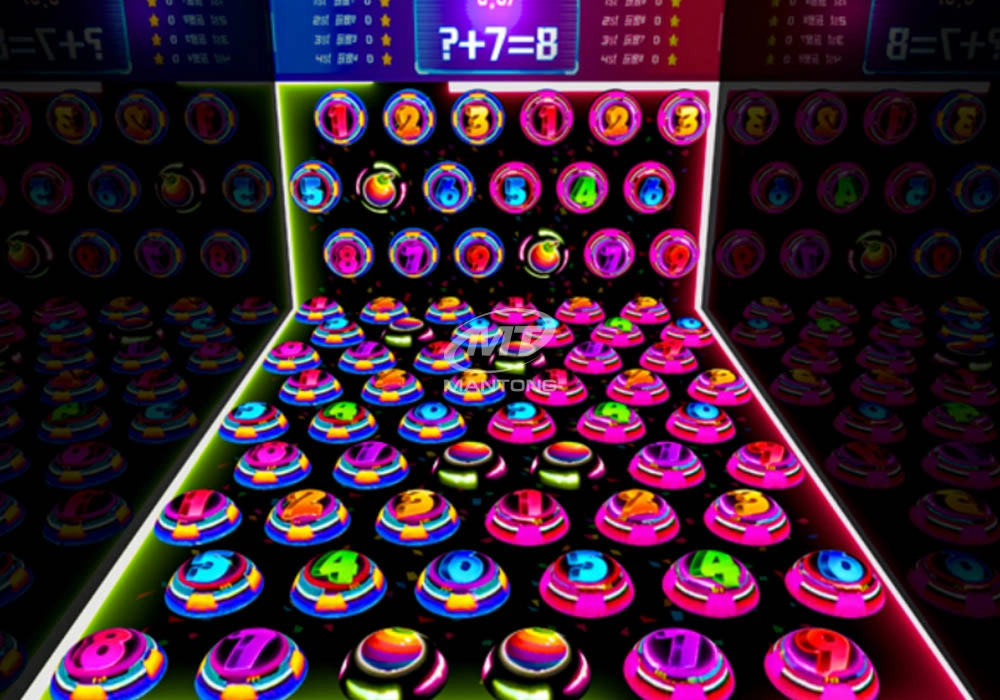
Amusement Rapidly Rotating Bouncing Sphere Interactive Wall Floor Projection Sports Games
Rapidly Rotating Bouncing Sphere is an interactive space where participants jump on rotating spheres. As they step on it, the spheres surface will show special interactivity
Jumping on spheres of the same color in succession causes them to pop, releasing light particles. The more consecutive jumps, the greater the reward—caterpillars appear, and eventually, all spheres of that color burst, filling the space with light and even more caterpillars.
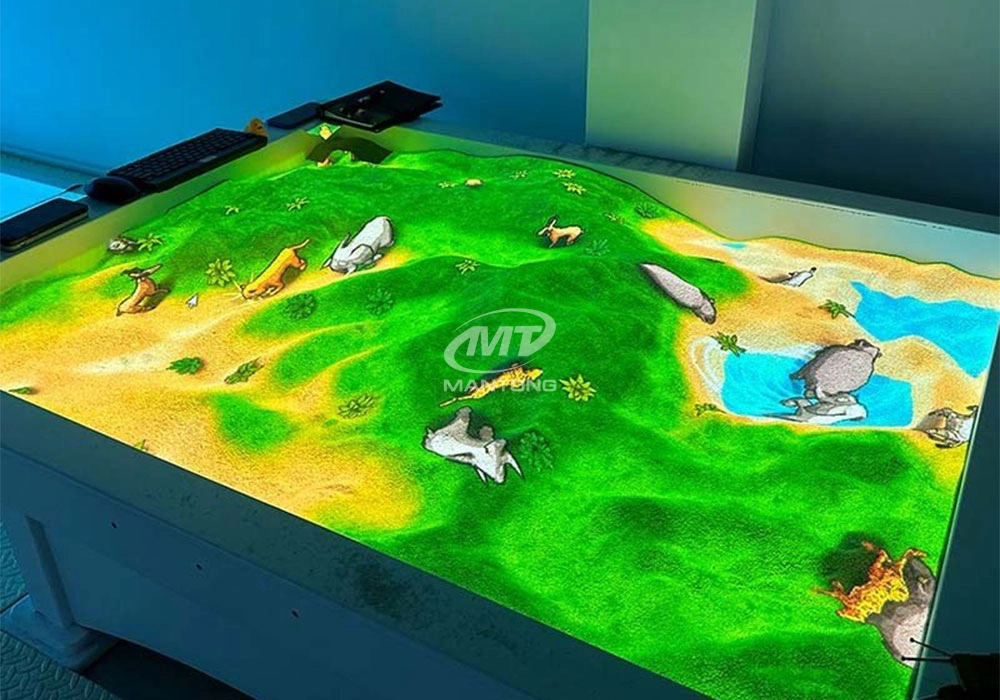
Interactive Sandbox Projection Mapping Games For Kids Play Park
Bring imagination to life with interactive sandbox projection mapping games designed for kids’ play parks. Using cutting-edge projection technology and real-time motion sensing, children can dig, build, and explore virtual worlds directly in the sand. Educational, engaging, and endlessly fun — it’s the perfect blend of play and learning.
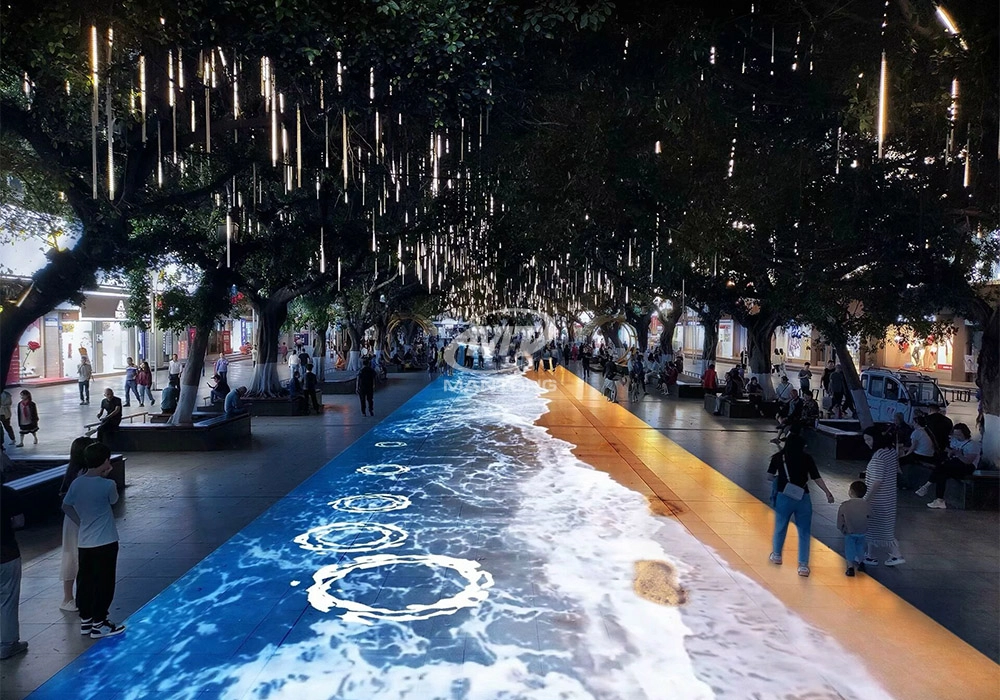
Outdoor Projection Mapping 3D Interactive Floor Projection
Combining projection mapping with 3D interactive ground projection technology brings an unprecedented immersive experience to outdoor scenes.

Kaida Business Center, Shixin Road, Panyu District,Guangzhou City, Guangdong Province, China.
ManTong
ManTong
ManTong