
Choosing Interactive Floor Games for Museums and Exhibits
- Why museums invest in floor-based interactivity
- Visitor engagement and learning outcomes
- Behavioral metrics and accessibility
- Use cases where floor interactivity excels
- Core technologies behind interactive floor games
- Projection and projection mapping
- Sensing: depth cameras, IR sensors, pressure mats
- Processing and software engines
- How to choose the right interactive floor game for your exhibit
- Step 1: Define objectives and target audiences
- Step 2: Site survey and infrastructure assessment
- Step 3: Match technology to goals and constraints
- Technology comparison table
- Design, accessibility and operational considerations
- Content design and UX principles
- Accessibility, safety and hygiene
- Maintenance, durability and lifecycle
- Procurement, vendor selection and piloting
- Evaluating vendors and proposals
- Pilot installations and metrics
- Case study benchmarking and standards
- Mantong Digital: supplier profile and why choose a direct manufacturer
- Mantong Digital overview
- Core strengths and differentiators
- Typical offerings and partnership model
- Checklist for procurement and deployment
- Pre-procurement checklist
- Installation and post-launch checklist
- FAQs
- 1. What are interactive floor games?
- 2. How much space and ceiling height do I need?
- 3. Are these systems safe for children and visitors with disabilities?
- 4. How much do interactive floor games cost to install and maintain?
- 5. How long does content remain engaging and how do we refresh it?
- 6. Can interactive floor games collect visitor data and how do we handle privacy?
- Contact and next steps
Interactive floor games combine projected visuals, sensor-driven interactions and game logic to create immersive, visitor-centered experiences in museums, science centers and temporary exhibits. When chosen and deployed thoughtfully, these systems increase dwell time, improve learning outcomes and broaden accessibility. This article explains how to evaluate interactive floor games by matching objectives, audience profiles and facility constraints to technology choices, installation models and content strategies—providing practical criteria, comparisons and references to industry resources for museum professionals and exhibit designers.
Why museums invest in floor-based interactivity
Visitor engagement and learning outcomes
Interactive floor games are powerful tools for increasing visitor engagement. Multiple studies in museum education and visitor studies show that multisensory, kinesthetic experiences improve recall and perceived enjoyment, especially for families and young learners. The International Council of Museums (ICOM) emphasizes visitor-centered interpretation as a best practice for museums (ICOM).
Behavioral metrics and accessibility
Floor-based systems often produce measurable behavioral metrics—dwell time, interaction counts and repeat engagements—that help justify ROI. Well-designed floor games also support universal design principles: large, low-contrast targets and non-reliance on handheld devices make activities accessible to wheelchair users and visitors with limited fine motor control.
Use cases where floor interactivity excels
Typical scenarios for interactive floor games include science centers (explaining ecology through footsteps that “grow” plants), children’s museums (interactive puddles, animal shadows), historical exhibits (animated maps responding to steps) and public spaces (wayfinding games). For temporary exhibits, portable floor systems can deliver high impact with relatively low infrastructural changes.
Core technologies behind interactive floor games
Projection and projection mapping
Most interactive floor games use short-throw or ultra-short-throw projectors to cast bright, distortion-controlled images on floor surfaces. When floor geometry is non-flat or includes obstacles, projection mapping techniques are applied to warp the image so interactive elements align correctly. For an overview of projection mapping concepts, see the Projection mapping article on Wikipedia (Projection mapping).
Sensing: depth cameras, IR sensors, pressure mats
Sensing options determine the granularity of interactions. Common sensors include depth cameras (e.g., Intel RealSense, Microsoft Azure Kinect), infrared (IR) motion sensors and pressure-sensitive mats. Depth cameras enable precise body tracking and multi-user interactions; IR sensors are simpler and robust in many lighting conditions; pressure mats are reliable for discrete zone triggers but limit interaction complexity.
Processing and software engines
Interactive logic typically runs on a dedicated PC or embedded media server. Engines range from custom-built applications (C++/C#/Unity/Unreal) to turnkey middleware platforms that offer templates for gamified interactions. When selecting software, prioritize stable frame rates (≥30–60 FPS), low latency (<50 ms ideally) and easy content updates to support evolving exhibits.
How to choose the right interactive floor game for your exhibit
Step 1: Define objectives and target audiences
Start by articulating measurable goals: increase dwell time by X%, improve content retention for ages Y–Z, or provide inclusive play for families. Audience profiling (age ranges, mobility levels, bilingual needs) directly informs content complexity, UI language options and interaction modalities.
Step 2: Site survey and infrastructure assessment
Conduct a site survey: measure ceiling height, ambient light (lux), floor material, power availability and mounting options. Projection brightness (ANSI lumens) and sensor placement are constrained by these factors. See the sample checklist: ceiling clearance, visitor flow patterns, cable raceways and HVAC considerations.
Step 3: Match technology to goals and constraints
Choose the sensing and projection stack that aligns with your priorities—precision tracking for educational content, or robust simple triggers for high-traffic play areas. Balance cost against expected lifetime and maintenance overhead.
Technology comparison table
The table below compares common sensing + projection configurations used in interactive floor games. Cost ranges are industry estimates and should be validated with suppliers for specific projects.
| Configuration | Typical Use Case | Advantages | Limitations | Approx. Installed Cost (USD) |
|---|---|---|---|---|
| Short-throw projector + depth camera | Multi-user educational games, body tracking | High accuracy, supports gestures and multiple users | Higher software complexity; sensitive to sunlight | $8,000–$25,000 |
| Ultra-short-throw projector + IR sensors | High-traffic family zones, interactive puddles | Robust in varied lighting; lower tracking complexity | Less spatial precision; limited gesture recognition | $6,000–$15,000 |
| Projector + pressure mats | Simple zone-triggered exhibits, safety-critical areas | Very reliable; simple maintenance | Discrete interactions only; wear over time | $3,000–$10,000 |
| Multiple projectors + projection mapping | Large immersive floors or irregular surfaces | Seamless large-area visuals | Complex calibration and higher cost | $20,000–$100,000+ |
Sources: industry supplier data and market reports (e.g., Grand View Research on projection markets) and field experience from museum integrators. For market context see Grand View Research—Projection Mapping Market (grandviewresearch.com).
Design, accessibility and operational considerations
Content design and UX principles
Good interactive floor games follow clear UX rules: immediate feedback (visual/audio) on interaction, simple objectives for first-time visitors, progressive difficulty for repeat visitors, and clear affordances (visual cues) indicating how to play. For multilingual audiences, use iconography and audio prompts rather than text-heavy instructions.
Accessibility, safety and hygiene
Follow universal design: avoid small targets, provide adjustable audio volume, and ensure floor materials are slip-resistant. Touchless interaction (gesture, foot tracking) can reduce surface contact and support hygiene protocols—an important consideration since the COVID-19 pandemic. Consult museum accessibility guidelines such as ICOM (ICOM) and local regulations when planning installations.
Maintenance, durability and lifecycle
Operational uptime depends on easy access to projectors, replaceable bulbs or solid-state light sources (laser projectors), and modular sensor mounts. Establish a maintenance SLA with the vendor: routine calibration, software updates and spare part supply. Factor lifecycle costs—annual maintenance typically ranges from 5%–15% of hardware CAPEX.
Procurement, vendor selection and piloting
Evaluating vendors and proposals
Request detailed proposals including: system architecture diagrams, component specs (lumens, resolution, sensor model), content samples, maintenance plans, training and service terms. Prefer vendors who provide onsite testing and reference installations in museums or public exhibits.
Pilot installations and metrics
Run small-scale pilots to validate engagement metrics before full rollout. Define KPIs: average dwell time, interactions per visitor, repeat interactions, and technical uptime. Use A/B testing for content variants to optimize learning outcomes and retention.
Case study benchmarking and standards
Benchmark against similar museums or exhibits. The Smithsonian and major science centers publish case studies and evaluation reports that can be instructive. For academic methods on visitor studies, see the Visitor Studies Association (visitorstudies.org).
Mantong Digital: supplier profile and why choose a direct manufacturer
Mantong Digital overview
Mantong Digital is a one-stop interactive projection solution provider and direct manufacturer based in Guangzhou, China, with over 10 years of industry experience. They provide both hardware and software—offering customized interactive projection systems for museums, immersive attractions and projection shows. Learn more at Mantong Digital.
Core strengths and differentiators
Mantong’s strengths include in-house manufacturing (shorter lead times and cost control), an extensive product range (immersive projection, interactive floor projection, interactive wall projection, immersive rooms, 3D projection, interactive projection games, projection shows, and interactive projection mapping) and proven project experience. As a manufacturer, Mantong can deliver tailored solutions, fast prototyping and flexible warranties—advantages for museums seeking both customization and long-term support.
Typical offerings and partnership model
Services include site surveys, content design, hardware supply (projectors, sensors, mounts), software development (Unity/Unreal-based interactive engines), installation and post-install support. Mantong seeks global business partnerships and positions itself to scale from small pop-ups to large permanent exhibits. Their vision is to become the world's leading interactive projection manufacturer.
Checklist for procurement and deployment
Pre-procurement checklist
- Define clear objectives and measurable KPIs.
- Complete a site survey with light measurements and visitor flow mapping.
- Create an accessibility and safety compliance plan.
- Budget for CAPEX and OPEX (hardware, software, maintenance).
Installation and post-launch checklist
- Calibrate sensors and projection mapping on-site.
- Run staff training and visitor orientation sessions.
- Implement monitoring: remote health checks, uptime alerts.
- Collect and analyze visitor data for iterative improvements.
FAQs
1. What are interactive floor games?
Interactive floor games are experiences where projected visuals on floors respond to visitor movement or inputs via sensors, creating games, simulations or interpretive interactions that encourage physical engagement and exploration.
2. How much space and ceiling height do I need?
Requirements vary. Typical interactive floor zones start at 2.5 x 2.5 meters for small installations; larger immersive floors may exceed 10 x 10 meters. Ceiling height depends on projector throw: ultra-short-throw projectors can work with ceilings under 3 meters, while mapped multi-projector systems need higher clearances. Conduct a site survey to determine exact specs.
3. Are these systems safe for children and visitors with disabilities?
Yes—when designed for universal access. Use slip-resistant flooring, avoid trip hazards (recess cables), and implement adjustable audio/visual cues. Touchless sensing modes (foot tracking) increase hygiene and accessibility. Always consult local safety codes and accessibility standards.
4. How much do interactive floor games cost to install and maintain?
Installed costs typically range from a few thousand dollars for simple pressure-mat-based setups to tens or hundreds of thousands for large mapped, multi-projector immersive floors. Annual maintenance is often estimated at 5%–15% of hardware CAPEX. Exact costs depend on scope, hardware quality and content complexity.
5. How long does content remain engaging and how do we refresh it?
Content lifecycle depends on audience and frequency of visits. Many museums schedule content refreshes annually or seasonally. Use modular content architectures and vendor-supported content management systems to update themes quickly without full system replumbing.
6. Can interactive floor games collect visitor data and how do we handle privacy?
Yes, systems can collect anonymized metrics (dwell time, interaction counts, heatmaps). Comply with local privacy regulations (e.g., GDPR) by avoiding personally identifiable information (PII), using aggregated reporting and displaying clear privacy notices where appropriate.
Contact and next steps
If you’re planning an exhibit and want expert help selecting or deploying interactive floor games, Mantong Digital offers end-to-end services from concept design to installation and ongoing support. As a direct manufacturer based in Guangzhou with over 10 years of experience, Mantong delivers customized, flexible and cost-effective projection solutions including immersive projection, interactive floor projection, interactive wall projection, immersive rooms, 3D projection, interactive projection games, projection shows and interactive projection mapping. View product portfolios or request a consultation at https://www.mtprojection.com/.
Ready to pilot an interactive floor game? Contact Mantong Digital to schedule a site assessment, request demos or obtain a tailored proposal.
Top 10 immersive 360 projection Manufacturers and Supplier Brands
Future Trends in Floor Projection Game Technology
How to Choose the wall interactive projection manufacturer and supplier in China?
Compare Interactive Floor Games vs. Traditional Play Areas
One-Stop Projection Solution Provider Since 2011
Are you trader or manufacturer ?
We are direct manufacturer who specialize in providing one-stop solution for different outdoor & indoor projection project with our stable software and qualified projectors
How to install the projection equipment ?
1) Install the projector in a suitable position. We will provide you with a hanger, which you need to fix on the ceiling with
screws.
2) Connect projectors, computers and other accessories through wires.
3) After completing the above 2 steps, we will carry out the edge blending steps. Our team can complete it through remote
control.
In general, installation instructions for each project need to be specified on a project-by-project basis. The above is for
reference only.
What about the wall/floor material for the projection?
It’s recommended to choose a light-colored material with minimal reflectivity—pure white or light grey works best. the
common material is cement & plaster board
For optimal projection results, the surface should be free of any patterns or textures, as the projector will display content
directly onto it.
There are no specific material requirements; you may use any commonly available material in your local market, as long as it
meets the above conditions.
What information do you need to know before making the proposal/solution?
We know that everyone wants to know the price, but the price of our products is determined by many factors since most of our products are custom, so no ready price list. In order to fast understand what you need, can you send us an inquiry like this?
For example: I am really interested in your immersive projection products, we are a company in the USA and want to install some in my restaurant. It is about 50 meters long, and 5m in width. Projection size you can decide but the length should be not less than 20 meters. We want some content about SeaWorld because our place is all about the sea. Thank you.
What's Immersive Projection ?
Immersive projection refers to a technology that creates a captivating and all-encompassing visual experience for viewers by projecting images or videos onto large surfaces, such as walls, floors, or even entire rooms. This technology aims to immerse the audience in a simulated environment, blurring the boundaries between the physical and virtual worlds.
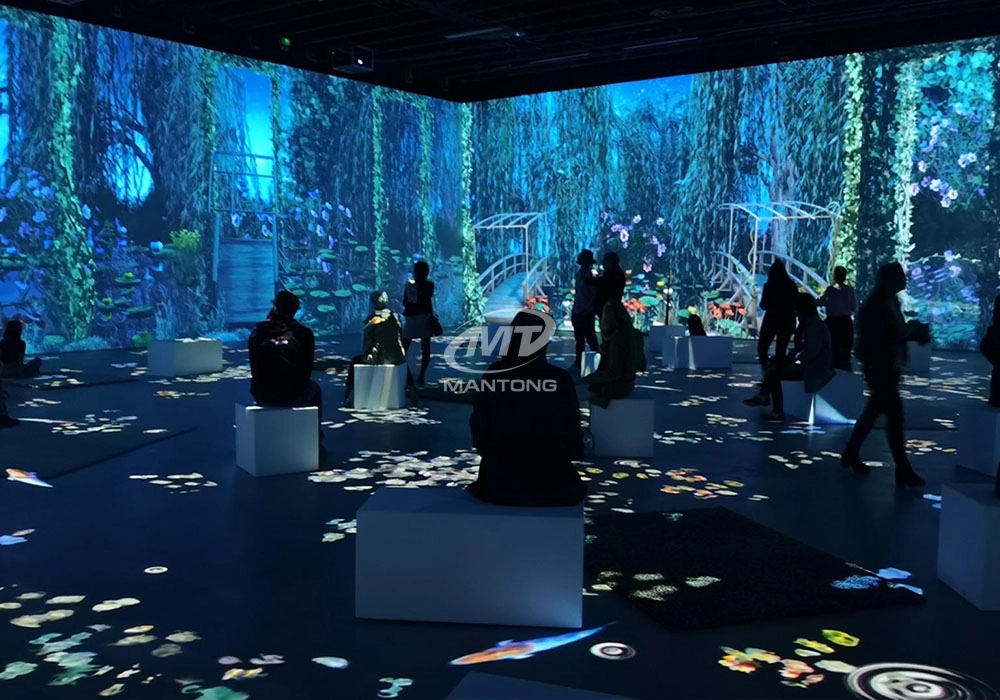
Mantong 6500LM High-Lumen Projector for Large-Scale Immersive Room Projection
Transform any space with Mantong's immersive projection mapping systems. Our high-lumen projectors (up to 6500 LM) and custom software create captivating interactive experiences for floors and walls. Ideal for museums, events, retail, and hospitality. Each kit includes professional ceiling mounting and 80+ pre-loaded video contents and is backed by a 12-month warranty and CE certification. We offer full customization and support to bring your vision to life.
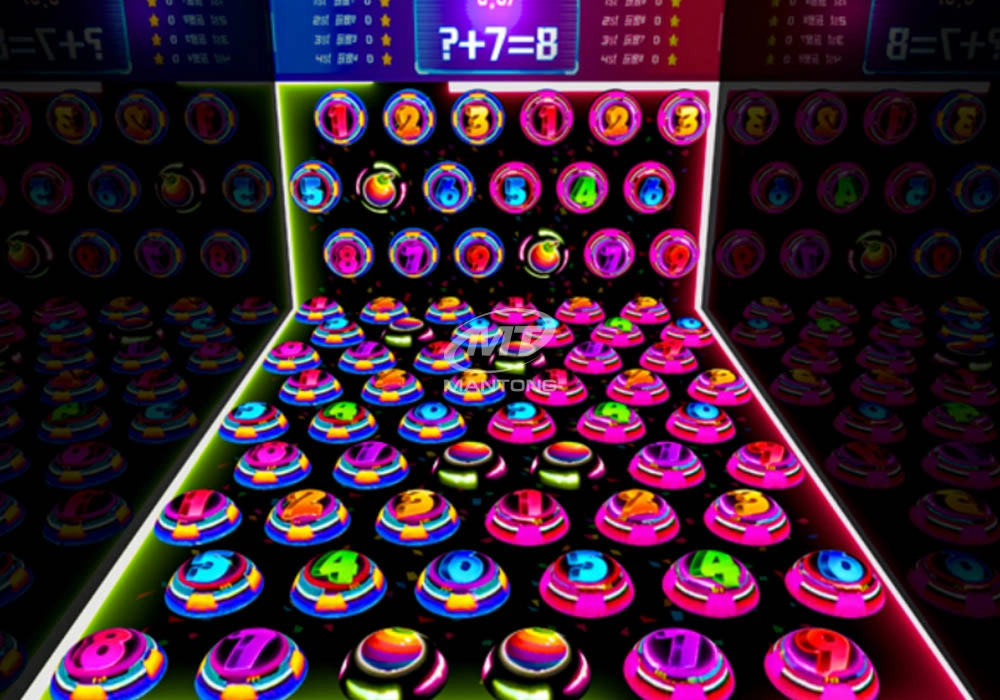
Amusement Rapidly Rotating Bouncing Sphere Interactive Wall Floor Projection Sports Games
Rapidly Rotating Bouncing Sphere is an interactive space where participants jump on rotating spheres. As they step on it, the spheres surface will show special interactivity
Jumping on spheres of the same color in succession causes them to pop, releasing light particles. The more consecutive jumps, the greater the reward—caterpillars appear, and eventually, all spheres of that color burst, filling the space with light and even more caterpillars.
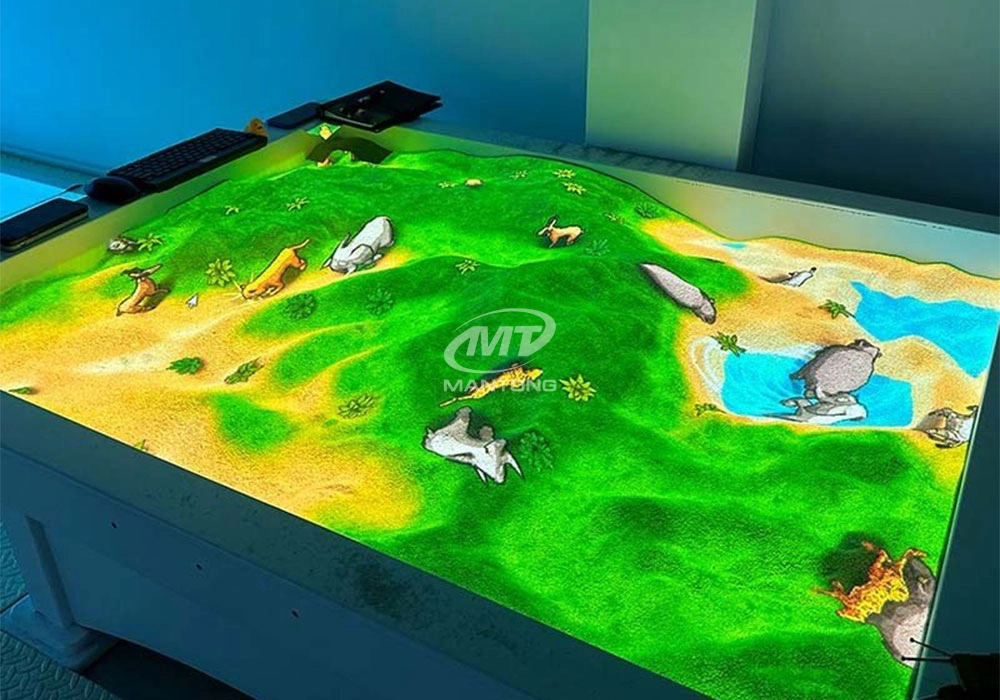
Interactive Sandbox Projection Mapping Games For Kids Play Park
Bring imagination to life with interactive sandbox projection mapping games designed for kids’ play parks. Using cutting-edge projection technology and real-time motion sensing, children can dig, build, and explore virtual worlds directly in the sand. Educational, engaging, and endlessly fun — it’s the perfect blend of play and learning.
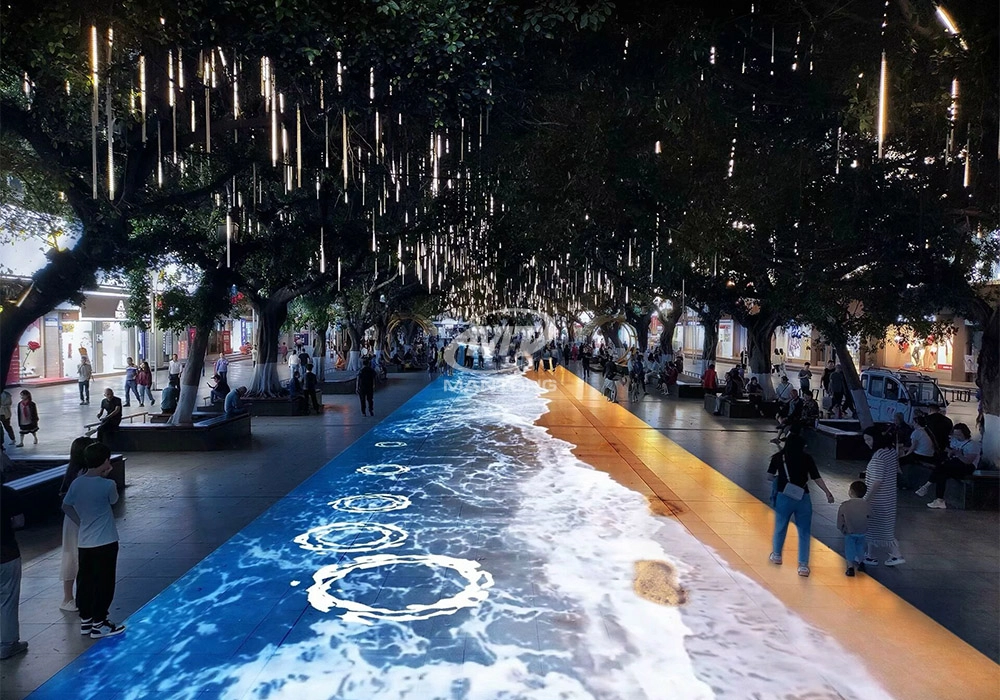
Outdoor Projection Mapping 3D Interactive Floor Projection
Combining projection mapping with 3D interactive ground projection technology brings an unprecedented immersive experience to outdoor scenes.

Kaida Business Center, Shixin Road, Panyu District,Guangzhou City, Guangdong Province, China.
ManTong
ManTong
ManTong