
Cost Guide: Hiring an Interactive Projection Mapping Supplier
- Why brands invest in projection experiences
- Business goals and measurable outcomes
- Types of interactive projection experiences
- Reference on the technique
- Cost components and what drives price
- Itemized cost breakdown
- Major price drivers
- Typical budget ranges and sample scenarios
- Small installations (concepts, pop-ups)
- Mid-size projects (galleries, experiential pop-ups)
- Large-scale and outdoor projection shows
- How to evaluate and hire an interactive projection mapping supplier
- Procurement checklist I use with clients
- Comparing suppliers: manufacturer vs integrator
- Technical red flags to watch for
- Why work with a one-stop manufacturer: the Mantong Digital advantage
- Who we are and what we offer
- Product and solution highlights
- Competitive differentiators
- Practical tips to control cost without sacrificing quality
- Design-phase decisions that save money
- Leverage modular systems and standardized components
- Plan for lifecycle and maintenance
- FAQ — Common questions when hiring an interactive projection mapping supplier
- 1. How much should I budget for a basic interactive floor projection?
- 2. Do I need a local integrator if I work with a manufacturer overseas?
- 3. What drives the biggest cost increases for outdoor projection mapping?
- 4. Can interactive content be reused across different sites?
- 5. How do I compare multiple supplier quotes effectively?
- 6. What standards or references should I ask my supplier about?
- Closing: Next steps and consulting help
Summary for : As an industry consultant and content creator based in Guangzhou with over a decade of experience working with manufacturers and suppliers, I explain realistic cost ranges, pricing drivers, and a procurement checklist you can use when hiring an interactive projection mapping supplier. The guide helps event producers, museums, retail brands and cities compare proposals and choose a partner who delivers immersive projection, interactive floor projection, interactive wall projection, and projection-mapped shows on budget.
Why brands invest in projection experiences
Business goals and measurable outcomes
I often start client conversations by clarifying goals: brand awareness, ticket sales, dwell time, social shares, or urban beautification. The commercial value of immersive projection and interactive experiences stems from measurable outcomes—higher footfall in retail, increased time-on-exhibit in museums, or ticket revenue for projection shows. Defining these outcomes up front directly impacts the scope and budget of a project.
Types of interactive projection experiences
Projection projects vary widely: immersive room installations, interactive floor projection, interactive wall projection, 3D projection mapping on architectural facades, and interactive projection games. Each format has different technical needs (projectors, servers, sensors, mounting, weatherproofing) and therefore different cost structures.
Reference on the technique
For an overview of projection mapping technology and its evolution see Projection mapping - Wikipedia. That article provides a helpful technical and historical context that complements practical budgeting decisions.
Cost components and what drives price
Itemized cost breakdown
When I prepare budgets as a consultant or manufacturer representative, I divide costs into clear categories so clients can compare quotes apples-to-apples.
| Cost Category | What it covers | Typical considerations |
|---|---|---|
| Hardware | Projectors, servers, media players, lenses, mounts | Brightness (lumens), throw distance, weatherproofing, redundancy |
| Software & Content | Mapping software licenses, content design, interactivity engines | Custom animation, real-time engines, touch/gesture modules |
| Design & Consulting | Concepting, 3D modelling, content direction, system design | Experience design depth influences hours and cost |
| Installation & Integration | Rigging, mounting, calibration, sensor setup, networking | Site access, scaffolding, permits |
| Testing & Commissioning | On-site calibration, commissioning, training | Time for iterative tuning and user testing |
| Maintenance & Support | Service contracts, spare parts, remote monitoring | Warranty length and SLA terms |
Major price drivers
The primary factors that raise or lower total cost are:
- Scale and complexity (surface area, number of projection faces).
- Required brightness and image quality (affects projector class).
- Level of interactivity (basic motion tracking vs multi-user real-time interaction).
- Outdoor vs indoor (weatherproof enclosures, power, permits).
- Content sophistication (custom 3D animation and real-time effects cost more than templated content).
Typical budget ranges and sample scenarios
Small installations (concepts, pop-ups)
For simple interactive displays (single projector, interactive floor or small wall, off-the-shelf content templates) expect initial costs from approximately USD 5,000 to 25,000. These are suitable for retail windows, small exhibitions, or promo activations. Hardware is usually consumer/prosumer class; content is limited or templated.
Mid-size projects (galleries, experiential pop-ups)
Mid-level immersive rooms or multi-surface interactive installations typically range from USD 25,000 to 150,000. Projects at this level involve multiple high-lumen projectors, custom content, bespoke interactivity, controlled lighting environments, and professional installation.
Large-scale and outdoor projection shows
Large public projection mapping or projection shows on architecture often start at USD 150,000 and can exceed USD 1,000,000 depending on scope, number of projectors, site complexity, permitting, and duration. Outdoor shows require robust weatherproof hardware, power logistics, and often a larger creative team.
These ranges align with market examples and manufacturer pricing: see manufacturer resources such as Barco and Christie for projector and system examples (Barco projection mapping; Christie projection mapping).
How to evaluate and hire an interactive projection mapping supplier
Procurement checklist I use with clients
When reviewing proposals, I compare suppliers using a consistent checklist. I recommend asking for:
- Detailed itemized quote (hardware, software, content, labor, travel).
- Proof of previous similar projects (case studies, references, videos).
- Technical drawings and system architecture (power, network, mounting).
- Warranty, maintenance options, and SLA for support.
- Clear acceptance criteria and testing schedule.
Comparing suppliers: manufacturer vs integrator
There are meaningful differences between direct manufacturers and local integrators. I’ve worked on both sides: as a manufacturer engineer and as a consultant to integrators. Below is a snapshot comparison:
| Characteristic | Direct Manufacturer | Local Integrator |
|---|---|---|
| Cost | Potentially lower hardware cost, better control of production | Higher markup but localized services and quicker onsite response |
| Customization | Strong—can modify hardware/software directly | Good—may rely on third-party hardware; strong system integration |
| Support | Manufacturer-level parts and firmware updates | Fast local maintenance and familiarity with local codes/permits |
If your project values cost effectiveness and deep technical customization, a direct manufacturer partner can be advantageous. If you need rapid local response, a trusted local integrator is often better.
Technical red flags to watch for
Beware of vague quotes, missing deliverables (no content timeline), or suppliers who cannot provide references for similar interactive projection mapping projects. Also check whether the supplier specifies projector models (not just lumens) and provides test reports for image alignment and color calibration.
Why work with a one-stop manufacturer: the Mantong Digital advantage
Who we are and what we offer
At ManTong Digital I represent a one-stop interactive projection solution provider and direct manufacturer based in Guangzhou, China, with over 10 years of industry experience. We provide both hardware and software, offering innovative, flexible and cost-effective projection solutions to meet diverse needs. Visit our site at https://www.mtprojection.com/ for product details.
Product and solution highlights
Our core offerings include immersive projection, interactive floor projection, interactive wall projection, immersive rooms, 3D projection, interactive projection games, Projection Show systems, and interactive projection mapping solutions. Because we manufacture the hardware, we can optimize projector choice, enclosure design, and media servers to reduce total cost of ownership while maintaining high image fidelity and interactivity.
Competitive differentiators
From my experience working with multiple suppliers, ManTong stands out in several ways:
- Direct manufacturing reduces procurement layers and hardware cost.
- Integrated hardware + software stack—fewer compatibility risks.
- Ability to deliver fully customized solutions for complex façades or multi-sensor interactivity.
- Strong experience in outdoor Projection Show logistics and weatherproofing.
We are now seeking global business partnerships and aim to be the world’s leading interactive projection manufacturer. Our experience delivering projects across multiple scenarios—museums, retail, events, and urban projection shows—means we can design systems that balance creativity, reliability, and budget.
Practical tips to control cost without sacrificing quality
Design-phase decisions that save money
Spend more time on experience design early. A well-defined scope reduces costly change orders later. I often recommend mockups and small-scale proof-of-concepts: validating interactivity and content before full production drastically reduces rework.
Leverage modular systems and standardized components
Choose suppliers who use modular enclosures and standard interfaces (e.g., industry-standard media servers, common control protocols). This approach lowers maintenance cost and enables easier upgrades. For guidance on interoperability and standards see resources from professional AV organizations such as AVIXA.
Plan for lifecycle and maintenance
Consider total cost of ownership: projector lamp or laser life, spare parts inventory, and remote monitoring. A slightly higher initial investment in quality hardware and an SLA can reduce downtime costs and keep the experience consistent for audiences.
FAQ — Common questions when hiring an interactive projection mapping supplier
1. How much should I budget for a basic interactive floor projection?
Budget USD 5,000–25,000 for a basic single-projector interactive floor with off-the-shelf software and basic sensors. Costs vary by space, surface, and desired interactivity.
2. Do I need a local integrator if I work with a manufacturer overseas?
Not always. A direct manufacturer can ship turnkey systems; however, for installation, permits, and rapid on-site maintenance, a local integrator or a manufacturer with local partners is recommended.
3. What drives the biggest cost increases for outdoor projection mapping?
Weatherproof housings, higher-lumen projectors, power logistics, permits, and public-safety measures are the main cost drivers for outdoor shows.
4. Can interactive content be reused across different sites?
Yes—content can be adapted and repurposed. However, projection mapping often requires remapping for different surfaces; planning for adaptable assets reduces recreation costs.
5. How do I compare multiple supplier quotes effectively?
Use an itemized checklist that includes hardware specs, content hours, installation labor, testing, maintenance, and warranty. Ask for references and a demo of similar work.
6. What standards or references should I ask my supplier about?
Ask about projector and electrical safety standards, environmental protection for outdoor gear, and media server compatibility. Industry organizations such as AVIXA publish guidance on best practices for AV installations.
Closing: Next steps and consulting help
If you're planning a project, start by sharing your goals (target outcomes, site photos, budget range, timeline). I recommend obtaining at least three detailed proposals and treating manufacturer-supplied options as comparable partners rather than commodity vendors.
If you’d like direct manufacturer support, ManTong Digital offers end-to-end services from concept to installation and ongoing support. Learn more and contact us at ManTong Digital. We can provide a tailored proposal, case studies, and a clear cost breakdown for your specific scenario.
Contact / Request a Quote: Visit https://www.mtprojection.com/ to request a consultation and view product examples for immersive projection, interactive floor projection, interactive wall projection, immersive rooms, 3D projection, interactive projection games, Projection Shows, and interactive projection mapping.
Sources and further reading: Projection mapping - Wikipedia; Barco: Projection Mapping; Christie: Projection Mapping; AVIXA (professional AV industry).
Future trends in interactive projection technology 2026
Future Trends: AI and AR in Immersive Meeting Rooms
Event Planning: Using Interactive Projection for Live Shows
Why Interactive Wall Projection Is a Must-Have for Modern Entertainment Venues
One-Stop Projection Solution Provider Since 2011
What's Immersive Projection ?
Immersive projection refers to a technology that creates a captivating and all-encompassing visual experience for viewers by projecting images or videos onto large surfaces, such as walls, floors, or even entire rooms. This technology aims to immerse the audience in a simulated environment, blurring the boundaries between the physical and virtual worlds.
Are you trader or manufacturer ?
We are direct manufacturer who specialize in providing one-stop solution for different outdoor & indoor projection project with our stable software and qualified projectors
How to Write an Interactive-Effect Video Customisation Script ?
① Project Background: Briefly introduce the context in which this interactive scene will be used (e.g., exhibition, museum,
event space, children's area). Example: This scene is part of the “Underwater World” zone in a children's science museum,
designed to be engaging and exploratory.
②Visual Style / Atmosphere: What kind of visual mood are you aiming for? Please describe the color scheme, style, and any
references. it should focus solely on describing the visual aspects of the scene, supported by relevant charts or reference
images.
③ Interaction Points Overview:List each interactive hotspot along with the effect you'd like to trigger when the user
touches or clicks the area. example: when player touch the clownfish, it will swims away with bubble trail (animation effect)
and produce the bubble sound ( sound effect requirement )
④ Static Visual Reference:including but not limited to background image/video, a list of major visual elements (e.g., coral,
rocks, seaweed, fish), which elements should be interactive?
How to install the projection equipment ?
1) Install the projector in a suitable position. We will provide you with a hanger, which you need to fix on the ceiling with
screws.
2) Connect projectors, computers and other accessories through wires.
3) After completing the above 2 steps, we will carry out the edge blending steps. Our team can complete it through remote
control.
In general, installation instructions for each project need to be specified on a project-by-project basis. The above is for
reference only.
What's the application of Immersive projection ?
It can be used in various venues, such as art exhibition, entertainment venues, educational institution, Wedding hall /Banquet/Bar,Yoga Studio and so on. It often involves advanced projection techniques, multimedia content, and interactive elements to engage and captivate the audience's senses.
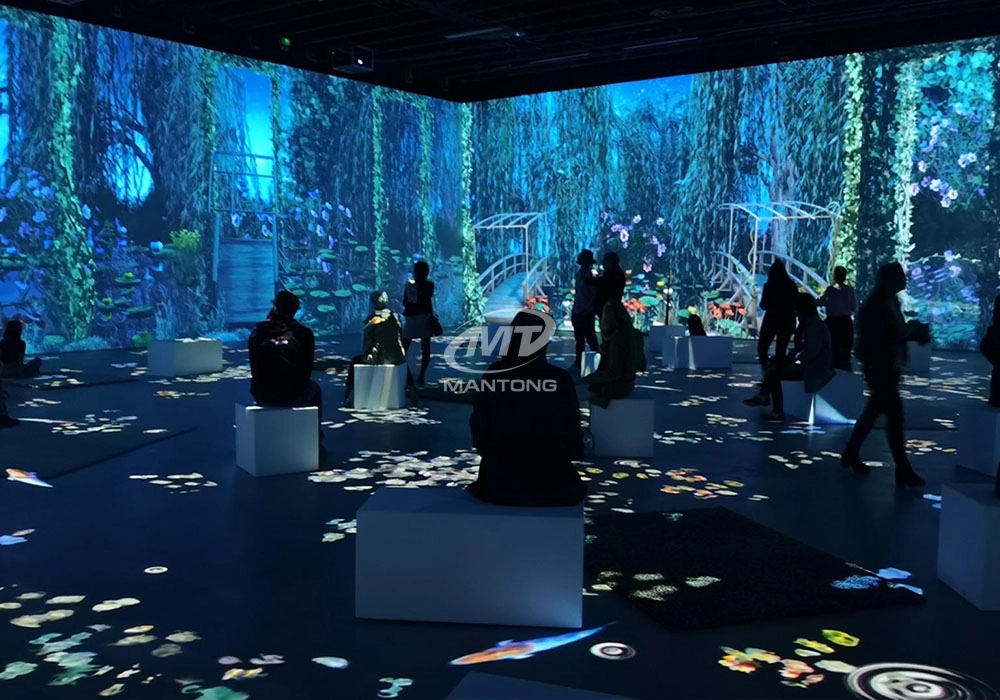
Mantong 6500LM High-Lumen Projector for Large-Scale Immersive Room Projection
Transform any space with Mantong's immersive projection mapping systems. Our high-lumen projectors (up to 6500 LM) and custom software create captivating interactive experiences for floors and walls. Ideal for museums, events, retail, and hospitality. Each kit includes professional ceiling mounting and 80+ pre-loaded video contents and is backed by a 12-month warranty and CE certification. We offer full customization and support to bring your vision to life.
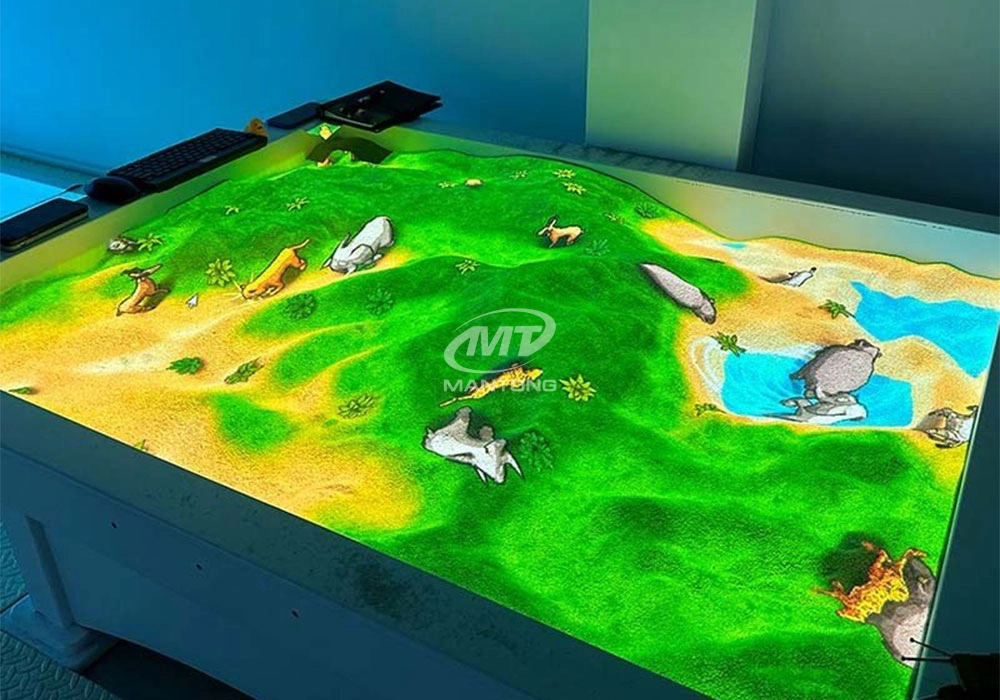
Interactive Sandbox Projection Mapping Games For Kids Play Park
Bring imagination to life with interactive sandbox projection mapping games designed for kids’ play parks. Using cutting-edge projection technology and real-time motion sensing, children can dig, build, and explore virtual worlds directly in the sand. Educational, engaging, and endlessly fun — it’s the perfect blend of play and learning.
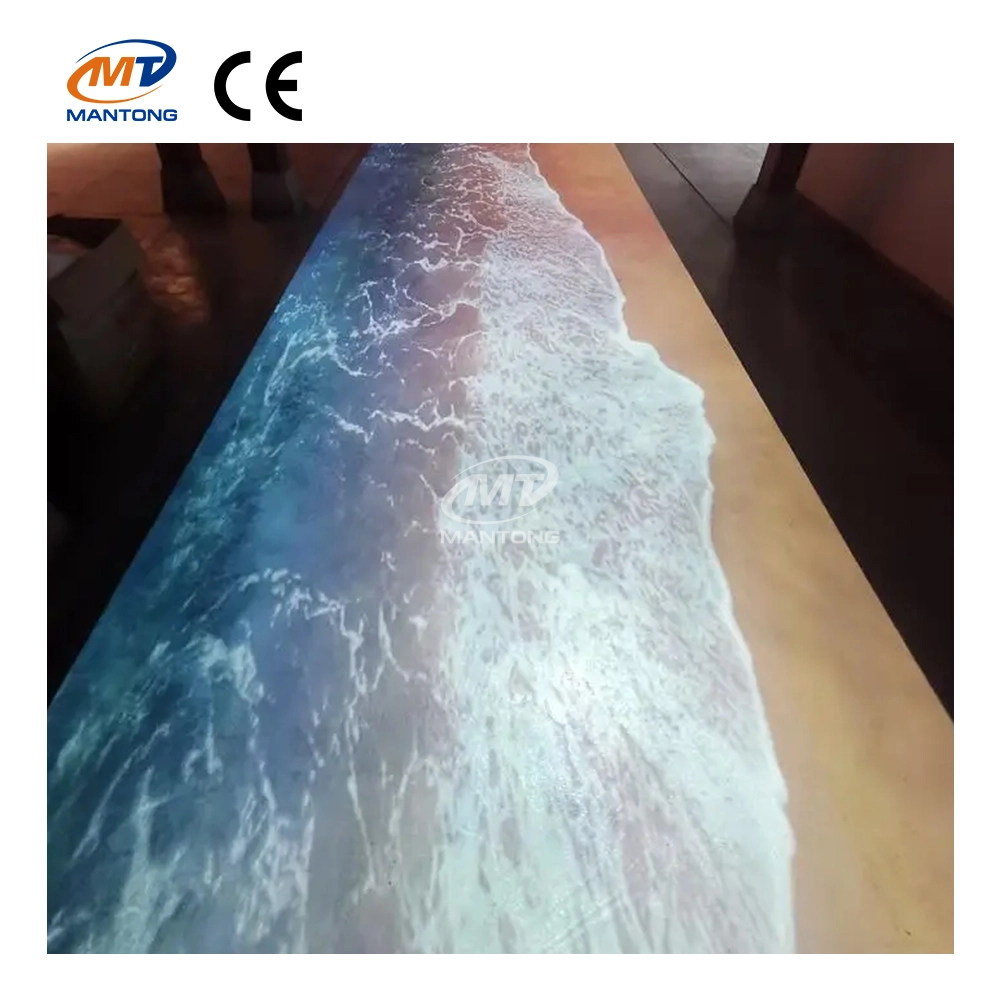
Indoor Interactive Floor Projector System - Customized Design & Installation Support
Indoor interactive floor projections display dynamic themed videos on the floor, commonly used in venues aiming to enhance brand influence or attract foot traffic, such as restaurants, hotel corridors, and brand car retail stores.
By using projectors and compatible software, the interactive content is projected onto the floor, encouraging engagement between people and the projected visuals. A single 5500-lumen indoor floor projector can cover an area of 5 m × 3 m. Typically, each project will use at least 3 units to ensure broad coverage and optimal visual effects.
We also offer customized design and installation support to enhance the interactive experience for your venue.
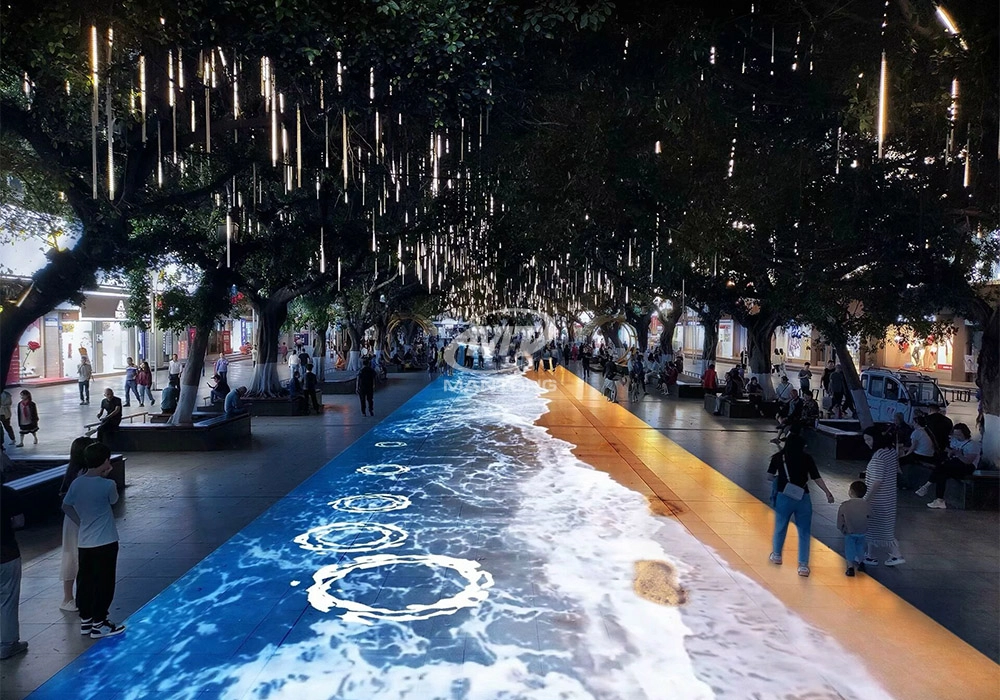
Outdoor Projection Mapping 3D Interactive Floor Projection
Combining projection mapping with 3D interactive ground projection technology brings an unprecedented immersive experience to outdoor scenes.

Kaida Business Center, Shixin Road, Panyu District,Guangzhou City, Guangdong Province, China.
ManTong
ManTong
ManTong