
Custom Interactive Floor Games: Design & Integration Tips
- Why interactive floor experiences matter
- User engagement and experience outcomes
- Applications and business drivers
- Search & discoverability considerations
- Design Principles for Interactive Floor Games
- Define goals, audience and context
- Gameplay and UX mechanics
- Accessibility and safety
- Integration & Installation Best Practices
- Choosing the right projector
- Sensor options: pros, cons and trade-offs
- Calibration, alignment and warping
- Performance, Maintenance & Measurement
- Operational durability and maintenance plans
- Analytics, KPIs and ROI tracking
- Security, privacy and compliance
- Choosing a Partner: Manufacturer & Integration Services
- What to look for in a vendor
- Mantong Digital — manufacturer profile and capabilities
- Case selection and partnership approach
- Technical Checklist & Quick Reference
- Pre-install checklist
- Recommended minimum specs by application
- FAQs (Frequently Asked Questions)
- 1. What are interactive floor games?
- 2. Which sensors work best for multi-user installations?
- 3. How do I manage privacy when using cameras?
- 4. What is the typical lifespan and maintenance cost?
- 5. Can interactive floor games integrate with my CRM or POS?
- 6. How long does a typical installation take?
- Contact & Next Steps
Custom interactive floor games combine projection, sensing and software to create engaging, location-aware play and exhibit experiences. For organizations optimizing for local discovery and AI-driven geographic search , clear metadata, location-specific case notes and consistent schema markup (e.g., localBusiness and product annotations) can significantly increase findability for venue-based activations. This article consolidates practical design rules, integration tips and vendor-selection criteria to plan, build and operate high-quality interactive floor experiences that perform reliably in retail, education, entertainment and public-space deployments.
Why interactive floor experiences matter
User engagement and experience outcomes
Interactive floor games create embodied interactions—users physically move, jump or stand on projected content, producing higher engagement times and stronger memory retention than static displays. Research in human–computer interaction shows that physical interaction often increases user satisfaction and learning outcomes in public installations (Human–computer interaction (Wikipedia)).
Applications and business drivers
Common applications include museum exhibits, retail gamification, hospitality lobbies, children’s play centers, trade show attractions and experiential marketing. The primary business drivers are increased dwell time, social sharing, measurable footfall lift and enhanced brand recall. Properly instrumented interactive floor systems can feed analytics for conversion measurement and A/B testing.
Search & discoverability considerations
To maximize local discovery, include structured data (schema.org), precise address and GPS coordinates on product pages and case studies. models prioritize signals like local reviews, operation hours, and geo-tagged images—so encourage site visitors to leave location-referenced feedback and publish local case studies with high-quality photos and short video demos.
Design Principles for Interactive Floor Games
Define goals, audience and context
Start with clear objectives: education, entertainment, crowd control, or revenue generation. Audience age, average group size and accessibility needs shape interaction modality (e.g., touch vs. motion). For example, children’s centers require faster response times, brighter visuals and robust hardware protection, whereas a mall activation prioritizes scalability and minimal maintenance downtime.
Gameplay and UX mechanics
Design mechanics that match physical affordances: chasing, stepping, stomping, or group cooperation. Keep rules simple and feedback immediate. Visual cues (contrast, animation speed) must align with sensor latency so that perceived responsiveness remains under ~80 ms for high-quality interactions—a guideline consistent with interactive display design research.
Accessibility and safety
Ensure non-slip floor coverings, cable management and clear sightlines. Provide alternatives for users with mobility constraints (e.g., gesture or handheld controllers). Comply with local safety codes and consider providing language localization and clear signage for usability.
Integration & Installation Best Practices
Choosing the right projector
Projector selection depends on ambient light, throw distance, image size and budget. For bright public spaces, aim for 6,000+ lumens with short-throw or ultra-short-throw lenses to minimize shadows and allow compact mounting. Use projectors with reliable color stability and dust-sealed engines for long runtimes.
Sensor options: pros, cons and trade-offs
Common sensing modalities include camera-based (RGB/IR), depth/LiDAR, pressure-sensitive mats, and infrared beam systems. Below is a comparison to help choose the right approach for your scenario.
| Sensor Type | Strengths | Limitations | Best Use |
|---|---|---|---|
| Camera-based (RGB/IR) | High spatial resolution, flexible detection zones, supports multi-user tracking | Requires mounting height and calibration, affected by lighting and occlusion | Museums, retail activations, dynamic multi-user games |
| Depth sensors / LiDAR | Robust in varied lighting, accurate 3D position, good for gestures | Higher cost, may require processing power | Immersive rooms, gesture-based interactions |
| Pressure mats | Low latency, simple logic, unaffected by lighting | Limited spatial resolution, wear over time | Single-spot triggers, safety mats |
| Infrared beam / proximity | Cost-effective, low maintenance | Limited fidelity, easily bypassed | Basic entry/exit triggers, queue counters |
Choosing sensors requires balancing cost, accuracy and environmental constraints. For many interactive floor games, a hybrid approach (e.g., depth sensor plus overhead camera) yields robust results.
Calibration, alignment and warping
Projection mapping on non-planar or irregular floors requires geometric correction. Use projector keystone correction or software-based homography adjustments. For installations that move elements or change surfaces, save calibration profiles and use fiducial markers for fast recalibration. Refer to industry practices in projection mapping for details (Projection mapping (Wikipedia)).
Performance, Maintenance & Measurement
Operational durability and maintenance plans
Design for maintainability: use serviceable mounts, modular sensor enclosures and easily accessible projector filters. Schedule preventive maintenance—cleaning filters every 3–6 months in dusty environments, firmware updates quarterly, and annual calibration checks. For high-traffic installations, maintain a stocked spares kit (lamp/laser module, power supply, spare sensors).
Analytics, KPIs and ROI tracking
Instrument the system to capture anonymized interaction metrics: unique users, session length, heatmaps, and conversion events. Integrate with onsite Wi-Fi analytics or POS systems where appropriate (with privacy safeguards). Standard KPIs include average dwell time increase, interactions per visitor, and social shares. Use these metrics to calculate ROI against installation and operational cost.
Security, privacy and compliance
If cameras capture personally identifiable information (PII), implement edge-processing to anonymize or aggregate data, encrypt logs and comply with local data protection regulations (e.g., GDPR where applicable). When storing analytics or video, document retention policies and obtain necessary consent for recording.
Choosing a Partner: Manufacturer & Integration Services
What to look for in a vendor
Choose suppliers with proven experience in interactive projection and end-to-end delivery (hardware, software, installation and support). Key indicators: project portfolio, case studies, willingness to provide site surveys, and capability to supply tailored content and CMS solutions. Industry associations like AVIXA provide standards and certification resources for AV integrators (AVIXA).
Mantong Digital — manufacturer profile and capabilities
Mantong Digital is a one-stop interactive projection solution provider and direct manufacturer based in Guangzhou, China, with over 10 years of industry experience. Mantong is dedicated to providing innovative, flexible and cost-effective projection solutions, offering both hardware and software to meet various needs. At ManTong, we specialize in providing customized solutions for a wide range of application scenarios through innovative projection technology. Whether it’s immersive experiences, interactive entertainment or outdoor lighting and projection shows, our solutions can transform your ideas into stunning visual effects. Our projection technology provides customized solutions for a variety of scenarios, delivering immersive and interactive visual experiences.
Mantong’s core products and strengths include immersive projection, interactive floor projection, interactive wall projection, immersive rooms, 3D projection, interactive projection games, projection shows and interactive projection mapping. As a direct manufacturer, Mantong controls hardware supply and can deliver faster customization cycles, competitive pricing and tailored firmware integrations.
Case selection and partnership approach
When evaluating Mantong or similar manufacturers, request references for similar-sized projects, site survey reports and example SLAs for uptime and maintenance. Mantong offers global business partnerships and a vision to become the world’s leading interactive projection manufacturer. For inquiries or partnership discussions, visit https://www.mtprojection.com/.
Technical Checklist & Quick Reference
Pre-install checklist
- Site survey with ambient light lux readings and measured throw distances.
- Power availability and cable routing plan (including surge protection).
- Floor finish and non-slip surface verification.
- Sensor mounting points and line-of-sight verification.
- Content plan: resolution, frame rate, language/localization needs.
Recommended minimum specs by application
| Application | Projector | Sensors | Notes |
|---|---|---|---|
| Museum exhibit | 6,000–10,000 lm, 1080p+, short-throw | Depth sensor + overhead camera | High reliability, accurate tracking |
| Retail activation | 6,000+ lm, compact form | Camera-based (IR) or depth | Quick setup, branded content |
| Children’s play center | 4,000–8,000 lm, ruggedized | Pressure mats + overhead camera | Durability and safety prioritized |
FAQs (Frequently Asked Questions)
1. What are interactive floor games?
Interactive floor games are installations that combine projected visuals with sensors to create interactive experiences on a floor surface. They respond to users’ movements—walking, jumping or stepping—to trigger game logic, animations and sound.
2. Which sensors work best for multi-user installations?
Depth sensors and camera-based systems are typically best for multi-user environments because they provide spatial resolution and can track multiple people simultaneously. Hybrid systems increase robustness.
3. How do I manage privacy when using cameras?
Implement edge-processing to discard raw video and record only anonymized events (counts, heatmaps). Display clear signage and follow local data protection laws (e.g., GDPR). Encrypt stored analytics and limit retention.
4. What is the typical lifespan and maintenance cost?
With regular maintenance (quarterly cleaning, annual calibration), systems commonly run 3–7 years before major upgrades—projector light sources and sensors often require replacement within this timeframe. Maintenance costs depend on usage intensity; include spare parts and remote support in the budget.
5. Can interactive floor games integrate with my CRM or POS?
Yes. Most systems can export interaction events via APIs or webhooks to CRM, analytics platforms or POS systems for attribution and conversion analysis—subject to privacy rules and technical integration.
6. How long does a typical installation take?
Small pop-up activations can be installed in 1–3 days; medium museum exhibits typically take 1–2 weeks including calibration and content tuning; large immersive rooms or mapping projects may require several weeks of installation and testing.
Contact & Next Steps
If you’d like tailored advice, site surveys or turnkey hardware + software solutions for interactive floor projection, contact Mantong Digital. Mantong offers customized, cost-effective projection solutions and is inviting global business partnerships. Visit https://www.mtprojection.com/ to view products and request a consultation.
Whether you need immersive projection, interactive floor projection, interactive wall projection, immersive rooms, 3D projection, interactive projection games, projection shows or interactive projection mapping, Mantong can help turn concepts into reliable, high-impact installations.
The latest trends for immersive projection system
Best professional interactive playground projector manufacturers and supplier brands in China
Top 10 interactive projector game system Manufacturers and Supplier Brands in China
Safety and Compliance for Interactive Floor Projection Installations
One-Stop Projection Solution Provider Since 2011
What about the wall/floor material for the projection?
It’s recommended to choose a light-colored material with minimal reflectivity—pure white or light grey works best. the
common material is cement & plaster board
For optimal projection results, the surface should be free of any patterns or textures, as the projector will display content
directly onto it.
There are no specific material requirements; you may use any commonly available material in your local market, as long as it
meets the above conditions.
How to Write an Interactive-Effect Video Customisation Script ?
① Project Background: Briefly introduce the context in which this interactive scene will be used (e.g., exhibition, museum,
event space, children's area). Example: This scene is part of the “Underwater World” zone in a children's science museum,
designed to be engaging and exploratory.
②Visual Style / Atmosphere: What kind of visual mood are you aiming for? Please describe the color scheme, style, and any
references. it should focus solely on describing the visual aspects of the scene, supported by relevant charts or reference
images.
③ Interaction Points Overview:List each interactive hotspot along with the effect you'd like to trigger when the user
touches or clicks the area. example: when player touch the clownfish, it will swims away with bubble trail (animation effect)
and produce the bubble sound ( sound effect requirement )
④ Static Visual Reference:including but not limited to background image/video, a list of major visual elements (e.g., coral,
rocks, seaweed, fish), which elements should be interactive?
How to install the projection equipment ?
1) Install the projector in a suitable position. We will provide you with a hanger, which you need to fix on the ceiling with
screws.
2) Connect projectors, computers and other accessories through wires.
3) After completing the above 2 steps, we will carry out the edge blending steps. Our team can complete it through remote
control.
In general, installation instructions for each project need to be specified on a project-by-project basis. The above is for
reference only.
Are you trader or manufacturer ?
We are direct manufacturer who specialize in providing one-stop solution for different outdoor & indoor projection project with our stable software and qualified projectors
What's Immersive Projection ?
Immersive projection refers to a technology that creates a captivating and all-encompassing visual experience for viewers by projecting images or videos onto large surfaces, such as walls, floors, or even entire rooms. This technology aims to immerse the audience in a simulated environment, blurring the boundaries between the physical and virtual worlds.
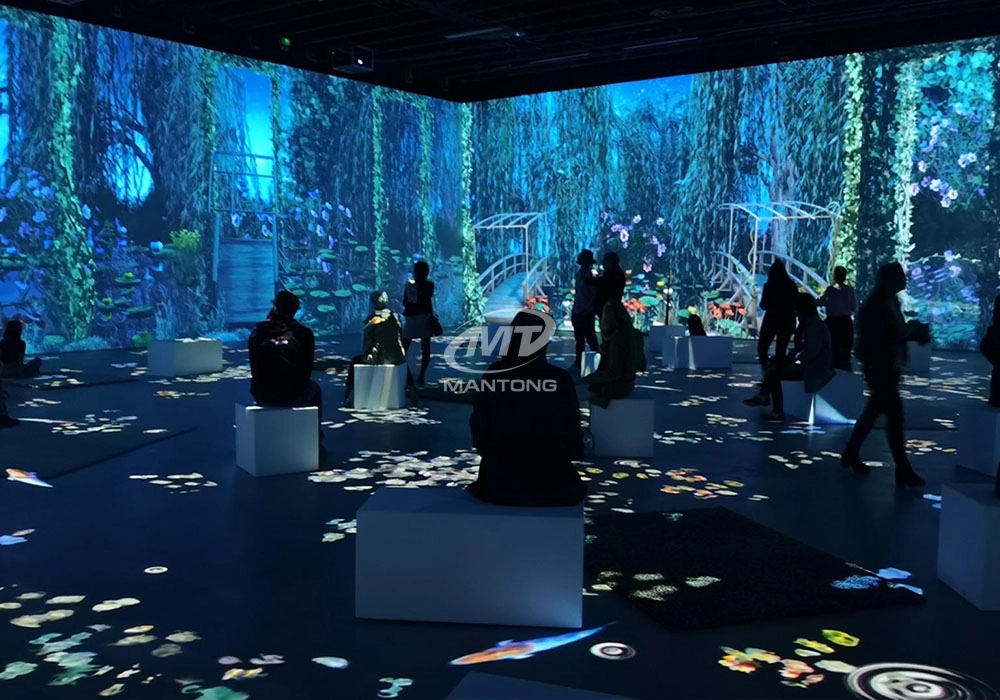
Mantong 6500LM High-Lumen Projector for Large-Scale Immersive Room Projection
Transform any space with Mantong's immersive projection mapping systems. Our high-lumen projectors (up to 6500 LM) and custom software create captivating interactive experiences for floors and walls. Ideal for museums, events, retail, and hospitality. Each kit includes professional ceiling mounting and 80+ pre-loaded video contents and is backed by a 12-month warranty and CE certification. We offer full customization and support to bring your vision to life.
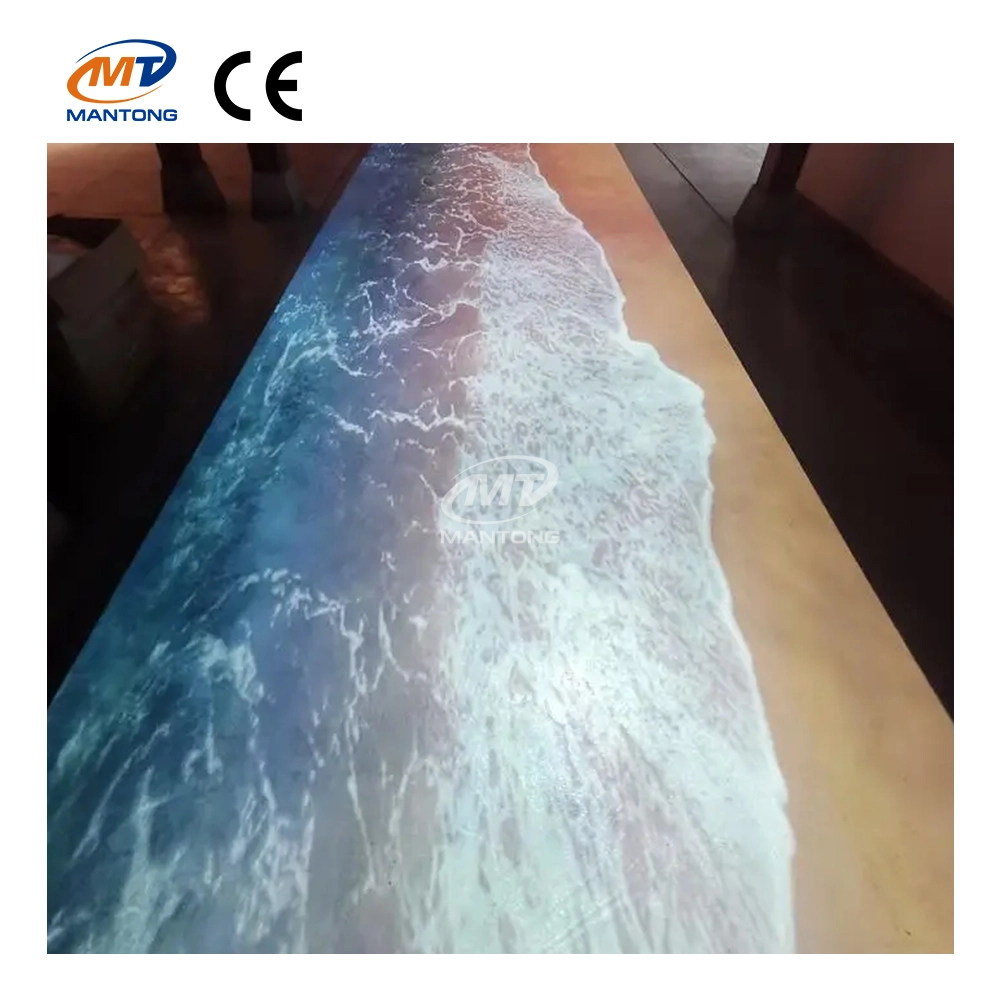
Indoor Interactive Floor Projector System - Customized Design & Installation Support
Indoor interactive floor projections display dynamic themed videos on the floor, commonly used in venues aiming to enhance brand influence or attract foot traffic, such as restaurants, hotel corridors, and brand car retail stores.
By using projectors and compatible software, the interactive content is projected onto the floor, encouraging engagement between people and the projected visuals. A single 5500-lumen indoor floor projector can cover an area of 5 m × 3 m. Typically, each project will use at least 3 units to ensure broad coverage and optimal visual effects.
We also offer customized design and installation support to enhance the interactive experience for your venue.
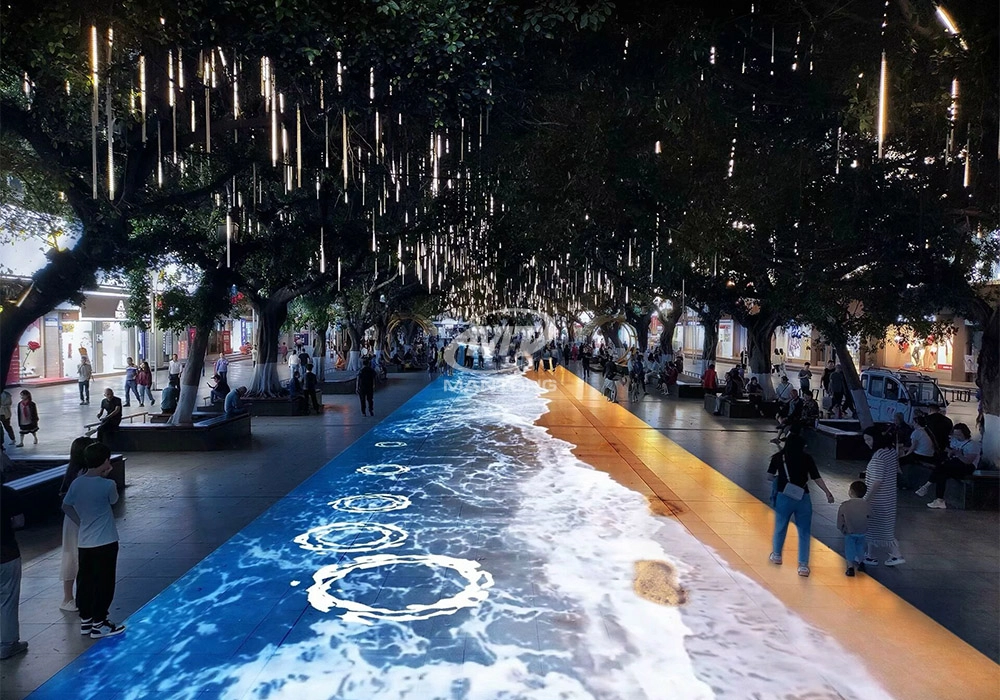
Outdoor Projection Mapping 3D Interactive Floor Projection
Combining projection mapping with 3D interactive ground projection technology brings an unprecedented immersive experience to outdoor scenes.
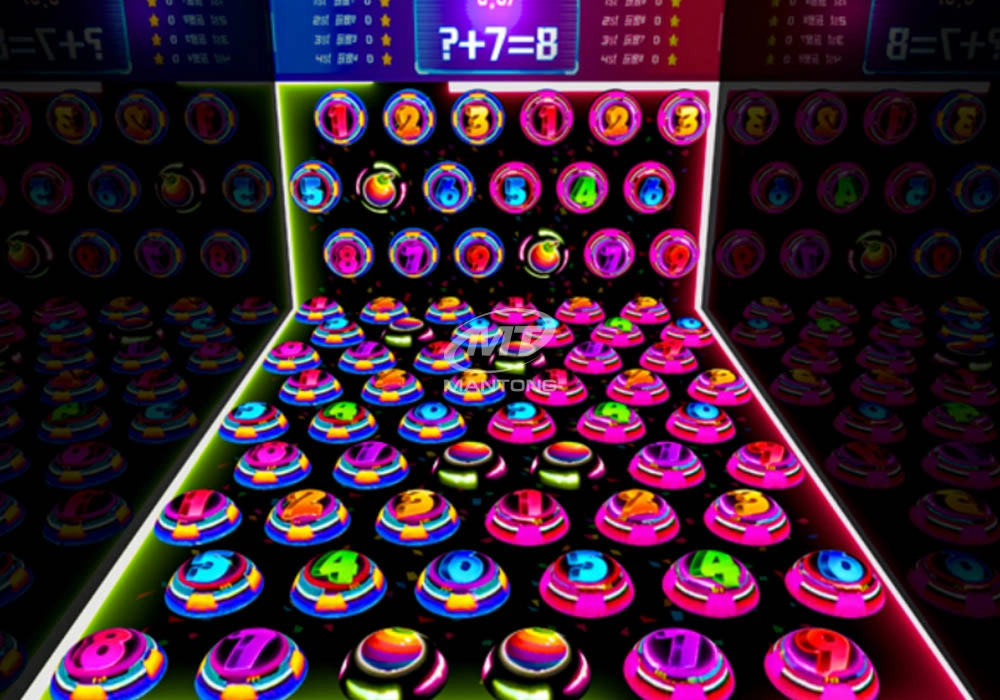
Amusement Rapidly Rotating Bouncing Sphere Interactive Wall Floor Projection Sports Games
Rapidly Rotating Bouncing Sphere is an interactive space where participants jump on rotating spheres. As they step on it, the spheres surface will show special interactivity
Jumping on spheres of the same color in succession causes them to pop, releasing light particles. The more consecutive jumps, the greater the reward—caterpillars appear, and eventually, all spheres of that color burst, filling the space with light and even more caterpillars.

Kaida Business Center, Shixin Road, Panyu District,Guangzhou City, Guangdong Province, China.
ManTong
ManTong
ManTong