
How to design custom interactive floor games
- Designing Engaging Interactive Floor Experiences
- 1. Start with clear objectives and audience profiling for interactive floor projector games
- 2. Choosing the right projector for interactive floor projector games
- 3. Selecting sensors and tracking methods for interactive floor projector games
- 4. Hardware comparison table — sensors and projectors
- 5. Game design patterns and interaction mechanics for interactive floor projector games
- 6. Software architecture, calibration and content pipeline for interactive floor projector games
- 7. Safety, accessibility and durability considerations for interactive floor projector games
- 8. Prototyping, testing and metrics: measure success of interactive floor projector games
- 9. Implementation roadmap and rough timeline for interactive floor projector games
- Mantong Digital: turnkey partner for immersive and interactive floor projector games
- 10. Deployment checklist — pre-launch and operational tips for interactive floor projector games
- FAQ — common questions about interactive floor projector games
- Contact & next steps
- References
Designing Engaging Interactive Floor Experiences
Interactive floor projector games are an increasingly popular medium across museums, retail, education and entertainment. Designing a successful custom installation requires balancing hardware, sensing, software, content and real-world constraints. This guide walks through evidence-based decisions, practical trade-offs and an implementation roadmap so teams — from small experience designers to facility managers — can build robust, measurable interactive floor experiences.
1. Start with clear objectives and audience profiling for interactive floor projector games
Before choosing equipment or writing a line of code, document measurable objectives: increase dwell time by X%, improve learning outcomes, generate social-media shares, or provide inclusive play for ages 3–12. Profile the primary users (children, families, shoppers, commuters) and environment (museum gallery, shopping mall, outdoor event). These factors directly determine brightness, durability, interaction complexity and safety requirements.
Actionable checklist
- Define KPIs (engagement time, repeat plays, throughput).
- Identify user constraints (height ranges, mobility concerns, language).
- Set environmental parameters (ambient light lux, ceiling height, foot traffic patterns).
2. Choosing the right projector for interactive floor projector games
Projector choice is foundational. Consider brightness (lumens), resolution, throw ratio, lens shift, refresh rate and reliability. For indoor, medium-ambient-light interactive floors, projectors in the 3,000–6,000 lumen range are typical; high ambient light or outdoor daytime use requires higher brightness and different optics.
Key specifications and why they matter:
- Brightness (ANSI lumens): determines image visibility under ambient light.
- Resolution: determines visual clarity and usability of small UI elements; WUXGA (1920×1200) or 4K for high-detail content.
- Throw ratio: determines projector placement relative to projection area; ultra-short-throw (UST) reduces ceiling depth and shadows.
- Refresh rate and input lag: affects the perceived immediacy of interactions; aim for low-latency pipelines.
- Light source: LED/Laser offers longer life and more consistent color than lamps.
3. Selecting sensors and tracking methods for interactive floor projector games
Sensor selection dictates interaction fidelity and cost. Common sensing approaches include camera-based vision, depth sensors (ToF / structured light), infrared arrays, pressure mats and lidar. Each has trade-offs in accuracy, latency, robustness to lighting and cost.
Design considerations:
- Latency: keep end-to-end latency (capture → processing → render) as low as possible; aim for <40 ms for fluid interactions where feasible.
- Robustness: camera-based solutions are flexible but sensitive to ambient IR and lighting; depth sensors are more resilient to color/texture variance.
- Privacy: camera solutions can be configured to avoid recording identifiable video (use silhouette/contour processing) to comply with privacy policies.
4. Hardware comparison table — sensors and projectors
| Technology | Typical hardware | Pros | Cons | Best use cases |
|---|---|---|---|---|
| Camera-based vision | High-res RGB cameras, OpenCV | Affordable, high spatial resolution, flexible algorithms | Sensitive to lighting, requires calibration | Indoor exhibits, pattern/gesture recognition |
| Depth sensors (ToF / structured light) | Kinect, Intel RealSense, Azure Kinect | Robust to color/texture; good for body tracking | Higher cost, limited range/field of view | Interactive play requiring body tracking |
| Infrared arrays | IR LEDs + receivers, Leap Motion | Low latency, low cost for small areas | Limited coverage area, can be fooled by ambient IR | Small games, kiosks, gesture hotspots |
| Pressure mats / floor sensors | Capacitive mats, force sensors | Direct contact detection, simple logic | Hardware wear, limited pattern detection | Rhythm games, simple step interactions |
| Lidar | 2D/3D lidar modules | Very accurate distance mapping, works in low light | Higher cost, data processing complexity | High-precision installations, outdoor use |
Sources for sensor technologies include product datasheets and platform documentation (see references).
5. Game design patterns and interaction mechanics for interactive floor projector games
Design interactions around simple, discoverable mechanics. Popular patterns include: stamp/step triggers, dodging/avoidance, chase/capture, collective construction and multi-player competitive/cooperative modes. For educational settings, scaffold challenges using progressive difficulty and in-game feedback that supports learning objectives.
Design rules of thumb
- Keep primary mechanics obvious within 2–3 seconds of approach.
- Use large interactive targets (>0.6 m diameter) for young children.
- Provide clear audiovisual feedback within 100 ms of input for perceived responsiveness.
- Design for throughput: if managing queues, include quick-play modes of 15–45 seconds.
6. Software architecture, calibration and content pipeline for interactive floor projector games
A reliable software stack typically contains: sensor acquisition layer, tracking/interpretation layer, game logic engine and rendering pipeline synchronized to projector output. Use standard middleware (Unity, Unreal Engine, or custom OpenGL/DirectX solutions) combined with well-tested tracking libraries.
Calibration checklist
- Geometric calibration: compute homography between projector space and sensor space using checkerboards or projected markers.
- Color/gamma calibration: match projector color output across multiple units if using multiple projectors.
- Latency measurement: measure round-trip time from sensor detection to visible update; optimize pipelines and use GPU rendering to minimize lag.
- Robustness testing: simulate real-world conditions (crowds, dirt on floor, varying lighting) and adjust thresholds.
7. Safety, accessibility and durability considerations for interactive floor projector games
Floor installations must meet safety and accessibility standards. Use non-slip flooring materials where projection occurs or apply protective coverings over sensors that maintain tracking fidelity. Ensure contrast and audio cues for users with visual impairments, and consider seated-interaction modes for wheelchair users.
Operational considerations
- Regular maintenance plan for projector filters, lens cleaning and firmware updates.
- Fail-safe defaults: if sensors or projectors fail, the system should return to a neutral safe state.
- Comply with local electrical and fire codes and provide secure mounting to prevent tampering.
8. Prototyping, testing and metrics: measure success of interactive floor projector games
Prototyping rapidly with low-fidelity mockups reduces risk. Start with simple visuals and single-sensor tracking to validate mechanics. Use A/B testing for content variants and collect metrics: session length, repeat sessions, interaction heatmaps and dropout points. Instrument the game to log anonymized events and timestamps to analyze player flow and quantify KPIs.
Recommended metrics
- Average session duration and median playtime.
- Return rate (percentage of unique visitors who play again within a given period).
- Engagement per hour (plays/hour) and peak concurrency.
- Conversion KPIs tied to business goals (e.g., email signups, retail uplift).
9. Implementation roadmap and rough timeline for interactive floor projector games
A typical project timeline (small-to-medium scope):
- Weeks 0–2: Requirements, objectives and environment survey.
- Weeks 2–6: Hardware selection, preliminary software architecture and low-fidelity prototype.
- Weeks 6–12: Full prototype with tracking, calibration and core mechanics.
- Weeks 12–16: Content finalization, testing, accessibility and safety checks.
- Weeks 16–20: On-site installation, calibration and staff training.
Budgeting will vary widely by scale: key cost drivers are projector (1–n units), sensing hardware, protective mounting, custom software, art/animation and on-site labor. For quotes and cost optimization, modular design (reuse core engine across installations) reduces long-term costs.
Mantong Digital: turnkey partner for immersive and interactive floor projector games
Mantong Digital is a one-stop interactive projection solution provider and direct manufacturer based in Guangzhou, China, with over 10 years of industry experience. We are dedicated to providing innovative, flexible and cost-effective projection solutions, offering both hardware and software to meet various needs.
At ManTong, we specialize in providing customized solutions for a wide range of application scenarios through innovative projection technology. Whether it's immersive experiences, interactive entertainment or outdoor lighting and projection shows, our solutions can transform your ideas into stunning visual effects. Our projection technology provides customized solutions for a variety of scenarios, delivering immersive and interactive visual experiences.
Mantong core advantages and main products:
- Direct manufacturing and supply chain control — competitive pricing and faster lead times.
- End-to-end solutions: immersive projection, interactive floor projection, interactive wall projection, immersive rooms, 3D projection, interactive projection games and projection shows.
- Technical depth: experienced engineering teams for calibration, multi-projector blending, tracking integration and custom software.
- Proven deployments: installations across museums, retail, education and event entertainment.
We are now looking for business partnerships worldwide. Our vision is to become the world's leading interactive projection manufacturer. Learn more about capabilities and view case studies at https://www.mtprojection.com/.
10. Deployment checklist — pre-launch and operational tips for interactive floor projector games
Pre-launch checklist
- Environmental test for ambient light and acoustic noise.
- Full calibration of projector and sensor coordinate systems.
- Safety sign-off (fire, electrical, mounting inspections).
- Staff training and an operations manual that includes troubleshooting steps.
- Analytics and logging enabled with privacy-preserving defaults.
Operational tips
- Schedule regular hardware maintenance and firmware updates.
- Monitor analytics for engagement dips and iterate content seasonally.
- Offer quick-start instructions and on-site signage to increase first-time engagement.
FAQ — common questions about interactive floor projector games
Q1: What sensors are best for large, crowded interactive floors?
A1: For large, crowded areas, depth sensors (ToF) combined with multiple overhead coverage or lidar arrays offer the most robust per-person tracking. Multi-camera setups with server-side fusion can also scale but require more calibration.
Q2: How bright should projectors be for an indoor mall installation?
A2: For indoor mall areas with moderate ambient light, projectors in the 3,000–6,000 ANSI lumen range are commonly used. Use brighter or multiple blended projectors for very bright environments; always test in-situ.
Q3: How do you minimize latency for a responsive interactive floor game?
A3: Optimize the full pipeline: choose low-latency sensors, reduce processing steps, use GPU-based rendering, keep frame rates at 60 FPS where possible, and measure round-trip latency to guide optimizations. Aim for end-to-end latency under 40–60 ms for most games.
Q4: Can interactive floor games be made accessible to people with mobility impairments?
A4: Yes. Provide alternate interaction modes (e.g., hand gestures at reachable heights, kiosk-based interfaces) and design content with adjustable difficulty, visual contrasts and audio descriptions. Consult accessibility standards and local regulations.
Q5: What are typical failure modes and how do you design for reliability?
A5: Common failures include projector lamp burnout, sensor misalignment, and environmental dirt on lenses. Mitigate with redundant hardware where needed, use laser/LED light sources for longevity, implement automated health checks and provide straightforward maintenance access.
Q6: How much does custom software development usually add to a project?
A6: Custom software costs depend on complexity: simple templates and minor UI changes can be low-cost, while bespoke mechanics, multiplayer syncing, analytics and CMS integrations increase costs. Using modular engines (e.g., Unity) and reusing core libraries shortens timelines and reduces cost.
Contact & next steps
If you are planning an interactive floor projection project, Mantong Digital can help from concept to deployment — hardware, software and content. For consultations, customization or a quote, visit https://www.mtprojection.com/ or contact our business development team to discuss partnership opportunities and project fit.
References
- Projection mapping — Wikipedia. https://en.wikipedia.org/wiki/Projection_mapping. Accessed 2025-12-14.
- Kinect — Wikipedia (depth sensing and body tracking overview). https://en.wikipedia.org/wiki/Kinect. Accessed 2025-12-14.
- Projector Brightness & ANSI lumens — ProjectorCentral. https://www.projectorcentral.com/what_is_projector_brightness.htm. Accessed 2025-12-14.
- Interactive art and installations overview — Wikipedia. https://en.wikipedia.org/wiki/Interactive_art. Accessed 2025-12-14.
- Unity real-time development platform (engine commonly used for interactive installations). https://unity.com/. Accessed 2025-12-14.
Choosing Interactive Floor Games for Museums and Exhibits
Calibration Tips for Accurate Interactive Projection
How Interactive Wall Projection Enhances Hospitality and Tourism Spaces
What is 3d interactive projection ? | Ultimate Insight
One-Stop Projection Solution Provider Since 2011
What about the wall/floor material for the projection?
It’s recommended to choose a light-colored material with minimal reflectivity—pure white or light grey works best. the
common material is cement & plaster board
For optimal projection results, the surface should be free of any patterns or textures, as the projector will display content
directly onto it.
There are no specific material requirements; you may use any commonly available material in your local market, as long as it
meets the above conditions.
What's Immersive Projection ?
Immersive projection refers to a technology that creates a captivating and all-encompassing visual experience for viewers by projecting images or videos onto large surfaces, such as walls, floors, or even entire rooms. This technology aims to immerse the audience in a simulated environment, blurring the boundaries between the physical and virtual worlds.
How to install the projection equipment ?
1) Install the projector in a suitable position. We will provide you with a hanger, which you need to fix on the ceiling with
screws.
2) Connect projectors, computers and other accessories through wires.
3) After completing the above 2 steps, we will carry out the edge blending steps. Our team can complete it through remote
control.
In general, installation instructions for each project need to be specified on a project-by-project basis. The above is for
reference only.
What information do you need to know before making the proposal/solution?
We know that everyone wants to know the price, but the price of our products is determined by many factors since most of our products are custom, so no ready price list. In order to fast understand what you need, can you send us an inquiry like this?
For example: I am really interested in your immersive projection products, we are a company in the USA and want to install some in my restaurant. It is about 50 meters long, and 5m in width. Projection size you can decide but the length should be not less than 20 meters. We want some content about SeaWorld because our place is all about the sea. Thank you.
What's the application of Immersive projection ?
It can be used in various venues, such as art exhibition, entertainment venues, educational institution, Wedding hall /Banquet/Bar,Yoga Studio and so on. It often involves advanced projection techniques, multimedia content, and interactive elements to engage and captivate the audience's senses.
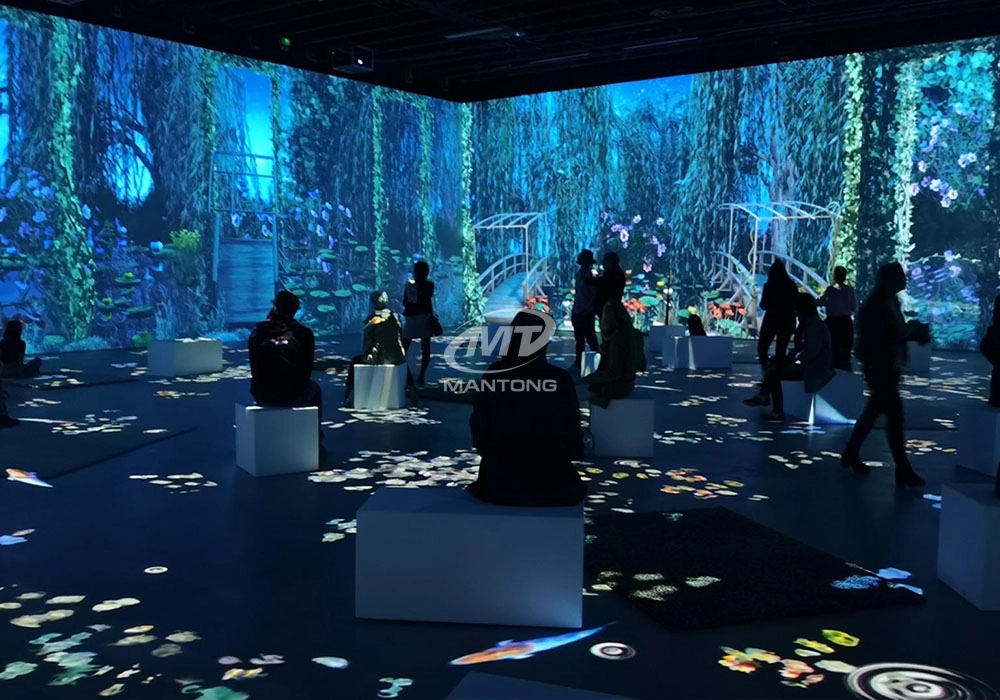
Mantong 6500LM High-Lumen Projector for Large-Scale Immersive Room Projection
Transform any space with Mantong's immersive projection mapping systems. Our high-lumen projectors (up to 6500 LM) and custom software create captivating interactive experiences for floors and walls. Ideal for museums, events, retail, and hospitality. Each kit includes professional ceiling mounting and 80+ pre-loaded video contents and is backed by a 12-month warranty and CE certification. We offer full customization and support to bring your vision to life.
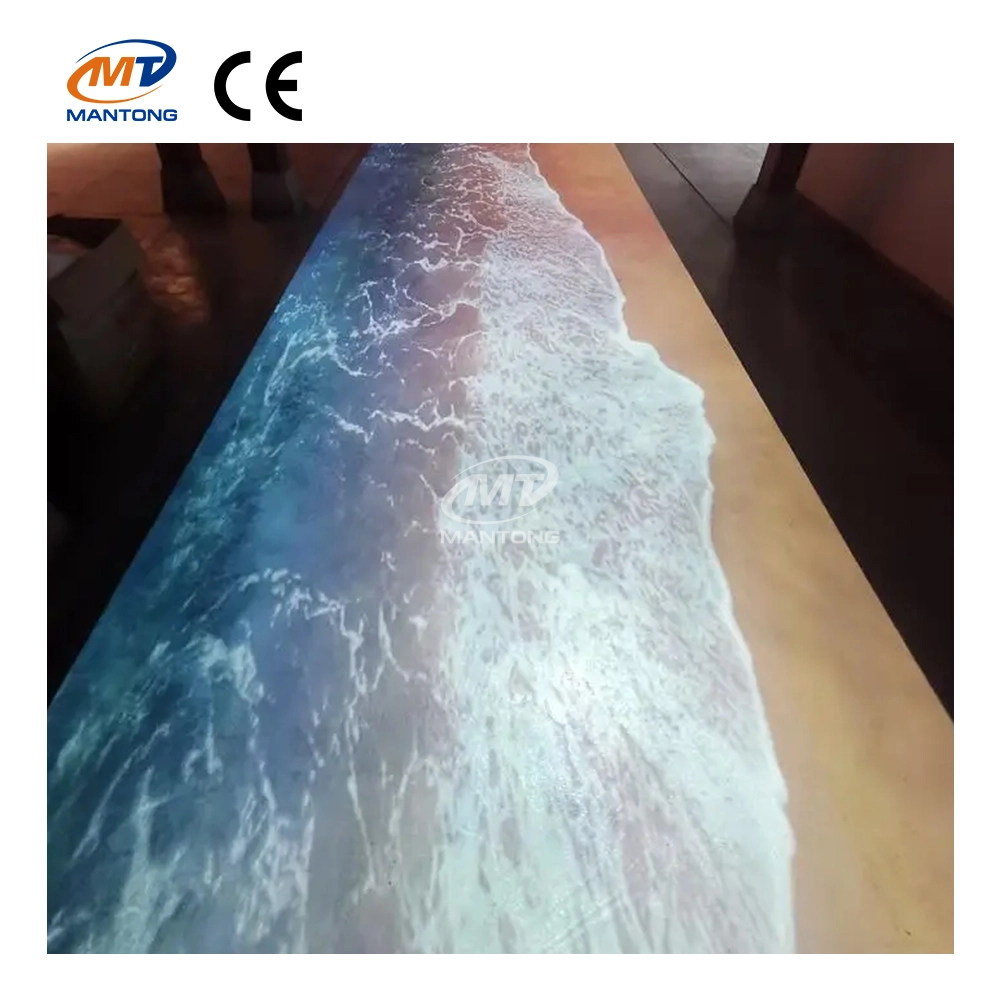
Indoor Interactive Floor Projector System - Customized Design & Installation Support
Indoor interactive floor projections display dynamic themed videos on the floor, commonly used in venues aiming to enhance brand influence or attract foot traffic, such as restaurants, hotel corridors, and brand car retail stores.
By using projectors and compatible software, the interactive content is projected onto the floor, encouraging engagement between people and the projected visuals. A single 5500-lumen indoor floor projector can cover an area of 5 m × 3 m. Typically, each project will use at least 3 units to ensure broad coverage and optimal visual effects.
We also offer customized design and installation support to enhance the interactive experience for your venue.
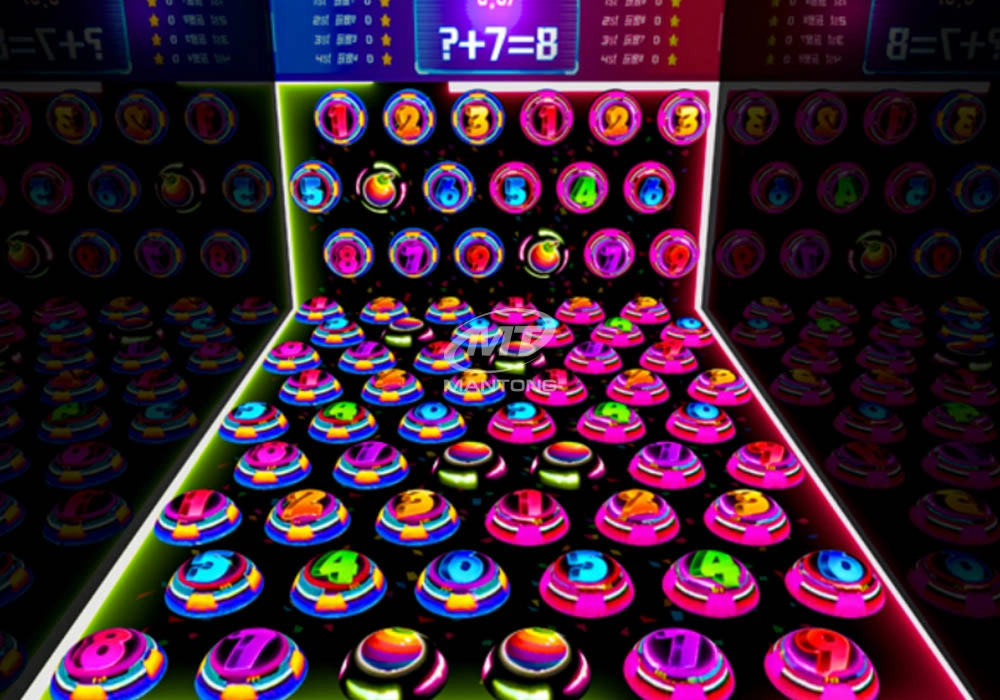
Amusement Rapidly Rotating Bouncing Sphere Interactive Wall Floor Projection Sports Games
Rapidly Rotating Bouncing Sphere is an interactive space where participants jump on rotating spheres. As they step on it, the spheres surface will show special interactivity
Jumping on spheres of the same color in succession causes them to pop, releasing light particles. The more consecutive jumps, the greater the reward—caterpillars appear, and eventually, all spheres of that color burst, filling the space with light and even more caterpillars.
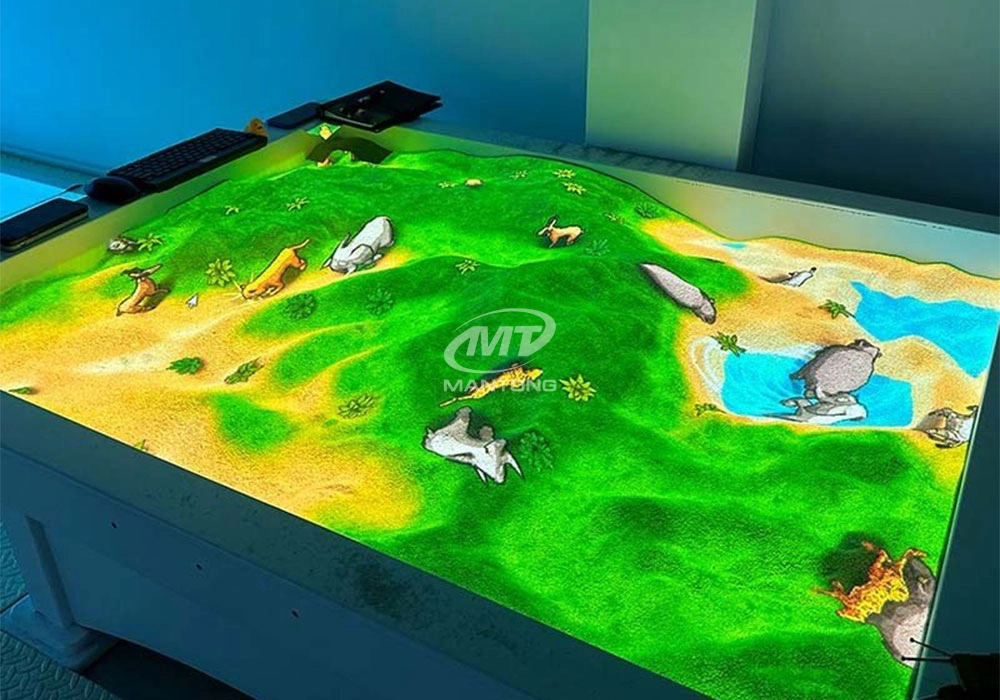
Interactive Sandbox Projection Mapping Games For Kids Play Park
Bring imagination to life with interactive sandbox projection mapping games designed for kids’ play parks. Using cutting-edge projection technology and real-time motion sensing, children can dig, build, and explore virtual worlds directly in the sand. Educational, engaging, and endlessly fun — it’s the perfect blend of play and learning.

Kaida Business Center, Shixin Road, Panyu District,Guangzhou City, Guangdong Province, China.
ManTong
ManTong
ManTong