
Estimating Immersive Experience Cost per Square Foot
- How to Budget an Immersive Experience Project
- Key components affecting cost of immersive experience build
- Typical cost per square foot by experience type (cost of immersive experience build)
- Detailed cost breakdown example for a 1,000 sq ft immersive room (cost of immersive experience build)
- Major variables that change the cost of immersive experience build
- Quantifying a few typical unit costs (cost of immersive experience build)
- Estimating timeline, maintenance and total cost of ownership (cost of immersive experience build)
- How to reduce cost and improve ROI when planning immersive experiences (cost of immersive experience build)
- Why choose Mantong Digital for cost-effective immersive projection builds (cost of immersive experience build)
- Practical steps to create an accurate per-square-foot estimate (cost of immersive experience build)
- FAQs — Estimating Immersive Experience Costs (cost of immersive experience build)
- 1. What is a realistic minimum cost per square foot for an immersive projection room?
- 2. How much does interactive sensor hardware add to the budget?
- 3. Can I reuse existing AV equipment to lower costs?
- 4. How much should I budget for content updates and refreshes?
- 5. Is LED a cheaper option than projection for immersive experiences?
- 6. How do I compare quotes from different integrators?
- 7. What contingency should I include in the estimate?
- References
How to Budget an Immersive Experience Project
The objective when planning an immersive installation is to convert creative goals into a realistic budget. Stakeholders commonly ask: what is the cost of immersive experience build per square foot, and which line items drive the most variance? This article provides an evidence-based framework and practical price ranges so you can estimate budgets, compare options, and make procurement decisions with confidence.
Key components affecting cost of immersive experience build
Estimating the cost of immersive experience build starts with decomposing the project into core components. Each component has its own unit costs and scale effects. Typical line items include:
- Projection hardware (projectors, lenses, mounts)
- Display alternatives (LED video walls, screens, projection surfaces)
- Media servers and control systems
- Interactivity hardware (sensors, cameras, motion tracking, touch systems)
- Content design and production (animation, mapping, audio)
- Structural work and venue modifications (rigging, black-boxing, acoustics)
- Installation labor, testing and calibration
- Power, cooling, and ongoing maintenance/support
- Permits, insurance, and contingency
Because these components scale differently, cost per square foot is not linear: smaller projects often have higher per-sqft costs due to fixed minimums (media server, design retainer, installation mobilization), while larger rooms spread fixed costs across more area.
Typical cost per square foot by experience type (cost of immersive experience build)
Below are industry-accepted ballpark ranges for initial build cost per square foot. These are ranges informed by manufacturer pricing, integrator experience, and public case studies. Use them as starting points — final estimates require site-specific assessment.
| Experience Type | Typical Cost per sq ft (USD) | Main cost drivers |
|---|---|---|
| Basic immersive projection (single projector, darkened room) | $20 – $80 | Projector & lens, screen prep, basic content |
| Interactive floor/wall projection | $50 – $200 | Sensors/cameras, interactive middleware, more calibration |
| Multi-projector 360° immersive room | $150 – $600 | Multiple projectors, edge blending, media servers, rigging |
| High-resolution 3D projection mapping / museum-grade exhibit | $300 – $1,200+ | High-end projectors, bespoke content, finer-surface prep |
| Outdoor projection show / projection mapping (perft. events) | $200 – $2,000+ (event-based) | Weatherproofing, high-brightness projectors, logistics |
Sources for these ranges include manufacturer pricing tiers for professional projectors and integrator case studies; they represent installed costs (hardware + basic installation + initial content). For permanent exhibits expect higher content and infrastructure budgets.
Detailed cost breakdown example for a 1,000 sq ft immersive room (cost of immersive experience build)
Below is a representative estimate for a 1,000 sq ft multi-projector immersive room (edge-blended, interactive capability). The example demonstrates how per-sqft costs emerge from line items.
| Budget Item | Estimated Cost (USD) | Notes |
|---|---|---|
| Projectors & lenses (4 x mid-high lumen) | $60,000 | ~$15k each (professional grade) |
| Media server & control (1-2 units) | $12,000 | Redundant options add cost |
| Interactivity (cameras, depth sensors, middleware) | $15,000 | Includes tracking & licensing |
| Mounts, rigging, cabling, power upgrades | $20,000 | Site-specific |
| Content design & production (mapping + audio) | $40,000 | Original immersive content, iterative process |
| Installation labor & calibration | $18,000 | Integration team onsite |
| Testing, training & documentation | $5,000 | Operator training |
| Contingency & permits | $10,000 | ~10% contingency |
| Total (1,000 sq ft) | $180,000 | Equivalent: $180 / sq ft |
This example produces ~$180/sq ft, which places it in the mid-to-high range for a high-quality, interactive immersive room. Swap hardware tiers, reuse existing content, or reduce interactivity to significantly lower cost per square foot.
Major variables that change the cost of immersive experience build
Understanding which variables move the needle helps you manage budget expectations. The top variables are:
- Image brightness & resolution requirements: Higher lumen and higher-resolution projectors or LED walls increase equipment cost exponentially.
- Interactivity complexity: Simple foot-tracking vs. full 3D volumetric tracking with AI analytics are orders of magnitude apart in cost.
- Content scope & quality: Original CGI, 3D animation and bespoke audio are labor-intensive; licensing repurposed content is cheaper.
- Environmental conditions: Outdoor or high ambient light venues require more expensive high-brightness or specialized projection systems.
- Finish level & visitor throughput: Museums and high-dwell attractions require robust housings, redundancy and service contracts.
- Local labor rates and logistics: Skilled AV labor and rigging vary by market; remote sites increase travel/mobilization costs.
Quantifying a few typical unit costs (cost of immersive experience build)
| Item | Typical Installed Cost | Source / Notes |
|---|---|---|
| Professional projector (installed) | $8,000 – $60,000 each | Ranges from reliable lamp projectors to high-end laser cinema/projectors (manufacturer ranges) |
| LED video wall | $600 – $2,500 per sqm (installed) | Indoor fine-pitch LED shows wide price range depending on pitch |
| Media server | $3,000 – $30,000 | Depends on redundancy and software licensing |
| Interactive sensor package | $2,000 – $25,000 | From simple IR floors to high-end LIDAR/camera arrays |
| Custom content per minute | $2,000 – $15,000 per finished minute | Highly variable with complexity |
These unit prices align with published product ranges from major AV manufacturers and integrators. For instance, professional-grade projectors from Barco and Christie sit in the mid-to-high end of the projector price range; media-server and software licensing (e.g., Watchout, Disguise) add recurring and upfront costs.
Estimating timeline, maintenance and total cost of ownership (cost of immersive experience build)
Budgeting should include lifecycle costs. Typical timelines and recurring costs include:
- Design & content: 6–20 weeks depending on iteration cycles
- Procurement & delivery: 4–12 weeks for hardware, longer for custom builds
- Installation & commissioning: 1–6 weeks depending on complexity
- Annual maintenance & licensing: 5–15% of initial hardware+software cost
Example: a $180k installation with a 10% annual maintenance/license budget implies $18k/year for parts, service and software renewals. Plan for lamp or laser module replacement (if not covered by warranty) and possible content refresh every 2–5 years to maintain relevance.
How to reduce cost and improve ROI when planning immersive experiences (cost of immersive experience build)
Cost control strategies that preserve impact:
- Define the visitor experience first: Prioritize which elements must be immersive vs. decorative.
- Use modular hardware: Scalable projector farms or reusable media server templates reduce future refresh costs.
- Leverage manufacturer-direct suppliers: Buying from a direct manufacturer or integrated supplier can reduce markup and improve support.
- Consider staged content: Launch with a core set of assets and add content over time to spread costs.
- Optimize brightness vs. cost: Effective surface finish and controlled ambient light can let you achieve good image quality with lower-cost projectors.
- Negotiate service agreements: Fixed-rate maintenance and spare-part pools reduce long-term risk.
Why choose Mantong Digital for cost-effective immersive projection builds (cost of immersive experience build)
Mantong Digital is a one-stop interactive projection solution provider and direct manufacturer based in Guangzhou, China, with over 10 years of industry experience. We are dedicated to providing innovative, flexible and cost-effective projection solutions, offering both hardware and software to meet various needs.
At ManTong, we specialize in providing customized solutions for a wide range of application scenarios through innovative projection technology. Whether it's immersive experiences, interactive entertainment or outdoor lighting and projection shows, our solutions can transform your ideas into stunning visual effects. Our projection technology provides customized solutions for a variety of scenarios, delivering immersive and interactive visual experiences.
Key competitive advantages:
- Direct manufacturing: Reduced cost by eliminating multiple resellers and tighter control over component sourcing and quality.
- End-to-end capability: Hardware, firmware and content partnerships allow better integration and predictable installation costs.
- Customization & flexibility: Proven experience across immersive projection, interactive floor projection, interactive wall projection, immersive rooms, 3D projection, interactive projection games, projection shows, and projection mapping.
- Global partnership focus: Ready for worldwide business partnerships and international installations with professional service teams.
- Proven track record: 10+ years in production and deployment of interactive projection systems demonstrates operational reliability and manufacturing expertise.
Typical Mantong-supported solutions that reduce per-sqft costs:
- Optimized projector packages (matched brightness, lensing and mounts)
- Integrated media-server presets and templates to reduce content development time
- Sensor + software bundles for interactive floors and walls that simplify installation and QA
- Modular outdoor housings and logistics packages for projection shows
If you are planning an immersive project and want manufacturer-level pricing, technical support or a site-specific proposal, contact Mantong at https://www.mtprojection.com/ to request a consultation. We are now looking for business partnerships worldwide and our vision is to become the world's leading interactive projection manufacturer.
Practical steps to create an accurate per-square-foot estimate (cost of immersive experience build)
- Establish the experience goals and minimum technical requirements (brightness, resolution, interactivity level).
- Survey the site to confirm ambient light, mounting points, power and structural constraints.
- Define content scope: number of minutes, level of animation, audio requirements and localization.
- Request itemized quotes from at least two integrators/manufacturers and one content studio; compare hardware tiers and support levels.
- Model three scenarios (minimum viable, preferred, High Quality) to show stakeholders trade-offs in cost and visitor experience.
- Include contingency (8–15%), shipping, import duties (if applicable), and 2–3 year maintenance funding in your capital plan.
FAQs — Estimating Immersive Experience Costs (cost of immersive experience build)
1. What is a realistic minimum cost per square foot for an immersive projection room?
For a very basic dark-room projection (one or two projectors, minimal interaction and light control) expect $20–$80 per sqft installed. This assumes limited content creation and simple mounting.
2. How much does interactive sensor hardware add to the budget?
Simple sensor packages (floor sensors or single-camera tracking) can add $2k–$8k. High-precision multi-camera arrays, LIDAR or custom sensor systems can add $10k–$25k or more depending on coverage and processing needs.
3. Can I reuse existing AV equipment to lower costs?
Yes. Reusing projectors, servers, or mounts lowers initial capital spend but check whether they meet project requirements (brightness, resolution, reliability). Older hardware may increase maintenance and replacement risk.
4. How much should I budget for content updates and refreshes?
Plan for a content refresh every 2–5 years. Annual content maintenance and small updates can be budgeted at 2–6% of initial content cost; full refreshes can equal 25–100% of the original content budget depending on scope.
5. Is LED a cheaper option than projection for immersive experiences?
Not necessarily. LED has advantages in brightness and contrast and may simplify installation in high ambient light, but fine-pitch LED is typically more expensive per square foot than projection for the same visual area. Consider image size, viewing distance, and budget when choosing technology.
6. How do I compare quotes from different integrators?
Ask for an itemized bill of materials, labor hours, warranties, SLAs for support, and a breakdown of recurring software or licensing fees. Compare total cost of ownership, not just initial capital cost.
7. What contingency should I include in the estimate?
Include 8–15% contingency for unforeseen site conditions, shipping delays, or scope changes. For international projects add allowances for customs, import duties and extended logistics.
Ready to get a site-specific quote or explore cost-saving architectures? Contact Mantong Digital for manufacturer-direct pricing, technical consultation and turnkey interactive projection solutions: https://www.mtprojection.com/
References
- Barco product range — UDX projectors. Accessed 2025-11-30. https://www.barco.com/en/product-range/udx-projectors
- Christie Digital — Professional projection products. Accessed 2025-11-30. https://www.christiedigital.com/en-us/products/projectors/
- Bluecadet — How much does a museum exhibit cost? (case studies & ranges). Accessed 2025-11-30. https://www.bluecadet.com/how-much-does-a-museum-exhibit-cost
- U.S. Bureau of Labor Statistics — Electricians: wages and employment. Accessed 2025-11-30. https://www.bls.gov/ooh/construction-and-extraction/electricians.htm
- Dataton — WATCHOUT media server solutions (product information). Accessed 2025-11-30. https://dataton.com/products/watchout/
Data and price ranges above are compiled from manufacturer product information, integrator case studies, and professional experience deploying immersive projection systems. For a precise per-square-foot estimate please request a free site consultation through Mantong Digital at https://www.mtprojection.com/.
Top Uses of Interactive Water Projection in Events: Practical Applications and ROI
Custom Interactive Floor Games: Design & Integration Tips
Interactive Projector Market Size and Growth Forecast 2026-2032
Best The Future of Business Meetings: Exploring Immersive Meeting Room Technology manufacturers and supplier brands
One-Stop Projection Solution Provider Since 2011
Are you trader or manufacturer ?
We are direct manufacturer who specialize in providing one-stop solution for different outdoor & indoor projection project with our stable software and qualified projectors
What information do you need to know before making the proposal/solution?
We know that everyone wants to know the price, but the price of our products is determined by many factors since most of our products are custom, so no ready price list. In order to fast understand what you need, can you send us an inquiry like this?
For example: I am really interested in your immersive projection products, we are a company in the USA and want to install some in my restaurant. It is about 50 meters long, and 5m in width. Projection size you can decide but the length should be not less than 20 meters. We want some content about SeaWorld because our place is all about the sea. Thank you.
What's the application of Immersive projection ?
It can be used in various venues, such as art exhibition, entertainment venues, educational institution, Wedding hall /Banquet/Bar,Yoga Studio and so on. It often involves advanced projection techniques, multimedia content, and interactive elements to engage and captivate the audience's senses.
How to Write an Interactive-Effect Video Customisation Script ?
① Project Background: Briefly introduce the context in which this interactive scene will be used (e.g., exhibition, museum,
event space, children's area). Example: This scene is part of the “Underwater World” zone in a children's science museum,
designed to be engaging and exploratory.
②Visual Style / Atmosphere: What kind of visual mood are you aiming for? Please describe the color scheme, style, and any
references. it should focus solely on describing the visual aspects of the scene, supported by relevant charts or reference
images.
③ Interaction Points Overview:List each interactive hotspot along with the effect you'd like to trigger when the user
touches or clicks the area. example: when player touch the clownfish, it will swims away with bubble trail (animation effect)
and produce the bubble sound ( sound effect requirement )
④ Static Visual Reference:including but not limited to background image/video, a list of major visual elements (e.g., coral,
rocks, seaweed, fish), which elements should be interactive?
What's Immersive Projection ?
Immersive projection refers to a technology that creates a captivating and all-encompassing visual experience for viewers by projecting images or videos onto large surfaces, such as walls, floors, or even entire rooms. This technology aims to immerse the audience in a simulated environment, blurring the boundaries between the physical and virtual worlds.
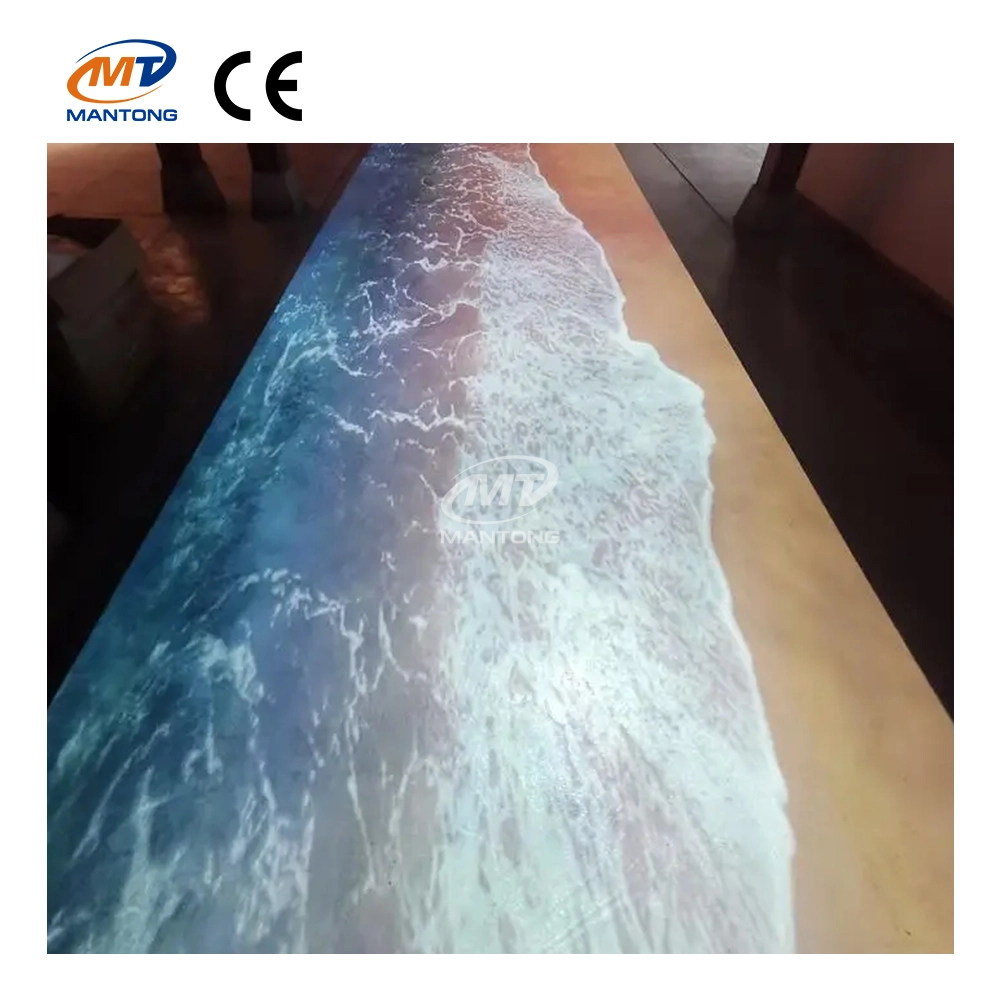
Indoor Interactive Floor Projector System - Customized Design & Installation Support
Indoor interactive floor projections display dynamic themed videos on the floor, commonly used in venues aiming to enhance brand influence or attract foot traffic, such as restaurants, hotel corridors, and brand car retail stores.
By using projectors and compatible software, the interactive content is projected onto the floor, encouraging engagement between people and the projected visuals. A single 5500-lumen indoor floor projector can cover an area of 5 m × 3 m. Typically, each project will use at least 3 units to ensure broad coverage and optimal visual effects.
We also offer customized design and installation support to enhance the interactive experience for your venue.
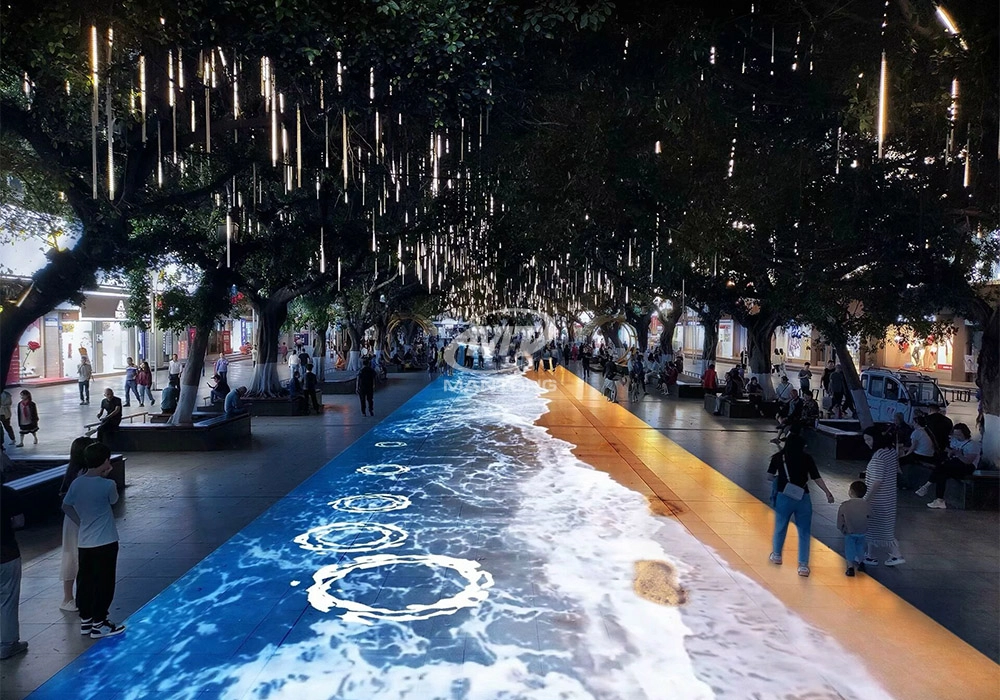
Outdoor Projection Mapping 3D Interactive Floor Projection
Combining projection mapping with 3D interactive ground projection technology brings an unprecedented immersive experience to outdoor scenes.
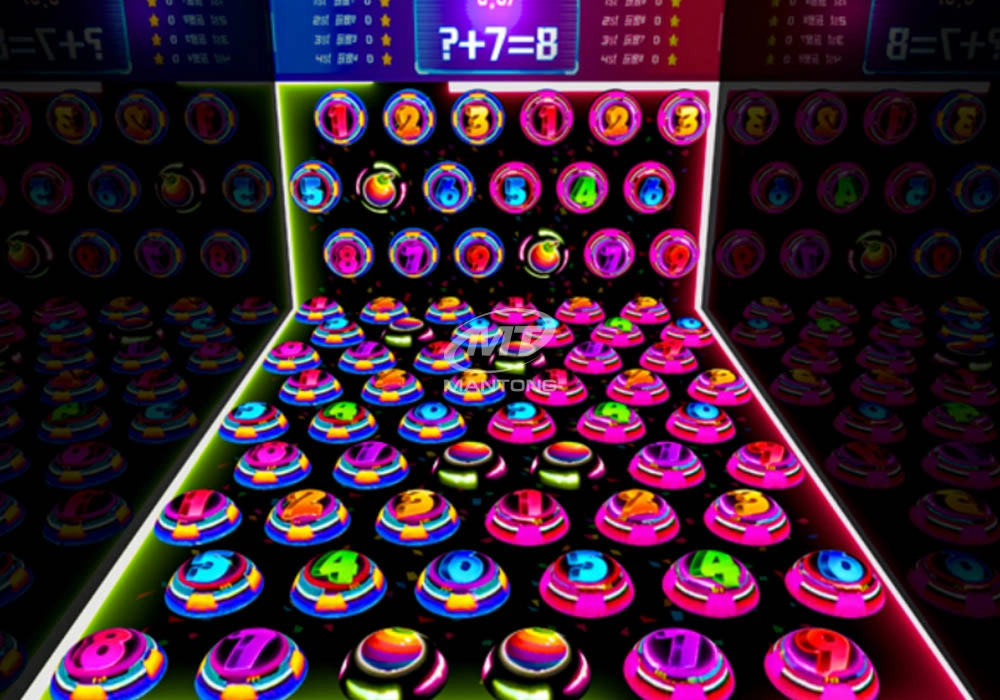
Amusement Rapidly Rotating Bouncing Sphere Interactive Wall Floor Projection Sports Games
Rapidly Rotating Bouncing Sphere is an interactive space where participants jump on rotating spheres. As they step on it, the spheres surface will show special interactivity
Jumping on spheres of the same color in succession causes them to pop, releasing light particles. The more consecutive jumps, the greater the reward—caterpillars appear, and eventually, all spheres of that color burst, filling the space with light and even more caterpillars.
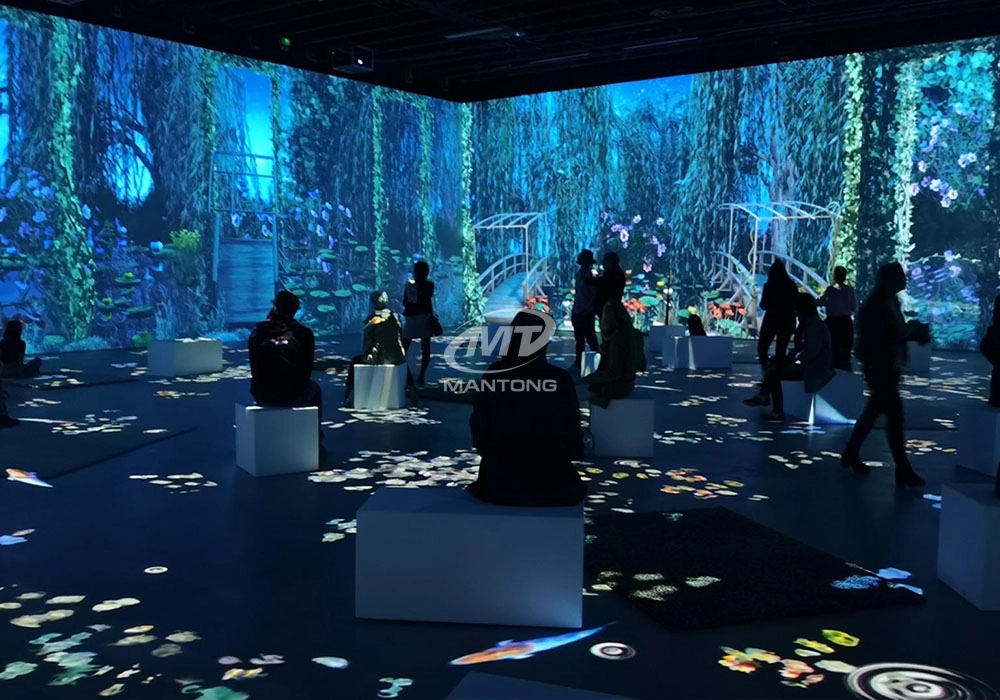
Mantong 6500LM High-Lumen Projector for Large-Scale Immersive Room Projection
Transform any space with Mantong's immersive projection mapping systems. Our high-lumen projectors (up to 6500 LM) and custom software create captivating interactive experiences for floors and walls. Ideal for museums, events, retail, and hospitality. Each kit includes professional ceiling mounting and 80+ pre-loaded video contents and is backed by a 12-month warranty and CE certification. We offer full customization and support to bring your vision to life.

Kaida Business Center, Shixin Road, Panyu District,Guangzhou City, Guangdong Province, China.
ManTong
ManTong
ManTong