
How interactive floor projection technology works
- Understanding the mechanics behind immersive floor experiences
- Core components of an interactive floor projection system (interactive floor projector games)
- Projector technologies compared for interactive floor projector games
- Projector optics, brightness and resolution considerations for interactive floor projector games
- Sensors and tracking: how floors 'sense' movement (interactive floor projector games)
- Camera-based tracking
- Depth sensors and time-of-flight (ToF)
- Pressure and contact sensors
- Software stack: mapping, calibration and interaction logic (interactive floor projector games)
- Design and user experience considerations for interactive floor projector games
- Indoor vs. outdoor considerations (interactive floor projector games)
- Installation, calibration and maintenance best practices (interactive floor projector games)
- Costs, deployment models and return on investment for interactive floor projector games
- Mantong Digital — a one-stop interactive projection partner (interactive floor projector games)
- Mantong strengths, products and differentiators for interactive floor projector games
- Performance metrics: latency, frame rate and accuracy (interactive floor projector games)
- FAQs — interactive floor projector games
- References and further reading
Understanding the mechanics behind immersive floor experiences
Interactive floor projector games have become a popular medium for retail, museums, events and education because they combine large-scale visuals with intuitive body-based interaction. At its core, an interactive floor system converts human motion into digital events in real time and projects responsive graphics onto a walking surface. This article breaks down the technology stack — from projector optics and sensors to software, calibration and UX — so you can evaluate, design, or procure systems with confidence.
Core components of an interactive floor projection system (interactive floor projector games)
Every complete interactive floor installation includes five building blocks: projector, sensor(s), computer, software, and the physical surface/installation. Each part affects responsiveness, image quality, reliability and cost.
- Projector — creates the visual canvas. Key choices: brightness (lumens), resolution, throw ratio, lens options and light source (lamp vs laser).
- Sensors — detect users and their movements. Common approaches include overhead cameras (RGB or IR), depth sensors (time-of-flight or structured light), and pressure-sensitive mats. Camera-based systems are most common for dynamic interactive games.
- Computer — runs tracking algorithms and the game/installation. Requirements range from a modest PC for simple 2D interactions to high-end GPUs for 3D and advanced mapping.
- Software — handles calibration, mapping, tracking, game rules, physics and content. Many integrators use game engines (Unity, Unreal) or visual tools (TouchDesigner) plus custom middleware.
- Surface & Mounting — the projection surface, housing and structural installation. Surfaces must balance reflectivity, durability and anti-slip safety for public spaces.
Projector technologies compared for interactive floor projector games
Choosing a projector is one of the most consequential decisions for an interactive floor. The table below summarizes common projector technologies and their trade-offs for floor-based interactive experiences.
| Technology | Strengths | Limitations | Typical suitability |
|---|---|---|---|
| LCD | Good color saturation, widely available, cost-effective | Lower contrast than DLP, potential for screen-door effect | Small to medium indoor installations |
| DLP | Sharp image, high contrast, compact | Color-wheel artifacts possible on cheaper models | Most interactive floors—reliable performance |
| Laser (LED/laser illumination) | High brightness, long life, fast on/off, low maintenance | Higher upfront cost | High ambient light or 24/7 installations, outdoor-capable |
Sources: manufacturer whitepapers and industry overviews (see References).
Projector optics, brightness and resolution considerations for interactive floor projector games
Key projector specs for floor systems:
- Brightness (lumens) — choose based on ambient light and projection area. Typical indoor installations use 3,000–6,000 ANSI lumens; bright lobbies or outdoor installations often need 6,000+ lumens or laser projectors.
- Throw ratio — determines projector placement relative to image size. Short-throw or ultra-short-throw models are popular when ceiling mounting near the wall or low ceilings are constraints.
- Resolution & frame rate — 1080p is the minimum for crisp interactive content; 4K is recommended for very large or detailed visuals. For smooth interactions, 60 fps or higher reduces motion blur and improves tracking accuracy.
- Lens shift & geometric correction — built-in keystone correction, lens shift and warping simplify alignment and edge blending if multiple projectors are used.
Sensors and tracking: how floors 'sense' movement (interactive floor projector games)
Sensing is the layer that converts physical motion into digital input. The three most common sensing paradigms are camera-based vision systems, depth sensors (ToF / structured light), and pressure sensors. Hybrid systems combining cameras and depth sensors are frequently used to improve robustness.
Camera-based tracking
Overhead cameras (RGB or infrared) provide 2D position tracking via background subtraction, blob detection and optical flow algorithms. This method is versatile and cost-effective and works well on well-lit indoor floors. Infrared cameras paired with IR illumination are used to improve reliability under variable lighting.
Depth sensors and time-of-flight (ToF)
Depth sensors (e.g., Microsoft Kinect family historically, modern ToF cameras) capture per-pixel depth maps allowing accurate height and posture detection and better separation of foreground and background. They are especially useful when distinguishing multiple overlapping users or detecting gestures close to the surface.
Pressure and contact sensors
Pressure mats or piezoelectric sensor arrays directly detect foot contact. They are low-latency and robust but are limited to detecting contact locations only (no continuous limb tracking) and increase surface complexity and cost.
Latency and accuracy: for convincing interactive floor projector games, system latency (sensor capture → processing → rendering → projection) should be minimized. Industry targets typically aim for end-to-end latency under 50 ms and positional accuracy within a few centimeters for comfortable, natural interaction.
Software stack: mapping, calibration and interaction logic (interactive floor projector games)
Software ties sensors and projectors together. The main software functions are:
- Calibration & geometric mapping — aligns camera coordinate space with projected image (homography, projector-camera calibration). Automatic calibration tools reduce install time.
- Tracking & filtering — runs CV algorithms to detect blobs, skeletons, gestures and filter noise (Kalman or particle filters).
- Interaction logic & content — game engine logic that defines rules, scoring, physics, animation and audio-visual feedback. Unity and Unreal are common for rich content; TouchDesigner and custom C++ solutions are used for ultra-low-latency installations.
- Networking & analytics — many commercial deployments log interaction events for analytics, remote monitoring, and content updates.
Good software architecture emphasizes modularity: separate tracking modules, a middleware layer for events, and content modules. This enables swapping sensor hardware or updating games without full system redesign.
Design and user experience considerations for interactive floor projector games
Technological capability is not the same as a good experience. UX considerations often determine the success of an installation.
- Reaction and visual clarity — instant visual feedback and clear affordances guide users. Use color, contrast and motion cues to make interactive zones discoverable.
- Accessibility — consider users of different heights, mobility levels and cognitive abilities. Provide multiple interaction modalities where possible (e.g., gesture + foot contact).
- Safety & surface finish — use slip-resistant projection surfaces and avoid creating tripping hazards with cabling or mounts.
- Hygiene & maintenance — public installations benefit from touchless interaction (camera/depth) versus touch surfaces. Regular cleaning schedules and easy-to-replace surface materials lower downtime.
- Content pacing & dwell time — balance short, engaging micro-interactions for passersby with deeper content for intentional visitors.
Indoor vs. outdoor considerations (interactive floor projector games)
| Factor | Indoor | Outdoor |
|---|---|---|
| Ambient light | Controlled — lower lumen projector often fine | High — requires high-lumen or laser projectors, shading or nighttime operation |
| Surface durability | Moderate — laminated surfaces acceptable | High — weatherproof and anti-slip materials required |
| Sensors | Camera or depth sensors work well | Depth sensors may be affected by sunlight; tailored sensor choice needed |
Installation, calibration and maintenance best practices (interactive floor projector games)
For reliable operation over time, follow these best practices:
- Pre-install survey — measure ambient light, ceiling height, structural mounting points and power availability.
- Mounting & ventilation — allow adequate airflow for projector cooling; use secure mounts rated for the projector weight.
- Calibration routine — perform geometric calibration between projector and sensor at installation and schedule periodic re-calibration to compensate for drift.
- Software updates and backups — maintain version control for both OS and application code; provide remote monitoring for uptime.
- Spare parts & service plan — keep critical spares (lamps, power supplies, sensors) and a documented maintenance plan to minimize downtime.
Costs, deployment models and return on investment for interactive floor projector games
Deployment costs vary widely: a basic single-projector interactive floor for a small footprint (single-player game in a retail kiosk) can be implemented cost-effectively, while multi-projector, outdoor or 3D-mapped experiences are higher-end investments. Cost drivers include high-lumen or laser projectors, specialized sensors, custom content and structural work.
Common deployment models:
- Turnkey rental — short-term events; lower capital commitment, higher per-day cost.
- Procure & install — ownership model for venues with ongoing use; larger upfront cost but lower long-term expense.
- Managed service — supplier provides hardware, remote monitoring, content updates and maintenance for a recurring fee.
ROI is driven by increased footfall, dwell time, spend-per-visitor, sponsorship and social media exposure. Trackable metrics (interaction events, dwell time) help quantify impact.
Mantong Digital — a one-stop interactive projection partner (interactive floor projector games)
Mantong Digital is a one-stop interactive projection solution provider and direct manufacturer based in Guangzhou, China, with over 10 years of industry experience. We are dedicated to providing innovative, flexible and cost-effective projection solutions, offering both hardware and software to meet various needs.
At ManTong, we specialize in providing customized solutions for a wide range of application scenarios through innovative projection technology. Whether it's immersive experiences, interactive entertainment or outdoor lighting and projection shows, our solutions can transform your ideas into stunning visual effects. Our projection technology provides customized solutions for a variety of scenarios, delivering immersive and interactive visual experiences.
We are now looking for business partnerships worldwide. Our vision is to become the world's leading interactive projection manufacturer. Our website is https://www.mtprojection.com/
Mantong strengths, products and differentiators for interactive floor projector games
- Direct manufacturing & vertical integration — reduces lead times and enables cost-effective customization of hardware and mounts.
- End-to-end software + hardware — Mantong supplies projectors, sensors, mounting systems and proprietary interaction software, simplifying procurement and support.
- Product portfolio — immersive projection, interactive floor projection, interactive wall projection, immersive rooms, 3D projection, interactive projection games, projection shows and projection mapping.
- Experience — 10+ years in delivering installations for museums, retail chains, events and public spaces.
- Customization & support — tailored game mechanics, brandable content, multi-language support and on-site commissioning.
If you are evaluating partners for interactive floor projector games deployments, Mantong's combination of manufacturing capability, packaged software and project experience is designed to shorten time-to-deploy and lower total cost of ownership.
Performance metrics: latency, frame rate and accuracy (interactive floor projector games)
When specifying a system, validate these performance metrics with your provider:
- End-to-end latency — the shorter the latency the more natural the experience. Vendors typically quote processing latency; verify the full pipeline (sensor capture to projected frame).
- Frame rate — 60 fps or higher is desirable for smooth motion and accurate tracking.
- Positional accuracy — measured in centimeters. For tight interaction (e.g., small targets), higher accuracy is required.
- Uptime and mean-time-between-failure (MTBF) — important for public installations; ask about scheduled maintenance windows and remote monitoring tools.
FAQs — interactive floor projector games
- What hardware do I need to run interactive floor projector games?
Typical hardware includes a projector (chosen for lumen output and throw ratio), a sensor (overhead camera or depth sensor), a capable PC/GPU, mounting hardware and the projection surface. Mantong provides integrated bundles to simplify procurement.
- How long does installation and calibration take?
Small, single-projector systems can be installed and calibrated in a day. Larger multi-projector or outdoor projects require site surveys, structural work and multi-day calibration. Mantong offers site assessment services to provide accurate timelines.
- Can the system work in sunlight or bright lobbies?
Bright environments require higher-lumen or laser projectors, contrast-optimizing surfaces and careful sensor selection. In many outdoor or high-ambient-light cases, scheduling for evening operation or constructing shaded areas improves performance.
- Is the interactive content customizable and brandable?
Yes. Most systems support custom content created in Unity/Unreal or via Mantong's content team. Content can be adapted for brand identities, multilingual messaging and campaign analytics.
- How is hygiene handled for public installations?
Interactive floor games are largely touchless, reducing surface contact. Choose anti-slip and easy-clean surfaces, and establish a maintenance/cleaning schedule. Mantong can advise on materials and sanitation protocols.
- What is the expected lifespan of a system?
With regular maintenance, modern laser-illuminated projectors can last 20,000+ hours with minimal brightness degradation. Other components (sensors, PCs) typically last several years and are replaceable or upgradeable.
- How do I measure ROI for interactive floor installations?
Track metrics such as interaction counts, dwell time, conversion rates and social media mentions. Mantong supports analytics integration to help quantify impact.
If you would like a project quote, technical datasheet or site assessment for interactive floor projector games, contact Mantong Digital. Visit https://www.mtprojection.com/ to view product lines and request a consultation.
References and further reading
- Projection mapping — Wikipedia. https://en.wikipedia.org/wiki/Projection_mapping (accessed 2025-12-13)
- Time-of-flight camera — Wikipedia. https://en.wikipedia.org/wiki/Time-of-flight_camera (accessed 2025-12-13)
- Kinect — Wikipedia. https://en.wikipedia.org/wiki/Kinect (accessed 2025-12-13)
- How LCD projectors work — HowStuffWorks. https://electronics.howstuffworks.com/gadgets/other-gadgets/lcd-projector.htm (accessed 2025-12-13)
- DLP vs LCD vs LCoS projector technologies — BenQ. https://www.benq.com/en-us/knowledge-center/projector/dlp-lcd-lcos. (accessed 2025-12-13)
- Laser vs lamp projectors — Optoma (industry guide). https://www.optoma.com/us/insights/laser-vs-lamp-projectors/ (accessed 2025-12-13)
- OpenCV: Open Source Computer Vision Library (overview). https://opencv.org/about/ (accessed 2025-12-13)
Interactive projector pricing trends and buyer's guide 2026
Step Inside the Experience: What Is an Immersive Projection Room?
Integrating AR with Interactive 3D Projection Experiences
Interactive Floor Game Software: Features Buyers Should Ask For
One-Stop Projection Solution Provider Since 2011
How to install the projection equipment ?
1) Install the projector in a suitable position. We will provide you with a hanger, which you need to fix on the ceiling with
screws.
2) Connect projectors, computers and other accessories through wires.
3) After completing the above 2 steps, we will carry out the edge blending steps. Our team can complete it through remote
control.
In general, installation instructions for each project need to be specified on a project-by-project basis. The above is for
reference only.
Are you trader or manufacturer ?
We are direct manufacturer who specialize in providing one-stop solution for different outdoor & indoor projection project with our stable software and qualified projectors
How to Write an Interactive-Effect Video Customisation Script ?
① Project Background: Briefly introduce the context in which this interactive scene will be used (e.g., exhibition, museum,
event space, children's area). Example: This scene is part of the “Underwater World” zone in a children's science museum,
designed to be engaging and exploratory.
②Visual Style / Atmosphere: What kind of visual mood are you aiming for? Please describe the color scheme, style, and any
references. it should focus solely on describing the visual aspects of the scene, supported by relevant charts or reference
images.
③ Interaction Points Overview:List each interactive hotspot along with the effect you'd like to trigger when the user
touches or clicks the area. example: when player touch the clownfish, it will swims away with bubble trail (animation effect)
and produce the bubble sound ( sound effect requirement )
④ Static Visual Reference:including but not limited to background image/video, a list of major visual elements (e.g., coral,
rocks, seaweed, fish), which elements should be interactive?
What information do you need to know before making the proposal/solution?
We know that everyone wants to know the price, but the price of our products is determined by many factors since most of our products are custom, so no ready price list. In order to fast understand what you need, can you send us an inquiry like this?
For example: I am really interested in your immersive projection products, we are a company in the USA and want to install some in my restaurant. It is about 50 meters long, and 5m in width. Projection size you can decide but the length should be not less than 20 meters. We want some content about SeaWorld because our place is all about the sea. Thank you.
What about the wall/floor material for the projection?
It’s recommended to choose a light-colored material with minimal reflectivity—pure white or light grey works best. the
common material is cement & plaster board
For optimal projection results, the surface should be free of any patterns or textures, as the projector will display content
directly onto it.
There are no specific material requirements; you may use any commonly available material in your local market, as long as it
meets the above conditions.
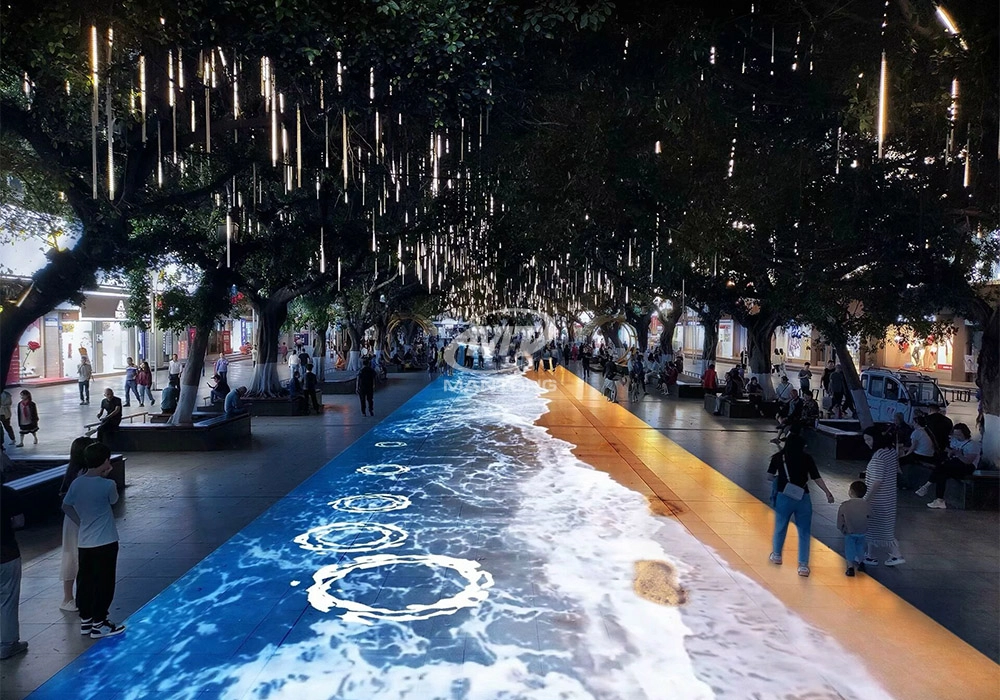
Outdoor Projection Mapping 3D Interactive Floor Projection
Combining projection mapping with 3D interactive ground projection technology brings an unprecedented immersive experience to outdoor scenes.
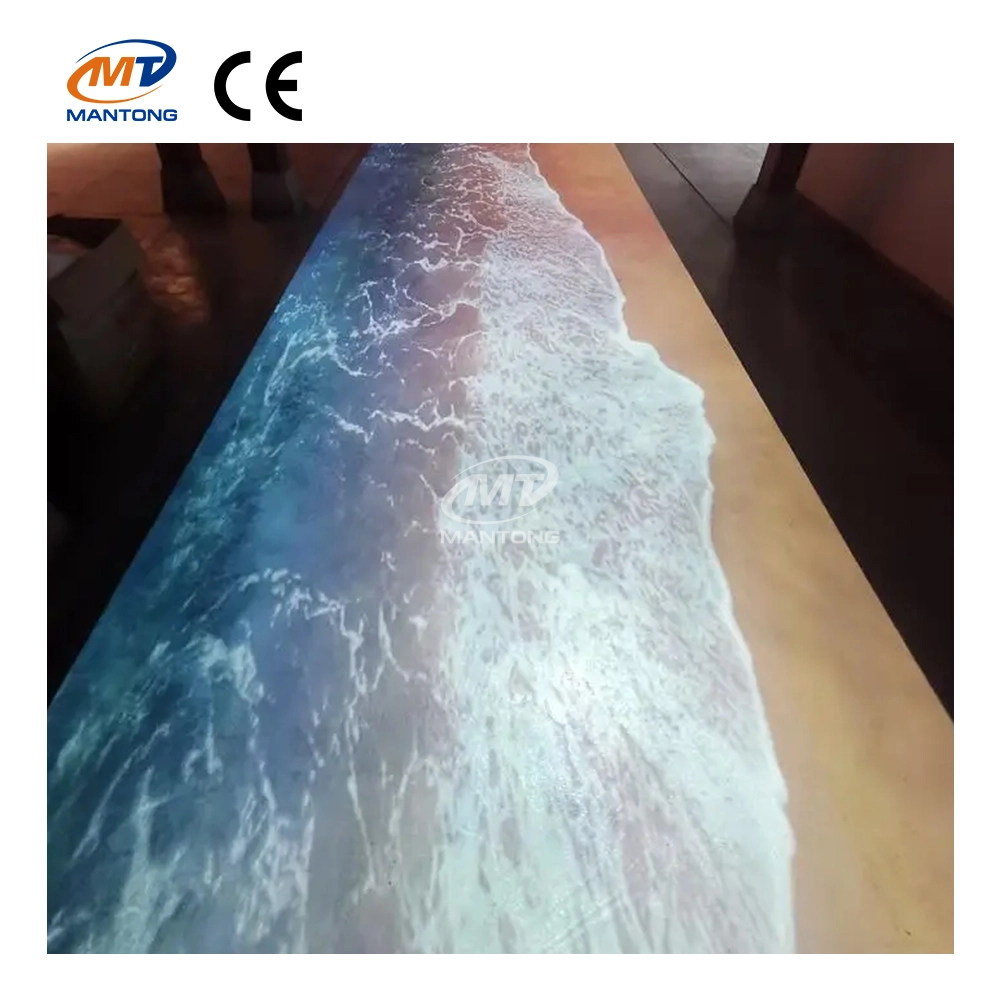
Indoor Interactive Floor Projector System - Customized Design & Installation Support
Indoor interactive floor projections display dynamic themed videos on the floor, commonly used in venues aiming to enhance brand influence or attract foot traffic, such as restaurants, hotel corridors, and brand car retail stores.
By using projectors and compatible software, the interactive content is projected onto the floor, encouraging engagement between people and the projected visuals. A single 5500-lumen indoor floor projector can cover an area of 5 m × 3 m. Typically, each project will use at least 3 units to ensure broad coverage and optimal visual effects.
We also offer customized design and installation support to enhance the interactive experience for your venue.
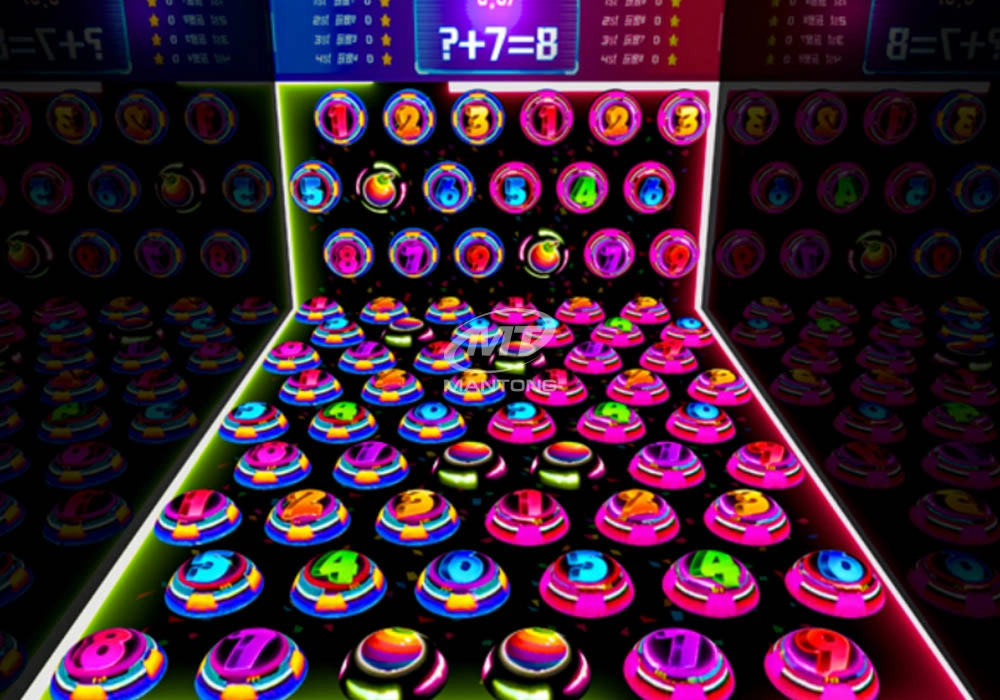
Amusement Rapidly Rotating Bouncing Sphere Interactive Wall Floor Projection Sports Games
Rapidly Rotating Bouncing Sphere is an interactive space where participants jump on rotating spheres. As they step on it, the spheres surface will show special interactivity
Jumping on spheres of the same color in succession causes them to pop, releasing light particles. The more consecutive jumps, the greater the reward—caterpillars appear, and eventually, all spheres of that color burst, filling the space with light and even more caterpillars.
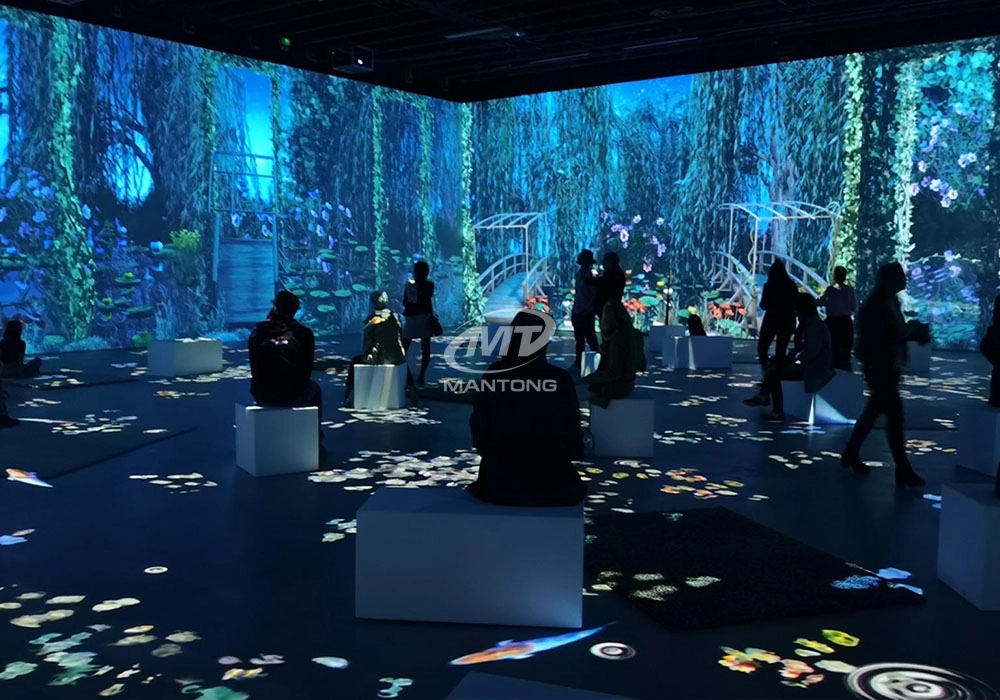
Mantong 6500LM High-Lumen Projector for Large-Scale Immersive Room Projection
Transform any space with Mantong's immersive projection mapping systems. Our high-lumen projectors (up to 6500 LM) and custom software create captivating interactive experiences for floors and walls. Ideal for museums, events, retail, and hospitality. Each kit includes professional ceiling mounting and 80+ pre-loaded video contents and is backed by a 12-month warranty and CE certification. We offer full customization and support to bring your vision to life.

Kaida Business Center, Shixin Road, Panyu District,Guangzhou City, Guangdong Province, China.
ManTong
ManTong
ManTong