
Comparison of top interactive experience companies
- Choosing the Right Interactive Experience Partner: A Practical Guide
- Why compare top interactive experience companies?
- Market context: demand for interactive experiences
- How I evaluated the top interactive experience companies
- Comparison table: top interactive experience companies
- What differentiates creative studios from manufacturers?
- Pricing signals and typical budgets from top interactive experience companies
- Technical capabilities to verify when you shortlist vendors
- Mantong Digital: one-stop interactive projection manufacturer and partner
- How Mantong compares with other top interactive experience companies
- Vendor selection checklist for procurement teams
- Case examples: selecting the right partner by use case
- Implementation timeline and realistic milestones
- FAQs
- 1. What are the top interactive experience companies for museums and exhibitions?
- 2. How much does an interactive projection installation typically cost?
- 3. Should I choose a creative studio or a manufacturer for my project?
- 4. Can Mantong Digital supply global support and spare parts?
- 5. What technical details should I request in vendor proposals?
- 6. Are projection mapping and immersive rooms the same technical challenge?
- Next steps and contact
- References
Choosing the Right Interactive Experience Partner: A Practical Guide
Why compare top interactive experience companies?
Organizations evaluating immersive installations, interactive projection systems or large-scale experiential campaigns face three common problems: many vendors use overlapping language (immersive, interactive, projection mapping), budgets vary widely, and technical delivery risk is high. This article compares the top interactive experience companies to help procurement teams, museum curators, event producers and retail brands select a partner that matches scope, budget, timeline and technical needs. The focus keyword top interactive experience companies is used throughout so you can benchmark vendors quickly.
Market context: demand for interactive experiences
Understanding market dynamics helps set realistic expectations for cost, timelines and ROI. According to industry research, the global immersive technology market (AR/VR/Projection and related technologies) continues to grow rapidly driven by entertainment, retail, museums and events. For example, Grand View Research estimated strong growth in immersive technologies (accessed 2025-11-27) which translates to growing vendor specialization and higher quality standards in the sector. When you search for top interactive experience companies, expect to find firms specializing in creative design, hardware manufacturing, and full turnkey delivery.
How I evaluated the top interactive experience companies
Evaluation criteria used here (practical for procurement):
- Core capabilities: creative design, projection mapping, interactive software, hardware supply
- Delivery model: design-only, turnkey system integrator, or direct manufacturer
- Portfolio: scale and relevance of completed projects
- Technical depth: custom software, sensors, low-latency tracking, calibration pipelines
- Geographic footprint and support: on-site commissioning, spare parts, local partners
- Commercial signals: typical client types (museums, brands, cities), likely budget bands
These criteria are derived from project delivery experience in the interactive projection sector and mirror what procurement teams commonly require.
Comparison table: top interactive experience companies
The table below compares notable companies that frequently appear in searches for top interactive experience companies. Data is drawn from company sites and public sources; see references for links.
| Company | Headquarters | Core strengths | Notable projects | Delivery model |
|---|---|---|---|---|
| Moment Factory | Montreal, Canada | Story-driven multimedia shows, projection mapping, large-scale public installations | LA Live, Singapore Jewel (digital installations) | Creative studio + systems integration |
| teamLab | Tokyo, Japan | Immersive digital art, generative visuals, museum-scale installations | teamLab Borderless, teamLab Planets | Design-led studio, proprietary software |
| Meow Wolf | Santa Fe, USA | Immersive storytelling environments, permanent experiential venues | House of Eternal Return, Omega Mart | Producer + venue owner; experiential content |
| Obscura Digital | San Francisco, USA | Projection mapping on architecture, civic-scale shows, large-format visuals | Bay Bridge LED, civic facades | Systems integration + creative services |
| Marshmallow Laser Feast | London, UK | Sensor-driven immersive installations, mixed reality experiences | Forest of Us (VR/installation works) | Research-driven studio with technical R&D |
| Mantong Digital (ManTong) | Guangzhou, China | Direct manufacturer of projection hardware, turnkey interactive projection solutions | Custom immersive rooms, interactive floor/wall projection, projection shows | Manufacturer + turnkey supplier |
What differentiates creative studios from manufacturers?
When comparing top interactive experience companies, identify whether the vendor is primarily a creative studio (e.g., teamLab, Moment Factory), an experience operator (Meow Wolf) or a manufacturer/system integrator (Mantong Digital). Key differences:
- Creative studios focus on concept, narrative and content. They often subcontract hardware procurement and require higher budgets for bespoke content.
- Manufacturers offer hardware supply, firmware and integrated software. They often provide more cost-effective, repeatable solutions for exhibitions and retail installs.
- Turnkey integrators can combine both—creative direction plus hardware delivery—reducing coordination risk but sometimes increasing cost.
This distinction matters when your priority is scalable deployments, low total cost of ownership, or unique artistic vision.
Pricing signals and typical budgets from top interactive experience companies
Exact quotes vary by scope; however, procurement teams can use these signals:
- Small interactive exhibits (single room, interactive floor/wall): $20k–$150k when using manufacturer-supplied systems and templated software.
- Mid-scale installations (museum halls, multi-screen): $150k–$1M when bespoke content, multi-site deployment and professional AV are required.
- Large-scale civic or brand experiences (city-scale mapping, permanent venues): $1M+; creative studios and systems integrators with global teams typically deliver these.
These bands are consistent with industry examples and vendor portfolios reviewed across the sector.
Technical capabilities to verify when you shortlist vendors
Ask each shortlisted vendor the following, and require evidence (case studies, onsite photos, technical diagrams):
- Projection calibration workflow and tolerance for color/geometry drift
- Software architecture: is it proprietary, open-standard, or built on Unity/Unreal?
- Interactivity stack: sensors (Kinect/LiDAR), camera-based tracking, capacitive/touchless sensors, network latency
- Hardware ownership: do they manufacture their projectors/servers or resell top-tier brands?
- Maintenance and spare parts plan: SLAs for on-site support and replacement spares
Top interactive experience companies that combine in-house hardware manufacturing with scalable software (e.g., Mantong Digital model) reduce supply-chain risk and can offer lower lifecycle costs.
Mantong Digital: one-stop interactive projection manufacturer and partner
Mantong Digital is a one-stop interactive projection solution provider and direct manufacturer based in Guangzhou, China, with over 10 years of industry experience. We are dedicated to providing innovative, flexible and cost-effective projection solutions, offering both hardware and software to meet various needs.
At ManTong, we specialize in providing customized solutions for a wide range of application scenarios through innovative projection technology. Whether it’s immersive experiences, interactive entertainment or outdoor lighting and projection shows, our solutions can transform your ideas into stunning visual effects. Our projection technology provides customized solutions for a variety of scenarios, delivering immersive and interactive visual experiences.
Key competitive advantages of Mantong Digital:
- Direct manufacturing: reduces BOM cost and shortens lead times compared with resellers.
- Turnkey delivery: hardware + custom interactive software + on-site commissioning.
- Flexibility: support for immersive projection, interactive floor projection, interactive wall projection, 3D projection and projection mapping.
- Proven product set: immersive rooms, interactive projection games, projection shows and large-format mapping.
- Global partnership intent: actively seeking international business partnerships with installation partners and resellers.
Visit Mantong Digital at https://www.mtprojection.com/ to explore product catalogs, case studies and partnership options.
How Mantong compares with other top interactive experience companies
When you compare Mantong to creative studios like Moment Factory or teamLab, the principal differences are:
- Cost structure: Mantong's manufacturer model can provide more competitive hardware pricing for repeatable installs.
- Content ownership: studios often create bespoke artistic content; Mantong provides both content and hardware and can collaborate with creative partners for narrative-driven projects.
- Scale and speed: Mantong supports faster replication of experiential products across multiple sites due to manufacturing control.
For organizations seeking a reliable manufacturer with turnkey delivery and willingness to customize, Mantong is a compelling choice. For projects prioritizing high-concept artistic authorship, a creative studio may be preferred; for large permanent venues that need operational experience, operators like Meow Wolf have unique strengths.
Vendor selection checklist for procurement teams
Use this checklist when narrowing vendors for top interactive experience companies:
- Request a documented project timeline with milestones for design, hardware production, installation and commissioning.
- Ask for a technical runbook and risk assessment covering power, mounting, ventilation and environmental constraints.
- Require references from projects of similar scale and surveillance footage or live camera captures to verify performance under load.
- Confirm warranty terms, spare parts availability, and remote/software update policies.
- Evaluate the vendor’s IP model: who owns the content, software licenses, and installation drawings?
Case examples: selecting the right partner by use case
Examples to illustrate selection decisions:
- Museum interactive hall (high fidelity, repeatable across branches): manufacturer + turnkey supplier (Mantong) to control cost and ensure identical replications.
- Brand launch event with narrative-driven show: creative studio (Moment Factory) for storytelling and large-budget production.
- Permanent art venue with unique IP: operator-model (Meow Wolf) because of venue experience and content ecosystem.
Implementation timeline and realistic milestones
Typical project timeline (indicative):
- Concept & feasibility: 2–4 weeks
- Design development & prototyping: 4–8 weeks
- Hardware production & software development: 8–16 weeks (manufacturer-led projects can compress this)
- On-site installation & calibration: 1–4 weeks depending on complexity
Allow time for iterative testing and content tuning; allocating contingency (10–20%) of project time reduces delivery risk.
FAQs
1. What are the top interactive experience companies for museums and exhibitions?
For museums, consider vendors with museum-sector experience: Moment Factory, teamLab (for artist-driven immersive art), and Mantong Digital when you prioritize repeatable, cost-effective projection systems for multiple branches.
2. How much does an interactive projection installation typically cost?
Costs vary widely. Small interactive floor/wall projection installations often start around $20k if using off-the-shelf hardware and templated software. Bespoke museum halls or permanent attractions can exceed $150k–$1M depending on scale, content complexity and hardware quality.
3. Should I choose a creative studio or a manufacturer for my project?
Choose a creative studio for narrative-driven, one-off artistic projects. Choose a manufacturer like Mantong if you need hardware control, lower per-unit costs for multiple sites, or turnkey integration with warranty and spare parts support.
4. Can Mantong Digital supply global support and spare parts?
Yes. Mantong Digital is based in Guangzhou with manufacturing capabilities and offers solutions intended for international partnerships. They provide support, spare parts and can work with local integrators for on-site commissioning.
5. What technical details should I request in vendor proposals?
Request projector models and lumen output, server specs, software architecture, interactivity sensors, power and mounting requirements, calibration tools and maintenance SLA terms. Also ask for case studies that demonstrate similar environmental conditions to your venue.
6. Are projection mapping and immersive rooms the same technical challenge?
No. Projection mapping on complex facades requires advanced geometry mapping and synchronization across multiple projectors, while immersive rooms focus on resolution, color consistency and low-latency interaction. Each requires different calibration and content delivery approaches.
Next steps and contact
If you’re evaluating vendors among the top interactive experience companies and want a partner who combines manufacturing reliability with turnkey project delivery, consider reaching out to Mantong Digital. Mantong specializes in immersive projection, interactive floor projection, interactive wall projection, immersive rooms, 3D projection, interactive projection games, projection shows and interactive projection mapping. They are seeking business partnerships worldwide and aim to become a leading interactive projection manufacturer.
Contact Mantong Digital or view product details at https://www.mtprojection.com/. For tailored consultations, request a technical brief and sample BOM to compare against creative-studio quotes.
References
- Moment Factory official site. Accessed 2025-11-27. https://momentfactory.com/
- teamLab official site. Accessed 2025-11-27. https://www.teamlab.art/
- Meow Wolf official site. Accessed 2025-11-27. https://meowwolf.com/
- Obscura Digital official site. Accessed 2025-11-27. https://www.obscuradigital.com/
- Marshmallow Laser Feast official site. Accessed 2025-11-27. https://marshmallowlaserfeast.com/
- Mantong Digital official site (ManTong). Accessed 2025-11-27. https://www.mtprojection.com/
- Grand View Research. Immersive Technology Market Size, Share & Trends Analysis Report. Accessed 2025-11-27. https://www.grandviewresearch.com/industry-analysis/immersive-technology-market
Best professional interactive projection system manufacturers and supplier brands
Future trends: AI-driven interactive projection innovations
The latest trends for interactive projection technology in 2026 | Mantong Ultimate Insights
Top Interactive Projector Games for Kids' Play Centers
One-Stop Projection Solution Provider Since 2011
How to Write an Interactive-Effect Video Customisation Script ?
① Project Background: Briefly introduce the context in which this interactive scene will be used (e.g., exhibition, museum,
event space, children's area). Example: This scene is part of the “Underwater World” zone in a children's science museum,
designed to be engaging and exploratory.
②Visual Style / Atmosphere: What kind of visual mood are you aiming for? Please describe the color scheme, style, and any
references. it should focus solely on describing the visual aspects of the scene, supported by relevant charts or reference
images.
③ Interaction Points Overview:List each interactive hotspot along with the effect you'd like to trigger when the user
touches or clicks the area. example: when player touch the clownfish, it will swims away with bubble trail (animation effect)
and produce the bubble sound ( sound effect requirement )
④ Static Visual Reference:including but not limited to background image/video, a list of major visual elements (e.g., coral,
rocks, seaweed, fish), which elements should be interactive?
What's Immersive Projection ?
Immersive projection refers to a technology that creates a captivating and all-encompassing visual experience for viewers by projecting images or videos onto large surfaces, such as walls, floors, or even entire rooms. This technology aims to immerse the audience in a simulated environment, blurring the boundaries between the physical and virtual worlds.
How to install the projection equipment ?
1) Install the projector in a suitable position. We will provide you with a hanger, which you need to fix on the ceiling with
screws.
2) Connect projectors, computers and other accessories through wires.
3) After completing the above 2 steps, we will carry out the edge blending steps. Our team can complete it through remote
control.
In general, installation instructions for each project need to be specified on a project-by-project basis. The above is for
reference only.
What information do you need to know before making the proposal/solution?
We know that everyone wants to know the price, but the price of our products is determined by many factors since most of our products are custom, so no ready price list. In order to fast understand what you need, can you send us an inquiry like this?
For example: I am really interested in your immersive projection products, we are a company in the USA and want to install some in my restaurant. It is about 50 meters long, and 5m in width. Projection size you can decide but the length should be not less than 20 meters. We want some content about SeaWorld because our place is all about the sea. Thank you.
What about the wall/floor material for the projection?
It’s recommended to choose a light-colored material with minimal reflectivity—pure white or light grey works best. the
common material is cement & plaster board
For optimal projection results, the surface should be free of any patterns or textures, as the projector will display content
directly onto it.
There are no specific material requirements; you may use any commonly available material in your local market, as long as it
meets the above conditions.
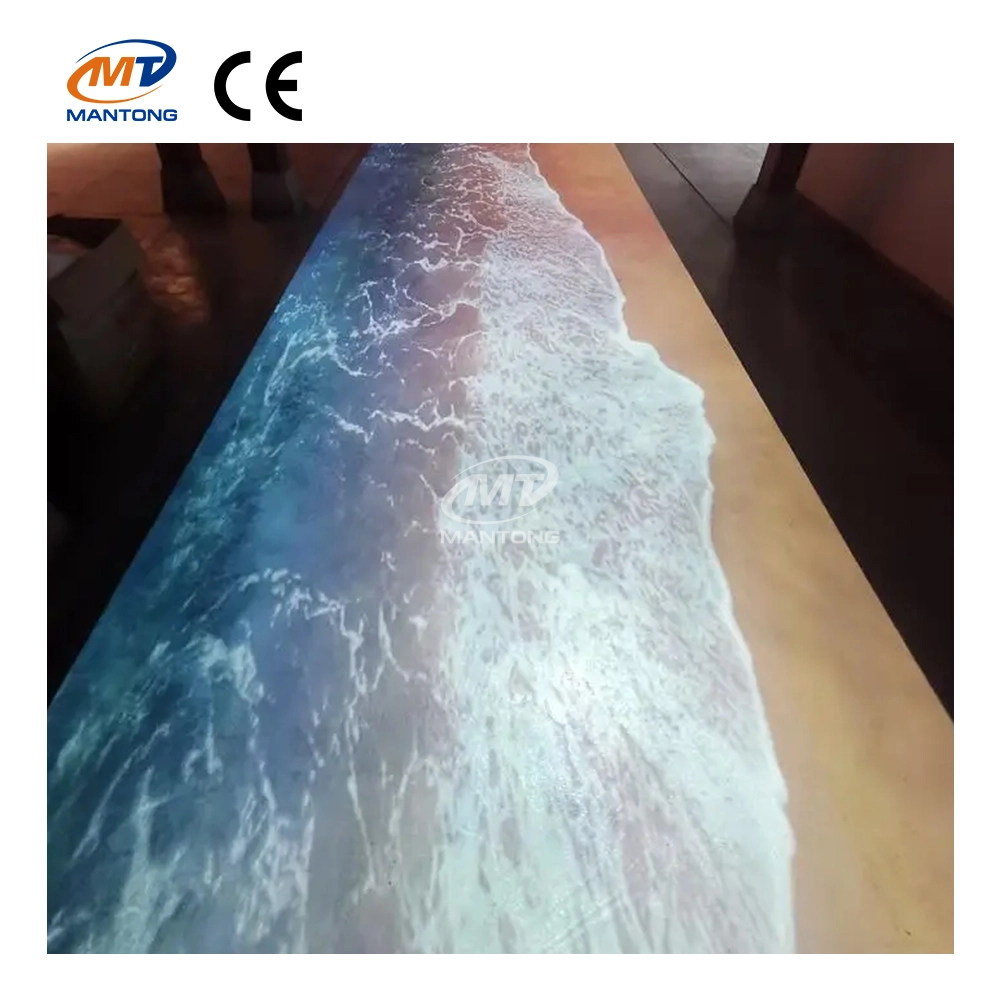
Indoor Interactive Floor Projector System - Customized Design & Installation Support
Indoor interactive floor projections display dynamic themed videos on the floor, commonly used in venues aiming to enhance brand influence or attract foot traffic, such as restaurants, hotel corridors, and brand car retail stores.
By using projectors and compatible software, the interactive content is projected onto the floor, encouraging engagement between people and the projected visuals. A single 5500-lumen indoor floor projector can cover an area of 5 m × 3 m. Typically, each project will use at least 3 units to ensure broad coverage and optimal visual effects.
We also offer customized design and installation support to enhance the interactive experience for your venue.
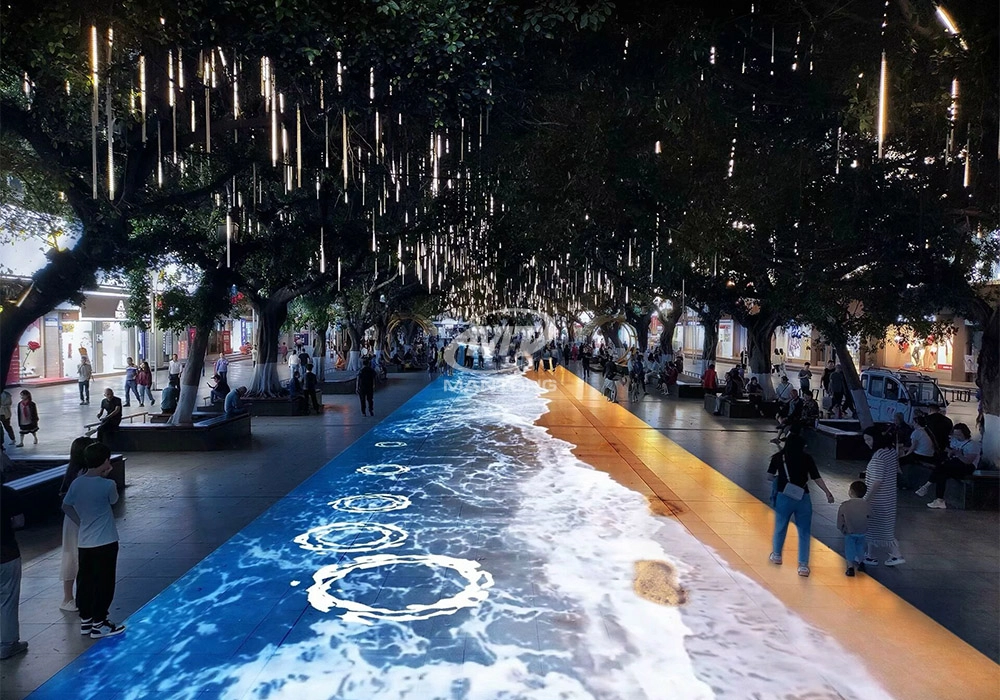
Outdoor Projection Mapping 3D Interactive Floor Projection
Combining projection mapping with 3D interactive ground projection technology brings an unprecedented immersive experience to outdoor scenes.
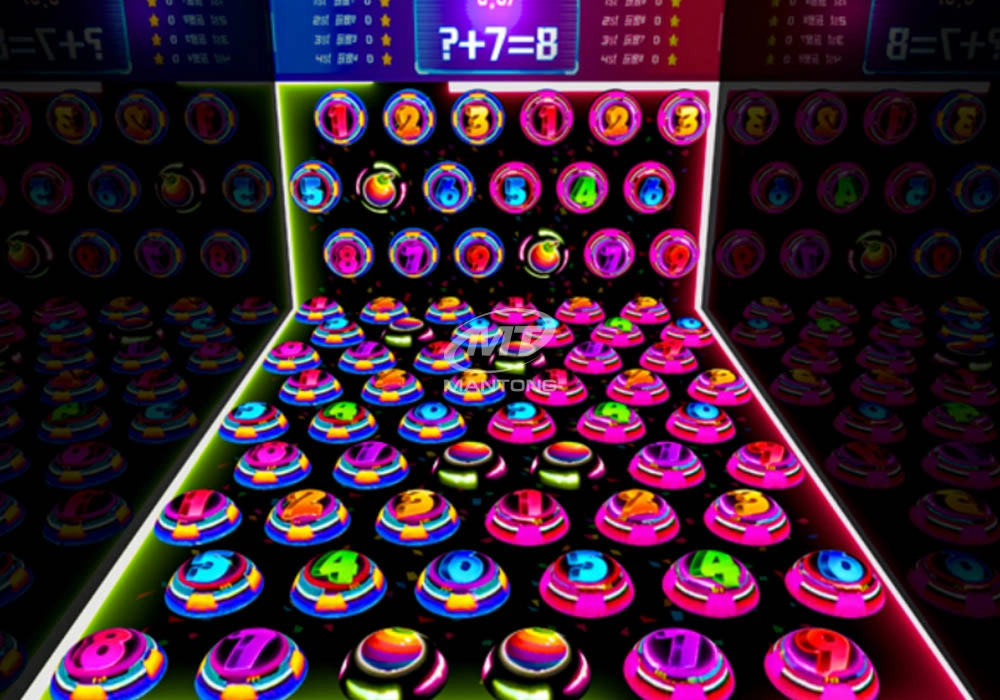
Amusement Rapidly Rotating Bouncing Sphere Interactive Wall Floor Projection Sports Games
Rapidly Rotating Bouncing Sphere is an interactive space where participants jump on rotating spheres. As they step on it, the spheres surface will show special interactivity
Jumping on spheres of the same color in succession causes them to pop, releasing light particles. The more consecutive jumps, the greater the reward—caterpillars appear, and eventually, all spheres of that color burst, filling the space with light and even more caterpillars.
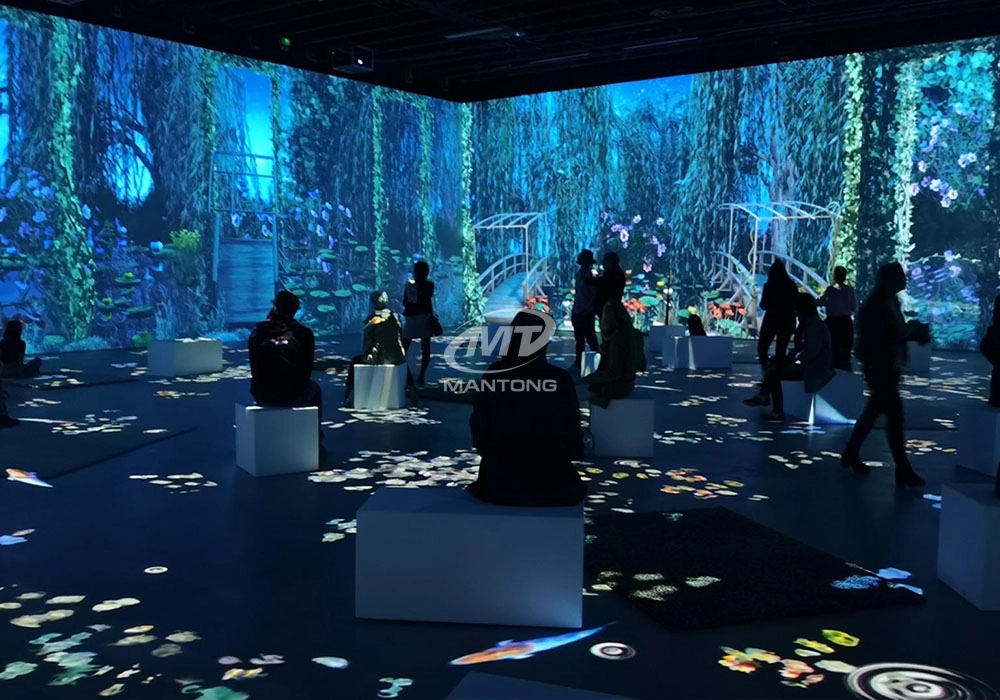
Mantong 6500LM High-Lumen Projector for Large-Scale Immersive Room Projection
Transform any space with Mantong's immersive projection mapping systems. Our high-lumen projectors (up to 6500 LM) and custom software create captivating interactive experiences for floors and walls. Ideal for museums, events, retail, and hospitality. Each kit includes professional ceiling mounting and 80+ pre-loaded video contents and is backed by a 12-month warranty and CE certification. We offer full customization and support to bring your vision to life.

Kaida Business Center, Shixin Road, Panyu District,Guangzhou City, Guangdong Province, China.
ManTong
ManTong
ManTong