
Comparing Immersive Projection vs LED Video Walls for Venues
- Why venue visual systems shape audience experience
- Audience expectations and the rise of immersive rooms
- Key decision drivers for venue owners
- Technical comparison: projection vs LED video walls
- Brightness, contrast and color fidelity
- Resolution, pixel pitch and image scale
- Maintenance, lifespan and reliability
- Experience design and interactivity in immersive rooms
- Seamless enveloping environments
- Direct-view clarity and touch/gesture integration
- Cost analysis and lifecycle considerations
- Budgeting: CapEx vs OpEx
- Total cost of ownership factors
- Practical decision guide by use case
- Museum exhibits and immersive rooms
- Corporate lobbies, stages and high-ambient venues
- Outdoor shows and projection mapping events
- Comparison table: immersive projection vs LED video walls
- Mantong Digital: a practical partner for immersive rooms
- Who Mantong is and what they offer
- Mantong’s core competencies and product focus
- Why consider Mantong for your venue
- Implementation checklist and best practices
- Site survey and environmental controls
- Content pipeline and playback systems
- Redundancy and serviceability
- Conclusions and recommendations
- Decision summary
- Hybrid approaches
- FAQs
- 1. Which is better for creating an immersive room—projection or LED?
- 2. How do running costs compare between projection and LED?
- 3. Can I mix projection and LED in the same venue?
- 4. What pixel pitch should I choose for an immersive room?
- 5. How important is content in determining perceived quality?
- 6. How do I evaluate vendors and choose the right integrator?
- References and further reading
Why venue visual systems shape audience experience
Audience expectations and the rise of immersive rooms
Venues today—from museums and themed attractions to corporate auditoriums and live events—are judged not only by sound and seating but by how visual systems shape the experience. The phrase immersive room captures environments that fully surround visitors with coordinated visuals, audio and interaction. Choosing the right display technology is therefore a strategic decision: it affects storytelling, throughput, accessibility, budget and long-term upgradeability.
Key decision drivers for venue owners
When evaluating immersive projection versus LED video walls, stakeholders should prioritize: brightness under ambient conditions, perceived image quality, installation and floor/ceiling constraints, long-term operational cost, content flexibility (including real-time interactivity) and safety/regulatory considerations. These drivers, not marketing taglines, determine fit for purpose.
Technical comparison: projection vs LED video walls
Brightness, contrast and color fidelity
LED video walls are emissive displays measured in nits (cd/m²). Indoor LED walls typically range 600–2,000 nits; outdoor and high-ambient versions can reach 5,000+ nits. Projectors are rated in ANSI lumens; large-venue projectors commonly range from 6,000 to 50,000 lumens. However, lumen output does not equal on-screen brightness: projected images depend on screen gain, distance, surface reflectivity and ambient light. For high ambient light, LED walls generally deliver superior perceived brightness and more consistent color in direct-view applications.
Resolution, pixel pitch and image scale
LED walls provide native pixel resolution determined by pixel pitch (mm). For close viewing in immersive rooms, fine pixel pitches (P1.2–P2.5) are needed for crisp images. Projection scales with optics and source resolution; a 4K projector can produce a very large image with fewer apparent pixels per degree if viewed closely. For very large wraparound environments, projection can be more cost-effective to achieve a continuous ultra-wide canvas without visible panel seams.
Maintenance, lifespan and reliability
LED modules offer long lifespans (often 100,000 hours to half-brightness in ideal conditions) and modular repairability—individual tiles can be swapped. Projectors require lamp or laser light-source maintenance (laser projectors reduce servicing but still involve airflow, filters and possible engine replacement). Environmental factors such as dust, heat and humidity affect both systems differently: projectors are more sensitive to HVAC and dust; LED walls demand stable power and careful handling during installation.
Experience design and interactivity in immersive rooms
Seamless enveloping environments
Projection inherently supports large continuous canvases (floors, ceilings, curved surfaces) with careful warping and edge blending; this makes it a natural choice for immersive room designs where the goal is an uninterrupted environment. Projection mapping techniques can transform irregular architectural surfaces into storytelling elements.
Direct-view clarity and touch/gesture integration
LED walls excel when direct-view clarity and high ambient-light resilience are prerequisites, such as lobbies, stages or exhibition facades. They also pair well with camera-based or sensor interactivity where visuals are bright and discernible under room lighting. Some LED pixel surfaces can support capacitive touch overlays for interactive exhibits, while projectors can enable floor/ground interaction using IR or camera tracking—useful for interactive floor projection games and motion-driven content.
Cost analysis and lifecycle considerations
Budgeting: CapEx vs OpEx
Initial capital expenditure (CapEx) varies widely with scale, resolution and brand. In many large-scale, curved or floor/ceiling immersive installations, projection systems (multiple projectors, blending processors and mounting) can be less expensive than equivalent high-resolution LED walls. However, LED walls can offer lower operating costs over time (lower maintenance, no projector engine replacements) and predictable brightness decay.
Total cost of ownership factors
Consider these ongoing costs: electricity consumption, spare parts, service contracts, calibration and content updates. LED walls consume steady power proportional to pixel count and brightness. Laser projectors trade higher initial cost for reduced lamp replacement and longer maintenance intervals. Operational uptime requirements (24/7 exhibits vs occasional events) will sway the decision toward the more reliable/repairable option for your use case.
Practical decision guide by use case
Museum exhibits and immersive rooms
For darkened, fully controlled immersive rooms where continuous wraparound imagery and projection mapping are the priorities, high-lumen projectors with edge blending and geometric correction are often the best fit. Projection allows custom screens, curved surfaces and floor mapping with fewer visible seams. It is also cost-efficient for very large canvases.
Corporate lobbies, stages and high-ambient venues
Where ambient light cannot be controlled—corporate lobbies, branded stage backdrops, trade show booths—LED video walls typically perform better due to high nits and stable color. They deliver a modern, high-impact aesthetic and easier maintenance in spaces requiring long uptime.
Outdoor shows and projection mapping events
Outdoor projection mapping demands extremely high-lumen projectors and often creative positioning; LED is increasingly used for outdoor façades because of its brightness and durability. Hybrid approaches (LED for stage and projection for architectural mapping) are common at large events.
Comparison table: immersive projection vs LED video walls
| Factor | Immersive Projection | LED Video Wall |
|---|---|---|
| Perceived Brightness (Indoor) | Depends on projector lumens & screen gain; lower in high ambient light | Typically 600–2,000 nits (indoor); maintains clarity in brighter rooms |
| Resolution & Pixel Structure | Depends on source and optics; can scale to very large seamless canvases | Native pixel pitch (e.g., P1.2–P4); visible pixel structure at close distances |
| Seams & Surface Continuity | No seams when mapped to continuous surfaces | Panel seams may be visible; careful installation minimizes gaps |
| Interactivity | Excellent for floor & environment tracking (projected surfaces) | Excellent for bright displays and camera/sensor interaction; touch possible with overlays |
| Maintenance | Projector servicing (filters, optics); laser models reduce lamp swaps | Modular tile replacement; generally lower day-to-day maintenance |
| Typical Lifespan | Projector engines 10k–30k+ hours (laser) depending on model | LED modules rated to 50k–100k hours (until half-brightness) |
| Cost Profile | Often lower CapEx for very large or curved installations; ongoing maintenance | Higher initial cost for high-resolution direct view; predictable OpEx |
Mantong Digital: a practical partner for immersive rooms
Who Mantong is and what they offer
Mantong Digital is a one-stop interactive projection solution provider and direct manufacturer based in Guangzhou, China, with over 10 years of industry experience. We are dedicated to providing innovative, flexible and cost-effective projection solutions, offering both hardware and software to meet various needs.
Mantong’s core competencies and product focus
At ManTong, we specialize in providing customized solutions for a wide range of application scenarios through innovative projection technology. Whether it's immersive experiences, interactive entertainment or outdoor lighting and projection shows, our solutions can transform your ideas into stunning visual effects. Our projection technology provides customized solutions for a variety of scenarios, delivering immersive and interactive visual experiences.
Why consider Mantong for your venue
Mantong combines manufacturing control with application experience—advantages include faster customization, competitive pricing, and close collaboration on content and control systems. Mantong’s portfolio covers immersive projection, interactive floor projection, interactive wall projection, 3D projection, interactive projection games, projection shows and interactive projection mapping. This breadth makes them a practical partner for venue projects seeking integrated hardware/software solutions and global business partnerships.
Implementation checklist and best practices
Site survey and environmental controls
Begin with a rigorous site survey: measure ambient lux levels, sightlines, audience viewing distances, access for maintenance, HVAC performance and structural load limits. For projection, confirm rigging points and sightline clearance; for LED, confirm power infrastructure and ventilation.
Content pipeline and playback systems
Design content at the native resolution of the target system and plan for asset scaling. Choose playback servers and media servers that support the necessary warping/blending and real-time inputs (e.g., TouchDesigner, Resolume, or bespoke engines). Test content under expected lighting conditions and with final audio mixes.
Redundancy and serviceability
For venues with uptime demands, specify redundant media servers, spare tiles or spare projector engines, and define service-level agreements (SLA) with vendors. Train in-house staff on basic diagnostics and safe handling of modules and projector equipment.
Conclusions and recommendations
Decision summary
No single technology universally outperforms the other; the right choice depends on venue type, ambient conditions, desired viewing distance, budget, required interactivity and long-term operational model. Use projection for seamless, large-scale immersive rooms and irregular surfaces; choose LED video walls for bright, high-impact direct-view displays in lit environments and for applications demanding minimal seams and predictable brightness.
Hybrid approaches
Consider hybrid systems that combine LED for stage/backdrops and projection for architectural mapping—this leverages the strengths of both technologies and is a common approach for high-end events and permanent installations seeking both brightness and environmental immersion.
We are now looking for business partnerships worldwide. Our vision is to become the world's leading interactive projection manufacturer. Our website is https://www.mtprojection.com/
FAQs
1. Which is better for creating an immersive room—projection or LED?
If your priority is a seamless, enveloping environment (floors, ceilings, curved walls) in a controlled lighting environment, projection usually gives better cost-to-scale and surface continuity. For bright public spaces with uncontrolled ambient light, LED walls are typically better.
2. How do running costs compare between projection and LED?
LED walls generally have lower day-to-day maintenance but higher electricity consumption and higher upfront cost for high-resolution direct view. Projectors (especially lamp-based) require periodic lamp/filter servicing; laser projectors reduce this overhead but can still require engine maintenance.
3. Can I mix projection and LED in the same venue?
Yes. Hybrid systems are common: LED for stage/backdrop visibility and projection for immersive environmental mapping. Integration requires careful color matching and synchronization but provides strong visual variety.
4. What pixel pitch should I choose for an immersive room?
Choose pixel pitch based on typical viewing distance and content detail. For close interactive spaces where visitors are within a few meters, P1.2–P2.5 is common. For larger viewing distances, coarser pitches are acceptable. For projection, design content at the system's effective pixels per degree to avoid softness.
5. How important is content in determining perceived quality?
Extremely important. Well-designed content that leverages the strengths of the chosen medium (warping/mapping for projection, ultra-high-contrast bright imagery for LED) will outperform technically superior hardware with poor content. Plan content and hardware concurrently.
6. How do I evaluate vendors and choose the right integrator?
Look for vendors with end-to-end experience in immersive room projects, strong references, clear SLAs, and the ability to provide both hardware and content workflows. Direct manufacturers with customization capabilities can shorten lead times and reduce costs.
Contact us to discuss your project needs, request a proposal or view product demos: Mantong Digital – https://www.mtprojection.com/
References and further reading
- Projection mapping — Wikipedia. https://en.wikipedia.org/wiki/Projection_mapping (accessed 2026-01-07)
- Video wall — Wikipedia. https://en.wikipedia.org/wiki/Video_wall (accessed 2026-01-07)
- AVIXA (formerly InfoComm) — trade resources on projection and large-scale displays. https://www.avixa.org/ (accessed 2026-01-07)
- Christie Digital whitepapers and technical comparisons (LED vs projector). https://www.christiedigital.com/ (accessed 2026-01-07)
- Manufacturer specifications and product pages for LED brightness and projector lumens (examples: Barco, Panasonic, Leyard/Planar product pages). Barco: https://www.barco.com/ (accessed 2026-01-07); Leyard: https://www.leyard.com/ (accessed 2026-01-07)
The Future of Entertainment: Why Immersive Projection Rooms Are in Demand
Interactive Floor Game Software: Features Buyers Should Ask For
Top 10 interactive floor projector Manufacturers and Supplier Brands in China
Top immersive cinema experience Manufacturers and Suppliers in China
One-Stop Projection Solution Provider Since 2011
What information do you need to know before making the proposal/solution?
We know that everyone wants to know the price, but the price of our products is determined by many factors since most of our products are custom, so no ready price list. In order to fast understand what you need, can you send us an inquiry like this?
For example: I am really interested in your immersive projection products, we are a company in the USA and want to install some in my restaurant. It is about 50 meters long, and 5m in width. Projection size you can decide but the length should be not less than 20 meters. We want some content about SeaWorld because our place is all about the sea. Thank you.
Are you trader or manufacturer ?
We are direct manufacturer who specialize in providing one-stop solution for different outdoor & indoor projection project with our stable software and qualified projectors
What's the application of Immersive projection ?
It can be used in various venues, such as art exhibition, entertainment venues, educational institution, Wedding hall /Banquet/Bar,Yoga Studio and so on. It often involves advanced projection techniques, multimedia content, and interactive elements to engage and captivate the audience's senses.
How to install the projection equipment ?
1) Install the projector in a suitable position. We will provide you with a hanger, which you need to fix on the ceiling with
screws.
2) Connect projectors, computers and other accessories through wires.
3) After completing the above 2 steps, we will carry out the edge blending steps. Our team can complete it through remote
control.
In general, installation instructions for each project need to be specified on a project-by-project basis. The above is for
reference only.
What's Immersive Projection ?
Immersive projection refers to a technology that creates a captivating and all-encompassing visual experience for viewers by projecting images or videos onto large surfaces, such as walls, floors, or even entire rooms. This technology aims to immerse the audience in a simulated environment, blurring the boundaries between the physical and virtual worlds.
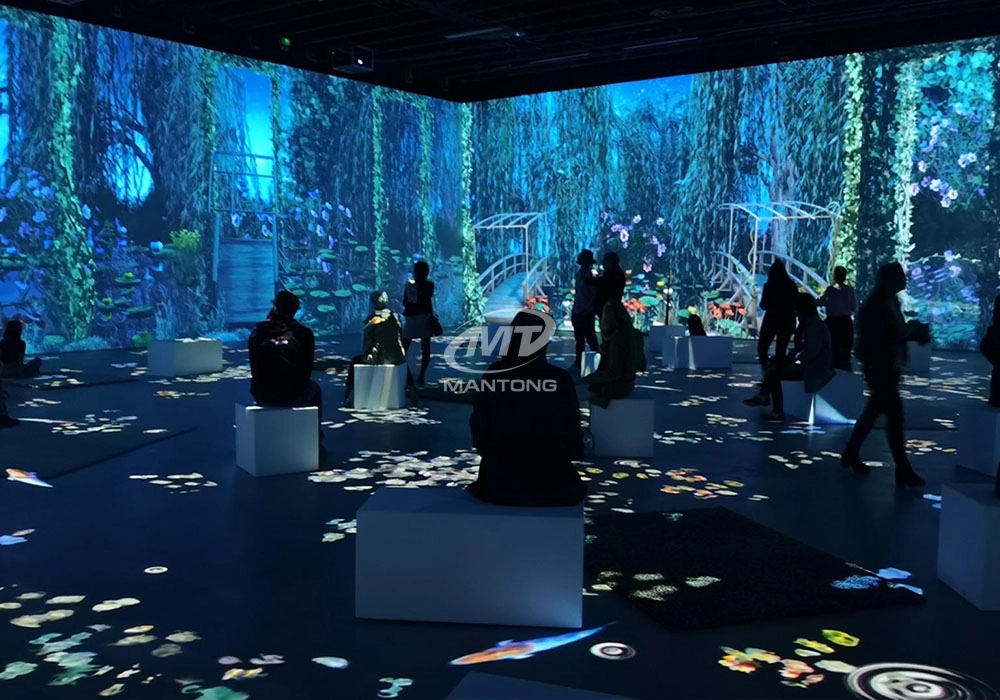
Mantong 6500LM High-Lumen Projector for Large-Scale Immersive Room Projection
Transform any space with Mantong's immersive projection mapping systems. Our high-lumen projectors (up to 6500 LM) and custom software create captivating interactive experiences for floors and walls. Ideal for museums, events, retail, and hospitality. Each kit includes professional ceiling mounting and 80+ pre-loaded video contents and is backed by a 12-month warranty and CE certification. We offer full customization and support to bring your vision to life.
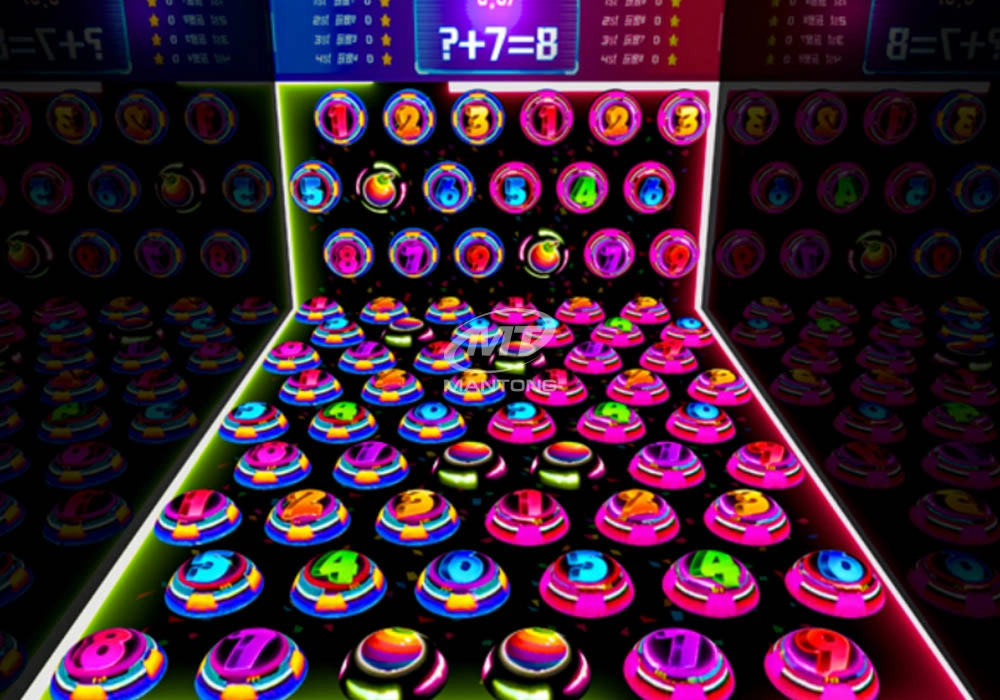
Amusement Rapidly Rotating Bouncing Sphere Interactive Wall Floor Projection Sports Games
Rapidly Rotating Bouncing Sphere is an interactive space where participants jump on rotating spheres. As they step on it, the spheres surface will show special interactivity
Jumping on spheres of the same color in succession causes them to pop, releasing light particles. The more consecutive jumps, the greater the reward—caterpillars appear, and eventually, all spheres of that color burst, filling the space with light and even more caterpillars.
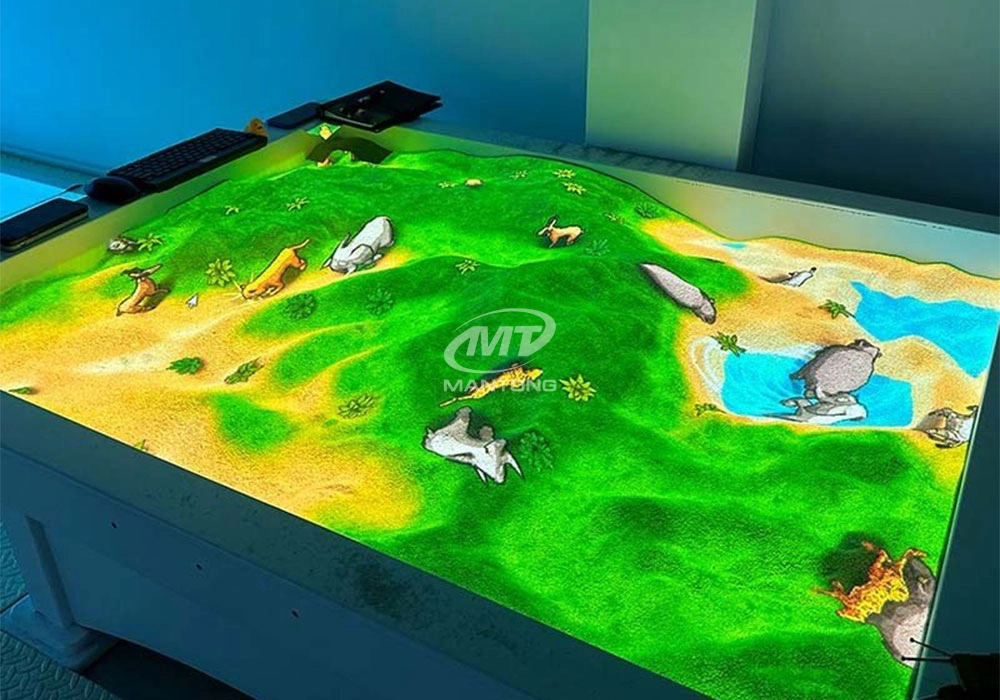
Interactive Sandbox Projection Mapping Games For Kids Play Park
Bring imagination to life with interactive sandbox projection mapping games designed for kids’ play parks. Using cutting-edge projection technology and real-time motion sensing, children can dig, build, and explore virtual worlds directly in the sand. Educational, engaging, and endlessly fun — it’s the perfect blend of play and learning.
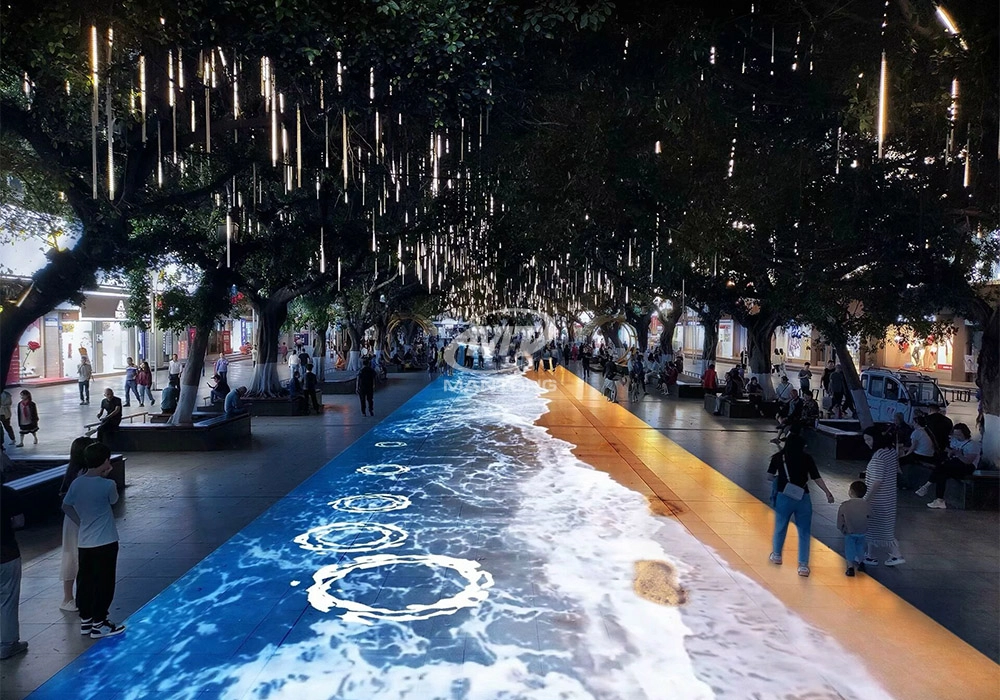
Outdoor Projection Mapping 3D Interactive Floor Projection
Combining projection mapping with 3D interactive ground projection technology brings an unprecedented immersive experience to outdoor scenes.

Kaida Business Center, Shixin Road, Panyu District,Guangzhou City, Guangdong Province, China.
ManTong
ManTong
ManTong