
Integrating AR with Interactive 3D Projection Experiences
- Why AR and Projection Converge: Benefits and Use Cases
- Technical complementarity between AR and projection
- User experience improvements
- Primary practical use cases
- Core Technical Challenges and Solutions
- Calibration and registration
- Latency, tracking and synchronization
- Color, brightness and ambient light management
- Design Principles for Compelling AR-Enhanced 3D Projection
- Interaction design: shared vs. private layers
- Content pipelines and asset management
- Hardware selection and redundancy
- Commercial Implementation and Mantong Digital Solutions
- Why partner with Mantong Digital
- Mantong's competitive strengths and product portfolio
- Typical deployment workflow and performance expectations
- Implementation Checklist: From Prototype to Production
- Site survey and initial proofs
- Middleware and developer tooling
- Testing, accessibility and long term maintenance
- FAQ
- 1. What is the difference between projection-based AR and headset AR?
- 2. How do you ensure alignment between projected content and AR overlays?
- 3. Can interactive 3d projection work outdoors?
- 4. What hardware is recommended for low-latency interactive projection?
- 5. How do you measure ROI for AR + projection installations?
- 6. How long does deployment take?
I build and advise on large-scale immersive installations that combine augmented reality concepts with interactive 3d projection. In this article I summarize practical integration strategies, technical tradeoffs, and design principles that help product teams and experience designers deploy stable, engaging projection-based AR systems in museums, retail, events, and architectural mapping. I also reference authoritative sources on augmented reality and projection mapping and share real-world operational guidance you can validate in your own pilot projects.
Why AR and Projection Converge: Benefits and Use Cases
Technical complementarity between AR and projection
Augmented reality traditionally overlays virtual content on a user's view (often via head-mounted displays or mobile screens). Projection-based approaches, by contrast, project imagery directly onto physical surfaces and environments. Combining these modalities leverages strengths from both: projection provides scale and shared presence, while AR provides per-user personalization, occlusion handling, and device-based augmentation. For background on augmented reality concepts, see the augmented reality overview on Wikipedia (https://en.wikipedia.org/wiki/Augmented_reality).
User experience improvements
From my deployments, integrating AR cues with 3d projection reduces cognitive load and improves engagement. Projection supplies atmospheric context—lighting, depth shading and environmental animation—while AR adds precise annotations, interactive affordances, and individualized pathways. This hybrid approach suits scenarios where multiple users must share an experience but also require personalized information (e.g., trade shows, retail fitting rooms, and museum exhibits).
Primary practical use cases
Common, high-impact use cases I see are: immersive façade shows augmented by phone-based AR layers, interactive floors whose projected content responds to body tracking with AR-guided games, and retail installations where projected product visualizations are complemented by AR product configurators. For technical background on projection mapping techniques, consult the projection mapping overview (https://en.wikipedia.org/wiki/Projection_mapping).
Core Technical Challenges and Solutions
Calibration and registration
Accurate alignment between projected pixels and virtual AR elements is the greatest technical demand. I use a mix of automated projector-camera calibration and markerless surface reconstruction. Tools like projector-camera (pro-cam) calibration algorithms and structured-light scanning turn a rough site survey into a spatial model you can register to. Foundational research such as the Shader Lamps work by Raskar et al. shows techniques for animating real objects with projected illumination (https://people.csail.mit.edu/raskar/papers/shaderlamp-shaderlamp.pdf).
Latency, tracking and synchronization
For interactive 3d projection, latency kills presence. I design pipelines where tracking (OptiTrack, depth cameras, or IMU-based systems) feeds a low-latency middleware that updates both the projection server and AR clients. Time-synchronization (NTP or PTP where available) plus predictive filtering (e.g., Kalman or optical flow prediction) keeps virtual and projected elements coherent when users move quickly.
Color, brightness and ambient light management
Projection systems compete with ambient light. I pick projectors with appropriate lumen output and optical throw for the venue, and I design content with high-contrast palettes and ambient-aware shaders. For outdoor or large-venue work, consider high-lumen laser projectors and dynamic intensity scaling tied to environmental sensors.
Design Principles for Compelling AR-Enhanced 3D Projection
Interaction design: shared vs. private layers
I split the experience into shared projection layers (audience-scale environment and theatrical cues) and private AR layers (user-specific information, controls, or viewpoints). This separation reduces occlusion complexity and makes system debugging easier: projection is deterministic and centrally controlled; AR clients render per-session personalization.
Content pipelines and asset management
Successful projects need a robust content pipeline. I recommend GLTF/GLB for 3D assets, video codecs optimized for low-latency playback, and layered rendering schemes where projected assets are baked to match surface geometry. Version control for assets and automated content validation (checks for projector gamut, falloff, and mapping seams) prevent late-stage surprises.
Hardware selection and redundancy
Choose hardware to match the deployment life: experimental installations can use fewer, consumer-level projectors; permanent exhibits require industrial-grade laser projectors and redundant servers. Where uptime matters, I design N+1 redundancy for key components (projection, network, and tracking servers) and plan for hot swap and fallback content that safely degrades the experience without breaking interaction.
Commercial Implementation and Mantong Digital Solutions
Why partner with Mantong Digital
Mantong Digital is a one-stop interactive projection solution provider and direct manufacturer based in Guangzhou, China, with over 10 years of industry experience. We are dedicated to providing innovative, flexible and cost-effective projection solutions, offering both hardware and software to meet various needs. At ManTong, we specialize in providing customized solutions for a wide range of application scenarios through innovative projection technology. Whether it's immersive experiences, interactive entertainment or outdoor lighting and projection shows, our solutions can transform your ideas into stunning visual effects. Our projection technology provides customized solutions for a variety of scenarios, delivering immersive and interactive visual experiences. We are now looking for business partnerships worldwide. Our vision is to become the world's leading interactive projection manufacturer. Our website is https://www.mtprojection.com/
Mantong's competitive strengths and product portfolio
From my collaboration with Mantong teams, their advantages include vertical integration (direct manufacturing), rapid prototyping capabilities, and proven field experience in immersive projection, interactive floor projection, interactive wall projection, immersive rooms, 3d projection, interactive projection games, projection shows, and interactive projection mapping. Mantong provides both turnkey installations and OEM hardware, which shortens the procurement cycle and reduces hidden costs typical in multi-vendor projects.
Typical deployment workflow and performance expectations
My recommended workflow for a Mantong-powered deployment is: site survey and photogrammetry → prototype mapping (lab preview) → hardware delivery → on-site calibration and acceptance testing → 30-day stabilization and tuning followed by training and handover. Mantong supports both immersive experiences and outdoor projection shows and can provide projectors, control servers, sensors, and integration software.
| Tradeoff | Projection-first (Mantong hardware) | AR-first (Mobile HMD/phone) |
|---|---|---|
| Audience scale | Large shared audiences; theatrical impact | Individualized, single-user focus |
| Interactivity | High for body-scale, floor/ wall interaction | High for detailed, per-user controls and occlusion |
| Cost drivers | Hardware (projectors), installation, calibration | Client devices, app development, device management |
Implementation Checklist: From Prototype to Production
Site survey and initial proofs
Begin with photogrammetry or LiDAR scans to create an accurate geometry model. Run a small-scale projection proof-of-concept to validate alignment and environmental light assumptions. Use camera-based validation images to quantify mapping error (pixels misaligned vs. surface coordinates).
Middleware and developer tooling
I recommend middleware that abstracts tracking, time sync, and content distribution. Unity and Unreal both have mature ecosystems for mixed AR/projection workflows; however, for production stability I often use a headless rendering server for projection frames and thin AR clients for device-specific overlays.
Testing, accessibility and long term maintenance
Include accessibility testing (contrast, audio cues, and non-visual fallbacks), and define a maintenance contract for recalibration every 6-12 months or after significant site changes. Keep a live runbook for field technicians and retain the spatial models and calibration files in a versioned repository.
FAQ
1. What is the difference between projection-based AR and headset AR?
Projection-based AR displays imagery onto surfaces in the real world for all viewers, creating a shared experience. Headset AR renders overlays on a per-user display (HMD or phone). The hybrid model uses projection for shared theatrical elements and headset/phone AR for individualized information and interaction.
2. How do you ensure alignment between projected content and AR overlays?
Alignment requires a spatial model of the environment plus robust calibration. I use projector-camera calibration (pro-cam), structured light scans, and continuous tracking (optical markers, depth cameras or SLAM) combined with time synchronization between projection servers and AR clients.
3. Can interactive 3d projection work outdoors?
Yes—outdoor work needs high-lumen, high-contrast laser projectors, careful ambient light assessment, and weatherproofing. For large façades, edge blending and geometric correction are critical. Mantong provides solutions tailored to outdoor shows and projection mapping events.
4. What hardware is recommended for low-latency interactive projection?
Low-latency setups use high-refresh-rate projectors or LED walls with direct-driving control systems, solid-state storage for playback, GPU-accelerated rendering servers, and low-latency tracking sensors (infrared optical systems or depth cameras). Redundancy and real-time networks reduce failure risk.
5. How do you measure ROI for AR + projection installations?
Measure engagement metrics (dwell time, repeat visits), interaction counts, lead capture conversions, and operational uptime. For retail, track conversion uplift and average transaction value. For public installations, look at social reach and press impressions as indirect ROI.
6. How long does deployment take?
Typical timelines are: small pilot (2–6 weeks), mid-scale installation (2–3 months), and enterprise-grade multi-site rollouts (4–9 months), depending on custom content and permitting. Mantong's integrated manufacturing shortens hardware lead times.
If you'd like to explore a pilot or discuss a production deployment, contact Mantong Digital for a consultation. Visit https://www.mtprojection.com/ to view products and request a quote. I also offer consulting engagements to help scope technical requirements, write RFPs, and lead on-site calibration and acceptance testing.
Future trends in interactive projection technology 2026
Top floor projection game system Manufacturers and Suppliers in Guangzhou
Interactive Floor Projector Price Breakdown for Procurement
Measuring Engagement: Analytics for Interactive Floor Games
One-Stop Projection Solution Provider Since 2011
Are you trader or manufacturer ?
We are direct manufacturer who specialize in providing one-stop solution for different outdoor & indoor projection project with our stable software and qualified projectors
What's Immersive Projection ?
Immersive projection refers to a technology that creates a captivating and all-encompassing visual experience for viewers by projecting images or videos onto large surfaces, such as walls, floors, or even entire rooms. This technology aims to immerse the audience in a simulated environment, blurring the boundaries between the physical and virtual worlds.
What information do you need to know before making the proposal/solution?
We know that everyone wants to know the price, but the price of our products is determined by many factors since most of our products are custom, so no ready price list. In order to fast understand what you need, can you send us an inquiry like this?
For example: I am really interested in your immersive projection products, we are a company in the USA and want to install some in my restaurant. It is about 50 meters long, and 5m in width. Projection size you can decide but the length should be not less than 20 meters. We want some content about SeaWorld because our place is all about the sea. Thank you.
How to install the projection equipment ?
1) Install the projector in a suitable position. We will provide you with a hanger, which you need to fix on the ceiling with
screws.
2) Connect projectors, computers and other accessories through wires.
3) After completing the above 2 steps, we will carry out the edge blending steps. Our team can complete it through remote
control.
In general, installation instructions for each project need to be specified on a project-by-project basis. The above is for
reference only.
How to Write an Interactive-Effect Video Customisation Script ?
① Project Background: Briefly introduce the context in which this interactive scene will be used (e.g., exhibition, museum,
event space, children's area). Example: This scene is part of the “Underwater World” zone in a children's science museum,
designed to be engaging and exploratory.
②Visual Style / Atmosphere: What kind of visual mood are you aiming for? Please describe the color scheme, style, and any
references. it should focus solely on describing the visual aspects of the scene, supported by relevant charts or reference
images.
③ Interaction Points Overview:List each interactive hotspot along with the effect you'd like to trigger when the user
touches or clicks the area. example: when player touch the clownfish, it will swims away with bubble trail (animation effect)
and produce the bubble sound ( sound effect requirement )
④ Static Visual Reference:including but not limited to background image/video, a list of major visual elements (e.g., coral,
rocks, seaweed, fish), which elements should be interactive?
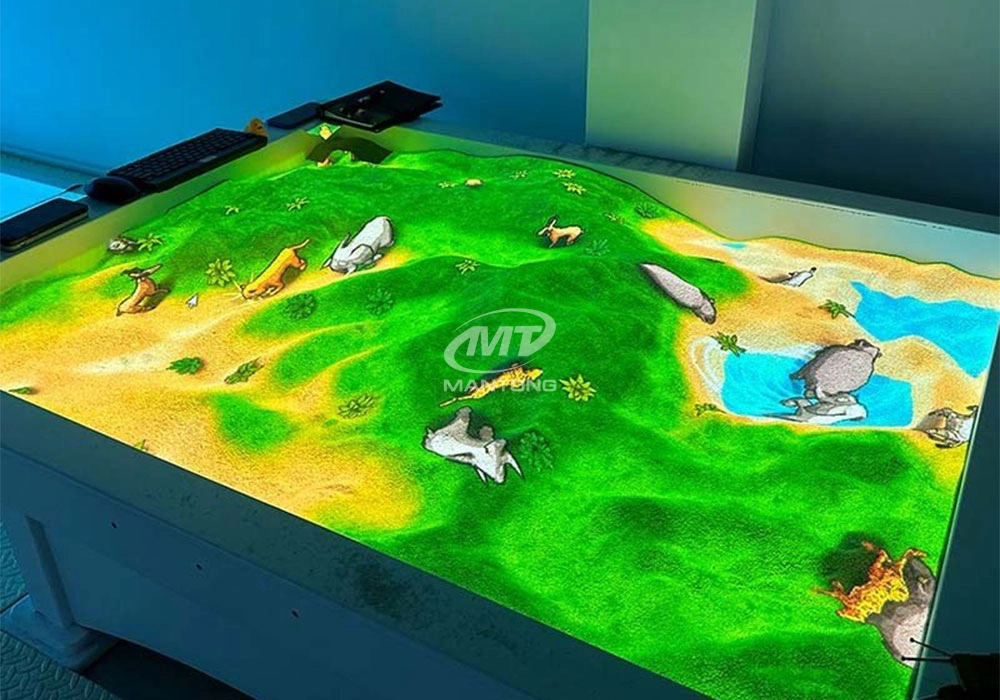
Interactive Sandbox Projection Mapping Games For Kids Play Park
Bring imagination to life with interactive sandbox projection mapping games designed for kids’ play parks. Using cutting-edge projection technology and real-time motion sensing, children can dig, build, and explore virtual worlds directly in the sand. Educational, engaging, and endlessly fun — it’s the perfect blend of play and learning.
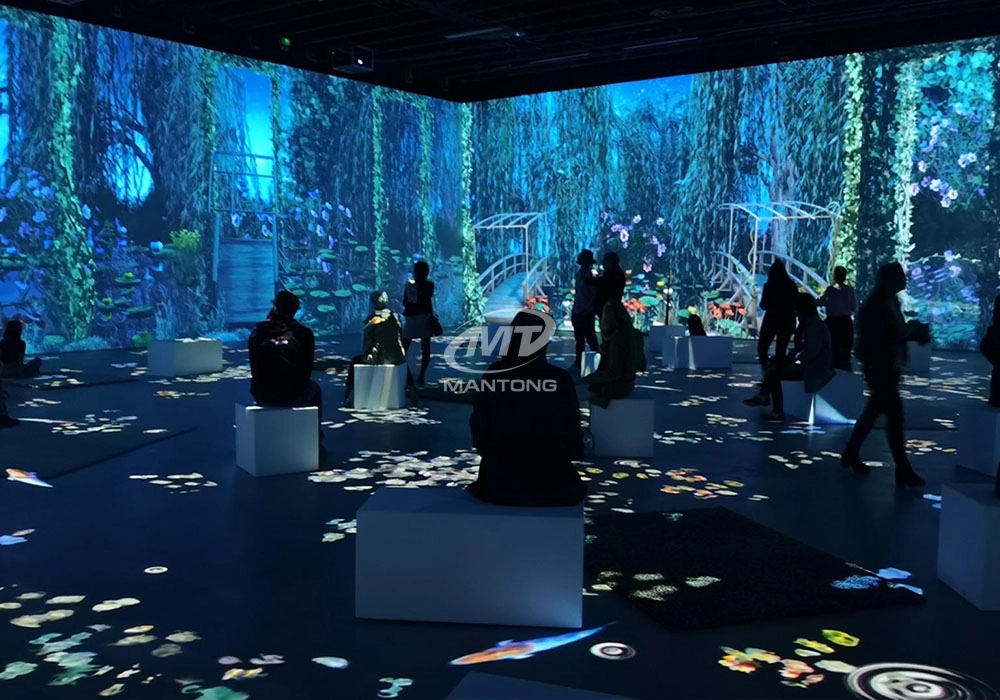
Mantong 6500LM High-Lumen Projector for Large-Scale Immersive Room Projection
Transform any space with Mantong's immersive projection mapping systems. Our high-lumen projectors (up to 6500 LM) and custom software create captivating interactive experiences for floors and walls. Ideal for museums, events, retail, and hospitality. Each kit includes professional ceiling mounting and 80+ pre-loaded video contents and is backed by a 12-month warranty and CE certification. We offer full customization and support to bring your vision to life.
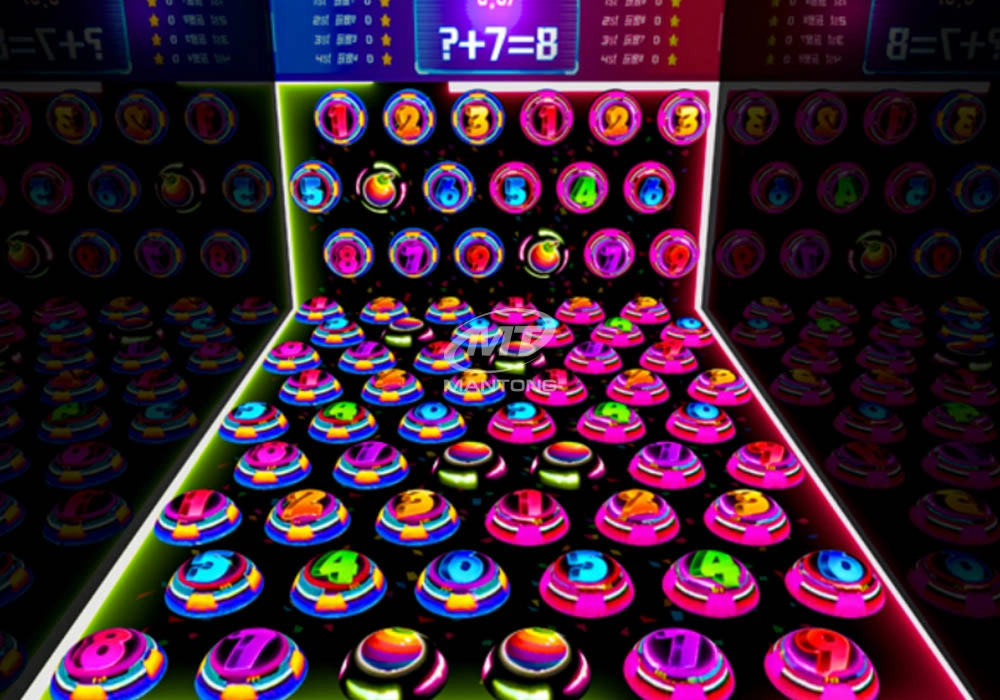
Amusement Rapidly Rotating Bouncing Sphere Interactive Wall Floor Projection Sports Games
Rapidly Rotating Bouncing Sphere is an interactive space where participants jump on rotating spheres. As they step on it, the spheres surface will show special interactivity
Jumping on spheres of the same color in succession causes them to pop, releasing light particles. The more consecutive jumps, the greater the reward—caterpillars appear, and eventually, all spheres of that color burst, filling the space with light and even more caterpillars.
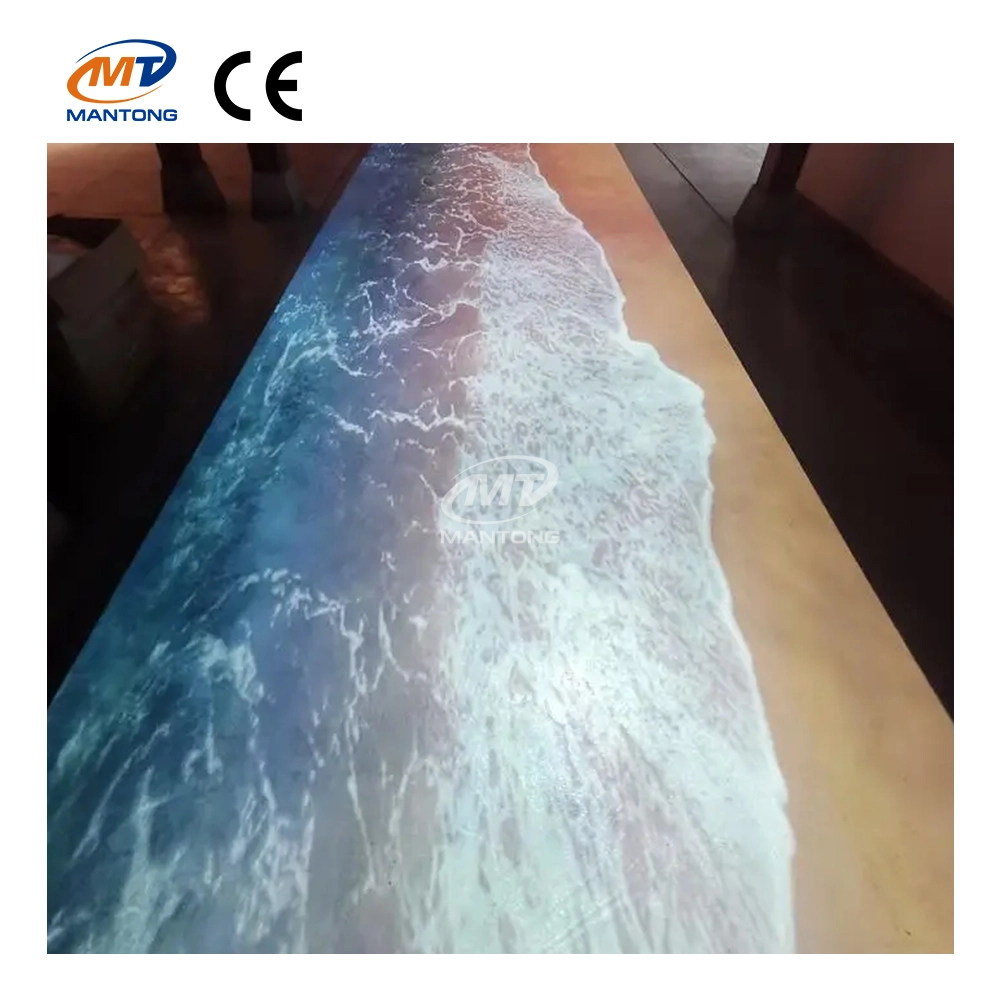
Indoor Interactive Floor Projector System - Customized Design & Installation Support
Indoor interactive floor projections display dynamic themed videos on the floor, commonly used in venues aiming to enhance brand influence or attract foot traffic, such as restaurants, hotel corridors, and brand car retail stores.
By using projectors and compatible software, the interactive content is projected onto the floor, encouraging engagement between people and the projected visuals. A single 5500-lumen indoor floor projector can cover an area of 5 m × 3 m. Typically, each project will use at least 3 units to ensure broad coverage and optimal visual effects.
We also offer customized design and installation support to enhance the interactive experience for your venue.

Kaida Business Center, Shixin Road, Panyu District,Guangzhou City, Guangdong Province, China.
ManTong
ManTong
ManTong