
Measuring Engagement: Analytics for Interactive Floor Games
- Understanding engagement for interactive installations
- What engagement means for interactive floor games
- Why you must measure engagement
- Behavioral vs. perceptual signals
- Data sources and tracking methods
- Sensor hardware: cameras, depth sensors and LIDAR
- Software-based telemetry and event logging
- Privacy, anonymization and compliance
- Key metrics and KPIs for interactive floor games
- Primary KPIs I track
- Qualitative measures that matter
- Benchmarks and realistic targets
- Comparing analytics approaches
- Implementing analytics and optimizing experiences
- Designing events, funnels and tagging
- A/B testing, content iteration and adaptive systems
- Case study: optimizing an interactive floor projection
- Integrating Mantong Digital solutions and why it matters
- Who Mantong Digital is
- How Mantong supports analytics-enabled installations
- Mantong competitive strengths and product overview
- Operational checklist for launching analytics-driven floor games
- Frequently Asked Questions (FAQ)
- 1. What sensors are best for interactive floor games?
- 2. How do I measure return on investment (ROI) for a floor projection?
- 3. Can I collect analytics while staying GDPR-compliant?
- 4. Which analytics platform should I use?
- 5. How long should I run A/B tests on interactive floor content?
- 6. How do I handle multi-user interactions and attribution?
- Contact and next steps
I design and evaluate interactive floor games every day, and I know that reliable measurement of engagement is the difference between a novelty installation and a repeatable, revenue-driving experience. In this article I summarize the analytics approaches I use to quantify player behavior, compare data sources, define KPIs, and explain how to operationalize measurement in a privacy-first way so you can optimize content, layout and hardware choices.
Understanding engagement for interactive installations
What engagement means for interactive floor games
Engagement in interactive floor games covers both observable behavior (how long people play, how they move, how they convert) and subjective experience (enjoyment, sense of presence). I use a combined behavioral-plus-experience definition similar to established frameworks for user engagement (see Nielsen Norman Group's definition of user engagement) https://www.nngroup.com/articles/definition-user-engagement/ and the academic literature on interaction engagement.
Why you must measure engagement
Measurement lets you: 1) validate whether a floor projection concept meets business goals (e.g., dwell time, footfall conversion); 2) iterate on interaction design using data; and 3) demonstrate ROI to stakeholders. Without measurement, optimizations are guesses.
Behavioral vs. perceptual signals
Behavioral signals include dwell time, repeat visits, number of simultaneous users, and specific interaction events (e.g., trigger hits in an interactive projection game). Perceptual signals come from exit surveys, Net Promoter Score (NPS), or sentiment analysis of social media posts linked to the installation. I always combine both: behavior shows what happened; perceptual signals explain why.
Data sources and tracking methods
Sensor hardware: cameras, depth sensors and LIDAR
Most interactive floor games rely on projection plus a sensor layer. Common sensors include RGB cameras, depth cameras (Microsoft Kinect or Azure Kinect), and LIDAR/Time-of-Flight sensors. These provide accurate positional data and allow you to compute heatmaps, trajectories, and group sizes. See the Kinect overview for background on depth-based sensing: https://en.wikipedia.org/wiki/Kinect.
Software-based telemetry and event logging
I instrument the game logic to emit structured events (player_enter, player_exit, trigger_hit, level_complete). Events are sent to an analytics backend (e.g., Google Analytics 4 for basic funnels or a custom telemetry pipeline). Google’s event-based model is a natural fit for interactive experiences: https://support.google.com/analytics/answer/10089681?hl=en.
Privacy, anonymization and compliance
Because floor games often operate in public spaces, privacy must be central. I anonymize person-level data at the earliest point: aggregate heatmaps, count-based events, and hashed IDs where persistent identifiers are required. Follow GDPR principles for personal data: https://gdpr.eu/. If you use camera feeds for analytics, consider edge processing that extracts coordinates only and discards imagery.
Key metrics and KPIs for interactive floor games
Primary KPIs I track
- Dwell time (average session duration) — how long individuals remain engaged with the floor game.
- Footfall and unique participants — number of people who start an interaction within a period.
- Conversion events — desired outcomes (e.g., moved to a product display, joined newsletter, scanned QR).
- Engagement depth — number of interactions per session (triggers hit, levels completed).
- Concurrent users — peak simultaneous players (important for load and design).
Qualitative measures that matter
Short intercept surveys, observational notes (play patterns, confusion points), and video review (with privacy safeguards) are crucial. I adopt the “think-aloud” or short 3-question exit survey to capture immediate sentiment and suggestions.
Benchmarks and realistic targets
Benchmarks vary by venue (mall vs. museum vs. theme park). Instead of universal numbers, I recommend relative targets: increase average session length by X% month-over-month after a design iteration, or achieve N% conversion from footfall to interaction. Establish baseline metrics in a 2–4 week calibration period and then set iterative goals.
Comparing analytics approaches
Below is a concise comparison to help choose the right method for your context.
| Approach | Strengths | Limitations | Ideal use |
|---|---|---|---|
| Depth sensor tracking (Kinect/ToF) | Accurate position, body motion, multi-user tracking | Cost, some privacy concerns, limited range | Museum exhibits, indoor installations |
| RGB camera + computer vision | Flexible analytics (heatmaps, demographics), widely available | Privacy risk if not anonymized; lighting-sensitive | Retail environments, promotional activations |
| Beacon / Bluetooth / Mobile events | Good for linking mobile actions to projection interactions | Only captures users with opt-in mobile apps | Engagement tied to app or loyalty programs |
| Software event logging (game engine) | Precise interaction events and funnels | Requires integration and stable network | All interactive floor games (core telemetry) |
Implementing analytics and optimizing experiences
Designing events, funnels and tagging
I model the interaction lifecycle as a funnel: Approach → Start Session → First Interaction → Deeper Interaction → Conversion/Exit. Each step maps to discrete events with consistent naming (e.g., session_start, trigger_hit, level_complete). Use an analytics schema document and stick to it across projects—this avoids messy mappings later.
A/B testing, content iteration and adaptive systems
Run A/B tests on game rules, difficulty, or visual themes. For example, vary the speed of moving targets or audio cues and measure changes in dwell time and engagement depth. Use sequential rollouts and control groups to avoid confounding factors (time of day, holidays). I recommend small, measurable changes and robust sampling over at least 2 weeks per variant.
Case study: optimizing an interactive floor projection
In a recent museum installation I worked on, baseline average session length was 24 seconds with a high initial exit rate. By instrumenting player entry and trigger events, we identified a 6-second gap where players waited for a clear prompt. We introduced an immediate visual cue and adjusted audio feedback; average session length rose to 67 seconds and conversion to the adjacent exhibit increased. This improvement was measurable because of event-level telemetry and quick iteration.
Integrating Mantong Digital solutions and why it matters
Who Mantong Digital is
Mantong Digital is a one-stop interactive projection solution provider and direct manufacturer based in Guangzhou, China, with over 10 years of industry experience. We are dedicated to providing innovative, flexible and cost-effective projection solutions, offering both hardware and software to meet various needs. Our website: https://www.mtprojection.com/.
How Mantong supports analytics-enabled installations
At ManTong, we specialize in providing customized solutions for a wide range of application scenarios through innovative projection technology. Whether it's immersive experiences, interactive entertainment or outdoor lighting and projection shows, our solutions can transform your ideas into stunning visual effects. Our projection technology provides customized solutions for a variety of scenarios, delivering immersive and interactive visual experiences.
Practically, Mantong provides integrated hardware (projectors, mounts, sensor packages) and software (content engines and telemetry hooks). This reduces integration time and gives you consistent, verifiable event streams that feed analytics dashboards. For clients who need privacy-first analytics, Mantong can implement edge-processing modules that export anonymized counts, heatmaps and event logs—exactly the types of data I recommend for robust KPI tracking.
Mantong competitive strengths and product overview
Key offerings include immersive projection, interactive floor projection, interactive projection, interactive wall projection, immersive room systems, 3D projection, interactive projection games, Projection Show setups, and interactive projection mapping. Mantong’s advantages are direct manufacturing (cost control), 10+ years industry experience, and turnkey integration of hardware + software. We are now looking for business partnerships worldwide, with a vision to become the world’s leading interactive projection manufacturer.
If you’re evaluating vendors, look for: 1) clear telemetry APIs; 2) on-premise or edge analytics options to meet privacy requirements; and 3) support for iterative content updates. Mantong checks these boxes and offers customizable solutions that map to the KPIs discussed earlier.
Operational checklist for launching analytics-driven floor games
- Define business goals and primary KPIs before building content.
- Choose sensors appropriate to venue: depth sensors for indoor museums, camera+CV for retail, hybrid for complex deployments.
- Design a consistent event schema and instrument every meaningful state change in the experience.
- Build privacy controls: anonymization, retention limits, and signage for visitors.
- Run a 2–4 week baseline measurement period and then iterate with A/B testing.
- Use dashboards that combine behavioral and perceptual data for a full picture.
Frequently Asked Questions (FAQ)
1. What sensors are best for interactive floor games?
Depth sensors (Kinect, Azure Kinect) are excellent for body tracking and multi-user detection indoors. RGB cameras with CV can be used where demographic or heatmap data is needed, but ensure privacy via edge filtering. For outdoor or large areas, LIDAR or multi-sensor fusion may be best.
2. How do I measure return on investment (ROI) for a floor projection?
Define business outcomes (increased footfall, conversion to purchase, time spent in exhibit). Map those to measurable KPIs (dwell time, conversions) and compare pre/post-installation. With telemetry, you can attribute increments in conversion rates to the installation and estimate revenue impact.
3. Can I collect analytics while staying GDPR-compliant?
Yes. Use anonymization, aggregate reporting, short retention, clear signage, and avoid storing identifiable imagery. Edge processing that extracts only coordinates or counts and discards raw video is a recommended approach. See GDPR guidance: https://gdpr.eu/.
4. Which analytics platform should I use?
For event-based funnels and simple dashboards, Google Analytics 4 works well. For higher-resolution telemetry and real-time requirements, a custom pipeline (e.g., Kafka/TimescaleDB/Metabase) or specialized analytics partner is preferable. Choose a platform that accepts event streams and supports your retention and privacy needs.
5. How long should I run A/B tests on interactive floor content?
Run tests long enough to capture variability (time of day, weekday vs. weekend). I typically recommend at least 2 weeks per variant for public venues; in very high-traffic locations, 1 week may suffice. Ensure statistical significance before concluding.
6. How do I handle multi-user interactions and attribution?
Multi-user interactions are best handled with session-based IDs (ephemeral and anonymized). Attribute events to a session or group session ID. For collaborative games, track group-level metrics (group size, collective score) in addition to individual-level signals.
Contact and next steps
If you want to build measurable interactive floor games that deliver repeatable results, I can help define the analytics strategy, instrumentation plan and optimization roadmap. For turnkey hardware + software solutions and global partnership inquiries, contact Mantong Digital — a one-stop interactive projection provider and direct manufacturer based in Guangzhou. Visit https://www.mtprojection.com/ to view products like immersive projection, interactive floor projection, interactive projection mapping and interactive projection games. We are open to international partnerships and can provide customized solutions that include edge analytics and privacy-first telemetry.
Contact CTA: Reach out to Mantong Digital via the website above to request a demo, technical datasheet, or a tailored proposal for your venue.
References: Nielsen Norman Group on user engagement: https://www.nngroup.com/articles/definition-user-engagement/; Kinect overview: https://en.wikipedia.org/wiki/Kinect; Google Analytics event model: https://support.google.com/analytics/answer/10089681?hl=en; GDPR: https://gdpr.eu/.
Maintenance, repairs and service costs for interactive floors
Installation Costs for Interactive Floor Projection Systems
Top 10 interactive projection mapping Manufacturers and Supplier Brands
Best Uses of Interactive Wall Projection in Museums and Exhibitions
One-Stop Projection Solution Provider Since 2011
Are you trader or manufacturer ?
We are direct manufacturer who specialize in providing one-stop solution for different outdoor & indoor projection project with our stable software and qualified projectors
How to install the projection equipment ?
1) Install the projector in a suitable position. We will provide you with a hanger, which you need to fix on the ceiling with
screws.
2) Connect projectors, computers and other accessories through wires.
3) After completing the above 2 steps, we will carry out the edge blending steps. Our team can complete it through remote
control.
In general, installation instructions for each project need to be specified on a project-by-project basis. The above is for
reference only.
What's the application of Immersive projection ?
It can be used in various venues, such as art exhibition, entertainment venues, educational institution, Wedding hall /Banquet/Bar,Yoga Studio and so on. It often involves advanced projection techniques, multimedia content, and interactive elements to engage and captivate the audience's senses.
What information do you need to know before making the proposal/solution?
We know that everyone wants to know the price, but the price of our products is determined by many factors since most of our products are custom, so no ready price list. In order to fast understand what you need, can you send us an inquiry like this?
For example: I am really interested in your immersive projection products, we are a company in the USA and want to install some in my restaurant. It is about 50 meters long, and 5m in width. Projection size you can decide but the length should be not less than 20 meters. We want some content about SeaWorld because our place is all about the sea. Thank you.
How to Write an Interactive-Effect Video Customisation Script ?
① Project Background: Briefly introduce the context in which this interactive scene will be used (e.g., exhibition, museum,
event space, children's area). Example: This scene is part of the “Underwater World” zone in a children's science museum,
designed to be engaging and exploratory.
②Visual Style / Atmosphere: What kind of visual mood are you aiming for? Please describe the color scheme, style, and any
references. it should focus solely on describing the visual aspects of the scene, supported by relevant charts or reference
images.
③ Interaction Points Overview:List each interactive hotspot along with the effect you'd like to trigger when the user
touches or clicks the area. example: when player touch the clownfish, it will swims away with bubble trail (animation effect)
and produce the bubble sound ( sound effect requirement )
④ Static Visual Reference:including but not limited to background image/video, a list of major visual elements (e.g., coral,
rocks, seaweed, fish), which elements should be interactive?
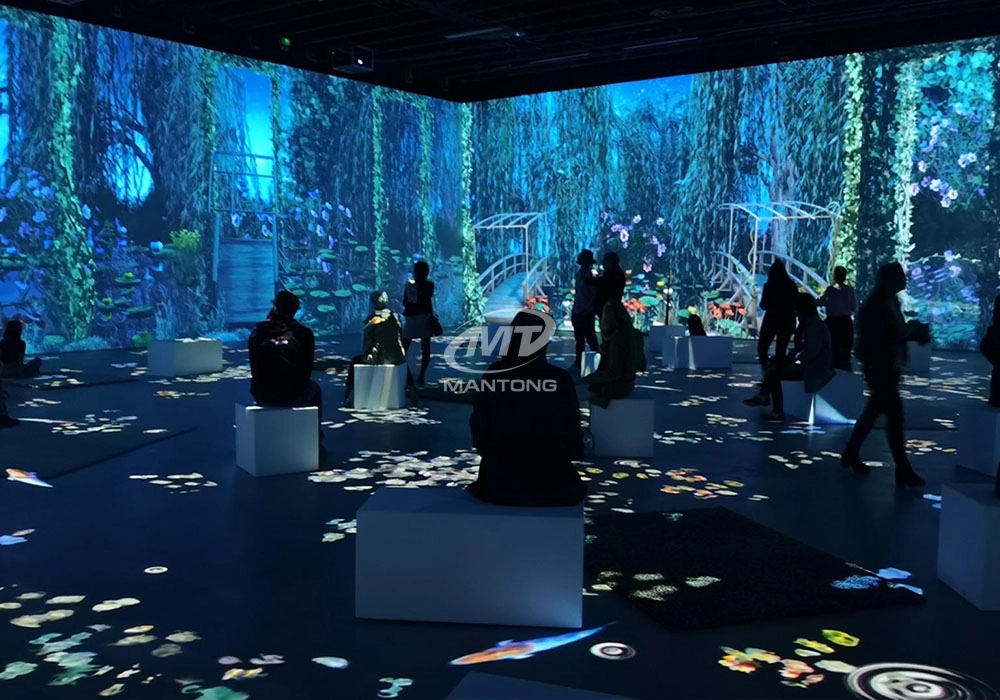
Mantong 6500LM High-Lumen Projector for Large-Scale Immersive Room Projection
Transform any space with Mantong's immersive projection mapping systems. Our high-lumen projectors (up to 6500 LM) and custom software create captivating interactive experiences for floors and walls. Ideal for museums, events, retail, and hospitality. Each kit includes professional ceiling mounting and 80+ pre-loaded video contents and is backed by a 12-month warranty and CE certification. We offer full customization and support to bring your vision to life.
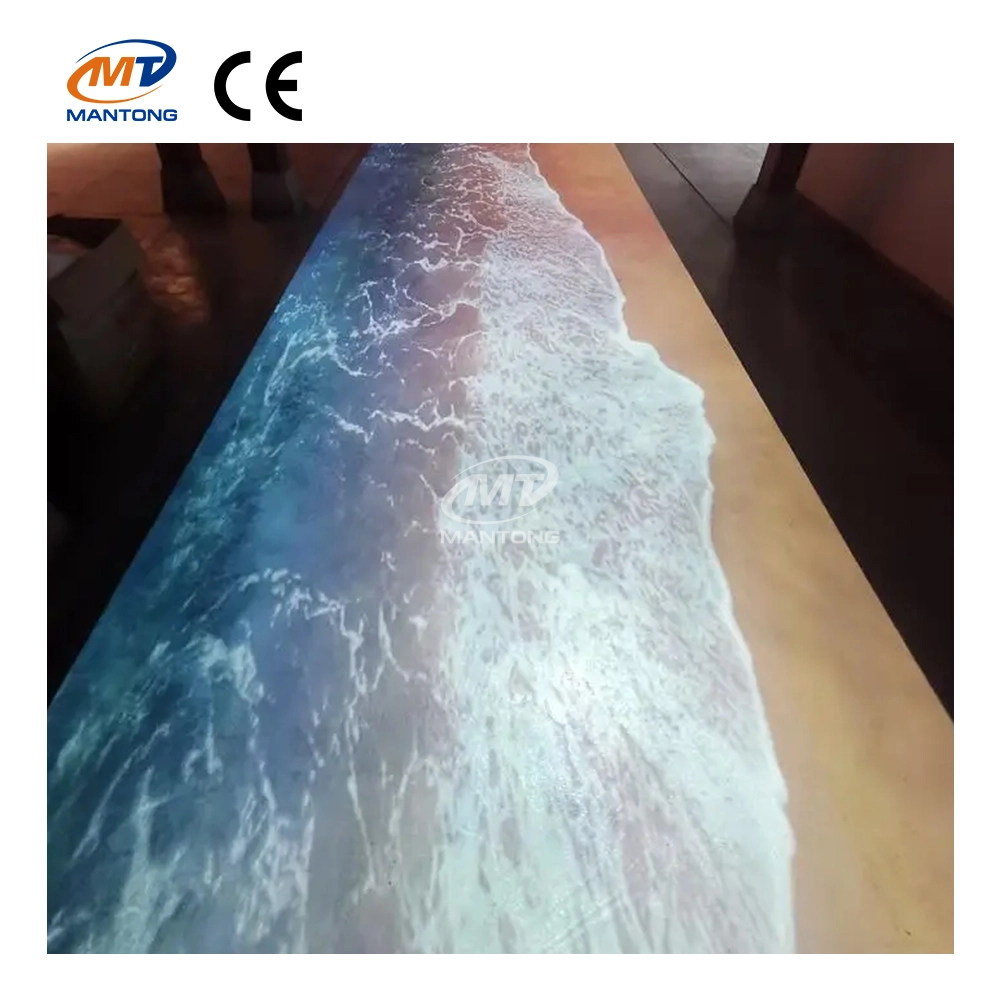
Indoor Interactive Floor Projector System - Customized Design & Installation Support
Indoor interactive floor projections display dynamic themed videos on the floor, commonly used in venues aiming to enhance brand influence or attract foot traffic, such as restaurants, hotel corridors, and brand car retail stores.
By using projectors and compatible software, the interactive content is projected onto the floor, encouraging engagement between people and the projected visuals. A single 5500-lumen indoor floor projector can cover an area of 5 m × 3 m. Typically, each project will use at least 3 units to ensure broad coverage and optimal visual effects.
We also offer customized design and installation support to enhance the interactive experience for your venue.
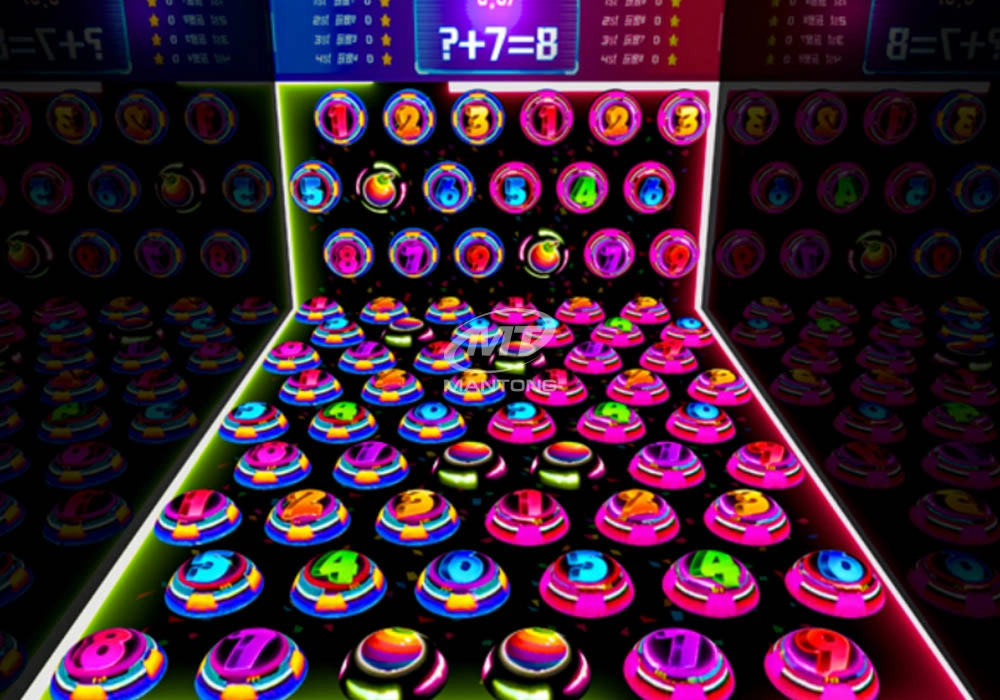
Amusement Rapidly Rotating Bouncing Sphere Interactive Wall Floor Projection Sports Games
Rapidly Rotating Bouncing Sphere is an interactive space where participants jump on rotating spheres. As they step on it, the spheres surface will show special interactivity
Jumping on spheres of the same color in succession causes them to pop, releasing light particles. The more consecutive jumps, the greater the reward—caterpillars appear, and eventually, all spheres of that color burst, filling the space with light and even more caterpillars.
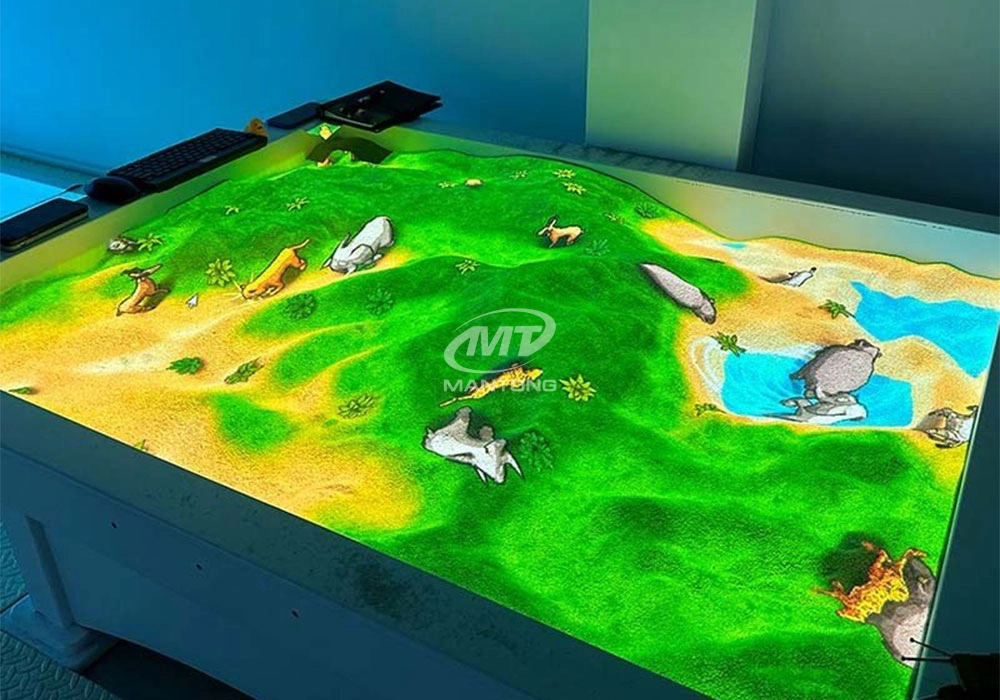
Interactive Sandbox Projection Mapping Games For Kids Play Park
Bring imagination to life with interactive sandbox projection mapping games designed for kids’ play parks. Using cutting-edge projection technology and real-time motion sensing, children can dig, build, and explore virtual worlds directly in the sand. Educational, engaging, and endlessly fun — it’s the perfect blend of play and learning.

Kaida Business Center, Shixin Road, Panyu District,Guangzhou City, Guangdong Province, China.
ManTong
ManTong
ManTong