
Integrating Sensors with Floor Projection Games
- Why sensor integration matters for interactive installations
- User experience and real-time responsiveness
- Safety, accessibility and environmental constraints
- Choosing the right sensors for floor projection games
- Common sensor types and how they change gameplay
- Performance metrics: latency, accuracy, and field of view
- System architecture and sensor fusion
- Hardware layout, mounting, and calibration
- Software stack and real-time processing
- Deployment, testing and maintenance
- Testing protocols and KPIs
- Accessibility, safety, and regulatory considerations
- Operational checklist and maintenance
- Maintenance tasks and frequency
- Data privacy and ethics
- Case example: Mixed sensor fusion for a high-traffic interactive floor
- Problem and design choices
- Results and lessons learned
- Mantong Digital: partner for turnkey interactive projection solutions
- FAQ
- 1. What sensors are best for detecting fast foot movement in floor projection games?
- 2. How do you minimize latency between a physical action and projected response?
- 3. Can floor projection games work outdoors?
- 4. How do you handle privacy when using cameras?
- 5. What is the expected lifetime and maintenance cost for a typical interactive floor system?
- 6. How scalable are multi-zone floor projection games?
As an interactive projection consultant with years of hands-on experience in designing and deploying immersive exhibits, I’ve observed that the difference between a good floor projection game and a great one usually comes down to how well the sensing layer is integrated. In this article I walk through why sensors matter for floor projection games, how to choose and combine sensor types, architectural and software best practices, real-world calibration and testing tips, and operational considerations to keep installations reliable and safe. I also explain how my team at Mantong Digital can help translate these principles into turnkey, manufacturable solutions. Keywords: floor projection games, interactive floor projection, projection mapping.
Why sensor integration matters for interactive installations
User experience and real-time responsiveness
Floor projection games require the illusion of immediate response: players expect visuals to react without perceptible delay. Sensor choice and placement directly affect latency, detection accuracy, and robustness under varying lighting and crowd conditions. Poor sensing yields false triggers, missed interactions, and a broken flow that damages engagement—especially for children’s games and high-traffic museum exhibits.
Safety, accessibility and environmental constraints
Sensors also support safety (detecting falls or crowding) and accessibility (supporting gestures, seated users, or assistive devices). In public spaces you must consider ambient light, reflections, floor texture, and vandalism. Standards for human-centered design such as ergonomics inform layout and interaction height; for projection fidelity and mapping I often reference projection mapping principles (projection mapping).
Choosing the right sensors for floor projection games
Common sensor types and how they change gameplay
Below I summarize sensor categories I use in production and how each affects gameplay design. The right mix depends on desired interactions (e.g., footstep detection, body tracking, object recognition) and installation constraints.
| Sensor Type | Strengths | Limitations | Typical Use Cases |
|---|---|---|---|
| RGB Camera (vision) | High resolution, color info, inexpensive | Lighting-sensitive; computationally heavier for robust detection | Object/marker recognition, silhouette tracking |
| Depth Camera (ToF / structured light) | Robust to lighting; direct distance measurement; good for body/floor plane detection | Cost higher; near-range noise; integration complexity | Foot and body tracking, avoiding floor reflections |
| Infrared (IR) arrays / active IR | Good in low light; inexpensive for presence detection | Limited spatial resolution | Presence zones, simple touchless buttons |
| Pressure mats / floor switches | Deterministic contact detection; low latency | Wear, intrusive installation, limited resolution | Step triggers, location-limited games |
| Ultrasonic / LiDAR | Reliable distance sensing; LiDAR has good resolution | Cost (LiDAR) and angular resolution trade-offs | Crowd density, object detection, mapping |
| RF / UWB / BLE | Good for tagged objects and coarse position; works through occlusion | Lower spatial precision for fine foot detection | Tagged props, tracking wearables |
For references on depth sensing and ToF cameras I often consult the technical summaries such as the Time-of-flight camera overview and product pages like Intel RealSense (intelrealsense.com). Historical context and widely used systems such as Microsoft Kinect are discussed on Wikipedia.
Performance metrics: latency, accuracy, and field of view
When I evaluate sensors I quantify three core metrics:
- Latency: end-to-end delay from physical event to visual update. Target for compelling interaction is typically < 100 ms; for fast-paced footwork you often need < 50 ms.
- Accuracy: spatial error in centimeters for position-sensitive interactions. Depth cameras provide centimeter to tens-of-centimeter accuracy depending on range and model.
- Field of view (FOV): coverage area for a single sensor and how many sensors are needed to cover the projected play area.
These numbers interact: increasing FOV can increase occlusions and reduce per-pixel accuracy; reducing latency often requires edge compute and simplified detection models.
System architecture and sensor fusion
Hardware layout, mounting, and calibration
Sensor placement is the first determinant of success. I follow these practical rules of thumb:
- Mount depth or RGB cameras overhead where possible to minimize occlusion and map directly to floor coordinates. Ceiling mounts yield stable perspective for floor projection games.
- Place IR emitters and receivers to avoid direct sun or reflective surfaces; use polarizing filters where reflections are problematic.
- For large playfields, design sensor overlap (20–30%) to enable smooth handover and fusion; depth sensors often require precise extrinsic calibration to the projector coordinate frame.
Calibration steps I use include intrinsic calibration for each camera (OpenCV routines), extrinsic calibration between camera(s) and projector using checkerboard or AR markers, and temporal synchronization (NTP or hardware trigger) to reduce timing jitter. Resources like OpenCV (opencv.org) are essential in the calibration stage.
Software stack and real-time processing
Real-time requirements push the system design toward edge computing: GPUs for vision/ML, or dedicated FPGA/ASIC for ultra-low latency. A typical software stack includes:
- Sensor drivers and capture layer (SDKs from device vendors)
- Preprocessing (denoising, background subtraction, floor plane estimation)
- Detection and tracking (computer-vision pipelines or neural networks)
- Sensor fusion and position smoothing (Kalman filters or particle filters)
- Projection mapping and rendering pipeline (Unity, Unreal, or custom OpenGL/DirectX engines)
For robust interaction I implement a sensor-fusion module that weights inputs by confidence and latency: for example, a pressure mat gives a deterministic footstep event (high confidence, low spatial resolution), while a depth camera provides continuous position (higher spatial resolution, moderate confidence). Fusion lets the game logic use the low-latency event for instant feedback and the depth camera for smoothing and context.
Deployment, testing and maintenance
Testing protocols and KPIs
I deploy a staged testing protocol to reduce field surprises:
- Bench testing: validate drivers, latency, and basic detection in lab conditions.
- Controlled environment testing: mimic ambient lighting and foot traffic; measure false positive/negative rates.
- Pilot in-situ testing: run a soft launch to gather usage metrics (average session length, peak concurrent users) and unmanned stress tests.
Key performance indicators I measure include:
| KPI | Target | Measurement Method |
|---|---|---|
| End-to-end latency | <100 ms (ideal <50 ms) | High-speed camera capture or timestamped events |
| Detection accuracy | >95% for presence; <10 cm positional error for tracked foot points | Annotated ground-truth trials |
| Uptime | >99% during opening hours | Automated health checks and logs |
When I cite thresholds (latency <100 ms, positional error <10 cm) these are industry practice for interactive installations; researchers exploring human perception and latency confirm that delays above ~100 ms begin to reduce sense of direct control (see human-computer interaction literature).
Accessibility, safety, and regulatory considerations
Accessibility and safety must be designed, not bolted on. I ensure clear sightlines, non-slip flooring under projection areas, and visible overflow zones. For high-traffic public installations, add emergency stop capabilities and monitor crowd density to avoid stampede risks. For legal and standard considerations, consult ergonomics and building safety standards; when in doubt, coordinate with local authorities.
Operational checklist and maintenance
Maintenance tasks and frequency
Regular maintenance keeps systems performing well. Below is a practical checklist I provide to clients.
| Task | Frequency | Reason |
|---|---|---|
| Camera lens cleaning and dusting | Weekly | Dust degrades image quality and depth accuracy |
| Check projector alignment and focus | Monthly | Thermal drift can alter mapping |
| Firmware and software updates (staged) | Quarterly | Security patches and performance improvements |
| Health diagnostics and log review | Daily automated; human review weekly | Catch early errors and prevent downtime |
Data privacy and ethics
If you capture video or identifiable data, implement privacy-by-design: anonymize streams, avoid storage of raw images, and post clear notices. Many museums and public spaces prefer on-device processing and ephemeral data to reduce risk. For compliance and best practices, consult local privacy regulations (e.g., GDPR in Europe).
Case example: Mixed sensor fusion for a high-traffic interactive floor
Problem and design choices
I was asked to design a museum floor interactive that supports up to 6 simultaneous users, robust family play, and operates both day and night. I chose a hybrid architecture: overhead depth cameras for continuous tracking, pressure mats at high-traffic hotspots for deterministic events, and an IR array for presence during low-light hours. These combined to reduce false positives from stroller wheels and reflected sunlight.
Results and lessons learned
After calibration and a two-week pilot, we achieved <70 ms average latency and positional error under 8 cm across the playfield. Key lessons: plan for housekeeping (clean floor markings), provide fallback behaviors (audio cues when vision is occluded), and log interaction metrics to iterate on game balance.
Mantong Digital: partner for turnkey interactive projection solutions
Mantong Digital is a one-stop interactive projection solution provider and direct manufacturer based in Guangzhou, China, with over 10 years of industry experience. We are dedicated to providing innovative, flexible and cost-effective projection solutions, offering both hardware and software to meet various needs.
At ManTong, we specialize in providing customized solutions for a wide range of application scenarios through innovative projection technology. Whether it's immersive experiences, interactive entertainment or outdoor lighting and projection shows, our solutions can transform your ideas into stunning visual effects. Our projection technology provides customized solutions for a variety of scenarios, delivering immersive and interactive visual experiences.
Our core strengths include:
- Manufacturing depth: direct production of projectors, mounting hardware, and sensor arrays allows tight integration and cost control.
- End-to-end software: from sensor fusion middleware to Unity/Unreal-based content, reducing handoff friction between hardware and creative teams.
- Proven projects: immersive projection, interactive floor projection, interactive wall projection, immersive rooms, 3D projection, interactive projection games, projection shows, and interactive projection mapping.
- R&D and customization: tailored sensing strategies (ToF, depth cameras, pressure sensing), calibration toolkits, and accessibility features.
We are now looking for business partnerships worldwide. Our vision is to become the world's leading interactive projection manufacturer. Learn more and contact us at https://www.mtprojection.com/.
FAQ
1. What sensors are best for detecting fast foot movement in floor projection games?
For fast footwork I recommend a hybrid of high-frame-rate depth cameras (30–60 FPS) combined with local pressure mats at critical points. The depth camera provides tracking and spatial context while pressure mats provide near-instantaneous, deterministic footstep triggers to minimize perceived latency.
2. How do you minimize latency between a physical action and projected response?
Minimize software pipeline stages, use edge compute (GPU) for vision inference, timestamp and synchronize sensors, and prioritize low-latency events (e.g., treat pressure mat hits as immediate triggers while using vision for smoothing). Measure end-to-end latency with timestamped events to validate.
3. Can floor projection games work outdoors?
Outdoor deployments are possible but challenging: bright ambient light reduces projector contrast and can saturate RGB cameras. Use high-lumen projectors, choose sensors robust to sunlight (LiDAR or ToF tuned for outdoor use), and design interactions for shaded or evening hours when possible.
4. How do you handle privacy when using cameras?
Prefer on-device processing, do not record or store raw identifiable video, blur or anonymize any footage kept for diagnostics, and post clear signage. Follow local privacy laws (e.g., GDPR). Consider non-imaging sensors like pressure mats where privacy is a concern.
5. What is the expected lifetime and maintenance cost for a typical interactive floor system?
With regular maintenance (weekly cleaning, monthly alignment checks), projectors typically last 3–5 years depending on lamp/LED lifetime, and sensors like depth cameras last 5+ years in stable environments. Budget for periodic calibration, occasional sensor replacement, and software updates. Mantong Digital provides maintenance plans tailored to site usage.
6. How scalable are multi-zone floor projection games?
Scalability requires planning: partition the playfield into overlapping sensor zones, ensure synchronization across servers/clients, and use centralized session management to avoid conflicting game state. For very large areas, consider multiple projection nodes with a master timing server and networked sensor fusion.
If you’d like help scoping a project, selecting sensors, or designing a production-grade interactive floor game, contact Mantong Digital for a consultation or quote. Visit https://www.mtprojection.com/ to view products and request a partnership. We offer end-to-end services—from sensor selection and calibration tools to content development and long-term maintenance plans.
Interactive Water Projection in Theme Parks and Attractions: Practical Guide for Operators and Developers
How to Plan an Immersive 360 Projection Experience for Museums
Best professional floor projection system manufacturers and supplier brands
Case Study: Immersive Rooms Transforming Corporate Training
One-Stop Projection Solution Provider Since 2011
Are you trader or manufacturer ?
We are direct manufacturer who specialize in providing one-stop solution for different outdoor & indoor projection project with our stable software and qualified projectors
What's Immersive Projection ?
Immersive projection refers to a technology that creates a captivating and all-encompassing visual experience for viewers by projecting images or videos onto large surfaces, such as walls, floors, or even entire rooms. This technology aims to immerse the audience in a simulated environment, blurring the boundaries between the physical and virtual worlds.
What information do you need to know before making the proposal/solution?
We know that everyone wants to know the price, but the price of our products is determined by many factors since most of our products are custom, so no ready price list. In order to fast understand what you need, can you send us an inquiry like this?
For example: I am really interested in your immersive projection products, we are a company in the USA and want to install some in my restaurant. It is about 50 meters long, and 5m in width. Projection size you can decide but the length should be not less than 20 meters. We want some content about SeaWorld because our place is all about the sea. Thank you.
How to Write an Interactive-Effect Video Customisation Script ?
① Project Background: Briefly introduce the context in which this interactive scene will be used (e.g., exhibition, museum,
event space, children's area). Example: This scene is part of the “Underwater World” zone in a children's science museum,
designed to be engaging and exploratory.
②Visual Style / Atmosphere: What kind of visual mood are you aiming for? Please describe the color scheme, style, and any
references. it should focus solely on describing the visual aspects of the scene, supported by relevant charts or reference
images.
③ Interaction Points Overview:List each interactive hotspot along with the effect you'd like to trigger when the user
touches or clicks the area. example: when player touch the clownfish, it will swims away with bubble trail (animation effect)
and produce the bubble sound ( sound effect requirement )
④ Static Visual Reference:including but not limited to background image/video, a list of major visual elements (e.g., coral,
rocks, seaweed, fish), which elements should be interactive?
What's the application of Immersive projection ?
It can be used in various venues, such as art exhibition, entertainment venues, educational institution, Wedding hall /Banquet/Bar,Yoga Studio and so on. It often involves advanced projection techniques, multimedia content, and interactive elements to engage and captivate the audience's senses.
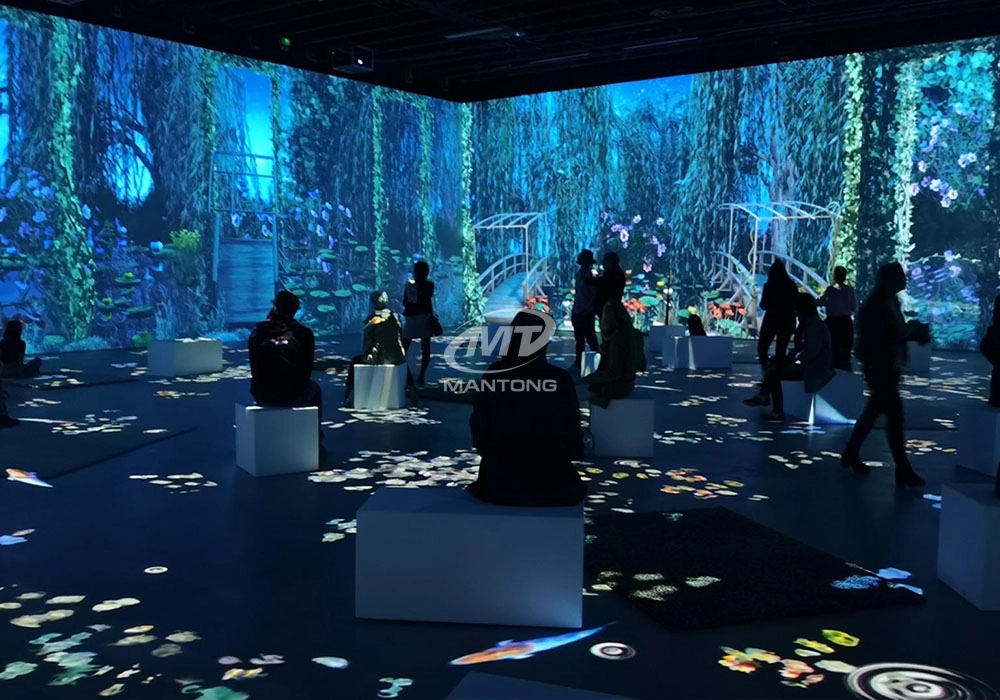
Mantong 6500LM High-Lumen Projector for Large-Scale Immersive Room Projection
Transform any space with Mantong's immersive projection mapping systems. Our high-lumen projectors (up to 6500 LM) and custom software create captivating interactive experiences for floors and walls. Ideal for museums, events, retail, and hospitality. Each kit includes professional ceiling mounting and 80+ pre-loaded video contents and is backed by a 12-month warranty and CE certification. We offer full customization and support to bring your vision to life.
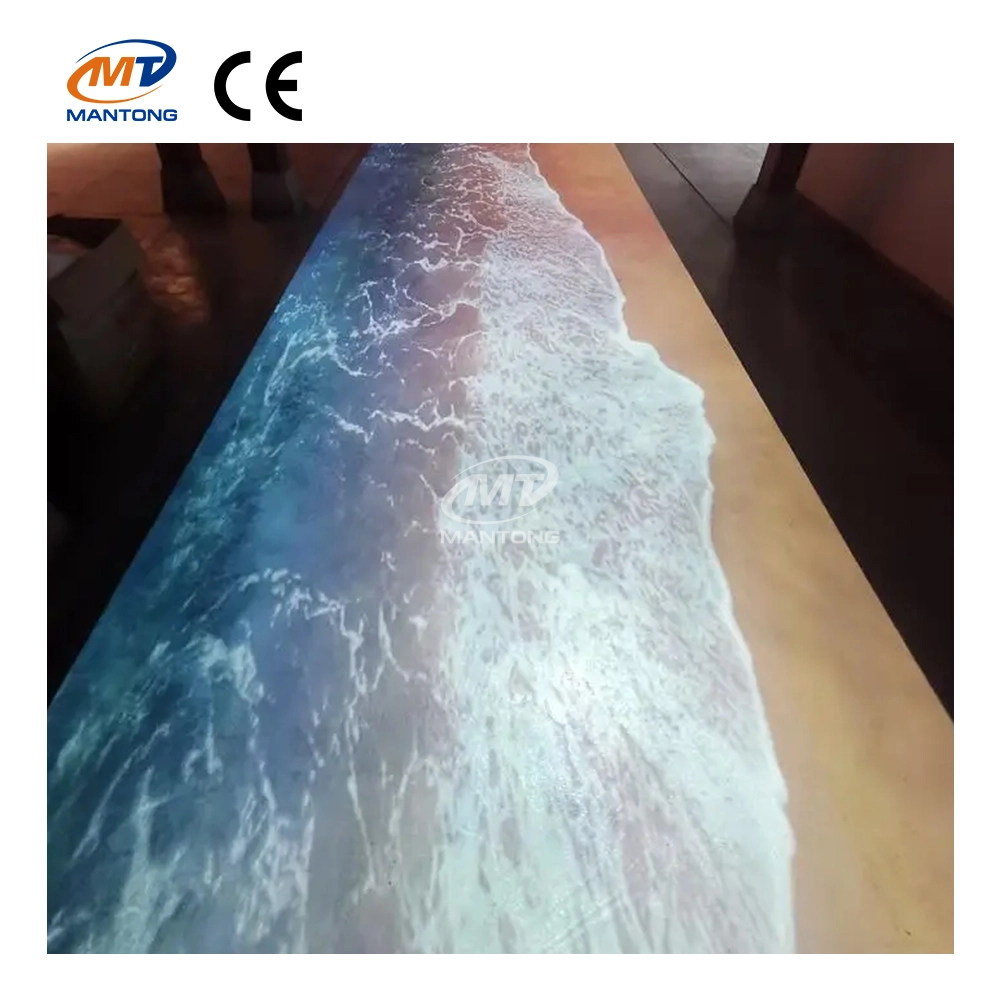
Indoor Interactive Floor Projector System - Customized Design & Installation Support
Indoor interactive floor projections display dynamic themed videos on the floor, commonly used in venues aiming to enhance brand influence or attract foot traffic, such as restaurants, hotel corridors, and brand car retail stores.
By using projectors and compatible software, the interactive content is projected onto the floor, encouraging engagement between people and the projected visuals. A single 5500-lumen indoor floor projector can cover an area of 5 m × 3 m. Typically, each project will use at least 3 units to ensure broad coverage and optimal visual effects.
We also offer customized design and installation support to enhance the interactive experience for your venue.
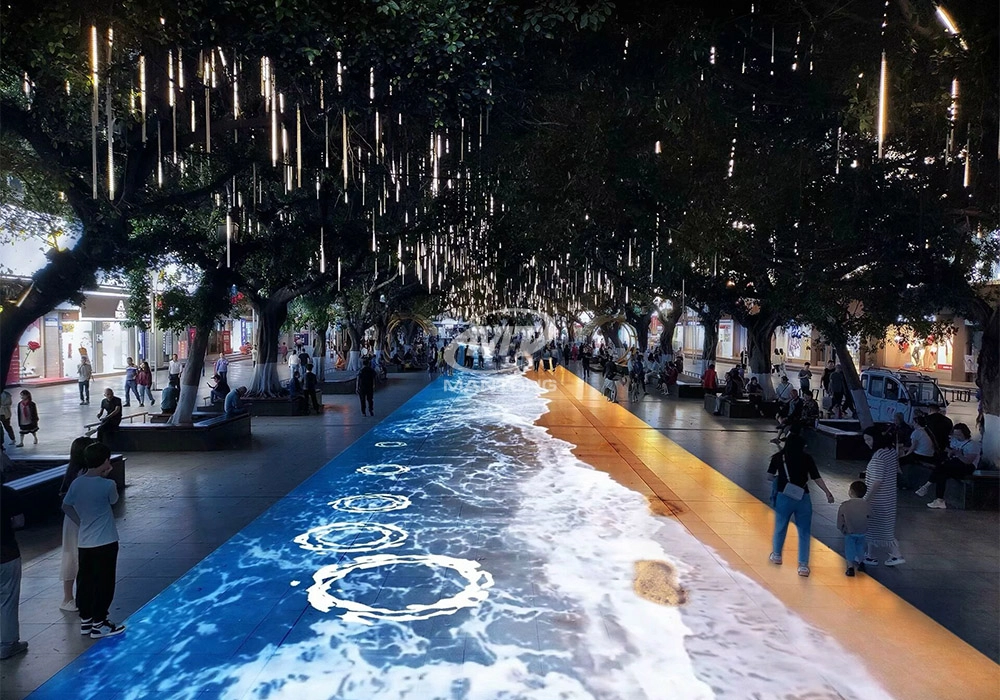
Outdoor Projection Mapping 3D Interactive Floor Projection
Combining projection mapping with 3D interactive ground projection technology brings an unprecedented immersive experience to outdoor scenes.
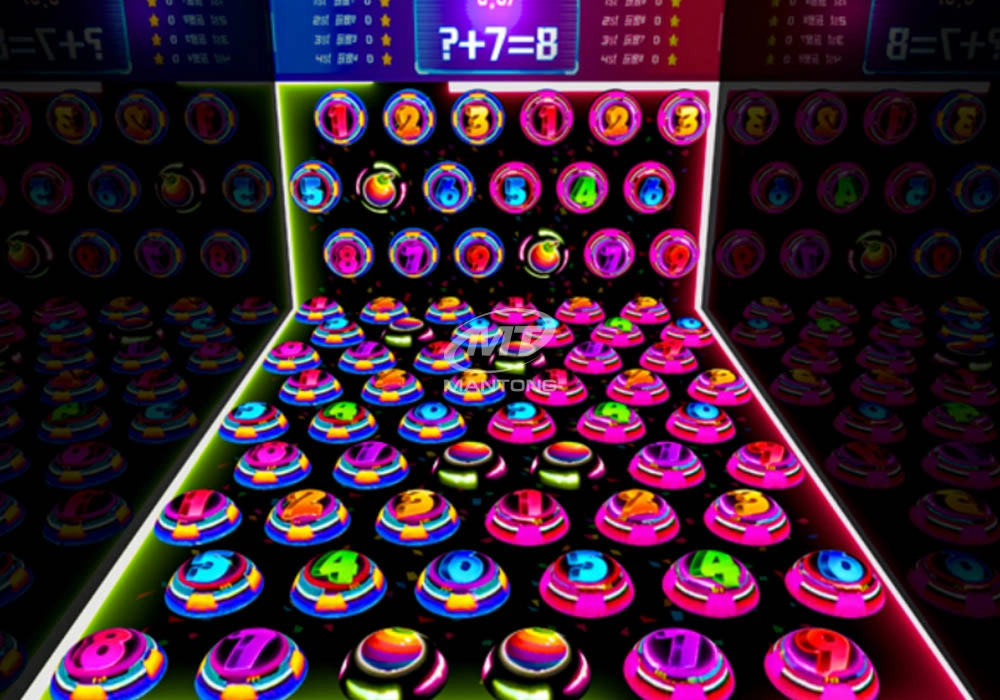
Amusement Rapidly Rotating Bouncing Sphere Interactive Wall Floor Projection Sports Games
Rapidly Rotating Bouncing Sphere is an interactive space where participants jump on rotating spheres. As they step on it, the spheres surface will show special interactivity
Jumping on spheres of the same color in succession causes them to pop, releasing light particles. The more consecutive jumps, the greater the reward—caterpillars appear, and eventually, all spheres of that color burst, filling the space with light and even more caterpillars.

Kaida Business Center, Shixin Road, Panyu District,Guangzhou City, Guangdong Province, China.
ManTong
ManTong
ManTong