
Top interactive floor games for schools and classrooms
- Why interactive floor projector games are reshaping modern classrooms
- Literacy boost: interactive floor projector games for reading and language
- Math and STEM: best interactive floor projector games for numeracy
- Physical education and motor skills: interactive floor projector games for active learning
- Social-emotional learning: collaborative interactive floor projector games
- How to choose hardware and software for interactive floor projector games
- Installation, classroom management and content strategy for interactive floor projector games
- Measuring impact: assessment strategies with interactive floor projector games
- Mantong Digital: a partner for scalable interactive floor projector games
- Common challenges and mitigation strategies for interactive floor projector games
- Cost considerations and budgeting for schools
- Frequently Asked Questions about interactive floor projector games
- 1. Are interactive floor projector games safe for classroom use?
- 2. What age groups benefit most from interactive floor projector games?
- 3. How do interactive floor projector games align with curriculum standards?
- 4. What maintenance is required for interactive floor projector systems?
- 5. Can teachers create their own interactive floor projector games?
- 6. How do I measure whether these games improve learning?
- References
Why interactive floor projector games are reshaping modern classrooms
Interactive floor projector games have moved from novelty demo rooms into everyday classrooms because they combine movement, multisensory stimulation and instant feedback — ingredients that support engagement and deeper learning. Research on active learning shows that student-centered, interactive activities significantly improve outcomes in STEM and general learning domains (Freeman et al., PNAS, 2014). For elementary and middle-school students, interactive floor games address kinesthetic learning preferences, support differentiated instruction and make inclusive, hands-on learning feasible for whole groups.
Literacy boost: interactive floor projector games for reading and language
Interactive floor projector games for literacy are particularly effective for early readers and English language learners. Examples include:
- Word Hunt — students run to projected letter tiles to form words, reinforcing phonics and sight vocabulary.
- Sentence Builder — move-and-place sentence components to practice syntax, tenses and punctuation.
- Phonics Pond — a fishing-style game where children 'catch' words with a target sound.
Classroom application tips: align the game content to your week’s learning objectives, set time-bound rounds for formative checks, and use paired or small-group play to build language interaction. Progress can be tracked by the number of correct formations per round and time-to-completion metrics collected via simple teacher observation sheets or built-in software logs.
Math and STEM: best interactive floor projector games for numeracy
Interactive floor projector games for math make abstract concepts concrete through movement and visualization. Popular game formats:
- Number Chase — step on numbers in sequence or answers to mental math prompts.
- Shape Sorting Arena — match projected shapes to categories, teaching geometry vocabulary and spatial skills.
- Math Relay — teams solve problems then physically run to the right answer.
Alignment: these games map well to common core and national standards for K–8 math when tasks are designed around grade-level objectives. Use adaptive difficulty to differentiate: increase problem complexity or add time pressure for older students. Collect evidence by recording correct responses and response times; this supports formative assessment and individualized remediation.
Physical education and motor skills: interactive floor projector games for active learning
Interactive floor projector games for PE and motor development combine cardio, coordination and cognitive tasks. Examples include:
- Fitness Dash — follow patterns of steps and jumps projected on the floor, varying intensity.
- Balance Path — projected narrow paths requiring slow, balanced movement to build proprioception.
- Reaction Race — quick-step responses to changing targets that develop reaction time.
Safety and logistics: ensure non-slip floor coverings, clear boundaries, and teacher supervision. Integrate games within PE curricula to meet physical literacy goals and use simple heart-rate monitors or observational rubrics to track intensity and progress.
Social-emotional learning: collaborative interactive floor projector games
Interactive floor projector games for SEL encourage cooperation, perspective-taking and emotional vocabulary. Examples:
- Team Quest — small groups solve puzzles requiring coordinated movement and role-taking.
- Emotion Explorer — match facial expressions to scenarios, then role-play responses.
- Problem-Solve Maze — groups negotiate routes while following classroom norms.
Use debriefs after play to scaffold reflection: What strategies worked? How did the team resolve conflict? These conversations turn play into explicit SEL instruction and can be recorded in student reflection journals.
How to choose hardware and software for interactive floor projector games
Choosing the right system for interactive floor projector games is as important as the game design. Key considerations include projector throw type, brightness, sensor technology, floor surface compatibility and content software flexibility. Below is a practical comparison to guide decision-making:
| Component | Options | Pros | Cons |
|---|---|---|---|
| Projector type | Ultra-short-throw / Short-throw / Ceiling standard | Reduces shadows (UST), flexible mounting (short-throw) | UST can be more costly; standard throws need more space |
| Brightness | 2000–5000 lumens (classroom recommended range) | Higher lumens for bright rooms; more visible graphics | Higher lumen projectors cost more and may need better cooling |
| Sensor | Camera-based / Infrared (IR) / Pressure-sensitive mat | Camera: flexible, accurate; IR: low latency; Mats: reliable contact detection | Camera needs calibration and lighting control; mats limit layout |
| Mounting | Ceiling-mounted / Wall-mounted / Portable trolley | Ceiling: permanent, out-of-reach; Portable: flexible usage | Portable units are less stable; ceiling installation needs planning |
| Software | Pre-built lesson libraries / Custom content editors | Pre-built: quick deployment; Custom: curriculum alignment | Custom development requires time and expertise |
Source guidance: projector throw and sensor trade-offs are commonly discussed by industry resources such as ProjectorCentral. Brightness ranges align with recommendations for education environments (see references).
Installation, classroom management and content strategy for interactive floor projector games
Deployment best practices minimize disruption and maximize learning impact:
- Perform a pilot in one classroom to test light conditions, mounting height and traffic flow.
- Plan content schedules: rotate game genres (literacy, math, PE, SEL) to align with weekly lessons.
- Train staff: a 1–2 hour workshop helps teachers run sessions and interpret basic logs.
- Establish safety rules and floor boundaries; post visual reminders next to the activity space.
- Backup plan: have low-tech alternatives for days when the system is unavailable.
Measuring impact: assessment strategies with interactive floor projector games
To prove impact, combine quantitative and qualitative measures:
- Pre/post-tests linked to the game objective (e.g., phonics inventory before/after Word Hunt).
- In-game analytics: correct responses, time-to-completion, and participation counts.
- Observation rubrics for collaboration, motor skills, and engagement.
- Student reflection and teacher logs to capture perceived learning and usability.
Pair classroom data with broader evidence on active learning benefits for stronger claims (Freeman et al., 2014). For longitudinal evaluation, measure retention after several weeks and compare to matched control classes when possible.
Mantong Digital: a partner for scalable interactive floor projector games
Mantong Digital is a one-stop interactive projection solution provider and direct manufacturer based in Guangzhou, China, with over 10 years of industry experience. We are dedicated to providing innovative, flexible and cost-effective projection solutions, offering both hardware and software to meet various needs. At ManTong, we specialize in providing customized solutions for a wide range of application scenarios through innovative projection technology. Whether it's immersive experiences, interactive entertainment or outdoor lighting and projection shows, our solutions can transform your ideas into stunning visual effects. Our projection technology provides customized solutions for a variety of scenarios, delivering immersive and interactive visual experiences. We are now looking for business partnerships worldwide. Our vision is to become the world's leading interactive projection manufacturer. Our website is https://www.mtprojection.com/.
Mantong advantages and main products for schools include:
- Direct manufacturing model: cost control and faster customization cycles for schools and districts.
- Comprehensive product range: immersive projection, interactive floor projection, interactive wall projection, immersive rooms, 3D projection, interactive projection games, projection shows, and interactive projection mapping.
- End-to-end services: hardware supply, software/game development, installation guidance and after-sales technical support.
- Technical strengths: integration of camera-based and IR sensing, optimized content engines for low-latency interaction, and modular systems that scale from single classrooms to whole-campus installations.
- Proven experience: over a decade in projection systems, with case studies in education, museums and corporate training environments.
Why schools choose Mantong for interactive floor projector games:
- Customization: match game content to curriculum standards and language needs.
- Affordability: manufacturer pricing and flexible packages (hardware + software + training).
- Deployment support: remote commissioning and local partner networks for installation.
- Content ecosystem: ready-made lesson libraries and authoring tools for teacher-created games.
Contact Mantong to discuss pilot programs, volume pricing for multi-classroom rollouts, or custom game development that aligns with your district's standards.
Common challenges and mitigation strategies for interactive floor projector games
Challenges when adopting interactive floor projector games include ambient light interference, wear on floor surfaces, scheduling conflicts, and teacher confidence with new tech. Mitigation tactics:
- Use higher-lumen projectors or controllable window shades to combat bright rooms.
- Choose durable non-slip mats or robust floor films for high-traffic installations.
- Integrate activities into existing lesson plans to avoid scheduling friction.
- Offer short, hands-on teacher training and classroom-ready lesson packs to lower the adoption barrier.
Cost considerations and budgeting for schools
Budgeting should include hardware (projector, sensor, mounting), software licenses or development, installation, teacher training and maintenance. Options to control costs:
- Start with a single portable kit before committing to fixed installations.
- Consider software-as-a-service (SaaS) licenses that bundle content and updates.
- Explore grant funding for technology in education and inclusive learning initiatives.
Frequently Asked Questions about interactive floor projector games
1. Are interactive floor projector games safe for classroom use?
Yes — when safety steps are followed. Use non-slip floor surfaces, maintain clear activity zones, keep projector cables secured and provide teacher supervision. Pilot testing and simple rules (no running near walls, feet-only on the mat, etc.) reduce risk.
2. What age groups benefit most from interactive floor projector games?
Primary and early secondary students (K–8) typically show the largest gains because games support kinesthetic learning and foundational skills (phonics, number sense, motor skills). However, appropriately designed games can engage older students for review, team-building and STEM simulations.
3. How do interactive floor projector games align with curriculum standards?
Games can be designed to target specific learning objectives (e.g., 2nd-grade addition strategies or Year 4 geometry). Work with vendors or use content authoring tools to tag activities to standards, enabling teachers to select grade- and skill-appropriate games.
4. What maintenance is required for interactive floor projector systems?
Maintenance typically includes projector lamp/LED checks, sensor calibration, cleaning lenses and floor surfaces, and software updates. Schools should schedule routine checks (monthly/termly) and keep spare parts like mounts and cables available.
5. Can teachers create their own interactive floor projector games?
Many vendors (including Mantong) provide authoring tools that allow teachers to customize content without programming. For deeper customization, vendors also offer development services to turn lesson plans into interactive experiences.
6. How do I measure whether these games improve learning?
Use a mix of pre/post assessments aligned to game objectives, in-game analytics (accuracy, speed, participation) and observational rubrics for skills like collaboration and motor control. Where possible, run a short controlled comparison to quantify gains.
Ready to pilot interactive floor projector games in your school? Contact Mantong Digital for tailored solutions, pricing and pilot programs: https://www.mtprojection.com/.
References
- Freeman, S., et al. (2014). Active learning increases student performance in science, engineering, and mathematics. Proceedings of the National Academy of Sciences (PNAS). https://www.pnas.org/content/111/23/8410 (accessed 2025-12-13)
- Edutopia. Kinesthetic Learning in the Classroom. https://www.edutopia.org/article/kinesthetic-learning-classroom (accessed 2025-12-13)
- UNESCO. ICT in Education. https://en.unesco.org/themes/icts-education (accessed 2025-12-13)
- ProjectorCentral. Technology and installation guidance for education projectors. https://www.projectorcentral.com/ (accessed 2025-12-13)
- ManTong Digital (Mantong). Company website and product information. https://www.mtprojection.com/ (accessed 2025-12-13)
Top interactive projection applications for hospitality
Best Immersive Meeting Room Trends 2025: What Businesses Should Know manufacturers and supplier brands
Best How Interactive Projector Games Are Changing Entertainment Spaces manufacturers and supplier brands
What is interactive tabletop projector ?
One-Stop Projection Solution Provider Since 2011
What's the application of Immersive projection ?
It can be used in various venues, such as art exhibition, entertainment venues, educational institution, Wedding hall /Banquet/Bar,Yoga Studio and so on. It often involves advanced projection techniques, multimedia content, and interactive elements to engage and captivate the audience's senses.
What about the wall/floor material for the projection?
It’s recommended to choose a light-colored material with minimal reflectivity—pure white or light grey works best. the
common material is cement & plaster board
For optimal projection results, the surface should be free of any patterns or textures, as the projector will display content
directly onto it.
There are no specific material requirements; you may use any commonly available material in your local market, as long as it
meets the above conditions.
What's Immersive Projection ?
Immersive projection refers to a technology that creates a captivating and all-encompassing visual experience for viewers by projecting images or videos onto large surfaces, such as walls, floors, or even entire rooms. This technology aims to immerse the audience in a simulated environment, blurring the boundaries between the physical and virtual worlds.
Are you trader or manufacturer ?
We are direct manufacturer who specialize in providing one-stop solution for different outdoor & indoor projection project with our stable software and qualified projectors
How to install the projection equipment ?
1) Install the projector in a suitable position. We will provide you with a hanger, which you need to fix on the ceiling with
screws.
2) Connect projectors, computers and other accessories through wires.
3) After completing the above 2 steps, we will carry out the edge blending steps. Our team can complete it through remote
control.
In general, installation instructions for each project need to be specified on a project-by-project basis. The above is for
reference only.
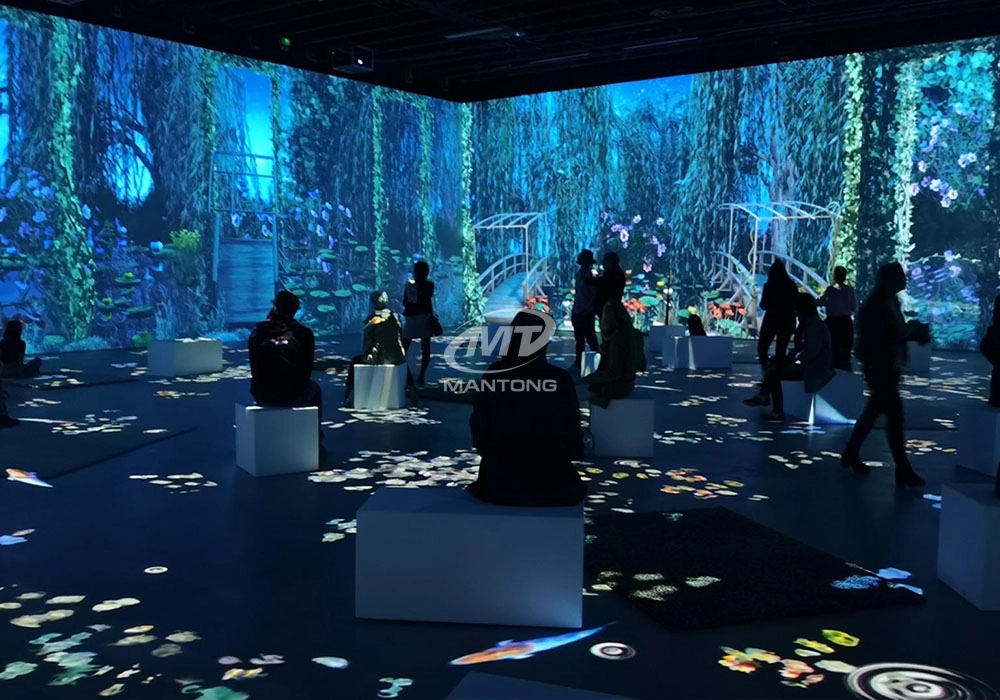
Mantong 6500LM High-Lumen Projector for Large-Scale Immersive Room Projection
Transform any space with Mantong's immersive projection mapping systems. Our high-lumen projectors (up to 6500 LM) and custom software create captivating interactive experiences for floors and walls. Ideal for museums, events, retail, and hospitality. Each kit includes professional ceiling mounting and 80+ pre-loaded video contents and is backed by a 12-month warranty and CE certification. We offer full customization and support to bring your vision to life.
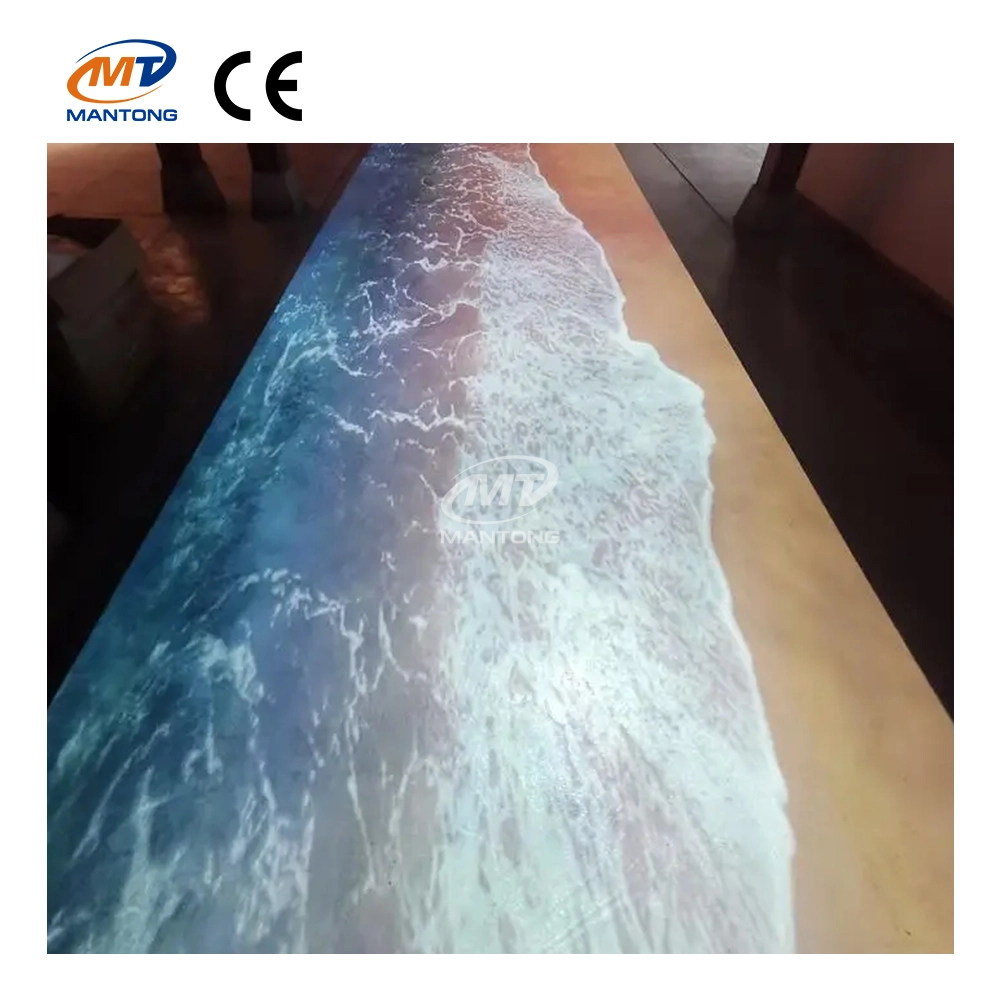
Indoor Interactive Floor Projector System - Customized Design & Installation Support
Indoor interactive floor projections display dynamic themed videos on the floor, commonly used in venues aiming to enhance brand influence or attract foot traffic, such as restaurants, hotel corridors, and brand car retail stores.
By using projectors and compatible software, the interactive content is projected onto the floor, encouraging engagement between people and the projected visuals. A single 5500-lumen indoor floor projector can cover an area of 5 m × 3 m. Typically, each project will use at least 3 units to ensure broad coverage and optimal visual effects.
We also offer customized design and installation support to enhance the interactive experience for your venue.
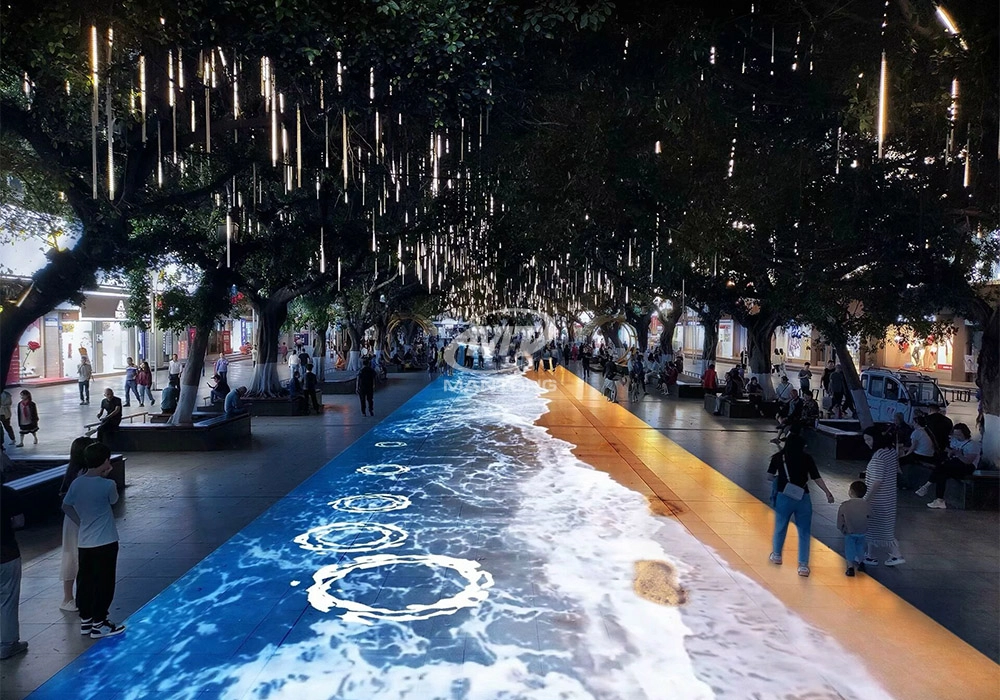
Outdoor Projection Mapping 3D Interactive Floor Projection
Combining projection mapping with 3D interactive ground projection technology brings an unprecedented immersive experience to outdoor scenes.
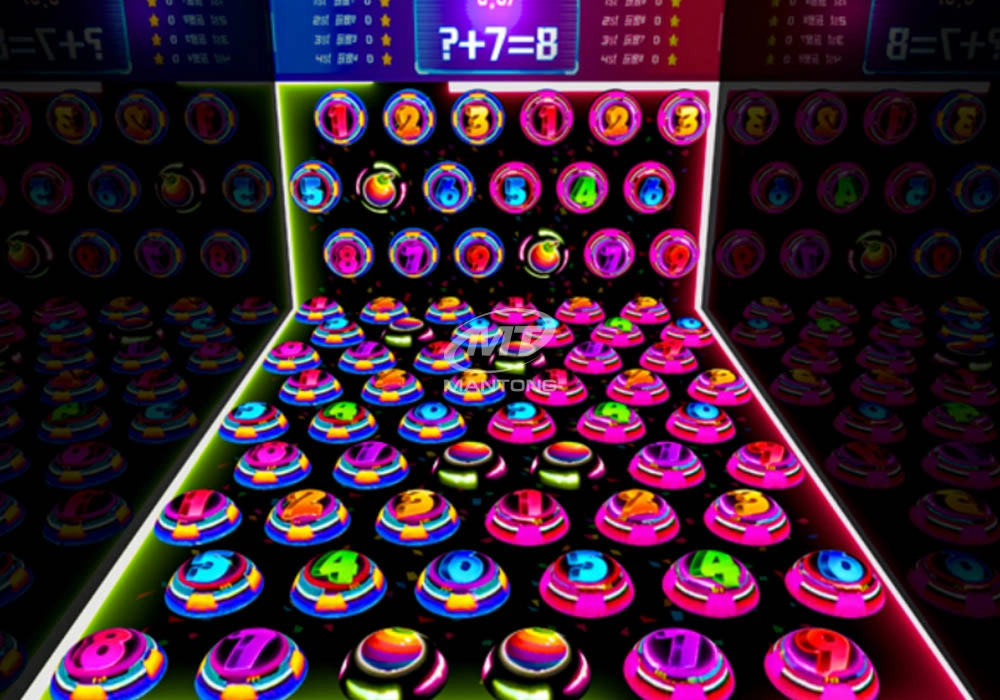
Amusement Rapidly Rotating Bouncing Sphere Interactive Wall Floor Projection Sports Games
Rapidly Rotating Bouncing Sphere is an interactive space where participants jump on rotating spheres. As they step on it, the spheres surface will show special interactivity
Jumping on spheres of the same color in succession causes them to pop, releasing light particles. The more consecutive jumps, the greater the reward—caterpillars appear, and eventually, all spheres of that color burst, filling the space with light and even more caterpillars.

Kaida Business Center, Shixin Road, Panyu District,Guangzhou City, Guangdong Province, China.
ManTong
ManTong
ManTong