
Interactive Floor Games vs Traditional Floor Displays
- Trends Driving Immersive and Interactive Experiences
- Growing demand for experiential engagement
- Technological enablers
- User behavior and accessibility trends
- Technical and Interaction Differences
- How interactive floor games work
- How traditional floor displays operate
- Sensors, latency and accuracy
- Comparing Outcomes: Engagement, Costs and Use Cases
- Engagement metrics and KPIs
- Cost of deployment and TCO
- Best-fit use cases
- Implementation Strategy, Maintenance and Compliance
- Site survey and technical planning
- Content strategy and UX design
- Maintenance, analytics and lifecycle
- Mantong Digital: Manufacturer Capabilities and Why It Matters
- Who we are and what we offer
- Our core strengths
- Products and solutions
- Choosing Between Interactive Floor Games and Traditional Floor Displays — Practical Recommendations
- Decision flow: questions to ask
- Suggested matches
- Pilot first, scale later
- FAQ
- 1. What are interactive floor games?
- 2. How do interactive floor games compare to LED floor tiles?
- 3. Are interactive floor games hygienic and accessible?
- 4. What maintenance do interactive floor systems require?
- 5. How can I measure ROI for an interactive floor installation?
- 6. Can Mantong provide a custom pilot or demonstration?
Interactive floor games have become a powerful tool for engagement in retail, museums, education and entertainment venues. This article compares interactive floor games and traditional floor displays across technology, user experience, measurable outcomes and total cost of ownership. It provides actionable guidance for decision-makers who need to choose a solution that maximizes dwell time, accessibility and return on investment while fitting technical and operational constraints.
Trends Driving Immersive and Interactive Experiences
Growing demand for experiential engagement
Consumers and visitors increasingly expect immersive, interactive experiences. Market research shows rising investments in interactive display technologies as brands and institutions seek higher dwell times and social sharing. Reports from industry analysts indicate the interactive display market is growing year-over-year, driven by demand in entertainment, retail and education (Grand View Research, MarketsandMarkets).
Technological enablers
Key enablers for interactive floor games include high-lumen projection, depth cameras (ToF, infrared), computer vision algorithms and low-latency rendering engines. Projection mapping and interactive projection techniques have matured; see the overview of projection mapping on Wikipedia. These advances make large-scale, touchless interactions feasible and cost-effective.
User behavior and accessibility trends
Health and hygiene concerns have increased interest in contactless interactive systems. Interactive floor games that rely on motion and position detection (rather than touch) align with these concerns and can be more inclusive for wheelchair users or visitors with limited reach if properly designed.
Technical and Interaction Differences
How interactive floor games work
Interactive floor games typically combine a projector, a tracking sensor (camera, infrared sensor, or LiDAR), and specialized software. The system projects dynamic content onto the floor and uses real-time tracking to detect feet, bodies or objects. The software maps physical movements to game logic, enabling responsive visuals like footprints, bubbles, or sports simulations. This combination supports large interaction areas and multi-user experiences.
How traditional floor displays operate
Traditional floor displays include static printed floor graphics, LED floor tiles and non-interactive projection (e.g., looping videos). They are primarily visual-only and do not respond to visitor actions. LED floor tiles provide durability and brightness but are typically fixed in content unless physically replaced or networked with centralized controllers for simple animations.
Sensors, latency and accuracy
Interactive floor games require sub-100ms system latency to feel responsive. Sensor selection affects accuracy and cost: depth cameras offer reliable body tracking in mixed lighting; infrared arrays are cost-effective for basic presence detection. Traditional floor displays have no sensing requirements, so their performance constraints are limited to brightness and durability.
Comparing Outcomes: Engagement, Costs and Use Cases
Engagement metrics and KPIs
Interactive floor games can measurably increase dwell time, repeat visitation and social media sharing. Typical KPIs to track include average dwell time, interaction count per hour, unique users per day and conversions (e.g., purchases after interaction). Case studies in museums and retail often report dwell time increases of 20–200% depending on design and context, although specific numbers vary by venue and content quality.
Cost of deployment and TCO
Initial costs differ: traditional floor solutions (printed graphics, LED tiles) may have lower initial complexity but can be expensive if frequent content refreshes are needed. Interactive floor games have higher upfront costs for projection and sensors plus software development, but they often yield better long-term value by supporting dynamic content, remote updates and analytics.
Best-fit use cases
Interactive floor games excel in environments where active engagement and social interaction are goals: museums, family entertainment centers, experiential retail, trade show booths and educational installations. Traditional floor displays are appropriate for high-traffic corridors where durability and simplicity matter, or where budget and maintenance resources are limited.
| Feature | Interactive Floor Games | Traditional Floor Displays |
|---|---|---|
| Interactivity | High — motion-based, multi-user, dynamic content | Low — static visuals or pre-programmed loops |
| Engagement | Higher dwell time and social share potential | Lower — depends on visual appeal |
| Initial cost | Medium–High (projector, sensors, software) | Low–Medium (printing, LED tiles) |
| Maintenance | Moderate — sensor calibration, projector lamp/filters | Low — occasional cleaning or tile replacement |
| Content flexibility | Very flexible — remote updates, seasonal themes | Limited — physical replacement or rigid programming |
| Analytics | Built-in interaction data possible | None or limited (requires external sensors) |
| Accessibility | High if designed for multi-modal input (motion, audio) | Variable — can be more accessible if simple visuals |
| Typical lifespan | 5–10+ years (depends on hardware refresh) | 5–15+ years (depends on materials) |
Data sources: market summaries and technology overviews from Grand View Research and technology descriptions on Wikipedia. Specific ROI will vary by location, volume and creative quality; collect baseline KPIs before deployment to measure impact.
Implementation Strategy, Maintenance and Compliance
Site survey and technical planning
Begin with a site survey: measure ambient light, ceiling height, floor reflectivity, power availability and foot-traffic patterns. These factors determine required projector lumen output, throw ratio, sensor placement and content scale. For example, high ambient light increases required projector brightness and affects image contrast.
Content strategy and UX design
Design content for short interaction loops (5–30 seconds) to accommodate high throughput. Include visual cues for approach, clear affordances for interaction and fallback content for when sensors momentarily fail. For accessible design, provide multiple interaction modes (motion, audio prompts) and ensure color contrast for people with visual impairment. Usability guidance from standards such as ISO 9241 (ergonomics of human-system interaction) can inform UX decisions.
Maintenance, analytics and lifecycle
Plan routine checks for projector alignment, lens cleaning, sensor calibration and software updates. Interactive systems benefit from analytics dashboards that capture interaction counts, heatmaps and session duration—data that support iterative content improvement and justify ROI. Traditional displays require less technical maintenance but also provide little behavioral data.
Mantong Digital: Manufacturer Capabilities and Why It Matters
Who we are and what we offer
Mantong Digital is a one-stop interactive projection solution provider and direct manufacturer based in Guangzhou, China, with over 10 years of industry experience. We are dedicated to providing innovative, flexible and cost-effective projection solutions, offering both hardware and software to meet various needs. Our official website: https://www.mtprojection.com/.
Our core strengths
At Mantong, we specialize in customized solutions across application scenarios using advanced projection technology. Key competitive advantages include:
- End-to-end manufacturing and R&D capabilities that reduce lead times and cost.
- Proven experience in immersive projection, interactive floor projection, interactive wall projection and interactive projection mapping.
- Flexible software platforms for interactive projection games and content management, enabling remote updates and analytics.
- Project experience across immersive rooms, 3D projection, projection shows and large-scale installations.
Products and solutions
Mantong's offerings include immersive projection systems, interactive floor projection solutions, interactive wall projection packages, projection mapping services and turnkey interactive projection games. We support custom hardware configurations (projectors, sensors, mounting) and bespoke software development for content, control and analytics. Our target is to become the world's leading interactive projection manufacturer, and we are actively seeking business partnerships worldwide.
For partnership inquiries, technical specifications or a tailored quotation, visit our site or contact Mantong via the website above. Our solutions have been deployed in museums, shopping centers, entertainment venues and outdoor projection events—transforming ideas into memorable, measurable experiences.
Choosing Between Interactive Floor Games and Traditional Floor Displays — Practical Recommendations
Decision flow: questions to ask
Use these questions to guide your choice:
- What is the primary goal? (increase dwell time, wayfinding, branding, durability)
- What is the daily foot traffic and peak density?
- Is contactless interaction a priority due to hygiene or accessibility concerns?
- Are analytics and remote content updates important?
- What is the available budget for CapEx and OpEx?
Suggested matches
Use interactive floor games when your goals include measurable engagement uplift, multi-user play, educational interaction or event activation. Choose traditional floor displays for long-term static messaging, heavy-traffic walkways where robustness is paramount, or very tight budgets.
Pilot first, scale later
Run a small pilot to collect baseline KPIs. For interactive installations, test sensor placement, lighting tolerance and content effectiveness. Pilots reduce risk and provide real data to model ROI for scaled deployments.
FAQ
1. What are interactive floor games?
Interactive floor games are projection-based installations that use sensors and software to detect movement and render responsive content on the floor. They enable touchless, multi-user interactions for play, learning or marketing.
2. How do interactive floor games compare to LED floor tiles?
LED floor tiles are durable and bright, serving well for static or simple animated content. Interactive floor games provide richer interaction through projection and sensors, better suited for dynamic experiences and analytics-enabled campaigns. LED floors may be preferable in extremely high-traffic or outdoor conditions.
3. Are interactive floor games hygienic and accessible?
Yes — they are inherently contactless, which reduces hygiene concerns. Accessibility depends on design: include audio cues, adjustable interaction zones and wheelchair-friendly content to serve diverse users.
4. What maintenance do interactive floor systems require?
Typical maintenance includes projector lamp or filter replacement, lens and sensor cleaning, sensor calibration and periodic software updates. Scheduled preventive maintenance increases reliability and longevity.
5. How can I measure ROI for an interactive floor installation?
Track KPIs such as dwell time, interaction counts, conversion lift (e.g., purchases), repeat visits and social shares. Compare pre-installation baselines and use analytics dashboards to quantify impact.
6. Can Mantong provide a custom pilot or demonstration?
Yes. Mantong Digital offers custom pilots, on-site demonstrations and remote demos to validate concepts. Visit https://www.mtprojection.com/ to request a consultation.
Contact us to discuss specific projects, request technical specifications, or explore partnership opportunities. Mantong Digital is ready to provide consultancy, hardware and software to bring your interactive floor game or projection project to life. Visit https://www.mtprojection.com/ to learn more and get a quote.
What is interactive tabletop projector ?
How to Choose the interactive projection manufacturer and supplier in China?
What is an Immersive Projection Room? Benefits & Uses
Price vs Performance: Selecting the Right Floor Projector
One-Stop Projection Solution Provider Since 2011
How to Write an Interactive-Effect Video Customisation Script ?
① Project Background: Briefly introduce the context in which this interactive scene will be used (e.g., exhibition, museum,
event space, children's area). Example: This scene is part of the “Underwater World” zone in a children's science museum,
designed to be engaging and exploratory.
②Visual Style / Atmosphere: What kind of visual mood are you aiming for? Please describe the color scheme, style, and any
references. it should focus solely on describing the visual aspects of the scene, supported by relevant charts or reference
images.
③ Interaction Points Overview:List each interactive hotspot along with the effect you'd like to trigger when the user
touches or clicks the area. example: when player touch the clownfish, it will swims away with bubble trail (animation effect)
and produce the bubble sound ( sound effect requirement )
④ Static Visual Reference:including but not limited to background image/video, a list of major visual elements (e.g., coral,
rocks, seaweed, fish), which elements should be interactive?
What's Immersive Projection ?
Immersive projection refers to a technology that creates a captivating and all-encompassing visual experience for viewers by projecting images or videos onto large surfaces, such as walls, floors, or even entire rooms. This technology aims to immerse the audience in a simulated environment, blurring the boundaries between the physical and virtual worlds.
Are you trader or manufacturer ?
We are direct manufacturer who specialize in providing one-stop solution for different outdoor & indoor projection project with our stable software and qualified projectors
What information do you need to know before making the proposal/solution?
We know that everyone wants to know the price, but the price of our products is determined by many factors since most of our products are custom, so no ready price list. In order to fast understand what you need, can you send us an inquiry like this?
For example: I am really interested in your immersive projection products, we are a company in the USA and want to install some in my restaurant. It is about 50 meters long, and 5m in width. Projection size you can decide but the length should be not less than 20 meters. We want some content about SeaWorld because our place is all about the sea. Thank you.
What's the application of Immersive projection ?
It can be used in various venues, such as art exhibition, entertainment venues, educational institution, Wedding hall /Banquet/Bar,Yoga Studio and so on. It often involves advanced projection techniques, multimedia content, and interactive elements to engage and captivate the audience's senses.
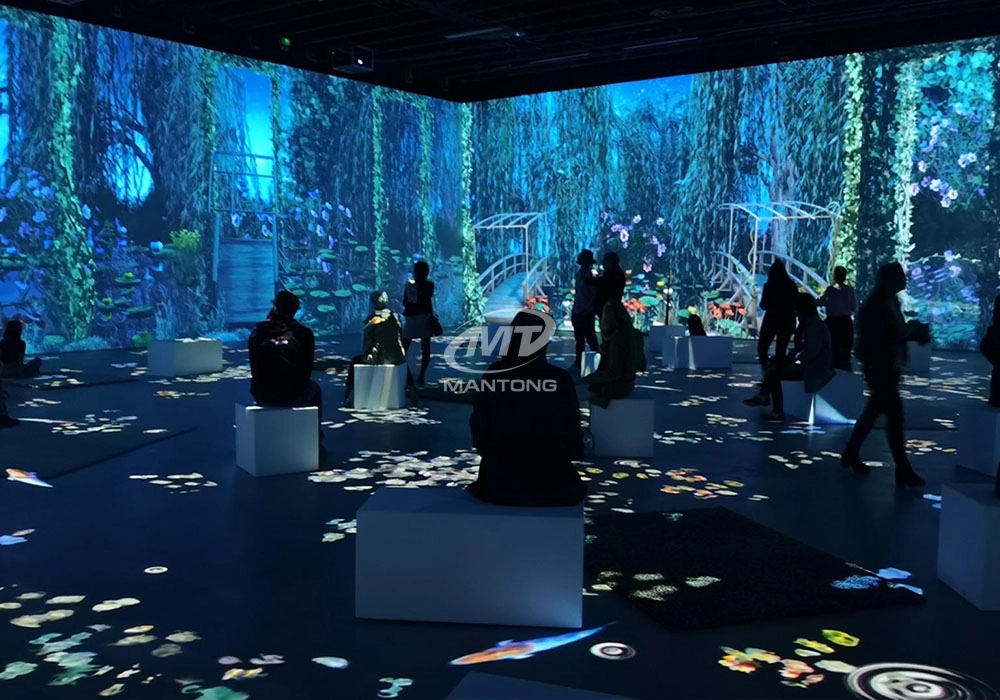
Mantong 6500LM High-Lumen Projector for Large-Scale Immersive Room Projection
Transform any space with Mantong's immersive projection mapping systems. Our high-lumen projectors (up to 6500 LM) and custom software create captivating interactive experiences for floors and walls. Ideal for museums, events, retail, and hospitality. Each kit includes professional ceiling mounting and 80+ pre-loaded video contents and is backed by a 12-month warranty and CE certification. We offer full customization and support to bring your vision to life.
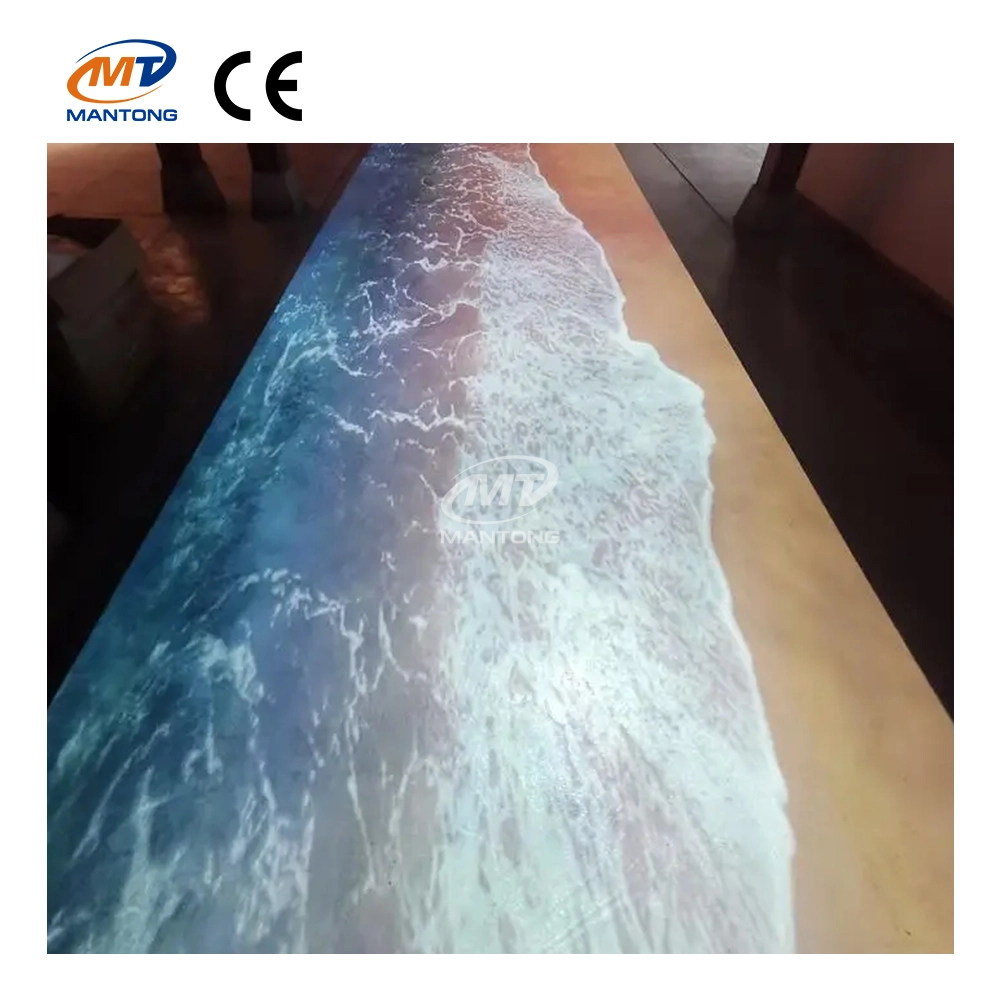
Indoor Interactive Floor Projector System - Customized Design & Installation Support
Indoor interactive floor projections display dynamic themed videos on the floor, commonly used in venues aiming to enhance brand influence or attract foot traffic, such as restaurants, hotel corridors, and brand car retail stores.
By using projectors and compatible software, the interactive content is projected onto the floor, encouraging engagement between people and the projected visuals. A single 5500-lumen indoor floor projector can cover an area of 5 m × 3 m. Typically, each project will use at least 3 units to ensure broad coverage and optimal visual effects.
We also offer customized design and installation support to enhance the interactive experience for your venue.
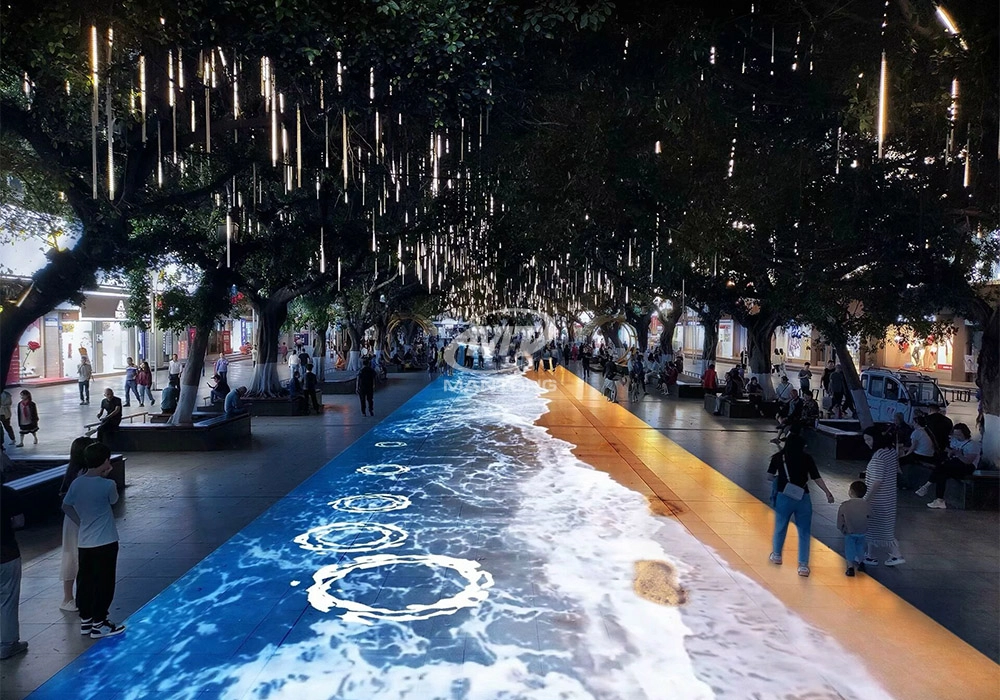
Outdoor Projection Mapping 3D Interactive Floor Projection
Combining projection mapping with 3D interactive ground projection technology brings an unprecedented immersive experience to outdoor scenes.
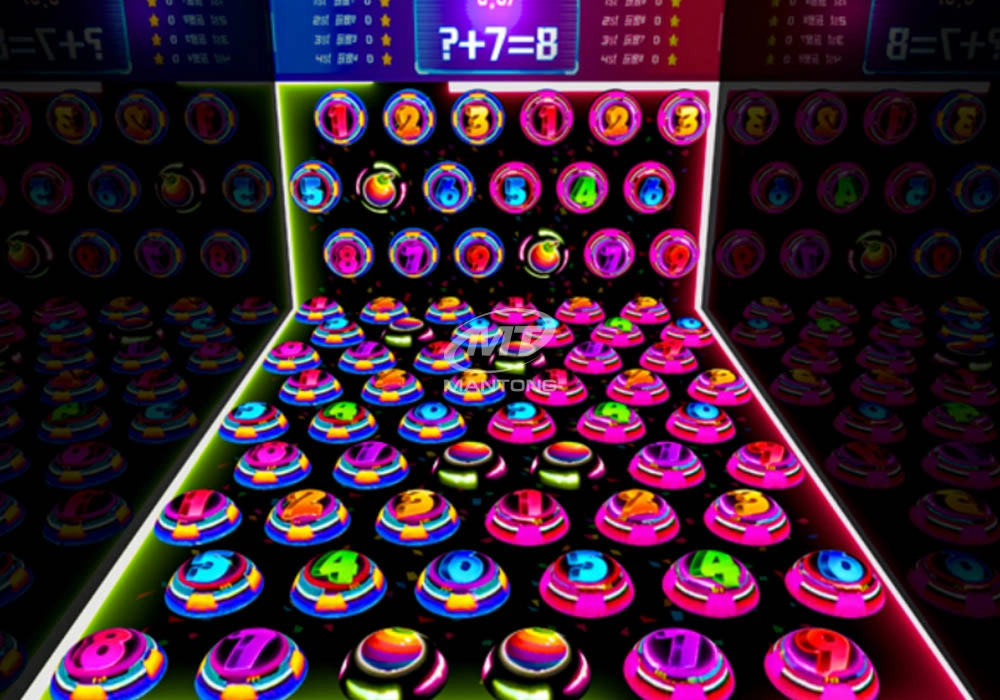
Amusement Rapidly Rotating Bouncing Sphere Interactive Wall Floor Projection Sports Games
Rapidly Rotating Bouncing Sphere is an interactive space where participants jump on rotating spheres. As they step on it, the spheres surface will show special interactivity
Jumping on spheres of the same color in succession causes them to pop, releasing light particles. The more consecutive jumps, the greater the reward—caterpillars appear, and eventually, all spheres of that color burst, filling the space with light and even more caterpillars.

Kaida Business Center, Shixin Road, Panyu District,Guangzhou City, Guangdong Province, China.
ManTong
ManTong
ManTong