
Interactive Floor Projection Installation: Site Survey Checklist
- Preparing Your Site for a Successful Interactive Floor Projection
- Why a formal site survey matters for interactive floor projection installation
- Who should be present during the survey
- Core Measurements and Documentation
- Floor and ceiling geometry
- Surface reflectivity and finish
- Ambient light measurement and mapping
- Projection Hardware and Mounting Considerations
- Projector type and throw requirements
- Mounting points, structural capacity and safety
- Comparing projector types (quick reference)
- Power, Data, Sensors and Cabling
- Power availability and redundancy
- Network and control cabling
- Sensors, cameras and tracking systems
- Operational, Safety and Accessibility Checks
- Fire, egress and regulatory compliance
- Accessibility and user flow
- Cleaning, maintenance and service access
- Testing, Calibration and Acceptance Criteria
- On-site testing checklist
- Calibration and alignment tools
- Acceptance criteria and handover documentation
- Procurement and Vendor Selection Guidance
- Technical vs. commercial evaluation
- Why choose a one-stop interactive projection solution provider
- Vendor profile: ManTong Digital
- FAQs — Interactive Floor Projection Installation
- 1. What ceiling height is required for interactive floor projection?
- 2. How much brightness (lumens) do I need for a floor projection?
- 3. Can interactive floors work with glass or glossy tiles?
- 4. What sensors are best for multi-user tracking?
- 5. How long does a typical installation take?
- Contact and Next Steps
- References
Preparing Your Site for a Successful Interactive Floor Projection
An interactive floor projection installation begins long before the hardware arrives. A proper site survey minimizes surprises, controls cost, and ensures the immersive experience performs as designed. This checklist focuses on the critical physical, electrical and environmental factors you must record and verify on-site to achieve dependable performance and reduce rework during deployment of interactive floor projection systems.
Why a formal site survey matters for interactive floor projection installation
Interactive floor systems combine projection hardware, sensors or cameras, content playback, and control software. Mistakes in throw distance, ceiling mounting, ambient light, or cabling lead to image geometry problems, insufficient brightness, or intermittent sensor tracking. Performing a systematic site survey aligns client expectations, technical choices, and budget before purchase.
Who should be present during the survey
- Project manager or client representative
- Technical integrator or AV consultant
- Facility or site manager (for power, access and timing)
- Content or UX designer if layout or interaction zones are critical
Core Measurements and Documentation
Floor and ceiling geometry
Measure the usable floor area and ceiling height across the entire interaction zone. Note any slopes, steps, or level changes. Capture precise distances to permanent objects (columns, railings) because these affect projection coverage and blind spots for sensors. Record dimensions in both metric and imperial units if needed by stakeholders.
Surface reflectivity and finish
Interactive floor projection installation is strongly influenced by floor surface properties. Record the material (e.g., epoxy, vinyl, tile), color, gloss level and presence of seams or joints. Some high-gloss surfaces cause specular reflections and hotspotting; matte or slightly textured surfaces usually yield more even images and reliable tracking.
Ambient light measurement and mapping
Measure ambient light levels in lux across the intended interaction area at the times the installation will operate. Use a calibrated light meter and create a simple heatmap noting direct light sources (skylights, windows, accent lighting). Typical projector brightness planning uses these values to determine required ANSI lumens for readable, vibrant imagery.
Projection Hardware and Mounting Considerations
Projector type and throw requirements
Selecting the right projector is central to a successful interactive floor projection installation. Choose between short-throw, ultra-short-throw (UST) or ceiling-mounted long-throw projectors based on ceiling height, footprint and safety. Note lens shift and keystone specifications, and calculate actual throw distance from mount location to the intended floor coverage.
Mounting points, structural capacity and safety
Inspect ceiling structure for suitable mounting points. Confirm load capacity, vibration isolation, and route for mounting hardware. If installing overhead projectors in public spaces, document anchor points, fall-protection needs and local code requirements for suspended equipment.
Comparing projector types (quick reference)
| Type | Typical Brightness | Throw Ratio | Advantages | Best for |
|---|---|---|---|---|
| Ultra-short-throw (UST) | 3,000–10,000 ANSI lumens | <0.4 | Minimal ceiling height required; reduced shadowing; neat mounting | Low ceilings, museums, retail displays |
| Short-throw (ST) | 4,000–12,000 ANSI lumens | 0.4–1.0 | Good balance of flexibility and image size; fewer hotspots than long-throw | Galleries, interactive exhibits |
| Long-throw | 8,000–30,000+ ANSI lumens | >1.0 | High brightness for large spaces and ambient light tolerance | Outdoor shows, large atriums |
Sources such as manufacturer specification pages and industry guides (see references) provide exact model numbers and measured ANSI lumen figures for procurement.
Power, Data, Sensors and Cabling
Power availability and redundancy
Document nearby power outlets, dedicated circuits, and UPS or backup power requirements. List circuit breaker labels and distance from equipment locations. For installations running extended hours or critical experiences, plan for UPS to protect media servers, network switches and projectors against brief outages and voltage fluctuations.
Network and control cabling
Record Ethernet access points, VLAN needs, and whether the site supports PoE for sensors. Note planned routes for HDMI/SDI, fiber, or AV-over-IP links. For interactive floor projection installation, low-latency network paths are essential when sensor data is processed remotely or when using networked media servers.
Sensors, cameras and tracking systems
List sensor types (infrared cameras, depth sensors, LIDAR, capacitive mats) and mounting constraints. For camera-based tracking, ensure clear sightlines, avoid reflective surfaces in the camera field and verify mounting heights to prevent obstruction. Record required frame rate and field-of-view to match content interaction design.
Operational, Safety and Accessibility Checks
Fire, egress and regulatory compliance
Confirm local fire code requirements for mounted equipment, cable management and electrical installations. Coordinate with the site authority to ensure egress paths remain unobstructed by temporary housings or cabling. If permanent installations are planned, obtain necessary permits and schedule inspections as part of the project timeline.
Accessibility and user flow
Map user approach lines, typical dwell zones and how multiple users will interact. Ensure floor materials meet slip-resistance standards and that projected interactions do not encourage unsafe crowding near drop-offs or stairs. Include signage or physical barriers if necessary to guide safe usage.
Cleaning, maintenance and service access
Document how the site will manage routine maintenance: projector filter access, lamp or laser module replacement, sensor recalibration and cleaning of floor surfaces. Ensure sufficient access space and list maintenance intervals and responsibility for consumables.
Testing, Calibration and Acceptance Criteria
On-site testing checklist
- Image coverage and edge-to-edge brightness uniformity
- Color accuracy and gamma matching (if multiple projectors)
- Sensor latency and tracking accuracy under different lighting conditions
- Network latency and content delivery verification
- Failover tests for power and media server redundancy
Calibration and alignment tools
Use geometric correction tools, warping and edge-blend utilities, and color calibration hardware for multi-projector arrays. Record final settings and save profiles for quick re-commissioning after service interventions.
Acceptance criteria and handover documentation
Define measurable acceptance criteria such as lux levels, tracking latency (ms), minimum usable brightness (ANSI lumens equivalent), and uptime. Deliver a survey report with as-built drawings, cable routes, device IP addresses, spare parts list and recommended support SLA to the client at handover.
Procurement and Vendor Selection Guidance
Technical vs. commercial evaluation
Balance performance specifications (brightness, throw, lifetime, warranty) with total cost of ownership, including installation labor, maintenance and software licensing. Ensure the vendor can provide both hardware and software support to reduce finger-pointing during commissioning.
Why choose a one-stop interactive projection solution provider
Working with a vendor that supplies both hardware and content/control software simplifies responsibility for system integration and long-term maintenance. A direct manufacturer can also offer customization, spare parts and faster global logistics for rollouts across multiple sites.
Vendor profile: ManTong Digital
ManTong Digital is a one-stop interactive projection solution provider and direct manufacturer based in Guangzhou, China, with over 10 years of industry experience. We are dedicated to providing innovative, flexible and cost-effective projection solutions, offering both hardware and software to meet various needs. At ManTong, we specialize in providing customized solutions for a wide range of application scenarios through innovative projection technology. Whether it's immersive experiences, interactive entertainment or outdoor lighting and projection shows, our solutions can transform your ideas into stunning visual effects. Our projection technology provides customized solutions for a variety of scenarios, delivering immersive and interactive visual experiences. We are now looking for business partnerships worldwide. Our vision is to become the world's leading interactive projection manufacturer. Our website is https://www.mtprojection.com/
Mantong advantages and main products include immersive projection, interactive floor projection, interactive projection, interactive wall projection, immersive room, 3D projection, interactive projection games, projection show, and interactive projection mapping. ManTong's competitive strengths include:
- Direct manufacturing and vertical control of hardware components for competitive pricing and timely spares
- Integrated hardware + software solutions to simplify commissioning and long-term support
- Customization capability for unique form-factors and projection surfaces
- Global project experience and references from museum, retail and entertainment installations
- Dedicated R&D in immersive and interactive projection technologies to maintain technical leadership
If you want to evaluate turn-key interactive floor projection installation solutions or request a site survey from an experienced manufacturer-integrator, contact ManTong Digital through the website above to discuss project scope, timelines, and pricing.
FAQs — Interactive Floor Projection Installation
1. What ceiling height is required for interactive floor projection?
Ceiling height depends on projector type and desired image size. Ultra-short-throw systems can work with ceilings as low as 2.5–3 m, while long-throw solutions need higher clearances. Record exact dimensions and run a throw-distance calculation during the survey.
2. How much brightness (lumens) do I need for a floor projection?
Brightness depends on ambient lux levels and image size. For dim environments, 3,000–6,000 ANSI lumens may suffice. For brighter public spaces, 8,000+ lumens or higher may be required. Measure ambient lux during the site survey and consult manufacturer lumen guides for model selection.
3. Can interactive floors work with glass or glossy tiles?
Highly reflective surfaces can cause hotspots and interfere with camera-based tracking. If the site has glossy tiles or glass, consider adding a diffuse projection surface (removable mat or surface treatment) or using projection hardware and software tuned to compensate for reflections.
4. What sensors are best for multi-user tracking?
Depth sensors and camera-based computer vision systems are common. The choice depends on accuracy, latency and privacy considerations. Depth sensors (e.g., time-of-flight) excel in low-light and can be less sensitive to color variations, while camera-based systems can provide higher resolution interactions when privacy and lighting allow.
5. How long does a typical installation take?
Small installations can be completed in 1–3 days after site prep; larger multi-projector systems with structural work and permits may take several weeks. Proper pre-survey planning shortens on-site time and helps avoid schedule overruns.
Contact and Next Steps
Ready to move from survey to deployment? For professional site surveys, custom interactive floor projection installation quotes, and worldwide partnerships, contact ManTong Digital via https://www.mtprojection.com/. Request a site survey, provide your floor plans and photos, and the team will produce a tailored bill of materials, timeline and estimate.
References
- Projection mapping — Wikipedia, accessed 2026-01-11, https://en.wikipedia.org/wiki/Projection_mapping
- How Many Lumens Do You Need? — ProjectorCentral, accessed 2026-01-11, https://www.projectorcentral.com/How-many-Lumens-do-you-need.htm
- AVIXA (Audiovisual and Integrated Experience Association) — AV Industry Best Practices and standards, accessed 2026-01-11, https://www.avixa.org
- Manufacturer projector specifications and whitepapers — Christie Digital and Epson Pro, accessed 2026-01-11, https://www.christiedigital.com/ and https://epson.com/
- National Fire Protection Association (NFPA) — NFPA 70 (National Electrical Code) guidance, accessed 2026-01-11, https://www.nfpa.org/
What Is an Interactive Projection Solution? A Beginner's Guide
Interactive Floor Projection for Museums and Exhibitions
Where to Buy interactive projection mapping games
Best Uses of Interactive Wall Projection in Museums and Exhibitions
One-Stop Projection Solution Provider Since 2011
What's the application of Immersive projection ?
It can be used in various venues, such as art exhibition, entertainment venues, educational institution, Wedding hall /Banquet/Bar,Yoga Studio and so on. It often involves advanced projection techniques, multimedia content, and interactive elements to engage and captivate the audience's senses.
What's Immersive Projection ?
Immersive projection refers to a technology that creates a captivating and all-encompassing visual experience for viewers by projecting images or videos onto large surfaces, such as walls, floors, or even entire rooms. This technology aims to immerse the audience in a simulated environment, blurring the boundaries between the physical and virtual worlds.
How to install the projection equipment ?
1) Install the projector in a suitable position. We will provide you with a hanger, which you need to fix on the ceiling with
screws.
2) Connect projectors, computers and other accessories through wires.
3) After completing the above 2 steps, we will carry out the edge blending steps. Our team can complete it through remote
control.
In general, installation instructions for each project need to be specified on a project-by-project basis. The above is for
reference only.
What about the wall/floor material for the projection?
It’s recommended to choose a light-colored material with minimal reflectivity—pure white or light grey works best. the
common material is cement & plaster board
For optimal projection results, the surface should be free of any patterns or textures, as the projector will display content
directly onto it.
There are no specific material requirements; you may use any commonly available material in your local market, as long as it
meets the above conditions.
How to Write an Interactive-Effect Video Customisation Script ?
① Project Background: Briefly introduce the context in which this interactive scene will be used (e.g., exhibition, museum,
event space, children's area). Example: This scene is part of the “Underwater World” zone in a children's science museum,
designed to be engaging and exploratory.
②Visual Style / Atmosphere: What kind of visual mood are you aiming for? Please describe the color scheme, style, and any
references. it should focus solely on describing the visual aspects of the scene, supported by relevant charts or reference
images.
③ Interaction Points Overview:List each interactive hotspot along with the effect you'd like to trigger when the user
touches or clicks the area. example: when player touch the clownfish, it will swims away with bubble trail (animation effect)
and produce the bubble sound ( sound effect requirement )
④ Static Visual Reference:including but not limited to background image/video, a list of major visual elements (e.g., coral,
rocks, seaweed, fish), which elements should be interactive?
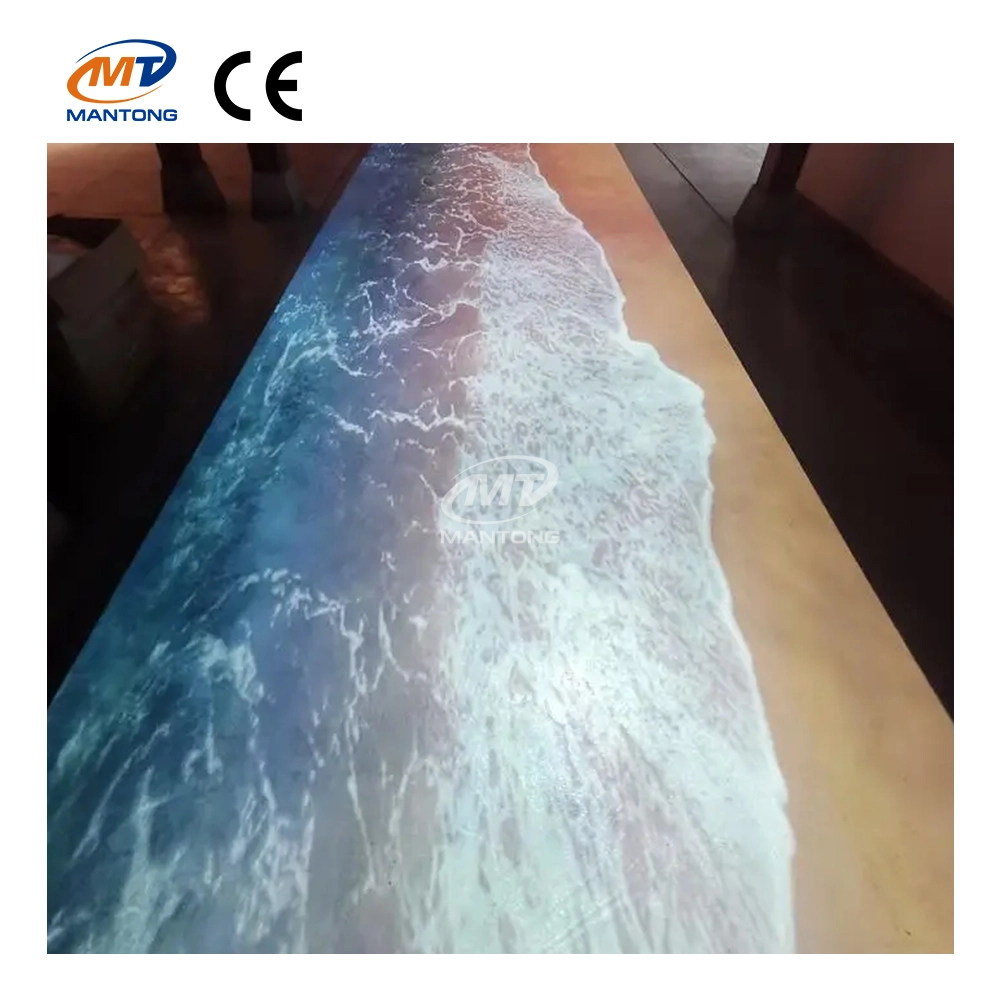
Indoor Interactive Floor Projector System - Customized Design & Installation Support
Indoor interactive floor projections display dynamic themed videos on the floor, commonly used in venues aiming to enhance brand influence or attract foot traffic, such as restaurants, hotel corridors, and brand car retail stores.
By using projectors and compatible software, the interactive content is projected onto the floor, encouraging engagement between people and the projected visuals. A single 5500-lumen indoor floor projector can cover an area of 5 m × 3 m. Typically, each project will use at least 3 units to ensure broad coverage and optimal visual effects.
We also offer customized design and installation support to enhance the interactive experience for your venue.
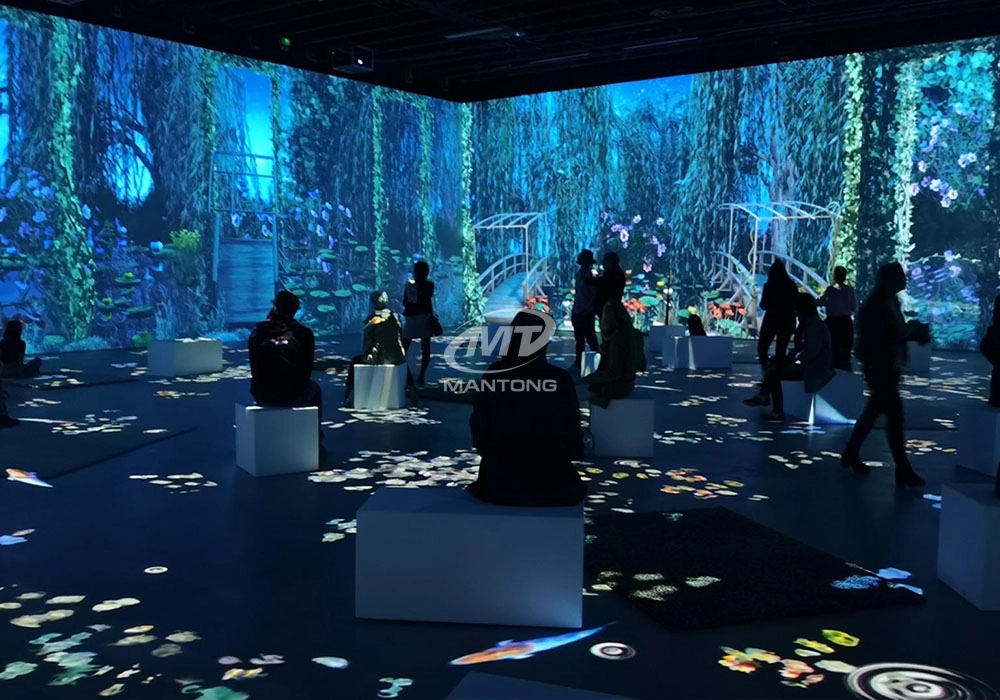
Mantong 6500LM High-Lumen Projector for Large-Scale Immersive Room Projection
Transform any space with Mantong's immersive projection mapping systems. Our high-lumen projectors (up to 6500 LM) and custom software create captivating interactive experiences for floors and walls. Ideal for museums, events, retail, and hospitality. Each kit includes professional ceiling mounting and 80+ pre-loaded video contents and is backed by a 12-month warranty and CE certification. We offer full customization and support to bring your vision to life.
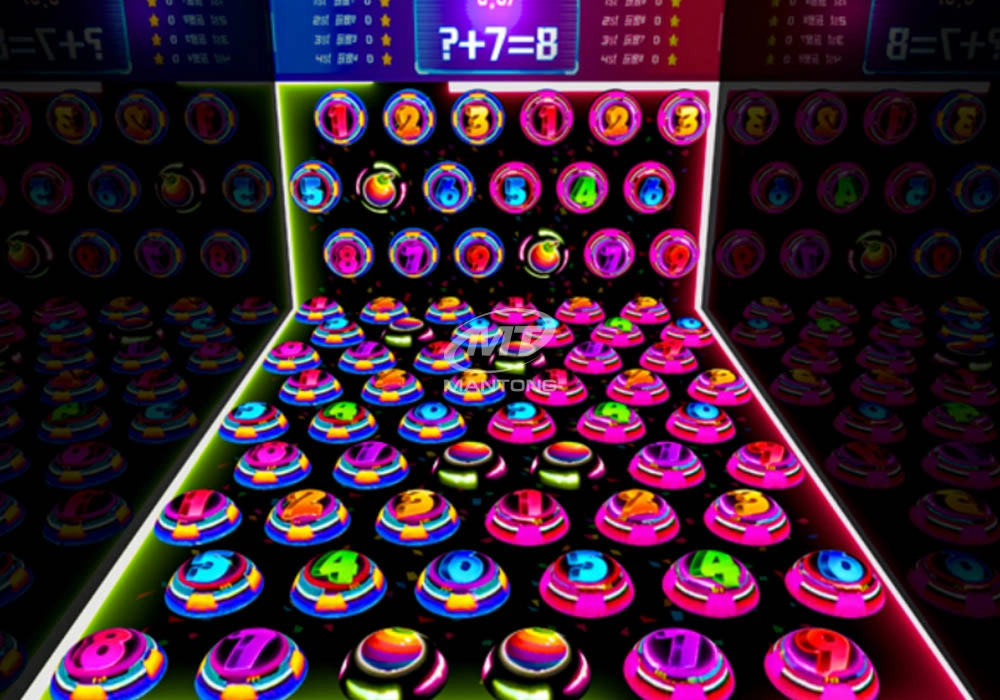
Amusement Rapidly Rotating Bouncing Sphere Interactive Wall Floor Projection Sports Games
Rapidly Rotating Bouncing Sphere is an interactive space where participants jump on rotating spheres. As they step on it, the spheres surface will show special interactivity
Jumping on spheres of the same color in succession causes them to pop, releasing light particles. The more consecutive jumps, the greater the reward—caterpillars appear, and eventually, all spheres of that color burst, filling the space with light and even more caterpillars.
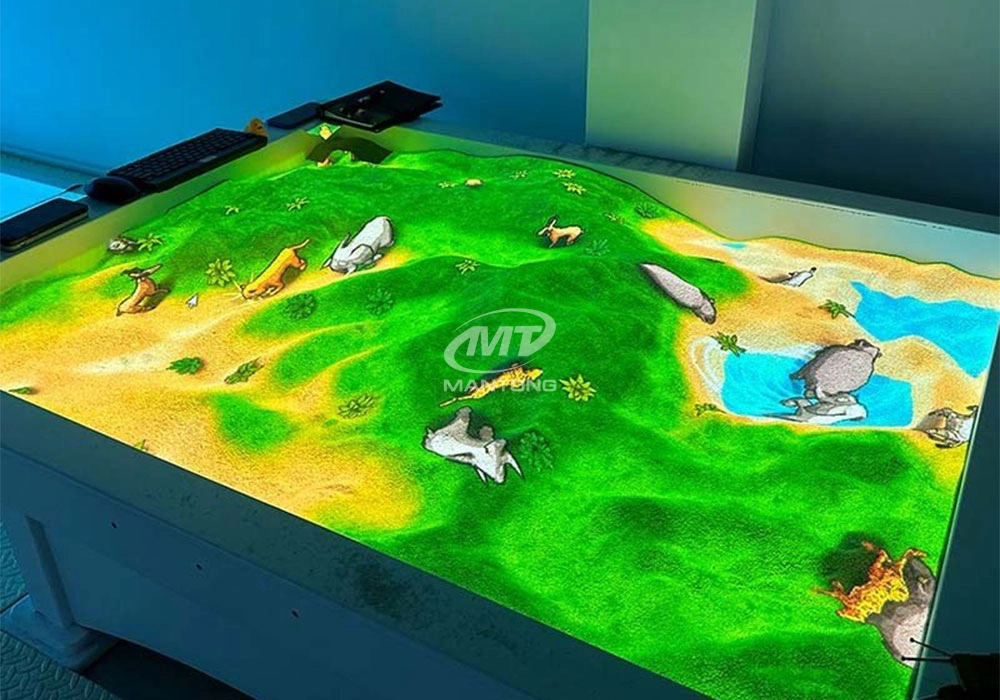
Interactive Sandbox Projection Mapping Games For Kids Play Park
Bring imagination to life with interactive sandbox projection mapping games designed for kids’ play parks. Using cutting-edge projection technology and real-time motion sensing, children can dig, build, and explore virtual worlds directly in the sand. Educational, engaging, and endlessly fun — it’s the perfect blend of play and learning.

Kaida Business Center, Shixin Road, Panyu District,Guangzhou City, Guangdong Province, China.
ManTong
ManTong
ManTong