
Interactive Floor Projection Installation Guide for Beginners
- Getting Started with Interactive Floor Projection
- 1. Define Goals and Requirements for Your Interactive Floor Projection Installation
- Deliverable checklist for project planning
- 2. Choosing the Right Projector: Brightness, Throw Ratio and Resolution
- 3. Mounting and Physical Installation
- 4. Sensor Options and Integration for Interaction
- 5. Software Choices and Content Design
- 6. Calibration, Mapping and Warping
- 7. Electrical, Networking and Power Considerations
- 8. Safety, Accessibility and Maintenance
- 9. Cost Breakdown and ROI Considerations
- 10. Troubleshooting: Common Problems and Fixes
- Partnership & Manufacturer Spotlight: Mantong Digital
- FAQs — Interactive Floor Projection Installation
- 1. How much ceiling height do I need for an interactive floor projection?
- 2. What brightness (lumens) is required for a floor projection in a shopping mall?
- 3. Can I use a single projector for very large floor areas?
- 4. Which sensors are best for multi-user interactive floors?
- 5. How often should I recalibrate the system?
- 6. Is interactive floor projection installation safe for children and large crowds?
- Contact, Consultation & Product Information
- References
Getting Started with Interactive Floor Projection
Interactive floor projection installation is an increasingly popular way to create immersive experiences in museums, retail, hospitality, education and events. This guide walks beginners through the practical decisions and tasks required to plan, install, calibrate and maintain a reliable interactive floor projection system. It emphasizes choices that reduce risk, control cost, and improve engagement — from projector selection and mounting to sensors, software and ongoing support.
1. Define Goals and Requirements for Your Interactive Floor Projection Installation
Before buying equipment, clarify what success looks like. Typical questions to answer:
- Purpose: entertainment, wayfinding, engagement metrics, advertising, education?
- Space: indoor/outdoor, floor material, ceiling height, mounting locations?
- User volume and interaction type: single-user spots, multi-user zones, dwell time?
- Environment: ambient light level, foot traffic, safety and accessibility requirements?
- Budget and timeline: initial capex vs ongoing maintenance, turnkey vs custom integration?
Documenting these will guide projector lumen requirements, throw ratio, sensor selection (camera, infrared, LIDAR), software complexity and content design. Embedding the keyword interactive floor projection installation here reflects that the planning stage directly affects cost and performance.
Deliverable checklist for project planning
- Site survey photos and measurements
- Ambient light readings (lux)
- Estimated user flow and peak simultaneous users
- Preferred interaction modes (touch, shadow detection, motion tracking)
- Power and network availability
2. Choosing the Right Projector: Brightness, Throw Ratio and Resolution
Projector selection is the single most impactful decision in an interactive floor projection installation. Key specs:
- Brightness (lumens): determines visibility under ambient light.
- Throw ratio: affects mounting distance to achieve the desired floor image size.
- Resolution and contrast: defines image clarity and perceived quality.
- Keystone/warping support and lens shift: useful for oblique ceiling mounts and shaping the image onto irregular surfaces.
Use the table below as a practical starting point for brightness and throw-ratio selection. These ranges reflect common practice in commercial interactive floor systems and are informed by projector vendor and AV industry guidance.
| Environment (approx. ambient lux) | Recommended Projector Brightness (ANSI lumens) | Typical Throw Type | Notes |
|---|---|---|---|
| Dark rooms & theaters (<100 lux) | 1,500 – 4,000 lm | Short-throw or standard | Lower lumen acceptable; higher contrast and resolution preferred |
| Moderate ambient light (100–500 lux) | 3,500 – 8,000 lm | Short-throw or ultra-short-throw | Common for retail, museums with lighting |
| Bright public spaces (>500 lux) | 8,000 – 15,000+ lm | Short-throw / long-throw depending on mounting | Consider projection screen treatments or shading to improve image |
Source guidance: vendor brightness recommendations and projector calculators (see references). For most commercial interactive floor projection installations, choose short-throw (0.4–1.0:1) or ultra-short-throw (<0.4:1) projectors to place optics closer to the ceiling and minimize shadows from participants.
3. Mounting and Physical Installation
Mounting strategy depends on ceiling height, people flow, and maintenance access. Key considerations for interactive floor projection installation:
- Secure ceiling mounts rated for projector weight with vibration isolation.
- Use protective housings for projectors in high-traffic or public spaces to reduce dust and tampering.
- Plan service access: bulbs/lamp modules, filters and cleaning should be reachable without disrupting visitors.
- Cable management: power, HDMI/SDI, network and sensor cables should be concealed and protected.
For outdoor projections, choose weatherproof enclosures and climate control; for semi-enclosed public spaces, consider lockable cabinets and tamper-proof mounts.
4. Sensor Options and Integration for Interaction
Interaction is enabled by sensors that detect motion, touch proxies, or body position. Common choices:
- Infrared (IR) arrays: good for simple motion detection and low cost.
- Depth cameras (e.g., Intel RealSense, Microsoft Azure Kinect): provide point-cloud data for accurate multi-user tracking and gestures.
- 2D cameras with computer vision: flexible and cost-effective but sensitive to lighting and require calibration.
- LIDAR or ultrasonic sensors: used in specialized scenarios for robust distance measurement.
Integration tips:
- Synchronize sensor data and projected content to minimize latency — aim for end-to-end latency <50 ms for natural-feeling interactions.
- Keep sensors aligned and calibrated to the projected area; physical alignment errors are the most common source of interaction failure.
- Use middleware or SDKs that support sensor fusion if you combine multiple input types.
5. Software Choices and Content Design
Software drives the experience. Choices range from out-of-the-box interactive packages to fully custom applications. Factors to evaluate:
- Supported sensors and plugins
- Content authoring workflow and non-technical editor access
- Performance and multi-instance management
- Licensing costs and ongoing support
Content design recommendations for interactive floor projection installation:
- Design clear visual affordances: where to stand, how to interact, and expected outcomes.
- Keep response times short and provide visual or audio feedback for every interaction.
- Design for multi-user scenarios and avoid single-point hotspots that create congestion.
- Consider accessibility: provide non-visual cues where appropriate and ensure safe navigation around installation areas.
6. Calibration, Mapping and Warping
To ensure that the projected image aligns with the physical floor and sensor data, perform geometric calibration and color calibration:
- Use projector warping tools to match the projection to irregular surfaces or architectural features.
- Calibrate sensor-to-projection mapping using checkerboard patterns or automated SDK tools.
- Validate accuracy across the entire interaction zone; ensure alignment remains acceptable at the edges.
Regular re-calibration is advisable after maintenance or if ambient conditions change (lighting, floor coverings).
7. Electrical, Networking and Power Considerations
Plan electrical and network infrastructure during design. Key points:
- Ensure dedicated circuits for high-lumen projectors to avoid tripping breakers.
- Use PoE or dedicated network switches for sensors and cameras where applicable.
- Implement UPS or surge protection for critical installations to prevent data loss and hardware damage.
- Consider remote management tools for firmware updates and monitoring.
8. Safety, Accessibility and Maintenance
Safety and ease of maintenance are vital for long-term success:
- Comply with local electrical and public safety regulations.
- Provide clear walkways and avoid tripping hazards around cabling and housings.
- Implement routine maintenance plans: dust filters, lens cleaning, lamp life checks or laser projector servicing.
- Track performance metrics: uptime, event logs, and interaction analytics to justify ROI.
9. Cost Breakdown and ROI Considerations
Costs typically include hardware (projector, sensors, server), mounting and enclosures, software licensing or development, content creation, installation labor, and ongoing maintenance. When sizing ROI, measure engagement uplift, dwell time, brand impressions or ticket sales depending on objectives. Interactive floor projection installations can be high-impact marketing or engagement tools when planned for measurable outcomes.
| Cost Category | Typical Range (USD) | Notes |
|---|---|---|
| Projector | $2,000 – $25,000+ | Depends on brightness, laser or lamp, and lens options |
| Sensors & Cameras | $200 – $8,000 | Depth cameras and custom sensor arrays increase cost |
| Mounting & Enclosures | $300 – $5,000 | Weatherproof or tamper-proof solutions cost more |
| Software & Content | $1,000 – $50,000+ | From off-the-shelf licenses to full custom productions |
| Installation & Labor | $500 – $20,000+ | Site complexity and integration time drive costs |
10. Troubleshooting: Common Problems and Fixes
Common issues during interactive floor projection installation and how to address them:
- Image misalignment: re-run geometric warping and sensor calibration; check for shifted mounts.
- Low contrast or washed-out images: verify lumen output, clean projector filters, reduce ambient light or increase projector brightness.
- Latency in interactions: profile the pipeline, reduce processing steps, increase sensor framerate or optimize network.
- Sensor noise in bright sunlight: switch to depth sensors or use IR-filtered cameras.
Partnership & Manufacturer Spotlight: Mantong Digital
Mantong Digital is a one-stop interactive projection solution provider and direct manufacturer based in Guangzhou, China, with over 10 years of industry experience. We are dedicated to providing innovative, flexible and cost-effective projection solutions, offering both hardware and software to meet various needs.At ManTong, we specialize in providing customized solutions for a wide range of application scenarios through innovative projection technology. Whether it's immersive experiences, interactive entertainment or outdoor lighting and projection shows, our solutions can transform your ideas into stunning visual effects. Our projection technology provides customized solutions for a variety of scenarios, delivering immersive and interactive visual experiences.We are now looking for business partnerships worldwide.Our vision is to become the world's leading interactive projection manufacturer.Our website is https://www.mtprojection.com/
Summary of Mantong's advantages and main products: Mantong Digital combines direct manufacturing capacity with end-to-end integration services. Key strengths include rapid customization, combined hardware-software solutions, and experience across diverse scenarios such as immersive projection rooms, interactive floor projection, interactive wall projection, projection mapping and outdoor projection shows. Their main products and solutions include:
- Immersive projection systems and rooms
- Interactive floor projection solutions and kits
- Interactive wall projection systems
- 3D projection & interactive projection mapping
- Interactive projection games and projection shows
Competitive differentiators: Mantong's value propositions include in-house manufacturing (cost control and faster revisions), decade-plus industry experience, end-to-end support (hardware, software, content and installation), and a strong product portfolio tailored to both small installations and large-scale projection events. For organizations seeking a turnkey partner for interactive floor projection installation, Mantong offers both off-the-shelf modules and fully bespoke systems.
FAQs — Interactive Floor Projection Installation
1. How much ceiling height do I need for an interactive floor projection?
It depends on the projector's throw ratio and desired image size. Ultra-short-throw models can produce large images from 0.5–1 meter from the floor, while standard projectors may need several meters. Use the projector throw ratio (throw distance / image width) to calculate required height. For most public installations, 3–6 meters is common; confirm with a throw-distance calculation before purchase.
2. What brightness (lumens) is required for a floor projection in a shopping mall?
Shopping malls typically have moderate to bright ambient light (100–1,000 lux). A good starting point is 5,000–12,000 ANSI lumens depending on shading and projection surface. Consider surface treatments or shading to improve contrast and reduce required lumens.
3. Can I use a single projector for very large floor areas?
For very large areas, multiple projectors with edge blending are standard to ensure uniform brightness and resolution. Single projectors can work for limited-size zones, but blending and synchronization are better for scale and redundancy.
4. Which sensors are best for multi-user interactive floors?
Depth cameras (Azure Kinect, Intel RealSense) or multi-camera stereoscopic systems provide robust multi-user tracking. Infrared arrays are cheaper but less precise in dense multi-user conditions. Choose based on accuracy needs and ambient light conditions.
5. How often should I recalibrate the system?
Perform a basic calibration quarterly in stable indoor environments, or after any maintenance, equipment movement, or changes in lighting or floor surface. More frequent checks are recommended for high-traffic or mission-critical installations.
6. Is interactive floor projection installation safe for children and large crowds?
Yes, if properly designed. Ensure slip-resistant floor surfaces, avoid tripping hazards, mount projectors and housings securely, and maintain clear signage. Also consider limiting interactive zones to manage crowding and providing staff supervision for large events.
Contact, Consultation & Product Information
If you are planning an interactive floor projection installation and would like professional support or a quote, visit Mantong Digital at https://www.mtprojection.com/ to view products and request a consultation. For worldwide business partnerships and custom solutions, Mantong can help with system design, manufacturing and installation services.
References
- AVIXA (InfoComm) — Professional AV standards and projector recommendations. https://www.avixa.org/ (accessed 2025-12-18)
- ProjectorCentral — Throw distance calculator and lumen guidance. https://www.projectorcentral.com/ (accessed 2025-12-18)
- Epson Projectors — Projector brightness and installation best practices. https://epson.com/projectors (accessed 2025-12-18)
- BenQ Knowledge Center — Projector brightness and selection guidance. https://www.benq.com/ (accessed 2025-12-18)
- Mantong Digital official website — product and company information. https://www.mtprojection.com/ (accessed 2025-12-18)
- Wikipedia — Projector (optical) and related technology summaries. https://en.wikipedia.org/wiki/Video_projector (accessed 2025-12-18)
The latest trends for interactive floor projector for schools
Asia-Pacific interactive projector market growth outlook
Top 10 Interactive Projector Games for Classrooms
Future Trends: AI and AR in Immersive Meeting Rooms
One-Stop Projection Solution Provider Since 2011
What information do you need to know before making the proposal/solution?
We know that everyone wants to know the price, but the price of our products is determined by many factors since most of our products are custom, so no ready price list. In order to fast understand what you need, can you send us an inquiry like this?
For example: I am really interested in your immersive projection products, we are a company in the USA and want to install some in my restaurant. It is about 50 meters long, and 5m in width. Projection size you can decide but the length should be not less than 20 meters. We want some content about SeaWorld because our place is all about the sea. Thank you.
What's Immersive Projection ?
Immersive projection refers to a technology that creates a captivating and all-encompassing visual experience for viewers by projecting images or videos onto large surfaces, such as walls, floors, or even entire rooms. This technology aims to immerse the audience in a simulated environment, blurring the boundaries between the physical and virtual worlds.
What about the wall/floor material for the projection?
It’s recommended to choose a light-colored material with minimal reflectivity—pure white or light grey works best. the
common material is cement & plaster board
For optimal projection results, the surface should be free of any patterns or textures, as the projector will display content
directly onto it.
There are no specific material requirements; you may use any commonly available material in your local market, as long as it
meets the above conditions.
What's the application of Immersive projection ?
It can be used in various venues, such as art exhibition, entertainment venues, educational institution, Wedding hall /Banquet/Bar,Yoga Studio and so on. It often involves advanced projection techniques, multimedia content, and interactive elements to engage and captivate the audience's senses.
Are you trader or manufacturer ?
We are direct manufacturer who specialize in providing one-stop solution for different outdoor & indoor projection project with our stable software and qualified projectors
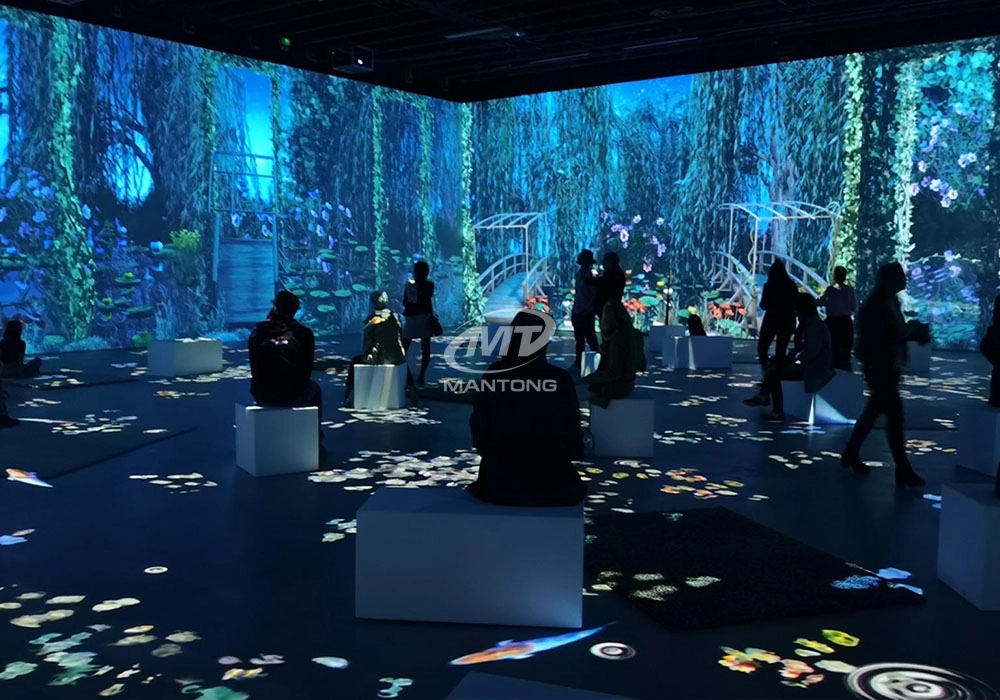
Mantong 6500LM High-Lumen Projector for Large-Scale Immersive Room Projection
Transform any space with Mantong's immersive projection mapping systems. Our high-lumen projectors (up to 6500 LM) and custom software create captivating interactive experiences for floors and walls. Ideal for museums, events, retail, and hospitality. Each kit includes professional ceiling mounting and 80+ pre-loaded video contents and is backed by a 12-month warranty and CE certification. We offer full customization and support to bring your vision to life.
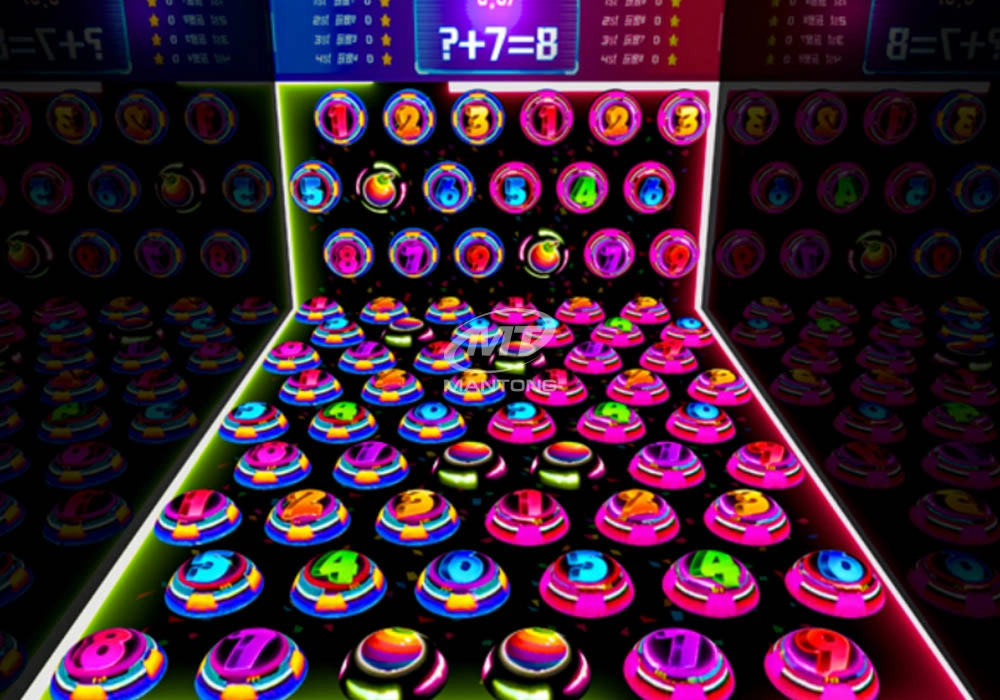
Amusement Rapidly Rotating Bouncing Sphere Interactive Wall Floor Projection Sports Games
Rapidly Rotating Bouncing Sphere is an interactive space where participants jump on rotating spheres. As they step on it, the spheres surface will show special interactivity
Jumping on spheres of the same color in succession causes them to pop, releasing light particles. The more consecutive jumps, the greater the reward—caterpillars appear, and eventually, all spheres of that color burst, filling the space with light and even more caterpillars.
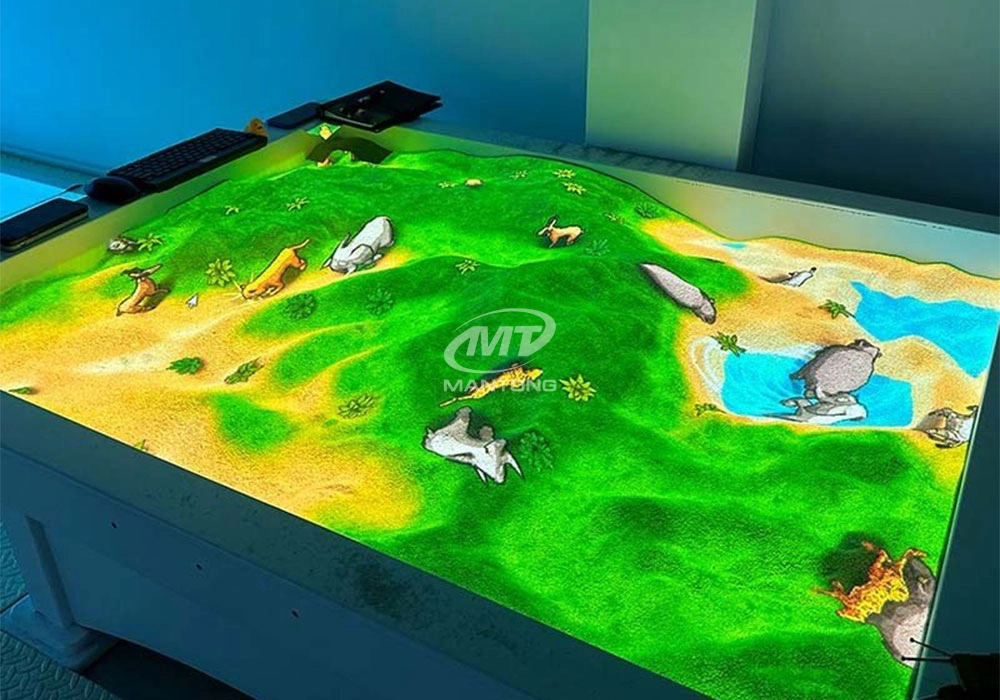
Interactive Sandbox Projection Mapping Games For Kids Play Park
Bring imagination to life with interactive sandbox projection mapping games designed for kids’ play parks. Using cutting-edge projection technology and real-time motion sensing, children can dig, build, and explore virtual worlds directly in the sand. Educational, engaging, and endlessly fun — it’s the perfect blend of play and learning.
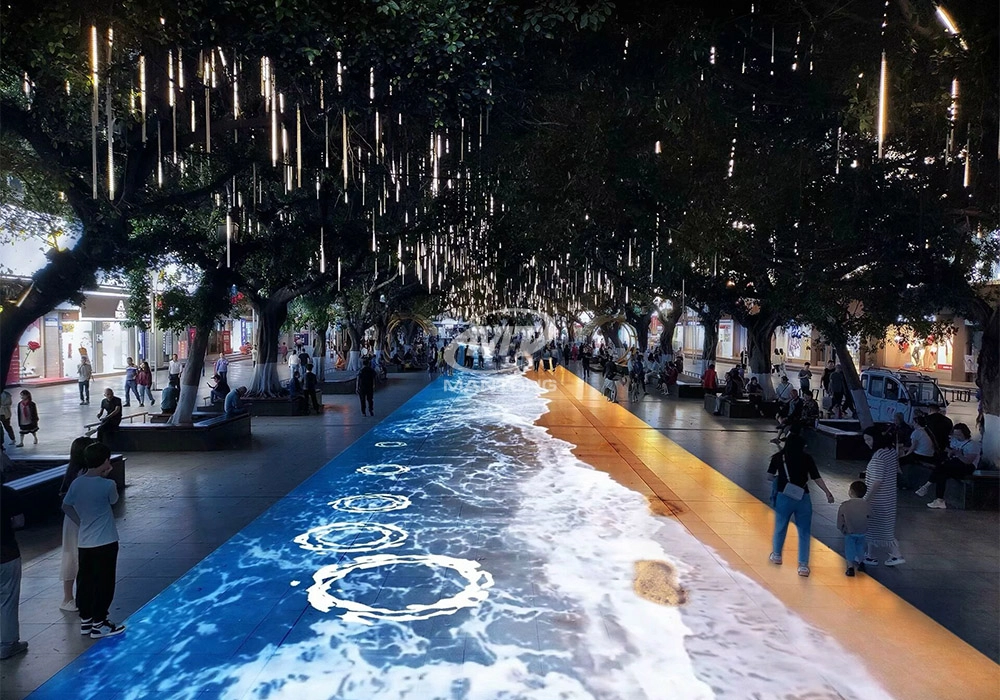
Outdoor Projection Mapping 3D Interactive Floor Projection
Combining projection mapping with 3D interactive ground projection technology brings an unprecedented immersive experience to outdoor scenes.

Kaida Business Center, Shixin Road, Panyu District,Guangzhou City, Guangdong Province, China.
ManTong
ManTong
ManTong