
Interactive Floor Projection for Museums and Exhibits
- Why Museums Need New Interactive Experiences - interactive floor projection installation
- interactive floor projection installation: What it is and how it works
- interactive floor projection installation: Visitor experience and accessibility benefits
- interactive floor projection installation: Design considerations for museums
- interactive floor projection installation: Comparing exhibit technologies
- interactive floor projection installation: Hardware choices, costs and performance metrics
- interactive floor projection installation: Content strategies and storytelling
- interactive floor projection installation: Installation, maintenance and measuring ROI
- interactive floor projection installation: Choosing a vendor and procurement checklist
- interactive floor projection installation: Mantong Digital — a partner for museums and exhibits
- interactive floor projection installation: Practical planning checklist
- FAQ — interactive floor projection installation
- Q1: How much floor space do I need for an effective interactive floor projection installation?
- Q2: Will projected content be visible in a bright gallery?
- Q3: Is interactive floor projection suitable for all ages and accessibility needs?
- Q4: What is the expected lifespan and ongoing costs of a projection-based installation?
- Q5: Can we update or change the projection content after installation?
- Q6: How can we measure the educational impact of an interactive floor projection installation?
- References and further reading
Why Museums Need New Interactive Experiences - interactive floor projection installation
Museums and cultural exhibits are competing for attention in an age of short attention spans and abundant digital content. Interactive floor projection installation offers an effective, low-barrier way to increase dwell time, encourage multi-generational engagement, and present complex subjects through play and motion. This article explains what an interactive floor projection installation is, how it works, how to plan and measure success, and why many institutions choose projection-based interactivity over other digital exhibit options.
interactive floor projection installation: What it is and how it works
An interactive floor projection installation combines a projector, sensors (camera-based tracking, infrared, or Lidar), media-server or computer, and software that maps visuals onto horizontal (floor) surfaces. The system detects visitor movement and triggers visual or auditory responses in real time, creating games, simulations, or informational overlays. Projection mapping techniques are often applied to ensure visuals align with irregular floors or set pieces.
Key technical components:
- Projector — brightness (lumens), resolution, throw ratio and lens options determine image clarity and size.
- Sensor layer — depth cameras (e.g., structured light, ToF), stereo cameras, or infrared arrays enable real-time interaction.
- Processing unit — media servers, PCs or dedicated embedded controllers run the interaction engine and content.
- Content engine/software — authoring tools or custom applications that handle tracking, visual effects and data logging.
For a technical baseline, brightness is measured in lumens, which governs image visibility in ambient light conditions (see Lumen definition in References).
interactive floor projection installation: Visitor experience and accessibility benefits
Interactive floor projection can increase inclusivity and engagement in several concrete ways:
- Universal access: Unlike headsets (VR) or small touchscreens, floor projections can be experienced by groups, young children, wheelchair users, and visitors with limited digital literacy.
- Low hygiene barrier: No physical contact is required in gesture-tracked installations, which is desirable for public health concerns.
- Multi-sensory appeal: Combining motion, sound and dynamic visuals supports diverse learning styles and can improve information retention.
- Scalable social engagement: Floor-based experiences invite collaborative play and social interpretation, increasing group dwell time.
Measured outcomes in museum deployments typically include longer average dwell times, higher repeat interactions and improved subjective visitor satisfaction scores — all important KPIs for funders and curators (see References for visitor behavior reports).
interactive floor projection installation: Design considerations for museums
Designing a successful interactive floor projection installation requires balancing technical constraints with interpretive goals. Core considerations include:
- Content intent: Define learning objectives or emotional outcomes first, then design interaction mechanics to support those goals.
- Site survey: Assess ambient light levels, ceiling height, traffic flow, ADA access, and floor material reflectivity before selecting projector brightness and sensor type.
- Durability & safety: Use floor surfaces and projected content that avoid slip hazards, disorienting visuals, or overstimulating effects (e.g., avoid rapid flashing for epilepsy safety).
- Maintenance access: Provide serviceable access to projectors and sensors without disrupting galleries.
- Content refreshability: Plan for seasonal or campaign-based content updates to keep repeat visits engaging.
Embedding the keyword interactive floor projection installation in design documentation helps procurement and RFP processes clearly communicate the intended solution and to vendors.
interactive floor projection installation: Comparing exhibit technologies
Below is a concise comparison of common exhibit technologies to help institutions choose the right mix. Values are qualitative estimates intended to guide planning; actual outcomes depend on design and execution.
| Technology | Visitor engagement | Accessibility | Typical installation cost | Maintenance complexity |
|---|---|---|---|---|
| Interactive floor projection | High — invites movement & group play | High — no personal devices required | Medium — projector + sensors + software | Low–Medium — projector maintenance, occasional recalibration |
| Touchscreen kiosks | Medium — focused on single users | Medium — reachable but limited to standing/seat height | Low–Medium — hardware + enclosure | Medium — touch wear, sanitization |
| Augmented Reality (AR) | Medium–High — personalized experiences | Medium — requires devices and digital literacy | Medium — app & content development | High — device compatibility and updates |
| Virtual Reality (VR) | High — immersive but siloed | Low — physical constraints and motion issues | High — headsets + space + supervision | High — sanitation and hardware refresh |
Source: synthesized from industry case studies and exhibit design literature (see References).
interactive floor projection installation: Hardware choices, costs and performance metrics
When selecting hardware, focus on these metrics:
- Brightness (lumens) — determines readability in ambient light. Galleries with controlled dim lighting can use lower-lumen projectors; brighter spaces require 5,000+ lumens or more.
- Resolution — higher resolution improves fine-detail legibility for text or maps. For large floor canvases, 1080p is a practical minimum; 4K is preferred for detailed imagery.
- Throw ratio and lens flexibility — determines mounting distance and image size without distortion.
- Uptime/reliability — commercial-grade projectors with sealed optics and dust management reduce maintenance.
- Sensor accuracy and latency — low-latency tracking (under 50 ms) is critical for believable interactions.
Cost ranges (very approximate and dependent on scale):
- Small floor activation (single projector, basic sensors): US$8,000–$25,000
- Medium installation (multi-projector, advanced tracking, content): US$25,000–$75,000
- Large immersive floorscape (multiple projectors, redundant systems, custom fabrication): US$75,000+
These ranges include hardware, software, content and basic installation but not long-term maintenance or creative services. For precise budgeting, request line-item proposals from suppliers with site surveys.
interactive floor projection installation: Content strategies and storytelling
Content makes or breaks an installation. Consider these content strategies:
- Start with a story arc: Hook — Explore — Reflect. Use interaction to move visitors along this arc.
- Layered content: Provide playful surface interactions for families and deeper layers (touchpoints or QR codes) for adult learners who want more detail.
- Analytics-driven iteration: Log interactions (anonymized) to learn which elements perform best and iterate on content to improve engagement and learning outcomes.
- Content lifecycle: Plan seasonal updates and modular content packages to renew interest without rebuilding the whole system.
interactive floor projection installation: Installation, maintenance and measuring ROI
Installation timeline typically follows: discovery & goals (2–4 weeks), site survey & technical design (2–6 weeks), hardware procurement (4–8 weeks), on-site installation & calibration (1–2 weeks), UAT and staff training (1 week), and public launch. Project timelines vary by scale and procurement policies.
Maintenance considerations:
- Projector lamp or laser life cycle — maintain spare parts and schedule preventative maintenance.
- Sensor recalibration — periodic recalibration preserves tracking accuracy.
- Software updates — secure update workflow and rollback options.
Key performance indicators (KPIs) to measure ROI:
- Average dwell time near the installation (pre/post comparison).
- Interaction counts per day and per visitor cohort.
- Repeat visitation rate and membership upticks following installation.
- Qualitative feedback via surveys for learning outcomes and satisfaction.
ROI example (simplified): Increase in membership revenue or ticket upgrades attributable to improved exhibit appeal can offset initial capital and operational costs within a specified payback period. Tracking conversion actions (e.g., sign-ups prompted by the installation) is important for attribution.
interactive floor projection installation: Choosing a vendor and procurement checklist
When evaluating suppliers, consider these differentiators:
- Industry experience and case studies in museums and public spaces.
- Ability to provide turnkey solutions: hardware, software, creative content, installation and long-term support.
- Manufacturing control vs reseller — direct manufacturers may offer cost and lead-time advantages.
- Customization and integration flexibility with your CMS, ticketing or analytics stack.
- Support SLA options and on-site service capability in your region.
Procurement checklist (RFP essentials): technical drawings, ambient light measurements, desired interaction mechanics, content objectives and KPIs, warranty & SLA requirements, training and knowledge transfer expectations, budget bands and timeline.
interactive floor projection installation: Mantong Digital — a partner for museums and exhibits
Mantong Digital is a one-stop interactive projection solution provider and direct manufacturer based in Guangzhou, China, with over 10 years of industry experience. We are dedicated to providing innovative, flexible and cost-effective projection solutions, offering both hardware and software to meet various needs. At ManTong, we specialize in providing customized solutions for a wide range of application scenarios through innovative projection technology. Whether it's immersive experiences, interactive entertainment or outdoor lighting and projection shows, our solutions can transform your ideas into stunning visual effects. Our projection technology provides customized solutions for a variety of scenarios, delivering immersive and interactive visual experiences. We are now looking for business partnerships worldwide. Our vision is to become the world's leading interactive projection manufacturer. Our website is https://www.mtprojection.com/.
Mantong’s competitive strengths:
- Direct manufacturing capability — better control over cost, lead times and customization.
- Proven product lines — immersive projection, interactive floor projection, interactive wall projection, immersive rooms, 3D projection and interactive projection games.
- End-to-end services — hardware, software, content and installation with global partnership ambitions.
- Industry experience — over a decade delivering projection shows and interactive exhibits to public spaces.
For museums seeking a supplier who can both design content and supply reliable hardware, Mantong offers a consolidated procurement path and after-sales service that reduces vendor handoffs and simplifies project management.
interactive floor projection installation: Practical planning checklist
Quick checklist to move from concept to launch:
- Define learning and business goals (engagement, revenue, education metrics).
- Conduct a site survey (light, ceiling height, power, floor material, traffic patterns).
- Create interaction concept and content brief tied to objectives.
- Request proposals from at least 3 qualified vendors; include Mantong Digital as an option for turnkey manufacturing solutions.
- Plan for analytics & data capture, privacy compliance and accessibility audits.
- Schedule installation window, staff training and soft-launch period for testing.
- Prepare maintenance & spare parts plan and a content refresh roadmap.
FAQ — interactive floor projection installation
Q1: How much floor space do I need for an effective interactive floor projection installation?
A: Effective floor space can be small (2–3 sqm) for singular interactions, but multi-user installations typically require 10–50 sqm depending on group size. Ceiling height and projector throw ratio also affect required space. A site survey will provide exact dimensions and projector placement.
Q2: Will projected content be visible in a bright gallery?
A: Visibility depends on projector brightness (lumens) and the floor surface reflectivity. Brighter projectors (>5,000–15,000 lumens) and matte, light-colored flooring help. When ambient light is high, consider shading, dedicated gallery zones, or using higher-brightness laser projectors.
Q3: Is interactive floor projection suitable for all ages and accessibility needs?
A: Yes—floor projections are often highly inclusive because they allow passive observers, standing participants, children, and wheelchair users to engage. Design controls (font size, interaction speed, sound levels) and an accessibility audit ensure the experience meets diverse needs.
Q4: What is the expected lifespan and ongoing costs of a projection-based installation?
A: Commercial laser projectors commonly offer >20,000 hours of life; lamp-based units require periodic lamp replacements. Ongoing costs include electricity, occasional calibration, software updates and potential content refresh budgets. Budget 3–7% of initial capital annually for maintenance as a starting point.
Q5: Can we update or change the projection content after installation?
A: Yes. Most systems include content management workflows. Choose a solution that supports modular content packages and remote updates to keep the exhibit fresh and aligned to programming schedules.
Q6: How can we measure the educational impact of an interactive floor projection installation?
A: Combine quantitative analytics (interaction counts, dwell time) with qualitative measures (visitor surveys, facilitator observations) and pre/post knowledge checks for targeted learning outcomes. Partner with your education team or external evaluators for structured assessment.
Want help planning an interactive floor projection installation? Contact Mantong Digital to discuss turnkey solutions, custom content, and international partnerships. Visit https://www.mtprojection.com/ or email their sales team for a site survey and proposal.
References and further reading
- Projection mapping — Wikipedia. https://en.wikipedia.org/wiki/Projection_mapping (accessed 2025-12-22).
- Lumen (unit) — Wikipedia. https://en.wikipedia.org/wiki/Lumen_(unit) (accessed 2025-12-22).
- UNESCO, Museums around the world in the face of COVID-19. https://en.unesco.org/news/museums-around-world-face-covid-19 (published 29 June 2020; accessed 2025-12-22).
- Statista, Museums topic overview. https://www.statista.com/topics/971/museums/ (accessed 2025-12-22).
- Industry report (for market and procurement context): Grand View Research, Projection Mapping Market Size (overview). https://www.grandviewresearch.com/industry-analysis/projection-mapping-market (accessed 2025-12-22).
- Mantong Digital corporate site: https://www.mtprojection.com/ (company information and product lines; accessed 2025-12-22).
Best Interactive Projectors for Classrooms in 2025
Best professional projection restaurant manufacturers and supplier brands in China
Best The Role of Immersive Meeting Rooms in Hybrid Work Environments manufacturers and supplier brands
Event and Theme Park Interactive Floor Projection Ideas
One-Stop Projection Solution Provider Since 2011
What about the wall/floor material for the projection?
It’s recommended to choose a light-colored material with minimal reflectivity—pure white or light grey works best. the
common material is cement & plaster board
For optimal projection results, the surface should be free of any patterns or textures, as the projector will display content
directly onto it.
There are no specific material requirements; you may use any commonly available material in your local market, as long as it
meets the above conditions.
How to install the projection equipment ?
1) Install the projector in a suitable position. We will provide you with a hanger, which you need to fix on the ceiling with
screws.
2) Connect projectors, computers and other accessories through wires.
3) After completing the above 2 steps, we will carry out the edge blending steps. Our team can complete it through remote
control.
In general, installation instructions for each project need to be specified on a project-by-project basis. The above is for
reference only.
Are you trader or manufacturer ?
We are direct manufacturer who specialize in providing one-stop solution for different outdoor & indoor projection project with our stable software and qualified projectors
What's the application of Immersive projection ?
It can be used in various venues, such as art exhibition, entertainment venues, educational institution, Wedding hall /Banquet/Bar,Yoga Studio and so on. It often involves advanced projection techniques, multimedia content, and interactive elements to engage and captivate the audience's senses.
What information do you need to know before making the proposal/solution?
We know that everyone wants to know the price, but the price of our products is determined by many factors since most of our products are custom, so no ready price list. In order to fast understand what you need, can you send us an inquiry like this?
For example: I am really interested in your immersive projection products, we are a company in the USA and want to install some in my restaurant. It is about 50 meters long, and 5m in width. Projection size you can decide but the length should be not less than 20 meters. We want some content about SeaWorld because our place is all about the sea. Thank you.
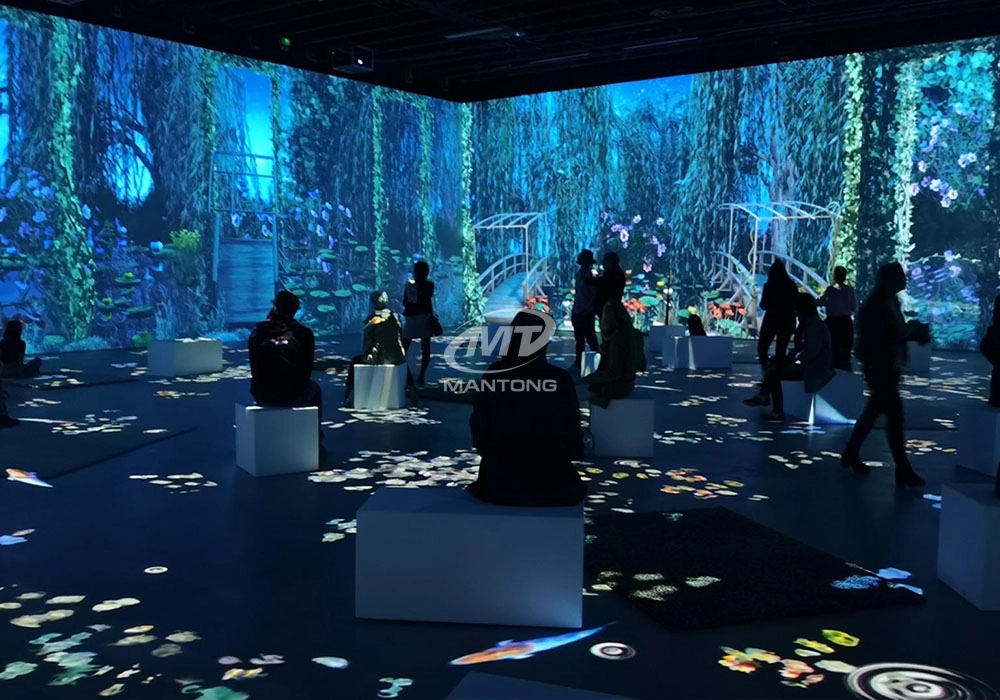
Mantong 6500LM High-Lumen Projector for Large-Scale Immersive Room Projection
Transform any space with Mantong's immersive projection mapping systems. Our high-lumen projectors (up to 6500 LM) and custom software create captivating interactive experiences for floors and walls. Ideal for museums, events, retail, and hospitality. Each kit includes professional ceiling mounting and 80+ pre-loaded video contents and is backed by a 12-month warranty and CE certification. We offer full customization and support to bring your vision to life.
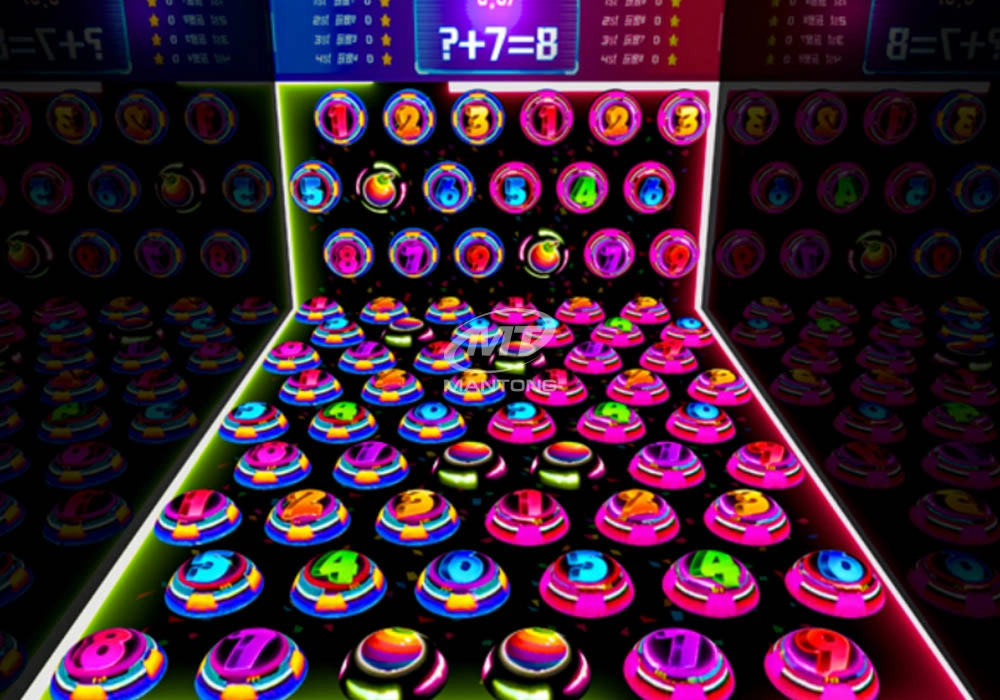
Amusement Rapidly Rotating Bouncing Sphere Interactive Wall Floor Projection Sports Games
Rapidly Rotating Bouncing Sphere is an interactive space where participants jump on rotating spheres. As they step on it, the spheres surface will show special interactivity
Jumping on spheres of the same color in succession causes them to pop, releasing light particles. The more consecutive jumps, the greater the reward—caterpillars appear, and eventually, all spheres of that color burst, filling the space with light and even more caterpillars.
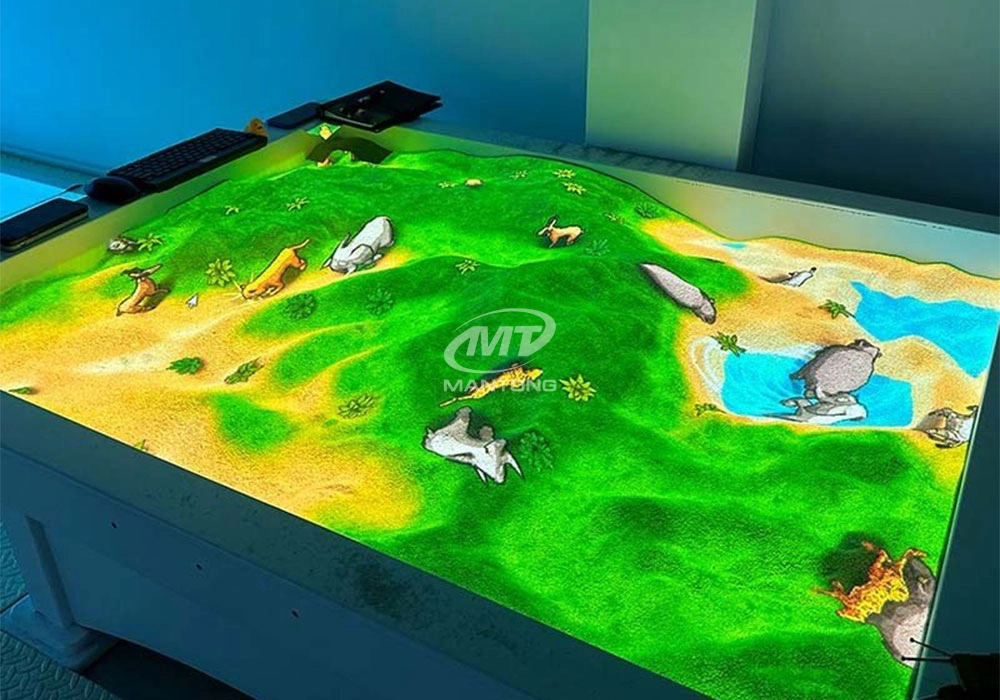
Interactive Sandbox Projection Mapping Games For Kids Play Park
Bring imagination to life with interactive sandbox projection mapping games designed for kids’ play parks. Using cutting-edge projection technology and real-time motion sensing, children can dig, build, and explore virtual worlds directly in the sand. Educational, engaging, and endlessly fun — it’s the perfect blend of play and learning.
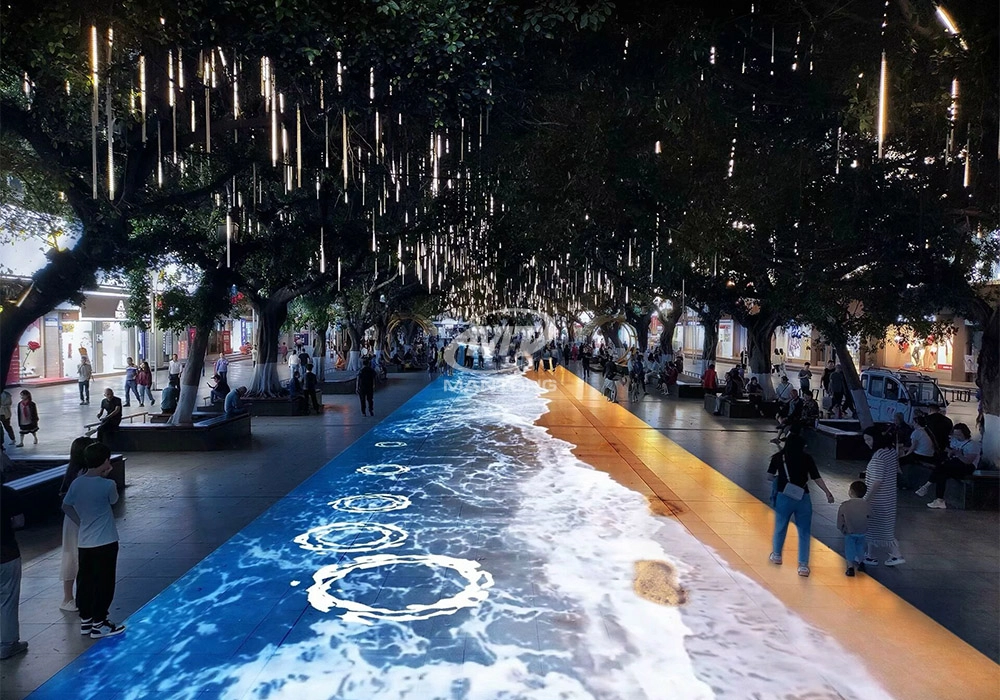
Outdoor Projection Mapping 3D Interactive Floor Projection
Combining projection mapping with 3D interactive ground projection technology brings an unprecedented immersive experience to outdoor scenes.

Kaida Business Center, Shixin Road, Panyu District,Guangzhou City, Guangdong Province, China.
ManTong
ManTong
ManTong