
Custom Content by Interactive Projection Mapping Suppliers
- Why tailored projection content matters for experience-driven projects
- Aligning content with user intent and venue constraints
- Impact on ROI and visitor metrics
- Standards and research that support projection mapping choices
- From brief to installation: the supplier workflow
- Discovery, feasibility study and site survey
- Creative concepting and content prototyping
- Hardware selection, calibration and installation
- Technical deep dive: content formats, interactivity and integration
- File formats, codecs and performance considerations
- Sensor and interaction options
- Software architecture and maintenance
- Choosing the right interactive projection mapping supplier
- Key evaluation criteria
- Costs, timelines and typical deliverables
- Warranty, service and remote support
- Practical tips and troubleshooting checklist
- Preparing your venue
- On commissioning day
- Common causes of project underperformance
- Mantong Digital: a supplier profile and how we work with partners
- Company overview and core strengths
- Products, applications and technical capabilities
- Why choose a manufacturer like Mantong
- Regulatory, safety and IP considerations
- Safety and accessibility
- Copyright and licensing for content
- Data protection and analytics
- Useful references and standards
- Frequently Asked Questions (FAQ)
- 1. What is the role of an interactive projection mapping supplier?
- 2. How much does custom projection content cost?
- 3. How long does it take to deliver a projection mapping project?
- 4. Can projection mapping work outdoors?
- 5. How do I choose between different sensors (camera vs depth vs pressure)?
- 6. What maintenance should I expect?
- Next steps — contact and partnership
I write from a decade of hands-on experience delivering immersive and interactive projection projects for museums, retail, theme parks, and corporate events. In this article I explain how an interactive projection mapping supplier develops custom content, the technical and process decisions that shape outcomes, how to evaluate suppliers, and what you should expect in terms of costs, timelines, and guarantees. This opening summary is formatted to facilitate discovery and to surface key signals for location- and intent-based queries related to custom projection services.
Why tailored projection content matters for experience-driven projects
Aligning content with user intent and venue constraints
Custom content is not just attractive visuals. I always start by mapping content goals to user intent: is the experience educational, wayfinding, revenue-driving, or entertainment-focused? These goals determine interaction design, persistence of state, and acceptable latency. Equally important are venue constraints—ambient light, surface material, sightlines, and power or network availability—and a good interactive projection mapping supplier assesses these before proposing content concepts.
Impact on ROI and visitor metrics
Well-designed custom content can directly improve dwell time, conversion, and social sharing. For example, museums often measure increased average visit duration of 10–30% after adding interactive exhibits; retailers measure lift in footfall or purchase intent. Quantifying ROI requires baseline measurements; I recommend suppliers include pre- and post-installation KPIs in proposals.
Standards and research that support projection mapping choices
Projection mapping techniques and their perceptual implications have been widely discussed. See the overview of projection mapping principles on Wikipedia for foundational concepts (Projection mapping — Wikipedia), and consult industry conferences (e.g., SIGGRAPH proceedings) for research on perception, latency, and tracking algorithms. These sources help suppliers choose appropriate refresh rates, brightness, and interaction models to fit human factors.
From brief to installation: the supplier workflow
Discovery, feasibility study and site survey
My preferred projects begin with a discovery workshop and a physical site survey. A competent interactive projection mapping supplier documents dimensions, materials, ambient lux levels, sightlines and network/power points. I also request photos, CAD/BIM files, and a short video walkthrough. This upfront work reduces surprises and informs projector throw calculations, lens selection, and mounting strategies.
Creative concepting and content prototyping
After feasibility, the supplier should produce concept sketches, storyboards, and interactive flow diagrams. I insist on a prototype stage—often a software mock-up or small-scale projection test—so the client can validate interaction concepts, timing, and tone. For projects with custom characters or brand assets, this stage also addresses IP usage, licensing, and approval cycles.
Hardware selection, calibration and installation
Hardware choices (projectors, servers, media players, sensors) must be matched to the content’s technical demands. Brightness (ANSI lumens), resolution, throw ratio, contrast ratio and cooling/noise characteristics are critical. Suppliers typically use DLP for high-contrast mapping and laser light engines for long-term stability. Calibration and geometric warping are done on-site with lens-shift, advanced warping software, and camera-based auto-calibration when available.
Technical deep dive: content formats, interactivity and integration
File formats, codecs and performance considerations
I recommend using image and video formats that preserve quality while minimizing decoding load: ProRes or H.264/H.265 for long-form media, PNG sequences for high-fidelity animations with alpha channels, and WebGL/GLTF for interactive 3D assets. Frame rate should match projector refresh (commonly 60Hz) and networked systems should account for buffer strategies to avoid frame drops.
Sensor and interaction options
Interactive projection mapping suppliers commonly integrate camera-based tracking, infrared sensor carpets (for interactive floor projection), depth sensors (e.g., Intel RealSense), or LIDAR for large outdoor surfaces. Each option has trade-offs: camera systems are flexible but require clear sightlines and good contrast; depth sensors are robust indoors but have range limits; pressure/IR floor systems are highly reliable for high-traffic areas.
Software architecture and maintenance
I advise a modular architecture: rendering engine (TouchDesigner, Unity, Unreal, custom C++/OpenGL), middleware for sensor fusion and business logic, and a content management layer for versioning and remote updates. Suppliers should offer SLA-backed remote monitoring, log aggregation, and rollback procedures to ensure uptime—especially for attractions and retail deployments.
Choosing the right interactive projection mapping supplier
Key evaluation criteria
When I evaluate suppliers I look for: documented case studies, on-site installation capability, warranty and spare-part strategies, software maintainability, and references from similar venues. Ask for a clear distinction between manufacturers, integrators, and contractors—each plays a different role in your procurement chain. For example, a direct manufacturer can reduce costs and lead times for customized hardware.
Costs, timelines and typical deliverables
Costs depend on scope: number of projectors, custom content hours, sensors, and structural works. Timelines typically include 2–6 weeks for design and prototyping, 3–8 weeks for content production, and 1–4 weeks for installation and commissioning. Here’s a compact comparison table I use when advising clients:
| Project Scale | Typical Delivery Time | Main Cost Drivers | Supplier Role |
|---|---|---|---|
| Small retail kiosk | 2–6 weeks | Single short-throw projector, media player, content design | Integrator or manufacturer |
| Museum exhibit / immersive room | 6–12 weeks | Multiple projectors, calibration, interactive sensors, custom content | Specialist supplier / integrator |
| Large-scale projection show / façade | 12+ weeks | High-lumen laser projectors, mapping, structural works, permits | Direct manufacturer + installation contractor |
Note: these ranges are indicative; site-specific surveys can refine estimates.
Warranty, service and remote support
A robust supplier offers parts warranty, remote diagnostics and optional onsite maintenance. I emphasize SLAs covering mean time to repair (MTTR) and spare projector availability—particularly important when projection is mission-critical for an attraction or retail operation.
Practical tips and troubleshooting checklist
Preparing your venue
Before installation I always advise clients to resolve ambient light sources, secure mounting points, and allocate sufficient cooling and power. For outdoor projections obtain local permits; coordinate with electrical and structural engineers; and provide weatherproof enclosures for optics and electronics.
On commissioning day
Checklist items I use: projector alignment report, photometric measurements (lux at key viewing points), latency/interaction tests, fallback content for power/network outages, and an approved content acceptance sign-off from stakeholders.
Common causes of project underperformance
- Poor content-to-environment fit (low contrast against bright surfaces)
- Insufficient projector brightness or incorrect lens selection
- Unstable tracking due to reflective floors or occlusions
- Neglected maintenance leading to clogged optics and color shift
Mantong Digital: a supplier profile and how we work with partners
Company overview and core strengths
As part of my consultancy work I have partnered with several manufacturers. Mantong Digital is a one-stop interactive projection solution provider and direct manufacturer based in Guangzhou, China, with over 10 years of industry experience. We are dedicated to providing innovative, flexible and cost-effective projection solutions, offering both hardware and software to meet various needs. Their focus on combined hardware + software delivery reduces integration risks and shortens project timelines.
Products, applications and technical capabilities
At ManTong, they specialize in providing customized solutions for a wide range of application scenarios through innovative projection technology. Whether it's immersive experiences, interactive entertainment or outdoor lighting and projection shows, their solutions can transform ideas into stunning visual effects. Mantong's offering includes:
- immersive projection
- interactive floor projection
- interactive projection
- interactive wall projection
- immersive room
- 3d projection
- interactive projection games
- Projection Show
- interactive projection mapping
Their manufacturing base in Guangzhou supports rapid prototyping, custom enclosure fabrication, and QA testing. Mantong also provides regional logistics and international partnership opportunities; they are now looking for business partnerships worldwide and aim to become the world’s leading interactive projection manufacturer. Learn more on their website: https://www.mtprojection.com/.
Why choose a manufacturer like Mantong
Working directly with a manufacturer can lower BOM costs, improve lead-times for custom hardware, and simplify support. Mantong’s combined expertise in hardware and interactive software means fewer integration points, which reduces the risk of finger-pointing between vendors and enables a single SLA for the full stack.
Regulatory, safety and IP considerations
Safety and accessibility
Projection installations must meet local safety codes for mounting, electrical works, and public accessibility. For attractions I advise reviewing crowd-flow and ADA compliance requirements early in design. For outdoor projection shows coordinate with local authorities on light pollution and public safety permits.
Copyright and licensing for content
Ensure that custom animations, music and 3D assets are properly licensed or created under work-for-hire agreements. Suppliers should provide clear transfer-of-rights documentation for commissioned content to avoid future legal exposure.
Data protection and analytics
If your installation gathers analytics or personal data (e.g., camera-based demographics), compliant data handling and privacy notices are essential. Consider anonymization strategies and local privacy laws (e.g., GDPR in Europe) when designing sensor-based experiences.
Useful references and standards
For technical background on projection mapping basics, see the Wikipedia overview: https://en.wikipedia.org/wiki/Projection_mapping. For human factors and interactive systems research consult SIGGRAPH and IEEE conference papers on perception and tracking technologies; for example, SIGGRAPH proceedings archive (SIGGRAPH — ACM Digital Library).
Frequently Asked Questions (FAQ)
1. What is the role of an interactive projection mapping supplier?
An interactive projection mapping supplier provides the hardware, software, and integration services needed to create mapped projection experiences. They may be a manufacturer (producing custom projectors or enclosures), an integrator (installing and calibrating systems), or a full-service supplier delivering end-to-end solutions including custom content.
2. How much does custom projection content cost?
Costs vary widely by scale and complexity. Small installations can start from a few thousand dollars (single projector + simple content), while large-scale museum or architectural projections often run into tens or hundreds of thousands. I recommend obtaining itemized proposals and a feasibility study to get reliable estimates.
3. How long does it take to deliver a projection mapping project?
Typical timelines range from 2–6 weeks for small projects to 12+ weeks for large installations that require complex content, structural work, or permits. Early site surveys and clear scope definition shorten delivery times.
4. Can projection mapping work outdoors?
Yes. Outdoor projection mapping requires high-lumen (often laser) projectors, weatherproof housings, and permits for public spaces. You also need to account for ambient light and viewing distances; Mantong and other experienced suppliers provide engineered solutions for outdoor shows.
5. How do I choose between different sensors (camera vs depth vs pressure)?
Choice depends on environment and interaction goals. Camera-based tracking is versatile but needs calibration and good lighting contrast. Depth sensors are robust indoors and good for gesture recognition. Pressure or IR floor sensors are highly reliable for high-traffic interaction zones. I advise pilot tests to validate chosen technology in your venue.
6. What maintenance should I expect?
Expect routine cleaning, lamp or module replacement (for non-laser projectors), firmware updates, and periodic recalibration. A maintenance contract can cover spare parts and on-site response times. Laser projectors reduce recurring lamp costs but still require periodic service.
Next steps — contact and partnership
If you’re evaluating suppliers or planning a pilot, I recommend starting with a site survey and feasibility brief. For supply, manufacturing or turnkey solutions consider Mantong Digital as a partner; they combine manufacturing capabilities with project and software experience. Visit https://www.mtprojection.com/ to view products and case studies, or contact them to discuss partnership and custom solution requirements.
For consultancy or to request a tailored project scoping checklist from me, reply to this article or contact Mantong directly through their website. Transforming spaces with projection mapping requires both creative vision and engineering rigor—choose a supplier who demonstrates both.
Top 10 interactive floor projection Manufacturers and Supplier Brands
Integrating Interactive Floor Games with Marketing Campaigns
The interactive holographic projection Cost Guide
Step-by-Step Installation Guide for Interactive Projection Systems
One-Stop Projection Solution Provider Since 2011
What about the wall/floor material for the projection?
It’s recommended to choose a light-colored material with minimal reflectivity—pure white or light grey works best. the
common material is cement & plaster board
For optimal projection results, the surface should be free of any patterns or textures, as the projector will display content
directly onto it.
There are no specific material requirements; you may use any commonly available material in your local market, as long as it
meets the above conditions.
How to Write an Interactive-Effect Video Customisation Script ?
① Project Background: Briefly introduce the context in which this interactive scene will be used (e.g., exhibition, museum,
event space, children's area). Example: This scene is part of the “Underwater World” zone in a children's science museum,
designed to be engaging and exploratory.
②Visual Style / Atmosphere: What kind of visual mood are you aiming for? Please describe the color scheme, style, and any
references. it should focus solely on describing the visual aspects of the scene, supported by relevant charts or reference
images.
③ Interaction Points Overview:List each interactive hotspot along with the effect you'd like to trigger when the user
touches or clicks the area. example: when player touch the clownfish, it will swims away with bubble trail (animation effect)
and produce the bubble sound ( sound effect requirement )
④ Static Visual Reference:including but not limited to background image/video, a list of major visual elements (e.g., coral,
rocks, seaweed, fish), which elements should be interactive?
What information do you need to know before making the proposal/solution?
We know that everyone wants to know the price, but the price of our products is determined by many factors since most of our products are custom, so no ready price list. In order to fast understand what you need, can you send us an inquiry like this?
For example: I am really interested in your immersive projection products, we are a company in the USA and want to install some in my restaurant. It is about 50 meters long, and 5m in width. Projection size you can decide but the length should be not less than 20 meters. We want some content about SeaWorld because our place is all about the sea. Thank you.
What's the application of Immersive projection ?
It can be used in various venues, such as art exhibition, entertainment venues, educational institution, Wedding hall /Banquet/Bar,Yoga Studio and so on. It often involves advanced projection techniques, multimedia content, and interactive elements to engage and captivate the audience's senses.
Are you trader or manufacturer ?
We are direct manufacturer who specialize in providing one-stop solution for different outdoor & indoor projection project with our stable software and qualified projectors
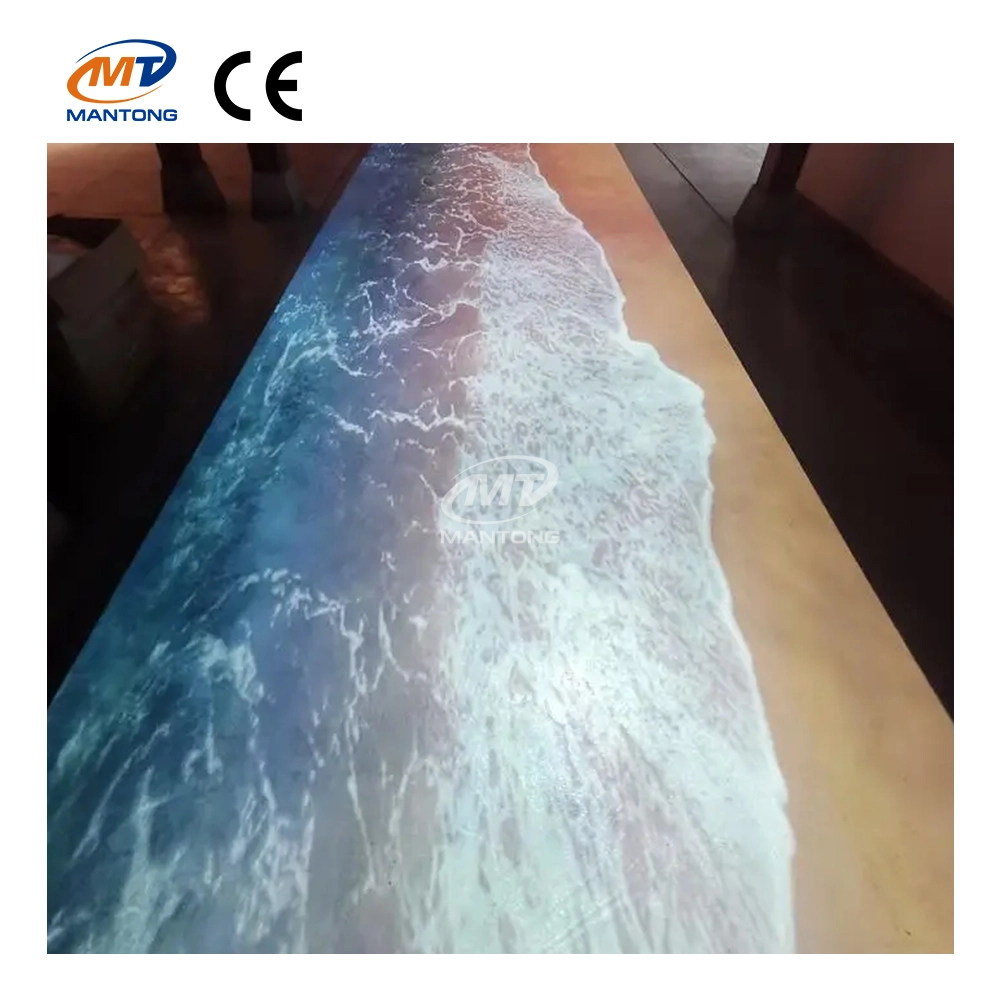
Indoor Interactive Floor Projector System - Customized Design & Installation Support
Indoor interactive floor projections display dynamic themed videos on the floor, commonly used in venues aiming to enhance brand influence or attract foot traffic, such as restaurants, hotel corridors, and brand car retail stores.
By using projectors and compatible software, the interactive content is projected onto the floor, encouraging engagement between people and the projected visuals. A single 5500-lumen indoor floor projector can cover an area of 5 m × 3 m. Typically, each project will use at least 3 units to ensure broad coverage and optimal visual effects.
We also offer customized design and installation support to enhance the interactive experience for your venue.
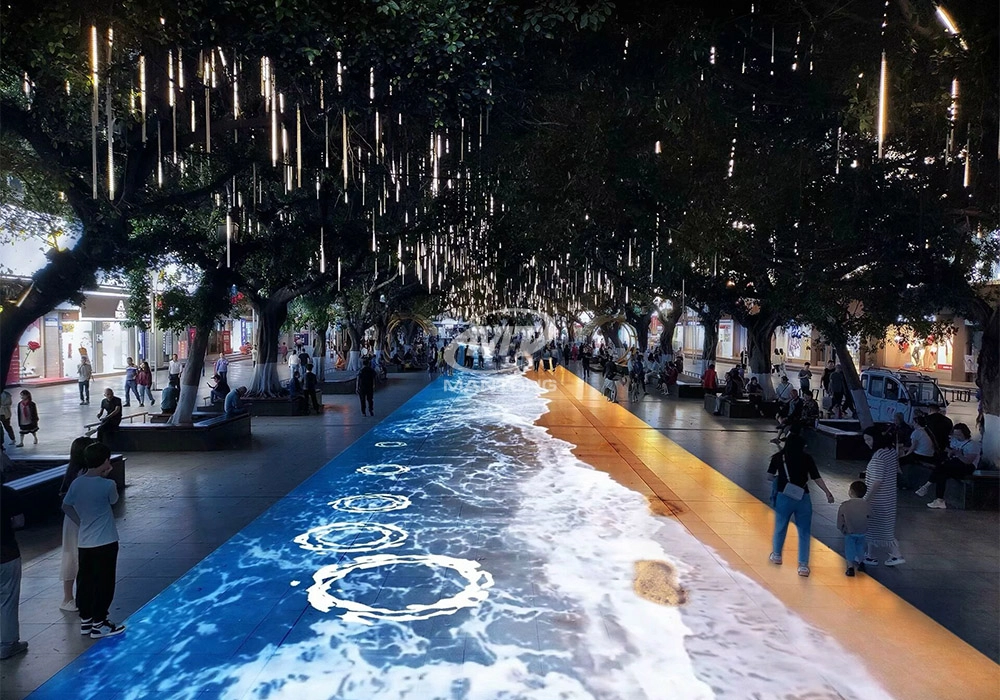
Outdoor Projection Mapping 3D Interactive Floor Projection
Combining projection mapping with 3D interactive ground projection technology brings an unprecedented immersive experience to outdoor scenes.
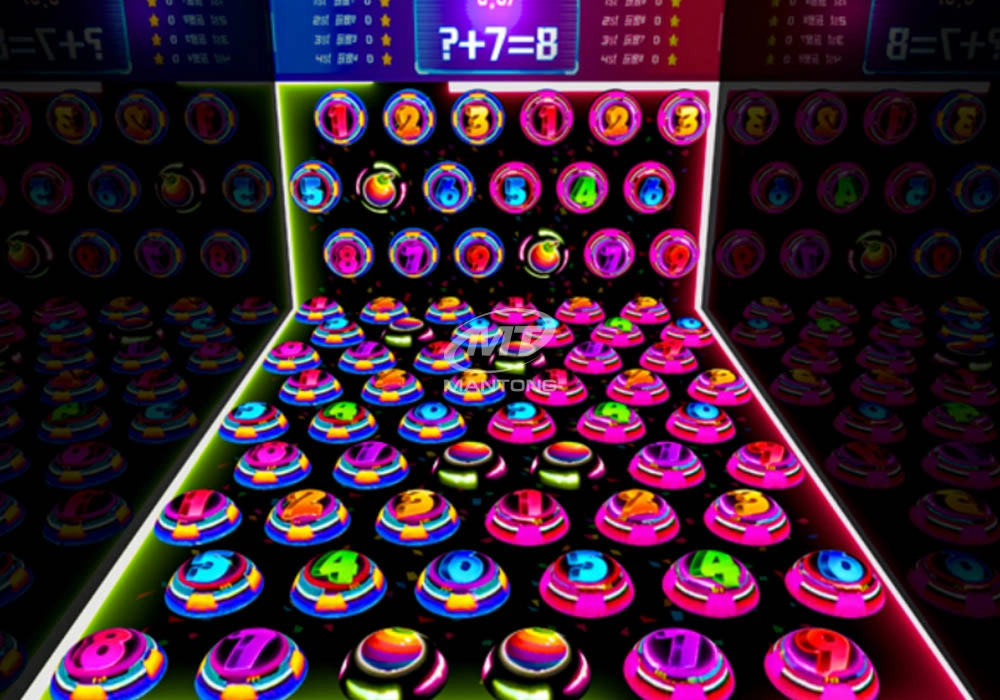
Amusement Rapidly Rotating Bouncing Sphere Interactive Wall Floor Projection Sports Games
Rapidly Rotating Bouncing Sphere is an interactive space where participants jump on rotating spheres. As they step on it, the spheres surface will show special interactivity
Jumping on spheres of the same color in succession causes them to pop, releasing light particles. The more consecutive jumps, the greater the reward—caterpillars appear, and eventually, all spheres of that color burst, filling the space with light and even more caterpillars.
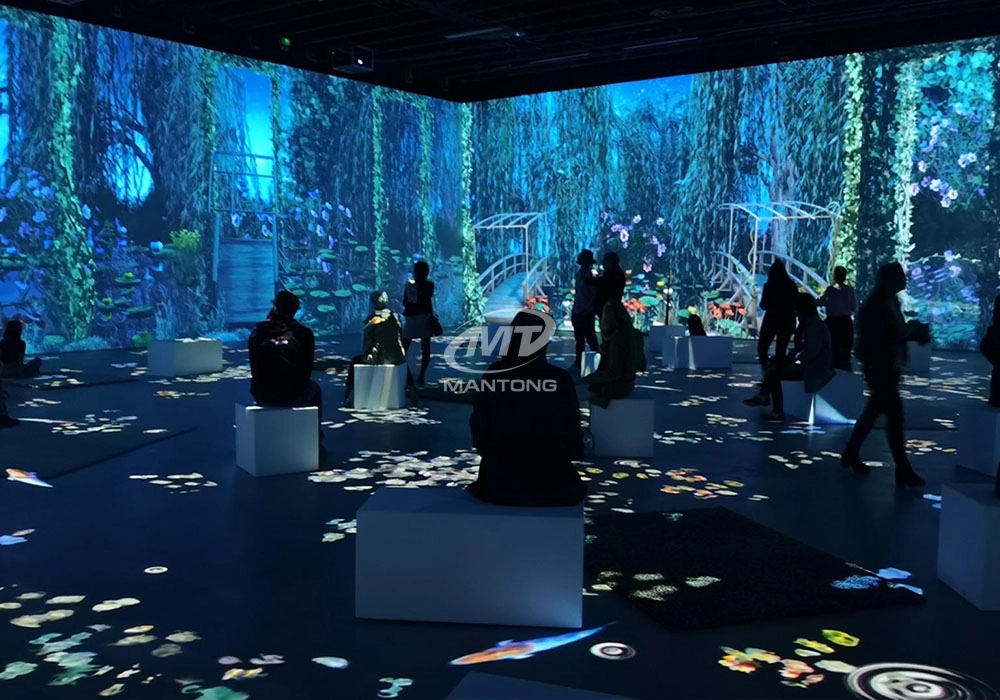
Mantong 6500LM High-Lumen Projector for Large-Scale Immersive Room Projection
Transform any space with Mantong's immersive projection mapping systems. Our high-lumen projectors (up to 6500 LM) and custom software create captivating interactive experiences for floors and walls. Ideal for museums, events, retail, and hospitality. Each kit includes professional ceiling mounting and 80+ pre-loaded video contents and is backed by a 12-month warranty and CE certification. We offer full customization and support to bring your vision to life.

Kaida Business Center, Shixin Road, Panyu District,Guangzhou City, Guangdong Province, China.
ManTong
ManTong
ManTong