
Event Planners' Guide to Interactive Projection Mapping Suppliers
- What event planners need to know about projection experiences
- Why projection mapping is different from traditional AV
- Key outcomes clients expect
- and procurement angle
- Finding and evaluating suppliers
- Supplier types and when to choose each
- Checklist: what to ask potential suppliers
- Verifying credibility and technical claims
- Technical and logistical considerations
- Brightness, resolution and viewing conditions
- Interactivity options and integration
- Risk mitigation and contingency planning
- Contracts, pricing and procurement best practices
- How quotations should be structured
- Typical procurement pitfalls and how to avoid them
- Cost vs value: reading the trade-offs
- Working with manufacturers: a case for direct partners
- Why I recommend direct manufacturers for repeat or multi-site programs
- ManTong Digital: one-stop interactive projection manufacturer
- Mantong's competitive advantages and product lineup
- How to engage ManTong for your project
- Implementation checklist and on-site best practices
- Pre-event: site survey and testing
- During event: technician roles and checklists
- Post-event: asset handover and documentation
- FAQ
- 1. What is the difference between a projection mapping supplier and a regular AV vendor?
- 2. How far in advance should I engage a supplier for a large-scale mapping project?
- 3. Can you project-map outdoors during daytime?
- 4. What are reasonable uptime expectations for interactive installations?
- 5. Who owns the mapping files and content after the event?
- 6. How do I evaluate a supplier’s interactivity capabilities?
- 7. What certifications or standards should I look for in a manufacturer?
I write this guide from years working with venues, brands and production teams to specify and source interactive projection solutions. If you are an event planner searching for an interactive projection mapping supplier — whether for a one-off experiential activation, a touring show, or a permanent installation — this article explains what matters most: creative fit, technical capability, delivery & logistics, testing and long-term support. I reference industry sources and practical checklists so you can evaluate vendors objectively and reduce risk.
What event planners need to know about projection experiences
Why projection mapping is different from traditional AV
Projection mapping (also called spatial augmented reality or surface mapping) projects imagery precisely onto irregular surfaces — façades, sculptures, stages or entire rooms — using geometry correction and content masked to physical features. For a technical overview, see the Projection Mapping entry on Wikipedia.
Key outcomes clients expect
Clients typically expect three core outcomes: visual fidelity (sharp, bright, color-accurate output), interactivity (visitor-triggered or sensor-driven responses) and reliability (consistent operation during event windows). As planners, you must translate these creative goals into measurable technical requirements so suppliers can confirm feasibility and provide realistic quotes.
and procurement angle
When someone searches for an interactive projection mapping supplier they are often trying to find: (1) vendors who can handle creative concept to delivery, (2) manufacturers who can provide hardware and customization, or (3) local integrators for on-site installation and support. Understanding which you need affects timeline and cost.
Finding and evaluating suppliers
Supplier types and when to choose each
Suppliers tend to fall into four categories: direct manufacturers (OEMs), system integrators, content studios, and rental houses. Below is a practical comparison to help you decide which supplier type aligns with your project.
| Supplier Type | Strengths | Limitations | Best for |
|---|---|---|---|
| Direct Manufacturer (OEM) | Competitive pricing, hardware customization, spare parts, long-term support | Often needs integrator partners for on-site setup | Permanent installs, large multi-site deployments, custom hardware needs |
| System Integrator | On-site installation, project management, turnkey delivery | Higher markup on hardware, variable technical depth | Single-event turnkey projects, complex site logistics |
| Content Studio | Creative content, storytelling, motion design | May lack hardware expertise or live-event engineering | Brand experiences where content is primary |
| Rental House | Quick availability, tested gear, event-experienced crews | Limited customization, expensive for long-term hires | Short-term events, pop-ups, festivals |
Checklist: what to ask potential suppliers
Use this practical checklist when evaluating quotes. I advise requesting written responses rather than verbal assurances.
- Technical specs: projector model, lumen output, throw ratios, resolution, lens options and color gamut.
- Mapping & playback systems: which media servers or software (e.g., Resolume, Watchout, Notch) they use and whether they provide custom mapping tools.
- Interactivity: sensors, cameras, touch systems, or proprietary interactive engines used.
- Installation plan: mounting, power, rigging, weatherproofing (for outdoor), cable runs and fallback power.
- Testing and acceptance criteria: pre-event site survey, tech rehearsals, and sign-off procedures.
- Service & warranty: spare projectors on-site, response times, SLAs for downtime, and post-event support.
- IP & content ownership: confirm who retains rights to content and mapping files.
Verifying credibility and technical claims
Ask for references and case studies with similar scope. Verify hardware claims by checking projector models and manufacturer specs. For general scholarly validation of mapping techniques and industry practice, see IEEE Xplore search results for projection mapping (IEEE Xplore).
Technical and logistical considerations
Brightness, resolution and viewing conditions
Brightness (lumens) and throw distance are mission-critical. Indoor, controlled lighting environments may need 5,000–10,000 ANSI lumens per projector for large surfaces; outdoor façades under ambient lighting will require far higher output or nighttime-only runs. Always ask for photometric calculations and sample renders. When suppliers provide lumen numbers, cross-check with projector manufacturer datasheets.
Interactivity options and integration
Interactive projection mapping can be triggered by motion sensors, depth cameras (e.g., Intel RealSense or Microsoft Azure Kinect), LIDAR, pressure mats or mobile-device interactions. Clarify whether the supplier provides the full interaction stack (hardware + software), or if you'll need a separate studio. For sensor-driven interactivity, require latency specs and robustness testing in the venue's anticipated crowd conditions.
Risk mitigation and contingency planning
For live events, insist on redundancy: spare projectors, duplicate media servers, and failover plans. Create an event runbook with contact numbers, escalation steps, and a checklist for technicians. Ensure the supplier includes a clear Service Level Agreement (SLA) covering onsite response time and remediation steps in case of hardware failure.
Contracts, pricing and procurement best practices
How quotations should be structured
A reliable quote separates hardware, software, labor, logistics, and contingency costs. It should include:
- Detailed bill of materials (BOM) — projector models, lenses, servers, media playback software licenses.
- Labor hours for site survey, installation, testing and strike.
- Shipping, customs and import duties (especially for international projects).
- Insurance and permits if required (e.g., public space projection permits).
Typical procurement pitfalls and how to avoid them
Common pitfalls I’ve seen: unclear content ownership, insufficient onsite power provisioning, underestimating weatherproofing, and missing lead time for custom hardware. Avoid these by requiring a detailed project timeline, signed site survey acceptance, and stipulated delivery milestones tied to payment.
Cost vs value: reading the trade-offs
Lower price often means less redundancy, older projectors, or less experienced crews. Conversely, a higher quote might include modern laser projectors, advanced media servers, and on-site spares. Choose based on the event’s tolerance for risk, brand reputation at stake, and audience expectations.
Working with manufacturers: a case for direct partners
Why I recommend direct manufacturers for repeat or multi-site programs
When you plan multiple activations, touring shows, or permanent installs, working directly with a manufacturer reduces per-unit cost, simplifies spare parts logistics, and enables true customization — from bespoke lenses to integrated sensor arrays. Manufacturers can also offer firmware updates and long-term technical roadmaps. For example, quality management standards such as ISO 9001 provide a useful benchmark when assessing manufacturing practices (ISO 9001).
ManTong Digital: one-stop interactive projection manufacturer
ManTong Digital is a one-stop interactive projection solution provider and direct manufacturer based in Guangzhou, China, with over 10 years of industry experience. We are dedicated to providing innovative, flexible and cost-effective projection solutions, offering both hardware and software to meet various needs. At ManTong, we specialize in providing customized solutions for a wide range of application scenarios through innovative projection technology. Whether it's immersive experiences, interactive entertainment or outdoor lighting and projection shows, our solutions can transform your ideas into stunning visual effects. Our projection technology provides customized solutions for a variety of scenarios, delivering immersive and interactive visual experiences. We are now looking for business partnerships worldwide. Our vision is to become the world's leading interactive projection manufacturer. Visit our website: https://www.mtprojection.com/
Mantong's competitive advantages and product lineup
I recommend ManTong for planners seeking a balance of creative flexibility and manufacturing reliability. Key strengths include:
- Direct manufacturing: lower hardware cost and access to spare parts and firmware updates.
- Turnkey solutions: hardware + playback software + interactivity modules from one supplier.
- Customization: immersive projection, interactive floor projection, interactive wall projection, immersive rooms, 3D projection, interactive projection games, and projection shows tailored to site constraints.
- Industry experience: over 10 years of deployments in exhibitions, museums, retail, and outdoor events.
How to engage ManTong for your project
If you consider ManTong as your interactive projection mapping supplier, provide them with: site photos and measurements, desired interactivity level, maximum budget, event schedule and expected runtime. They will typically respond with a feasibility study, BOM, and an implementation timeline. For direct contact and product exploration, see ManTong Digital.
Implementation checklist and on-site best practices
Pre-event: site survey and testing
Always schedule a physical site survey. Virtual surveys can miss reflective surfaces, ambient light sources, and mounting constraints. Require the supplier to deliver photometric mock-ups, a mapping preview, and an on-site tech rehearsal.
During event: technician roles and checklists
Ensure the supplier provides a dedicated technical lead plus an assistant. The lead should have admin access to media servers and network equipment. Provide a run-of-show document and enforce a one-call escalation for any failures.
Post-event: asset handover and documentation
Obtain the mapping files, content masters, equipment manuals, and a debrief report. If you're commissioning a permanent installation, insist on spare parts and a maintenance schedule. Confirm whether the supplier will provide training for venue staff.
FAQ
1. What is the difference between a projection mapping supplier and a regular AV vendor?
Projection mapping suppliers specialize in geometric correction, warping, content masking and often interactivity. Regular AV vendors may supply projectors and screens but may lack mapping software, calibration workflows and interactive engines required for complex surfaces.
2. How far in advance should I engage a supplier for a large-scale mapping project?
For large or permanent projects, engage the supplier 3–6 months in advance to allow for surveys, content production, hardware procurement and permits. For short-term events, 6–8 weeks may be possible if hardware is available locally.
3. Can you project-map outdoors during daytime?
Daytime outdoor projection is technically possible but requires extremely high-lumen systems or projection surfaces with retro-reflective/coating enhancements. Most outdoor projection mapping is scheduled at night to ensure image visibility and color fidelity.
4. What are reasonable uptime expectations for interactive installations?
With proper redundancy and preventative maintenance, installations should target 98–99% uptime. For critical branded activations, require SLA terms in the contract that specify on-site response time and spare-equipment availability.
5. Who owns the mapping files and content after the event?
Ownership depends on the contract. Clarify rights up front: whether the client receives final mapping files and content masters, or if the supplier retains copies for future use. Ensure IP rights are explicitly stated in the agreement.
6. How do I evaluate a supplier’s interactivity capabilities?
Request live demos or recorded case studies that show sensor robustness in crowds, latency measurements, and flow handling. Ask whether the interactivity engine supports analytics or visitor tracking if you need performance metrics.
7. What certifications or standards should I look for in a manufacturer?
Look for manufacturers with quality management certifications (e.g., ISO 9001), clear CE/UL markings for hardware, and documented test reports for electrical safety. These reduce procurement risk, particularly for permanent installations.
If you are ready to shortlist suppliers or want a feasibility consultation, I recommend contacting ManTong Digital for customized proposals that cover hardware, software and interactivity. Visit https://www.mtprojection.com/ to view product offerings and request a quote. For direct inquiries, ask suppliers to provide a feasibility study and a written risk mitigation plan tailored to your venue.
Top 5 immersive escape room Company List and Products Compared
Interactive Projection vs. Projection Mapping: Key Differences
Interactive Water Projection in Theme Parks and Attractions: Practical Guide for Operators and Developers
Interactive Floor Games Buying Guide: Features & ROI
One-Stop Projection Solution Provider Since 2011
What's the application of Immersive projection ?
It can be used in various venues, such as art exhibition, entertainment venues, educational institution, Wedding hall /Banquet/Bar,Yoga Studio and so on. It often involves advanced projection techniques, multimedia content, and interactive elements to engage and captivate the audience's senses.
What about the wall/floor material for the projection?
It’s recommended to choose a light-colored material with minimal reflectivity—pure white or light grey works best. the
common material is cement & plaster board
For optimal projection results, the surface should be free of any patterns or textures, as the projector will display content
directly onto it.
There are no specific material requirements; you may use any commonly available material in your local market, as long as it
meets the above conditions.
How to install the projection equipment ?
1) Install the projector in a suitable position. We will provide you with a hanger, which you need to fix on the ceiling with
screws.
2) Connect projectors, computers and other accessories through wires.
3) After completing the above 2 steps, we will carry out the edge blending steps. Our team can complete it through remote
control.
In general, installation instructions for each project need to be specified on a project-by-project basis. The above is for
reference only.
How to Write an Interactive-Effect Video Customisation Script ?
① Project Background: Briefly introduce the context in which this interactive scene will be used (e.g., exhibition, museum,
event space, children's area). Example: This scene is part of the “Underwater World” zone in a children's science museum,
designed to be engaging and exploratory.
②Visual Style / Atmosphere: What kind of visual mood are you aiming for? Please describe the color scheme, style, and any
references. it should focus solely on describing the visual aspects of the scene, supported by relevant charts or reference
images.
③ Interaction Points Overview:List each interactive hotspot along with the effect you'd like to trigger when the user
touches or clicks the area. example: when player touch the clownfish, it will swims away with bubble trail (animation effect)
and produce the bubble sound ( sound effect requirement )
④ Static Visual Reference:including but not limited to background image/video, a list of major visual elements (e.g., coral,
rocks, seaweed, fish), which elements should be interactive?
What information do you need to know before making the proposal/solution?
We know that everyone wants to know the price, but the price of our products is determined by many factors since most of our products are custom, so no ready price list. In order to fast understand what you need, can you send us an inquiry like this?
For example: I am really interested in your immersive projection products, we are a company in the USA and want to install some in my restaurant. It is about 50 meters long, and 5m in width. Projection size you can decide but the length should be not less than 20 meters. We want some content about SeaWorld because our place is all about the sea. Thank you.
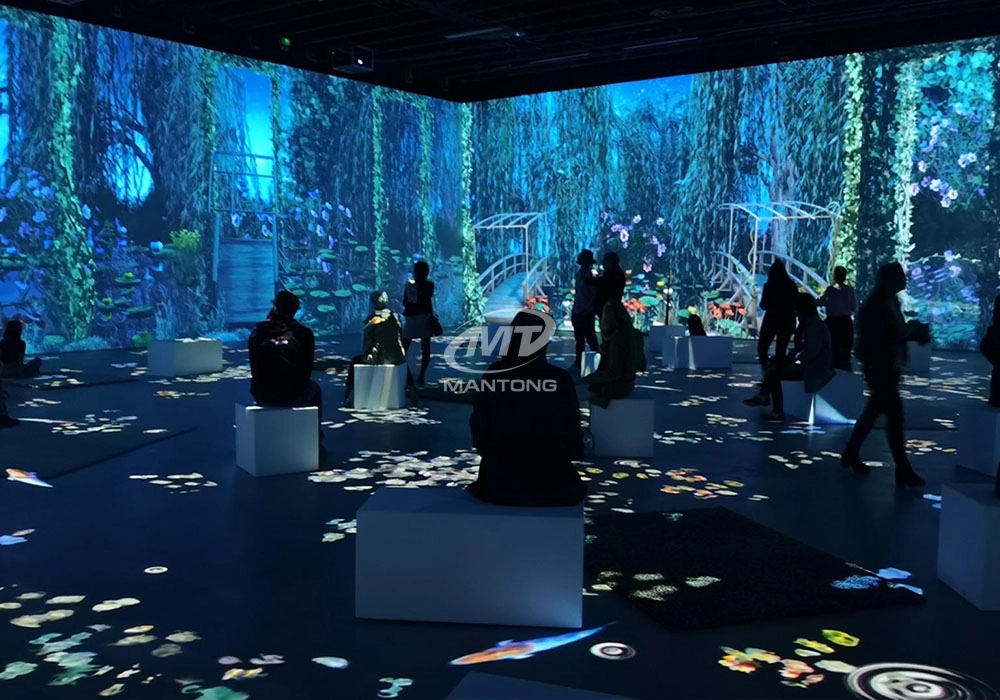
Mantong 6500LM High-Lumen Projector for Large-Scale Immersive Room Projection
Transform any space with Mantong's immersive projection mapping systems. Our high-lumen projectors (up to 6500 LM) and custom software create captivating interactive experiences for floors and walls. Ideal for museums, events, retail, and hospitality. Each kit includes professional ceiling mounting and 80+ pre-loaded video contents and is backed by a 12-month warranty and CE certification. We offer full customization and support to bring your vision to life.
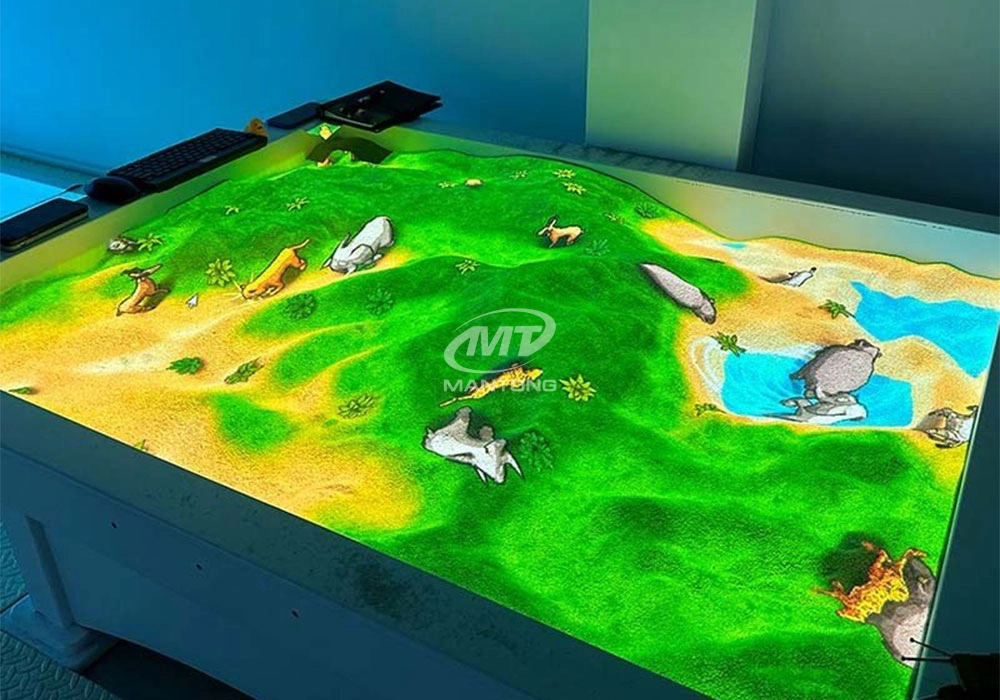
Interactive Sandbox Projection Mapping Games For Kids Play Park
Bring imagination to life with interactive sandbox projection mapping games designed for kids’ play parks. Using cutting-edge projection technology and real-time motion sensing, children can dig, build, and explore virtual worlds directly in the sand. Educational, engaging, and endlessly fun — it’s the perfect blend of play and learning.
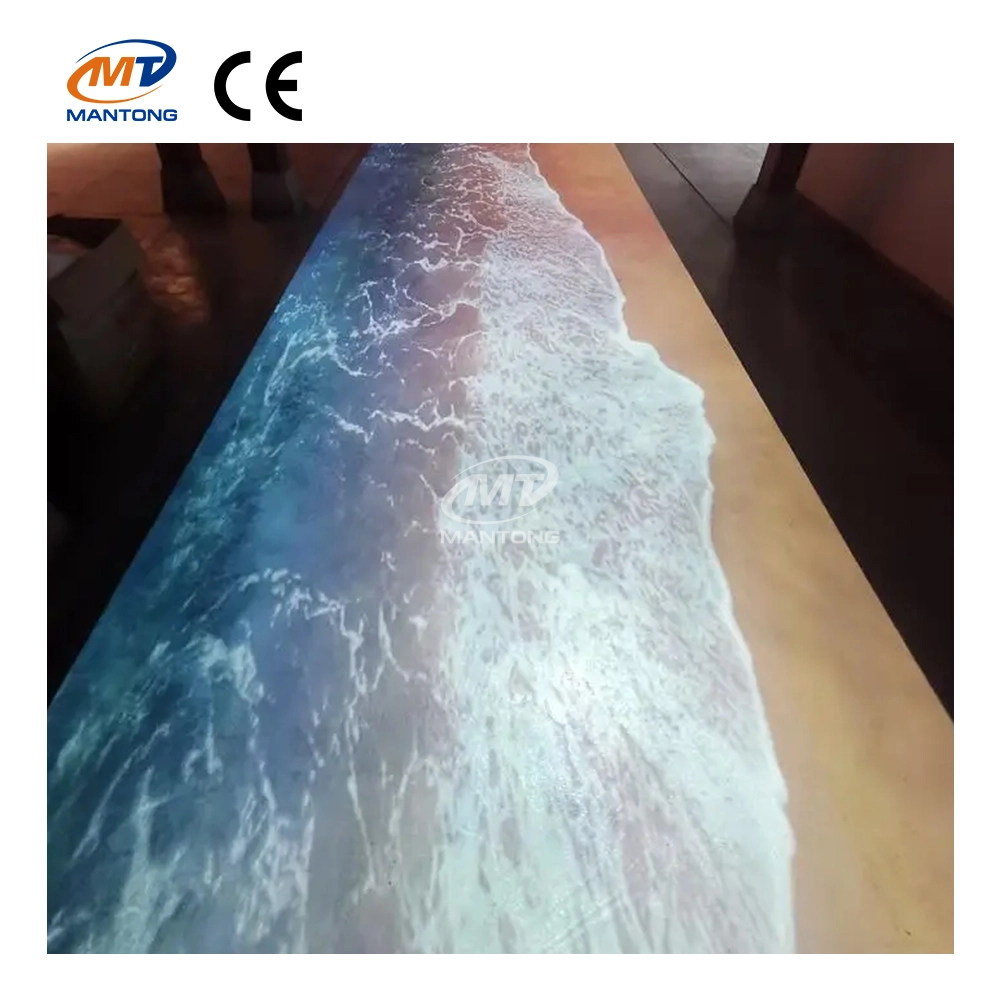
Indoor Interactive Floor Projector System - Customized Design & Installation Support
Indoor interactive floor projections display dynamic themed videos on the floor, commonly used in venues aiming to enhance brand influence or attract foot traffic, such as restaurants, hotel corridors, and brand car retail stores.
By using projectors and compatible software, the interactive content is projected onto the floor, encouraging engagement between people and the projected visuals. A single 5500-lumen indoor floor projector can cover an area of 5 m × 3 m. Typically, each project will use at least 3 units to ensure broad coverage and optimal visual effects.
We also offer customized design and installation support to enhance the interactive experience for your venue.
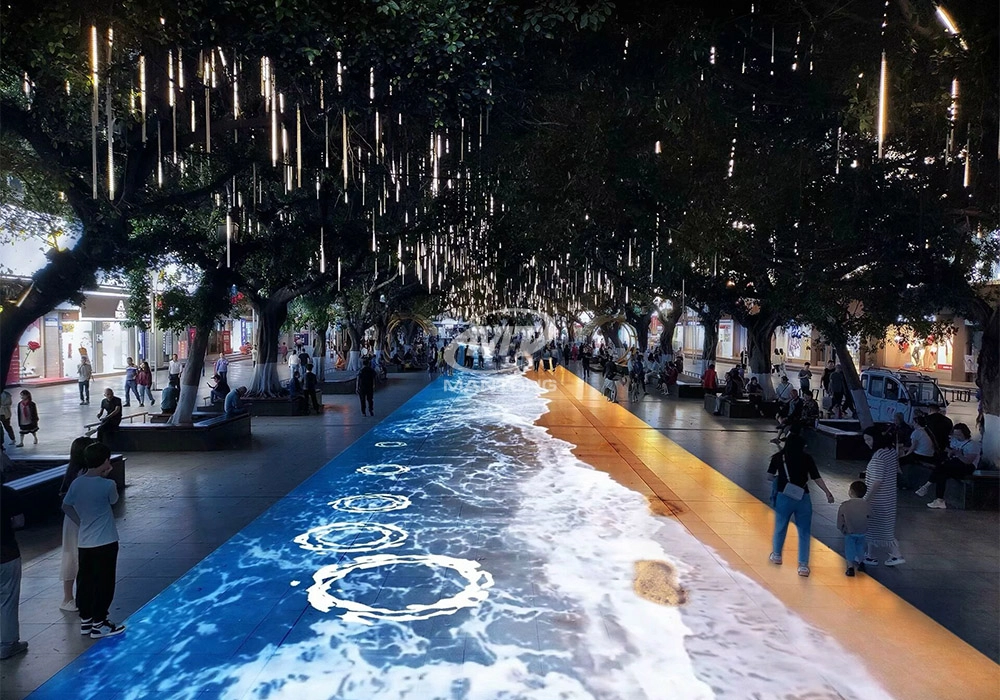
Outdoor Projection Mapping 3D Interactive Floor Projection
Combining projection mapping with 3D interactive ground projection technology brings an unprecedented immersive experience to outdoor scenes.

Kaida Business Center, Shixin Road, Panyu District,Guangzhou City, Guangdong Province, China.
ManTong
ManTong
ManTong