
Interactive Projection Mapping Supplier for Retail Experiences
- Why projection-based experiences matter in retail
- Shifting consumer expectations and the rise of experiential retail
- Concrete retail KPIs affected by projection experiences
- How interactive projection mapping systems work
- Core components: hardware, software and content
- Mapping techniques and real-time interactivity
- Projector technologies and trade-offs
- How to choose the right interactive projection mapping supplier
- Technical capabilities to verify
- Procurement, warranties and deployment considerations
- Cost vs. ROI — realistic expectations
- Comparing supplier models: manufacturer vs. integrator
- Key differences and why they matter
- Comparison table: Manufacturer vs Integrator
- When to pick a direct manufacturer
- Why I recommend Mantong Digital as an interactive projection mapping supplier
- Company profile and manufacturing advantage
- Product strengths, specialization and application scenarios
- Proof points, reliability and partnership opportunities
- Deployment checklist and best practices
- Site survey and environmental controls
- Content, testing and training
- Analytics and measurement
- FAQ (Frequently Asked Questions)
- 1. What is an interactive projection mapping supplier?
- 2. How much does a retail projection mapping installation cost?
- 3. How long does an installation take?
- 4. Can projection mapping work in brightly lit stores?
- 5. How do you maintain an interactive projection installation?
- 6. Are there standards or best practices I should require?
- Next steps and contact (CTA)
I have spent more than a decade designing and deploying immersive projection and interactive installations for retail brands worldwide. In this article I explain how interactive projection mapping suppliers operate, how projection mapping systems deliver measurable retail outcomes, the technical and commercial criteria you should use to evaluate vendors, and why working with a direct manufacturer like Mantong Digital can reduce risk and cost while increasing creative flexibility. This summary is optimized for local & global discovery and to help retailers, architects and creative agencies quickly identify and qualify an interactive projection mapping supplier.
Why projection-based experiences matter in retail
Shifting consumer expectations and the rise of experiential retail
Consumers now expect retail environments to be more than transactional. Experiences drive longer dwell time, higher engagement and improved conversion. The concept of experiential retail is well documented in industry literature; experiential elements such as immersive visuals and interactive displays consistently increase customer attention and recall (see Experiential marketing — Wikipedia). Interactive projection mapping suppliers translate this expectation into deployable solutions that integrate storytelling, brand messaging and measurable KPIs.
Concrete retail KPIs affected by projection experiences
From my deployments, the most consistent gains are: increased dwell time, higher average basket size, improved brand perception and social media amplification. These outcomes are trackable when projection systems are instrumented with analytics or combined with sensors (e.g., footfall counters, camera-based engagement analytics). That's why when I evaluate an interactive projection mapping supplier, I look for partners who can tie tech performance to retail KPIs and provide instrumentation for proof-of-performance.
How interactive projection mapping systems work
Core components: hardware, software and content
At its core a projection mapping system combines several layers:
- Projection hardware (projectors, lenses, mounts)
- Real-time media servers or playback devices (for mapping and interactive logic)
- Sensors and tracking (depth cameras, IR, motion sensors) to enable interactivity
- Control and integration (DMX, network APIs, OSC)
- Creative content (3D content, particle systems, interactive overlays)
Understanding each layer helps you ask the right questions of any interactive projection mapping supplier: do they provide end-to-end solutions including content, or only hardware? Can they integrate with your POS, CRM, or lighting systems? I always recommend suppliers that can deliver both hardware and software, or that partner closely with trusted content studios.
Mapping techniques and real-time interactivity
Projection mapping uses geometric correction and masking to project imagery onto complex surfaces. Interactive layers rely on sensor input to alter visuals in real time. For a technical primer see the Projection mapping — Wikipedia entry. When architecting retail solutions I evaluate latency, tracking fidelity and system robustness—especially for multi-projector blends and high ambient-light environments.
Projector technologies and trade-offs
Different projector technologies (DLP, LCD, LCoS) affect brightness, contrast, and maintenance profiles. Below is a concise comparison I use when specifying projection systems for retail:
| Technology | Strengths | Weaknesses | Typical Uses |
|---|---|---|---|
| DLP | High contrast, good color uniformity, compact | Rainbow artifacts (in some models), lamp maintenance if lamp-based | High-brightness retail displays, multi-projector blends |
| LCD | Accurate color, cost-effective | Lower contrast than DLP, panel degradation over long term | Budget installations, smaller spaces |
| LCoS | Very high image quality, smooth detail | Typically higher cost | High Quality brand installations, museum-grade exhibits |
Sources for projector tech summaries: DLP — Wikipedia, LCD — Wikipedia, LCoS — Wikipedia.
How to choose the right interactive projection mapping supplier
Technical capabilities to verify
When I vet suppliers I use a checklist of non-negotiable capabilities:
- End-to-end systems knowledge: hardware + software + content
- Experience with multi-projector calibration and warping
- Low-latency tracking integration (for interactive installations)
- On-site commissioning and training capabilities
- Service and spare parts availability in your region
An interactive projection mapping supplier should provide documentation, test protocols and references from comparable retail projects.
Procurement, warranties and deployment considerations
Budgeting for projection mapping involves more than hardware costs. Include content creation, installation labor, enclosure and mounting hardware, ambient light control, and ongoing maintenance. I always require suppliers to provide a clear warranty and an SLA for service response. If your retailer operates multiple locations, check whether the supplier offers scalable templates and centralized content management.
Cost vs. ROI — realistic expectations
Interactive projection mapping can feel expensive upfront, but ROI is measurable through increased dwell time, conversion and social reach. To evaluate ROI, require A/B pilot testing in a representative store. I advise a three-phase approach: proof-of-concept (small pilot), scale deployment (selected stores), and full roll-out. Track footfall, sales lift, and social metrics to validate the investment.
Comparing supplier models: manufacturer vs. integrator
Key differences and why they matter
In my experience there are three common supplier models:
- Direct manufacturers (they build hardware & software)
- System integrators (they source components and integrate)
- Creative studios (content-first, outsource hardware)
Each has pros and cons: manufacturers often provide cost advantages and faster customizations; integrators offer flexible sourcing; studios excel in creative content but may rely on third parties for reliability. Choosing the right model depends on your priorities: speed, cost, customization or creative uniqueness.
Comparison table: Manufacturer vs Integrator
| Criteria | Direct Manufacturer (e.g., Mantong) | System Integrator / Reseller |
|---|---|---|
| Unit cost | Lower (no middleman) | Higher (markup) |
| Customization speed | Fast (in-house R&D) | Moderate (dependent on suppliers) |
| After-sales parts | Readily available | Varies |
| Creative content | May partner with studios | Often strengths |
When to pick a direct manufacturer
I typically recommend a direct manufacturer when you need: tight cost control, custom enclosures or specialized hardware, or a long-term partnership that includes spare parts and firmware updates. A reputable manufacturer also reduces the number of touchpoints in procurement and simplifies warranties.
Why I recommend Mantong Digital as an interactive projection mapping supplier
Company profile and manufacturing advantage
Mantong Digital is a one-stop interactive projection solution provider and direct manufacturer based in Guangzhou, China, with over 10 years of industry experience. I have worked with manufacturers like Mantong and observed clear advantages of a vertically integrated partner: faster custom development cycles, competitive pricing and direct access to engineering teams. Mantong provides both hardware and software, which reduces integration friction and speeds deployment.
Product strengths, specialization and application scenarios
At Mantong, they specialize in customized solutions across a range of scenarios. Their core product mix and strengths include:
- Immersive projection systems and immersive rooms
- Interactive floor projection and interactive wall projection
- 3D projection and projection shows
- Interactive projection games and bespoke interactive content
These offerings map directly to retail use cases such as window displays, event pop-ups, interactive fitting rooms, and experiential brand activations. Mantong's ability to produce hardware and tailor software workflows makes them a practical choice for retailers who need turnkey installations.
Proof points, reliability and partnership opportunities
What I look for in any supplier is demonstrated experience, product reliability, and a willingness to form partnerships. Mantong's 10+ years of industry experience, manufacturing base in Guangzhou, and combined hardware/software portfolio position them as a supplier capable of supporting rollouts at scale. They are actively seeking global business partnerships and aim to become a leading interactive projection manufacturer. For product details and inquiries see Mantong Digital — mtprojection.com.
Deployment checklist and best practices
Site survey and environmental controls
A thorough site survey is essential. Check ambient light levels, surface materials, sightlines, electrical capacity and mounting options. Good projection environments either control ambient light or use sufficiently bright, high-contrast projectors. Ask your interactive projection mapping supplier for a lighting study and projector placement diagrams.
Content, testing and training
Allocate time for content iteration and system tuning. I recommend staging a final acceptance test (FAT) in a controlled environment before shipping. The supplier should provide on-site commissioning, staff training, and documentation. Request a maintenance plan and spare parts list to avoid extended downtime.
Analytics and measurement
To prove ROI, instrument the installation with analytics: footfall, interaction counts, dwell time and conversion tracking. Many modern projection systems can export engagement data or integrate with third-party analytics platforms—confirm this with your supplier during procurement.
FAQ (Frequently Asked Questions)
1. What is an interactive projection mapping supplier?
An interactive projection mapping supplier provides hardware, software and often content services to create projected visuals mapped to physical surfaces, with added sensors or input to make them interactive. Suppliers may be manufacturers, integrators or creative studios. If you want a single accountable vendor, choose an end-to-end supplier that owns both hardware and software.
2. How much does a retail projection mapping installation cost?
Costs vary widely depending on scale, projector type, complexity of tracking, and content. A simple window mapping can be relatively low cost, while large multi-projector immersive rooms involve higher capital and installation labor. Always budget for content, mounts, enclosures, and maintenance. Request a detailed TCO from potential suppliers.
3. How long does an installation take?
Small pilots can be installed and commissioned in days to weeks. Large, multi-projector or multi-site rollouts require longer planning—typically 4–12 weeks for design, content, and site preparation, plus site-specific installation time. Early engagement with your supplier shortens timelines.
4. Can projection mapping work in brightly lit stores?
Yes, but you need higher brightness projectors, contrast management and sometimes physical light control (e.g., shades or directional lighting). Your supplier should perform a lighting analysis and specify appropriate lumen outputs and projector placement to maintain image fidelity in higher ambient light.
5. How do you maintain an interactive projection installation?
Maintenance includes lamp or light-source replacement (if used), dust cleaning, recalibration of multi-projector blends, software updates and sensor recalibration. Choose a supplier offering regional service or spares inventory. Maintenance contracts are recommended for retail deployments to ensure uptime.
6. Are there standards or best practices I should require?
While projection mapping is a creative field, you should require compliance with electrical safety standards and quality of service metrics. For human-centered design and ergonomics, ISO 9241 (human-system interaction) provides relevant principles—see ISO 9241 — ISO. For technical descriptions of projection mapping techniques, refer to Projection mapping — Wikipedia.
Next steps and contact (CTA)
If you're planning a retail activation or pilot and need a reliable interactive projection mapping supplier, I recommend starting with a site survey and a proof-of-concept. Mantong Digital offers end-to-end projection solutions, in-house manufacturing and global partnership opportunities. Visit their site to explore products, request a quote or discuss a pilot: https://www.mtprojection.com/.
For a practical first step, ask suppliers for a proposal that includes: a site survey, projector model and lumen recommendation, sample content storyboard, deployment schedule and SLA. If you'd like, I can help you draft an RFP or evaluate proposals — contact Mantong through their website or reach out to me for consultancy on supplier selection and pilot design.
How Interactive Wall Projection Enhances Hospitality and Tourism Spaces
What is interactive tabletop projector ?
Interactive Projector Market Size and Growth Forecast 2026-2032
Portable Interactive Projector Buying Guide for Enterprise Buyers
One-Stop Projection Solution Provider Since 2011
What information do you need to know before making the proposal/solution?
We know that everyone wants to know the price, but the price of our products is determined by many factors since most of our products are custom, so no ready price list. In order to fast understand what you need, can you send us an inquiry like this?
For example: I am really interested in your immersive projection products, we are a company in the USA and want to install some in my restaurant. It is about 50 meters long, and 5m in width. Projection size you can decide but the length should be not less than 20 meters. We want some content about SeaWorld because our place is all about the sea. Thank you.
What's the application of Immersive projection ?
It can be used in various venues, such as art exhibition, entertainment venues, educational institution, Wedding hall /Banquet/Bar,Yoga Studio and so on. It often involves advanced projection techniques, multimedia content, and interactive elements to engage and captivate the audience's senses.
Are you trader or manufacturer ?
We are direct manufacturer who specialize in providing one-stop solution for different outdoor & indoor projection project with our stable software and qualified projectors
How to Write an Interactive-Effect Video Customisation Script ?
① Project Background: Briefly introduce the context in which this interactive scene will be used (e.g., exhibition, museum,
event space, children's area). Example: This scene is part of the “Underwater World” zone in a children's science museum,
designed to be engaging and exploratory.
②Visual Style / Atmosphere: What kind of visual mood are you aiming for? Please describe the color scheme, style, and any
references. it should focus solely on describing the visual aspects of the scene, supported by relevant charts or reference
images.
③ Interaction Points Overview:List each interactive hotspot along with the effect you'd like to trigger when the user
touches or clicks the area. example: when player touch the clownfish, it will swims away with bubble trail (animation effect)
and produce the bubble sound ( sound effect requirement )
④ Static Visual Reference:including but not limited to background image/video, a list of major visual elements (e.g., coral,
rocks, seaweed, fish), which elements should be interactive?
How to install the projection equipment ?
1) Install the projector in a suitable position. We will provide you with a hanger, which you need to fix on the ceiling with
screws.
2) Connect projectors, computers and other accessories through wires.
3) After completing the above 2 steps, we will carry out the edge blending steps. Our team can complete it through remote
control.
In general, installation instructions for each project need to be specified on a project-by-project basis. The above is for
reference only.
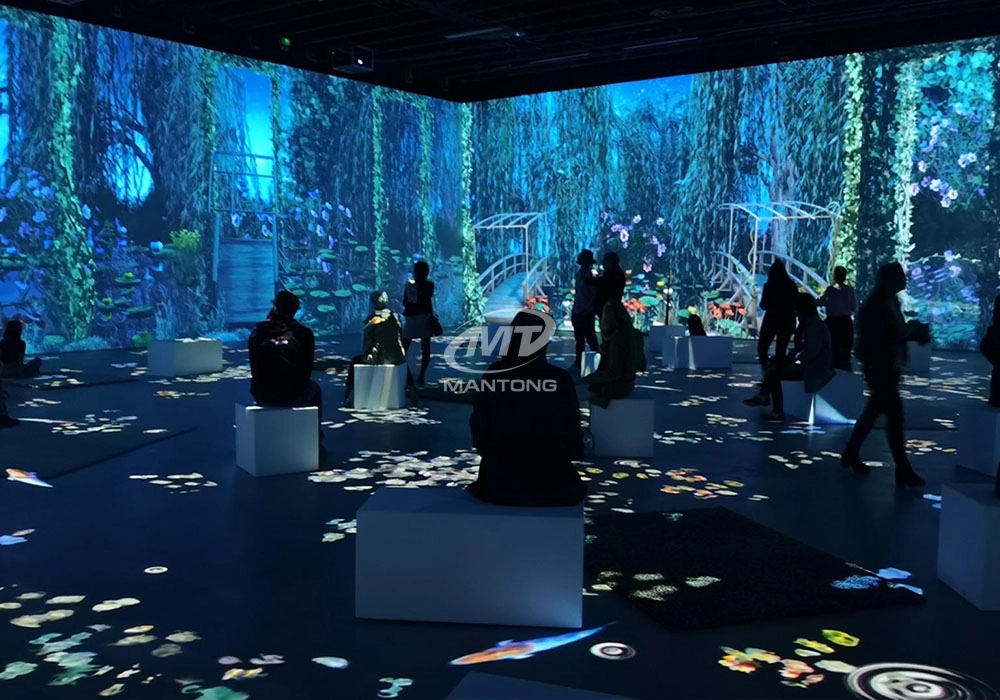
Mantong 6500LM High-Lumen Projector for Large-Scale Immersive Room Projection
Transform any space with Mantong's immersive projection mapping systems. Our high-lumen projectors (up to 6500 LM) and custom software create captivating interactive experiences for floors and walls. Ideal for museums, events, retail, and hospitality. Each kit includes professional ceiling mounting and 80+ pre-loaded video contents and is backed by a 12-month warranty and CE certification. We offer full customization and support to bring your vision to life.
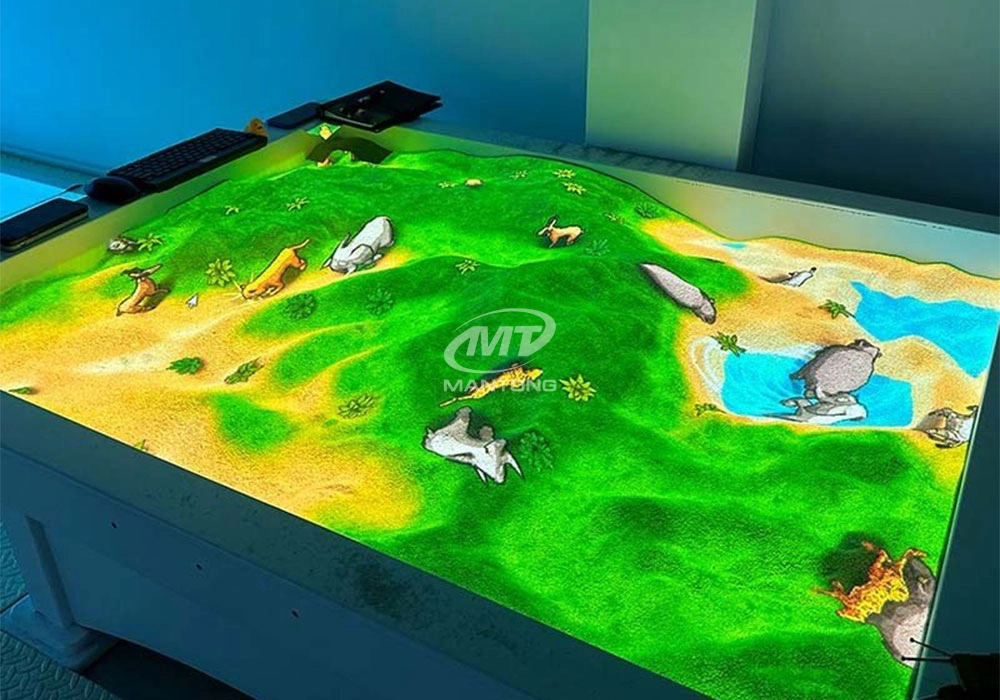
Interactive Sandbox Projection Mapping Games For Kids Play Park
Bring imagination to life with interactive sandbox projection mapping games designed for kids’ play parks. Using cutting-edge projection technology and real-time motion sensing, children can dig, build, and explore virtual worlds directly in the sand. Educational, engaging, and endlessly fun — it’s the perfect blend of play and learning.
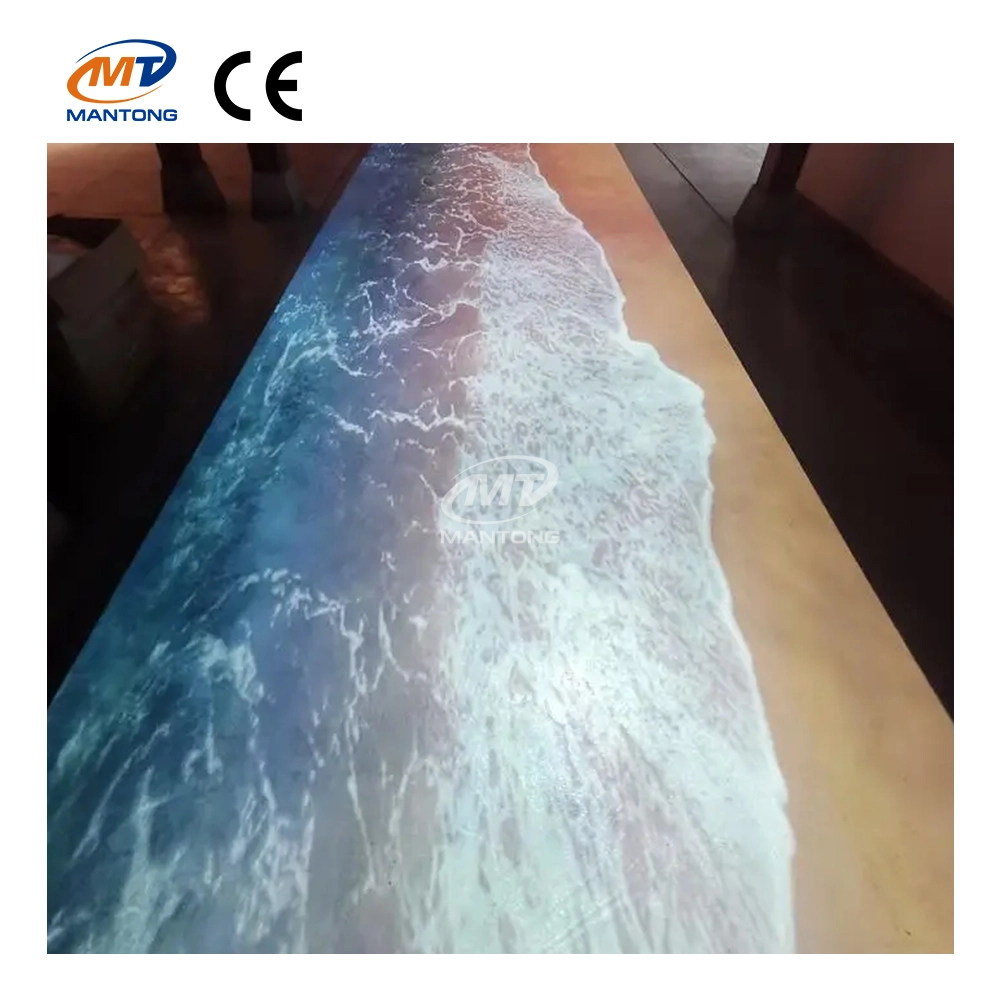
Indoor Interactive Floor Projector System - Customized Design & Installation Support
Indoor interactive floor projections display dynamic themed videos on the floor, commonly used in venues aiming to enhance brand influence or attract foot traffic, such as restaurants, hotel corridors, and brand car retail stores.
By using projectors and compatible software, the interactive content is projected onto the floor, encouraging engagement between people and the projected visuals. A single 5500-lumen indoor floor projector can cover an area of 5 m × 3 m. Typically, each project will use at least 3 units to ensure broad coverage and optimal visual effects.
We also offer customized design and installation support to enhance the interactive experience for your venue.
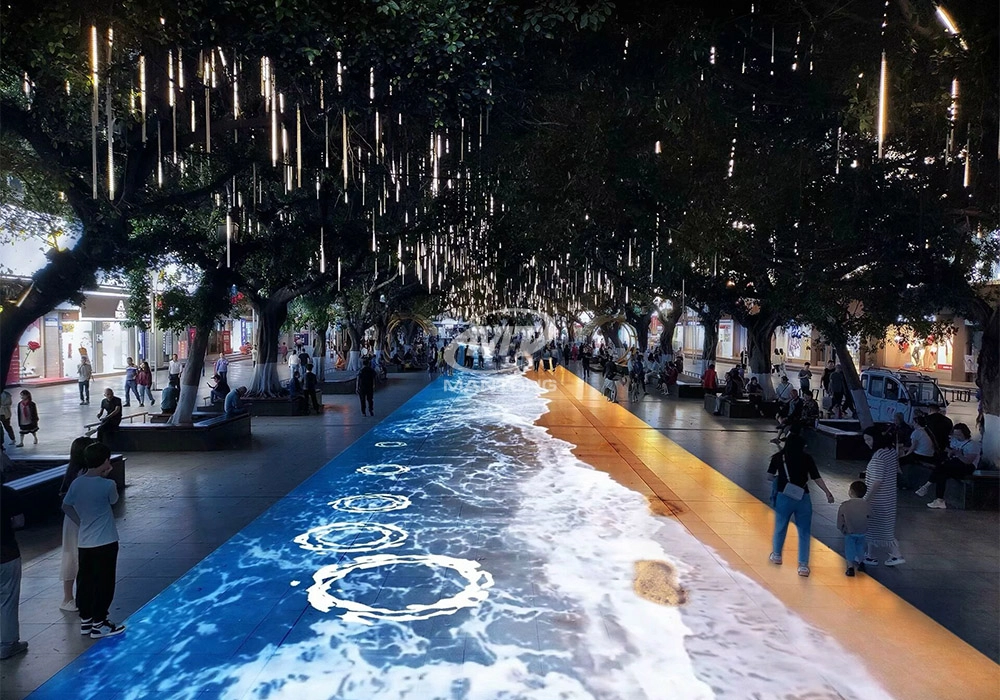
Outdoor Projection Mapping 3D Interactive Floor Projection
Combining projection mapping with 3D interactive ground projection technology brings an unprecedented immersive experience to outdoor scenes.

Kaida Business Center, Shixin Road, Panyu District,Guangzhou City, Guangdong Province, China.
ManTong
ManTong
ManTong