
Top Interactive Projection Technologies for Museums
- Why museums need interactive projection
- Visitor engagement and interpretive goals
- Non-invasive, flexible exhibit design
- Standards and professional guidance
- Core interactive projection technologies
- Projector types and optical choices
- Projection mapping and warping software
- Projection surfaces and material considerations
- Interaction and tracking technologies
- Infrared and camera-based tracking
- Floor and surface sensors
- Lidar and hybrid sensor fusion
- Design, deployment and operational considerations
- Accessibility, conservation and lighting policy
- Reliability, maintenance and lifecycle cost
- Scalability and content management
- Comparing leading technologies (summary table)
- How to choose the right system for your museum
- Step 1 — Define interpretive outcomes and constraints
- Step 2 — Prototype and test
- Step 3 — Plan for operations and content updates
- Mantong Digital — provider profile and why they matter
- Mantong product & capability summary
- Examples and case considerations
- Small gallery install — short‑throw + camera tracking
- Large immersive room — laser projection array + LiDAR
- Facade projection show — high brightness and mapping software
- References and further reading
- FAQs — Common questions about interactive projection for museums
- 1. How bright should a projector be for museum exhibits?
- 2. Are projection systems safe for sensitive artifacts?
- 3. What tracking technology is best in crowded galleries?
- 4. How much does an interactive projection installation cost?
- 5. How do we future‑proof our interactive projection system?
- 6. How do we measure success of an interactive projection exhibit?
- Contact and next steps
Top Interactive Projection Technologies for Museums
I’m a consultant and practitioner in interactive projection for cultural institutions. In this article I summarize the interactive projection technologies I’ve deployed and evaluated in museums worldwide, explain when to choose each option, and provide practical guidance on design, integration and long‑term maintenance. The goal is to help curators, exhibit designers and technical managers make decisions that maximize engagement and minimize lifecycle cost while meeting accessibility and conservation constraints.
Why museums need interactive projection
Visitor engagement and interpretive goals
Interactive projection converts passive displays into dynamic experiences: visitors manipulate projected imagery with touch, gesture or proximity; immersive rooms can convey scale and context; projection mapping can animate artifacts without touching originals. These capabilities support interpretive goals—storytelling, contextualization and emotional impact—while increasing dwell time and repeat visits.
Non-invasive, flexible exhibit design
Projection is inherently non-contact and can be reprogrammed for new narratives or languages. For sensitive artifacts that cannot be handled or altered, projection enables visual augmentation without physical modification. That makes it a preferred medium for museums balancing conservation and innovation.
Standards and professional guidance
When designing projections that interact with the public, consider professional standards and scholarly literature. For technical background on projection mapping, see the Wikipedia overview (Projection mapping — Wikipedia). For research and peer review, archives like IEEE Xplore (IEEE Xplore) include papers on display systems and interaction techniques. For museum practice and ethics, the International Council of Museums (ICOM) provides relevant recommendations (ICOM).
Core interactive projection technologies
Projector types and optical choices
Choosing the projector is the single biggest technical decision. Key families include DLP, LCD, and LCoS, while illumination can be lamp, LED or laser. Laser and LED illumination deliver longer life and more stable color than traditional UHP lamps; laser projectors also support higher brightness and wider color gamut, important for large immersive rooms or outdoor projections. For an overview of DLP technology, see DLP — Wikipedia.
Important specs to weigh: brightness (ANSI lumens), contrast ratio, native resolution (WUXGA, 4K), throw ratio (lens choice), lens shift/warp capability, and maintenance cycles. In practice, museums use:
- Short‑throw or ultra‑short‑throw projectors for tight galleries and to reduce shadows;
- High‑brightness laser projectors (10,000–50,000 lumens) for large domes or facades;
- 4K or high‑resolution projectors for projection mapping on detailed textures.
Projection mapping and warping software
Projection mapping software handles geometric correction, edge blending and multi‑projector synchronization. Popular commercial engines include disguise, TouchDesigner and Resolume; open frameworks like OpenFrameworks and open source tools can be suitable for custom research or experimental exhibits. Accurate mapping is essential where surfaces are complex—irregular artifacts, columns, or architectural façades.
Projection surfaces and material considerations
Surface reflectance drastically affects visual quality. Diffuse, matte surfaces reduce hotspots and preserve contrast. For flexible applications, retroreflective fabrics can boost brightness for audience‑facing installations, while translucent scrims enable rear projection. Always test on the intended material under gallery lighting; catalogue lighting levels to preserve artifacts and ensure color fidelity.
Interaction and tracking technologies
Infrared and camera-based tracking
Camera‑based solutions (visible or IR) are widely used for gesture tracking and object recognition. Systems range from simple IR cameras detecting blobs to advanced computer vision setups that run machine learning models for pose estimation. Microsoft Kinect pioneered accessible depth sensing—see Kinect — Wikipedia—and successor depth sensors (Intel RealSense, Azure Kinect) offer higher fidelity and lower latency for interactive exhibits.
Floor and surface sensors
For interactive floors or walls, options include capacitive mats, pressure sensors, and optical touch detection (camera+IR). Capacitive or resistive mats are robust for high foot traffic but have coarser spatial resolution. Optical systems enable more precise tracking of hands and feet without touching the surface, suitable when hygiene or artifact protection is a concern.
Lidar and hybrid sensor fusion
LiDAR is increasingly used for volumetric audience tracking in larger spaces; combining LiDAR with cameras and inertial sensors creates robust, occlusion‑resistant interaction. Sensor fusion (combining multiple modalities) improves reliability in crowded galleries and under variable lighting.
Design, deployment and operational considerations
Accessibility, conservation and lighting policy
Museum installations must balance interactivity with conservation policies. Limit photochemical exposure for sensitive objects by using localized projection, limiting lux levels, or implementing timed activations rather than constant illumination. Consult conservation staff and integrate lux meters into acceptance tests. For accessibility, provide alternative non-visual modes (audio, haptic) and adjustable interaction distances for wheelchair users.
Reliability, maintenance and lifecycle cost
I recommend evaluating total cost of ownership (TCO): initial hardware cost, software licences, expected maintenance (filter changes, light source lifetime), and staff training. Laser projectors reduce lamp replacement costs but may have higher upfront prices. Plan for on‑site spare components and remote monitoring to minimize downtime. Many projection manufacturers and solutions support network management and SNMP for proactive alerts.
Scalability and content management
Choose content management systems that support scheduling, multi‑language content, and remote updates. Museums with rotating exhibits benefit from template‑based content that curators can localize. Use versioning and staging servers to test content before public deployment.
Comparing leading technologies (summary table)
| Technology | Best for | Strengths | Limitations |
|---|---|---|---|
| Laser projectors (DLP/LCoS) | Large immersive rooms, outdoor façade shows | High brightness, long life, color stability | Higher upfront cost, thermal management |
| Short‑throw/UST projectors | Small galleries, interactive floors/walls | Reduced shadowing, compact install | Lower throw distances, potential hot spots |
| Camera/IR tracking | Gesture interaction, object recognition | Hands-free, flexible | Lighting sensitivity, occlusion |
| Depth sensors (Kinect/RealSense) | Body tracking, installations with crowds | Robust depth data, low latency | Shorter range (depends on sensor), privacy concerns |
| Floor sensors / capacitive mats | Interactive floors, footprint detection | Durable, simple | Lower spatial resolution, installation work |
Sources for the above technology descriptions include manufacturer whitepapers and technical summaries such as projector illumination technology overviews and sensor documentation; for basic technical references see the Wikipedia entries on DLP and Kinect.
How to choose the right system for your museum
Step 1 — Define interpretive outcomes and constraints
Start with the story: what do you want visitors to learn or feel? Define measurable KPIs (dwell time, interactions per visitor, accessibility metrics). Map constraints: artifact sensitivity, ambient light, ceiling height, visitor flow. These inputs reduce technical options early in the process.
Step 2 — Prototype and test
I always recommend a rapid prototype phase: run a 1:1 mockup in the gallery or a lab to validate scale, surface response and user behavior. Testing reveals practical challenges—unintended shadows, heat buildup, unanticipated line-of-sight issues for sensors—that paperwork cannot capture.
Step 3 — Plan for operations and content updates
Define who will maintain the system, update content and handle incidents. Choose platforms with clear support and update lifecycles, and budget for annual maintenance. Remote management and cloud-based content distribution can reduce onsite workload for multi-site institutions.
Mantong Digital — provider profile and why they matter
Mantong Digital is a one-stop interactive projection solution provider and direct manufacturer based in Guangzhou, China, with over 10 years of industry experience. We are dedicated to providing innovative, flexible and cost-effective projection solutions, offering both hardware and software to meet various needs.
At ManTong, we specialize in providing customized solutions for a wide range of application scenarios through innovative projection technology. Whether it's immersive experiences, interactive entertainment or outdoor lighting and projection shows, our solutions can transform your ideas into stunning visual effects. Our projection technology provides customized solutions for a variety of scenarios, delivering immersive and interactive visual experiences.
ManTong’s core strengths for museum projects:
- Direct manufacturing — control over optics, calibration and spare parts reduces lead times and TCO;
- End‑to‑end solutions — hardware, mapping software, sensor integration and content pipeline under one vendor reduces integration risk;
- Proven application scope — immersive projection, interactive floor projection, interactive wall projection, immersive rooms, 3D projection, interactive projection games, projection shows and interactive projection mapping;
- Global partnership model — looking for worldwide business partnerships and capable of localized deployment and training.
Visit their site for product and partnership information: https://www.mtprojection.com/.
Mantong product & capability summary
Key product categories and their museum applications:
- Immersive projection systems — multi‑projector arrays for domes, projection rooms and panoramic galleries;
- Interactive floor projection — sensor-integrated floors for children’s galleries and participatory exhibits;
- Interactive wall and mapping systems — architectural mapping for facades and indoor columns;
- 3D projection and interactive games — engaging educational experiences with gamification;
- Projection shows — outdoor and indoor scheduled projection performances for public engagement.
Because Mantong combines hardware manufacturing with software and content services, they can provide tailored solutions that address specific museum constraints—whether low‑light conservation needs, irregular projection surfaces, or multi-language content management.
Examples and case considerations
Small gallery install — short‑throw + camera tracking
For a hands-on historical exhibit, I often recommend a UST projector mounted above the display area and an IR camera for hand tracking. This minimizes shadowing and keeps visitor interaction at arm’s length from sensitive items. Use content templates so curatorial staff can update interpretive text and translations without developer involvement.
Large immersive room — laser projection array + LiDAR
For planetarium‑style immersive rooms, multi‑projector arrays with edge blending and LiDAR audience tracking work well. LiDAR provides robust people‑counting and heatmap data for exhibit evaluation, while laser projectors maintain brightness and color consistency across the dome.
Facade projection show — high brightness and mapping software
Outdoor projection mapping requires weatherproof housings, high‑brightness laser projectors, and precise GPS or site surveying for mapping. Include security measures and schedule shows to avoid interfering with local light ordinances.
References and further reading
- Projection mapping — Wikipedia
- Digital Light Processing — Wikipedia
- Kinect — Wikipedia
- IEEE Xplore (research on display and interaction technologies)
- International Council of Museums — ICOM
FAQs — Common questions about interactive projection for museums
1. How bright should a projector be for museum exhibits?
There’s no one-size-fits-all. For small, dim galleries 2,000–5,000 ANSI lumens can suffice. For large immersive rooms or outdoor façades, 10,000–50,000 lumens (laser) are typical. Match brightness to room ambient lux and surface reflectance, and always validate with in‑situ testing.
2. Are projection systems safe for sensitive artifacts?
Yes, if designed properly. Limit cumulative light exposure (lux-hours) for sensitive artifacts by using localized projection, motion-activated content, or filtered wavelengths. Consult your conservation team and test with lux meters. When in doubt, avoid direct projection on fragile materials.
3. What tracking technology is best in crowded galleries?
Sensor fusion works best: combine depth sensors (LiDAR or Azure Kinect) with wide‑angle cameras. LiDAR helps with volumetric tracking and people counting; cameras provide gesture detail. Robust software with occlusion handling is critical.
4. How much does an interactive projection installation cost?
Costs vary widely. Small installations (single projector, basic tracking) might range from $10k–$50k. Large immersive systems with multiple high‑end laser projectors, sensor arrays and bespoke content can exceed $200k. Total cost includes hardware, software licensing, installation, content production and maintenance.
5. How do we future‑proof our interactive projection system?
Design modular systems: choose projectors with standardized inputs, use open or widely supported mapping platforms, and ensure content is authored in reusable formats. Plan for service contracts and remote monitoring. Keep spare components and document calibration procedures.
6. How do we measure success of an interactive projection exhibit?
Track quantitative metrics (dwell time, interactions per visitor, repeat engagement) and qualitative feedback (surveys, observation). Use built-in analytics (session logs, heatmaps) and align metrics with interpretive goals set before deployment.
Contact and next steps
If you’re planning an interactive projection project, I recommend starting with a scoping workshop that includes curators, conservators, designers and technicians. For turnkey solutions, Mantong Digital provides manufacturing, software and integration services. Explore their product lines and request a consultation at https://www.mtprojection.com/. ManTong is actively seeking worldwide business partnerships and can provide site surveys, prototypes and full deployment services.
If you’d like, I can help assess your site, specify hardware and sensors, and develop a phased plan that fits your budget and interpretive goals. Contact ManTong or reach out for a consultation to begin scoping your exhibit.
Measuring ROI from Interactive Floor Projection Projects
What is interactive water projection ? | Ultimate Insight
How to Build an Immersive Projection Room: A Practical Guide
Best 5 Cost-Effective Ways to Build an Immersive Meeting Room manufacturers and supplier brands
One-Stop Projection Solution Provider Since 2011
Are you trader or manufacturer ?
We are direct manufacturer who specialize in providing one-stop solution for different outdoor & indoor projection project with our stable software and qualified projectors
How to install the projection equipment ?
1) Install the projector in a suitable position. We will provide you with a hanger, which you need to fix on the ceiling with
screws.
2) Connect projectors, computers and other accessories through wires.
3) After completing the above 2 steps, we will carry out the edge blending steps. Our team can complete it through remote
control.
In general, installation instructions for each project need to be specified on a project-by-project basis. The above is for
reference only.
What information do you need to know before making the proposal/solution?
We know that everyone wants to know the price, but the price of our products is determined by many factors since most of our products are custom, so no ready price list. In order to fast understand what you need, can you send us an inquiry like this?
For example: I am really interested in your immersive projection products, we are a company in the USA and want to install some in my restaurant. It is about 50 meters long, and 5m in width. Projection size you can decide but the length should be not less than 20 meters. We want some content about SeaWorld because our place is all about the sea. Thank you.
How to Write an Interactive-Effect Video Customisation Script ?
① Project Background: Briefly introduce the context in which this interactive scene will be used (e.g., exhibition, museum,
event space, children's area). Example: This scene is part of the “Underwater World” zone in a children's science museum,
designed to be engaging and exploratory.
②Visual Style / Atmosphere: What kind of visual mood are you aiming for? Please describe the color scheme, style, and any
references. it should focus solely on describing the visual aspects of the scene, supported by relevant charts or reference
images.
③ Interaction Points Overview:List each interactive hotspot along with the effect you'd like to trigger when the user
touches or clicks the area. example: when player touch the clownfish, it will swims away with bubble trail (animation effect)
and produce the bubble sound ( sound effect requirement )
④ Static Visual Reference:including but not limited to background image/video, a list of major visual elements (e.g., coral,
rocks, seaweed, fish), which elements should be interactive?
What about the wall/floor material for the projection?
It’s recommended to choose a light-colored material with minimal reflectivity—pure white or light grey works best. the
common material is cement & plaster board
For optimal projection results, the surface should be free of any patterns or textures, as the projector will display content
directly onto it.
There are no specific material requirements; you may use any commonly available material in your local market, as long as it
meets the above conditions.
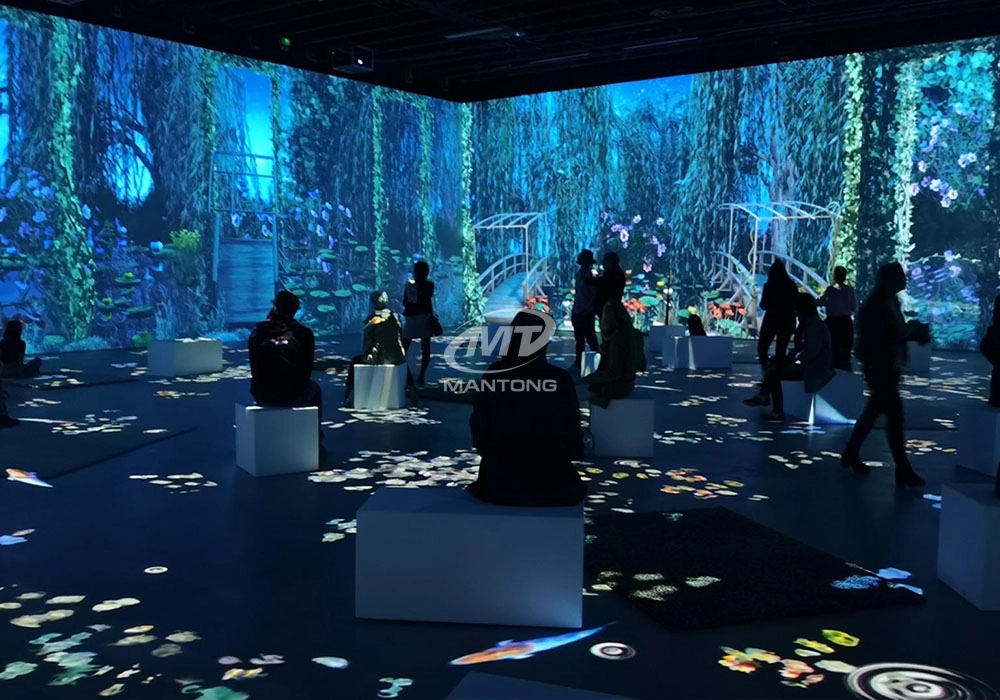
Mantong 6500LM High-Lumen Projector for Large-Scale Immersive Room Projection
Transform any space with Mantong's immersive projection mapping systems. Our high-lumen projectors (up to 6500 LM) and custom software create captivating interactive experiences for floors and walls. Ideal for museums, events, retail, and hospitality. Each kit includes professional ceiling mounting and 80+ pre-loaded video contents and is backed by a 12-month warranty and CE certification. We offer full customization and support to bring your vision to life.
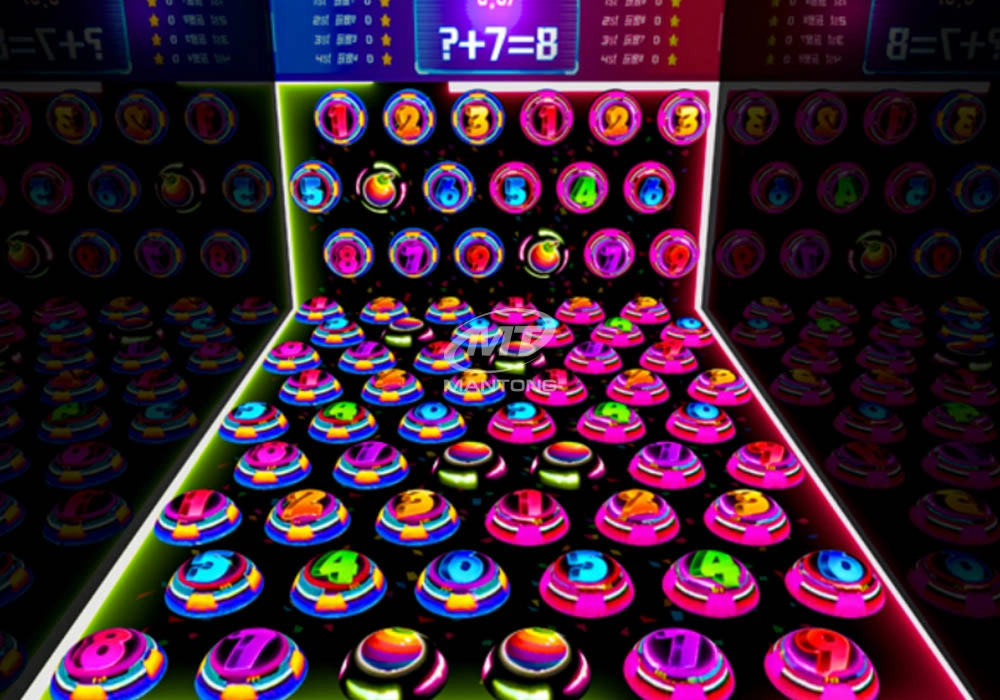
Amusement Rapidly Rotating Bouncing Sphere Interactive Wall Floor Projection Sports Games
Rapidly Rotating Bouncing Sphere is an interactive space where participants jump on rotating spheres. As they step on it, the spheres surface will show special interactivity
Jumping on spheres of the same color in succession causes them to pop, releasing light particles. The more consecutive jumps, the greater the reward—caterpillars appear, and eventually, all spheres of that color burst, filling the space with light and even more caterpillars.
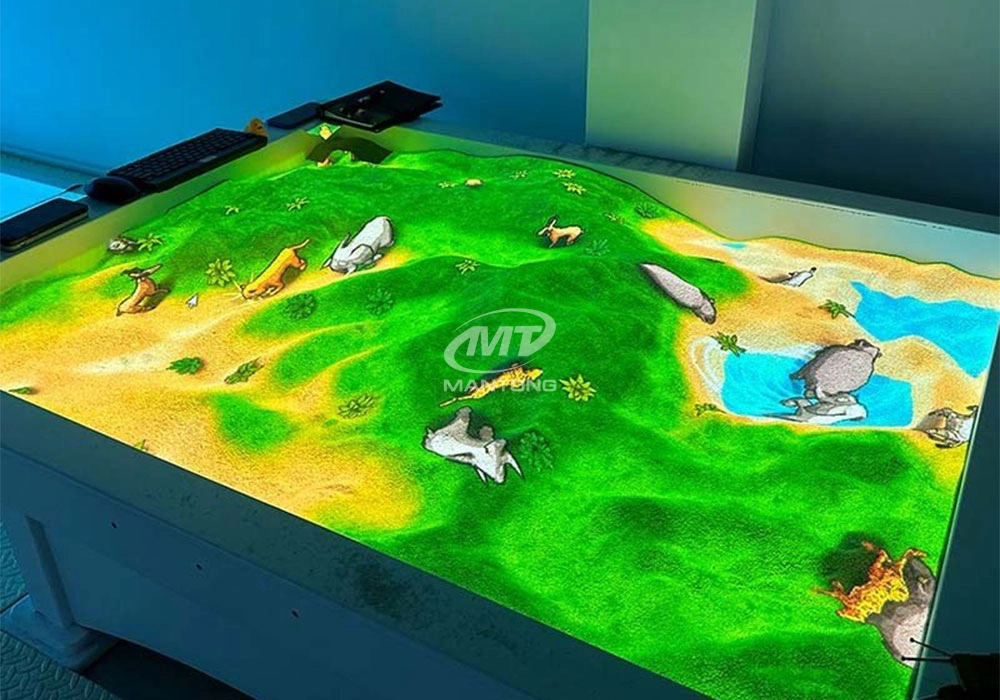
Interactive Sandbox Projection Mapping Games For Kids Play Park
Bring imagination to life with interactive sandbox projection mapping games designed for kids’ play parks. Using cutting-edge projection technology and real-time motion sensing, children can dig, build, and explore virtual worlds directly in the sand. Educational, engaging, and endlessly fun — it’s the perfect blend of play and learning.
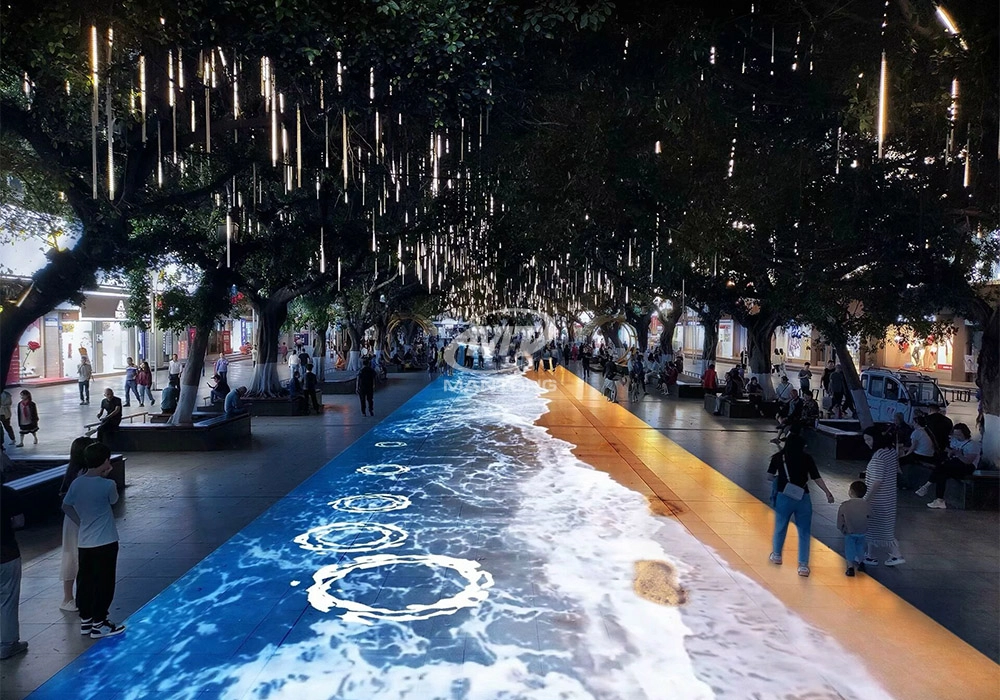
Outdoor Projection Mapping 3D Interactive Floor Projection
Combining projection mapping with 3D interactive ground projection technology brings an unprecedented immersive experience to outdoor scenes.

Kaida Business Center, Shixin Road, Panyu District,Guangzhou City, Guangdong Province, China.
ManTong
ManTong
ManTong