
Interactive projection technology: beginner's guide
- What is interactive projection technology?
- Core components of an interactive projection solution
- Projection engine: resolution, brightness and optics
- Interaction layer: sensors and tracking
- Processing and software
- Common interactive projection interaction methods and use cases
- Business intent and commercial applications
- Comparing sensor and projector options
- Design and installation best practices
- Legal, safety and accessibility considerations
- Performance metrics and evaluating ROI
- Common challenges and how to mitigate them
- Mantong Digital — one-stop interactive projection solution provider
- Mantong's technical strengths and competitive advantages
- Typical Mantong product and solution categories
- Selecting a vendor: checklist for procurement
- Cost considerations and lifecycle
- Quick-start project roadmap for beginners
- FAQ — Commonly asked questions about interactive projection technology
- 1. What is the difference between projection mapping and interactive projection?
- 2. Can interactive projection work outdoors?
- 3. How long does an installation take?
- 4. What maintenance should I budget for?
- 5. How do I measure success?
- 6. Are there affordable options for small businesses?
- 7. How can I contact Mantong Digital for a quote or partnership?
- References
What is interactive projection technology?
Interactive projection technology turns projected light into an engaging, responsive experience by combining a projector with sensing, processing and interaction layers. Instead of static imagery, content responds to people, objects, or environmental inputs in real time. This guide explains the technical building blocks, common interaction methods, hardware choices, design best practices, and business use cases so you can evaluate, design, or buy interactive projection solutions for museums, retail, events, education and more.
Core components of an interactive projection solution
An effective interactive projection system typically includes four core components: the projection engine (projector), sensing and tracking hardware (cameras, depth sensors, infrared, touch mats), a computation and control layer (PC, embedded controller, or media server), and the interactive software that maps inputs to visuals and audio. Each component affects cost, performance and installation complexity, so selecting the right combination is crucial when procuring interactive projection technology solutions.
Projection engine: resolution, brightness and optics
Projector choice depends on application scale and ambient light. For dark indoor environments, a 2,000–6,000 lumen projector can suffice; for bright atriums or outdoor façades, laser projectors rated 10,000 lumens and above are common. Key projector technologies include DLP, LCD and laser phosphor — each with trade-offs for contrast, durability and maintenance. When designing an interactive projection installation, prioritize brightness and optical throw (short-throw vs long-throw) based on mounting constraints and throw distance.
Interaction layer: sensors and tracking
Interaction is enabled by sensors that detect user presence and movement. Common options for interactive projection technology include RGB cameras (marker or computer-vision tracking), depth sensors (time-of-flight or structured light like Microsoft Kinect), infrared (IR) arrays for touch-less interaction, and capacitive/pressure mats for floor-based activations. Choosing between them depends on the required precision, latency tolerance and environment (e.g., sunlight can affect IR and camera-based tracking outdoors).
Processing and software
Interactive projection software maps raw sensor input to visual outcomes. Frameworks range from custom C++/Unity/Unreal engine applications for complex interactivity to turnkey products with drag-and-drop content editors for fast deployments. Real-time processing considerations include tracking latency (aim for sub-50 ms for natural-feeling interactions), synchronization between audio and visuals, and fallback strategies when sensors are occluded.
Common interactive projection interaction methods and use cases
Interactive projection technology supports diverse interaction models. Here are typical methods and where they excel:
- Floor projection with motion tracking: great for museums, retail and children's play areas where visitors walk through projected surfaces.
- Wall projection with gesture control: used in experiential marketing, showrooms and interactive exhibits.
- Projection mapping onto irregular 3D surfaces: ideal for façades, sculptures and stage production to transform architecture into storytelling canvases.
- Tabletop interactive projection: collaborative design, product configurators and educational displays.
Business intent and commercial applications
Organizations buy interactive projection technology to increase visitor dwell time, improve brand recall, enable immersive storytelling, or create configurable event backdrops. When selecting a vendor or system, evaluate evidence of past installations, measurable KPIs (dwell time, conversion uplift), and support/maintenance offerings — these are essential factors for procurement decisions.
Comparing sensor and projector options
Below is a comparison table summarizing common projector types and sensor technologies to help decision-makers weigh trade-offs when specifying interactive projection technology.
| Component | Typical Options | Pros | Cons | Best for |
|---|---|---|---|---|
| Projector | DLP | High contrast, fast response, compact | Rainbow effect (some units), lamp replacement (older models) | Indoor exhibits, projection mapping |
| Projector | LCD | Accurate colors, cost-effective | Lower contrast than DLP, larger chassis | Classrooms, small venues |
| Projector | Laser/LED | Long life, high brightness, low maintenance | Higher upfront cost | Outdoor façades, long-term installations |
| Sensor | RGB camera | Low cost, flexible (computer vision) | Lighting sensitive, calibration needs | Gestural control, marker tracking |
| Sensor | Depth (ToF/structured light) | Robust 3D tracking, works in low light | Higher cost, processing needs | Floor/interactive installations requiring accurate depth |
| Sensor | Infrared (IR) arrays | Reliable for touchless activation, fast | Can be affected by sunlight/outdoor conditions | Interactive floors and walls in controlled lighting |
Design and installation best practices
To implement reliable interactive projection technology, follow these professional best practices:
- Site survey: measure ambient light, surface reflectivity, mounting options, and electrical/network access.
- Calibration: perform geometric correction and color calibration on site; projection mapping often requires pixel-level alignment using fiducials or structured calibration routines.
- Redundancy: for mission-critical events, use backup media servers and dual power feeds for projectors.
- Latency testing: measure round-trip latency from sensor detection to visual change; keep it below ~50 ms for responsive interaction.
- Maintenance plan: plan lamp or filter replacements, dust cleaning, and software updates. Use sealed laser projectors for dusty outdoor contexts.
Legal, safety and accessibility considerations
Consider eye safety (laser class ratings), floor slip resistance for interactive floor installations, ADA accessibility (interaction methods for users with limited mobility), and data privacy if you store or analyze camera-based tracking data. Include signage and staff training during public activations to reduce risk.
Performance metrics and evaluating ROI
For stakeholders, key performance indicators for interactive projection technology projects typically include visitor dwell time, interaction counts, lead captures, social shares and conversion rate lift. Quantitative evaluation can be performed using analytics from sensors (unique users, session length) combined with sales or attendance figures. When procuring, request case studies with measurable KPIs from vendors to validate performance claims.
Common challenges and how to mitigate them
Practical deployment issues include ambient light interference, sensor occlusion, projector keystoning due to non-ideal surfaces, and software drift after updates. Mitigation approaches: choose high-brightness or high-contrast projectors, position sensors to minimize occlusion, implement automated recalibration routines, and use containerized software deployments to control update impacts.
Mantong Digital — one-stop interactive projection solution provider
Mantong Digital is a one-stop interactive projection solution provider and direct manufacturer based in Guangzhou, China, with over 10 years of industry experience. We are dedicated to providing innovative, flexible and cost-effective projection solutions, offering both hardware and software to meet various needs.At ManTong, we specialize in providing customized solutions for a wide range of application scenarios through innovative projection technology. Whether it's immersive experiences, interactive entertainment or outdoor lighting and projection shows, our solutions can transform your ideas into stunning visual effects. Our projection technology provides customized solutions for a variety of scenarios, delivering immersive and interactive visual experiences.We are now looking for business partnerships worldwide.Our vision is to become the world's leading interactive projection manufacturer.Our website is https://www.mtprojection.com/
Mantong's technical strengths and competitive advantages
Mantong offers end-to-end capability: direct manufacturing reduces markup, faster prototyping and flexible customization. Their in-house teams integrate projection hardware, optics, sensing modules and custom interactive software. Mantong’s strengths include:
- Manufacturing control: direct factory production shortens lead times for bespoke projection housings, short-throw lenses and ruggedized outdoor enclosures.
- Vertical integration: hardware + software bundles simplify procurement and reduce integration risk.
- Application breadth: experience across immersive projection, interactive floor projection, interactive wall projection, immersive rooms, 3D projection, interactive projection games, projection shows and interactive projection mapping.
- After-sales and global partnerships: overseas deployment support and willingness to collaborate with local integrators.
Typical Mantong product and solution categories
Mantong’s main product lines and solutions include immersive projection systems, interactive floor projection, interactive wall projection, immersive rooms, 3D projection systems, interactive projection games, projection shows and interactive projection mapping. For businesses seeking a single vendor for both hardware and software with customization capacity, Mantong positions itself as a practical partner. Visit their website at https://www.mtprojection.com/ for detailed case studies and product specifications.
Selecting a vendor: checklist for procurement
When comparing suppliers of interactive projection technology, use this checklist:
- Does the vendor provide onsite surveys and proof-of-concept (POC) installations?
- Are measurable case studies available with KPI data (dwell time, interactions)?
- Can the vendor deliver both hardware and software with a single SLA and maintenance contract?
- What warranty and spare-parts provisioning are offered for projectors and sensors?
- Does the vendor support local certification, safety compliance and customs documentation for international shipments?
Cost considerations and lifecycle
Project budgets vary widely depending on scale. Small indoor floor installations can start at several thousand dollars (projector, sensor, software), while complex multi-projector mapping or outdoor façade shows can reach six or seven figures including design, hardware and installation. Consider total cost of ownership: replacement lamps, calibration, software updates, and support contracts. Choosing laser-based projectors increases capital cost but can lower lifecycle maintenance expenses.
Quick-start project roadmap for beginners
Follow this practical roadmap when starting your first interactive projection project:
- Define goals and KPIs (e.g., increase dwell time by X% or capture Y leads per week).
- Conduct a site survey (light, surface, mounting, power, network).
- Choose interaction method (floor, wall, mapping) and sensor technology.
- Prototype with a single projector and a basic sensor to validate concept.
- Plan scaling, redundancy and maintenance, then execute full install and staff training.
- Measure KPIs and iterate the content and interaction logic to optimize results.
FAQ — Commonly asked questions about interactive projection technology
Here are answers to frequently searched questions that readers commonly ask before purchasing or deploying interactive projection technology.
1. What is the difference between projection mapping and interactive projection?
Projection mapping focuses on accurately projecting visuals onto 3D surfaces to create the illusion of transformation. Interactive projection adds a responsive layer — sensors and software — allowing the visuals to react to people, movement or objects in real time.
2. Can interactive projection work outdoors?
Yes. Outdoor interactive projection requires high-brightness (often laser) projectors, careful consideration of ambient daylight, weatherproof enclosures, and sensor strategies that work in sunlight (e.g., radar, thermal, or specially shielded depth sensors).
3. How long does an installation take?
Small installations (single projector, indoor) can be completed in days; larger mapping projects or multi-projector immersive rooms often require weeks for design, calibration and testing. A site survey and POC phase help produce accurate timelines.
4. What maintenance should I budget for?
Budget for periodic cleaning, calibration, possible lamp replacements (for traditional lamp projectors), software updates and spare parts. Laser projectors reduce lamp-related costs but still require preventive maintenance.
5. How do I measure success?
Define KPIs before deployment: visitor dwell time, interaction count, conversion lift, lead capture rate, or social engagement. Use built-in analytics from sensors and software to quantify outcomes and iterate on content.
6. Are there affordable options for small businesses?
Yes. Many vendors offer turnkey packages with pre-built content and simpler sensor options that reduce development costs. Consider starting with a prototype in a controlled environment to prove ROI before scaling up.
7. How can I contact Mantong Digital for a quote or partnership?
Visit Mantong Digital’s website at https://www.mtprojection.com/ to view products, case studies and contact information. Mantong is open to worldwide business partnerships and can provide customized quotes based on your project scope.
If you need expert help designing or quoting an interactive projection project, contact Mantong Digital for a free consultation and product demo. Explore solutions and request a proposal at https://www.mtprojection.com/.
References
- Projection mapping — Wikipedia. https://en.wikipedia.org/wiki/Projection_mapping (accessed 2025-12-01)
- Digital Light Processing — Wikipedia. https://en.wikipedia.org/wiki/Digital_light_processing (accessed 2025-12-01)
- Kinect — Wikipedia (depth sensing overview). https://en.wikipedia.org/wiki/Kinect (accessed 2025-12-01)
- OpenCV — Open Source Computer Vision Library. https://opencv.org/ (accessed 2025-12-01)
- Projectors — Statista topic overview. https://www.statista.com/topics/5096/projectors/ (accessed 2025-12-01)
- Mantong Digital official website. https://www.mtprojection.com/ (accessed 2025-12-01)
Top 10 interactive sensory floor projector Manufacturers and Supplier Brands in China
Best professional interactive table projection manufacturers and supplier brands
Interactive projector market size and forecast 2026-2030
Immersive Projection Room: How It’s Transforming Education and Training
One-Stop Projection Solution Provider Since 2011
What information do you need to know before making the proposal/solution?
We know that everyone wants to know the price, but the price of our products is determined by many factors since most of our products are custom, so no ready price list. In order to fast understand what you need, can you send us an inquiry like this?
For example: I am really interested in your immersive projection products, we are a company in the USA and want to install some in my restaurant. It is about 50 meters long, and 5m in width. Projection size you can decide but the length should be not less than 20 meters. We want some content about SeaWorld because our place is all about the sea. Thank you.
What's the application of Immersive projection ?
It can be used in various venues, such as art exhibition, entertainment venues, educational institution, Wedding hall /Banquet/Bar,Yoga Studio and so on. It often involves advanced projection techniques, multimedia content, and interactive elements to engage and captivate the audience's senses.
What's Immersive Projection ?
Immersive projection refers to a technology that creates a captivating and all-encompassing visual experience for viewers by projecting images or videos onto large surfaces, such as walls, floors, or even entire rooms. This technology aims to immerse the audience in a simulated environment, blurring the boundaries between the physical and virtual worlds.
What about the wall/floor material for the projection?
It’s recommended to choose a light-colored material with minimal reflectivity—pure white or light grey works best. the
common material is cement & plaster board
For optimal projection results, the surface should be free of any patterns or textures, as the projector will display content
directly onto it.
There are no specific material requirements; you may use any commonly available material in your local market, as long as it
meets the above conditions.
How to install the projection equipment ?
1) Install the projector in a suitable position. We will provide you with a hanger, which you need to fix on the ceiling with
screws.
2) Connect projectors, computers and other accessories through wires.
3) After completing the above 2 steps, we will carry out the edge blending steps. Our team can complete it through remote
control.
In general, installation instructions for each project need to be specified on a project-by-project basis. The above is for
reference only.
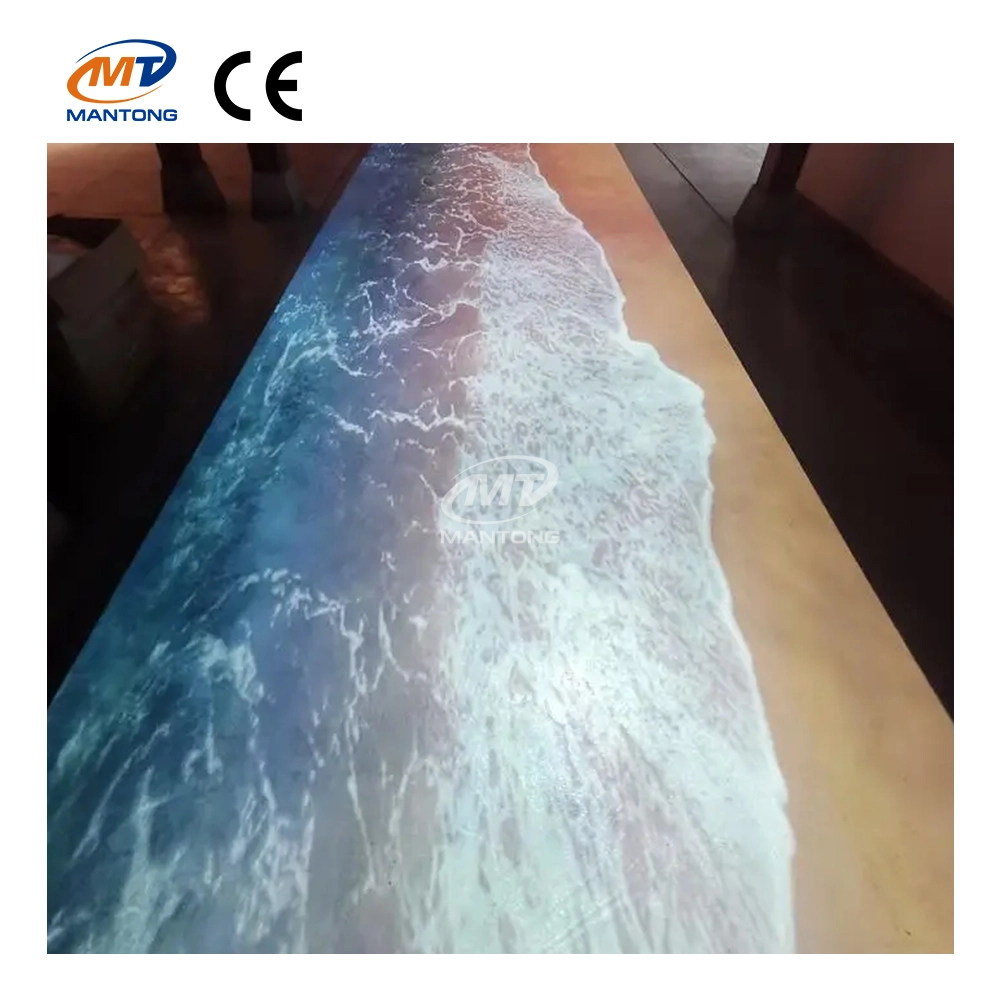
Indoor Interactive Floor Projector System - Customized Design & Installation Support
Indoor interactive floor projections display dynamic themed videos on the floor, commonly used in venues aiming to enhance brand influence or attract foot traffic, such as restaurants, hotel corridors, and brand car retail stores.
By using projectors and compatible software, the interactive content is projected onto the floor, encouraging engagement between people and the projected visuals. A single 5500-lumen indoor floor projector can cover an area of 5 m × 3 m. Typically, each project will use at least 3 units to ensure broad coverage and optimal visual effects.
We also offer customized design and installation support to enhance the interactive experience for your venue.
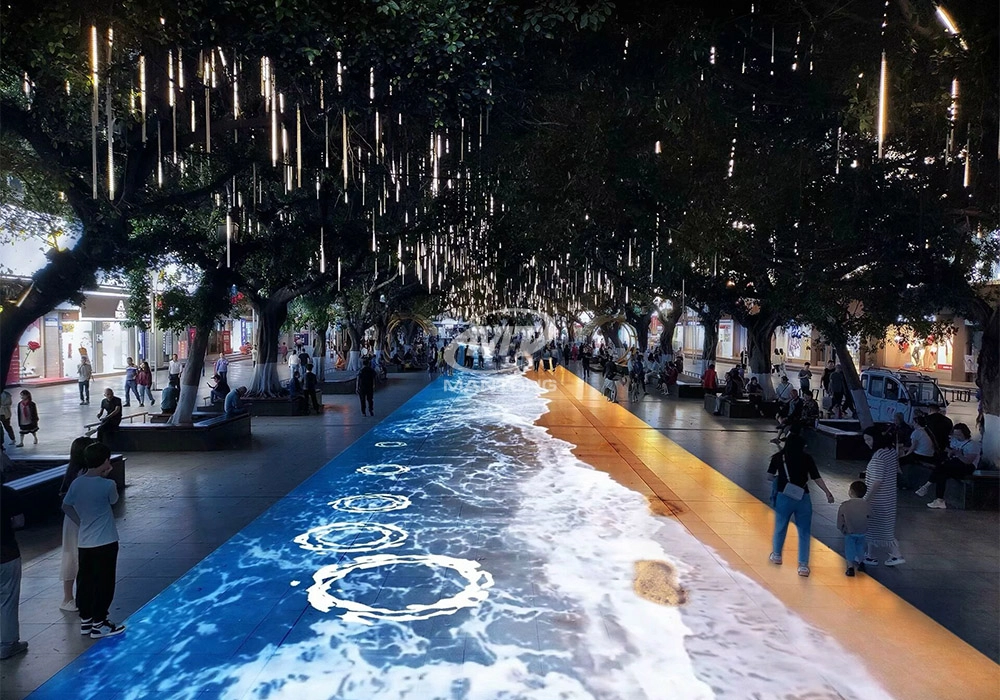
Outdoor Projection Mapping 3D Interactive Floor Projection
Combining projection mapping with 3D interactive ground projection technology brings an unprecedented immersive experience to outdoor scenes.
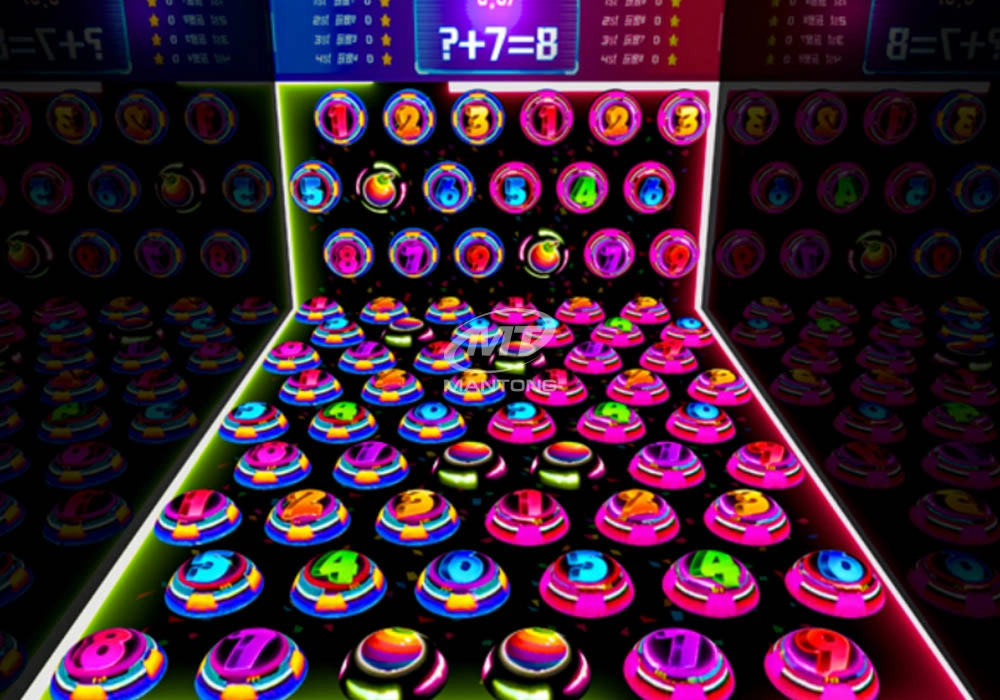
Amusement Rapidly Rotating Bouncing Sphere Interactive Wall Floor Projection Sports Games
Rapidly Rotating Bouncing Sphere is an interactive space where participants jump on rotating spheres. As they step on it, the spheres surface will show special interactivity
Jumping on spheres of the same color in succession causes them to pop, releasing light particles. The more consecutive jumps, the greater the reward—caterpillars appear, and eventually, all spheres of that color burst, filling the space with light and even more caterpillars.
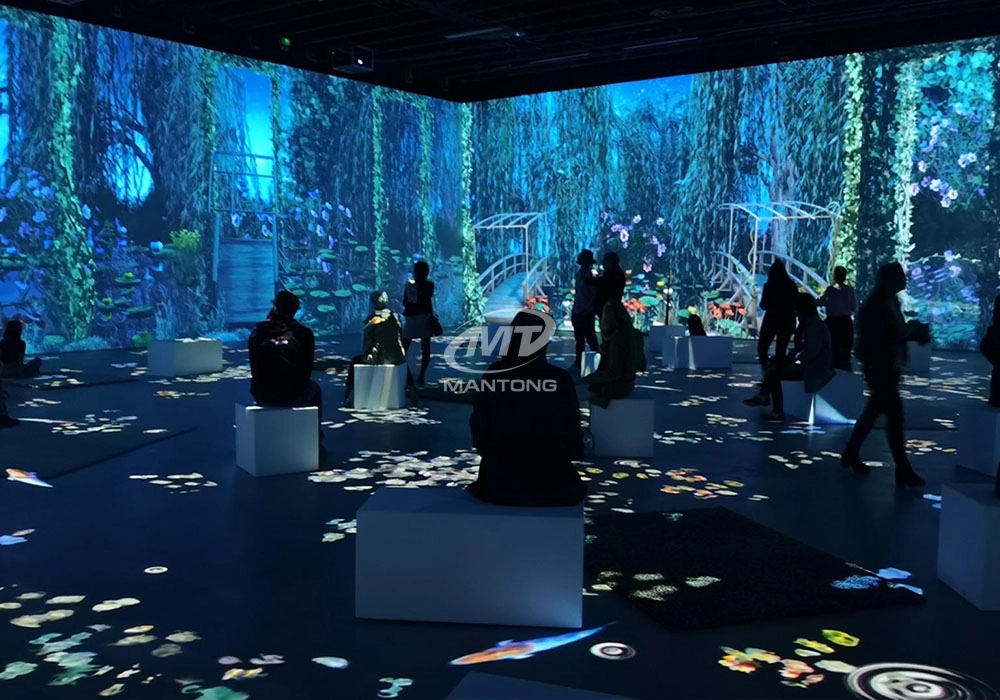
Mantong 6500LM High-Lumen Projector for Large-Scale Immersive Room Projection
Transform any space with Mantong's immersive projection mapping systems. Our high-lumen projectors (up to 6500 LM) and custom software create captivating interactive experiences for floors and walls. Ideal for museums, events, retail, and hospitality. Each kit includes professional ceiling mounting and 80+ pre-loaded video contents and is backed by a 12-month warranty and CE certification. We offer full customization and support to bring your vision to life.

Kaida Business Center, Shixin Road, Panyu District,Guangzhou City, Guangdong Province, China.
ManTong
ManTong
ManTong