
How interactive projectors disrupt education markets
- Transforming Classrooms with Immersive Projection
- Interactive projector market: Why education is the largest opportunity
- Market signals and adoption patterns
- How interactive projectors change pedagogy and learning outcomes
- Technical comparison: interactive projector vs interactive whiteboard vs flat-panel display
- Return on investment (ROI) and total cost of ownership (TCO)
- Implementation challenges and how to overcome them
- Evidence and case studies: what the research says
- Mantong Digital: turnkey interactive projection solutions from research to deployment
- How to evaluate suppliers in the interactive projector market
- Frequently Asked Questions (FAQs)
- 1. What is the difference between an interactive projector and a regular projector?
- 2. Are interactive projectors suitable for primary schools?
- 3. How much does it cost to install an interactive projection system?
- 4. Do interactive projectors work in bright classrooms?
- 5. How do I measure the impact of interactive projection on learning?
- 6. Can interactive projection support hybrid or remote learning?
- Contact and next steps
- References and authoritative sources
Transforming Classrooms with Immersive Projection
The rise of the interactive projector market is reshaping how schools, universities and training organizations design learning experiences. Unlike static displays, interactive projection blends scale, immersion and touch/gesture interactivity to support collaborative, multi-modal teaching. This article explains why interactive projection is a disruptive force in education, how it compares to alternatives, practical implementation strategies, and how institutions can evaluate suppliers and solutions to maximize learning outcomes and return on investment.
Interactive projector market: Why education is the largest opportunity
Education accounts for one of the fastest-growing segments for interactive projection systems. Key drivers include increased demand for flexible teaching spaces, emphasis on active learning, expansion of STEAM curricula, and need for socially-distanced, reconfigurable classrooms after the pandemic. District and campus budgets are increasingly allocated to technologies that boost engagement and improve measurable outcomes rather than single-purpose hardware.
From administrators’ perspective, interactive projectors offer a way to refresh existing rooms (projector mounts and screens) without full-scale renovation to install large displays, making them attractive from a capital-expenditure perspective. For curriculum designers and teachers, projection scales easily to room size and supports multi-user interaction, making whole-class activities and group work more natural.
Market signals and adoption patterns
Market research firms and education-technology analysts consistently highlight interactive projection as a growth area within the broader AV and EdTech markets. Institutions adopting interactive projection typically begin with pilot classrooms for collaborative learning, then scale when measurable engagement and satisfaction improvements are observed.
How interactive projectors change pedagogy and learning outcomes
Interactive projectors enable a shift from teacher-centered delivery to learner-centered, activity-based instruction. Core pedagogical advantages include:
- Multi-user interactivity: multiple students can annotate, move objects, and manipulate simulations simultaneously.
- Scale and flexibility: teachers can project onto walls, floors, and unconventional surfaces to design immersive scenarios that support kinesthetic learning.
- Integration with digital content: projection systems can run interactive software including simulations, quizzes, and collaborative whiteboards with instant saving and sharing.
- Better engagement metrics: richer interactions lead to higher attention and observed participation, which teachers report as improving formative assessment opportunities.
Research into active learning consistently shows that activities where students manipulate and discuss content result in deeper learning. While outcomes depend on pedagogy, interactive projection is a tool that enables those high-impact instructional strategies to scale across classrooms and subject areas.
Technical comparison: interactive projector vs interactive whiteboard vs flat-panel display
When evaluating the interactive projector market for education procurement, decision makers commonly compare three categories of solutions: interactive projectors, interactive whiteboards, and large flat-panel displays (LED/LCD). The table below summarizes typical trade-offs.
| Attribute | Interactive Projector | Interactive Whiteboard | Large Flat-Panel Display |
|---|---|---|---|
| Screen Size / Scale | High (adaptable to wall/floor; can reach very large sizes) | Medium (fixed board size) | Low–Medium (max 86 common; higher cost for larger) |
| Cost (per room) | Low–Medium (hardware + software; reuses mounts) | Medium (board + projector) | High (hardware-heavy; higher replacement costs) |
| Interactivity | Multi-touch, gesture, object tracking (varies by model) | Multi-touch; stylus-based | Multi-touch; high fidelity |
| Installation Flexibility | High (ceiling, floor, wall, curved surfaces) | Medium (wall-mounted) | Low (requires wall and supports) |
| Maintenance & Lifespan | Bulb/laser life; software updates; lens cleaning | Board surface wear; calibration | Long panel lifespan; costly repairs |
| Benefits for Immersion | High (full-room experiences possible) | Low–Medium | Low |
This qualitative comparison helps procurement teams match technology to learning goals. For example, immersive science labs or language labs benefit from large projected areas; lecture halls may prefer mixed systems with both projection and panel displays.
Return on investment (ROI) and total cost of ownership (TCO)
Administrators evaluating the interactive projector market should measure ROI beyond hardware price. Consider:
- Teacher training and professional development costs (often the key determinant of success).
- Software licensing and content subscriptions.
- Installation, mounting, and classroom redesign.
- Maintenance: lamp or laser module replacement, calibration, and service contracts.
- Lifecycle upgrades: modular systems allow component replacement rather than full-device refresh.
When properly deployed with teacher support, interactive projection often delivers a strong TCO due to lower per-room hardware costs at large display sizes and flexible reuse when room configurations change.
Implementation challenges and how to overcome them
Common barriers to successful deployment include insufficient teacher training, poor room acoustics or lighting control, inadequate support for content management, and mismatch between software and curriculum. Practical mitigations:
- Start with a pilot program that includes assessment metrics (engagement, learning gains, teacher satisfaction).
- Invest in targeted PD: short workshops, lesson co-planning, and peer coaching yield higher adoption than one-off demos.
- Choose solutions that integrate with existing LMS and classroom AV to reduce friction.
- Plan physical room changes (ambient light, mounting positions) and test with real lessons before scaling.
Evidence and case studies: what the research says
Multiple education research bodies and technology organizations report positive associations between active-learning environments and student outcomes. While interactive projectors are a delivery mechanism rather than a pedagogy, evidence shows that technologies which enable collaboration and active manipulation of content support deeper learning when paired with effective instruction.
Rather than promising universal gains, research encourages administrators to focus on implementation quality: teacher supports, alignment with curriculum, and iterative improvement. Relevant authoritative organizations to consult when building a business case include UNESCO (education technology guidance), EDUCAUSE (higher education IT best practices), and market reports that track adoption and growth in AV and EdTech sectors.
Mantong Digital: turnkey interactive projection solutions from research to deployment
Mantong Digital is a one-stop interactive projection solution provider and direct manufacturer based in Guangzhou, China, with over 10 years of industry experience. We are dedicated to providing innovative, flexible and cost-effective projection solutions, offering both hardware and software to meet various needs.At ManTong, we specialize in providing customized solutions for a wide range of application scenarios through innovative projection technology. Whether it's immersive experiences, interactive entertainment or outdoor lighting and projection shows, our solutions can transform your ideas into stunning visual effects. Our projection technology provides customized solutions for a variety of scenarios, delivering immersive and interactive visual experiences.We are now looking for business partnerships worldwide.Our vision is to become the world's leading interactive projection manufacturer.Our website is https://www.mtprojection.com/
Key Mantong advantages for education buyers:
- Direct manufacturing and supply chain control — lower unit costs and faster customization turnarounds compared to resellers.
- Integrated hardware + software stack — one vendor for calibration, content, and support reduces compatibility risks.
- Product breadth: immersive projection, interactive floor projection, interactive wall projection, immersive room, 3D projection, interactive projection games, projection shows, and interactive projection mapping.
- Proven experience in customized installations — valuable when projects require unusual surfaces, multiple projectors, or mapping across complex geometries.
- Global partnership orientation — Mantong actively supports overseas deployment and local integration partners.
For education customers, Mantong can provide turnkey packages: projectors and mounts, sensors for touch/gesture, interactive software tailored to curriculum, installation, training, and ongoing support. This end-to-end model simplifies procurement and helps ensure solutions are classroom-ready from day one.
How to evaluate suppliers in the interactive projector market
When selecting vendors or integrators, apply a checklist approach:
- Technical fit: Does the solution support required interactive modalities (touch, gesture, object tracking) and room sizes?
- Integration: Can the system integrate with LMS, AV controllers, and existing displays?
- Support and training: Is teacher PD included? What SLAs exist for hardware repair or replacement?
- References and case studies: Request references in similar school sizes or subject areas; visit pilot classrooms if possible.
- Cost transparency: Ask for full TCO projections including licenses, consumables, and support.
Shortlist vendors that offer pilot programs with clear evaluation metrics and provide modular upgrades so schools avoid costly rip-and-replace cycles.
Frequently Asked Questions (FAQs)
1. What is the difference between an interactive projector and a regular projector?
Interactive projectors add sensors and software that allow touch, stylus, gesture, or object-based interaction on the projected surface. This turns a passive display into an input device for collaboration and learning activities.
2. Are interactive projectors suitable for primary schools?
Yes. Their large, flexible surfaces support group activities and kinesthetic learning. For younger learners, floor projection or immersive room setups can be especially effective for movement-based lessons and early literacy games.
3. How much does it cost to install an interactive projection system?
Costs vary widely based on projector brightness, lens and mapping needs, sensors, software licenses, and installation complexity. Total cost of ownership should include training and maintenance; many districts find interactive projectors to be more cost-effective than very large flat-panel displays for large rooms.
4. Do interactive projectors work in bright classrooms?
Modern interactive projectors with higher lumen output and laser light sources perform well in controlled ambient light. Room modifications such as blinds, screen surfaces with high gain, or ambient light rejection screens improve visibility.
5. How do I measure the impact of interactive projection on learning?
Define baseline metrics (engagement surveys, formative assessment scores, attendance) before deployment, then compare after implementation. Include qualitative teacher feedback and classroom observations as part of evaluation.
6. Can interactive projection support hybrid or remote learning?
Yes. When integrated with classroom cameras, conferencing tools, and learning platforms, interactive projection can make on-site lessons visible and interactive for remote participants. Choose systems that support screen sharing and remote input where needed.
Contact and next steps
If you are evaluating the interactive projector market for your institution and want turnkey solutions that include hardware, software, installation, and teacher training, contact Mantong Digital. Visit https://www.mtprojection.com/ to view product lines and request a pilot or quotation. Mantong’s experience in immersive projection, interactive floor and wall systems, 3D projection, interactive projection games, projection shows, and mapping makes them a strong partner for education transformation projects. We are open to global partnerships and can provide references, demos, and pilot programs tailored to your curriculum goals.
References and authoritative sources
- Grand View Research — Interactive Projector Market Size, Share & Trends Analysis Report. https://www.grandviewresearch.com/industry-analysis/interactive-projector-market (accessed 2025-12-16).
- UNESCO — Guidelines on the use of ICT in education and technology in learning recommendations. https://en.unesco.org/ (accessed 2025-12-16).
- EDUCAUSE — research and case studies on active learning classrooms and AV technologies. https://www.educause.edu/ (accessed 2025-12-16).
- Statista — education technology adoption and market overviews. https://www.statista.com/ (accessed 2025-12-16).
- OECD — The impact of digital technologies on learning reports and policy guidance. https://www.oecd.org/ (accessed 2025-12-16).
For deployment examples, product specifications, or to request a pilot from Mantong Digital, please visit https://www.mtprojection.com/ or contact Mantong’s sales team via the site to discuss tailored interactive projection solutions for education.
How Interactive Projection Works: Sensors and Tech Explained
How to Choose the 360 immersive projection manufacturer and supplier ?
Calibration Tips for Accurate Interactive Projection
The mapping floor projection Cost Guide
One-Stop Projection Solution Provider Since 2011
What information do you need to know before making the proposal/solution?
We know that everyone wants to know the price, but the price of our products is determined by many factors since most of our products are custom, so no ready price list. In order to fast understand what you need, can you send us an inquiry like this?
For example: I am really interested in your immersive projection products, we are a company in the USA and want to install some in my restaurant. It is about 50 meters long, and 5m in width. Projection size you can decide but the length should be not less than 20 meters. We want some content about SeaWorld because our place is all about the sea. Thank you.
What's the application of Immersive projection ?
It can be used in various venues, such as art exhibition, entertainment venues, educational institution, Wedding hall /Banquet/Bar,Yoga Studio and so on. It often involves advanced projection techniques, multimedia content, and interactive elements to engage and captivate the audience's senses.
Are you trader or manufacturer ?
We are direct manufacturer who specialize in providing one-stop solution for different outdoor & indoor projection project with our stable software and qualified projectors
What's Immersive Projection ?
Immersive projection refers to a technology that creates a captivating and all-encompassing visual experience for viewers by projecting images or videos onto large surfaces, such as walls, floors, or even entire rooms. This technology aims to immerse the audience in a simulated environment, blurring the boundaries between the physical and virtual worlds.
What about the wall/floor material for the projection?
It’s recommended to choose a light-colored material with minimal reflectivity—pure white or light grey works best. the
common material is cement & plaster board
For optimal projection results, the surface should be free of any patterns or textures, as the projector will display content
directly onto it.
There are no specific material requirements; you may use any commonly available material in your local market, as long as it
meets the above conditions.
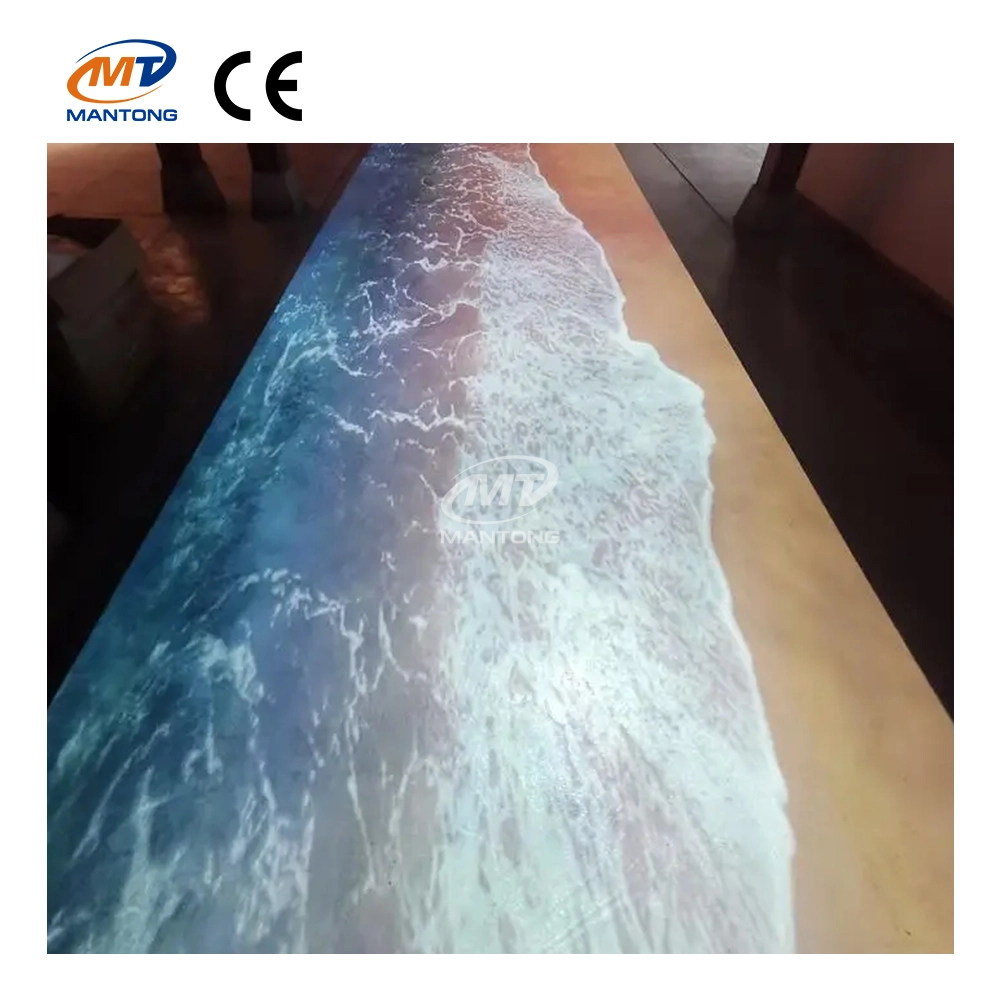
Indoor Interactive Floor Projector System - Customized Design & Installation Support
Indoor interactive floor projections display dynamic themed videos on the floor, commonly used in venues aiming to enhance brand influence or attract foot traffic, such as restaurants, hotel corridors, and brand car retail stores.
By using projectors and compatible software, the interactive content is projected onto the floor, encouraging engagement between people and the projected visuals. A single 5500-lumen indoor floor projector can cover an area of 5 m × 3 m. Typically, each project will use at least 3 units to ensure broad coverage and optimal visual effects.
We also offer customized design and installation support to enhance the interactive experience for your venue.
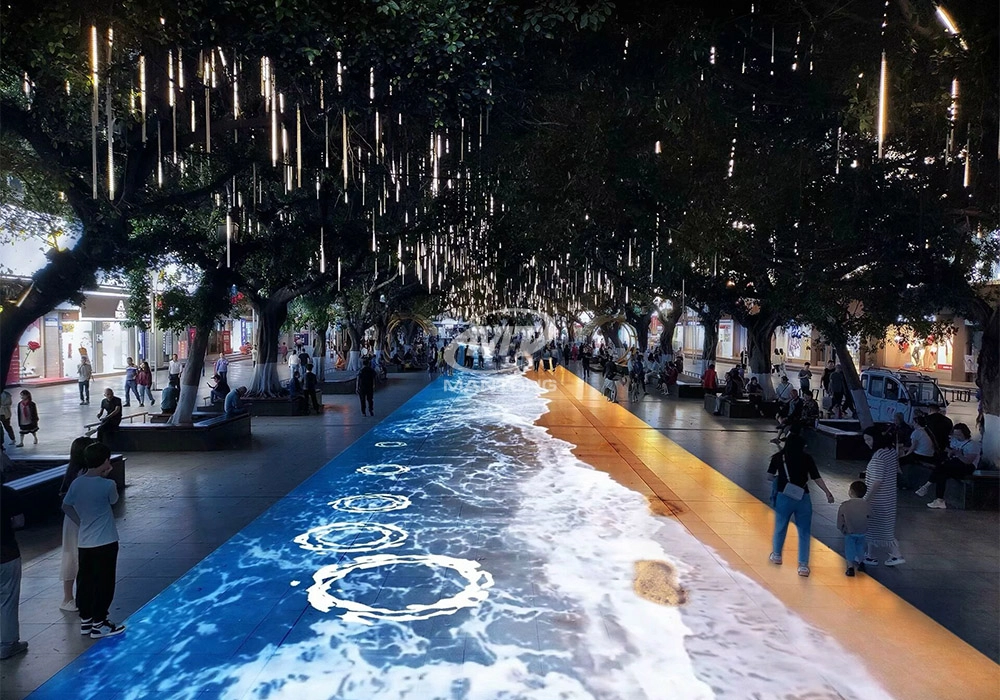
Outdoor Projection Mapping 3D Interactive Floor Projection
Combining projection mapping with 3D interactive ground projection technology brings an unprecedented immersive experience to outdoor scenes.
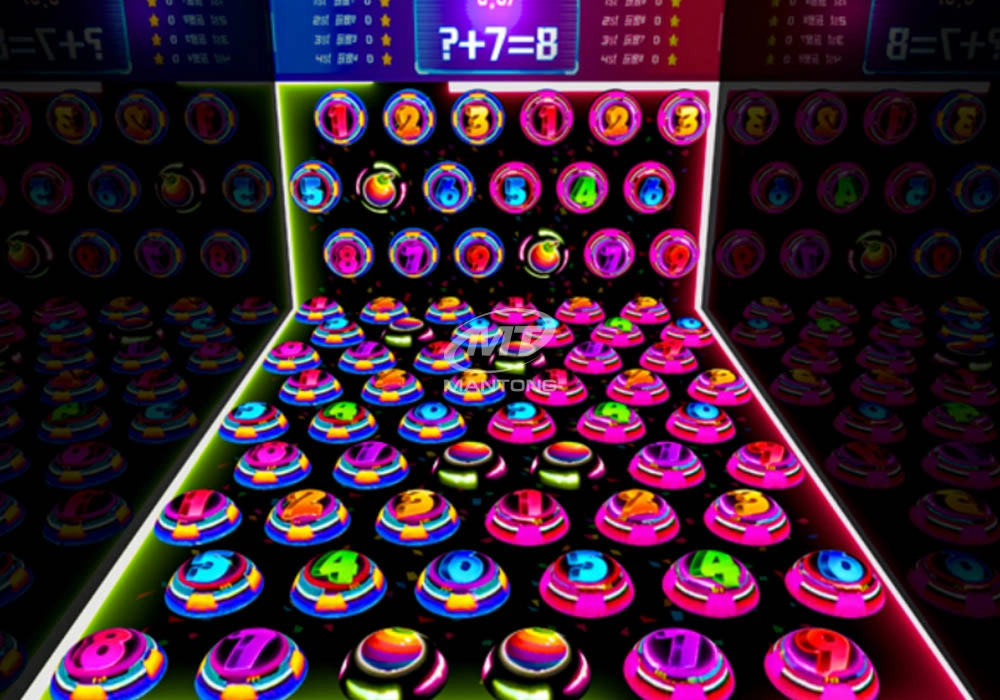
Amusement Rapidly Rotating Bouncing Sphere Interactive Wall Floor Projection Sports Games
Rapidly Rotating Bouncing Sphere is an interactive space where participants jump on rotating spheres. As they step on it, the spheres surface will show special interactivity
Jumping on spheres of the same color in succession causes them to pop, releasing light particles. The more consecutive jumps, the greater the reward—caterpillars appear, and eventually, all spheres of that color burst, filling the space with light and even more caterpillars.
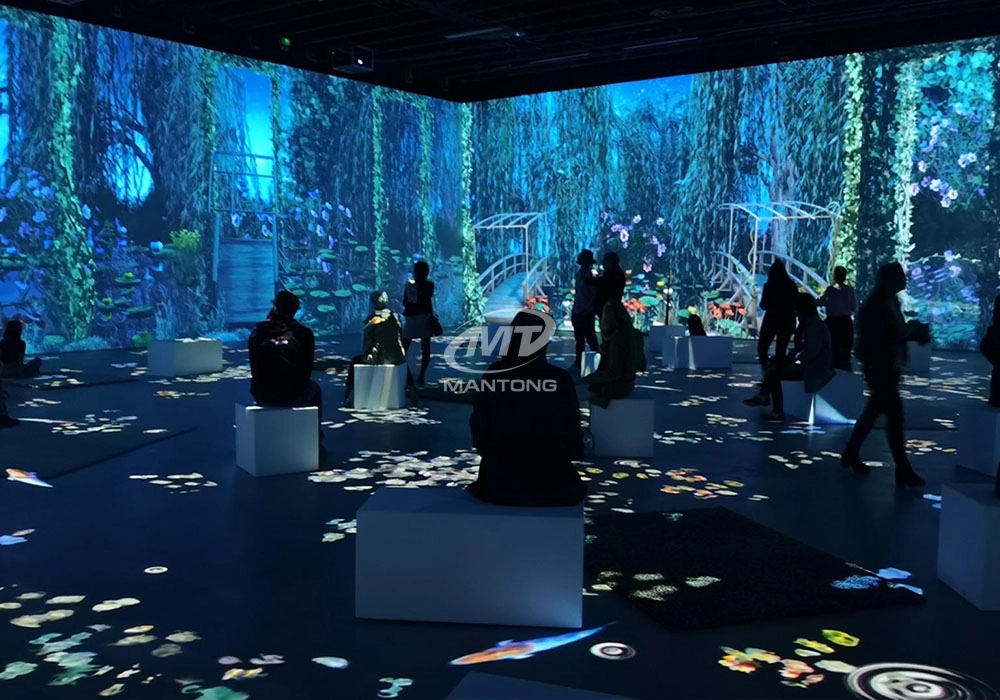
Mantong 6500LM High-Lumen Projector for Large-Scale Immersive Room Projection
Transform any space with Mantong's immersive projection mapping systems. Our high-lumen projectors (up to 6500 LM) and custom software create captivating interactive experiences for floors and walls. Ideal for museums, events, retail, and hospitality. Each kit includes professional ceiling mounting and 80+ pre-loaded video contents and is backed by a 12-month warranty and CE certification. We offer full customization and support to bring your vision to life.

Kaida Business Center, Shixin Road, Panyu District,Guangzhou City, Guangdong Province, China.
ManTong
ManTong
ManTong