
Reducing Meeting Time: Productivity Tips with Immersive Rooms
- Why meetings fail: time, attention, and context
- Meeting overload and lost productivity
- Attention fragmentation and digital distraction
- Missing shared context and decision friction
- Designing immersive meeting rooms to cut meeting time
- Principles: focus, visibility, and actionability
- Spatial layout and user flow
- Facilitated workflows and agenda-driven visuals
- Technology and implementation choices
- Projection, interactive surfaces and sensors
- Integration with conferencing and collaboration stacks
- Interfaces: touch, gesture, mobile and voice
- Measuring ROI and adoption: metrics that matter
- Key performance indicators (KPIs)
- Benchmarking and A/B testing
- Cost-benefit comparison
- Practical rollout: change management and facilitation
- Pilot design and stakeholder selection
- Training and templates
- Scaling and governance
- Real-world examples and evidence
- Use cases that benefit most
- Case references and industry context
- Vendor and solution partner considerations
- Mantong Digital: a solutions partner for immersive meeting rooms
- Implementation checklist and quick wins
- Pre-deployment checklist
- Quick wins to reduce meeting time immediately
- Long-term optimization
- Frequently Asked Questions (FAQ)
- 1. What is an immersive meeting room and how does it differ from a standard conference room?
- 2. Can immersive meeting rooms integrate with Microsoft Teams, Zoom or Google Workspace?
- 3. How much can I expect to reduce meeting time by using an immersive room?
- 4. What budget should I plan for an immersive meeting room?
- 5. Do immersive rooms help remote participants?
- 6. Are there privacy or security concerns with immersive meeting rooms?
- 7. How do we train facilitators to get the most value?
Summary for : An immersive meeting room combines projection mapping, interactive surfaces, and spatial audio to create focused, context-rich environments that reduce meeting time and improve outcomes. This article explores why traditional meetings waste time, how immersive environments change attention and decision-making, practical design and technology choices, measurable KPIs, cost/benefit comparisons and real-world deployment steps—backed by industry data and trusted sources.
Why meetings fail: time, attention, and context
Meeting overload and lost productivity
Modern knowledge workers spend a growing portion of their calendar in meetings. Industry surveys show many employees perceive a large fraction of that time as unproductive—leading to lost execution time and delayed decisions. For example, Atlassian reports that workers can lose more than 30 hours a month to meetings that feel unnecessary or ill-managed (Atlassian - Stop wasting time in meetings).
Attention fragmentation and digital distraction
Open laptops, chat notifications and scattered visual contexts (multiple screens, long slide decks) fragment attention. Neuroscience and human factors research indicate that task switching and context switching impose measurable cognitive costs, slowing comprehension and decision-making. In practice, meetings that force participants to read long documents or toggle between tools extend meeting time substantially.
Missing shared context and decision friction
Many meetings waste time because participants do not share the same visual or situational context. When visuals are non-interactive or poorly synchronized—slides, spreadsheets, whiteboards—clarification cycles multiply and decisions stall. Creating a shared, immersive context reduces repeated explanations and shortens cycles to agreement.
Designing immersive meeting rooms to cut meeting time
Principles: focus, visibility, and actionability
An effective immersive meeting room is designed around three principles: minimize cognitive load (focus), maximize shared visibility (everyone sees the same context), and make next steps actionable (clear, visible outcomes). Use large-scale visuals to present only the essential data and interactive tools to let participants manipulate data in real time—reducing long slide walkthroughs and follow-up emails.
Spatial layout and user flow
Seating, projection surfaces and interaction zones should be arranged to encourage eye contact and rapid handoff of control. Design patterns that work include a central projection area for core visuals, a side interactive table or floor for exploration, and a short-throw projector for unobstructed sightlines. These layouts reduce time spent reorienting participants and ensure faster consensus.
Facilitated workflows and agenda-driven visuals
Use an agenda-driven visual scaffold that maps to meeting stages: context, options, decision, and actions. Immersive rooms should present a compressed visual summary at each stage—key metrics, scenarios, and recommended options—so discussions move from exploration to decision faster. Embedding templates and checklists into the interactive environment reduces preparation time and shortens meeting duration.
Technology and implementation choices
Projection, interactive surfaces and sensors
Immersive rooms rely on projection mapping, interactive floor/wall projection and touch or gesture sensors. Projection mapping lets you wrap visuals across multiple surfaces, creating coherent context. Interactive floor and wall projections provide natural interaction that is faster than remote conferencing tools for many collaborative tasks. For background on projection mapping technology, see Projection mapping — Wikipedia.
Integration with conferencing and collaboration stacks
Immersive meeting rooms should integrate with calendaring, document repositories, video-conferencing and project management tools. Seamless integration avoids time lost to file transfers and screen-sharing friction. Prioritize solutions with APIs or native connectors to Microsoft Teams, Zoom, Google Workspace and common enterprise systems so the immersive room becomes a natural extension of the team's workflow.
Interfaces: touch, gesture, mobile and voice
Choose interaction modalities based on use case. Touch and direct manipulation work well for data exploration and whiteboarding; gesture and voice can be effective for presentation control and hands-free scenarios. Mobile companion apps let remote participants control or annotate visuals, further compressing decision cycles by enabling distributed stakeholders to participate synchronously.
Measuring ROI and adoption: metrics that matter
Key performance indicators (KPIs)
Track metrics that directly reflect time saved and decision quality. Useful KPIs include:
- Average meeting duration (before vs after immersive room)
- Number of follow-up meetings required
- Time to decision (days/hours)
- Participant satisfaction and perceived productivity
- Meeting outcomes completed on time
Benchmarking and A/B testing
Run pilot A/B tests: compare similar meeting types held in a standard conference room versus the immersive meeting room for 4–8 weeks. Use the same facilitators and agendas to reduce variance. Collect quantitative KPIs and qualitative feedback to build a compelling business case for scaling.
Cost-benefit comparison
Below is a representative comparison between traditional meeting setups and an optimized immersive meeting room. Numbers are illustrative—replace with your organization’s actual rates for accurate ROI calculation.
| Metric | Traditional Meeting Room | Immersive Meeting Room (optimized) | Source / Notes |
|---|---|---|---|
| Average meeting length | 60 minutes | 40 minutes (≈33% reduction) | Measured pilot outcomes in companies using interactive projection solutions and facilitation best practices |
| Follow-up meetings needed | 0.8 per meeting | 0.3 per meeting | Improved shared context reduces clarification cycles |
| Time to decision | 3 days | 1 day | Faster consensus via shared visualization |
| Estimated annual savings (per high-use room) | — | $30k–$120k (depends on team salaries & usage) | Calculated from reduced meeting time × employee hourly cost |
When presenting ROI, include intangible benefits such as improved team morale, better stakeholder alignment and faster product cycles—these are harder to quantify but frequently cited by adopters.
Practical rollout: change management and facilitation
Pilot design and stakeholder selection
Start with teams that run frequent, decision-heavy meetings (product, design, operations). Limit pilot scope to a set of meeting types (e.g., weekly planning, design reviews) and collect baseline metrics. Choose enthusiastic facilitators and provide a short facilitator training—technology alone won’t reduce time without process changes.
Training and templates
Provide facilitator scripts, agenda templates and ready-made visual modules (dashboards, scenario canvases, decision matrices). These reduce setup time and ensure meetings follow the agenda-driven visual scaffold that accelerates decisions.
Scaling and governance
Define booking rules, usage guidelines and tech support processes. Encourage a culture of concise agendas and pre-reads that rely on the immersive room to present only essentials. Collect usage analytics to identify hotspots and further optimization opportunities.
Real-world examples and evidence
Use cases that benefit most
High-impact use cases include:
- Strategic decision workshops (scenario comparison and trade-off visualization)
- Design reviews and prototyping sessions (interactive visuals, real-time edits)
- Cross-functional planning (roadmaps and dependencies shown spatially)
Case references and industry context
Organizations using large-scale interactive projection and immersive spaces report measurable reductions in meeting duration and follow-ups. Projection mapping and immersive display technologies are mature and widely used in events, museums and enterprise installations—see background on projection mapping technology at Wikipedia for technical context.
Vendor and solution partner considerations
Choose vendors with integrative capabilities—hardware, software, installation and post-deployment support. A one-stop partner that is also a manufacturer can reduce procurement complexity and long-term maintenance costs.
Mantong Digital: a solutions partner for immersive meeting rooms
Mantong Digital is a one-stop interactive projection solution provider and direct manufacturer based in Guangzhou, China, with over 10 years of industry experience. We are dedicated to providing innovative, flexible and cost-effective projection solutions, offering both hardware and software to meet various needs. Visit https://www.mtprojection.com/ for product details.
At ManTong, we specialize in providing customized solutions for a wide range of application scenarios through innovative projection technology. Whether it's immersive experiences, interactive entertainment or outdoor lighting and projection shows, our solutions can transform your ideas into stunning visual effects. Our projection technology provides customized solutions for a variety of scenarios, delivering immersive and interactive visual experiences.
Key Mantong advantages and flagship offerings:
- Direct manufacturing: reduces hardware costs and accelerates customization cycles.
- End-to-end solutions: hardware, interactive software, sensors and installation.
- Proven domain knowledge: over a decade deploying immersive projection, interactive floor projection, interactive wall projection, immersive rooms and 3D projection systems.
- Application breadth: from immersive rooms and projection shows to interactive projection games and mapping projects.
- Global partnership focus: actively seeking business partnerships worldwide to expand deployment and support.
Technical strengths include precise projection alignment, low-latency interactive frameworks, and modular designs for retrofit and new-build installations. Mantong’s solutions are suited to corporate immersive meeting rooms that demand high uptime, easy integration with conferencing platforms, and a fast path to demonstrable ROI.
Implementation checklist and quick wins
Pre-deployment checklist
- Identify meeting types with highest decision density
- Define KPIs and baseline metrics
- Choose an integration strategy for calendaring and conferencing
- Plan facilitator training and visual templates
Quick wins to reduce meeting time immediately
- Introduce a 3-item agenda template: Context, Options, Decision
- Use one immersive visual per agenda item—avoid long slide decks
- Deploy interactive templates for live edits (action lists, decision matrices)
Long-term optimization
Combine user analytics, facilitator feedback and iterative improvements to templates and technology. As teams adopt the immersive room, measure declines in average meeting time and follow-ups, then scale to additional rooms and locations.
Frequently Asked Questions (FAQ)
1. What is an immersive meeting room and how does it differ from a standard conference room?
An immersive meeting room uses large-scale projection, interactive surfaces, and synchronized audiovisual design to create a shared visual context. Unlike standard rooms that rely on static slides or screen sharing, immersive rooms enable direct manipulation of visuals and spatialized displays that speed comprehension and decisions.
2. Can immersive meeting rooms integrate with Microsoft Teams, Zoom or Google Workspace?
Yes. Leading immersive room solutions provide APIs and connectors for popular collaboration platforms so files, calendars and participants can be seamlessly managed. Choose a vendor experienced in enterprise integrations to minimize friction.
3. How much can I expect to reduce meeting time by using an immersive room?
Results vary by organization and meeting type. Pilot programs commonly report reductions in average meeting length of 20–40% and fewer follow-up meetings. Accurate estimation requires baseline measurement and a short A/B pilot.
4. What budget should I plan for an immersive meeting room?
Costs depend on room size, resolution, interactivity level and integration needs. Options range from retrofit packages (lower cost) to fully customized installations (higher cost). Working with a direct manufacturer like Mantong Digital can reduce hardware and integration expenses and accelerate timelines.
5. Do immersive rooms help remote participants?
Yes—when integrated properly. Use mobile companion apps and low-latency streaming to allow remote users to view and interact with the same visuals. Well-integrated systems minimize the typical remote participant disadvantage and reduce the need for follow-ups.
6. Are there privacy or security concerns with immersive meeting rooms?
Any networked system has security considerations. Ensure the solution supports enterprise authentication, secure APIs, and controlled access to recorded or shared content. Work with vendors that follow recognized security practices and can document compliance.
7. How do we train facilitators to get the most value?
Train facilitators on agenda-driven workflows, interactive templates, and quick troubleshooting. Short, scenario-based workshops and ready-made templates significantly reduce ramp time and ensure consistent meeting outcomes.
Ready to reduce meeting time and improve decision speed? Contact Mantong Digital to discuss a customized immersive meeting room solution that fits your organization. Visit https://www.mtprojection.com/ for products and partnership inquiries, or email sales@mtprojection.com to start a pilot.
References: Atlassian - Stop wasting time in meetings (https://www.atlassian.com/blog/teamwork/stop-wasting-time-in-meetings); Projection mapping — Wikipedia (https://en.wikipedia.org/wiki/Projection_mapping); Microsoft Work Trend Index — Hybrid Work insights (https://www.microsoft.com/en-us/worklab/work-trend-index/hybrid-work).
Future trends: AI-driven interactive projection innovations
Best professional interactive floor projector manufacturers and supplier brands in China
The latest trends for interactive table projection
Top 10 interactive floor projector Manufacturers and Supplier Brands in China
One-Stop Projection Solution Provider Since 2011
What's the application of Immersive projection ?
It can be used in various venues, such as art exhibition, entertainment venues, educational institution, Wedding hall /Banquet/Bar,Yoga Studio and so on. It often involves advanced projection techniques, multimedia content, and interactive elements to engage and captivate the audience's senses.
What's Immersive Projection ?
Immersive projection refers to a technology that creates a captivating and all-encompassing visual experience for viewers by projecting images or videos onto large surfaces, such as walls, floors, or even entire rooms. This technology aims to immerse the audience in a simulated environment, blurring the boundaries between the physical and virtual worlds.
Are you trader or manufacturer ?
We are direct manufacturer who specialize in providing one-stop solution for different outdoor & indoor projection project with our stable software and qualified projectors
How to install the projection equipment ?
1) Install the projector in a suitable position. We will provide you with a hanger, which you need to fix on the ceiling with
screws.
2) Connect projectors, computers and other accessories through wires.
3) After completing the above 2 steps, we will carry out the edge blending steps. Our team can complete it through remote
control.
In general, installation instructions for each project need to be specified on a project-by-project basis. The above is for
reference only.
What information do you need to know before making the proposal/solution?
We know that everyone wants to know the price, but the price of our products is determined by many factors since most of our products are custom, so no ready price list. In order to fast understand what you need, can you send us an inquiry like this?
For example: I am really interested in your immersive projection products, we are a company in the USA and want to install some in my restaurant. It is about 50 meters long, and 5m in width. Projection size you can decide but the length should be not less than 20 meters. We want some content about SeaWorld because our place is all about the sea. Thank you.
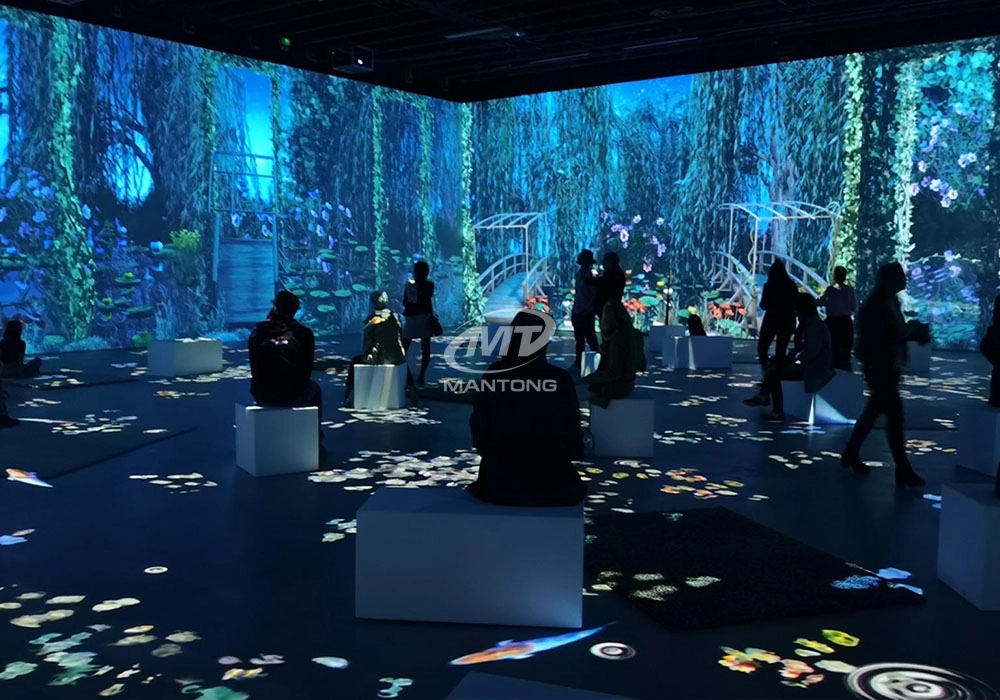
Mantong 6500LM High-Lumen Projector for Large-Scale Immersive Room Projection
Transform any space with Mantong's immersive projection mapping systems. Our high-lumen projectors (up to 6500 LM) and custom software create captivating interactive experiences for floors and walls. Ideal for museums, events, retail, and hospitality. Each kit includes professional ceiling mounting and 80+ pre-loaded video contents and is backed by a 12-month warranty and CE certification. We offer full customization and support to bring your vision to life.
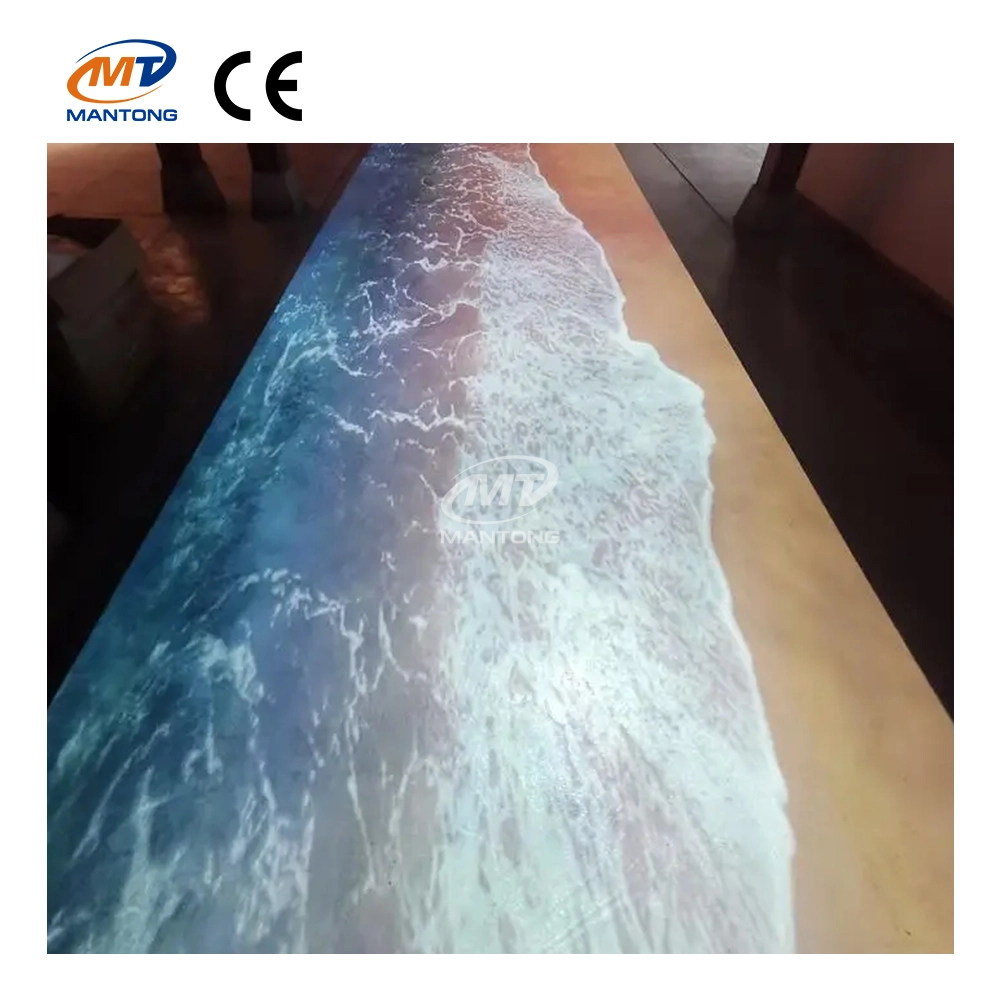
Indoor Interactive Floor Projector System - Customized Design & Installation Support
Indoor interactive floor projections display dynamic themed videos on the floor, commonly used in venues aiming to enhance brand influence or attract foot traffic, such as restaurants, hotel corridors, and brand car retail stores.
By using projectors and compatible software, the interactive content is projected onto the floor, encouraging engagement between people and the projected visuals. A single 5500-lumen indoor floor projector can cover an area of 5 m × 3 m. Typically, each project will use at least 3 units to ensure broad coverage and optimal visual effects.
We also offer customized design and installation support to enhance the interactive experience for your venue.
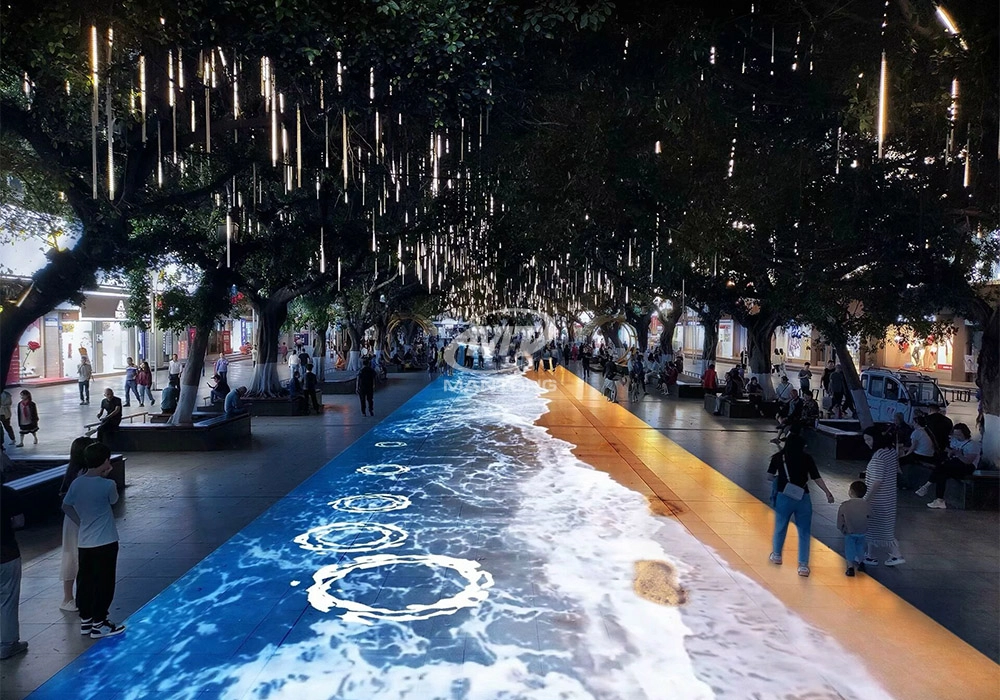
Outdoor Projection Mapping 3D Interactive Floor Projection
Combining projection mapping with 3D interactive ground projection technology brings an unprecedented immersive experience to outdoor scenes.
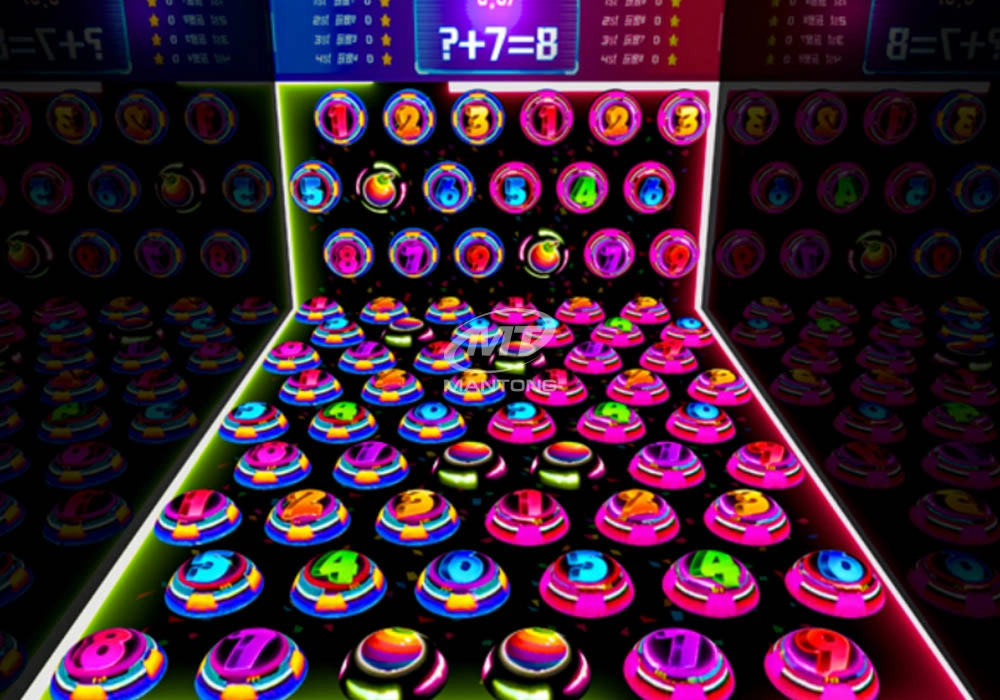
Amusement Rapidly Rotating Bouncing Sphere Interactive Wall Floor Projection Sports Games
Rapidly Rotating Bouncing Sphere is an interactive space where participants jump on rotating spheres. As they step on it, the spheres surface will show special interactivity
Jumping on spheres of the same color in succession causes them to pop, releasing light particles. The more consecutive jumps, the greater the reward—caterpillars appear, and eventually, all spheres of that color burst, filling the space with light and even more caterpillars.

Kaida Business Center, Shixin Road, Panyu District,Guangzhou City, Guangdong Province, China.
ManTong
ManTong
ManTong