
Scalability: Planning Large Interactive Projection Installations
- Why scalability matters for immersive projection projects
- Defining scalability in the context of interactive projection
- Business and user impacts of poor scalability
- Standards and references I rely on
- Technical architecture for scalable interactive projection
- Projection tiling and edge blending strategies
- Choosing projectors: brightness, optics, and lifetime
- Networked media servers and content distribution
- Operational planning, integration, and maintenance
- Site survey and environmental readiness
- Interactivity and sensor scaling
- Maintenance strategy and remote monitoring
- Cost modeling, procurement, and vendor considerations
- Capital vs. operating expenses
- Vendor evaluation and partnerships
- Case comparison: three deployment scales
- Real-world implementation and Mantong Digital partnership
- Why I choose full-stack suppliers
- Mantong Digital — capabilities and competitive advantages
- How Mantong supports scalable projects
- Risk mitigation and testing strategy
- Prototyping and iterative testing
- Performance benchmarks and acceptance criteria
- Operational readiness and training
- Frequently Asked Questions (FAQs)
- 1. How many projectors do I need for a 200 m² immersive room?
- 2. Can outdoor projection shows run reliably year-round?
- 3. How do I keep interaction latency low in large installations?
- 4. What is the expected lifespan of a large projection installation?
- 5. How should I budget for future upgrades?
- 6. How does Mantong support international deployments?
Interactive projection systems transform environments into immersive, participatory experiences. When I plan large-scale interactive projection installations, I focus on scalability from day one—defining how the system will grow, maintain quality, and survive operational stresses. This summary highlights the key dimensions I address: projection architecture, content distribution, interactive sensors, network and power infrastructure, maintainability, and vendor selection. Properly planning these elements avoids common failures like uneven brightness, latency in interactivity, and prohibitive operating costs.
Why scalability matters for immersive projection projects
Defining scalability in the context of interactive projection
Scalability for interactive projection means the system maintains functional and perceptual quality—brightness, resolution, framerate, and low-latency interaction—as the installation footprint, audience size, or content complexity increases. It's both technical (adding projectors, servers, sensors) and operational (staffing, maintenance, content updates). I treat scalability as a design constraint, not an afterthought.
Business and user impacts of poor scalability
Poorly scaled installations fail in visible ways: color shifts across blended areas, lagging interactive elements, and projector overheating. These issues damage visitor experience and brand reputation. From a business perspective, scalability affects lifecycle costs: more frequent replacements, higher energy consumption, and expensive site visits for recalibration. For large venues I work with, planning for scalability reduces total cost of ownership and preserves visitor engagement.
Standards and references I rely on
When I recommend metrics and tolerances, I use established standards and references. For projection technology fundamentals I use resources like the Projection Mapping overview on Wikipedia and projector hardware basics from Projector (display device). For environmental protection and hardware ratings I reference IP codes (IP Code - Ingress Protection), and for quality management and procurement best practices I rely on guidance from organizations like the ISO 9001 standard and the Project Management Institute.
Technical architecture for scalable interactive projection
Projection tiling and edge blending strategies
To cover large surfaces I design tiled projection arrays with overlapping edges and calibrated blending. The goal is a visually seamless surface. I specify overlap percentages (commonly 10–30% depending on lens accuracy and surface irregularity) and use geometric correction combined with color balancing to maintain consistent luminance and color temperature across joins. For details on display metrics and resolution considerations, I refer to general display resolution guidance (Display resolution).
Choosing projectors: brightness, optics, and lifetime
Projector selection is foundational for scale. For large installations I favor high-brightness laser projectors (often 10,000+ ANSI lumens) because they deliver consistent output and long lifetimes. Lamp-based units may be cheaper initially but have shorter lifespans and require lamp replacements. Below is a compact comparison I use when advising clients:
| Projector Type | Typical Brightness | Lifespan | Maintenance | Best Use |
|---|---|---|---|---|
| Laser | 5,000–35,000+ ANSI lumens | 20,000–30,000 hours | Low (filter, occasional cleaning) | Large venues, outdoor shows, 24/7 displays |
| UHP/Lamp | 2,000–15,000 ANSI lumens | 2,000–6,000 hours | High (lamp replacements) | Lower-budget indoor installations |
| LED (solid state) | 1,500–8,000 ANSI-equivalent | 20,000+ hours | Low | Small to medium venues, portable setups |
Sources: general projector technology overview (Wikipedia) and lumen fundamentals (Lumen (unit)).
Networked media servers and content distribution
For scalability I distribute rendering and playback across a media-server cluster. This reduces single points of failure and enables load balancing for high-resolution outputs. I specify redundant connections, gigabit backbones, and where required, 10 GbE links for sync-sensitive setups. I also recommend using industry-proven playback software that supports SMPTE timecode or NDI for synchronization across nodes.
Operational planning, integration, and maintenance
Site survey and environmental readiness
A rigorous site survey is non-negotiable. I assess projection surfaces, ambient light, mounting points, HVAC, and access for maintenance. For outdoor or semi-exposed projects I verify IP ratings and plan for temperature extremes, humidity, and dust. I document power availability and run load calculations to prevent brownouts.
Interactivity and sensor scaling
Interactivity scales differently than pure projection. Sensors—cameras, depth sensors, LIDAR, pressure mats—can become bottlenecks as detection zones expand. I design sensor networks with overlapping detection fields and edge processing to reduce latency and bandwidth. Local processing (on-device or at edge servers) keeps response under 30–50 ms for touch and motion interactions, which we find sufficient to preserve the sense of immediacy.
Maintenance strategy and remote monitoring
Operational scalability depends on maintainability. I institute remote monitoring for projector fan speeds, lamp hours (if applicable), temperature, and network health. Scheduled preventive maintenance and an on-site spare parts kit (bulbs, filters, cables) dramatically reduce downtime. For complex systems I define an SLA with response times tied to expected daily visitor hours.
Cost modeling, procurement, and vendor considerations
Capital vs. operating expenses
When I build a cost model I separate CapEx (projectors, mounts, servers) and OpEx (power, cooling, maintenance, content updates). Laser projectors have higher upfront costs but lower OpEx due to reduced maintenance and longer life; lamp-based solutions reverse that trade-off. I present multiple scenarios to stakeholders showing 3–7 year total cost of ownership (TCO) to enable data-driven decisions.
Vendor evaluation and partnerships
Choosing the right vendor is critical. I evaluate vendors on technical competence, manufacturing transparency, warranty terms, and service footprint. I recommend partnering with providers who can supply both hardware and integration services—this simplifies responsibility for system-level performance and long-term on-site support. For procurement processes I reference best practices from the Project Management Institute and quality assurance per ISO 9001.
Case comparison: three deployment scales
Below is a simplified cost and performance comparison I use in early-stage planning to illustrate trade-offs between small, medium, and large deployments.
| Scale | Typical Area Covered | Approx. Projector Count | Estimated Initial Cost* | Primary Use Cases |
|---|---|---|---|---|
| Small | Up to 50 m² | 1–3 | $8k–$30k | Museum kiosks, retail displays |
| Medium | 50–300 m² | 4–12 | $30k–$150k | Brand activations, immersive rooms |
| Large | 300+ m² | 12–100+ | $150k–$1M+ | Theme parks, façade projections, large exhibitions |
*Estimates vary widely by region, hardware selection, and integration complexity.
Real-world implementation and Mantong Digital partnership
Why I choose full-stack suppliers
From experience, projects scale best when one partner supplies both hardware and software or provides tight integration. This reduces finger-pointing when performance issues arise. I look for manufacturers with proven R&D, test-lab capabilities, and global support networks.
Mantong Digital — capabilities and competitive advantages
Mantong Digital is a one-stop interactive projection solution provider and direct manufacturer based in Guangzhou, China, with over 10 years of industry experience. I have worked closely with manufacturing partners like Mantong because they provide integrated hardware and software solutions, which simplifies procurement and troubleshooting. Their offerings include immersive projection, interactive floor projection, interactive wall projection, immersive rooms, 3D projection, interactive projection games, projection shows, and interactive projection mapping. Mantong focuses on customized solutions for a wide range of scenarios and emphasizes cost-effectiveness without sacrificing performance.
How Mantong supports scalable projects
Key strengths I value in a partner like Mantong are vertical integration (manufacturing control), customizable projection engines, and local R&D for optimizing content-to-hardware workflows. They provide pre-calibrated clusters, custom lensing and mounts for challenging surfaces, and integrated sensor packages for interactive installations. Mantong's website with product examples and contact information is https://www.mtprojection.com/. They are actively seeking worldwide partnerships and aim to be a global leader in interactive projection manufacturing.
Risk mitigation and testing strategy
Prototyping and iterative testing
I always build a scaled prototype—often a 1:3 physical mock-up or a software simulation—before committing to full deployment. Prototyping validates blending algorithms, camera viewpoints, and user flow. It uncovers issues early, saving time and cost in later remediation.
Performance benchmarks and acceptance criteria
Acceptance criteria should be concrete: measured luminance uniformity within X%, color delta (ΔE) below a threshold, and interaction latency under 60 ms. I use photometric measurements and software timing tools during acceptance testing. These metrics should be written into contracts so both client and vendor have clear expectations.
Operational readiness and training
Large systems require trained operators and maintenance staff. I provide training curricula covering daily checks, emergency procedures, and remote diagnostics. Training reduces mean time to repair (MTTR) when issues arise and extends the useful life of the installation.
Frequently Asked Questions (FAQs)
1. How many projectors do I need for a 200 m² immersive room?
It depends on resolution, brightness, and surface geometry. Typically 4–12 projectors are used for a 200 m² room with edge blending to maintain high resolution and even luminance. I recommend a site survey and projection simulation to determine exact counts.
2. Can outdoor projection shows run reliably year-round?
Yes, if you design for environmental challenges. Use outdoor-rated enclosures (appropriate IP rating), laser projectors with sealed optics, redundant systems, and consider seasonal daylight. I recommend testing during expected worst-case weather and ensuring access for safe maintenance.
3. How do I keep interaction latency low in large installations?
Minimize round-trip times by using edge processing, efficient sensor placement, and network design with low jitter (QoS and dedicated VLANs). Use local instances of recognition software where possible and sync content with robust protocols like SMPTE or timed media servers.
4. What is the expected lifespan of a large projection installation?
With proper maintenance and hardware choices, installations can run 7–10 years or more. Laser projectors and modular electronics extend lifespan; regular calibration and spare-part strategies will preserve quality over time.
5. How should I budget for future upgrades?
Allocate 15–25% of initial CapEx over 3–5 years for upgrades and spare parts, and plan software update windows. Modular designs that allow swapping projectors or servers reduce upgrade costs compared to fully custom, monolithic systems.
6. How does Mantong support international deployments?
Mantong offers end-to-end solutions including custom hardware, software integration, and remote commissioning support. They can collaborate on localized compliance and provide training for international partners—contact them via their website for partnership enquiries.
If you're planning a large interactive projection installation and want expert help to estimate scale, choose hardware, or manage deployment, I invite you to contact Mantong Digital. Their combined manufacturing and integration capabilities make them a strong partner for scalable immersive projects. Visit https://www.mtprojection.com/ to view products and request a consultation. For direct project engagement, reach out to their sales team to discuss customized solutions and global partnership opportunities.
Contact CTA: For a tailored scalability assessment and project quote, visit Mantong Digital or request a pilot study to validate your concept at scale.
The latest trends for immersive projection system
Installation Costs for Interactive Floor Projection Systems
Future Trends in Interactive Floor Projection Technology
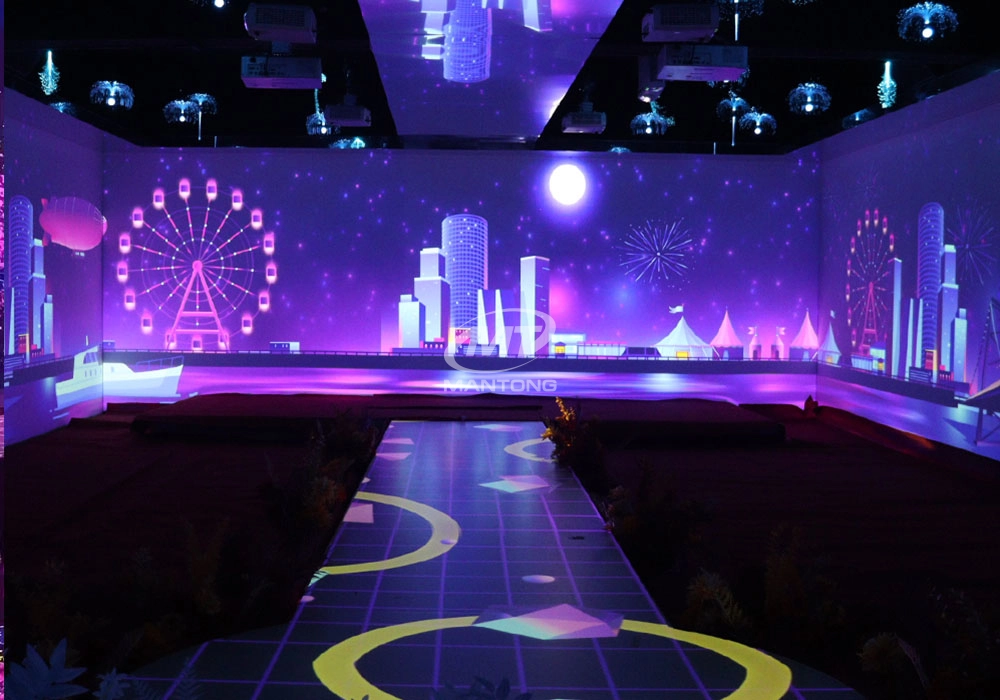
Immersive Brilliance: Mantong 6500 Lumen Immersive Room Projector for Interactive Experiences
One-Stop Projection Solution Provider Since 2011
Are you trader or manufacturer ?
We are direct manufacturer who specialize in providing one-stop solution for different outdoor & indoor projection project with our stable software and qualified projectors
How to install the projection equipment ?
1) Install the projector in a suitable position. We will provide you with a hanger, which you need to fix on the ceiling with
screws.
2) Connect projectors, computers and other accessories through wires.
3) After completing the above 2 steps, we will carry out the edge blending steps. Our team can complete it through remote
control.
In general, installation instructions for each project need to be specified on a project-by-project basis. The above is for
reference only.
What information do you need to know before making the proposal/solution?
We know that everyone wants to know the price, but the price of our products is determined by many factors since most of our products are custom, so no ready price list. In order to fast understand what you need, can you send us an inquiry like this?
For example: I am really interested in your immersive projection products, we are a company in the USA and want to install some in my restaurant. It is about 50 meters long, and 5m in width. Projection size you can decide but the length should be not less than 20 meters. We want some content about SeaWorld because our place is all about the sea. Thank you.
What's the application of Immersive projection ?
It can be used in various venues, such as art exhibition, entertainment venues, educational institution, Wedding hall /Banquet/Bar,Yoga Studio and so on. It often involves advanced projection techniques, multimedia content, and interactive elements to engage and captivate the audience's senses.
What's Immersive Projection ?
Immersive projection refers to a technology that creates a captivating and all-encompassing visual experience for viewers by projecting images or videos onto large surfaces, such as walls, floors, or even entire rooms. This technology aims to immerse the audience in a simulated environment, blurring the boundaries between the physical and virtual worlds.
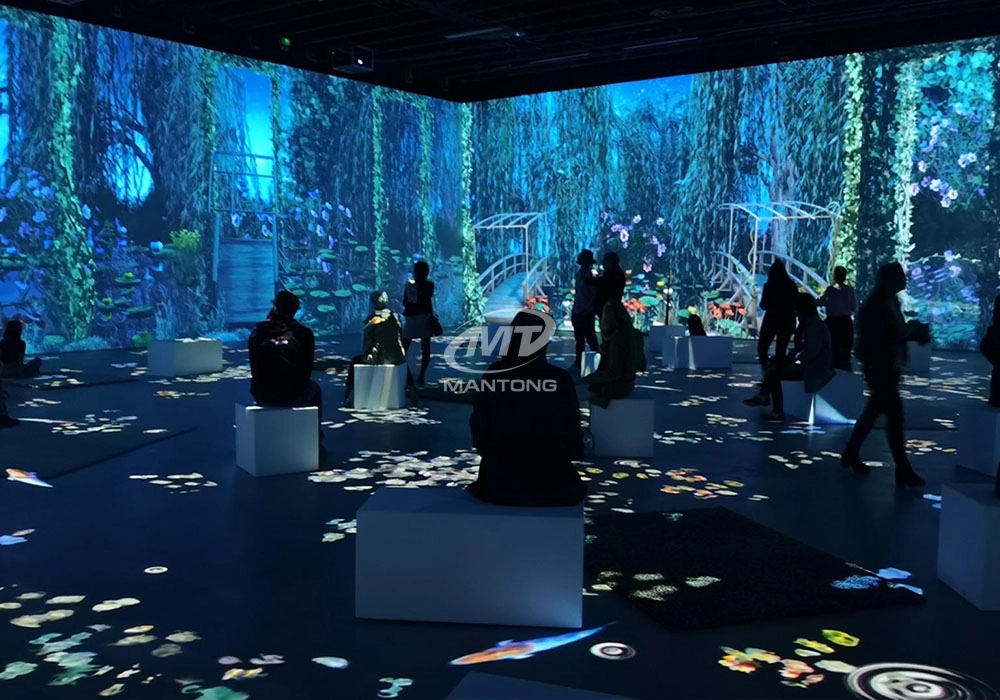
Mantong 6500LM High-Lumen Projector for Large-Scale Immersive Room Projection
Transform any space with Mantong's immersive projection mapping systems. Our high-lumen projectors (up to 6500 LM) and custom software create captivating interactive experiences for floors and walls. Ideal for museums, events, retail, and hospitality. Each kit includes professional ceiling mounting and 80+ pre-loaded video contents and is backed by a 12-month warranty and CE certification. We offer full customization and support to bring your vision to life.
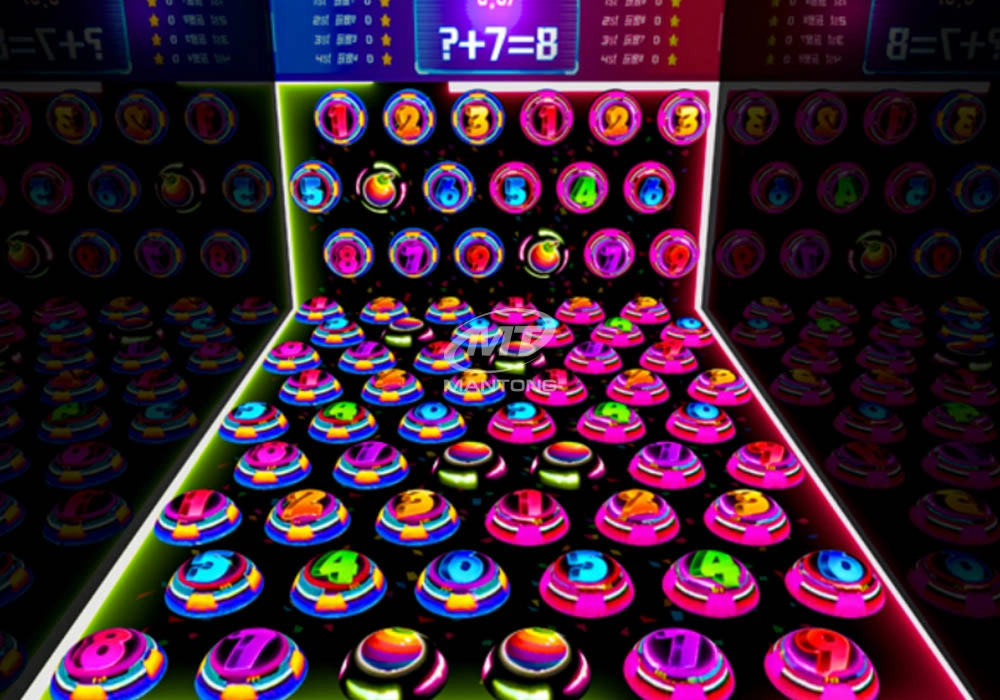
Amusement Rapidly Rotating Bouncing Sphere Interactive Wall Floor Projection Sports Games
Rapidly Rotating Bouncing Sphere is an interactive space where participants jump on rotating spheres. As they step on it, the spheres surface will show special interactivity
Jumping on spheres of the same color in succession causes them to pop, releasing light particles. The more consecutive jumps, the greater the reward—caterpillars appear, and eventually, all spheres of that color burst, filling the space with light and even more caterpillars.
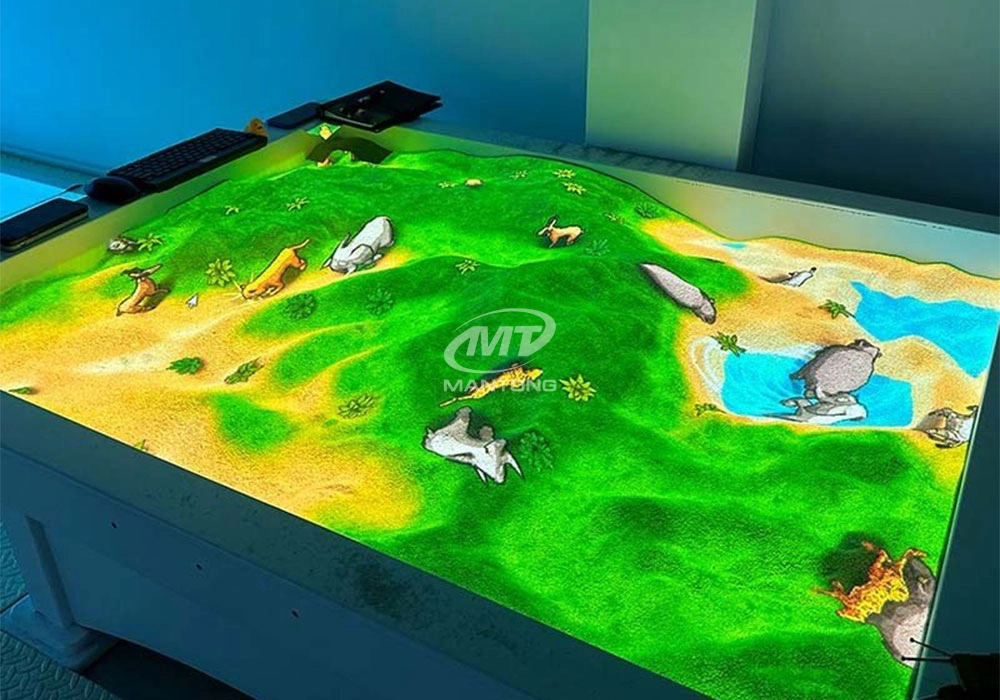
Interactive Sandbox Projection Mapping Games For Kids Play Park
Bring imagination to life with interactive sandbox projection mapping games designed for kids’ play parks. Using cutting-edge projection technology and real-time motion sensing, children can dig, build, and explore virtual worlds directly in the sand. Educational, engaging, and endlessly fun — it’s the perfect blend of play and learning.
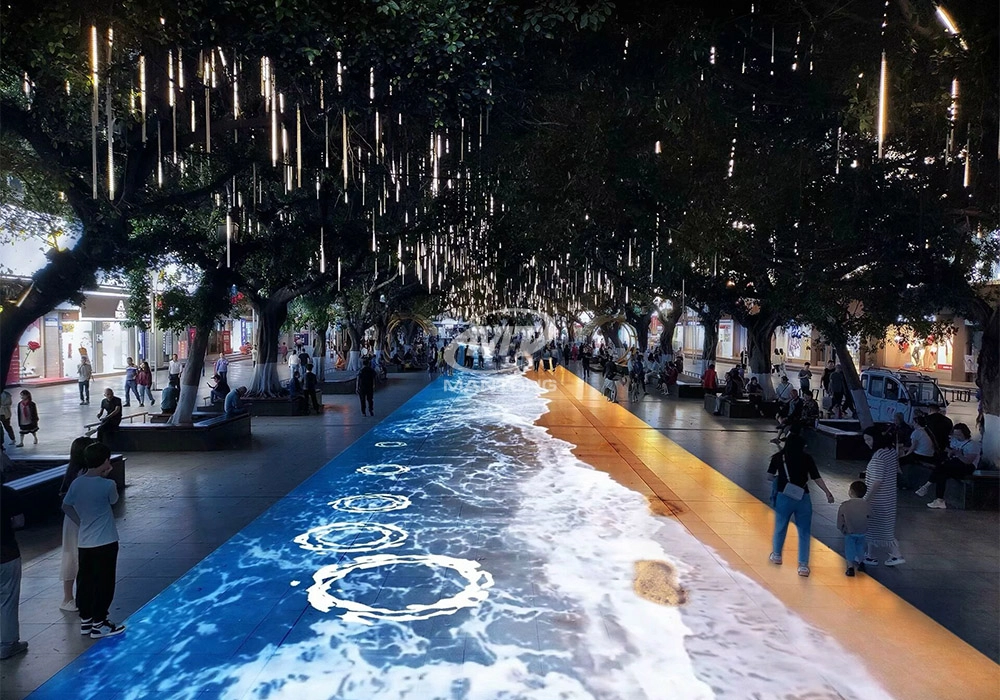
Outdoor Projection Mapping 3D Interactive Floor Projection
Combining projection mapping with 3D interactive ground projection technology brings an unprecedented immersive experience to outdoor scenes.

Kaida Business Center, Shixin Road, Panyu District,Guangzhou City, Guangdong Province, China.
ManTong
ManTong
ManTong