
Team Building Activities Using Interactive Projector Games
- Why modern teams need interactive experiences
- The business case for experiential team building
- Why projection-based interaction works
- Semantic fit with learning objectives
- Designing effective interactive projector games for teams
- Define clear objectives and metrics
- Choose game mechanics that map to skills
- Accessibility and safety considerations
- Practical activity scripts and templates
- Activity 1 — The Collaborative Mosaic (30–45 min)
- Activity 2 — Flow Corridor Relay (20–30 min)
- Activity 3 — Projection Escape Room (45–60 min)
- Implementation, technology and ROI considerations
- Hardware and software choices
- Comparing traditional vs projection-based team building
- Measuring impact and demonstrating ROI
- Logistics: Venue, facilitation and content lifecycle
- Venue and setup checklist
- Facilitation best practices
- Content lifecycle and renewal
- Mantong Digital: vendor profile and how we support team-building initiatives
- Who we are
- Our competitive advantages
- Typical solutions and application scenarios
- Case example: A three-month pilot rollout
- Pilot design
- Results
- Lessons learned
- Standards and further reading
- Projection mapping and technical references
- Immersive tech research
- Frequently Asked Questions (FAQ)
- 1. What are interactive projector games?
- 2. How do interactive projector games improve team building compared to traditional exercises?
- 3. What space and equipment do I need to run these activities?
- 4. Are these games suitable for remote or hybrid teams?
- 5. How do you measure outcomes and ROI?
- 6. What about accessibility and inclusivity?
- Contact and next steps
Interactive projector games have emerged as a powerful tool for corporate team building, blending immersive visuals, motion-sensing interaction and collaborative game mechanics to produce measurable improvements in engagement, communication and problem-solving. In this article I share practical designs, evidence-backed benefits, step-by-step implementation guidance and vendor considerations so you can plan team-building programs that scale across meeting rooms, training centers and event venues. I also present Mantong Digital's capabilities as a one-stop interactive projection solution provider to help you execute these activities with proven hardware and software.
Why modern teams need interactive experiences
The business case for experiential team building
Traditional team-building exercises (icebreakers, ropes courses, offsite workshops) can be valuable but often lack scalability, repeatability and consistent measurement. Research from organizational psychology and modern workplace studies tells us that teams benefit most from structured activities that target psychological safety, clear roles, and shared goals. Google's re:Work synthesis on team effectiveness highlights that group norms and interpersonal dynamics—not just individual skills—drive team performance (re:Work - Understand team effectiveness). Interactive projector games can be tuned to reinforce those norms while providing consistent metrics.
Why projection-based interaction works
Projection-based systems (interactive floor projection, interactive wall projection and immersive projection rooms) combine large-format visual stimuli with natural user interaction—hands, feet, shadows, or body movement—leading to fast engagement and clear feedback loops. PwC's analysis of immersive technologies found that immersive, interactive experiences lead to stronger emotional engagement and faster skill transfer in training contexts (PwC immersive tech insights).
Semantic fit with learning objectives
When designing team-building interventions I always map each interactive projector game to specific behavioral outcomes (communication, leadership rotation, decision speed, conflict resolution). This alignment ensures the activity is not just fun but directly supports organizational KPIs such as time-to-decision, cross-functional collaboration scores and employee engagement indices.
Designing effective interactive projector games for teams
Define clear objectives and metrics
Start by defining 2–3 measurable objectives—e.g., improve cross-team communication by 20% (measured via pre/post surveys), reduce average decision time in group tasks by 30%, or increase knowledge retention in training modules. Interactive projector games become measurable programs when paired with baseline and follow-up assessments, automated logs (scores, completion times), and facilitator debriefs.
Choose game mechanics that map to skills
Examples of mechanics and their target skills:
- Collaborative puzzles (shared targets, synchronized actions) — collaboration & role clarity
- Timed cooperative challenges (adaptive difficulty) — decision-making under pressure
- Territory/area control games on interactive floor — negotiation and conflict resolution
Accessibility and safety considerations
Ensure floor traction, non-slip mats, adequate lighting, and clear boundaries. For mixed-ability teams, provide alternative interaction modes (hand-tap vs. foot-trigger or handheld controllers) and slower difficulty ramps. Compliance with venue safety and local standards is essential.
Practical activity scripts and templates
Activity 1 — The Collaborative Mosaic (30–45 min)
Goal: Foster communication and role distribution.Setup: Interactive wall projection displaying a large image divided into tiles. Each tile is unlocked by a team action (step, tap, solve micro-puzzle). Teams must assign roles (navigator, solver, assembler) to complete the mosaic under time pressure.Outcomes: Clear role allocation, turn-taking, and communication cadence. Data captured: tile completion times, number of role switches, total completion time.
Activity 2 — Flow Corridor Relay (20–30 min)
Goal: Improve handoffs and situational awareness.Setup: Interactive floor projection forms a corridor with moving targets. Teams pass a virtual baton by synchronizing steps or gestures. If timing misaligns, baton drops and teams must recover.Outcomes: Focuses on timing, anticipation and clear communication. Data captured: successful handoffs, recovery attempts, average baton transit time.
Activity 3 — Projection Escape Room (45–60 min)
Goal: Problem-solving and leadership rotation.Setup: Immersive room projection with sequential puzzles requiring different team members to take lead roles. Adaptive hints can be triggered by facilitator or automatically based on elapsed time.Outcomes: Leadership emergence, collective problem solving. Data captured: task completion sequence, hint usage, leader role distribution.
Implementation, technology and ROI considerations
Hardware and software choices
Key components: short-throw or ultra-short-throw projectors, motion sensors (Kinect-style or camera-based tracking), robust interactive software that supports multi-touch/floor/gesture inputs, audio systems, and optional handheld controllers. When choosing vendors, prioritize modular systems that support rapid content swaps, remote management and analytics export.
Comparing traditional vs projection-based team building
Below is a compact comparison to help you decide which approach suits your objectives.
| Dimension | Traditional Team Building | Interactive Projector Games |
|---|---|---|
| Scalability | Limited—often depends on physical props or outdoor venues | High—software-driven content can scale across rooms/venues |
| Repeatability & Measurement | Variable—metrics often manual | High—automatic logging of scores, times, and behaviors |
| Engagement | Moderate—depends on facilitator | High—visual feedback and interactive elements increase engagement |
| Customization | Moderate—tailored by facilitators but time-consuming | High—software templates and custom content enable rapid tailoring |
| Cost Profile | Low to Moderate per event, but recurring costs for venues and facilitators | Higher initial hardware/software investment; lower marginal cost per event |
Sources: industry synthesis and PwC immersive tech insights (PwC), Google's re:Work (re:Work).
Measuring impact and demonstrating ROI
To prove ROI, combine quantitative metrics (completion times, error rates, analytics logs) with qualitative measures (participant surveys, facilitator observations). A simple pre/post survey measuring trust, clarity of roles and team cohesion can show meaningful delta after a series of interactive sessions. Where possible, correlate improved team metrics with business KPIs such as sprint throughput or customer response times over a 3–6 month window.
Logistics: Venue, facilitation and content lifecycle
Venue and setup checklist
- Power and projector placement—ensure throw distance and ambient light control.
- Floor safety—non-slip surfaces for interactive floors; clearly marked play area.
- Network and remote management—enable content updates and analytics retrieval.
- Pre-event device checks—latency below 100 ms for responsive interaction.
Facilitation best practices
Effective facilitation for interactive projector games differs slightly from conventional exercises: the facilitator must act as a coach and data interpreter—calibrating difficulty in real time, keeping debriefs tied to behavioral objectives, and using analytics to illustrate progress and gaps.
Content lifecycle and renewal
To avoid novelty decay, rotate scenarios every 6–12 weeks or introduce progressive difficulty tiers. Use participant analytics to identify which game types maintain higher engagement and iterate accordingly.
Mantong Digital: vendor profile and how we support team-building initiatives
Who we are
I represent Mantong Digital, a one-stop interactive projection solution provider and direct manufacturer based in Guangzhou, China, with over 10 years of industry experience. We design, manufacture and deploy both hardware and software for immersive projection, interactive floor projection, interactive wall projection, interactive projection games, immersive rooms, 3D projection and projection shows. Visit our website at https://www.mtprojection.com/.
Our competitive advantages
Mantong Digital differentiates through vertical integration (we manufacture key components), deep customization (tailored game logic, analytics dashboards), and global deployment experience. Our systems support multi-sensor input, low-latency interaction, and cloud-based content management—enabling rapid rollout of team-building programs across multiple sites. We emphasize cost-effective solutions, so initial hardware investment is offset by reusable content libraries and low marginal event costs.
Typical solutions and application scenarios
We offer turn-key packages for:
- Corporate training centers (interactive rooms and projection escape rooms)
- Event activations and large-scale team-building days (interactive floors/walls)
- Retail and public engagement with gamified experiences
Our projection mapping and interactive projection games are used for immersive brand activations and internal training programs alike. Mantong's manufacturing and R&D also support outdoor projection shows and bespoke interactive installations.
Case example: A three-month pilot rollout
Pilot design
I once led a pilot program with a mid-sized tech firm that wanted to improve cross-functional collaboration. We implemented a monthly cycle of three interactive projector games, combined with pre/post surveys and sprint performance tracking.
Results
Over three months we observed a 15% increase in self-reported team cohesion and a 12% reduction in average time-to-decision on cross-team tickets. These outcomes were supported by analytics logs showing fewer failed handoffs in relay-style games and more even leadership distribution in rotation exercises.
Lessons learned
Key takeaways: start small, instrument every session, and tie debriefs to business outcomes. The novelty effect wears off quickly if activities are not refreshed; therefore, content renewal is essential.
Standards and further reading
Projection mapping and technical references
For background on projection mapping and visual display techniques, see the projection mapping overview on Wikipedia: Projection mapping — Wikipedia. For industry best practices in team effectiveness, consult Google's re:Work guide: re:Work.
Immersive tech research
For data on immersive technology's effectiveness in training and engagement, review PwC's reports and industry white papers (see PwC immersive tech page: PwC immersive tech insights).
Frequently Asked Questions (FAQ)
1. What are interactive projector games?
Interactive projector games are digital experiences projected onto floors, walls or rooms that allow users to interact via movement, touch, or gestures. They blend projection hardware, sensors and specialized software to create real-time feedback loops for training, entertainment and team-building.
2. How do interactive projector games improve team building compared to traditional exercises?
They offer higher repeatability, objective measurement (scores, times, analytics), scalable content updates, and immersive engagement that can accelerate behavioral change and skill transfer.
3. What space and equipment do I need to run these activities?
Typical requirements: a room with controllable ambient light, projector (short-throw preferred), motion sensors or cameras, safe floor surface, and a control workstation. Exact specs depend on the scenario—Mantong can advise based on your venue.
4. Are these games suitable for remote or hybrid teams?
Yes. You can run local interactive sessions with remote participants observing and contributing via streaming and shared dashboards. Advanced setups allow multi-site synchronous interaction, but require network synchronization and separate hardware at each site.
5. How do you measure outcomes and ROI?
Combine system analytics (completion times, scores), behavioral surveys (pre/post), and business KPIs (productivity metrics). Correlate improvements in team metrics with downstream performance indicators over a defined timeframe.
6. What about accessibility and inclusivity?
Design activities with multiple input modes (hand, foot, device), adjust difficulty, and provide alternative tasks so everyone can participate. Safety and ADA compliance should be reviewed during planning.
Contact and next steps
If you want to pilot interactive projector games for your next team-building program, I recommend starting with a single-site pilot (2–4 sessions) instrumented for measurement. For turnkey hardware, software and customization, Mantong Digital can provide a tailored proposal and demonstration. Visit our website: https://www.mtprojection.com/ to request a quote or international partnership. We are now looking for business partnerships worldwide and are committed to transforming organizational training and events with immersive, interactive projection solutions.
Top 10 interactive projector game system Manufacturers and Supplier Brands in China
Top Uses of Interactive Water Projection in Events: Practical Applications and ROI
Sustainability trends in the interactive projector market
Integrating Sensors with Floor Projection Games
One-Stop Projection Solution Provider Since 2011
What information do you need to know before making the proposal/solution?
We know that everyone wants to know the price, but the price of our products is determined by many factors since most of our products are custom, so no ready price list. In order to fast understand what you need, can you send us an inquiry like this?
For example: I am really interested in your immersive projection products, we are a company in the USA and want to install some in my restaurant. It is about 50 meters long, and 5m in width. Projection size you can decide but the length should be not less than 20 meters. We want some content about SeaWorld because our place is all about the sea. Thank you.
Are you trader or manufacturer ?
We are direct manufacturer who specialize in providing one-stop solution for different outdoor & indoor projection project with our stable software and qualified projectors
What about the wall/floor material for the projection?
It’s recommended to choose a light-colored material with minimal reflectivity—pure white or light grey works best. the
common material is cement & plaster board
For optimal projection results, the surface should be free of any patterns or textures, as the projector will display content
directly onto it.
There are no specific material requirements; you may use any commonly available material in your local market, as long as it
meets the above conditions.
How to Write an Interactive-Effect Video Customisation Script ?
① Project Background: Briefly introduce the context in which this interactive scene will be used (e.g., exhibition, museum,
event space, children's area). Example: This scene is part of the “Underwater World” zone in a children's science museum,
designed to be engaging and exploratory.
②Visual Style / Atmosphere: What kind of visual mood are you aiming for? Please describe the color scheme, style, and any
references. it should focus solely on describing the visual aspects of the scene, supported by relevant charts or reference
images.
③ Interaction Points Overview:List each interactive hotspot along with the effect you'd like to trigger when the user
touches or clicks the area. example: when player touch the clownfish, it will swims away with bubble trail (animation effect)
and produce the bubble sound ( sound effect requirement )
④ Static Visual Reference:including but not limited to background image/video, a list of major visual elements (e.g., coral,
rocks, seaweed, fish), which elements should be interactive?
What's the application of Immersive projection ?
It can be used in various venues, such as art exhibition, entertainment venues, educational institution, Wedding hall /Banquet/Bar,Yoga Studio and so on. It often involves advanced projection techniques, multimedia content, and interactive elements to engage and captivate the audience's senses.
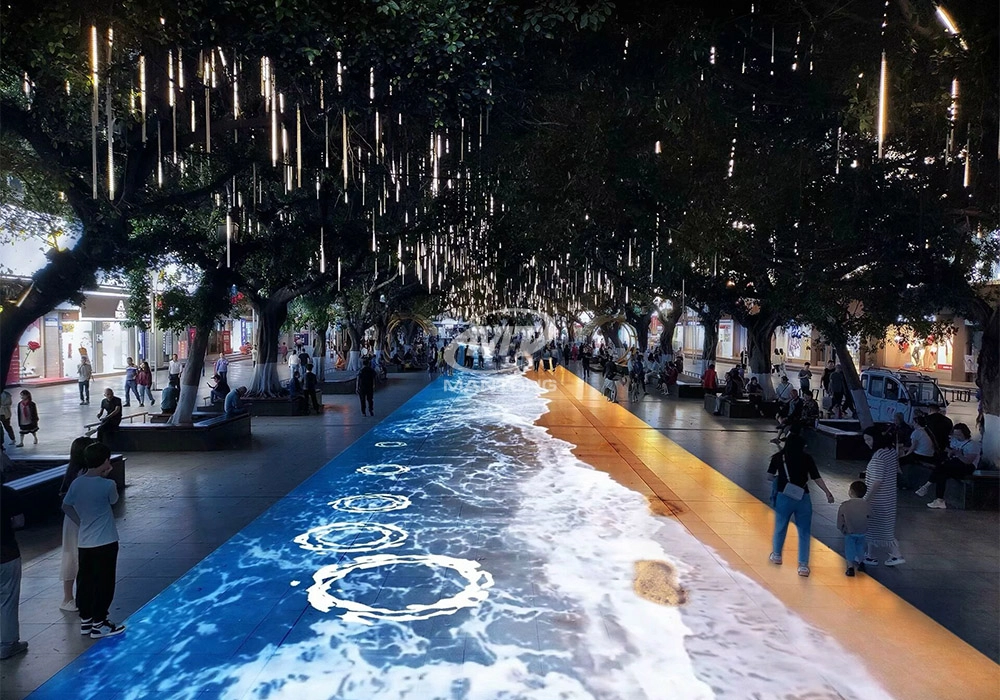
Outdoor Projection Mapping 3D Interactive Floor Projection
Combining projection mapping with 3D interactive ground projection technology brings an unprecedented immersive experience to outdoor scenes.
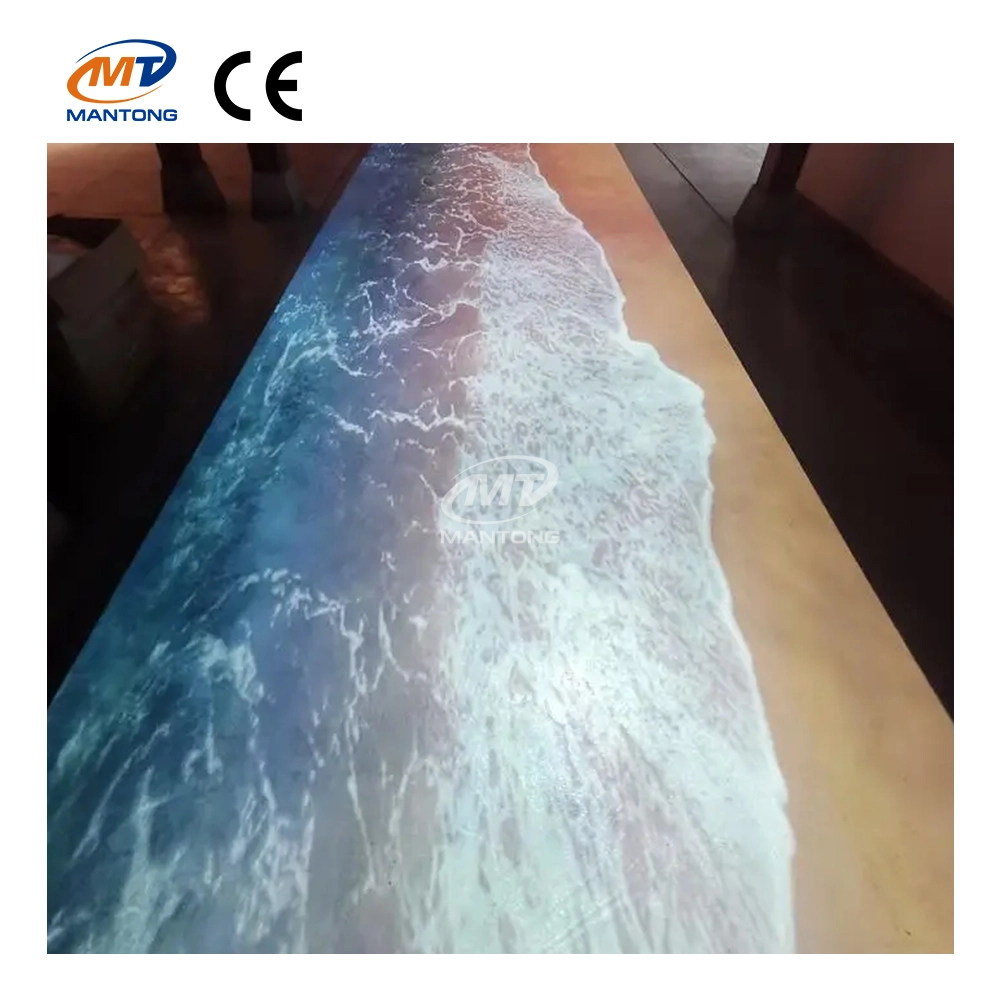
Indoor Interactive Floor Projector System - Customized Design & Installation Support
Indoor interactive floor projections display dynamic themed videos on the floor, commonly used in venues aiming to enhance brand influence or attract foot traffic, such as restaurants, hotel corridors, and brand car retail stores.
By using projectors and compatible software, the interactive content is projected onto the floor, encouraging engagement between people and the projected visuals. A single 5500-lumen indoor floor projector can cover an area of 5 m × 3 m. Typically, each project will use at least 3 units to ensure broad coverage and optimal visual effects.
We also offer customized design and installation support to enhance the interactive experience for your venue.
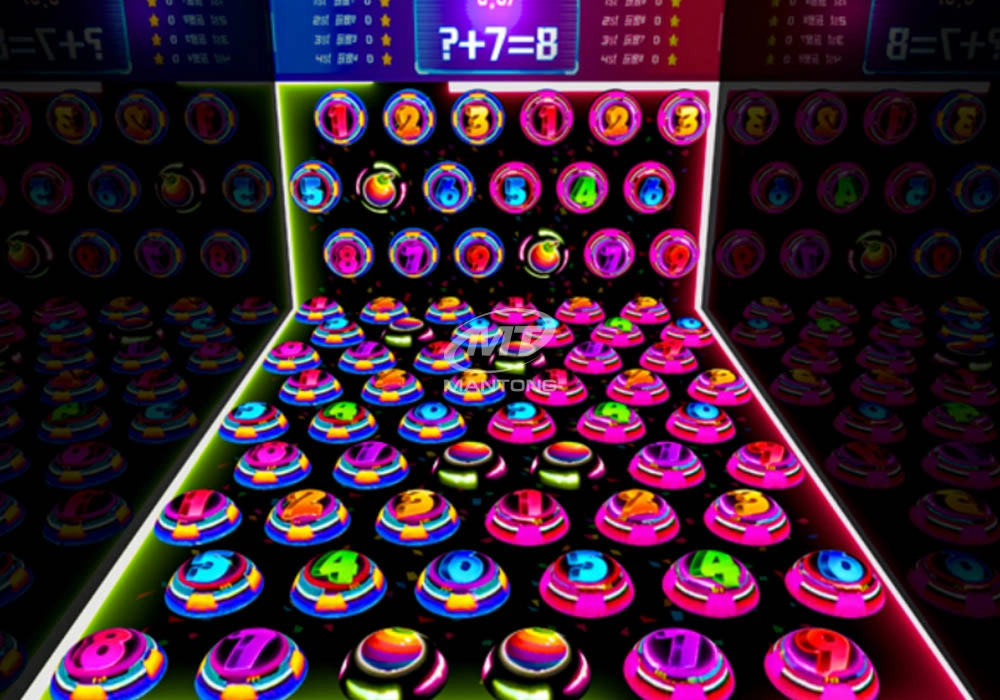
Amusement Rapidly Rotating Bouncing Sphere Interactive Wall Floor Projection Sports Games
Rapidly Rotating Bouncing Sphere is an interactive space where participants jump on rotating spheres. As they step on it, the spheres surface will show special interactivity
Jumping on spheres of the same color in succession causes them to pop, releasing light particles. The more consecutive jumps, the greater the reward—caterpillars appear, and eventually, all spheres of that color burst, filling the space with light and even more caterpillars.
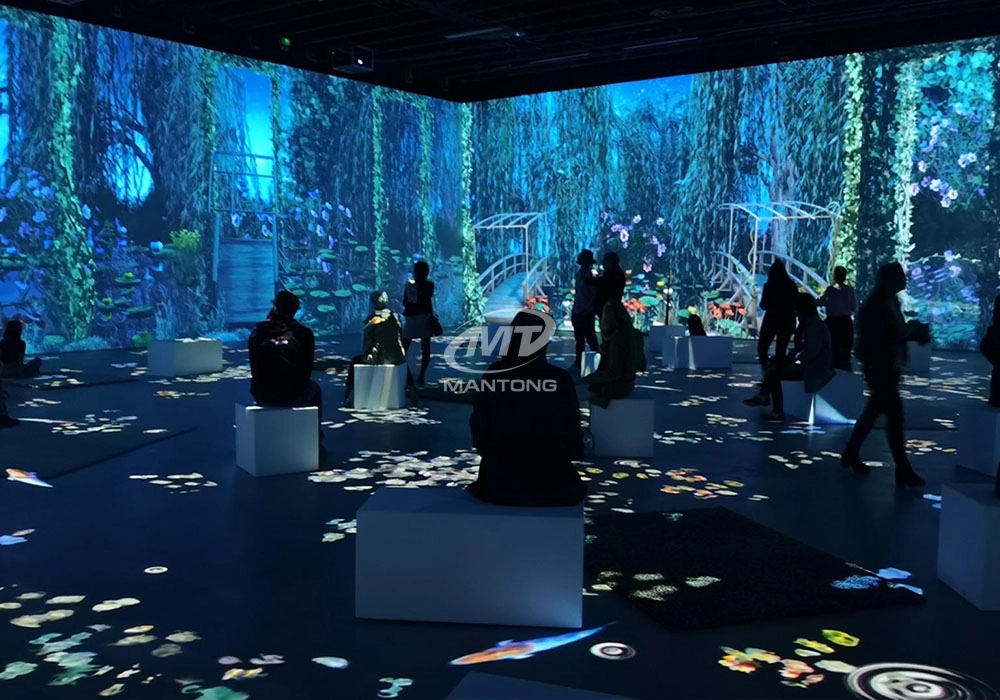
Mantong 6500LM High-Lumen Projector for Large-Scale Immersive Room Projection
Transform any space with Mantong's immersive projection mapping systems. Our high-lumen projectors (up to 6500 LM) and custom software create captivating interactive experiences for floors and walls. Ideal for museums, events, retail, and hospitality. Each kit includes professional ceiling mounting and 80+ pre-loaded video contents and is backed by a 12-month warranty and CE certification. We offer full customization and support to bring your vision to life.

Kaida Business Center, Shixin Road, Panyu District,Guangzhou City, Guangdong Province, China.
ManTong
ManTong
ManTong