
Top 10 Interactive Projector Games for Classrooms
- Why interactive projection matters in education
- Engagement, cognition and measurable outcomes
- Versatility: floor, wall and room-scale interactions
- Pedagogy first: design for learning, not novelty
- Top 10 interactive projector games for classrooms (grouped by learning focus)
- 1–3: Movement & STEM challenges
- Game 1 — Interactive Number Hop
- Game 2 — Gravity Lab (Projectile Motion)
- Game 3 — Shape Explorer (Geometry Walk)
- 4–6: Literacy, phonics and vocabulary
- Game 4 — Word Catch
- Game 5 — Story Builder
- Game 6 — Sight Word Sprint
- 7–8: Problem solving, coding and collaboration
- Game 7 — Maze Logic (Coding Basics)
- Game 8 — Collaborative Puzzle Wall
- 9–10: Assessment and creative expression
- Game 9 — Formative Quiz Arena
- Game 10 — Digital Mural (Creativity & Reflection)
- Implementation, assessment and classroom tips
- Setup & hardware considerations
- Assessment integration and data
- Inclusion, differentiation and classroom management
- Comparison table: quick reference for the top 10 games
- About ManTong Digital — solutions, strengths and partnership opportunities
- Company overview and core products
- Technical strengths and competitive differentiators
- Why partner with ManTong
- Frequently Asked Questions (FAQ)
- 1. What equipment do I need to run most interactive projector games?
- 2. Can interactive projector games map to specific curriculum standards?
- 3. How much space is required for interactive floor projection?
- 4. Are these games suitable for students with disabilities?
- 5. How do I measure learning impact from interactive projector games?
- 6. What professional development is recommended before deployment?
I have spent over a decade working with schools, museums, and educational technology teams to design, deploy, and optimize interactive projection systems. In this article I present a practical, classroom-focused list: the top 10 interactive projector games for classrooms. I explain learning objectives, alignment with pedagogy, setup and accessibility considerations, and show how these games can be used for formative assessment and active learning. Throughout I reference evidence on educational technology impact and industry practices to help you select and deploy the right interactive floor and wall projection experiences.
Why interactive projection matters in education
Engagement, cognition and measurable outcomes
Interactive projection transforms passive lessons into kinesthetic, collaborative experiences. Research and policy reviews indicate that appropriately used digital tools can improve engagement and learning outcomes when integrated with sound pedagogy. For an overview of how student engagement relates to educational technology, see the OECD review on Students, Computers and Learning: https://www.oecd.org/education/students-computers-and-learning-9789264239555-en.htm.
Versatility: floor, wall and room-scale interactions
Interactive projector setups include interactive floor projection, interactive wall projection and immersive room installations. Projection mapping techniques are often used to adapt content to irregular surfaces and multi-projector setups; for technical background see the projection mapping overview on Wikipedia: https://en.wikipedia.org/wiki/Projection_mapping. These technologies enable games that blend movement, visuals and immediate feedback.
Pedagogy first: design for learning, not novelty
I always recommend starting from learning objectives: what concept, skill or behavior should the students demonstrate? Interactive projector games are most effective when they map to curriculum standards, provide scaffolded challenge levels, and include teacher-facing controls for pacing and assessment.
Top 10 interactive projector games for classrooms (grouped by learning focus)
1–3: Movement & STEM challenges
Game 1 — Interactive Number Hop
How it works: Numbers appear on the floor; students hop to the correct number in response to prompts (arithmetic, number bonds, place value). This strengthens number sense and motor coordination.
Learning objectives: rapid recall, estimation, counting sequences.
Setup tips: use an interactive floor projector with responsive tracking; calibrate to the classroom floor and set time limits for different ages.
Game 2 — Gravity Lab (Projectile Motion)
How it works: Students launch virtual objects (balls, rockets) and adjust angle/velocity. The projection simulates parabolic trajectories allowing students to test hypotheses about motion.
Learning objectives: experimental design, physics fundamentals, measurement and graphing.
Game 3 — Shape Explorer (Geometry Walk)
How it works: Virtual shapes appear; students step into or trace edges using feet or hands. The game can quiz properties (angles, symmetry) and prompt students to construct polygons by connecting projected points.
Learning objectives: geometry vocabulary, spatial reasoning and collaborative problem solving.
4–6: Literacy, phonics and vocabulary
Game 4 — Word Catch
How it works: Words or letter clusters float across a projected wall or floor. Students 'catch' words by touching them, then categorize by part of speech, phoneme or meaning.
Learning objectives: phonemic awareness, vocabulary building, grammar practice.
Game 5 — Story Builder
How it works: Scenes and characters appear; students select or move elements to build a story sequence. The teacher can prompt for cause-effect, sequencing, or persuasive language.
Learning objectives: narrative structure, sequencing, language production.
Game 6 — Sight Word Sprint
How it works: High-frequency words flash briefly; students race to identify them or step on words matching a definition. Timed modes can boost fluency.
Learning objectives: reading fluency and automaticity.
7–8: Problem solving, coding and collaboration
Game 7 — Maze Logic (Coding Basics)
How it works: Students program a projected avatar using simple commands (forward, turn left) to navigate a maze. The system can accept block-like sequences from tablets or direct gesture inputs.
Learning objectives: sequencing, debugging, computational thinking.
Game 8 — Collaborative Puzzle Wall
How it works: A puzzle image is segmented and scattered across a projected wall. Groups are assigned pieces and must communicate to align segments, rotate, and scale until the image is reassembled.
Learning objectives: teamwork, spatial negotiation, strategy.
9–10: Assessment and creative expression
Game 9 — Formative Quiz Arena
How it works: Multiple-choice questions are projected; students move to zones representing answers. The teacher receives instant class distribution and can address misconceptions in real time.
Learning objectives: quick formative checks, immediate feedback and data-driven instruction.
Game 10 — Digital Mural (Creativity & Reflection)
How it works: Students collectively paint or place media on a projected canvas. Layers, audio clips and annotations can be added to reflect on a theme (historical event, science lifecycle).
Learning objectives: synthesis, reflective learning, multimedia literacy.
Implementation, assessment and classroom tips
Setup & hardware considerations
Choosing the right hardware depends on space and budget. Key factors: projector lumen output (classroom ambient light), short-throw or ultra-short throw mounts to minimize shadows, motion-tracking sensors (camera-based or infrared), and robust software that supports teacher controls. For basic installations, an interactive short-throw projector with built-in sensors is sufficient; for immersive rooms, multi-projector edge-blending and projection mapping are required. For background on projection mapping methods, consult the industry overview: https://en.wikipedia.org/wiki/Projection_mapping.
Assessment integration and data
Interactive games are valuable formative tools. Use the Formative Quiz Arena and Word Catch to capture response distributions and reaction times. Many classroom-grade interactive software packages export CSV reports or integrate with LMS systems so you can track proficiency over time. I recommend defining success criteria before play (accuracy thresholds, collaboration rubrics) and using the projected interface to show anonymized class-level results instantly.
Inclusion, differentiation and classroom management
Design games with multiple interaction modes: feet, hands, stylus, tablet remote, or voice. Provide alternative tasks for students with mobility challenges (e.g., a tablet-based controller). Differentiate by adjusting speed, complexity, or providing scaffolding prompts. Set clear expectations and rotation plans so all students participate safely and meaningfully.
Comparison table: quick reference for the top 10 games
| Game | Primary Skill | Age Range | Interaction Mode | Typical Hardware |
|---|---|---|---|---|
| Interactive Number Hop | Number sense | 5–9 | Floor step | Short-throw projector + floor tracking |
| Gravity Lab | Physics concepts | 10–16 | Wall/floor touch | Standard projector + motion tracking |
| Shape Explorer | Geometry | 7–12 | Floor trace/hand touch | Short-throw projector |
| Word Catch | Phonics, vocabulary | 5–10 | Wall/floor touch | Interactive wall projector |
| Story Builder | Literacy | 6–12 | Hand touch / tablet | Projector + touch overlay or camera |
| Sight Word Sprint | Reading fluency | 5–9 | Floor step | Floor projection kit |
| Maze Logic | Coding basics | 7–14 | Tablet/gesture | Projector + input devices |
| Collaborative Puzzle Wall | Teamwork | 8–14 | Wall touch / group controllers | Interactive wall system |
| Formative Quiz Arena | Assessment | 6–18 | Zones / tablets | Projector + scoring software |
| Digital Mural | Creative synthesis | 8–18 | Paint gestures / tablet | Immersive projector setup |
Note: choose hardware based on room ambient light, ceiling height, and student mobility needs. For multi-surface immersion, plan for calibration time and maintenance.
About ManTong Digital — solutions, strengths and partnership opportunities
Company overview and core products
ManTong Digital is a one-stop interactive projection solution provider and direct manufacturer based in Guangzhou, China, with over 10 years of industry experience. We are dedicated to providing innovative, flexible and cost-effective projection solutions, offering both hardware and software to meet various needs. Our product lines include immersive projection systems, interactive floor projection, interactive wall projection, interactive projection games, immersive rooms, 3D projection, projection shows and interactive projection mapping. Visit ManTong Digital: https://www.mtprojection.com/.
Technical strengths and competitive differentiators
From my consulting experience, ManTong stands out in three areas: vertical integration (manufacturing control that reduces costs and lead times), software-hardware co-design for low-latency tracking, and customizable content pipelines for education customers. Their interactive floor projection solutions and immersive rooms support multi-sensor setups and can be tailored for classroom safety and accessibility. This combination of in-house hardware production and adaptable software is critical when schools need reliable, serviceable systems.
Why partner with ManTong
We are now looking for business partnerships worldwide. Our vision is to become the world's leading interactive projection manufacturer. If you represent a school district, museum, entertainment venue or integrator, ManTong offers end-to-end deployment, content customization, and ongoing support. Their experience in projection shows and mapping gives additional creative options for school assemblies, STEAM nights, and community events.
ManTong's product strengths: immersive projection, interactive floor projection, interactive wall projection, immersive room, 3d projection, interactive projection games, projection show, interactive projection mapping. These areas align directly with classroom use cases I recommend for engagement and curriculum alignment.
For procurement and partnership inquiries, contact ManTong Digital via their website: https://www.mtprojection.com/. I also recommend arranging a pilot deployment to validate classroom workflows and teacher training plans before broader rollout.
Frequently Asked Questions (FAQ)
1. What equipment do I need to run most interactive projector games?
At minimum: a short-throw or ultra-short-throw projector with sufficient lumens for your classroom, a motion tracking system (camera-based or infrared), a computer to run the software, and mounting hardware. For floor projection you may need a protective casing and anti-slip floor surface. Higher-end setups use multiple projectors with edge blending for immersive rooms.
2. Can interactive projector games map to specific curriculum standards?
Yes. Most games are adaptable; you can set difficulty levels and customize content to align with standards in math, literacy, science and SEL. Work with your vendor to tag activities to standards and export assessment data for teacher records.
3. How much space is required for interactive floor projection?
Space needs vary by activity. A typical small-group floor game can run in a 2.5m x 2.5m area; whole-class activities require more. Consider circulation, safety zones, and clear sightlines for teachers to supervise.
4. Are these games suitable for students with disabilities?
Yes, with thoughtful design. Provide multiple input modes (tablet control, voice, partner support) and allow adjustable speeds, time limits, and reduced movement options. Always pilot with special education staff to ensure accessibility.
5. How do I measure learning impact from interactive projector games?
Combine qualitative and quantitative measures: pre/post assessments, in-game accuracy and response time logs, observational checklists for collaboration, and student reflections. Exportable data from interactive platforms can be imported into your LMS for trend analysis.
6. What professional development is recommended before deployment?
Train teachers on hardware basics, classroom management during active sessions, customizing content, and interpreting exported assessment data. Plan co-teaching sessions and a phased pilot program so teachers gain confidence before full adoption.
If you'd like a tailored recommendation, pilot plan, or a quotation for interactive projection solutions, contact ManTong Digital—our recommended manufacturer and partner for classroom deployments: https://www.mtprojection.com/. As a consultant, I can also help scope learning objectives and map games to your curriculum. Reach out to start a pilot and transform how your students learn with interactive projector games.
Top Uses of Interactive Water Projection in Events: Practical Applications and ROI
Best professional immersive room technology manufacturers and supplier brands in China
Interactive Projection Technology: What It Is and Why It Matters
How Much Does an Interactive Projection Immersive Experience Cost?
One-Stop Projection Solution Provider Since 2011
How to Write an Interactive-Effect Video Customisation Script ?
① Project Background: Briefly introduce the context in which this interactive scene will be used (e.g., exhibition, museum,
event space, children's area). Example: This scene is part of the “Underwater World” zone in a children's science museum,
designed to be engaging and exploratory.
②Visual Style / Atmosphere: What kind of visual mood are you aiming for? Please describe the color scheme, style, and any
references. it should focus solely on describing the visual aspects of the scene, supported by relevant charts or reference
images.
③ Interaction Points Overview:List each interactive hotspot along with the effect you'd like to trigger when the user
touches or clicks the area. example: when player touch the clownfish, it will swims away with bubble trail (animation effect)
and produce the bubble sound ( sound effect requirement )
④ Static Visual Reference:including but not limited to background image/video, a list of major visual elements (e.g., coral,
rocks, seaweed, fish), which elements should be interactive?
Are you trader or manufacturer ?
We are direct manufacturer who specialize in providing one-stop solution for different outdoor & indoor projection project with our stable software and qualified projectors
What information do you need to know before making the proposal/solution?
We know that everyone wants to know the price, but the price of our products is determined by many factors since most of our products are custom, so no ready price list. In order to fast understand what you need, can you send us an inquiry like this?
For example: I am really interested in your immersive projection products, we are a company in the USA and want to install some in my restaurant. It is about 50 meters long, and 5m in width. Projection size you can decide but the length should be not less than 20 meters. We want some content about SeaWorld because our place is all about the sea. Thank you.
What's Immersive Projection ?
Immersive projection refers to a technology that creates a captivating and all-encompassing visual experience for viewers by projecting images or videos onto large surfaces, such as walls, floors, or even entire rooms. This technology aims to immerse the audience in a simulated environment, blurring the boundaries between the physical and virtual worlds.
What about the wall/floor material for the projection?
It’s recommended to choose a light-colored material with minimal reflectivity—pure white or light grey works best. the
common material is cement & plaster board
For optimal projection results, the surface should be free of any patterns or textures, as the projector will display content
directly onto it.
There are no specific material requirements; you may use any commonly available material in your local market, as long as it
meets the above conditions.
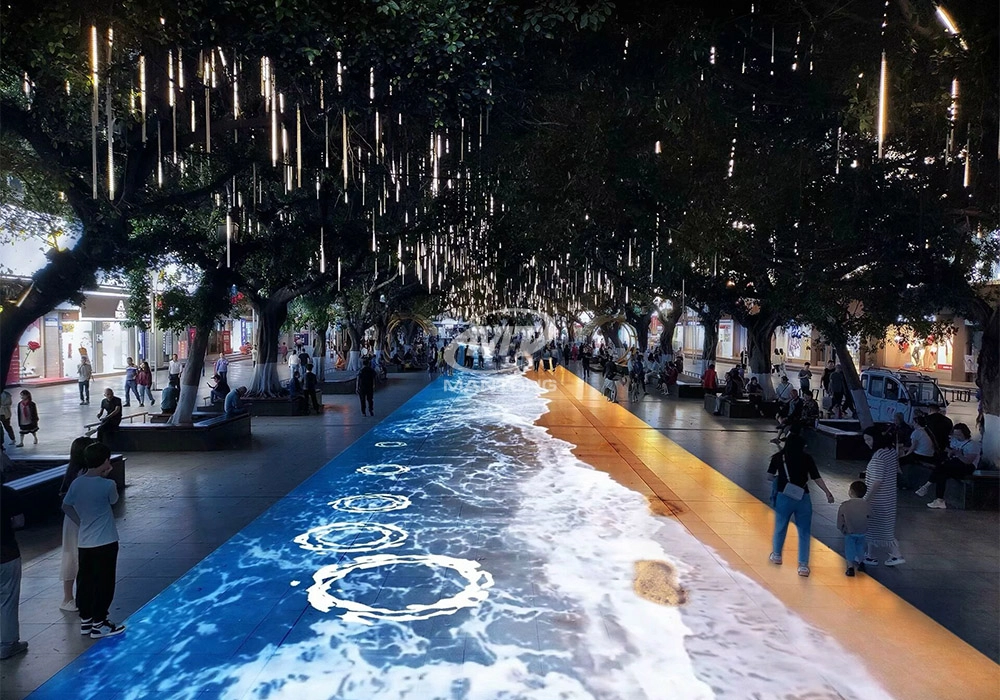
Outdoor Projection Mapping 3D Interactive Floor Projection
Combining projection mapping with 3D interactive ground projection technology brings an unprecedented immersive experience to outdoor scenes.
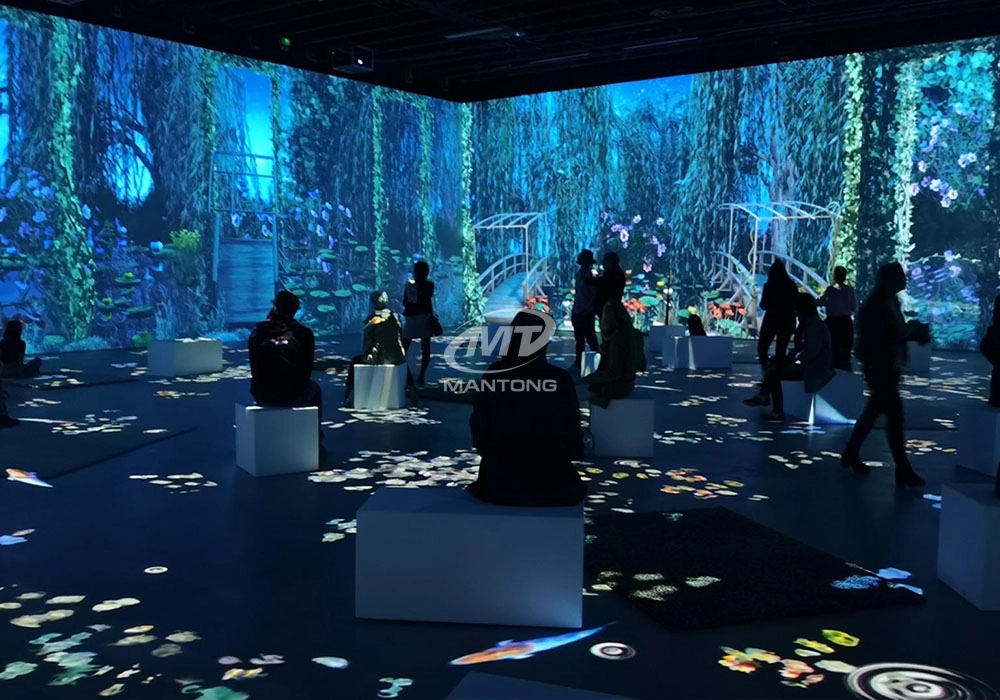
Mantong 6500LM High-Lumen Projector for Large-Scale Immersive Room Projection
Transform any space with Mantong's immersive projection mapping systems. Our high-lumen projectors (up to 6500 LM) and custom software create captivating interactive experiences for floors and walls. Ideal for museums, events, retail, and hospitality. Each kit includes professional ceiling mounting and 80+ pre-loaded video contents and is backed by a 12-month warranty and CE certification. We offer full customization and support to bring your vision to life.
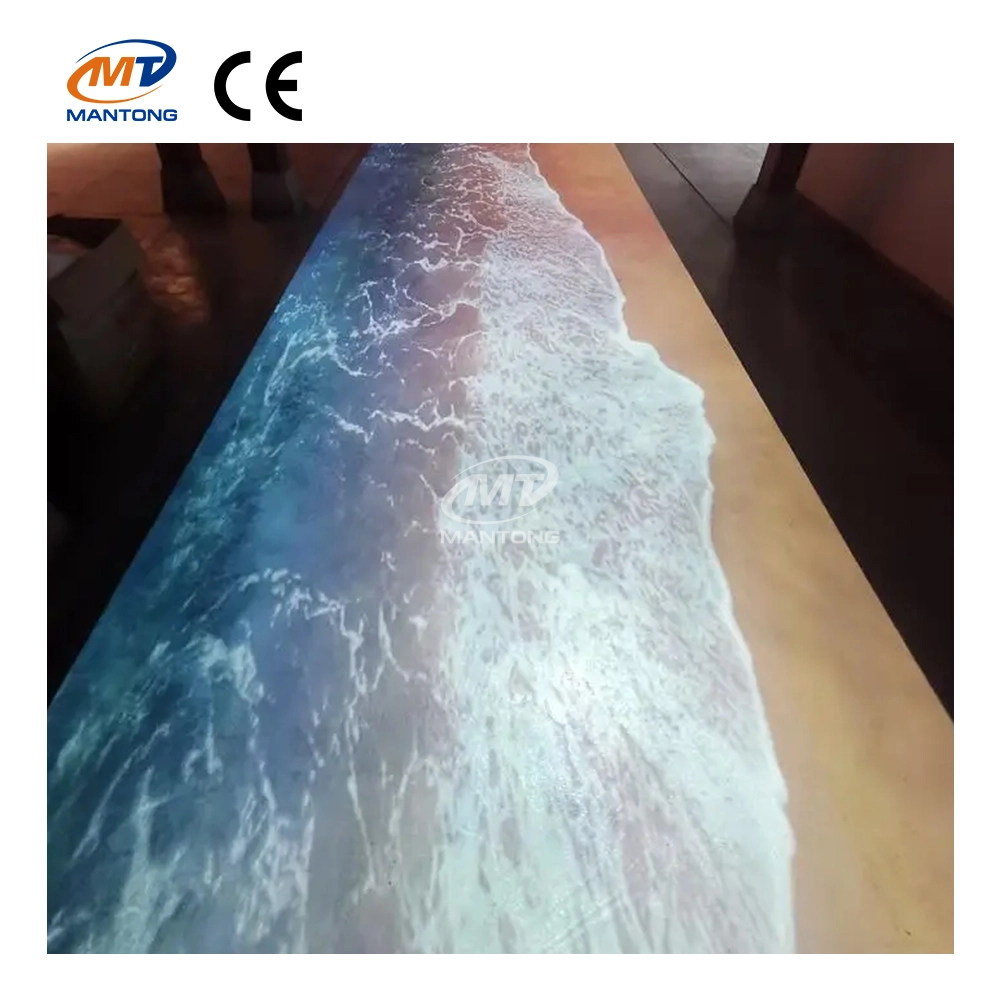
Indoor Interactive Floor Projector System - Customized Design & Installation Support
Indoor interactive floor projections display dynamic themed videos on the floor, commonly used in venues aiming to enhance brand influence or attract foot traffic, such as restaurants, hotel corridors, and brand car retail stores.
By using projectors and compatible software, the interactive content is projected onto the floor, encouraging engagement between people and the projected visuals. A single 5500-lumen indoor floor projector can cover an area of 5 m × 3 m. Typically, each project will use at least 3 units to ensure broad coverage and optimal visual effects.
We also offer customized design and installation support to enhance the interactive experience for your venue.
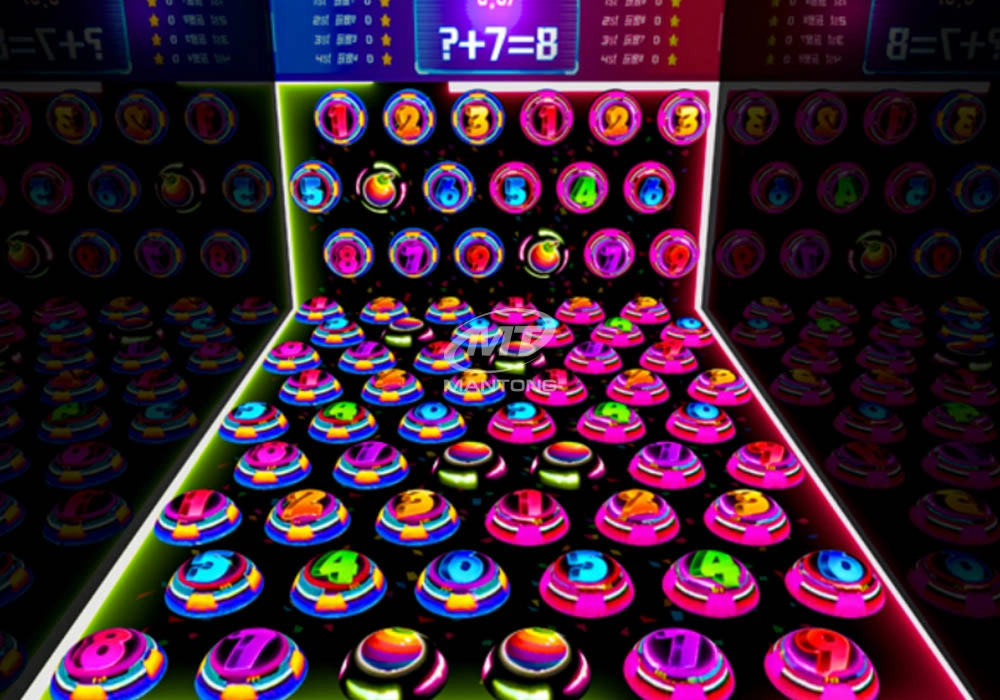
Amusement Rapidly Rotating Bouncing Sphere Interactive Wall Floor Projection Sports Games
Rapidly Rotating Bouncing Sphere is an interactive space where participants jump on rotating spheres. As they step on it, the spheres surface will show special interactivity
Jumping on spheres of the same color in succession causes them to pop, releasing light particles. The more consecutive jumps, the greater the reward—caterpillars appear, and eventually, all spheres of that color burst, filling the space with light and even more caterpillars.

Kaida Business Center, Shixin Road, Panyu District,Guangzhou City, Guangdong Province, China.
ManTong
ManTong
ManTong